
What does Reddit say about Google AI Overviews for local businesses?
Reddit discussions about local topics feed directly into AI answers, including Google AI Overviews. Across 12,041 checks, Reddit earned roughly 1,200 citations, making it the second most cited source after YouTube. Being present where people talk about your business on Reddit helps AI engines source and name local businesses more often.
Want it done for you? See our local SEO services.
How often do Google AI Overviews actually name local businesses?
Google AI Overviews named local businesses in about 9% of checks, the lowest naming rate among all engines tested. Perplexity named businesses around 34% of the time and ChatGPT around 18%. Despite the low rate, Google AI Overviews matter most because they reach the largest audience.
Want more customers from Google & AI search?
Get a free SEO audit of your site — see exactly what to fix first.
Why does Reddit keep showing up in Google AI Overview answers?
Reddit threads appear in Google AI Overview citations because AI engines pull from places where real people discuss local problems and services. In this dataset, Reddit earned approximately 1,200 citations, second only to YouTube. Creating or participating in Reddit conversations about your service category increases the chance AI sources that content.

Can Google AI Overviews find my local business if I have no YouTube channel?
Skipping YouTube puts local businesses at a serious disadvantage. YouTube was the single most cited source in Google AI answers for local questions, earning around 1,000 citations in this dataset. Without video content and accompanying transcripts published on your site, you miss a large share of what Google AI Overviews actually reference.
Do Google AI Overviews get better if I answer pricing questions on my site?
Yes. Pricing and cost content earned a 31% naming rate across AI checks, the second highest category after specific-problem questions at 39%. Adding clear pricing pages gives Google AI Overviews a citable source when users ask what a service costs, meaningfully increasing the chance your business gets named.
Are Google AI Overviews replacing local organic search traffic?
Not replacing, but supplementing. Across 33 to 38 tracked client sites, AI referral sessions grew 98% from June to September while organic sessions grew 59% in the same period. Both are rising together, so local businesses should pursue AI visibility alongside traditional SEO rather than treating them as substitutes.
What kind of questions trigger Google AI Overviews to name a local business?
Specific-problem questions produce a 39% naming rate, the highest of any question type. Service-plus-city questions earn around 29%, ready-to-hire and comparison questions around 22 to 24%, and broad generic questions drop to roughly 9%. Narrow, problem-specific content consistently outperforms general content for AI mentions.
Is Google AI Mode different from Google AI Overviews for local businesses?
Google AI Mode and Google AI Overviews both showed low naming rates compared to Perplexity and ChatGPT, and both are described as the hardest AI surfaces to earn mentions in. They are tracked separately in this dataset but share the same challenge: getting into Google’s AI answers requires consistent, specific, well-cited content.
0:00 12,000 AI checks across 56 local businesses
0:34 Last video: 72 to 336 AI mentions
0:56 How we measure AI visibility
1:40 AI traffic nearly doubled in three months
2:22 Which AI tools send the visits
3:22 How often AI names local businesses
4:04 The honest part: same questions, smaller gains
4:58 Specific questions beat generic ones
5:45 YouTube is the top source for Google’s AI
6:58 Four moves for any local business
8:08 Get your AI visibility check
Full transcript
0:00 12,000 AI checks across 56 local businesses
Hey, I’m Jeremy Ashburn with PushLeads helping small businesses get more leads without struggle and frustration and Have you ever wondered what AI is really doing? Well, this is a look into what AI is actually doing across our 56 local businesses And what we looked at is 12,000 AI checks across our local client fleet And this is real data from ChatGPT Perplexity Google’s AI Overviews, and AI Mode. we’re gonna learn about the wins the loss and things we’re changing going forward
0:34 Last video: 72 to 336 AI mentions
So in the last video we talked about that we went from 72 to 336 AI mentions in four months and This was a small fixed panel right I mean going from 72 to 336 great But since then we have scaled measurement across our whole client fleet and so here is what the bigger picture shows. So what we’re measuring now is we’re
0:56 How we measure AI visibility
asking AI the question that your customers are asking you every week And so that’s just around 12,000 AI checks from September 1st to October 13th This is for 56 businesses including restoration Business different fitness businesses rental storage VoIP and more and of course we talked about the engines being ChatGPT, Perplexity, Google AI Overviews, Google AI Mode. and this the total cost is around $135 about one cent per check and each check records whether or not the business was named and whether a competitor was named instead and which businesses the AI actually cited.
1:40 AI traffic nearly doubled in three months
So, from measurements from Google Analytics 4, the visits from AI tools nearly doubled in three months So in June we had around 548 visits dropped down to 515 in July up to 673 in August and then up to 1,083 in September So we saw 98% more AI referral sessions from June through to September and 59% more organic growth sessions in the same period So that’s pretty strong and this tells us we’re on the right track right so being on the track So being on the right track is super important.
2:22 Which AI tools send the visits
So which AI is actually sending us the visits so ChatGPT sends us the most of the traffic But Gemini is going the fastest so ChatGPT was sending around 416 sessions in June and that’s up to 851 and that’s up to 851 September sessions around 105% change in that time period Gemini was from 38 to 141 So that’s another 271 and so that’s 271% improvement Perplexity which is only a tiny portion of the actual traffic is went from 26 to 39, a 50% improvement. Claude actually sort of went from 46 to 41 backwards and then Copilot went from 21 to 11 But Claude and Copilot and Perplexity really account for two, five or ten percent of the overall AI traffic So I’m not super worried and so that’s actually pretty strong. So yeah, I’ll take it now
3:22 How often AI names local businesses
Perplexity is naming local businesses about twice as often as Google and Again only around about two percent of the equation, but everyone is using a different chatbot, right? So some people love Perplexity and other people love ChatGPT and other people love AI Overviews. So Perplexity basically was giving us around a 34% chance of naming the local businesses. ChatGPT was like 18% AI Overviews was like 14% and Google AI Mode was 13.6%. So Google’s AI answers are the hardest to get into and they’re the ones that most people see so this Google AI Overviews, Google AI Mode is super important and of course we’re working on that So the honest
4:04 The honest part: same questions, smaller gains
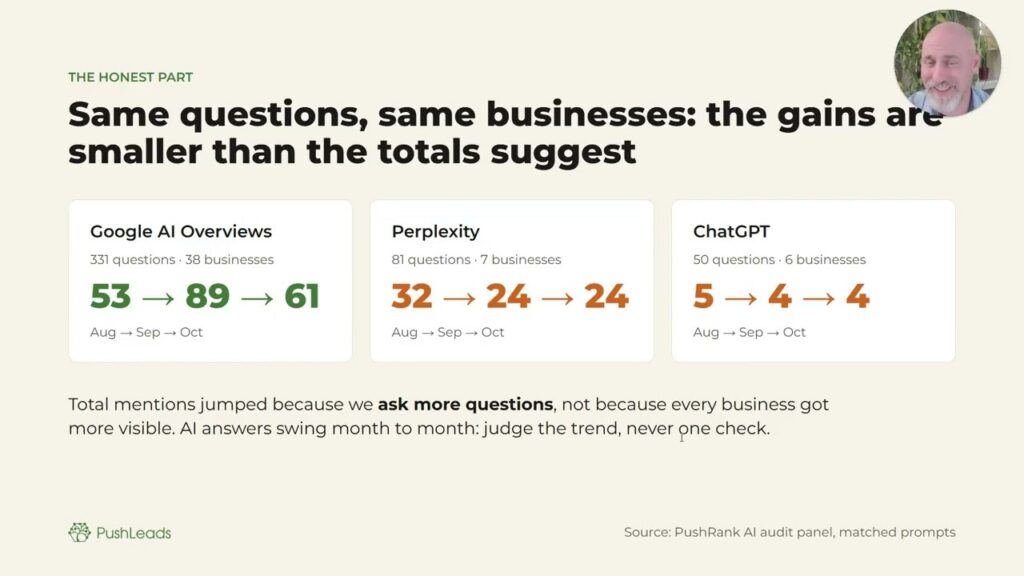
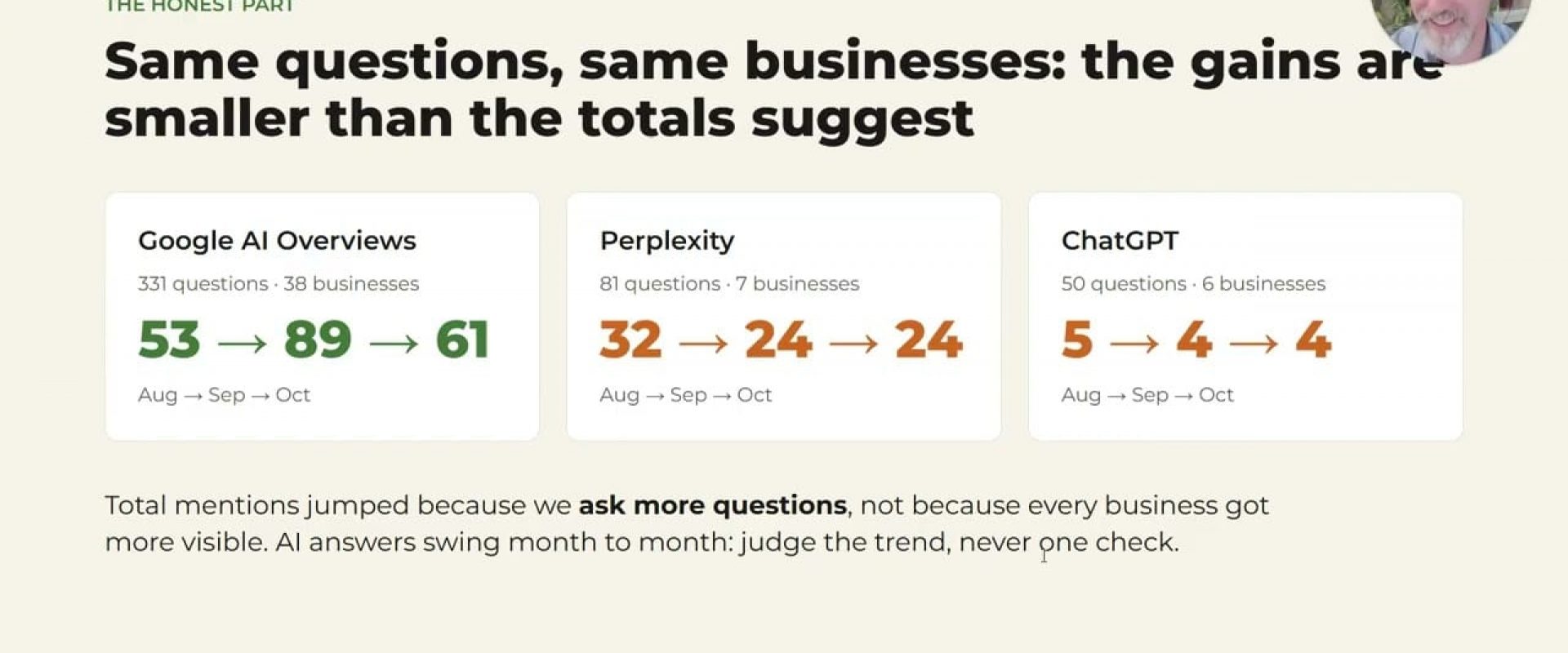
part if you ask the same questions for the same businesses, the gains are actually smaller than the total suggests So Google’s AI Overviews, So if we look at Google’s AI Overviews, We really went from 53 to 61 in that time frame Perplexity went from 32 down to 24, and ChatGPT went down from five to four. So the total mentions jumped because we’re asking more questions, not because every business is getting more visible. So AI answers of course are swinging from month to month I mean even from minute to minute right? So it’s really important to judge the trend never one particular check and say oh I’m suddenly showing up So if you just check one day and you’re showing up in ChatGPT. check the next minute That might be totally different right check the next hour check the next day or have tools to do it or work with an agency That’s actually tracking it like we’re doing So
4:58 Specific questions beat generic ones
another thing to look at here is specific questions actually get local businesses named Generic questions don’t actually get a local business name So if you work on a specific problem in your niche the odds of that being answered is like 39% And if you cover a pricing and cost so if you cover pricing and cost That’s around 31% if you cover your service in the city That’s around 29% and it drops down to 24% if you’re covering ready to hire questions comparisons 22% Anything that’s broad and generic is 14% so always cover specific problems first and cover pricing and cost questions secondly So I would definitely do it that way and
5:45 YouTube is the top source for Google’s AI
of course YouTube is the number one website that Google’s AI cites. And of course YouTube is the number one website that Google’s AI cites for local questions So if you’re not posting on YouTube then you’re gonna really be missing out One of the most interesting things I found recently is that Even though ChatGPT doesn’t even look at YouTube videos it reads the transcript of videos So whenever you post videos on YouTube You need to also put the video on your site embed the video on your site along with the transcript in the video schema If you’re not doing that you’re gonna be missing out And one of the reasons why I think we’re showing up for more ChatGPT searches is that we’re doing that we’re posting the video We’re posting the schema the transcripts the captions all that stuff. So anyway, YouTube basically was earning around 1,200 citations. Reddit was earning about 1,000. Facebook around 797. And on goes down it goes on down, etc
6:58 Four moves for any local business
So four moves if you run a local business You need to first answer specific questions questions about problems pricing and your service in your city and this is where this data shows up 30 to 39% so answer these questions make one video answering each question one video covering each problem How you solve the problem one video covering different kinds of pricing one video for the service that you offer in the city We’re an HVAC company in Asheville, North Carolina, covering this or that and then get on YouTube because Google’s AI is citing YouTube about half the equation really is YouTube and Short videos do count, but if you can make long videos that are between 10 to 20 minutes, you’ll get cited more often And then also be where people talk about you on Reddit, Facebook Yelp Angi Thumbtack those all feed the answers as well and then measure the same questions monthly have a fixed track set of Questions you’re asking we actually made a video about how to do this manually Of course, you can use tools like DataForSEO to do this naturally and do it that way
8:08 Get your AI visibility check
And so if you want to know what AI is recommending you for your local business We could run your business through ChatGPT, Perplexity, and Google’s AI Mode all the AIs, and show where you stand. I’m Jeremy Ashburn with PushLeads helping small businesses get more leads Without struggle and frustration talk to you soon
Key Takeaways
Between September 1 and October 13, 2026, we ran 12,041 AI checks across 56 PushLeads clients using ChatGPT, Perplexity, Google AI Overviews, and Google AI Mode. AI referral sessions to client sites nearly doubled in three months. Naming rates vary widely by engine and question type. The biggest wins go to businesses answering specific problem, pricing, and service-plus-city questions, and to those publishing on YouTube where Google’s AI pulls citations constantly.
- AI referral sessions across 33-38 client sites grew 98% from June to September 2026 (548 to 1,083), outpacing organic search growth of 59%.
- ChatGPT drove 79% of AI referral visits in September; Gemini grew the fastest at 271%.
- Naming rates by engine: Perplexity 34.5%, ChatGPT 18.7%, Google AI Overviews 14.9%, Google AI Mode 13.6%.
- On a fixed question set, month-over-month gains were modest; raw totals rose mainly because we asked more questions over time.
- Specific-problem questions named local businesses 39% of the time; broad generic questions only 14%.
- YouTube earned 1,201 citations in our checks, 1,093 of them inside Google AI Overviews and AI Mode answers, making it the single most-cited domain.
- Four moves matter most: answer specific questions, publish on YouTube with transcripts and VideoObject schema, build presence on Reddit, Facebook, Yelp, Angi, and Thumbtack, and track a fixed question set every month.
What 12,041 AI Checks Reveal About AI SEO Results for Local Businesses
AI SEO results for local businesses are real, measurable, and uneven: some question types get your business named nearly 40% of the time, while others barely crack 14%, and the engine doing the naming matters as much as the question itself. Between September 1 and October 13, 2026, we ran 12,041 AI checks for 56 PushLeads clients across four engines at a total cost of roughly $135, about one cent per check. Each check recorded whether the client business was named, whether a competitor was named instead, and which outside sites the AI cited in its answer. That gives us a cleaner picture than any single spot-check ever could.
This is the honest follow-up to our earlier case study where a small fixed panel went from 72 to 336 AI mentions over four months. That result was real, but it came from a narrow set of questions for a handful of businesses. When we scaled measurement across our whole client fleet, some of the headline optimism held up and some of it did not. AI mentions on the same fixed questions stayed mostly flat. AI referral traffic to client websites, however, nearly doubled. Both facts matter, and I want to walk through both clearly so you know exactly where to put your energy.
How We Built the Measurement Panel and Why It Matters
A reliable AI visibility measurement panel asks the same questions to the same engines on a regular schedule and records three things: whether your business was named, whether a competitor was named, and which sites the AI cited. Without that structure, you are just spot-checking, and AI answers can shift from hour to hour.
What kinds of businesses were included in the 56-client panel?
The 56 businesses in this panel are all PushLeads clients running the full range of local service categories: restoration contractors, fitness studios, rental and storage operators, VoIP service providers, and more. They are spread across different markets, not just Asheville, which makes the naming-rate data more generalizable than a single-city study would be. When we see a pattern repeated across that many business types, it is worth paying attention to.
How much does it cost to run AI checks at this scale?
The 12,041 checks across four engines from September 1 through October 13, 2026 cost approximately $135 total, which works out to roughly one cent per check (PushLeads internal data, 2026). Most of that cost came from API calls to ChatGPT and Perplexity. Google AI Overviews and Google AI Mode checks were run through search tooling. The low cost means any small business or agency can afford to run a meaningful fixed panel without a large budget.
Why do you need a fixed question set rather than random checks?
A fixed question set lets you separate real trend changes from AI randomness. AI answers are not deterministic; the same question asked twice in the same minute can produce different results. If you only check when you feel like it, you will misread noise as a signal. We track the same questions for the same businesses every month so that when we see a number move, we know whether it reflects an actual change in how the AI is representing that business.
AI Referral Traffic Trends Across 33-38 Client Sites
AI referral sessions to client websites roughly doubled between June and September 2026, growing from 548 to 1,083 sessions, a 98% increase, while organic search sessions grew 59% over the same period (GA4 data, PushLeads client fleet). Both trends are pointing up, which tells us that investing in AI visibility does not come at the expense of traditional search performance.
What does AI referral traffic look like as a share of overall search visits?
AI-referred sessions grew from 1.05% of total search visits in June to 1.30% in September across the same client group. That is still a small slice of total traffic, and I want to be straightforward about that. But the growth rate is steeper than organic search, and the share is expanding every month. In six months, a 1.3% share could easily be 3% or 4% if current growth rates hold, and at that point it becomes a meaningful lead source for service businesses.
Related: Prompt-Testing Your Brand Across AI Assistants Monthly.
Is AI traffic quality worth caring about right now?
We are not reporting AI referral conversion numbers in this update because our GA4 conversion definitions are still being refined across client accounts and I do not want to publish figures I cannot fully trust. What I can say is that the visitors coming from ChatGPT and Gemini are arriving with a question already answered to some degree: the AI told them about you before they clicked. Anecdotally, those conversations with clients have been positive. We will report conversion data once the tracking is cleaner.
Which AI Engines Are Actually Sending Visits
ChatGPT sent the most AI referral traffic in September 2026 at 851 sessions, accounting for 79% of all AI visits that month, but Gemini grew the fastest of any engine, rising 271% from June to September (GA4 data, PushLeads client fleet, June through September 2026).
How fast is ChatGPT traffic growing compared to Gemini?
ChatGPT sessions grew from 416 in June to 851 in September, a 105% increase over four months. Gemini sessions grew from 38 to 141, a 271% increase from a smaller base. Perplexity moved from 26 to 39 sessions, a 50% gain. Claude actually fell slightly from 46 to 41 sessions, and Copilot dropped from 21 to 11. Claude, Copilot, and Perplexity together represent somewhere between two and ten percent of total AI traffic, so their fluctuations do not change the overall picture much.
Should I optimize for every AI engine or focus on a few?
Focus your energy on ChatGPT and Google’s AI products first, because they drive the most volume. Gemini is worth watching closely given its 271% growth rate; it runs on the same Google infrastructure that powers AI Overviews and AI Mode, so good performance on one tends to help on the others. Perplexity matters for specific audiences who prefer it, and some professional and technical buyers use it heavily, so do not ignore it entirely if your target customer skews that way.
Naming Rates by Engine: What the October Data Shows
In October 2026 checks, Perplexity named client businesses at a 34.5% rate across 2,877 checks, making it more likely to name a local business by name than any other engine we tested; ChatGPT came in at 18.7% across 713 checks, Google AI Overviews at 14.9% across 1,034 checks, and Google AI Mode at 13.6% across 2,422 checks (PushLeads panel data, October 1-13, 2026).
Why is Perplexity’s naming rate so much higher than Google’s?
Perplexity is designed to surface specific sources and tends to name businesses, people, and locations more directly than Google’s AI products, which often generalize. Google AI Overviews and AI Mode are built for a mass audience and tend to give broader answers that may list categories or features rather than specific business names. That said, Google’s AI products reach far more people, so a 14% naming rate across a massive user base can still produce more actual impressions than Perplexity’s higher rate across a smaller one.
Does Google AI Mode behave differently than Google AI Overviews?
Google AI Mode showed a 13.6% naming rate versus 14.9% for AI Overviews in our October checks, so they are close but not identical. AI Mode tends to go deeper on follow-up questions and often cites more sources per answer, while AI Overviews appear more consistently at the top of standard search results and reach a broader audience. We track both separately because the citation patterns differ, particularly around which outside sites get pulled in.
The Honest Part: Fixed-Question Trends Are Modest
When we looked only at the same fixed questions asked to the same businesses across August, September, and October, the gains were smaller than the headline totals suggest: Google AI Overviews went from 53 to 89 to 61 mentions across 331 questions for 38 businesses, Perplexity went from 32 to 24 to 24 across 81 questions for 7 businesses, and ChatGPT went from 5 to 4 to 4 across 50 questions for 6 businesses (PushLeads fixed-panel data, August through October 2026).
Why did raw total mentions grow if fixed-question mentions stayed flat?
The raw totals grew mainly because we asked more questions over time, not because every business suddenly became more visible. This is an important distinction. If you only report the total number of AI mentions without controlling for question count, you can fool yourself into thinking you are making faster progress than you actually are. The fixed-question panel is the honest measurement. The total-mentions number is still useful for seeing which question types work, but it should not be your primary KPI.
Is it normal for AI mentions to fluctuate month to month?
Yes, and significantly so. AI answers swing from month to month and sometimes from minute to minute within the same engine. Google AI Overviews going from 89 mentions in September to 61 in October on the same fixed questions is not necessarily a sign that anything went wrong; it reflects how non-deterministic these systems are. The right response is to judge a three-to-six month trend rather than any single check. A single good result on one day means nothing on its own.
Which Question Types Get Local Businesses Named Most Often
Questions about a specific problem in your trade named local businesses 39.0% of the time across our panel, the highest of any category; pricing and cost questions came in at 31.4%, service-plus-city questions at 29.9%, ready-to-hire questions at 24.6%, comparisons at 22.4%, broad generic questions at 14.0%, and questions the business site never addresses at roughly 1.3% (PushLeads panel data, September 1 through October 13, 2026).
What does a specific-problem question look like for a home service business?
For an HVAC contractor, a specific-problem question might be “why is my heat pump making a clicking noise when it starts?” or “what causes ice to form on my AC unit in summer?” These are questions a homeowner types in a moment of stress, usually right before they are ready to call someone. When your website, YouTube channel, or a directory profile directly answers that question, the AI has a source to cite and a business name to surface. Generic questions like “best HVAC company near me” give the AI nothing specific to anchor to.
Should pricing content really be on my website?
Yes, pricing and cost content named businesses 31.4% of the time in our checks, the second-highest category. Many contractors avoid publishing pricing because they worry about losing competitive advantage or getting locked into numbers. But AI systems reward websites that give real answers, and a page explaining what drives your pricing, what a typical job costs, and what factors change the price performs better than a page that just says “call for a quote.” You do not have to publish an exact price list; a well-written pricing guide does the job.
How does a service-plus-city question differ from a generic local search?
A service-plus-city question is specific in two ways: it names what the person needs and where they are. “Roof repair in Asheville NC” is a service-plus-city question. “Roofer near me” is generic. Our data shows service-plus-city questions named businesses at 29.9%, more than double the 14% rate for broad generics. The practical takeaway is that location-specific service pages, where you name the city and describe the specific service in the same piece of content, are worth building out even if they feel repetitive to write.
This is part of our AI search visibility guide.
YouTube as the Top-Cited Source in Google’s AI Answers
YouTube earned 1,201 total citations in our 12,041 checks, with 1,093 of those citations appearing inside Google AI Overviews and Google AI Mode answers, making it the single most-cited domain in our entire dataset, ahead of Reddit at 1,074, Facebook at 797, Yelp at 326, Wikipedia at 271, Thumbtack at 268, and Angi at 242 (PushLeads panel data, September 1 through October 13, 2026).
Does YouTube help with ChatGPT if ChatGPT does not watch videos?
ChatGPT does not process YouTube video content directly, but it does read transcripts. When you publish a video on YouTube, the auto-generated captions create a transcript that gets indexed. If you also embed the video on your website alongside a written transcript and a VideoObject schema markup, you give ChatGPT and other text-based AI engines a structured, readable version of everything you said. We believe this practice is one reason our clients are showing up in more ChatGPT answers over time, and it is something we do for every video we publish.
Do short YouTube videos count, or do longer ones perform better?
Short videos do count and are worth publishing, but in our observation longer videos in the 10-to-20-minute range get cited more often in AI Overviews and AI Mode answers. Longer videos tend to cover a topic more thoroughly, which gives the AI more material to extract a specific answer from. A two-minute video that answers one narrow question can still earn a citation if the question matches exactly, but if you have the choice between a shallow short video and a substantive longer one, go longer when the topic calls for it.
The Four Moves That Move the Needle for Local AI Visibility
Based on the full 12,041-check dataset, the four practices most likely to improve how often AI names your local business are: answering specific questions about problems, pricing, and your service in your city; publishing on YouTube with full transcripts and VideoObject schema on your site; being active on Reddit, Facebook, Yelp, Angi, and Thumbtack; and tracking a fixed question set every month to separate real trends from noise.

How many questions should I answer to start seeing results?
Start with ten to fifteen questions your actual customers ask most often before they hire you. Divide them across the highest-performing categories: three or four specific-problem questions, two or three pricing questions, and two or three service-plus-city questions. Write or record a dedicated answer for each one, either as a page on your site or a YouTube video with a transcript. Then measure that exact list every month using a tool like DataForSEO or manually using a consistent prompt format, so you can see whether your visibility on those specific questions changes over time.
Why does Reddit show up so often in AI citations for local topics?
Reddit earned 1,074 citations in our checks because AI systems treat it as a source of authentic, experience-based answers. When someone on a local subreddit recommends a specific contractor or discusses their experience with a service provider, that content is findable, linkable, and often highly relevant to the questions AI engines are trying to answer. You cannot manufacture Reddit presence by posting promotional content; it has to come from genuine community participation or earned mentions from satisfied customers who naturally talk about their experience.
What should I track in GA4 to measure AI referral traffic?
In GA4, set up a custom channel grouping or segment that captures sessions from chatgpt.com, perplexity.ai, gemini.google.com, claude.ai, and copilot.microsoft.com as referral sources. Google AI Overviews and AI Mode traffic will often appear as organic search rather than a referral because the user is still on the Google search results page, so you will need separate tracking for those. Check your AI referral session count monthly on the same date range and track the trend. Do not compare single days; compare full months to account for AI answer variability.
Frequently Asked Questions
How often should I run AI checks for my local business?
Run a fixed set of checks once a month on the same questions and the same engines. Daily checks produce too much noise because AI answers vary significantly from hour to hour. Monthly checks give you enough data to see whether a trend is real. If you want to add ad-hoc checks when you publish new content or make a site change, do that separately and do not mix those results with your monthly fixed panel. Keeping those two data streams separate helps you understand what is actually moving the numbers.
Does my Google Business Profile still matter for AI visibility?
Yes. Your Google Business Profile feeds directly into Google AI Overviews and AI Mode answers for local queries. A complete, accurate, and regularly updated profile gives Google’s AI a structured source of information about your business name, category, location, hours, and reviews. Our checks show that Google AI Overviews named businesses at a 14.9% rate, and a well-maintained Business Profile is one of the clearest signals that helps put you in that named group for service-plus-city and ready-to-hire question types.
Will AI visibility replace traditional local SEO?
Not in the near term. Organic search sessions across our client sites grew 59% in the same period that AI referral sessions grew 98%, so both are moving up together right now. AI referral traffic represents roughly 1.3% of total search visits in our data. Traditional local SEO, including your Google Business Profile, local citations, on-site content, and link signals, still drives the large majority of search-generated traffic. The smarter frame is that AI visibility is an additional layer on top of traditional SEO, not a replacement for it.
Is it worth being on Yelp, Angi, and Thumbtack just for AI citations?
These platforms earned 326, 242, and 268 citations respectively in our checks, and they feed AI answers across multiple engines. Beyond citations, they also generate direct leads. Maintaining an accurate, review-rich profile on each platform costs relatively little time once it is set up, and the benefit is that AI systems pulling answers about local service providers will have structured, third-party data about your business to reference. Treat these as citation sources and lead sources at the same time rather than choosing between them.
How does VideoObject schema help AI find my video content?
VideoObject schema is structured markup you add to the page where your video is embedded. It tells search engines and AI crawlers the video title, description, duration, upload date, and thumbnail URL in a machine-readable format. When you pair that markup with a written transcript on the same page, you give AI systems a complete, text-accessible version of your video content alongside the structured metadata. Without the schema, an AI crawler sees a video embed but may not understand what the video is about or connect it to the topic you are covering.
What is the most common mistake local businesses make with AI SEO?
The most common mistake is writing content that is too broad and too generic to earn a citation in a specific AI answer. Pages titled “Our Services” or “About Us” rarely get cited because they do not answer a specific question. AI systems are looking for content that directly addresses what a user asked. A page titled “What Does a Water Damage Restoration Job Cost in Asheville NC?” is far more likely to be cited for a pricing question than a page that mentions pricing in passing among ten other topics. Specificity is the clearest lever you have.
How long does it take to see AI visibility improvements after making content changes?
In our experience, meaningful changes on a fixed question set take two to four months to show up consistently. AI systems recrawl and re-index content on their own schedules, and the non-deterministic nature of AI answers means one good month can be followed by a flat one before the trend becomes clear. Publish the content, set up your fixed tracking panel, measure monthly, and give it a full quarter before drawing conclusions. Businesses that expect results within two to three weeks after a content update are usually reading noise as signal.
Can a small business with a limited budget compete with larger companies for AI mentions?
Yes, and our data supports this. The businesses in our panel are all small local operators, not large franchises or national brands. What earns AI citations is specific, accurate, well-structured content that directly answers a question, and that is something a small business can produce without a large budget. A single YouTube video answering a specific customer problem, embedded on your site with a transcript and VideoObject schema, can earn citations in Google AI Overviews that a large company’s generic service page will not. Specificity beats scale in AI answers more often than in traditional paid search.
Run Your Own AI Visibility Check With PushLeads
The numbers from this 12,041-check study are not abstract. They come from real local service businesses, the kind of companies that depend on phone calls and contact form submissions to keep their crews busy. AI referral sessions nearly doubled in three months. Specific-problem and pricing questions named businesses at rates between 31% and 39%. YouTube is the most-cited domain in Google’s AI answers by a wide margin. These are patterns you can act on.
The first step is finding out where you actually stand today. Most small business owners have no idea whether ChatGPT, Perplexity, or Google’s AI recommends them when a potential customer asks a question in their trade. We can run your business through the same four engines we use for our full client panel, using the real questions your customers are asking, and show you exactly where you are named, where a competitor is named instead, and which question types represent your biggest opportunity.
If you want that check done for your business, reach out to us at PushLeads. You can contact us directly at https://pushleads.com/contact/ and we will get your AI visibility check set up.
Watch: AI SEO Update: What 12,000 AI Checks Across 56 Local Businesses Show (Oct 2026)
What this video covers
- 0:00 — What 12,000 AI Checks Revealed
- 0:34 — Scaling Measurement Across 56 Clients
- 0:56 — AI Referral Traffic Nearly Doubles
- 2:20 — Which AI Sends the Most Visits
- 3:21 — Mention Rates by AI Platform
- 4:11 — Honest Look at Fixed-Panel Results
- 5:06 — Question Types That Trigger Local Mentions
- 5:53 — YouTube as Top AI Citation Source
- 7:04 — Four Moves for Local Businesses
Full video transcript
Hey, I’m Jeremy Ashburn with PushLeads, helping small businesses get more leads without struggle and frustration.
Have you ever wondered what AI is really doing for local businesses? This is a look at what AI is actually doing across our 56 local business clients. We ran 12,000 AI checks across our entire client fleet, using real data from ChatGPT, Perplexity, Google AI Overviews, and Google AI Mode. We are going to cover the wins, the losses, and what we are changing going forward.
In the last video, we talked about going from 72 to 336 AI mentions. That was a small fixed panel. Going from 72 to 336 is great, but since then we have scaled measurement across our whole client fleet, and here is what the bigger picture showed.
What we are measuring now is the questions that your customers are actually asking AI every week. That is around 12,000 AI checks from September 1st through October 13th, covering 56 businesses including restoration companies, fitness businesses, rental, storage, VoIP, and more. The engines are ChatGPT, Perplexity, Google AI Overviews, and Google AI Mode. The total cost was around $135, about one cent per check. Each check records whether the business was named, whether a competitor was named instead, and which sources the AI actually cited.
Looking at Google Analytics 4, visits from AI tools nearly doubled in three months. In June we had around 548 visits, which dropped to 515 in July, then rose to 673 in August, and up to 1,083 in September. That is 98% more AI referral sessions from June through September, and 59% more organic sessions in the same period. That tells us we are on the right track.
So which AI is actually sending the visits? ChatGPT sends the most traffic, but Gemini is growing the fastest. ChatGPT went from around 416 sessions in June up to 851 in September, a 105% change. Gemini went from 38 to 141, which is a 271% improvement. Perplexity went from 26 to 39, a 50% improvement. Claude went slightly backwards from 46 to 41, and Copilot dropped from 21 to 11. Claude, Copilot, and Perplexity together account for roughly 2 to 10% of overall AI traffic, so I am not too worried about those individually.
Perplexity is naming local businesses about twice as often as Google, and while it is only about 2% of the equation, it matters because everyone is using a different chatbot. Some people love Perplexity, some love ChatGPT, and some rely on AI Overviews. Looking at mention rates by platform, Perplexity gave us around a 34% chance of naming a local business. ChatGPT was around 18%, Google AI Overviews around 14%, and Google AI Mode was 13.6%. Google’s AI answers are the hardest to get into, and they are the ones most people see. So Google AI Overviews and AI Mode are super important, and that is where we are focusing.
Now for the honest part. If you ask the same fixed questions for the same businesses, the gains are actually smaller than the total numbers suggest. For Google AI Overviews, we went from 53 to 61 mentions in that time frame. Perplexity went from 32 down to 24, and ChatGPT went from 5 down to 4. The total mention count jumped because we are asking more questions, not because every business is getting more visible. AI answers swing from month to month, and even from minute to minute. It is really important to judge the trend, not any single check. If you check one day and you are showing up in ChatGPT, check the next hour or the next day and it might be completely different. You need tools that track this consistently, or work with an agency that is doing it the way we are.
Another important finding is around question type. Generic questions rarely produce a local business name. If you focus on a specific problem in your niche, the odds of being named are around 39%. Pricing and cost questions come in around 31%. Questions about your service in a specific city are around 29%. Ready-to-hire and comparison questions are around 22%. Broad and generic questions drop to 14%. So always cover specific problems first, and pricing and cost questions second.
YouTube is the number one website source that Google’s AI cites for local questions. If you are not posting on YouTube, you are going to be missing out. One of the most interesting things I found recently is that even though ChatGPT does not watch YouTube videos, it does read the transcript. So whenever you post a video on YouTube, you also need to embed that video on your website along with the transcript and video schema markup. Part of the reason we are showing up in more ChatGPT results is that we are doing exactly that — posting the video, the schema markup, the transcripts, and the captions.
In our data, YouTube was earning around 1,200 citations. Reddit was earning about 1,000. Facebook was around 797, and it goes down from there.
So here are four moves if you run a local business. First, answer specific questions about problems, pricing, and your service in your city. The data shows these question types surface local businesses 30 to 39% of the time. Make one video answering each question — one video covering a specific problem and how you solve it, one video covering pricing, one video for each service you offer in your city. For example, if you are an HVAC company in Asheville, North Carolina, make a video covering that specific service in that specific market.
Second, get on YouTube, because Google’s AI is citing YouTube heavily. About half the equation really comes down to YouTube.
Third, short videos do count, but if you can make longer videos in the 10 to 20 minute range, you will get cited more often. Also work on getting people to talk about you on Reddit, Facebook, Yelp, Angi, and Thumbtack, because those all feed the AI answers as well.
Fourth, measure the same fixed set of questions every month. We made a video about how to do this manually, and you can also use tools like DataForSEO to automate it.
If you want to know what AI is recommending for your local business, we can run your business through ChatGPT, Perplexity, Google AI Mode, and the other AI platforms and show you exactly where you stand. I’m Jeremy Ashburn with PushLeads, helping small businesses get more leads without struggle and frustration. Talk to you soon.
Keep Reading
Want more customers from Google & AI search?
Get a free SEO audit of your site — see exactly what to fix first.
Your path · AI
Keep going: read these next

- Up nextAI Search Optimization for Local Service Companies: Complete Implementation Guide
- Local SEO in the AI Era
- The AI Search Revolution: How 2 Billion People Are Finding Information in 2025
- AI-SEO: How Artificial Intelligence is Revolutionizing Search Rankings in 2026




Want this done for you?
Scan your site. See the gaps. Decide with numbers.
- Rankings, Google Business Profile and site-speed teardown
- Report lands in your inbox in about a minute
- No obligation · 4.9 from 67 Google reviews
 Continue reading