
Competitor Intelligence Framework: Strategic Analysis for Service Business Advantage

In today’s crowded marketplace, understanding your competition isn’t just helpful—it’s essential for survival and growth. A well-structured competitor intelligence framework gives service businesses the insights needed to identify opportunities, anticipate market shifts, and create meaningful differentiation. At PushLeads, we’ve helped Asheville businesses transform competitive research into actionable strategies that drive real results. This guide will walk you through creating and implementing an effective competitor intelligence system tailored for service-based companies.
What Is a Competitor Intelligence Framework?
A competitor intelligence framework is a systematic approach to gathering, analyzing, and applying information about your competitors to inform your business decisions. Unlike casual competitor monitoring, a proper framework provides structure to the process, ensuring you collect relevant data that translates into strategic advantage.
For service businesses, this framework needs to capture both the tangible elements (pricing, service offerings) and intangible aspects (customer experience, brand perception) that influence competitive positioning. The goal isn’t to copy competitors but to understand the competitive landscape well enough to carve out your unique space within it.
Key Components of an Effective Competitor Intelligence Framework
Competitor Identification and Categorization
Start by creating a comprehensive map of your competitive landscape. This includes:
Direct competitors offering similar services to the same target market
Indirect competitors solving the same customer problems through different services
Potential competitors who could easily enter your market
For each competitor, assign a priority level based on their threat and opportunity potential. This helps focus your limited resources on analyzing the most relevant players.
Multi-dimensional Analysis Areas
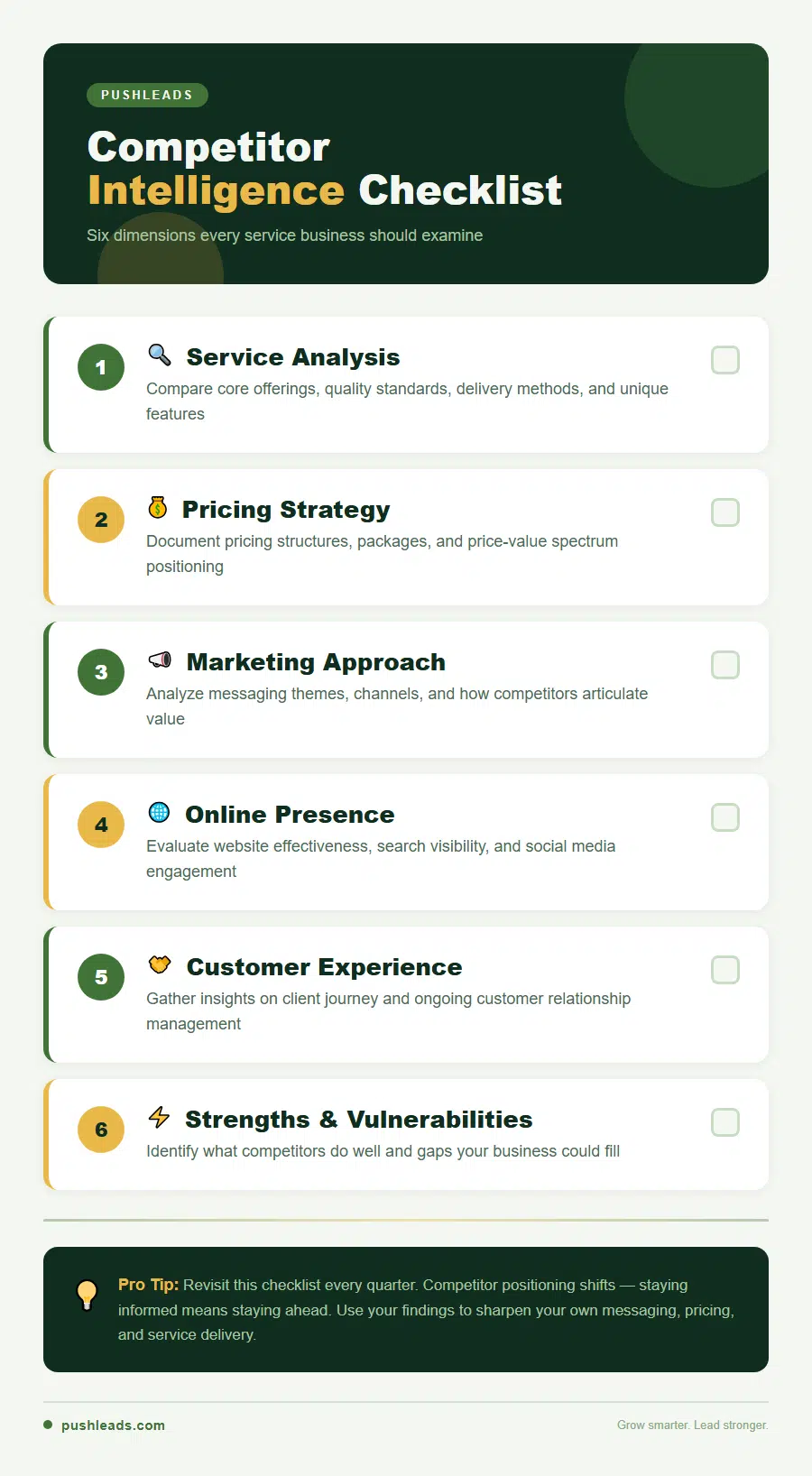
A complete competitor intelligence framework examines competitors across several dimensions:
Service Analysis: Compare core and supplementary service offerings, quality standards, delivery methods, and unique features that differentiate each competitor.
Pricing Strategy: Document pricing structures, package options, value-adds, and how competitors position themselves on the price-value spectrum.
Marketing Approach: Analyze messaging themes, communication channels, content strategies, and how competitors articulate their value proposition to potential clients.
Online Presence: Evaluate website effectiveness, search visibility, social media engagement, and overall digital footprint compared to your own.
Customer Experience: Gather insights about the client journey, service delivery processes, and how competitors manage ongoing customer relationships.
Strengths and Vulnerabilities: Identify what each competitor does exceptionally well and where gaps exist that your business could potentially fill.
Intelligence Gathering Methods
Implement multiple data collection approaches to build a comprehensive view:
Digital Research: Systematically review competitor websites, social profiles, customer reviews, and online content to understand their positioning and customer perception.
Mystery Shopping: Where appropriate, experience competitors’ services firsthand to gain insight into their customer experience and service delivery.
Customer Interviews: Speak with clients who have used competitors’ services to understand what influenced their decisions and experiences.
Industry Analysis: Review industry reports, attend trade events, and monitor news to track competitive moves and industry trends.
Want more customers from Google & AI search?
Get a free SEO audit of your site — see exactly what to fix first.
Turning Intelligence Into Strategic Advantage
Collecting data is only valuable when it informs action. Here’s how to translate competitive intelligence into business advantage:

Gap Analysis and Opportunity Identification
Map competitive findings against customer needs to identify underserved areas or quality gaps that your business can address. These gaps often represent your most promising opportunities for differentiation.
Defensive Positioning
Use competitor intelligence to shore up vulnerabilities in your service offerings or experience before competitors can exploit them. This might involve enhancing certain service aspects or adjusting your messaging to address potential weaknesses.
Messaging Differentiation
Craft marketing messages that clearly articulate your unique strengths relative to competitors. Rather than claiming generic excellence, highlight specific areas where your approach offers superior value to clients.
Service Development Roadmap
Let competitive insights inform your service evolution. This doesn’t mean simply matching competitor offerings but developing services that address unmet needs or deliver existing solutions in more effective ways.
Pricing Strategy Refinement
Adjust pricing strategies based on a clear understanding of your value position relative to competitors, allowing you to charge appropriately for your unique benefits rather than defaulting to competitive price matching.
Implementing Your Competitor Intelligence Framework
To make competitive intelligence an ongoing business advantage:
Assign Clear Ownership: Designate team members responsible for gathering and analyzing different types of competitive intelligence.
In this video
- 0:00 DIY vs Agency the Honest Math
- 0:44 Real Cost of DIY Time Calculated
- 1:25 Three Signals You Have Hit the Ceiling
- 2:17 Stalled DIY SEO What It Looks Like
- 2:51 Top DIY Mistakes and the Fixes
- 4:05 ROI Math Made Concrete
- 4:35 DIY vs Agency Side by Side
- 5:13 Local Agency vs National Agency
- 5:47 Ten Tasks to Handle Yourself
- 6:31 Hybrid Model the Data Case
- 7:05 What Each Option Actually Costs
- 7:46 One Task to Always Keep In-House
Create a Regular Review Cycle: Establish a consistent schedule for updating competitive information and reviewing insights as a team.
Develop Analysis Templates: Use standardized formats to ensure consistent data collection and make competitive information easier to compare over time.
Integrate With Business Planning: Make competitive intelligence review a standard component of your strategic planning and marketing development processes.
Share Insights Effectively: Establish methods to communicate competitive insights throughout your organization so frontline teams can respond appropriately to competitive situations.
Applying Competitor Intelligence to Local Search Visibility
For service businesses competing in a defined geographic area, competitor intelligence extends naturally into local search. Beyond tracking service offerings and pricing, it is worth examining how rivals show up when nearby customers are actively searching. A few specific areas deserve attention alongside your broader framework.
- Search result mapping: Run your most important service searches in a private browser and note which businesses appear consistently in both map results and organic listings. The ones appearing across multiple searches are your true local search competitors, regardless of who you consider a business rival.
- Profile completeness: Compare your Google Business Profile field by field against those top-appearing competitors, covering category choices, service lists, photo activity, and review volume. Gaps here are often quick wins.
- Local citation presence: Check whether competitors appear on regional directories or industry-specific platforms that your business has not yet claimed.
- Content relevance signals: Note whether competing sites publish content that connects their services to specific neighborhoods or locally relevant topics, since this can influence which searches they rank for.
- Quarterly refresh: Local search standings shift regularly, so a brief review on a fixed schedule keeps your intelligence current without requiring a full analysis each time.
Start Building Your Competitive Advantage Today
In Asheville’s evolving service marketplace, businesses that understand their competitive landscape gain the ability to make smarter strategic decisions. At PushLeads, we help local businesses develop and implement effective competitor intelligence frameworks that drive meaningful differentiation and growth.
Ready to turn competitor insights into business advantage? Contact our team for a personalized consultation on building a competitor intelligence framework that works for your specific service business.
Take Your Competitive Strategy to the Next Level
Speak with our Asheville SEO and digital strategy experts about developing a custom competitor intelligence framework for your business. We’ll help you translate market insights into actionable strategies that drive growth and differentiation.
Want more customers from Google & AI search?
Get a free SEO audit of your site — see exactly what to fix first.
Your path · What Is SEO? The Complete Guide to Search Engine Optimization for Businesses
Keep going: read these next

- Up nextThe Strategic Efficacy of AI-Powered Internal Linking: A Comprehensive Analysis of the LinkBoss Platform
- AI-SEO: How Artificial Intelligence is Revolutionizing Search Rankings in 2026
- An Expert Analysis of Internal Linking: The Foundational Imperative for Modern SEO




Want this done for you?
Scan your site. See the gaps. Decide with numbers.
- Rankings, Google Business Profile and site-speed teardown
- Report lands in your inbox in about a minute
- No obligation · 4.9 from 67 Google reviews
 Continue reading
