

✓GBP 10-Minute Audit: How Optimized Is Your Garage Door Profile?8 quick questions · about 1 minuteStart
Full transcript
Section 1
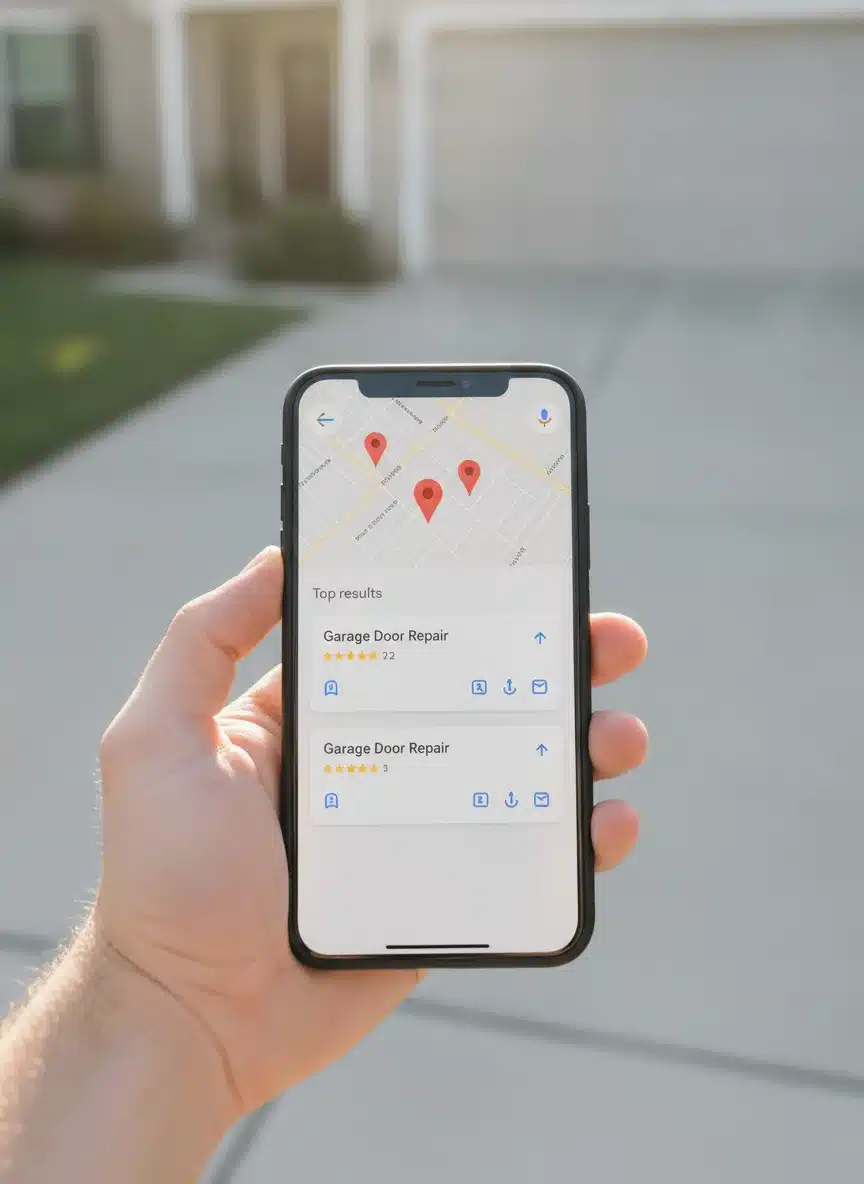
Most garage door companies need around $500 a month to compete seriously. The upper end of that range reaches $1,500. That number shifts based on your market size, but that range is where real traction starts. Let me tell you what this video is actually about. You want calls from real people in your city. You want your company to show up when someone searches. They type garage door repair near me and hit search. The map pack is the three listings above organic results.
Section 2
It shows your name and your rating. It also shows your phone number right there.
Section 3
A link goes directly to your Google business profile.
Section 4
Most of your competitors are not doing this well.
Section 5
That is good news for you.
Section 6
The Map Pack is not magic.
Section 7
It is a product Google builds from three data signals.
Section 8
Relevance, distance, and prominence.
Section 9
Relevance means your profile matches what the searcher typed.
Section 10
Distance means your verified address is close to where they searched.
Section 11
prominence means Google has evidence you are a real trusted active business you
Section 12
cannot control distance much you can control relevance and prominence almost
Section 13
entirely that is where your budget goes we looked at query data and found the
Section 14
phrase how many keywords should you target for a garage door company pulled
Section 15
62 impressions at a 50.4 average position that tells me people running
Section 16
garage door companies are actively searching for guidance right now the
Section 17
The phrase Google Maps SEO for garage door companies showed 44 impressions at a 10.6 average position.
Section 18
Those are not huge numbers, but the intent behind them is high.
Section 19
People searching that are ready to spend money.
Section 20
The map pack captures that intent better than almost any other channel.
Section 21
Let me give you the $500 to $1,500 range in plain terms.
Section 22
At $500 a month, you are doing the minimum viable version.
Section 23
that covers profile optimization basic citation management and maybe one or two
Section 24
review generation touch points per month you will see movement in smaller markets
Section 25
in a competitive Metro 500 keeps you in the game but probably does not push you
Section 26
into the top three at 800 to a thousand a month you add consistent content
Section 27
support for your website active citation cleanup and a structured review system
Section 28
this is the range where most mid-sized markets become winnable at 1200 to 1500
Section 29
a month you are running a full local SEO operation profile optimization weekly
Section 30
content citation building review response management competitor gap
Section 31
analysis and conversion tracking in a top 50 Metro this is where you start
Section 32
dominating when you spend money on map pack optimization here is what you are
Section 33
buying first profile completeness and accuracy your business name address and phone number must
Section 34
be consistent everywhere on the internet every inconsistency is a trust penalty second keyword
Section 35
relevance in your profile your business description services list and posts all feed google's
Section 36
understanding of what you do phrases like garage door spring repair emergency garage door service
Section 37
and garage door installation need to appear naturally in your content third review velocity
Section 38
and quality a consistent flow of four and five star reviews with responses
Section 39
from the owner signals to Google that you are active and trusted this is one
Section 40
of the highest leverage activities in local SEO I want to be straight with you
Section 41
here you will not dominate the map pack in 30 days in my experience working with
Section 42
local service companies here is a realistic timeline month one is cleanup
Section 43
you fix the profile correct citations remove duplicates and set up your review
Section 44
request process you may not move at all in rankings this month months two and
Section 45
three are when you typically see first movement you start appearing for lower
Section 46
competition phrases your impression share on Google business profile goes up
Section 47
calls may increase modestly months four through six are when consistent effort
Section 48
compounds if you have been generating reviews steadily fixing content gaps and
Section 49
And posting regularly, you should be showing in the top three for your core service phrases in most markets.
Section 50
Six to 12 months is when you can legitimately claim dominance in a competitive market.
Section 51
That is not a slow timeline. It is an accurate one.
Section 52
Here is where a lot of companies waste money.
Section 53
They try to rank for everything at once.
Section 54
Start with four phrases.
Section 55
Garage door repair plus your city name.
Section 56
Garage door spring replacement plus your city name.
Section 57
Emergency garage door service plus your city name.
Section 58
garage door opener installation plus your city name these are high intent high value and directly
Section 59
tied to calls once you are ranking in the top three for those you expand to surrounding zip
Section 60
codes and secondary service phrases mistake one inconsistent nappy data and app stands for name
Section 61
address and phone number if your yelp listing says one thing and your google business profile
Section 62
says another google gets confused and your ranking drops this is the single most common error i see
Section 63
Mistake two, not responding to reviews.
Section 64
Google watches engagement.
Section 65
When you respond to reviews, positive or negative, it signals that your business is active.
Section 66
Silence looks like neglect.
Section 67
Mistake three, ignoring the services tab.
Section 68
Most companies fill in one or two services and stop.
Section 69
The services section of your Google business profile is one of the most underused relevant signals available.
Section 70
List every service you actually offer.
Section 71
Mistake four, not posting to your profile.
Section 72
Google business profile posts are like a social feed regular posts tell Google
Section 73
you are active they also give you more surface area for keywords one post per
Section 74
week is a reasonable minimum mistake 5 chasing rankings and markets where your
Section 75
address is too far if your verified address is 15 miles from the city center
Section 76
you will struggle to rank in that city's map pack no matter how much you spend
Section 77
distance is a real constraint let me walk through a realistic scenario say
Section 78
Say you run a garage door company in a mid-sized city, population around 300,000.
Section 79
You have a Google business profile that was set up years ago but has not been touched
Section 80
since.
Section 81
You have 11 reviews, mixed response rate.
Section 82
Your competitors in the top three have between 60 and 140 reviews.
Section 83
Month one at $800, profile gets fully rebuilt.
Section 84
All citations get audited and corrected.
Section 85
A review request sequence gets set up.
Section 86
you post twice that month to your profile month two you are generating
Section 87
three to five reviews per week you have added all services to your profile
Section 88
website content gets optimized for your top five phrases you start appearing in
Section 89
the map pack for lower competition phrases month three you have around 30
Section 90
to 40 reviews now your average position for core phrases has improved you are
Section 91
getting five to ten more profile views per week than you were at the start
Section 92
month four through six consistent review flow continues citations are clean you
Section 93
add content covering nearby service areas by month six you are in the top
Section 94
three for your core service phrases that is a real outcome at eight hundred
Section 95
dollars a month over six months total investment around four thousand eight
Section 96
hundred dollars this is important local SEO is not a one-time project if you
Section 97
stop optimizing at month six you will hold your position for a few months then
Section 98
then competitors who are still working it will start closing the gap.
Section 99
Within six months of going dormant, you may lose two to three positions on key phrases.
Section 100
The companies that dominate long-term are the ones that treat this as an ongoing operating expense, not a campaign.
Section 101
Track these four numbers monthly.
Section 102
Profile views on Google Business Profile.
Section 103
The number of direction requests and calls from your profile.
Section 104
Your average position for your top five keyword phrases.
Section 105
Number of new reviews generated.
Section 106
If all four are trending in the right direction, your budget is working.
Section 107
If any of them stall for two consecutive months, something specific needs to change.
Section 108
Do not just look at calls in isolation.
Section 109
Calls can fluctuate with seasonality.
Section 110
Profile views and direction requests are pure signals of MapPack health.
Section 111
If you want to know exactly where you stand right now, we offer a free visibility teardown.
Section 112
Go to seo.pushleads.com slash audit or call 828-348-7686.
Section 113
We will look at your Google business profile, your top competitors in the map pack, your citation consistency, and your review standing.
Section 114
No pitch, no pressure, just a clear picture of what is working and what is not.
Section 115
If you are spending money on garage door leads and you are not in the top three on Google Maps
Section 116
This teardown will show you exactly why
By Jeremy Ashburn, founder of PushLeads, an Asheville, NC SEO and digital marketing agency for contractors and home-service businesses.
How do I do Google Maps SEO for my garage door company?
Want it done for you? See our local SEO services.
Start by setting your primary category to Garage Door Supplier, then configure your real service area, upload job photos with descriptive file names, seed your Q&A section with common questions, and ask for reviews at the job site. Posting once a week and responding to every review keeps your listing active and signals trust to Google.
How do I optimize Google Maps for a garage door company?
Correct your primary category to Garage Door Supplier first, since it is the single most important field Google reads. Then add two to four secondary categories, rewrite your description to include services and geography, upload at least two new job photos per week, and collect reviews consistently. These steps compound into stronger local rankings over weeks.
Want more customers from Google & AI search?
Get a free SEO audit of your site — see exactly what to fix first.
What does garage door company Google Business Profile management actually involve?
It means maintaining category accuracy, keeping photos uploading consistently at two to four per week, responding to every review, posting once a week, monitoring the Q&A section monthly, and auditing citations annually for exact name, address, and phone number matches. It is ongoing work, not a one-time setup.
What are the best Google Business Profile optimization tips for garage door companies?
The highest-impact tips are setting the primary category to Garage Door Supplier, renaming photo files before uploading with descriptive location-based names, asking for reviews at the job site immediately after the work is done, and seeding the Q&A section yourself with five to seven common customer questions answered accurately.
How do I improve my garage door company's Google Maps ranking?
Google ranks based on relevance, proximity, and prominence stacked together. Fix relevance by correcting your category and service area. Build prominence through consistent reviews, weekly posts, and citation accuracy. A company that corrects its category, uploads 30 photos, fixes citations, and starts collecting reviews can appear in new map pack positions within about three months.
How do I optimize a Google Business Profile for a garage door company?
Set the primary category to Garage Door Supplier, add two to three focused secondary categories, write a 750-character description naming your services and service area, upload job photos renamed with descriptive file names, configure your service area to cities you actually serve, and respond to every review. Do a ten-minute audit of each element to start.
How do I manage Google reviews for a garage door company?
Ask for the review at the job site the moment the work is done, texting the Google review link before leaving. Respond to every review including negative ones. A hundred reviews from three years ago is weaker than forty reviews with several from the last month, so recency and consistency matter more than total count alone.
What is a local business listing management service for garage door companies?
It is a service that audits and corrects your Google Business Profile category, description, service area, and photos, then ensures your name, address, and phone number match exactly across citations like Yelp, Angi, and the Better Business Bureau. Even minor discrepancies such as St versus Street lower your trust signal and hurt map pack rankings.
Key Takeaways
- Google Business Profile optimization for garage door companies directly determines whether your business shows up in the local 3-pack for high-intent searches like "garage door repair near me" or "emergency garage door service."
- Completeness, consistency, and activity on your GBP listing are the three pillars that drive map pack visibility.
- Categories, services, photos, and review responses all send ranking signals to Google's local algorithm.
- Businesses that post weekly GBP updates and respond to every review consistently outperform inactive listings in local search.
- Proximity, relevance, and prominence are Google's stated ranking factors for local results, and each one is addressable through your GBP listing.
If someone's garage door spring snaps at 7 PM on a Tuesday, they're not browsing. They're grabbing their phone and typing "emergency garage door repair near me." The businesses that show up in that local 3-pack get the call. The ones buried below it don't. Google My Business Optimization Service Companies Guide for garage door companies is the single most direct way to control where your business lands in that moment.
This page breaks down exactly how to set up, fill out, and actively manage your GBP listing so it works the way your customers need it to, and the way Google's local algorithm rewards it.
Full transcript
Section 1
Run Maps SEO first, then layer in Google Ads once your profile converts. That sequence cuts your cost per lead in half over 12 months. I'm going to show you the actual math on both channels, walk through a real worked example, and give you a clear sequence so you stop burning money in the wrong order.
Section 2
When a homeowner's spring breaks at 7 in the morning, they grab their phone and search
Section 3
garage door repair near me.
Section 4
Two things show up above everything else, the Google Maps 3-pack and paid ads.
Section 5
Most owners treat these as competitors for the same budget dollar.
Section 6
They're not.
Section 7
They're two different machines with two different payback timelines.
Section 8
One is a monthly rent payment.
Section 9
One is an asset you build.
Section 10
Knowing which one to start with is the difference between a 12-month break-even and a 12-month
Section 11
money pit.
Section 12
pit. Let's talk numbers first. In my experience, garage door companies pay between 40 and $80 per
Section 13
click on competitive keywords like garage door repair or garage door spring replacement. That's
Section 14
not cost per lead. That's cost per click. If your landing page converts at 10%, which is a solid
Section 15
number for a well-built service page, you're paying 400 to $800 per lead. If it converts at 5%,
Section 16
which is more common you're at eight hundred to sixteen hundred dollars per
Section 17
lead your average ticket on a spring replacement might be two hundred fifty
Section 18
dollars a full door install might run fifteen hundred to twenty five hundred
Section 19
so on repair calls ads can actually cost you money on the first job before you
Section 20
ever factor in lifetime value or callbacks now here's the critical thing
Section 21
most agency sales people won't tell you the moment you stop paying the lead stop
Section 22
day one of no budget zero impressions zero calls ads are rent you never own
Section 23
anything maps SEO is different the work compounds in my experience a garage door
Section 24
company investing in maps SEO spends somewhere between five hundred and
Section 25
fifteen hundred dollars a month depending on how competitive their
Section 26
market is that spend goes toward things like Google business profile
Section 27
optimization local citation building review generation systems and localized
Section 28
content on the website the payback curve looks like this months one through three
Section 29
you're mostly invisible months four through six you start cracking the three pack for lower
Section 30
competition terms like garage door repair plus your specific suburb months seven through twelve
Section 31
you're competing for the main city terms once you're in the three pack for your primary keywords
Section 32
the cost per lead drops dramatically industry ballpark puts it between 20 and 60 dollars per
Section 33
lead from maps versus that 400 to 1600 from ads and unlike ads when you hit month 13 and stop
Section 34
paying, you still rank. Your profile doesn't disappear overnight. The asset stays. Let me put
Section 35
both scenarios next to each other. Scenario one, you go ads first. You spend $1,500 a month on ads
Section 36
plus management. That's $18,000 over 12 months. At an industry ballpark of $600 per lead, you
Section 37
generate 30 leads. If you close 60%, that's 18 jobs. Average ticket of $800 gross across repairs
Section 38
pairs, and installs. That's $14,400 in revenue. You spent $18,000 to make $14,400. You're in the
Section 39
hole in year one. Year two looks no better because you've built no assets, so you spend
Section 40
$18,000 again. Scenario two, you go maps first. You spend $1,000 a month on maps SEO. That's
Section 41
$12,000 over 12 months. Months one through six, you generate maybe 20 leads total from maps as
Section 42
As you build ranking, month 7 through 12, you're generating 15 to 25 leads per month.
Section 43
Call it 110 leads over the year.
Section 44
60% close rate, 66 jobs.
Section 45
Same $800 average ticket, $52,800 in revenue.
Section 46
Year 2, your ranking holds.
Section 47
Your lead cost drops.
Section 48
The asset works for you.
Section 49
That's the math the ad salesperson doesn't show you.
Section 50
There's a very simple reason owners go ads first.
Section 51
Ads feel faster.
Section 52
you can have a campaign running tomorrow the phone might ring this week maps seo feels slow
Section 53
the agency says give it six months and owners here we don't know so owners write the check for ads
Section 54
because it feels like action and six months later they've spent nine thousand dollars and they're
Section 55
completely dependent on that spend continuing forever i'm not saying ads are bad i'm saying
Section 56
sequencing them wrong is expensive there is one legitimate reason to start with ads you just
Section 57
opened your doors for the very first time you have zero reviews and no
Section 58
ranking history whatsoever your Google business profile is completely brand new
Section 59
in that case you genuinely need calls while SEO builds run a small ads budget
Section 60
of $200 a month 500 is the upper end of that range that keeps the phone from
Section 61
going completely silent but run it like a timer not a long-term strategy set a
Section 62
hard cutoff date around month seven at that point you cut or reduce the ad
Section 63
spend then let your maps investment carry the full load if you are not new
Section 64
skip the ads phase entirely start maps optimization right now let me be
Section 65
specific because this term gets used loosely Google Maps ranking is driven by
Section 66
three things first relevance does your Google business profile and website tell
Section 67
Google clearly what you do where you do it and for whom this means your
Section 68
categories your services list your website content your target keywords in
Section 69
the right places second proximity how close is the searcher to your listed
Section 70
address you can't fake this but you can expand your service area signals with
Section 71
city specific landing pages and localized content third prominence how
Section 72
many reviews do you have how recent are they how many other websites mention
Section 73
your business name and address are those mentions consistent when people say maps
Section 74
SEO they mean working all three of those levers over time systematically it's not
Section 75
a one-time task it's a monthly process your Google business profile is the
Section 76
single highest leverage asset a local garage door company has online and most
Section 77
of them are set up wrong common mistakes I see category set to home improvement
Section 78
instead of garage door supplier or garage door repair service no services
Section 79
is added no photos added in the last 90 days description doesn't include any city names
Section 80
review response rate under 50 percent each one of those is a ranking signal you're leaving on
Section 81
the floor one data point from the query data we look at the phrase google maps seo for garage
Section 82
door companies get 75 impressions with a 7.2 percent click-through rate owners are searching
Section 83
for this they know they need it most just don't know what to do with it let me give you a worked
Section 84
example take two identical garage door companies same city same services same
Section 85
website quality company a has 42 reviews 3.9 stars last review posted six weeks
Section 86
ago company B has 91 reviews 4.7 stars last review posted three days ago
Section 87
company B wins the three-pack every time not even close reviews are ranking
Section 88
signal and a conversion signal at the same time when you rank and you have
Section 89
4.7 stars the homeowner calls you before they even look at anyone else your
Section 90
review strategy should be this simple text the customer a direct review link
Section 91
within two hours of finishing the job that one change in my experience doubles
Section 92
your review velocity your Google business profile ranks strongest near
Section 93
your address but most garage door companies serve a 20 to 40 mile radius
Section 94
city specific landing pages are how you compete in every suburb even when your
Section 95
shop isn't physically there. Each page targets a specific city or suburb, mentions the service
Section 96
clearly, uses that city name in the headline, the body, the meta title, and links back to your
Section 97
Google business profile naturally. In my experience, a garage door company with 8 to 12 city pages
Section 98
outranks competitors with zero city pages in those outer suburbs within 4 to 6 months. This is not
Section 99
complicated to build. It is boring and time consuming, which is why most don't do it. That's
Section 100
your advantage let me walk you through a hypothetical but realistic scenario month
Section 101
1 through 2 fix the Google business profile right categories full services
Section 102
list 35 new photos get the review request system running month 3 through
Section 103
4 build 6 city pages on the website clean up the local citations so the name
Section 104
address and phone number are consistent across the top 40 directories month 5
Section 105
Five through six, you start cracking the three-pack for suburb-level searches.
Section 106
Phone starts ringing from maps for the first time.
Section 107
Maybe eight to 15 calls a month.
Section 108
Month seven through nine, you're showing for your main city terms intermittently.
Section 109
Reviews are at 60-plus and climbing.
Section 110
Calls from maps hit 20 to 30 per month.
Section 111
Month 10 through 12, stable three-pack position for your main terms.
Section 112
40-plus calls per month from maps alone.
Section 113
Cost per lead under $50.
Section 114
Total investment, $12,000.
Section 115
Total leads from maps in year one, roughly 100 to 120.
Section 116
Year two, the ranking holds.
Section 117
The cost per lead keeps dropping.
Section 118
That's the asset.
Section 119
Mistake one, inconsistent in-app.
Section 120
Name, address, phone number spelled differently across directories.
Section 121
Google sees that as a trust signal problem.
Section 122
Fix it early.
Section 123
Mistake two, ignoring the Q&A section on your profile.
Section 124
file. Seed it with the 10 most common questions customers ask. It adds keyword relevance and it
Section 125
genuinely helps conversion. Mistake three, using the same generic description on every city page.
Section 126
Google reads duplicate content as low effort. Each page needs its own paragraph with local
Section 127
specifics. Mistake four, stopping review outreach after month two. Review velocity matters. Older
Section 128
reviews decay in influence. This is a forever system, not a launch task. Mistake five, no
Section 129
no photos of actual work. Stock photos do nothing. Real job photos, real doors,
Section 130
real driveways in your city. Post four to eight photos every single month.
Section 131
If you're a garage door company owner watching this, here's your next move. Pull up your Google
Section 132
business profile today. Check four things. One is your primary category, garage door supplier
Section 133
or garage door repair service, not contractor, not home improvement. Be specific. Two, do you
Section 134
You have a services section filled out with every service you offer.
Section 135
Spring replacement, cable repair, opener installation, panel replacement.
Section 136
List them all.
Section 137
Three, when was your last review?
Section 138
If it's been more than two weeks, your review request system is broken.
Section 139
Four, search your own main keyword in your city right now.
Section 140
Are you in the three-pack?
Section 141
If not, you know exactly what to work on.
Section 142
That audit takes 10 minutes.
Section 143
It shows you the gap, and it tells you whether you need to start at the foundation
Section 144
recommendation or whether you're close enough that a few months of focused work gets you over
Section 145
the top. Here's the simple version. Start with Maps SEO month one, run a small ads budget only
Section 146
if you're brand new and need calls now, then cut it by month seven, build city pages, get reviews,
Section 147
fix the profile. By month 12, you have an asset that generates leads at $20 to $50 each. Then if
Section 148
you want to layer ads back in for peak season or to dominate above the three pack two, do it. But
Section 149
top of a working foundation not a life support system for a company with no
Section 150
organic presence that's the sequence maps first add second if you want us to
Section 151
look at your specific profile and tell you exactly where you stand go to SEO
Section 152
dot push leads comm slash audit or call us at eight two eight three four eight
Section 153
seven six eight six we'll do a free visibility teardown and show you the
Section 154
gaps no pitch just the numbers
Why the Local 3-Pack Matters More Than Your Website for Garage Door Searches
The local map pack captures the majority of clicks for service-based searches. For garage door companies, this is where your customers make their decision before they ever visit your website.
According to BrightLocal (2023), 98% of consumers used the internet to find information about local businesses in the past year, with Google being the dominant platform. For urgent, high-intent services like emergency garage door repair, users rarely scroll past the map pack at all.

The 3-pack appears above organic search results, which means even a well-optimized website often sits below three GBP listings. For a garage door company competing locally, that positioning is everything. A customer in distress will call the first business that appears credible and close. Your GBP listing is your first impression, your phone number, your reviews, your hours, and your service list all in one place.
Google determines which three businesses appear in that pack based on three factors it has publicly acknowledged: relevance (how well your listing matches the search), distance (proximity to the searcher), and prominence (how well-known and trusted your business is online). All three can be directly influenced through your GBP profile when it's built and managed correctly. Understanding how local SEO for garage door companies intersects with your GBP signals gives you a clearer picture of what drives that prominence score.
The local 3-pack is where garage door companies win or lose emergency repair calls, and Google Business Profile optimization for garage door companies is the mechanism that controls your placement there. Google ranks local listings based on relevance, distance, and prominence, all of which are shaped by how completely and actively you manage your GBP listing.
Claiming and Verifying Your GBP Listing Before Any Optimization Begins
Before any optimization can happen, your listing needs to be claimed and verified. This step is non-negotiable, and getting it wrong early creates problems that are difficult to undo later.
Start by visiting Google Business Profile and searching for your business name. If a listing already exists, claim it. If not, create one from scratch. Google will send a verification postcard to your physical address, though phone and email verification are available in some cases. Complete this process before moving forward with anything else.
Once verified, set your primary category to Garage Door Supplier or Garage Door Repair Service, depending on your core revenue focus. According to Whitespark's Local Search Ranking Factors (2023), primary GBP category is consistently ranked among the top three local ranking signals by SEO professionals who specialize in local search.
Add secondary categories that reflect the full scope of your work: garage door installation, spring replacement, opener repair, and commercial garage door services if applicable. Configure your service area with the specific cities and zip codes you actually serve. Do not try to cover an unrealistically large region. Google rewards relevance and proximity, so being accurate here works in your favor.
Your business description should use plain language that explains what you do, where you do it, and why customers trust you. Include your primary service and city naturally within the first two sentences. Avoid keyword stuffing. Write for the person reading it, not the algorithm.
Watch: How do garage door companies get found on Google Maps without running ads?
What this video covers
- 0:00 — Google Maps Rankings Without Ads
- 1:06 — Why Google Decides Who Shows Up
- 2:00 — Primary Category the First Signal
- 3:12 — Business Name and Description Done Right
- 4:20 — Service Area Configuration Most Shops Skip
- 5:32 — Photo Strategy That Separates You
- 7:52 — Reviews the Ranking Factor You Can Influence
- 9:25 — GBP Posts Using the Update Feed
- 10:25 — Q&A Section Fix It Before Competitors Do
- 11:14 — Citations NAP Consistency Across the Web
- 12:07 — Real Shop Example Month by Month
- 13:18 — Mistakes That Undo Everything
- 14:32 — Ten Minute GBP Audit to Do Right Now
Full video transcript
How garage door companies get found in Google Maps without ads. Three numbers tell the whole story.
The keyword "garage door replacement Phoenix" pulls 3,200 impressions a month at a 3.8% click-through rate. The search "new garage door insulation Phoenix" pulls 1,600 impressions at a 2.6% rate. Custom garage doors — commercial-intent terms — pull 3,200 impressions at a 43.8% click-through rate.
That last number is the one no one talks about. People searching with commercial intent are clicking at nearly 11 times the rate of people searching for a specific city plus service. That means your Google Business Profile is not just a listing. It is the highest-converting asset you own, and most garage door shops are leaving almost all of it configured wrong.
This video walks through exactly what to fix, in the order that moves the needle fastest.
Why the map pack exists and how Google decides who shows up.
Google Maps is not showing you the most popular garage door company. It is showing the one that Google trusts most for this person, at this moment, in this location. Trust comes from all three of these signals stacked together.
First, relevance — does Google understand that you do garage door work? Second, proximity — is your business physically close enough to be useful? Third, prominence — does the broader web confirm that you are a real, active business?
Most shops optimize for nothing. They filled out their profile when they opened, posted one photo of a truck, and walked away. Every shop that does even one more thing better than that moves up in the Google Maps stack. We are going to make sure you are doing all of it.
Category selection — the first signal Google reads.
When Google looks at your profile, the very first thing it checks is your primary category. This is the single most important field in your entire profile.
For garage door companies, the correct primary category is "Garage Door Supplier." Not home improvement store, not contractor, not door supplier. Garage Door Supplier is the specific category Google recognizes as matching searches like "garage door repair near me" and "garage door installation."
After your primary category, you can add secondary categories. Good secondary choices are garage door repair service and door repair service. Do not stack ten categories trying to rank for everything. Two to four focused categories outperform a bloated list because Google reads the list as a confidence signal. A tight list says exactly what you do.
Go into your Google Business Profile right now and verify your primary category. If it is not Garage Door Supplier, change it today. That single edit can move your ranking within two to four weeks in my experience.
Business name and description — what most shops get wrong.
Your business name on your Google Business Profile must be your real, legitimate business name. Google's guidelines here are specific. Adding keywords to your business name — like putting "garage door repair" after your company name — violates the terms of service and can get your listing suspended. It can also get you reported by a competitor, and it is just not worth it.
What you can control is your business description. You have 750 characters to work with. Use the first two to three sentences to state plainly what you do, what areas you serve, and what you specialize in. A good example would be: "We install, repair, and replace residential and commercial garage doors throughout the greater Phoenix area. We specialize in same-day spring repairs, opener installations, and custom door builds."
That description hits service types, geography, and intent signals without stuffing keywords awkwardly. Write it like you are talking to a customer, not an algorithm. The algorithm understands natural language anyway.
Service area configuration — the signal most shops skip entirely.
Here is where a lot of garage door companies lose ranking without knowing exactly why. If you operate as a service area business — meaning you go to customers instead of customers coming to you — you need to configure your service area correctly in the profile.
Go to your Google Business Profile dashboard, find the service area section, and add every city and zip code that you actually serve. Be honest and be specific. Adding cities three hours away because you might drive there hurts your relevance signal for the cities you actually work in every day.
A good rule: add the cities you would turn down a job outside of. That radius is your real service area. For most garage door shops, that is somewhere between a 12-mile and a 30-mile radius from where the truck sleeps at night.
What happens is that Google cross-references your service area against where your reviews are coming from, where your website says you serve, and where your citations list your address. If those signals disagree, your ranking suffers. So make them agree.
Photo strategy — the visual signal that separates you from every competitor.
Around 61% of profiles on Google have fewer than five photos. That is an industry ballpark I have seen repeated consistently, and for trade businesses specifically it is usually much worse.
Here is what a complete photo set looks like for a garage door company.
Completed jobs: the door looks good, the driveway is clean, and the customer is happy. Take it with your phone and post it the same day.
Spring and hardware close-ups: the worn spring next to the new spring, the old cable next to the installed cable. This communicates expertise without a word of text.
Opener installs: the ceiling-mounted unit, the rail, the backup battery if you install one. Always show your work.
Before photos: the bent panel, the broken spring, the door sitting at an angle. Before-and-after sets do two things at once — they show the problem and how you solved it.
Team and truck photos are fine but secondary. What converts a viewer into a caller is seeing the work itself.
Post a minimum of two new photos per week. Set a reminder — this is not optional — because Google uses photo frequency as a freshness signal. A profile with 80 photos uploaded consistently over two years outperforms a profile with 80 photos uploaded all at once and never touched again.
Photo file names and descriptions — the step 90% of shops skip.
When you upload a photo to your Google Business Profile, rename the file itself before you upload it. Instead of uploading "image4821.jpg," name it something like "garage-door-spring-repair-Scottsdale-Arizona.jpg." That file name is metadata and Google reads it.
Same with the description field when you upload. Write out a plain sentence describing what is happening in the image and where the job was done — something like "broken torsion spring replaced on a two-car residential garage in Scottsdale." This only takes about 20 seconds of work per photo, but compounded over 100 photos it is a meaningful relevance signal that most competitors ignore completely.
Reviews — the ranking factor you cannot fake and can directly influence.
Reviews affect your Google Maps ranking. This is not a theory; it is documented in Google's own guidance. The factors that matter most are total number of reviews, recency of reviews — meaning how frequently you are getting them — and whether or not you respond to reviews.
For garage door companies specifically, the review request has to happen at the job site. You are already sitting with the customer, the door is working, they are happy. That is the highest-probability moment you will ever get to earn a five-star review. Pull out your phone, text them the Google review link, and wait before you even get back in the truck if you can. If you wait until you are back at the shop, the window closes fast.
For responding to reviews, it is important to respond to every single one — good reviews, neutral reviews, and even critical reviews. A short, genuine response signals to Google that there is a real person running this business.
One thing that helps your ranking is when customers mention a specific service or city in their review, because that reinforces your relevance for those specific search terms. You cannot ask them to include keywords, but you can ask a question that naturally leads them there. "What did we do for you today?" is a better review prompt than "leave us a five-star review."
Using the GBP post feed to stay fresh.
Google Business Profile has a post feature and most garage door companies have never used it. Posts show up right in your Google Business Profile and they signal activity. They have a short shelf life — about a week for a standard post — so posting once a week keeps the signal alive.
What to post: a completed job with a photo, a seasonal reminder about spring tune-ups or winter weather stripping, an answer to a common question like how long a torsion spring lasts, or a short tip about opener maintenance. Keep each post under 150 words and include a call to action. Use a category that fits — update, offer, or what's new.
This takes about ten minutes per week, but it is one of the lowest-effort, highest-consistency signals you can send.
Q&A — the section that is filling itself with the wrong information.
Go to your Google Business Profile right now and scroll to the questions and answers section. Anyone can post a question and anyone can answer it — including your competitors, including people who have never hired you. The fix is simple: seed it yourself.
Write five questions your customers ask most often and answer them yourself. Do you offer same-day garage door repair? What brands of openers do you install? Do you service commercial garage doors? How long does a spring replacement take? Do you offer free estimates?
Answer each one plainly and accurately. Then monitor the section monthly and flag or correct anything inaccurate that gets posted. This takes about 30 minutes once and about five minutes once a month to maintain.
Citations — making sure the web agrees on who you say you are.
A citation is any mention of your business name, address, and phone number on a site that is not yours — Yelp, Angi, HomeAdvisor, Houzz, the Better Business Bureau, and your local chamber of commerce website.
Citations need to be consistent. If your address is listed as "123 Main St" on one site and "123 Main Street" on another, Google counts that as a discrepancy and your trust signal drops. Go through your top ten citations and make sure the name, address, and phone number match your Google Business Profile exactly — character for character. This is tedious work, but you do it once and then set a reminder to check it annually.
A real-world example — what this looks like for an actual shop.
Let's run through what a garage door company in a midsize market looks like when they apply everything in this video.
In month one, they correct their primary category to Garage Door Supplier, rewrite their description, configure their actual service area, rename and upload 30 photos from past jobs with descriptive file names and captions, seed their Q&A with seven questions, audit their top citations and fix four discrepancies, and start asking for reviews at the job site that same week.
In month two, they are posting twice a week, collecting 11 new reviews and responding to all of them, and uploading eight to ten new job photos.
In month three, they are appearing in the map pack for two keywords they were not ranking for before, and call volume from Google Maps goes up.
This is not a guarantee — no one can guarantee a Google Maps ranking — but it is a repeatable sequence that works based on everything I have seen in this industry.
The mistakes that undo everything.
Keyword stuffing the business name. We covered it. Do not do it. Do not repeat keywords like "garage" or "repair" over and over in your content, your Google Business Profile, or even your social media. Always write for humans and keep it natural.
Hiding the address. If you have a physical office where customers can visit, showing the address increases your local relevance. Only hide it if you truly operate with no customer-facing location.
Letting the review count go stale. A hundred reviews from three years ago is weaker than 40 reviews with several from the last month. Recency matters.
Ignoring photo upload dates. Do not batch-upload all your photos at once. Upload consistently — two to four per week.
Using a virtual office address. Google can and does detect this. Profiles using virtual addresses get suspended regularly. Always use your real location.
Not responding to negative reviews. A negative review with no response looks worse than a negative review with a calm, professional reply. Respond every time.
What to do right now — the ten-minute audit.
Open your Google Business Profile. Check your primary category and fix it if it is wrong. Count your photos — if you are under 50, you have work to do. Read your most recent ten reviews and respond to any that do not have a response. Open your Q&A, read every entry, and correct anything inaccurate. Check your service area and make sure it reflects reality. Read your business description out loud — if it sounds like a keyword list, rewrite it.
That is your starting point.
If you want us to do the audit for you, go to seo.pushleads.com/audit or call 828-348-7686. We will look at your profile, your Google Maps listing, and what is costing you calls that you should already be getting. No cost, no pitch on the first call — just the numbers.
I'm Jeremy Ashburn with PushLeads, helping small businesses get more leads without the struggle and frustration. Talk to you soon.
How to Fully Optimize Your Garage Door Company's GBP Listing
A fully optimized GBP listing goes well beyond filling in your address and phone number. Every field Google gives you is a ranking signal, and leaving any of them blank is leaving visibility on the table.
Choose the Right Primary Category
Your primary category tells Google what your business does. For most garage door companies, "Garage Door Supplier" or "Garage Door Repair Service" are the most accurate options. Select the one that most closely matches your core revenue service. You can add secondary categories as well, such as "Door Supplier" if you also handle entry doors, but your primary category carries the most weight.
Build Out Your Services Section
Google allows you to list individual services with descriptions and prices. Use this section to name every service you offer: spring replacement, cable repair, opener installation, panel replacement, new door installation, and emergency repair. Write short, plain descriptions for each. This helps your listing match a wider range of specific search queries.
Write a Business Description That Works
You have 750 characters for your business description. Use the first 250 naturally and clearly, since that's what displays before the "more" cutoff. Describe what you do, where you serve, and what makes your service reliable. Avoid generic phrasing. Be specific about service areas and response times if emergency work is a core offering. The same specificity that strengthens your GBP description also applies when building garage door company website design pages that support your local search presence.
Upload Photos Consistently
According to Google Business Help, businesses with photos receive 42% more requests for directions and 35% more clicks to their websites than those without. For a garage door company, this means uploading photos of completed installs, before-and-after repair work, your vehicles, and your team. Aim to add new photos at least twice per month.
Set Accurate Hours and Enable Messaging
If you offer 24-hour emergency service, your hours need to reflect that. Listing hours as 9–5 when you take emergency calls around the clock costs you map pack clicks from customers searching at night. Enable the Google messaging feature so customers can contact you directly from your listing without picking up the phone first.
Fully optimizing a Google Business Profile for a garage door company means treating every available field as a ranking input, from categories and services to photos and business hours. Incomplete listings consistently underperform against competitors who have taken the time to build out every section Google provides.
Reviews: The Most Underused Ranking and Conversion Signal

Reviews do two jobs at once. They influence how Google ranks your listing, and they influence whether a potential customer decides to call you. Both matter, and both are within your control.
According to BrightLocal (2023), 49% of consumers trust online reviews as much as personal recommendations from friends and family. For emergency services like garage door repair, where trust needs to be established in seconds, your review count and average rating are doing heavy lifting.
Google's local algorithm uses review signals as a prominence indicator. More reviews, higher ratings, and owner responses all contribute positively. A garage door company with 80 reviews and a 4.7 average will typically outrank a competitor with 12 reviews and a 4.9 average, because volume and recency carry weight alongside quality. Pairing a strong review profile with a broader garage door company marketing strategy compounds these visibility gains across multiple channels.
"Your Google Business Profile is often the first thing a potential customer sees. If your reviews are thin or your responses are absent, you're signaling that you're not paying attention, and customers notice that before they even visit your website."
Build a repeatable process for asking customers to leave reviews immediately after a completed job. A simple text message with a direct link to your GBP review form works well. Respond to every review, positive and negative, within 48 hours. When responding to negative reviews, stay factual and solution-oriented. Google indexes your responses, which means the keywords you use there also contribute to your listing's relevance.
Reviews are one of the strongest ranking signals in Google's local algorithm and a direct trust trigger for customers making emergency service decisions. Garage door companies that actively collect reviews and respond to every one of them consistently outperform competitors who treat reviews as passive feedback rather than an active part of their GBP strategy.
NAP Consistency and Citation Building for Garage Door Companies
Google cross-references your business information across the web to confirm your legitimacy. If your name, address, and phone number appear differently across different directories, it creates doubt about which version is accurate, and that doubt can hurt your rankings.
Your NAP information needs to be identical everywhere it appears: your website, Yelp, Angi, HomeAdvisor, the Better Business Bureau, and any industry-specific directories. Even small differences like "St." versus "Street" or a missing suite number can dilute your local authority.
For garage door companies specifically, make sure you are listed on contractor and home services directories in addition to general business listings. These citations act as votes of confidence for your business, telling Google that multiple credible sources agree on who you are and where you operate.
Your website also plays a role here. Make sure your address and phone number appear in the footer of every page, and that your homepage includes clear mentions of the cities you serve. If you are covering multiple towns in a region, a dedicated service area page for each location can reinforce your relevance for searches in those areas. See how our web design services are built with local SEO in mind from the ground up.
GBP Posts and Q&A: Keeping Your Listing Active Between Jobs

Google treats your GBP listing like a living profile, not a static directory entry. Listings that are updated regularly send activity signals that help maintain and improve local rankings over time.
GBP Posts let you publish updates directly to your listing. For a garage door company, this means sharing seasonal offers (spring tune-up specials, winter weatherstripping checks), new service announcements, completed project highlights, or quick tips. Posts appear in your listing for seven days before expiring. Posting once per week keeps your profile active and gives Google fresh content to index. This same consistency in content activity is a core principle behind effective SEO for garage door companies as a whole.
The Q&A section is often completely ignored, which is a missed opportunity. Anyone can submit a question on your listing, and anyone can answer it. That means a competitor or a confused user could post inaccurate information if you're not watching. Add your own questions and answer them proactively. Common ones for garage door companies include: "Do you offer same-day emergency service?", "What areas do you serve?", and "Do you work on all garage door brands?" These answers show up in search and help customers qualify themselves before calling.
According to Search Engine Journal, businesses that actively use GBP Posts and maintain updated Q&A sections report stronger engagement metrics on their listings compared to those that only maintain basic profile information. Combining this activity with a well-structured Google Ads for garage door companies campaign ensures your business captures demand both in the map pack and in paid results simultaneously.
Active management of GBP Posts and the Q&A section keeps a garage door company's listing fresh in Google's eyes while also giving customers direct answers to the questions that determine whether they call. Weekly posting and proactive Q&A management are low-effort habits that produce measurable visibility improvements over time.
Tracking Performance and Knowing What to Adjust
Optimizing your GBP listing is not a one-time task. The businesses that stay in the 3-pack are the ones that monitor their performance and make adjustments over time.
Inside your Google Business Profile dashboard, the Insights section shows you how many people found your listing through direct searches, discovery searches, and branded queries. It also tracks calls, direction requests, and website visits. These numbers tell you whether your optimization efforts are translating into real customer actions.
If your call volume plateaus, it often points to a review problem — too few, too old, or unaddressed negative reviews — a category mismatch, or a geographic relevance issue. Each of these has a specific fix. The key is not guessing. Look at what the data shows, identify the weakest signal, and address it systematically.
According to BrightLocal (2023), 87% of consumers read online reviews before choosing a local business. If your review count is stagnant while a competitor is steadily accumulating new five-star ratings, that gap will show up in your rankings and in your call volume. The four numbers worth tracking every month are profile views, direction requests and calls from your profile, your average position for your top keyword phrases, and the number of new reviews generated.
Key Takeaways
- Google Business Profile optimization for garage door companies is the most direct lever for appearing in the local 3-pack, where emergency repair searches convert fastest.
- Every field in your GBP listing, from categories to service descriptions to photos, sends ranking signals to Google's local algorithm.
- Review volume, recency, and owner response rate all influence both your map pack ranking and your conversion rate with prospective customers.
- Weekly GBP posts and proactive Q&A management signal to Google that your listing is actively maintained, which supports consistent local visibility.
- Proximity, relevance, and prominence are the three factors Google uses to rank local results, and all three are shapeable through how you build and manage your profile.
Your Map Pack Action Plan for Garage Door Companies
Google Business Profile optimization for garage door companies works when it is treated as an ongoing system rather than a setup checklist. The local 3-pack for garage door repair is genuinely winnable in most markets. It requires consistent attention rather than a large budget.
- Claim and verify your listing at your real physical address. Never use a virtual office address — Google detects and suspends those profiles regularly.
- Set the right primary category to Garage Door Supplier or Garage Door Repair Service, not a generic option like home improvement or contractor.
- Complete every section of the profile: services, description, hours, and service area, with accurate and relevant information.
- Build a steady stream of genuine reviews by texting a direct review link to customers within two hours of finishing each job.
- Post regular updates at least once per week and keep photos uploading consistently at two to four new images per week.
- Keep your NAP consistent everywhere online, including your website footer, Yelp, Angi, HomeAdvisor, and the Better Business Bureau.
- Monitor your Insights monthly to identify which signals are stalling and address them specifically rather than making broad changes.
If you want help building and managing this system so that your phone rings more often, reach out to PushLeads and let's talk about what is possible for your business in your area.
Frequently Asked Questions
How long does it take for GBP optimization to affect local rankings?
Most garage door companies see measurable movement in local map pack rankings within 60 to 90 days of fully optimizing their GBP listing. Factors like review velocity, photo activity, and post frequency can accelerate results. Competitive markets may take longer, but consistent activity compounds over time and produces more stable rankings than one-time fixes.
Should I create separate GBP listings for each city I serve?
Only create a GBP listing for locations where you have a physical, staffed presence. Creating fake location listings violates Google's guidelines and can result in suspension. Instead, use your service area settings within your single listing to specify every city and zip code you serve. This tells Google's algorithm where your business is relevant without risking your account.
How many photos should a garage door company have on their GBP listing?
There's no official ceiling, but having fewer than 10 photos puts you at a disadvantage compared to competitors. Most well-optimized profiles in service industries maintain between 25 and 50 photos. The key is ongoing addition rather than a one-time upload. Google rewards listings that grow their photo libraries over time with stronger engagement signals.
What's the best way to get more Google reviews for a garage door company?
The most effective method is a direct, personal ask immediately after a completed job, while the customer's satisfaction is highest. Send a text or email with a direct link to your GBP review form. Don't ask in bulk or offer incentives, both practices violate Google's policies. Make the ask a standard part of your post-job process and review volume will build steadily.
Does responding to Google reviews actually help rankings?
Yes. Google has confirmed that responding to reviews is considered as part of your listing's management activity. Beyond the algorithmic signal, responses demonstrate to potential customers that you're attentive and professional. Including relevant keywords naturally in your responses, such as "garage door spring repair in [city]", can also contribute to your listing's relevance for those terms.
Quick answers on video
How does Google decide which businesses show up in the map pack?
Google builds the map pack from three signals: relevance (your profile matches the search query), distance (your verified address is near the searcher), and prominence (evidence you are a real, trusted, active business). Distance is hard to control, but relevance and prominence can be improved almost entirely through your own efforts.
Want more customers from Google & AI search?
Get a free SEO audit of your site — see exactly what to fix first.
Your path · Garage Door Company SEO
Keep going: read these next
 You’re hereGoogle Business Profile Optimization for Garage Door Companies: The Map Pack Formula
- Up nextGarage Door Company Link Building: Local Citations and Industry Directories That Move Rankings
- Commercial Garage Door Marketing: How to Land Property Management and Warehouse Contracts Through SEO
- Garage Door Company SEO: The Complete Guide to Ranking for Emergency Repair and Installation Keywords


Want this done for you?
Scan your site. See the gaps. Decide with numbers.
- Rankings, Google Business Profile and site-speed teardown
- Report lands in your inbox in about a minute
- No obligation · 4.9 from 67 Google reviews
 Continue reading
