0:00 Intro
0:37 Why Mold Queries Are Different
2:17 How Google Maps Works for Mold Companies
3:11 The Google Business Profile Checklist
4:12 What Your Website Needs to Do
5:10 The Content Pages That Actually Bring In Jobs
6:20 The Educational Content That Captures Pre-Buyers
7:06 How Reviews Actually Move Rankings
7:59 The Keyword Targeting Map
8:47 A Worked Example: How the Math Plays Out
9:37 Common Mistakes That Kill Mold SEO
10:52 What to Do First
11:38 Where to Get Help
Full transcript
0:00 Intro
You can get mold remediation jobs from Google organically by ranking your Google business profile in a handful of targeted pages before a competitor pays to outbid you on the same search. This works because mold queries convert at higher rates than almost any other restoration category and most of your local competitors haven’t figured that out yet. I’m gonna walk you through the full strategy, maps, content, the right keywords, the common mistakes and a worked example. So you can see exactly how the math plays out. Let’s get into it.
0:37 Why Mold Queries Are Different
First, let’s talk about why mold specifically. Water damage queries are huge in volume, but they’re noisy. People search how much does water remediation cost when they’re curious, not necessarily when their basement is flooded. Mold is different. When someone searches mold remediation at 11 at night, they already know they have a problem, they’ve probably seen it, they’ve smelled it, they’re scared. That is a buyer, not a researcher. The intent behind mold searches is almost always action oriented. The person is not comparing options for fun. They want it gone and they want someone they can trust. That’s the opportunity. Here are three numbers that matter for this strategy. First, 155, that’s the number of impressions per month for the phrase mold remediation SEO alone in the data I’m looking at, but that’s a marketing keyword. The actual job getting keywords have much higher buyer intent. Second, 60.7, that’s the position in the same data set for the phrase how to start a mold remediation business. Almost no one in the industry is targeting that correctly, but here’s the thing, your future competitor is searching that. If you show up there with the right content, you become the authority they remember when they realize they need to hire out instead of DIY. Third, 30.7, that’s the average position for mold remediation marketing queries. Position 30 means page three, nobody sees page three. These numbers tell me one thing. The category is under optimized. Most mold companies are not doing real SEO. They’re buying leads from aggregators and hoping the phone rings. That’s your opening. Your Google Business Profile is the fastest organic lever you have when someone in
2:17 How Google Maps Works for Mold Companies
your city searches mold remediation near me or mold removal company, the map pack shows up before the organic results. Three listings right at the top. If you’re in those three, you get the call. If you’re not, you’re invisible. Here’s what Google uses to rank the map pack. Relevance, proximity, and prominence. Relevance means your profile says exactly what you do. Not restoration company, not we handle all your indoor air quality needs. It says mold remediation in your business description, in your services, in your posts, and in your category selection. Proximity means how close you are to where the search happens. You can’t move your address, but you can expand your service area and make sure your profile covers the right zip codes. Prominence means Google trusts you. That comes from reviews, citations,
3:11 The Google Business Profile Checklist
and how your website supports the profile. Let me give you the exact things to audit on your profile. Primary category, make sure it says water damage restoration service, or the closest option to mold remediation available in your region. Secondary categories, add any applicable category for environmental or remediation services. Services section, list, mold inspection, mold testing, mold removal, black mold removal, crawl space mold remediation, attic mold remediation, while cavity mold removal, as individual services with short descriptions. Business description, write two to three sentences, use the words mold remediation, and your city name in the first sentence. Photos, upload real job photos before and after, your equipment, your crew working. Google Rewards active profiles with fresh photo uploads, posts, publish a short Google post once a week, answer a question, share a tip, show a completed job. This signals to Google that the profile is active. Reviews, I’ll come back to this in a minute.
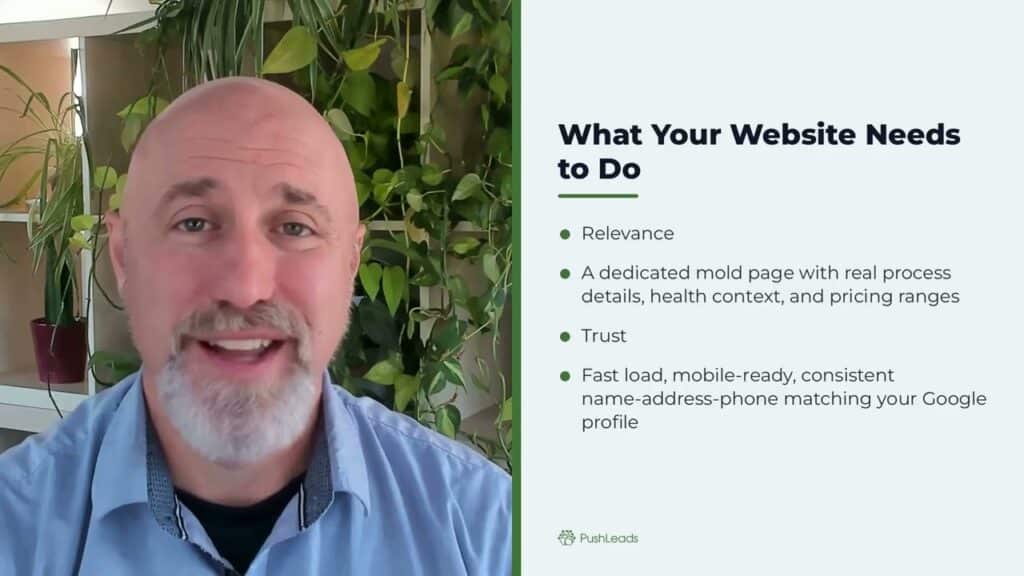
4:12 What Your Website Needs to Do
Your website has one job in this strategy. Make Google confident enough in your business to put you in the map pack and rank you on page one. That means your site needs to be relevant, trusted, and locally authoritative. Relevant means your pages specifically cover mold, not a generic restoration page that mentions mold once, a dedicated mold remediation service page with real information about the process, the health risks, what to expect, and how you price the work. Trusted means your site loads fast, works on mobile, has your name, address, and phone number consistent with your Google profile, and has other websites pointing to it. Locally authoritative means your content reflects your market. What types of mold are common in your climate? What does mold remediation cost in your city? What building types in your area tend to have hidden mold problems? When you answer those questions on your site, you’re giving Google exactly what it
5:10 The Content Pages That Actually Bring In Jobs
needs to rank you. Here is where most mold companies leave serious money on the table. They have one service page, maybe two, but searches in their market are far more specific. People search for black mold removal in their area. Others search for mold in a crawl space. Many search for attic mold remediation costs. Wall cavity and hidden mold remediation is another common search. That last one appears at an average position of 62. Almost nobody has a page targeting that query. Build a clean and helpful page on hidden wall cavity mold. You can own that search query entirely. A main mold remediation page is your flagship content. It covers your full service and your process. Include your certifications and a rough pricing range. Add a clear call to action on that page. Then build supporting pages for each subtype of mold. Cover attic mold, crawl space mold, and basement mold. Add pages for black mold and commercial mold remediation. Build location pages if you serve multiple cities. Make each location page specific to that market. Finally, write a handful of educational articles. These answer questions people ask before they ever call.
6:20 The Educational Content That Captures Pre-Buyers
This is the part of the strategy most competitors skip. Pre -buyer content targets people who are in the research phase. They’re not ready to call yet, but if you show up with a helpful answer, you become the company they trust when they are ready. Good pre -buyer topics for mold. How to tell if you have mold in your walls? What does mold remediation actually cost? Is mold remediation covered by homeowners insurance? How long does mold remediation take? What to do if you find mold when buying a house? Write these as honest specific articles. Give real answers, not vague non -answers. People can tell the difference and so can Google. Each article links back to your main service page. Your main service page links to your contact form.
7:06 How Reviews Actually Move Rankings
That’s the funnel. Reviews do two things for mold companies. One, they improve your map pack ranking. Google uses review quantity, recency, and keywords in review text as signals for local relevance. Two, they convert people who find you. Someone who searched mold remediation near me at midnight is scared and stressed. 20 reviews saying you showed up fast, explained the process, and left the house clean is the only thing that’s gonna make them pick up the phone. Here’s the mistake I see constantly. Companies get a bunch of reviews in year one, then stop asking. Google sees that plateau and starts favoring more active competitors. You need a consistent review cadence. Every completed mold job, ask for the review. Text works better than email. Send a direct link to your Google review page. Make it one tap, aim for at least two to three new reviews per
7:59 The Keyword Targeting Map
month minimum. Let me give you the hierarchy for how to target keywords across your site. Home page, your brand name, plus your course service, plus your city. Keep it clean, don’t stuff it. Main mold service page, mold remediation plus city, mold removal plus city, black mold removal plus city, supporting service pages, specific types, attic mold remediation plus city, crawl space mold removal plus city, commercial mold remediation plus city, educational articles, question based. How much does mold remediation cost in city? Signs of mold in walls, mold inspection versus mold testing, Google Business Profile, mirror your main page keywords in your description and services. This hierarchy means you’re not competing with yourself.
8:47 A Worked Example: How the Math Plays Out
Each page has a clear purpose and a clear keyword target. Picture a mold remediation company doing around 30 calls a month. 10 of those are coming from organic, 10 from referrals and 10 from purchased leads costing around $60 each. That’s $600 a month in lead cost on just the purchase portion. Now they run this strategy for six months. They build out the content pages, optimize the profile, work the reviews, organic calls go from 10 to 25. In a typical case, that kind of shift can cut the purchase lead dependency by half or more. Instead of buying 10 leads at $60, they’re buying five. $300 saved per month. And the organic calls keep coming without an ongoing cost per call. That’s the compounding part of SEO you build at once and it keeps working, leads you pay for stop the moment you stop paying.
9:37 Common Mistakes That Kill Mold SEO
Let me be direct about what kills this strategy. Mistake one, duplicate content on location pages. If you serve five cities and your five location pages, say the same thing with just the city name swapped, Google sees thin content and ignores those pages. Each location page needs locally specific information. Mistake two, ignoring your Google Business Profile after setup. A profile you set up two years ago and haven’t touched is losing ground to a competitor who posted last Tuesday. Mistake three, no internal linking. Your educational articles need to link to your service pages. Your service pages need to link to your contact page. If visitors have to hunt for how to reach you, you’re losing jobs. Mistake four, inconsistent name, address, and phone across the web. If your phone number on Yelp is different from your Google profile, that inconsistency confuses Google’s local algorithm. Audit your citations and make them match. Mistake five, no patience. Organic SEO takes time. Map pack improvements can show in 60 to 90 days if you’re consistent. Full page one rankings for competitive terms can take six months or more. If you expect leads in week two, the strategy will disappoint you.
10:52 What to Do First
If you’re starting from zero, here’s the order. Week one, audit and fix your Google Business Profile. Fill every field, add photos, add services, fix your description. Week two, fix your existing mold service page. Make it specific, make it local, make it complete. Week three, build your review request process. Get a direct link set up. Start sending it after every job. Week four, write your first two educational articles. Answer the two questions you get asked most often. Month two and three, build out supporting service pages and location pages. Month three and beyond. Keep posting to your Google profile weekly. Keep adding reviews, keep adding content. That’s it, no tricks, no shortcuts. Just consistent work in the right order.
11:38 Where to Get Help
If you want to see exactly where you stand right now, we do a free visibility tear down. We look at your Google Business Profile, your rankings, your content gaps, and we tell you what’s costing you calls. You can request that at SEO .PushLeads .com slash audit or call us at 828 -348 -7686. No pitch on the first call, just numbers.
Key Takeaways
Mold remediation searches convert at higher rates than almost any other restoration category because the person searching already knows they have a problem and wants it gone. Most local mold companies are not doing real SEO. They are buying leads from aggregators instead. By ranking your Google Business Profile and building a small set of targeted pages, you can own organic call volume that compounds over time without paying per lead.
- Mold searchers are buyers, not researchers. They already know they have a problem when they search.
- The Google Maps pack appears before ads and organic results. Getting into it is your fastest win.
- Specific service pages for attic mold, crawl space mold, and wall cavity mold outrank generic restoration pages.
- Educational pre-buyer articles capture trust before a prospect ever picks up the phone.
- A consistent review cadence improves both map pack rankings and phone conversion rates.
- Inconsistent NAP data, duplicate location pages, and stale profiles are the most common mistakes killing mold SEO.
- Organic leads keep coming after the work is done. Purchased leads stop the moment you stop paying.
Why Mold Remediation Searches Are Different From Every Other Restoration Query
Mold remediation searches convert at higher rates than water damage or fire restoration queries because the searcher is not curious. They are scared. Someone who types “mold remediation near me” at 11 PM has already seen something, smelled something, or gotten a bad air quality report. They are not comparing options for fun. They want it gone and they want someone they can trust to do it. That immediate urgency is the reason mold SEO works so well when you do it right.
Compare that to water damage queries. “How much does water remediation cost” gets searched by homeowners who are curious after a neighbor had a flood. It is a high-volume query but noisy. Plenty of those people are researching, not buying. Mold queries have almost no equivalent research traffic. The vast majority of people searching mold terms are ready to book a job.
Three numbers from the data I am working with tell the whole story. The phrase “mold remediation SEO” pulls 155 impressions per month. That is a marketing keyword, not a job-getting keyword, so its buyer intent is low. The phrase “how to start a mold remediation business” sits at an average position of 60.7, meaning almost no established mold company is targeting it, yet your future competitors are searching it right now. And the average position for mold remediation marketing queries across the board is around 30.7, which is page three. Nobody sees page three. That gap between what buyers are searching and what mold companies have optimized for is exactly your opening. The category is under-optimized. Most companies are buying leads from aggregators and hoping the phone rings. That is the opportunity this strategy is built to capture.
In this video
- 0:00 Mold Remediation Marketing Overview
- 0:43 Market Size and Structural Demand
- 1:07 Why Mold Buyers Are Harder to Convert
- 1:49 Paid Ads vs Organic SEO Compared
- 2:36 Search Volume and the Ranking Gap
- 3:09 Website Trust Signals That Convert
- 3:52 Reviews Mobile and GBP Optimization
- 5:12 Content Marketing Honest Timeline
- 6:22 Referral Relationships That Fill Gaps
- 7:18 Benchmarks and Strategy Decision
Full transcript: Mold Removal Marketing: Grow Your Remediation Business
Want more customers from Google & AI search?
Get a free SEO audit of your site — see exactly what to fix first.
How Google Maps Decides Which Three Mold Companies Show Up
Google uses three factors to rank the local map pack: relevance, proximity, and prominence. Relevance means your Google Business Profile explicitly says what you do. Proximity means how close your business address is to where the search is happening. Prominence means Google trusts your business, which comes from reviews, citations, and the authority of your website. You cannot move your physical address, but you can control relevance and prominence almost entirely.
What does “relevance” actually mean for a mold remediation Google Business Profile?
Relevance means your profile uses the specific language Google connects to mold jobs. Your primary category, your business description, your services section, and your Google posts all need to include the words “mold remediation” and your city name. If your profile still reads as a generic restoration company that handles everything from water to fire to biohazard, Google does not know to show you for mold-specific searches. Tighten the language so every section signals exactly what you do.
How does Google’s local algorithm use proximity and can I expand my reach?
Proximity is about the physical distance between your registered business address and where the search query originates. You cannot change your address, but you can expand your service area in your Google Business Profile settings to cover the zip codes and cities you actually serve. Adding those service areas tells Google which markets you are relevant for even when you are not physically located there. This is not a trick. It is a standard profile field that most mold companies leave incomplete.
What builds “prominence” and how long does it take to see results in the map pack?
Prominence comes from reviews, citations across directories, and the authority signals your website sends to Google. A profile with 40 reviews, consistent citations on Yelp, Angi, and industry directories, and a website that specifically covers mold remediation will outrank a newer profile with none of those signals. Map pack improvements from a focused effort typically begin showing within 60 to 90 days of consistent work. Full competitive rankings can take six months or more. For realistic SEO timeline expectations, it helps to have a clear benchmark before you start so you are measuring actual progress.

The Google Business Profile Checklist for Mold Companies
Your Google Business Profile is the fastest organic lever you have. When someone in your city searches “mold remediation near me,” the map pack appears above the organic results and often above paid ads. If you are in those three listings, you get the call. If you are not, you are invisible regardless of how good your website is. The checklist below covers every field that moves the needle for mold-specific searches.
Which primary category should a mold remediation company select on Google?
Select “Water Damage Restoration Service” as your primary category. It is the closest available option to mold remediation in most regions. Add any applicable secondary categories for environmental or remediation services that Google makes available in your area. Getting this wrong means Google is matching your profile to the wrong set of searches from the start, which is a foundational mistake that nothing else you do will fully compensate for.
What should the services section include for a mold remediation Google Business Profile?
List each service as an individual line item, not as one paragraph. The services that belong in that section include mold inspection, mold testing, mold removal, black mold removal, crawl space mold remediation, attic mold remediation, and wall cavity mold removal. Write a short one-to-two sentence description for each. These descriptions are indexed by Google and help match your profile to specific search variants. For a fuller breakdown of what goes into Google Business Profile optimization for contractors, that resource walks through each field in detail.
How often should a mold company post to their Google Business Profile?
Post at least once per week. Each post signals to Google that your profile is active, which Google treats as a positive trust signal. Good post formats for mold companies include answering a common question like “how do I know if I have mold behind my walls,” sharing a before-and-after from a completed job, or explaining what to expect during a mold inspection. These do not need to be long. Three to five sentences and a photo is enough to keep your activity signal healthy.
What Your Website Needs to Do for Mold SEO to Work
Your website has one job in this strategy: make Google confident enough in your business to put you in the map pack and rank you on page one for mold-specific searches. That confidence comes from three things. Your site needs to be relevant, trusted, and locally authoritative. A generic restoration website that mentions mold once on a catch-all services page will not accomplish any of those three.
What does Google mean by “locally authoritative” for a mold remediation website?
Locally authoritative means your content reflects the specific market you serve. What types of mold are common in your climate and housing stock? What does mold remediation actually cost in your city? What building types in your area, older craftsman homes, newer construction with tight envelopes, manufactured housing, tend to have hidden mold problems? When your site answers those specific questions, Google can confirm that you are genuinely relevant to that geography, not just a national lead-gen page with a city name dropped in.
How fast and mobile-friendly does a mold company website need to be?
Google uses Core Web Vitals and mobile usability as ranking factors. If your site loads slowly on a phone, you are losing rankings and conversions simultaneously. The person searching for mold help at 11 PM is almost certainly on a mobile device. A page that takes four seconds to load on a phone will lose that person before they read a single sentence. Run a free page speed test on your main service page and fix anything flagged as a critical issue before spending time on content.
Does my mold remediation website need backlinks and what kind actually help?
Yes. Backlinks from other websites are part of what Google uses to measure trust. For a local mold company, the most practical backlinks come from local business directories, your Chamber of Commerce listing, your IICRC or NORMI certification pages, any local news coverage, and from industry association sites. You do not need hundreds of links. You need consistent, legitimate citations that confirm your business is real, located where you say it is, and recognized by relevant organizations.
The Content Pages That Actually Bring In Mold Remediation Jobs
Most mold companies have one service page, maybe two. The problem is that searches in their market are far more specific than a single page can capture. People do not just search “mold remediation.” They search “attic mold remediation cost,” “crawl space mold removal near me,” and “wall cavity mold.” If you only have one page, you are only competitive for one of those searches at best. Building out a small set of targeted pages is where most of the organic job volume lives.
What should the main mold remediation service page include?
Your flagship mold remediation page should cover your full process from inspection through clearance testing, your certifications such as IICRC or NORMI, a rough pricing range so searchers know what to expect, and a clear call to action above the fold. This page targets “mold remediation” plus your city and “mold removal” plus your city. It should be your most detailed and authoritative page, somewhere between 800 and 1,500 words, with real information rather than vague assurances.
Which supporting mold pages drive the most calls and are easiest to rank?
The pages with the most opportunity are the ones targeting specific mold types and locations. Build separate pages for attic mold remediation, crawl space mold removal, basement mold, and black mold removal. Add a commercial mold remediation page if you serve businesses. The wall cavity and hidden mold remediation search sits at an average position of 62 in the data I looked at, meaning almost nobody has built a focused page for it. A clean, specific page targeting that query has a real shot at ranking on page one with relatively modest competition. Understanding mold remediation SEO costs before you invest in building these pages helps you plan your budget realistically.
How should location pages be built for a mold company serving multiple cities?
Each city you serve needs its own location page, and each page needs to be meaningfully different from the others. If your five location pages say the exact same thing with only the city name swapped, Google treats them as thin duplicate content and ignores them. Add locally specific information to each one. What neighborhoods in that city have older housing stock prone to mold? What is the typical price range in that market? What local events or flooding history makes mold more common there? That specificity is what gets those pages indexed and ranked.

Educational Content That Captures Prospects Before They Call Anyone
Pre-buyer content targets people who are in the research phase. They are not ready to call yet. They are typing questions into Google trying to understand their situation. If you show up with a genuinely helpful answer, you become the company they trust when they finally pick up the phone. This is the part of the strategy most mold companies skip entirely because it feels indirect. It is not. It is the top of a funnel that feeds your service pages and your contact form.
What educational articles should a mold remediation company publish first?
Start with the questions you get asked most often before someone books a job. Good starting topics include: how to tell if you have mold in your walls, what mold remediation actually costs in your city, whether mold remediation is covered by homeowners insurance, how long mold remediation takes, and what to do if you find mold when buying a house. Write honest, specific answers. Give real numbers where you can. Vague non-answers do not build trust and Google can tell the difference between a helpful article and a placeholder.
How do I link educational articles back to my service pages in a way that works?
Every educational article should contain at least one natural link to your main mold remediation service page or the most relevant supporting page. For example, an article on the cost of mold remediation links to your main service page where you explain pricing and next steps. That main service page links to your contact form. That is the funnel. If visitors have to hunt for how to reach you, you are losing jobs. Internal linking is not optional. It is the structure that moves a reader from curious to calling.
Can educational mold content also rank in AI search tools like ChatGPT and Perplexity?
Yes. AI answer engines pull from well-structured, specific, and trustworthy web pages when they answer questions about local services. If your educational articles give clear, direct answers to specific mold questions, they are exactly the kind of content those tools cite. This is a newer visibility channel that most restoration companies have not thought about at all. A multichannel contractor marketing system that includes both traditional local SEO and AI search visibility gives you coverage across every channel where buyers are looking for help.
How Reviews Actually Move Mold Remediation Rankings and Phone Calls
Reviews do two separate jobs for mold companies. First, they improve your map pack ranking. Google uses review quantity, recency, and the keywords people use in their review text as signals for local relevance. Second, they convert people who already found you. Someone who searched “mold remediation near me” at midnight is scared and stressed. Twenty reviews saying you showed up quickly, explained the process clearly, and left the house clean is what makes them pick up the phone instead of clicking the next listing.
How do I get more Google reviews consistently after mold jobs?
Ask every single customer after every completed job. Text outperforms email for review requests because the customer sees it immediately and can tap the link without navigating anywhere. Send a direct link to your Google review page, not a link to your website that then requires them to find the review button. Make it one tap. Aim for at least two to three new reviews per month as a floor. Setting up an automated Google review system removes the human memory factor from that process so it happens consistently after every job.
What keywords should customers mention in their mold remediation reviews?
You cannot instruct customers on specific words to use, and doing so violates Google’s review policies. What you can do is frame your review request in a way that naturally prompts descriptive responses. Ask them to share what the experience was like and what problem you solved for them. Customers who describe the mold problem, the process, and the result will naturally use relevant language. Reviews that mention specific services like crawl space mold or attic mold add keyword context that helps Google connect your profile to those search variants.
What happens to my map pack rankings when I stop getting new reviews?
Your rankings plateau and then start to decline relative to competitors who are still actively collecting reviews. Google treats recency as a quality signal. A company with 50 reviews but the most recent one from eight months ago looks stagnant compared to a competitor with 30 reviews and three in the last 30 days. The active competitor wins the trust signal even with fewer total reviews. That is why a consistent monthly cadence matters more than a one-time push to collect a large batch.
Keyword Targeting Map: Which Terms Go on Which Pages
Keyword targeting for mold SEO works best when each page has a single clear purpose and a small set of related terms. When you try to rank your homepage for every mold keyword in your market, the signal gets diluted. When every page competes for the same term, you are cannibalizing your own rankings. The hierarchy below is designed so you are never competing against yourself and Google knows exactly what each page is about.
What keywords belong on the homepage versus the main mold service page?
Your homepage should target your brand name, your primary service category, and your city. Keep it clean. The homepage is about trust and navigation, not keyword density. Your main mold remediation service page is where you target “mold remediation” plus city, “mold removal” plus city, and “black mold removal” plus city. These are your highest-intent job-getting terms and they belong on a dedicated page that covers the topic in full, not buried in a catch-all services section.
How should supporting service pages and educational articles divide up keyword targets?
Supporting service pages each take a specific subtype: attic mold remediation plus city, crawl space mold removal plus city, commercial mold remediation plus city, and so on. Educational articles target question-based queries: “how much does mold remediation cost in [city],” “signs of mold in walls,” “mold inspection versus mold testing.” These question queries will never convert directly but they feed trust into your service pages through internal links. For a fuller picture of how the whole process fits together, the seven-step local SEO process shows how each layer connects.
How do I mirror my keyword targets in my Google Business Profile?
Your Google Business Profile description and services section should use the same core language as your main mold service page. If your service page targets “mold remediation in Asheville” and your profile description says “full-service restoration and indoor air quality solutions,” Google does not see those as connected. Write your profile description to include “mold remediation” and your city name in the first sentence. List your services using the same terminology your pages use. Consistency across your site and your profile reinforces relevance from both directions.

A Worked Example: How the Math Plays Out for a Mold Company
Abstract strategy is hard to act on. Here is a concrete example of how the numbers change when this strategy is applied consistently. Picture a mold remediation company handling around 30 calls per month. Ten of those come from organic search, ten from referrals, and ten from purchased leads at roughly $60 each. That is $600 per month in direct lead cost on just the purchased portion. The company is functional but entirely dependent on spending to maintain volume.
What happens to purchased lead dependency after six months of mold SEO?
After six months of consistent work including content build-out, profile optimization, and steady review collection, organic calls in this scenario move from 10 per month to around 25. That shift in organic volume allows the company to cut purchased lead spending in half or more. Instead of buying 10 leads at $60, they are buying five. That is $300 saved per month. The organic calls continue coming without an ongoing cost per call, while the purchased leads stop the moment you stop paying. That compounding effect is the core financial argument for SEO over lead buying. For a deeper look at how the numbers compare long-term, the breakdown of SEO versus buying leads for mold companies runs through the full cost-per-lead math.
How long before the organic investment pays for itself?
In the scenario above, the break-even point comes when the monthly savings on purchased leads equal the monthly cost of the SEO work. If SEO costs $800 per month and you are saving $300 in lead costs while also adding 15 new organic calls that convert at your average job value, the math turns positive well before month six in most cases. The specific timeline depends on your market, your starting position, and how competitive your city is for mold terms. That is why auditing your current visibility before committing to a strategy is worth doing first.
Does this math hold for smaller mold companies just starting out?
Yes, and in some ways it works better for smaller companies because they often have less competition in their specific city or service area. A mold company doing 10 calls a month that doubles organic volume to 20 is growing 100 percent without adding a single dollar in lead costs. The same percentage improvement at a larger company moves bigger absolute numbers, but the proportional impact is often more dramatic for smaller operators who have been entirely reliant on purchased leads or word of mouth up to that point.
Common Mistakes That Kill Mold Remediation SEO
Most of the mold companies I audit are making the same five mistakes. None of them are complicated to fix, but each one is quietly costing calls every month. If you are running any of these patterns right now, addressing them before adding new content will make everything else work better.
Why do duplicate location pages hurt a mold remediation website?
If you serve five cities and your five location pages say essentially the same thing with the city name swapped, Google identifies them as thin duplicate content and either ignores them entirely or ranks them very poorly. You end up with five pages that collectively do less than one strong page would. The fix is to make each location page locally specific. Add detail about that particular market: its housing age, its common mold triggers, its neighborhoods. That differentiation is what earns rankings for location-specific searches.
What does an ignored Google Business Profile cost a mold company in rankings?
A profile you set up two years ago and have not touched since is losing ground steadily to competitors who are posting weekly and uploading fresh photos. Google’s local algorithm favors active profiles. Activity signals include new posts, new photos, new reviews, and responses to reviews. If a competitor posted last Tuesday and you posted nine months ago, the competitor has an activity advantage that contributes to their map pack placement. Profile maintenance takes about 20 minutes per week and the return on that time is disproportionately high.
How does inconsistent NAP data affect mold remediation local rankings?
NAP stands for name, address, and phone number. If your phone number on Yelp is different from your Google Business Profile, or your business name is formatted differently across directories, Google’s local algorithm reads those inconsistencies as a trust signal problem. It cannot confirm which version of your business is correct, so it deprioritizes your profile relative to competitors with clean, consistent citations. Audit your listings on Yelp, Angi, the BBB, Houzz, and any industry directories. Get every listing to match your Google profile exactly.
Frequently Asked Questions
How long does mold remediation SEO take to generate calls?
Map pack improvements typically show within 60 to 90 days of consistent profile optimization and review collection. Page one organic rankings for competitive mold terms take longer, often six months or more in markets with established competitors. The timeline depends on your starting position, how competitive your city is, and how consistently you execute the strategy. If you expect calls in the first two weeks, the results will disappoint you. If you plan for a six-month build, the compounding effect becomes clear.
Should a mold remediation company use Google Ads alongside SEO?
Running Google Ads while building SEO is a reasonable bridge strategy, particularly if you need call volume in the short term while your organic rankings develop. The risk is becoming permanently dependent on ad spend the way most mold companies are dependent on purchased leads. The goal of SEO is to reduce that dependency over time. Use ads as a temporary supplement, not a permanent replacement for organic visibility. Once your map pack and organic rankings are producing consistent calls, you can scale ads back accordingly.
How many pages does a mold remediation website actually need?
A well-structured mold SEO site typically needs one main mold remediation service page, four to six supporting pages for specific subtypes like attic, crawl space, basement, black mold, and commercial, one location page per city you serve, and four to eight educational articles covering common pre-buyer questions. That is roughly 15 to 20 pages total to cover a single-market mold company thoroughly. Multi-market companies need additional location pages but the same content structure applies.
Is it worth targeting “how to start a mold remediation business” as a content topic?
Yes, with the right intent behind it. The person searching that phrase today may be exploring DIY remediation or a career change. If your content shows up and positions your company as the knowledgeable authority in the space, some of those readers will decide the work is better left to a professional and call you. Others may refer jobs they cannot handle. The keyword sits at an average position of 60.7, meaning the competition is minimal. It is a low-effort page with a reasonable upside.
What review platform matters most for mold remediation local SEO?
Google reviews matter most by a significant margin. They directly influence your Google Business Profile ranking in the map pack, which is where the majority of local job calls originate. After Google, Yelp and Angi reviews carry secondary weight for general reputation and some directory ranking signals. Focus the majority of your review-collection effort on Google. Once you have a consistent Google review process working, adding Yelp and Angi requests to the same workflow takes minimal additional effort.
Can a mold remediation company rank in a city where it does not have an office?
Ranking in the Google Maps pack for a city where you have no registered address is very difficult. Google’s proximity factor strongly favors businesses with a verified address in or near the search location. For cities where you work but have no physical presence, the more practical approach is to rank organically through city-specific content pages on your website rather than trying to rank in the map pack. Those city pages can appear in standard organic results even without a local address.
What is the single highest-impact thing to fix first if my mold SEO is not working?
Audit your Google Business Profile first. In my experience working with restoration companies, the profile is almost always incomplete or outdated. Missing services, a vague description, no photos uploaded in months, and no recent posts are the most common issues I find. These are fast fixes that can move map pack rankings within weeks. Once the profile is solid, turn your attention to the main mold service page on your website. Those two steps together account for the majority of quick wins available in this strategy.
How do I know if my mold remediation SEO is actually working?
Track three things consistently. First, your Google Business Profile insight data showing how many people found your profile through search and how many clicked for directions or called. Second, your rankings for your main target keywords using a rank tracker or a free tool like Google Search Console. Third, ask every new caller how they found you. Self-reported attribution is imprecise but it tells you directionally whether organic is growing. If all three metrics are moving in the right direction over 90 days, the strategy is working.
Start Building Organic Mold Leads Before Your Competitor Does
The window to rank organically for mold remediation in most local markets is still open. Most of your competitors are buying leads and doing nothing to own the organic search results. The strategy in this post is straightforward: audit and fix your Google Business Profile this week, improve your main service page, build a consistent review process, and then add specific content pages for each mold subtype and location you serve. Each piece you add compounds the ones before it. The organic calls that come from this work do not stop when you stop paying. That is the structural advantage over purchased leads.
If you want to know exactly where you stand in your market right now, we do a free visibility teardown at PushLeads. We look at your Google Business Profile, your current rankings, your content gaps, and your citation consistency. Then we tell you plainly what is costing you calls and what to fix first. There is no pitch on the first conversation, just numbers. You can request the teardown or reach out directly at https://pushleads.com/contact/.
Keep Reading
Want more customers from Google & AI search?
Get a free SEO audit of your site — see exactly what to fix first.
Your path · Restoration SEO
Keep going: read these next

- Mold Remediation Cost Guide: Prices by Location, Severity, and Mold Type


Want this done for you?
Scan your site. See the gaps. Decide with numbers.
- Rankings, Google Business Profile and site-speed teardown
- Report lands in your inbox in about a minute
- No obligation · 4.9 from 67 Google reviews