
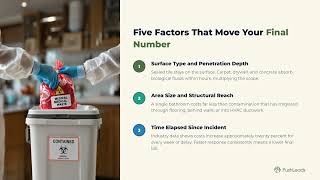

 Biohazard cleanup costs range from $1,000 for minor incidents to more than $25,000 for severe contamination, with the national average falling between $3,000 and $5,000 for most residential projects. Crime scene cleanup averages $1,000 to $5,000, unattended death remediation runs $2,000 to $7,000, and hoarding cleanup ranges from $1,000 to more than $10,000 depending on the severity and size of the property, according to industry data from the American Bio Recovery Association (ABRA, 2024).
If you’re reading this, you’re likely in one of the most difficult situations a person can face. This guide provides straightforward cost information so you can make informed decisions during an extraordinarily stressful time.
In this video
- 0:00 Biohazard Cleanup Cost Overview
- 0:38 National Price Range Explained
- 1:03 Crime Scene Cleanup Costs
- 1:59 Unattended Death Cleanup Pricing
- 2:29 Porous Surfaces Drive Up Costs
- 3:00 Who Pays Insurance Estate Funds
- 3:34 Suicide Hoarding Vehicle Scenarios
- 4:07 Why DIY Biohazard Cleanup Fails
- 4:55 Five Factors That Set Your Final Price
Full transcript: Biohazard Cleanup Cost: What You’ll Actually Pay
What Is Biohazard Cleanup?
Biohazard cleanup involves the removal, cleaning, and decontamination of biological hazards including blood, bodily fluids, human tissue, and other potentially infectious materials. It requires specialized training, equipment, and disposal procedures that standard cleaning services and general contractors don’t have.
Biohazard remediation technicians follow OSHA Bloodborne Pathogens Standard (29 CFR 1910.1030) protocols and use EPA-registered hospital-grade disinfectants. Contaminated materials are treated as regulated medical waste and disposed of through licensed medical waste haulers. According to OSHA, improper handling of biohazardous materials exposes workers and occupants to hepatitis B, hepatitis C, HIV, and other bloodborne pathogens (OSHA, 2024).
This is not work that family members, property managers, or janitorial services should attempt. Beyond the health risks, improper cleanup can leave behind invisible biological contamination that creates ongoing health hazards and potentially makes the property uninhabitable.
Biohazard Cleanup Costs by Scenario
Crime Scene Cleanup: $1,000 to $5,000
Crime scene cleanup covers the remediation of blood, bodily fluids, and fingerprint dust after law enforcement releases the scene. Costs depend on the area affected, the amount of biological material, and whether contamination has penetrated porous surfaces like carpet, padding, subfloor, drywall, or mattresses.
A minor incident contained to a small area with hard flooring may cost $1,000 to $2,000. Scenes involving extensive blood loss that has saturated carpet, soaked through padding into subfloor, and penetrated wall surfaces push costs to $3,000 to $5,000. Severe scenes involving multiple rooms may exceed $5,000.

Important: law enforcement agencies are not responsible for cleaning crime scenes. Once investigators release the scene, the property owner or family bears responsibility for cleanup and costs. This surprises many families who assume police handle remediation after completing their investigation.
Unattended Death Cleanup: $2,000 to $7,000
Unattended death cleanup is typically the most complex biohazard scenario because decomposition has had time to progress, creating extensive contamination. The longer the time between death and discovery, the greater the contamination and the higher the cost.
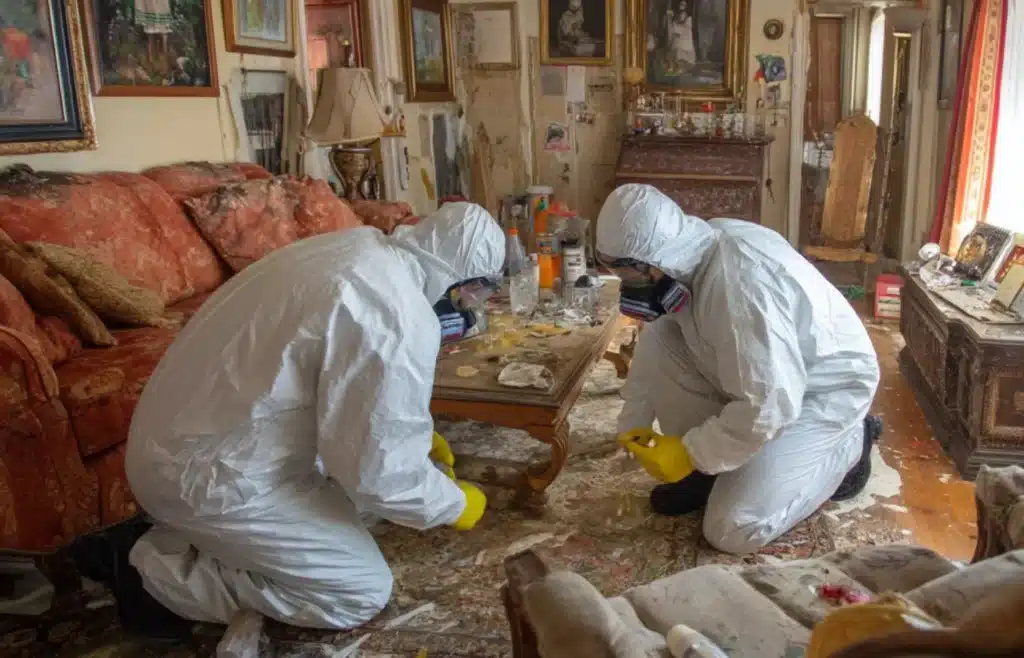
Bodies begin decomposing within hours of death. Within days, fluids seep into surrounding materials. After weeks, decomposition fluids can penetrate multiple layers of flooring, saturate subfloor and floor joists, and migrate through walls. Advanced decomposition may require removal and replacement of subfloor sections, framing treatment, and extensive odor remediation.
According to the CDC, decomposition creates biohazardous conditions including pathogenic bacteria, insects, and volatile organic compounds that pose health risks to anyone entering the space without proper protection (CDC, 2024).
Costs break down roughly as follows: early discovery (within 24 to 48 hours) typically costs $2,000 to $3,500. Moderate decomposition (several days to a week) runs $3,500 to $5,000. Advanced decomposition (weeks or longer) costs $5,000 to $7,000 or more, with some extreme cases exceeding $10,000 when structural material replacement is required.
For detailed information on financial responsibility for death cleanup, including insurance coverage and estate liability, review our dedicated guide.
Trauma and Accident Cleanup: $1,500 to $5,000
Trauma cleanup covers injuries, accidents, and medical events that produce blood or bodily fluids. This includes injuries from falls, slip-and-fall accidents in commercial properties, medical emergencies, and violent incidents. Costs parallel crime scene cleanup but typically run slightly lower because trauma scenes are usually discovered and reported immediately, limiting contamination spread.
Hoarding Cleanup: $1,000 to $25,000+
Hoarding cleanup costs vary the most widely because hoarding severity ranges from minor clutter to floor-to-ceiling accumulation in every room. The Institute for Challenging Disorganization uses a 5-level clutter scale. Levels 1 and 2 may cost $1,000 to $3,000, while levels 4 and 5 can exceed $25,000 for large homes.
Hoarding cleanup becomes a biohazard situation when the accumulation involves animal waste, human waste, spoiled food, mold growth, pest infestations, or other biological hazards. According to the International OCD Foundation, hoarding disorder affects 2.5% of the population, and demand for professional hoarding cleanup services has increased 15% over the past five years (IOCDF, 2024).
Cost drivers for hoarding cleanup include total volume of material (measured in dumpster loads, typically $500 to $1,000 per load), presence of biological hazards requiring specialized handling, structural damage from moisture, pests, or weight overload, cleaning and sanitization of surfaces after removal, and potential mold remediation if moisture damage is present.
Infectious Disease Decontamination: $2,000 to $8,000
Decontamination after infectious disease events (including drug-resistant bacterial infections in healthcare settings) requires hospital-grade disinfection protocols. Costs depend on the pathogen involved, the size of the affected area, and the level of decontamination required. Residential situations most commonly arise when a household member has been diagnosed with a highly contagious infection.
Want more customers from Google & AI search?
Get a free SEO audit of your site — see exactly what to fix first.
What Determines Biohazard Cleanup Costs
Several factors beyond the basic scenario type affect your total cost.
Area affected. A contained incident in a single bathroom costs far less than contamination spread across multiple rooms. Biohazard material that has seeped through flooring to the level below, migrated behind walls, or entered HVAC ductwork increases the scope significantly.
Material penetration depth. Blood and decomposition fluids on sealed tile stay on the surface and are relatively inexpensive to clean. The same fluids on carpet penetrate through padding into subfloor within hours, requiring removal of all three layers. Drywall acts like a sponge for biological fluids, often requiring removal 12 to 24 inches beyond the visible stain.
Time elapsed. The longer biological materials remain, the deeper they penetrate and the more extensive the remediation. Prompt response reduces costs significantly. According to restoration industry data, biohazard cleanup costs increase approximately 20% for every week of delay between the incident and professional remediation.
Structural involvement. When contamination reaches structural components (subfloor, joists, studs, concrete), those materials may require treatment or replacement. Concrete is especially challenging because it’s porous and absorbs fluids that are extremely difficult to extract. Sealant application over treated concrete is sometimes the most practical approach.
Disposal requirements. Biohazardous waste must be transported and disposed of through licensed medical waste facilities. Disposal fees vary by volume and region but typically add $200 to $1,000 to the project cost.
Does Insurance Cover Biohazard Cleanup?
Insurance coverage for biohazard cleanup depends on the specific situation and your policy.
Homeowners insurance typically covers biohazard cleanup resulting from a covered peril. Violent crimes, accidents, and unexpected deaths in the home generally fall under your standard policy. According to the Insurance Information Institute, most homeowners policies include coverage for cleanup of biological hazards without a specific exclusion (III, 2024).
Coverage specifics: Crime scene cleanup is usually covered. Unattended death cleanup is usually covered. Hoarding cleanup is often not covered because insurers consider it a maintenance and lifestyle issue rather than a sudden event.
Victims of crime compensation programs exist in every state and can cover cleanup costs for crime victims. These programs typically pay $1,000 to $25,000 for crime scene cleanup depending on the state. Contact your state’s victim assistance program for eligibility and limits.
Landlord insurance covers biohazard cleanup in rental properties. Tenants’ renters insurance may cover their personal property but typically does not cover the cleanup itself.
If you’re unsure about coverage, file the claim. The worst that happens is denial. Many families assume biohazard cleanup isn’t covered and pay out of pocket unnecessarily. Most professional biohazard companies will work directly with your insurance company on billing.

Choosing a Biohazard Cleanup Company
This is not a service where price shopping should be your primary concern. The consequences of inadequate biohazard remediation include ongoing health risks, legal liability, and property that fails environmental clearance testing.
What to Look For

Certifications. Look for technicians certified through the ABRA (American Bio Recovery Association) or IICRC. These certifications confirm training in bloodborne pathogen handling, OSHA compliance, and proper decontamination protocols.
Insurance. The company must carry general liability insurance, workers’ compensation, and pollution liability insurance. Biohazard work creates significant liability exposure, and an uninsured company puts you at financial risk.
Medical waste transport license. Every state requires specific licensing for transporting medical waste. Ask for proof. Companies that dispose of biohazardous materials through regular trash haulers are violating federal and state regulations.
24/7 availability. Biohazard situations are emergencies. Reputable companies answer calls around the clock and deploy within hours, not days. Emergency restoration response matters for both the practical need and the emotional wellbeing of affected families.
In this video
- 0:00 Biohazard Cleanup Costs Overview
- 0:46 National Average Price Ranges
- 1:50 Crime Scene Cleanup Pricing
- 2:18 Suicide Scene Cost Breakdown
- 2:52 Unattended Death and Decomposition Costs
- 3:28 Hoarding Cleanup Price Range
- 4:11 Meth Lab Decontamination Costs
- 4:51 Why DIY Biohazard Cleanup Is Illegal
- 5:32 Insurance and Reimbursement Options
- 6:04 Three Factors That Drive Final Cost
- 7:24 How to Hire a Licensed Biohazard Company
Full transcript: How Much Does Biohazard Cleanup Cost? (Full Price Breakdown)
Compassion and professionalism. The best biohazard companies train their technicians in crisis communication and trauma-informed service delivery. Families dealing with violent death, suicide, or traumatic accidents need professionals who understand the emotional dimension of the situation.
Red Flags
Companies that quote prices sight-unseen (proper biohazard scoping requires on-site assessment), lack proper insurance documentation, don’t provide written scope of work before beginning, can’t produce medical waste disposal credentials, or employ technicians without bloodborne pathogen training certifications should be avoided.
Frequently Asked Questions
Who is responsible for biohazard cleanup after a death?
The property owner or estate is typically responsible. For a homeowner death, responsibility falls to the estate or family. For rental properties, the landlord is responsible for the property cleanup. Families are responsible for their loved one’s personal belongings. Insurance coverage varies by situation. Our guide on who pays for death cleanup covers this in detail.
How long does biohazard cleanup take?
Minor incidents take 3 to 6 hours. Moderate situations (crime scenes, early-discovery unattended deaths) take 1 to 2 days. Severe cases (advanced decomposition, extensive hoarding) can take 3 to 7 days. The timeline includes cleaning, decontamination, removal of affected materials, and post-remediation verification.
Can I clean up a biohazard situation myself?
This is strongly discouraged. Bloodborne pathogens including hepatitis B, hepatitis C, and HIV can survive on surfaces for days to weeks. Exposure through skin cuts, mucous membrane contact, or accidental needle sticks creates serious infection risk. Professional biohazard companies have the training, PPE, equipment, and disposal resources to handle these situations safely.
Does biohazard cleanup include odor removal?
Yes. Professional biohazard remediation includes odor elimination as part of the standard scope. Decomposition odor is particularly persistent and penetrating. Professional odor removal technology including ozone generators and hydroxyl generators is typically required for unattended death and advanced decomposition scenarios.
Will I know if the cleanup was thorough enough?
Reputable companies use ATP (adenosine triphosphate) testing to verify surface decontamination. ATP tests measure biological contamination on surfaces and provide immediate, objective results. Some companies also offer post-remediation air quality testing. Request verification testing as part of your scope of work.
What happens to the property after biohazard cleanup?
After professional remediation and clearance testing, the property is safe for occupancy. Structural repairs (replacing removed drywall, subfloor, or flooring) may be needed. Some states require disclosure of certain events (homicide, unattended death) during future property sales. Check your state’s real estate disclosure requirements.
Getting Help When You Need It
If you’re facing a biohazard situation, call a certified biohazard cleanup company before attempting any cleanup yourself. Most companies provide 24/7 emergency response and can be on-site within hours. They’ll also help you understand insurance coverage and handle the paperwork during an incredibly difficult time.
Restoration companies offering biohazard services can reach affected families through targeted content and search visibility strategies. PushLeads helps biohazard restoration companies build the online authority that connects them with people who need their services.
Keep Reading
Want more customers from Google & AI search?
Get a free SEO audit of your site — see exactly what to fix first.
Your path · Restoration SEO
Keep going: read these next
 You’re hereBiohazard Cleanup Cost Guide: Crime Scene, Trauma, Unattended Death, and Hoarding
- Up nextCrime Scene Trauma Cleanup: Professional Biohazard Remediation Guide
- Hoarding Cleanup: Process, Costs, and Compassionate Solutions



Want this done for you?
Scan your site. See the gaps. Decide with numbers.
- Rankings, Google Business Profile and site-speed teardown
- Report lands in your inbox in about a minute
- No obligation · 4.9 from 67 Google reviews
 Continue reading
