TL;DR: Water damage restoration marketing requires running five channels at once: organic SEO, Google Local Service Ads, pay-per-click, Google Business Profile, and insurance referral networks. No single channel should exceed 40-50% of your booked jobs. Speed of response and operational readiness matter as much as ad spend because homeowners call whoever answers first.
✓Is Your Water Damage Marketing Ready to Win Jobs?8 quick questions · about 1 minuteStart
Full transcript
Section 1
Most restoration companies are paying somewhere between $40 and $300 per lead depending on the channel, but the number that actually matters is cost per booked job, not cost per click.
Section 2
That gap is enormous, and most owners never see it because the invoices don't show it.
Section 3
So today I'm going to walk you through the three main digital channels restoration companies use, show you what each one actually costs on a per booked job basis,
Section 4
walk through the math on a realistic example and tell you where the hidden
Section 5
money drains are let's get into it if you're running digital marketing for a
Section 6
restoration company right now you're probably touching at least one of these
Section 7
three channels number one organic SEO meaning your website showing up in the
Section 8
regular Google results number two local services ads which Google calls LSA the
Section 9
paper lead product that shows up at the very top with a green checkmark number
Section 10
Number three, shared-led platforms, things like Thumbtack, Angie, or similar services where multiple contractors get the same lead at the same time.
Section 11
Each one has a completely different cost structure, a completely different close rate, and a completely different path to a booked job.
Section 12
If you're comparing them on cost per click or even cost per lead without accounting for close rate, you're comparing apples to radiators.
Section 13
The search data I look at regularly shows terms like how much does digital marketing cost and digital marketing agency pricing, pulling in meaningful traffic with position scores in the 50s, which tells me a lot of restoration owners are shopping for a number without a framework to evaluate it.
Section 14
Cost per click tells you what you paid for someone to visit your website.
Section 15
It does not tell you whether that person called, whether someone answered, whether they were in your service area, or whether they booked.
Section 16
a channel with a low cost per click and a terrible close rate is more expensive
Section 17
in real terms than a channel with a higher cost per click and a strong close
Section 18
rate the only number worth tracking is cost per booked job and to get there you
Section 19
need to know three things for each channel what you paid to get the lead
Section 20
how many of those leads turned into calls and how many of those calls turned
Section 21
into booked jobs organic SEO has a high entry cost and a low long run cost per
Section 22
per lead. Here's what I mean. You're typically paying a monthly retainer for SEO work. In my
Section 23
experience, serious SEO for a restoration company in a mid-sized market runs somewhere in the range
Section 24
of $1,500 to $4,000 a month, depending on competition, how much ground you need to make up,
Section 25
and what the agency is actually doing. In the first six to 12 months, your cost per lead from
Section 26
SEO looks terrible because you're paying the retainer and the leads are still ramping up.
Section 27
But by month 18 or 24, if the work is done right, you might be generating water damage leads for $40 to $80 each in a typical market.
Section 28
And here's the part people miss.
Section 29
Organic leads close at a fundamentally higher rate than shared leads because the person found you specifically.
Section 30
They searched water damage restoration in their city.
Section 31
They saw your listing.
Section 32
They clicked your site, and they called you.
Section 33
They are not also calling four other companies at the same moment.
Section 34
that specificity is worth real money in close rate local services ads charge you
Section 35
per lead not per click Google sets the price based on your market and your job
Section 36
category for water damage in most markets you're looking at somewhere in
Section 37
the range of 50 to 150 dollars per lead as a general ballpark though it varies a
Section 38
lot by market the quality is generally better than a shared lead platform
Section 39
because the person is still looking for you specifically not responding to a
Section 40
marketplace ad the main risk with LSA is lead credit disputes and a limited daily
Section 41
budget that can get eaten up fast if your intake process is weak which means
Section 42
slow to answer no text follow-up no after-hours coverage you will pay for
Section 43
leads you never actually book LSA has a hard limit on volume too you can't scale
Section 44
it infinitely in a small or mid-sized market because the search volume just
Section 45
isn't there. Shared lead platforms make cost per lead look cheap, but cost per booked job
Section 46
tells a very different story. You might pay $20 per lead on a shared platform. Those same leads
Section 47
can cost up to $60 each. That lead was also sold to three other companies at once. It may have gone
Section 48
to four or even five competitors simultaneously. The homeowner's phone is ringing from every
Section 49
direction at once, the first company to call usually wins that job. If you wait longer than
Section 50
two minutes, your close rate drops significantly. Even with perfect speed, shared leads close far
Section 51
less often than organic ones. Organic leads come from homeowners who specifically chose you already.
Section 52
A reasonable close rate on shared leads is 15%. It might reach 20% under good conditions. Say you
Section 53
you paid $40 per lead and close one in five. Your cost per booked job becomes $200 minimum.
Section 54
That figure ignores leads where someone else booked first. Those lost leads still cost you
Section 55
real money every time. Picture a restoration company doing 30 leads a month across two
Section 56
channels. 15 of those leads come from a shared platform at $40 each. That's $600 in lead spend.
Section 57
If they close 20%, they book three jobs.
Section 58
Cost per booked job, $200.
Section 59
The other 15 come from their own organic SEO.
Section 60
The SEO retainer is $2,000 a month.
Section 61
At 15 leads, the cost per lead is $133.
Section 62
But their close rate is 45% because these leads are exclusive.
Section 63
And the person sought them out, they book roughly seven jobs.
Section 64
Cost per booked job, $286.
Section 65
dollars. Wait, that looks like SEO is more expensive per booked job. Why would you do it?
Section 66
Because those numbers shift over time. At month 24, the same $2,000 retainer might be generating
Section 67
45 leads a month instead of 15. Now, cost per lead drops to $44, and at a 45% close rate,
Section 68
cost per booked job is under $100. The shared platform stays flat. You pay the same rate per
Section 69
her lead forever. SEO builds an asset, shared leads rent someone else's audience. There is a
Section 70
meaningful change happening in how Google surfaces information, and restoration companies that move
Section 71
now are going to be in a much better position than the ones who wait. Google's AI-generated
Section 72
answers, what a lot of people are calling AIO or AI overviews, are pulling information directly
Section 73
from websites and summarizing it in search results. This is both a threat and an opportunity.
Section 74
The threat, clicks to individual websites can drop if Google is answering the question before anyone clicks.
Section 75
The opportunity, restoration is an emergency service.
Section 76
Someone with active water damage in their home is not reading a summary.
Section 77
They are clicking, calling, or hitting the map pack immediately.
Section 78
The companies that own the top organic positions for water damage terms in their market are still getting those calls.
Section 79
And if your content is the source Google is pulling from for those AI answers, your brand is appearing even on searches that don't result in a click.
Section 80
That brand exposure builds trust at a scale that a $40 shared lead will never build for you.
Section 81
Mistake number one, counting a lead before it's answered.
Section 82
If your phones aren't answered after hours or on weekends and you're in water damage, you are buying leads you cannot close.
Section 83
That's not a marketing problem. That's an operations problem that shows up in your marketing numbers.
Section 84
mistake number two measuring cost per lead instead of cost per booked job your
Section 85
CRM or even a simple spreadsheet should be telling you for every dollar spent on
Section 86
each channel how many booked jobs came back if you can't answer that you don't
Section 87
actually know what your marketing is costing you mistake number three
Section 88
canceling SEO before it matures SEO has a long ramp canceling a campaign at
Section 89
month four because it hasn't produced a positive return is like planting a tree
Section 90
watering it for a month and pulling it up the compounding is in months 12
Section 91
through 36 mistake number four ignoring speed to lead on shared platforms if
Section 92
you're going to pay for shared leads you have to win the speed race every minute
Section 93
past the first two is costing you close rate you don't need a complicated setup
Section 94
to track this properly at minimum you want a unique phone number on each
Section 95
channel so calls are attributed correctly a simple log of where each
Section 96
booked job came from and a monthly tally of spend versus booked jobs per channel if you have a crm
Section 97
that's better tag every lead at intake with the source call tracking tools can do most of this
Section 98
automatically the point is that if you don't have source level data on booked jobs you're
Section 99
optimizing based on feelings not numbers and in a market where water damage leads can run from 40
Section 100
to $150 depending on the channel. That's an expensive way to run a business.
Section 101
There's no universal answer, but here's a reasonable framework. If you're new and need
Section 102
leads immediately, LSA is your fastest entry point for legitimate, exclusive-ish leads at
Section 103
a manageable cost. Shared platforms can supplement volume, but watch your close rate closely. If
Section 104
you're established and want to build long-run margin, SEO is where the real cost per booked
Section 105
job advantage comes from over a two to three year horizon if you have both
Section 106
working the goal is to gradually shift budget toward the channels with the
Section 107
lowest cost per booked job not the lowest cost per lead the data I see on
Section 108
searches like restoration digital marketing and water damage restoration
Section 109
business marketing tells me there's a lot of competition hunting for the same
Section 110
information you are right now the company's building their organic
Section 111
presence now are getting ahead of that competition if you want to know what
Section 112
your market actually looks like specifically which water damage terms have real search volume in your
Section 113
city and where you currently stand the best next step is a visibility audit we do these at no cost
Section 114
for restoration companies you can request one at seo.pushleads.com slash audit or call us directly
Section 115
at 828-348-7686 no pitch you'll get actual data on where your site stands what your competitors
Section 116
are doing and what the opportunity looks like in your specific market that's the
Section 117
number that should drive every marketing decision you make
Full transcript
Section 1
You build a year-round pipeline that pulls calls even when the weather is calm, and that means
Section 2
owning the searches that people make every day, not just after the disaster. Hi, I'm Jeremy Ashburn
Section 3
with PushLeads, and we work with restoration companies on search visibility, showing up in
Section 4
AI search, being found by chatbots, and in this video, I'm going to walk you through the exact
Section 5
model that keeps your phones ringing in July just as much as in October. We're going to cover
Section 6
real numbers the most common mistakes that owners make and a work example so you can see how the
Section 7
math plays out for a shop during a steady volume of inbound calls every month so stick with me
Section 8
through the whole thing because the cta at the end is something i normally don't give away for free
Section 9
why storm chasing alone stalls growth post restoration owners i talked to build their
Section 10
first revenue on storm response. This makes complete sense. A hailstorm drops, phones go
Section 11
crazy, and the crews stay busy for months. But here's the problem. Storm chasing is essentially
Section 12
a feast or famine model. You're at the mercy of weather events, insurance cycles, and the
Section 13
competition from a hundred other companies who showed up in the same zip code the same week.
Section 14
The owners who scale past that pattern aren't necessarily working harder.
Section 15
They're pulling from a different source of demand.
Section 16
They're capturing the everyday, year-round calls that exist in every market regardless of weather.
Section 17
Water heater bursts on a Tuesday, sewage backup under a kitchen in March, and mold discovered during a home sale in August.
Section 18
And those calls happen every day.
Section 19
The question is whether your company shows up when someone else's search is for help.
Section 20
the search data that proves the demand is there. Let me give you some real numbers from the search
Section 21
query data I pulled for this specific topic. The phrase water damage restoration cost gets 680
Section 22
impressions in our track data set. The average position is 20.1. That means it's ranking but
Section 23
not near the top page two or a low page one where no one else clicks. How to market a restoration
Section 24
company gets 466 impressions and that's position 35.9 it's not even on the radar for most searches
Section 25
in the search disaster restoration marketing gets 344 impressions at position 47 and that's
Section 26
essentially invisible and these numbers tell me two things one the demand is real and consistent
Section 27
people are searching for restoration help and for restoration marketing help every single month
Section 28
Two, most of the market isn't raking well, and that's an open lane.
Section 29
So if Google's AI is already citing someone else in your market for these questions, that's a gap you need to close.
Section 30
What a year-round pipeline actually looks like.
Section 31
Picture a funnel with three layers.
Section 32
Layer one is awareness and education.
Section 33
This is content that answers the question that people ask before they even have an emergency.
Section 34
Things like, how much does water damage restoration cost?
Section 35
cons? Or what do I do after a pipe burst? Layer two is intent and consideration. These are the
Section 36
people that are actively searching for a company. Searches like water damage restoration near me
Section 37
or restoration company in Asheville. This is where local SEO and Google business profile do the heavy
Section 38
lifting. Layer three is the conversion, the call, the form, the book job. This is where your speed
Section 39
to answer, your online reviews, and your site's most trusted signals either close the deal or
Section 40
send the person to your competitor. Most restoration companies only invest in layer three.
Section 41
They run a little pay-per-click, maybe have a five-page website, and hope the phone rings.
Section 42
The companies that grow year-round invest in all three layers simultaneously.
Section 43
The role of SEO in restoration marketing. The search Restoration SEO pulls 408 impressions
Section 44
in our data at position 16.2, and then the search restoration company SEO lead generation
Section 45
pulls 362 at position 19.1. These are people actively looking for what we do, but more
Section 46
importantly, they reflect what your potential customers are also searching. SEO for a restoration
Section 47
company isn't complicated in concept, but it does require consistency. You need pages targeting the
Section 48
specific searches that you offer in the specific cities you serve. Water damage restoration is not
Section 49
the same page as fire damage restoration. Mold remediation is not the same page as storm damage
Section 50
cleanup. Each service, each city gets its own focus page. That's how you compete for the everyday
Section 51
searches, not just the storm, season, spike. The search fire damage restoration SEO shows up in
Section 52
In our data, at 179 impressions at position 22.3, water damage marketing is at 156 at position 21.6.
Section 53
And these aren't huge numbers individually, but stack 10 or 15 of those pages together, each ranking on page one, and you're generating consistent inbound volume every month of the year.
Section 54
The referral network most companies ignore.
Section 55
nor. SEO and paid ads get the most of our attention, but there's a channel that restoration
Section 56
companies routinely leave on the table, professional referral networks. Plumbers see water damage on
Section 57
every job. HVAC techs find mold behind walls. Real estate agents need remediation vendors
Section 58
before closings go sideways. Public adjusters are literally paid to help homeowners navigate
Section 59
insurance claims. Building a structured referral program with these professionals is not glamorous,
Section 60
but it's one of the most cost-effective pipelines you can build. You're not paying per click. You're
Section 61
paying in relationship building time and maybe referral acknowledgement structure that keeps
Section 62
you on top of mind. In my experience, one solid relationship with a busy plumber or a public
Section 63
adjuster network can generate 10 to 20 qualified calls a year do that with 10 different referral
Section 64
partners and you've got meaningful volume without even touching your ad budget how pay-per-click
Section 65
fits in pay-per-click for restoration companies shows up at 479 impressions across two related
Section 66
searches in our data ppc for restoration companies at 150 and restoration ppc at 145. ppc works and
Section 67
restoration, the intent is high, and someone searching for emergency water damage restoration
Section 68
at 11 o'clock at night is not Windows shopping. But PPC alone has a ceiling. When you stop paying,
Section 69
the calls stop. It also doesn't build any lasting equity in your market. The model that works best
Section 70
in my experience is PPC for immediate volume while SEO builds the foundation underneath it.
Section 71
Use paid ads to fill the calendar now.
Section 72
Use organic search to reduce your cost per lead over the next 6 to 18 months.
Section 73
Retargeting for restoration companies shows up 142 impressions at position 22.3 in our data.
Section 74
Retargeting is underused in industry.
Section 75
So if someone visits your water damage page and doesn't call, a retargeting campaign helps your brand stay in front of them as they browse other sites.
Section 76
For a service with high stakes and emotional urgency, that reminder can close jobs that you'd otherwise lose.
Section 77
Insurance restoration leads shows 149 impressions at position 22.6 in our data, and that's a specific buyer signal.
Section 78
People searching for this phrase are often looking for a company that can handle the full insurance restoration workflow, not just the mitigation piece.
Section 79
If your company does work directly with carriers or you have experience guiding homeowners through the claims process, that is a differentiator worth marketing explicitly.
Section 80
Create content around it.
Section 81
Build a page around insurance restoration or working with insurance on water damage.
Section 82
Show homeowners that you've done this before and that you can document properly for the adjuster that you'll handle the headaches they're dreading.
Section 83
That positioning separates you from the company that just shows up with a dehumidifier.
Section 84
The work example, how the math works.
Section 85
Here's how the math works for a shop doing 200 inbound calls a month with a mix of paid and organic searches.
Section 86
Let's say right now that 80% of those calls come from paid ads at an industry ballpark cost of around $250 per lead.
Section 87
That's $40,000 a month in ad spend for 186 paid leads.
Section 88
The other 40 calls come from word of mouth and whatever organic rankings exist.
Section 89
Your effective cost per lead on these is near zero.
Section 90
Now imagine over 18 months of consistent SEO, that ratio flips to 50-50.
Section 91
100 leads come from organic, 100 from paid.
Section 92
You're now spending $25,000 a month on paid instead of $40,000 and generating the same 200 calls.
Section 93
That's $15,000 a month back in your margin.
Section 94
Not because you worked harder, but because Organic Surge is doing the work for you around the clock.
Section 95
And that's just a ballpark illustration, not a guarantee.
Section 96
Your actual numbers will depend on your market, your close rate, and your average job value.
Section 97
But the direction of the math is always the same.
Section 98
Organic reduces your dependency on paid spend over time.
Section 99
Common mistakes restoration companies make.
Section 100
Let me run through the common ones I see most often.
Section 101
One, one-page or five-page websites trying to rank for 25 different services in 10 different cities.
Section 102
That spreads your authority too thin.
Section 103
Two, ignoring your Google Business Profile.
Section 104
For a local search, this is often more important than your actual website.
Section 105
Your Google Business Profile needs photos, weekly updates, review responses, and accurate service areas.
Section 106
areas three no review strategy and restoration specifically social proof is everything if your
Section 107
competitor has 400 reviews and you have 30 you're losing jobs before the first conversation four
Section 108
writing content for search engines instead of for anxious homeowners the person who just had a pipe
Section 109
burst is scared and overwhelmed write to that person and answer their real question five quitting
Section 110
Quitting SEO after 90 days Search visibility compounds over time.
Section 111
Most restoration companies see meaningful traction at the 6-12 month mark.
Section 112
The ones who quit after 90 days never find out what they left on the table.
Section 113
What to prioritize first?
Section 114
If you're starting from close to zero on the digital side, here's the order I would
Section 115
use.
Section 116
First, get your Google business profile fully built out and optimized.
Section 117
This is free and produces your local results first.
Section 118
First, second, build your core service pages on your website.
Section 119
One page per major service and one page per city you serve.
Section 120
Third, start a review generation process.
Section 121
Add to every job, ask for the review, make it easy with a direct link.
Section 122
Target 50 reviews as your first milestone.
Section 123
Fourth, build or improve your PPC campaigns if you need volume now while SEO develops.
Section 124
Fifth, add content that answers questions people ask before they need you.
Section 125
you. Cost pages, process pages, and what to expect pages. Sixth, build your referral network
Section 126
relationships in parallel with all the above. And none of this happens overnight, but none of it is
Section 127
mysterious either. It's a consistent system applied over time. What makes this approach
Section 128
different? Most marketing vendors sell restoration companies one piece of the puzzle. Here's a PPC
Section 129
campaign. Here's a website. Here's a directory listing. What actually grows a restoration
Section 130
business beyond storm season is treating all of those as one integrated system seo feeds organic
Section 131
calls paid ads fill gaps in the calendar retargeting captures people who didn't call
Section 132
referral partners send pre-qualified jobs reviews and content build trust before the first phone
Section 133
call when those channels work together you stop being a company that chases storms and start being
Section 134
the company in your market that people think of first year round. What to do next? I want to give
Section 135
you something concrete. If you want to know exactly where your online visibility stands right now,
Section 136
where the gaps are in your local search presence, and what would move the needle fastest in your
Section 137
market, you can get a free visibility teardown from our team. Just go to seo.pushleads.com
Section 138
backslash audit or call 828-348-7686 and we'll look at your current rankings, your Google business
Section 139
business profile, your site structure, your competitor or landscape, and give you a straight
Section 140
read on where you stand and what we would do first.
Section 141
No hard sell, just real data on your actual situation.
Section 142
I'm Jeremy Ashburn with Pushleads.
Section 143
We help restoration companies get more leads with best effort.
Section 144
Thanks for watching this video.
Section 145
Now go book that audit and let's see what your market actually looks like.
Full transcript
Section 1
You can get mold remediation jobs from Google organically by ranking your Google Business
Section 2
Profile in a handful of targeted pages before a competitor pays to outbid you on the same
Section 3
search. This works because mold queries convert at higher rates than almost any other restoration
Section 4
category, and most of your local competitors haven't figured that out yet. I'm going to
Section 5
walk you through the full strategy, maps, content, the right keywords, the common mistakes,
Section 6
and a worked example so you can see exactly how the math plays out. Let's get into it.
Section 7
First, let's talk about why mold specifically. Water damage queries are huge in volume,
Section 8
but they're noisy. People search how much does water remediation cost when they're curious,
Section 9
not necessarily when their basement is flooded. Mold is different. When someone searches mold
Section 10
remediation at 11 at night, they already know they have a problem. They've probably seen it.
Section 11
they've smelled it they're scared that is a buyer not a researcher the intent behind mold searches
Section 12
is almost always action oriented the person is not comparing options for fun they want it gone
Section 13
and they want someone they can trust that's the opportunity here are three numbers that matter
Section 14
for this strategy first 155 that's the number of impressions per month for the phrase mold
Section 15
remediation seo alone in the data i'm looking at but that's a marketing keyword the actual job
Section 16
job getting keywords have much higher buyer intent. Second, 60.7. That's the position in
Section 17
the same data set for the phrase, how to start a mold remediation business. Almost no one in
Section 18
the industry is targeting that correctly, but here's the thing. Your future competitor is
Section 19
searching that. If you show up there with the right content, you become the authority they
Section 20
remember when they realize they need to hire out instead of DIY. Third, 30.7. That's the average
Section 21
position for mold remediation marketing queries position 30 means page three
Section 22
nobody sees page three these numbers tell me one thing the category is under
Section 23
optimized most mold companies are not doing real SEO they're buying leads from
Section 24
aggregators and hoping the phone rings that's your opening your Google business
Section 25
profile is the fastest organic lever you have when someone in your city searches
Section 26
mold remediation near me or mold removal company the map pack shows up before the
Section 27
organic results three listings right at the top if you're in those three you get
Section 28
the call if you're not you're invisible here's what Google uses to rank the map
Section 29
pack relevance proximity and prominence relevance means your profile says
Section 30
exactly what you do not restoration company not we handle all your indoor
Section 31
air quality needs it says mold remediation in your business description
Section 32
in your services in your posts and in your category selection proximity means
Section 33
how close you are to where the search happens you can't move your address but
Section 34
you can expand your service area and make sure your profile covers the right
Section 35
zip codes prominence means Google trusts you that comes from reviews citations
Section 36
and how your website supports the profile let me give you the exact things
Section 37
to audit on your profile primary category make sure it says water damage
Section 38
restoration service or the closest option to mold remediation available in
Section 39
your region secondary categories add any applicable category for environmental or
Section 40
remediation services services section list mold inspection mold testing mold
Section 41
removal black mold removal crawl space mold remediation attic mold remediation
Section 42
wall cavity mold removal as individual services with short descriptions
Section 43
Business description, write two to three sentences.
Section 44
Use the words mold, remediation, and your city name in the first sentence.
Section 45
Photos, upload real job photos before and after your equipment, your crew working.
Section 46
Google rewards active profiles with fresh photo uploads.
Section 47
Posts, publish a short Google post once a week.
Section 48
Answer a question, share a tip, show a completed job.
Section 49
This signals to Google that the profile is active.
Section 50
Reviews, I'll come back to this in a minute.
Section 51
Your website has one job in this strategy.
Section 52
make Google confident enough in your business to put you in the map pack and
Section 53
rank you on page one that means your site needs to be relevant trusted and
Section 54
locally authoritative relevant means your pages specifically cover mold not a
Section 55
generic restoration page that mentions mold once a dedicated mold remediation
Section 56
service page with real information about the process the health risks what to
Section 57
expect and how you price the work trusted means your site loads fast works
Section 58
on mobile has your name address and phone number consistent with your Google
Section 59
profile and has other websites pointing to it locally authoritative means your
Section 60
content reflects your market what types of mold are common in your climate what
Section 61
does mold remediation cost in your city what building types in your area tend to
Section 62
have hidden mold problems when you answer those questions on your site you're giving google
Section 63
exactly what it needs to rank you here is where most mold companies leave serious money on the
Section 64
table they have one service page maybe two but searches in their market are far more specific
Section 65
people search for black mold removal in their area others search for mold in a crawl space
Section 66
many search for attic mold remediation costs wall cavity and hidden mold remediation is another
Section 67
common search that last one appears at an average position of 62 almost nobody
Section 68
has a page targeting that query build a clean and helpful page on hidden wall
Section 69
cavity mold you can own that search query entirely a main mold remediation
Section 70
page is your flagship content it covers your full service and your process
Section 71
include your certifications and a rough pricing range add a clear call to action
Section 72
on that page then build supporting pages for each subtype of mold cover attic
Section 73
mold crawl space mold and basement mold add pages for black mold and commercial mold remediation
Section 74
build location pages if you serve multiple cities make each location page specific to that market
Section 75
finally write a handful of educational articles these answer questions people ask before they
Section 76
ever call this is the part of the strategy most competitors skip pre-buyer content targets people
Section 77
who are in the research phase they're not ready to call yet but if you show up with a helpful
Section 78
answer you become the company they trust when they are ready good pre-buyer
Section 79
topics for mold how to tell if you have mold in your walls what does mold
Section 80
remediation actually cost is mold remediation covered by homeowners
Section 81
insurance how long does mold remediation take what to do if you find mold when
Section 82
buying a house write these as honest specific articles give real answers not
Section 83
vague non answers people can tell the difference and so can Google each
Section 84
article links back to your main service page your main service page links to
Section 85
your contact form that's the funnel reviews do two things for mold companies
Section 86
one they improve your map pack ranking Google uses review quantity recency and
Section 87
keywords and review text as signals for local relevance to they convert people
Section 88
who find you someone who searched mold remediation near me at midnight is
Section 89
scared and stressed 20 reviews saying you showed up fast explained the process
Section 90
and left the house clean is the only thing that's going to make them pick up the phone.
Section 91
Here's the mistake I see constantly. Companies get a bunch of reviews in year one,
Section 92
then stop asking. Google sees that plateau and starts favoring more active competitors.
Section 93
You need a consistent review cadence. Every completed mold job, ask for the review.
Section 94
Text works better than email. Send a direct link to your Google review page.
Section 95
Make it one tap. Aim for at least two to three new reviews per month minimum.
Section 96
them. Let me give you the hierarchy for how to target keywords across your site. Home page,
Section 97
your brand name, plus your core service, plus your city. Keep it clean. Don't stuff it. Main mold
Section 98
service page, mold remediation, plus city. Mold removal, plus city. Black mold removal, plus city.
Section 99
Supporting service pages, specific types. Attic mold remediation, plus city. Crawl space mold
Section 100
mold removal plus city, commercial mold remediation plus city, educational articles,
Section 101
question-based. How much does mold remediation cost in city? Signs of mold in walls. Mold
Section 102
inspection versus mold testing. Google business profile. Mirror your main page keywords in your
Section 103
description and services. This hierarchy means you're not competing with yourself. Each page
Section 104
has a clear purpose and a clear keyword target. Picture a mold remediation company doing around
Section 105
30 calls a month 10 of those are coming from organic 10 from referrals and 10
Section 106
from purchase leads costing around $60 each that's $600 a month in lead cost on
Section 107
just the purchase portion now they run this strategy for six months they build
Section 108
out the content pages optimize the profile work the reviews organic calls
Section 109
go from 10 to 25 in a typical case that kind of shift can cut the purchase lead
Section 110
dependency by half or more instead of buying 10 leads at $60 they're buying
Section 111
five three hundred dollars saved per month and the organic calls keep coming
Section 112
without an ongoing cost per call that's the compounding part of SEO you build it
Section 113
once and it keeps working leads you pay for stop the moment you stop paying let
Section 114
me be direct about what kills the strategy mistake one duplicate content
Section 115
on location pages if you serve five cities and your five location pages say
Section 116
the same thing with just the city name swapped Google sees thin content and
Section 117
and ignores those pages.
Section 118
Each location page needs locally specific information.
Section 119
Mistake two, ignoring your Google business profile
Section 120
after setup.
Section 121
A profile you set up two years ago and haven't touched
Section 122
is losing ground to a competitor who posted last Tuesday.
Section 123
Mistake three, no internal linking.
Section 124
Your educational articles need to link to your service pages.
Section 125
Your service pages need to link to your contact page.
Section 126
If visitors have to hunt for how to reach you,
Section 127
you're losing jobs.
Section 128
Mistake 4. Inconsistent name, address, and phone across the web. If your phone number on Yelp is different from your Google profile, that inconsistency confuses Google's local algorithm. Audit your citations and make them match.
Section 129
Mistake 5. No patience. Organic SEO takes time. Map pack improvements can show in 60-90 days if you're consistent. Full page 1 rankings for competitive terms can take 6 months or more.
Section 130
if you expect leads in week two this strategy will disappoint you if you're
Section 131
starting from zero here's the order week one audit and fix your Google business
Section 132
profile fill every field add photos add services fix your description week to
Section 133
fix your existing mold service page make it specific make it local make it
Section 134
complete week three build your review request process get a direct link set up
Section 135
start sending it after every job. Week four, write your first two educational articles. Answer the
Section 136
two questions you get asked most often. Month two and three, build out supporting service pages and
Section 137
location pages. Month three and beyond, keep posting to your Google profile weekly. Keep
Section 138
adding reviews. Keep adding content. That's it. No tricks, no shortcuts, just consistent work in
Section 139
the right order. If you want to see exactly where you stand right now, we do a free visibility
Section 140
We look at your Google business profile, your rankings, your content gaps, and we tell you what's costing you calls. You can request that at seo.pushleads.com slash audit or call us at 828-348-7686. No pitch on the first call, just numbers.
By Jeremy Ashburn, founder of PushLeads, an Asheville, NC SEO and digital marketing agency for contractors and home-service businesses.
Table of Contents
Part of our Water Damage Restoration SEO: Rank First, Get the Call. Want it done for you? See our restoration SEO and marketing agency.
- What Does Water Restoration Marketing Actually Involve?
- Water Damage Marketing: Why This Niche Is Different From Other Trades
- How to Market a Restoration Company With Organic SEO
- How to Market Your Restoration Business: The Five-Channel Lead Mix
- Water Mitigation Marketing: Google Local Service Ads Setup and Management
- Quick Recap
- Frequently Asked Questions

What Does Water Restoration Marketing Actually Involve?
Water restoration marketing combines Google Business Profile optimization, local SEO, Google Local Service Ads, pay-per-click campaigns, and referral networks running at the same time. No single channel should exceed 40 to 50 percent of your booked jobs. A visible phone number, 24/7 availability messaging, and a five-minute callback standard are the operational basics that determine whether a lead becomes a booked job rather than a call that goes to a competitor.
Restoration leads arrive through two separate audiences: the distressed homeowner who calls first and the insurance adjuster who approves the scope and cost. Your marketing has to work for both. The Insurance Information Institute reports that water damage and freezing accounts for roughly 24% of all homeowners insurance claims and averages $12,514 per claim (2024). That average claim value is why restoration marketing budgets that look large in comparison to other trades are almost always justified by a single booked job.
Mold growth can begin within 24 to 48 hours of water intrusion, according to the IICRC. Homeowners in active water emergencies call whoever answers first. Your marketing infrastructure has to put your company in front of that search and your operations have to support an immediate response. Those two requirements together define what restoration marketing actually is.
Want more customers from Google & AI search?
Get a free SEO audit of your site — see exactly what to fix first.
Water Damage Marketing: Why This Niche Is Different From Other Trades
Water damage restoration marketing is fundamentally different from HVAC, plumbing, or general contracting marketing because the sales cycle involves insurance, the average ticket is 5 to 10 times higher than a typical service call, and speed-to-response is a direct competitive advantage rather than a courtesy.
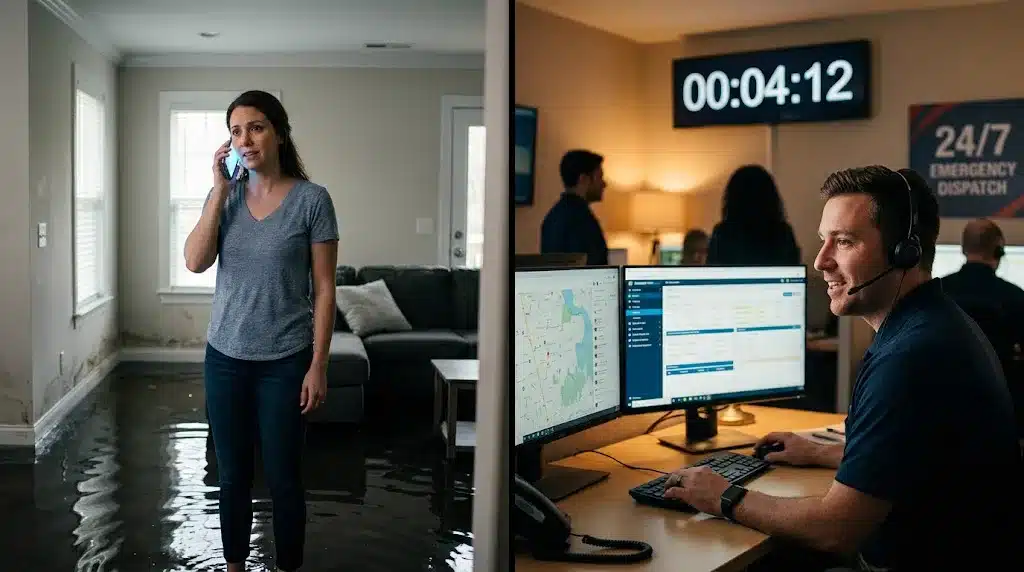
One water damage job can be worth $3,000 to $12,000 in mitigation revenue alone, before reconstruction. A $300 lead attached to a $12,000 job is inexpensive. A $50 lead that never converts because no one answered the phone is waste. That math changes how you should think about every line in your marketing budget.
Three factors make restoration marketing structurally different:
- Insurance-driven decisions. Most large jobs run through a homeowners insurance claim. Your marketing must reach both the homeowner who calls and the adjuster who ultimately approves the scope of work.
- B2B referral value. For established restoration companies, a significant share of revenue comes from insurance agents, property managers, and plumbers. These relationships require a completely different approach than consumer-facing digital campaigns.
- Emergency response as a marketing variable. Secondary damage from delayed response, including mold growth and structural deterioration, often doubles total job cost. Your ability to respond in under five minutes is part of your value proposition, and your marketing should say so explicitly.
Restoration companies with 40 or more water damage scenario pages on their website receive 3 to 4 times more organic traffic than those with fewer than 10, according to Ahrefs. Building content depth around every damage scenario your crews handle is not optional if you want sustainable organic lead volume.
How to Market a Restoration Company With Organic SEO
Organic SEO is the highest-ROI long-term channel for restoration companies because a page that ranks for "emergency water damage restoration" in your market generates calls every month without additional media spend. Building that ranking takes 6 to 12 months of consistent work on the right content architecture.
The SEO structure that produces results for water damage content strategy follows a hub-and-spoke model:
In this video
- 0:00 Water Damage SEO Why It Is Different
- 1:11 Cost Gap Making Organic SEO Mandatory
- 1:53 Emergency Intent Rewrites Your Site Structure
- 2:56 Technical Fixes That Move Rankings Fastest
- 3:30 Organic vs Paid Budget Decision
- 4:06 Three-Track Restoration SEO Strategy
- 5:31 Case Studies and Franchise Competitive Gap
- 6:50 GEO and AEO for Restoration Companies
- 8:43 Keyword Buckets and Landing Page Structure
- 10:10 Google Business Profile Priority Optimization
- 10:49 Timeline Expectations and Agency Vetting
- 12:19 Where to Get Your Free SEO Audit
Show transcript
If you already run a restoration company and you already know SEO matters, this is not the basics video. In this video we are going deep on the tactics that actually separate the companies ranking first for emergency water damage searches from everyone else sitting on page two paying $35 a click.
Water damage restoration commands over 49,500 monthly searches. That is the highest volume category in the entire restoration SEO space, and the stakes are real.
I'm Jeremy with PushLeads. My entire focus is making the phone ring for restoration company owners. Two decades of search work taught me what actually moves rankings and what is just noise. Today we are covering water damage restoration SEO.
Here is what makes water damage fundamentally different from every other home service vertical. The customer is not browsing. They are standing in ankle-deep water at two in the morning with a phone in their hand. You have roughly 30 seconds to appear in results, earn trust, and get the call. There is no research window. There is no comparison shopping cycle. The first credible result that loads fast gets the job. Every optimization decision you make flows from that single fact.
The cost gap makes organic SEO mandatory, not optional. Pay-per-click costs for water damage keywords run between $31 and $39 per click. National franchises like ServPro and BellFor bid aggressively because water damage jobs average $3,500 to $7,500. You cannot outspend them on paid, but you can absolutely out-local them on organic search. That is exactly where independent companies win. Ranking organically cuts your customer acquisition costs by 50% or more while capturing the same emergency callers.
Emergency intent rewrites how you structure your entire site. 76% of local mobile searchers visit a business within 24 hours of searching. For water damage, that window shrinks to minutes. Your phone number must be visible before anything else on mobile. Generic pages that lump all restoration services together do not rank as well and do not convert as consistently. Structured data using LocalBusiness and emergency service schema types from schema.org are not optional extras. They are the foundation of any program that produces measurable results.
Mobile speed is not a detail. It is the entire strategy. Google research shows 53% of mobile users abandon sites that take longer than three seconds to load. For emergency water damage searches that figure is higher because urgency removes patience entirely. Your Core Web Vitals target is Largest Contentful Paint under 2.5 seconds on mobile. If your site loads in five seconds and a competitor loads in two seconds, you lose both the ranking and the call. Google rewards the faster page, the homeowner calls the faster page — those are the same outcome.
The technical fixes that move rankings fastest are not mysterious. Compress images below 100 kilobytes where possible. Unoptimized images are the single largest cause of slow load times on restoration sites. Deploy a content delivery network to eliminate geographic latency across your service area. Minimize render-blocking JavaScript and CSS so the browser paints your phone number before scripts finish loading. Restoration companies that invest in this work see measurable ranking improvements within weeks, not months.
Let us look at the exact numbers for organic versus paid so you can make a real budget decision. Organic SEO costs zero per click after ranking. PPC costs $31 to $39 per click and stops the moment your budget ends. Organic takes 60 to 90 days to produce meaningful traffic. PPC produces visibility in days. The practical strategy is running both channels together during the ramp-up period, then reducing paid spend at the 90-day mark on any keywords your organic listing already wins. That is where your margins improve.
The restoration SEO strategy that works best runs three parallel tracks simultaneously.
First, fix the technical foundation — speed, mobile experience, structured data, and Google Business Profile — before any content work starts.
Second, build genuine hyper-local authority through neighborhood-specific pages, local case studies, and community involvement that no franchise running templated corporate content can replicate.
Third, create emergency intent content that answers the exact questions homeowners ask during and after water damage events. Add internal linking in a hub-and-spoke model and video of your emergency response team, and you build the kind of topical authority that pushes your entire domain up, not just individual pages.
The keyword position data from live queries tells you exactly where the gaps are. The query "water restoration keywords" sits at an average impression position of 27, meaning ranking for keyword research content itself attracts restoration company owners just starting to build their programs. "Building restoration keywords" sits at position 82, which signals that broader restoration categories remain underdeveloped across most markets. "Water damage restoration landing page" sits at position 23. These are not abstract opportunities. These are real searches with real buyer intent behind them right now.
See also our guide on Commercial content pack out services.
Case studies are among the most powerful content assets you can build. A detailed write-up of a specific job in a specific neighborhood, with before-and-after photos and a timeline of the restoration process, builds trust and ranks for hyper-local searches at the same time. A franchise location running identical corporate content across hundreds of locations simply cannot compete with that.
Case studies also serve a second function. AI-powered answer engines like Google AI Overviews and Perplexity pull from content that is factually specific. Real case studies with precise details are exactly what those systems cite.
Now look at where the real competitive advantages lie between independent companies and national franchises. Franchises have brand authority, national PPC budgets, established domain age, and corporate backlink profiles. Those are real advantages. But independent companies have genuine neighborhood-level content, real local photos, authentic community relationships, and hyper-local keywords that franchises never invest resources to target. BrightLocal research confirms that proximity and local relevance are among the top factors homeowners use when choosing an emergency service from a map pack result. That is your opening.
The query position data for adjacent service categories shows exactly where the opportunity sits. Fire damage restoration SEO sits at an average position of 18.8. Storm restoration SEO sits at 16.5. LLM optimization for restoration sits at 14.2. Generative engine optimization for restoration sits at 22. SEO for restoration company sits at 21. Each of these represents an active buyer researching how to compete, or a service type that needs its own dedicated page separate from your general water damage content.
GEO — generative engine optimization — and AEO — answer engine optimization — are not future trends. Restoration company owners are already searching for agencies that handle this. The query "water damage restoration AEO agency" appears in live search data at position 14.2. What GEO requires is structuring your content so AI-powered answer engines cite your business when a homeowner asks which restoration company to call. That means FAQ content with schema.org FAQPage markup, HowTo markup where applicable, and content that answers specific questions with precise factual language — not hedged marketing copy.
Storm and fire damage categories carry their own seasonal keyword windows worth capturing separately. Fire damage jobs average higher revenue than water damage jobs, making each organically captured fire damage lead worth more per click than any paid alternative. Build dedicated pages targeting smoke odor removal, structural assessment, and board-up services. For storm restoration, build your dedicated page before hurricane or tornado season begins. Companies that rank before the volume spike pick up jobs that competitors who built pages after the storm simply cannot claim.
Keyword strategy divides cleanly into three buckets, and each bucket needs its own optimized page.
Emergency action terms — "burst pipe water damage help," "water damage cleanup tonight" — signal someone with water actively entering their home right now.
Response capability terms — "24-hour water damage restoration," "same-day water extraction" — signal a homeowner who has stabilized the situation but needs help fast.
Process and cost terms — "how much does water damage restoration cost," "water damage restoration insurance claim" — serve the research phase in the days after the event.
Mixing all three on one page dilutes your ranking signal for each.
A high-converting water damage landing page follows a precise structure. Phone number visible before any scroll on mobile — no hero image that pushes it below the fold. Response time and service area stated in the headline itself. A single call to action, not multiple competing options. Trust signals with specificity: years in business, number of jobs completed, customer quotes that include the customer's first name and their neighborhood. And the page must load under two seconds on a 4G mobile connection. Test with real device throttling, not just a desktop Lighthouse score. A page that ranks organically and also serves as your PPC landing destination effectively doubles its return.
Your Google Business Profile may be the single highest-priority optimization task in your entire program for emergency water damage searches. The local map pack appears above organic results. Many homeowners call directly from the map pack result without ever visiting your website. That means a fully optimized GBP — accurate service categories, complete business hours including 24-hour emergency availability, recent photos, and a consistent flow of genuine customer reviews with neighborhood mentions — gives you a measurable advantage before a homeowner ever sees your website.
Set realistic timeline expectations so you allocate budget correctly. Priority local and hyper-local emergency keywords show meaningful movement within 60 to 90 days when starting from a solid foundation. A metro-level query like "emergency water damage restoration" in a competitive market typically requires four to six months of consistent work. The timeline depends on your current site authority, how competitive your market is, and how aggressively national franchises are investing in your geography. Combining Google Business Profile optimization with on-page and content work produces faster results than any single-channel approach.
Related: Soot removal.
When you evaluate a restoration SEO agency, four questions filter out generalists immediately.
First, demand before-and-after ranking data for actual water damage or restoration clients in competitive markets — not testimonials, actual position history with timestamps.
Second, ask whether they build a location page for each neighborhood you serve or one generic service page for your entire market.
Third, confirm that Google Business Profile optimization and review generation are included in the engagement, not sold as add-ons.
Fourth, ask how they coordinate SEO and PPC. Separate agencies managing each channel often bid on keywords the organic strategy already wins, driving your acquisition costs up unnecessarily.
Every month your company sits at position 17 instead of position one for a $5,000 average water damage job is revenue your competitor books instead of you. PushLeads builds fast, locally authoritative restoration websites that rank for emergency searches and convert visitors into calls without paying $35 per click for every lead. See exactly where your visibility stands today with a free teardown at seo.pushleads.com/audit or call 828-348-7686.
- A primary water damage hub page that covers your full mitigation process, costs, insurance claim assistance, and service area in depth. Comprehensive hub pages on high-value service topics outperform thin overview pages for competitive restoration keywords, according to Moz's 2024 local content analysis.
- Scenario-specific supporting pages targeting the most common water damage sources homeowners search: burst pipe damage, dishwasher overflow, roof leak intrusion, basement flooding, sewage backup, and water heater failure. Each page targets a specific search intent and builds your topical authority collectively.
- Cost guide pages. Searches for water damage restoration cost are high-intent and convert well. Transparent, locally relevant cost content ranks and attracts homeowners who are deciding whether to file a claim or pay out of pocket.
- Local area pages for each city and county you serve. Location-specific pages with embedded reviews and service references outperform a single "we serve all of [Metro]" paragraph for every location outside your primary city.
The most effective SEO programs for restoration companies publish 20 to 40 supporting inner pages per month while maintaining and updating the primary hub. That pace builds topical authority faster than competitors who publish one or two posts per month.
For the full framework, see our guide to restoration company SEO. You'll also want specific strategies for water damage content strategy, marketing reconstruction services, and the 2026 lead generation playbook for water damage restoration.
How to Market Your Restoration Business: The Five-Channel Lead Mix
Damage restoration marketing that produces stable, year-round lead volume runs five channels simultaneously rather than relying on any single source. No single channel should exceed 40 to 50 percent of booked jobs. When one channel becomes seasonal, expensive, or disrupted by algorithm changes, the others keep the pipeline moving.
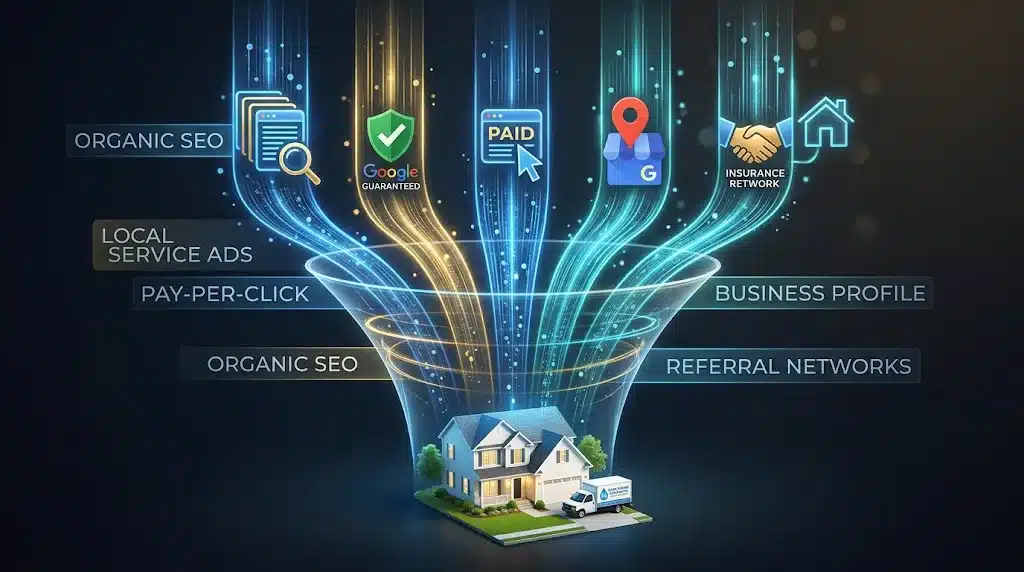
The five channels and what each one does:
- Google Local Service Ads (LSA). Appear at the top of emergency search results with the Google Guaranteed badge. Charge per lead rather than per click. Cost per lead in major metros ranges from $40 to $150 (Google LSA data, 2025). A starting budget of $2,000 to $3,000 is a reasonable entry point for most markets. Learn more about Google Local Service Ads for restoration.
- Google Business Profile. Your local pack ranking for searches like "water damage restoration near me" depends on profile completeness, review volume, and posting activity. List your primary category as "water damage restoration service" and post job photos regularly to signal active business operation.
- Organic SEO. Builds slowly but compounds. Restoration companies with deep content architecture generate calls at near-zero marginal cost after the initial investment in content and technical SEO.
- Pay-per-click search ads. Captures emergency queries immediately. Ad copy must lead with speed and availability rather than price. Bid on your own brand name to prevent competitors from capturing traffic from homeowners who already know your company. See our guide to Google Ads for restoration companies.
- Insurance and referral networks. The highest average job value of any channel. One strong adjuster relationship can introduce jobs worth $50,000 to $100,000 annually. Requires consistent relationship maintenance rather than campaign management. Details are in our insurance marketing guide for restoration companies.
Leads come fastest from LSA and PPC while organic builds over months. Running all five keeps the pipeline stable regardless of which channel is underperforming in any given month.
Water Mitigation Marketing: Google Local Service Ads Setup and Management
Google Local Service Ads charge per lead rather than per click, which makes them easier to measure and budget for than traditional paid search. The cost per lead in major metro areas ranges from $40 to $150 (2025 data). A starting monthly budget of $2,000 to $3,000 is reasonable for most markets and will generate 20 to 75 leads depending on your metro size and competition level.
To run LSA successfully for water damage restoration:

- Set up your Google Local Service profile with full business documentation (tax ID, insurance, licensing). Google screens every company manually.
- Lead quality matters more than quantity. Accept only leads that fit your service area and capabilities. Declining poor-fit leads improves your overall account performance score.
- Respond to leads within 15 minutes to maximize conversion. LSA leads go to the first three companies that respond.
- Set your primary service category as "water damage restoration service" rather than general contractor.
- Upload before-and-after photos regularly. Active accounts with job imagery consistently outperform accounts with static information.
| Channel | Cost Model | Speed to Lead | Lead Quality | Typical Monthly Budget |
|---|---|---|---|---|
| Google Local Service Ads | $40-$150 per lead | Hours to minutes | High intent, verified | $2,000-$3,000 |
| Google Ads (PPC) | $15-$50 per click | Minutes | High intent, unverified | $2,000-$5,000 |
| Organic SEO | None after initial build | Months to build | Very high intent | $1,000-$3,000 setup |
| Google Business Profile | Free | Months to build | Local search driven | $0 plus posting time |
| Insurance Referral Network | Relationship-based | Steady ongoing | Highest job value | Varies by relationship |
Google LSA works best when paired with strong customer service. A $100 lead that converts to a $12,000 job because you answered in 12 minutes instead of 20 is the best ROI in restoration marketing. LSA also tends to smooth out seasonal demand because Google distributes leads across the day and week rather than clustering all the clicks into peak hours.
You may also find this useful: Social media marketing for restoration companies.
For step-by-step LSA setup, see our detailed guide to Google Local Service Ads for restoration companies.
Quick Recap
- Run five marketing channels at once: organic SEO, Google Local Service Ads, pay-per-click, Google Business Profile, and insurance referral networks. No single channel should deliver more than 40-50% of your leads.
- Water damage jobs average $3,000 to $12,000 in mitigation revenue alone. A $300 lead cost attached to a $12,000 job is justified. A $50 lead that converts late is waste.
- Response speed is a marketing asset. Homeowners call whoever answers first. Your marketing infrastructure has to get them your number fast and your operations have to support answering in under 5 minutes.
- Build 40 or more water damage scenario pages on your website to get 3-4 times more organic traffic than competitors with fewer than 10 pages.
- Mold begins growing within 24-48 hours of water intrusion. Your marketing should emphasize that your team moves immediately because secondary damage doubles total job cost.
- Insurance adjusters are a separate audience from homeowners. Your marketing messaging has to address both the distressed owner and the professional making the scope decision.
- Google Local Service Ads charge $40-$150 per lead. Start with $2,000-$3,000 monthly and measure which leads convert to jobs.
Speed, Reviews and Your First 90 Days
Why answer speed decides most water damage jobs
A homeowner with water on the floor usually calls two or three companies and hires the first one that answers and gives an arrival time. That makes call handling part of your marketing. Track missed calls, test your own number after hours, and use an answering service or call routing that reaches a real person who can dispatch.
Review recency matters as much as review count
A profile with recent reviews that mention water damage and the towns you serve looks active and trustworthy to both Google and homeowners. Ask every customer for a review on the day the drying equipment comes out, when they are most relieved, and reply to every review.
A simple 90-day plan
Month one: fix your Google Business Profile, after-hours call answering and lead tracking. Month two: build one page per emergency (burst pipes, water heaters, flooded basements, appliance leaks) and one per town you want more work in. Month three: build referral relationships with local plumbers and insurance agents, keep reviews coming, and measure signed jobs by source so the next dollar goes where the jobs come from.
Referral Networks, Content Depth, and Crisis Messaging
Three areas tend to get less attention in restoration marketing conversations but have a real effect on lead quality and long-term volume.
- Insurance and trade referrals: Relationships with adjusters and plumbers tend to produce jobs with higher average values and more consistent volume than any paid digital channel. Established companies often find that cultivating a small group of reliable referral partners stabilizes revenue in ways that ad spend alone cannot.
- Topically connected content: Organic SEO for restoration goes beyond a single service page. Building out pages that cover related subtopics and link them together is what signals depth to Google. A site with one page on water damage restoration will consistently lose ground to a site that covers extraction, drying, mold risk, and structural concerns as separate but connected resources.
- Crisis-moment messaging: A homeowner searching at 2 a.m. with water on the floor is not evaluating brand stories. Every page and every ad needs a visible phone number, a clear statement of 24/7 availability, and signals that the company is real and licensed. Emotional clarity at that moment converts better than polished copy.
How SEO Scales Across Multiple Locations
Restoration companies that operate more than one location face a compounding visibility problem. Paid leads cost the same flat rate whether you are serving one market or five, so your cost structure never improves as you grow. Organic search works differently. Each location can rank for its own set of local terms, meaning the cumulative footprint of your brand in Google grows with the business rather than staying fixed.
Think of it as occupying more and more positions across different markets. A company ranking for several high-intent terms in one city and doing the same in a second city is not paying proportionally more to maintain that visibility once the foundation is built. That compounding effect is one reason franchise and multi-location restoration operators tend to shift their marketing mix toward SEO as they scale.
- Each new market adds a separate organic footprint without doubling ad spend
- Shared lead platforms charge the same per-lead rate regardless of how many locations you run
- A strong SEO foundation in one city can inform the content strategy for the next
Frequently Asked Questions

How much should I spend on restoration marketing?
Budget based on job value, not arbitrary percentages. A single water damage mitigation job is worth $3,000 to $12,000. A marketing budget of $3,000 to $5,000 monthly is justified if it generates even one booked job. Many restoration companies spend $5,000 to $10,000 monthly across all five channels and see consistent return.
Which marketing channel works fastest for water damage restoration?
Google Local Service Ads and pay-per-click search ads deliver leads within hours of setup. Organic SEO and Google Business Profile building take 3 to 12 months to produce reliable volume. Run fast-moving channels (LSA, PPC) while building slow-moving channels (organic, referral networks) for long-term stability.
Should I use Google Ads or Google Local Service Ads?
Use both. Google Ads (PPC) gives you control over ad copy and landing pages but requires you to pay per click regardless of conversion. Google LSA charges per lead and includes Google's verification badge, which improves trust. Start with LSA at $2,000-$3,000 monthly and add Google Ads if LSA volume isn't meeting your need.
How important is speed of response in water damage marketing?
Critical. Homeowners in emergency situations call whoever answers first. A five-minute response time is your competitive advantage against companies that return calls in 30 minutes. Your marketing dollars are wasted if your phones aren't staffed 24/7 or if callback time exceeds 5 minutes.
Do I need content on my website for water damage restoration SEO?
Yes. Restoration companies with 40 or more water damage scenario pages receive 3-4 times more organic traffic than those with fewer than 10. Create pages for burst pipes, dishwasher overflow, roof leaks, basement flooding, sewage backup, and water heater failure. Add local area pages for each city you serve.
How do insurance relationships fit into restoration marketing?
Insurance adjusters, agents, and property managers are your highest-value referral sources. One strong adjuster relationship introduces $50,000 to $100,000 annually in jobs. These relationships require consistent in-person contact and proof of work quality. See our insurance marketing guide for specific strategies.
What content should my water damage restoration website include?
Build a primary hub page on water damage restoration that covers mitigation process, costs, insurance claim help, and your service area. Add scenario pages for each type of damage your crews handle. Include transparent cost guides. Add local area pages for each city you serve. Post case studies and before-and-after photos. See the water damage content strategy guide for the full checklist.
Can I rely solely on organic SEO for restoration leads?
No. Organic SEO takes 6-12 months to build traffic. You need fast channels (LSA, PPC) running immediately to generate leads while organic grows. Once organic is producing 100+ calls per month, you can reduce paid spend. See the 2026 lead generation playbook for sequencing all five channels.
What's the difference between water damage restoration marketing and other trades?
Water damage jobs are 5-10 times higher ticket value than plumbing or HVAC service calls. Insurance is involved in most large jobs. Speed of response is a competitive advantage, not a courtesy. You need to reach two audiences: the distressed homeowner and the insurance adjuster. See our full restoration company SEO framework.
How do I measure ROI from restoration marketing?
Track which channel each lead came from using unique phone numbers or landing page codes. Record which leads book jobs and the job value. Calculate cost per booked job for each channel. LSA and PPC show ROI within 30-60 days. Organic SEO shows ROI after 6-12 months. Insurance referrals show the highest lifetime value. See our disaster restoration marketing data guide for detailed tracking setup.
Should I focus on homeowners or insurance adjusters in my marketing?
Both. Your Google Local Service Ads and pay-per-click campaigns target homeowners in emergency situations. Your Google Business Profile and content rank for homeowner searches. Your email marketing and direct outreach target adjusters, agents, and property managers. See email marketing guide for restoration companies for adjuster outreach strategies.
What's the impact of mold growth timing on restoration marketing?
Mold begins growing within 24-48 hours of water intrusion. This is your most powerful marketing message. Delayed response doubles total job cost. Position your company as the option that arrives immediately to prevent secondary damage. This justifies higher lead costs for LSA and PPC because speed prevents expensive complications.
Do I need to manage Google Business Profile if I'm running Google Ads?
Yes. Google Business Profile drives organic local search visibility and builds trust through customer reviews. It's free and compounds over time. People searching "water damage restoration near me" see your local pack listing before any ads. Optimize your profile with photos, accurate hours, service categories, and regular posts.
Contact Us Today
Water damage restoration marketing requires coordinating five channels at once while maintaining operational readiness to answer calls within 5 minutes. That complexity is exactly why most restoration companies struggle with growth. PushLeads helps Asheville-area restoration companies build systems that generate steady lead volume through organic SEO, Google Local Service Ads, pay-per-click, Google Business Profile, and insurance referral networks. If your current marketing is producing fewer than 20 qualified leads per month or your website isn't ranking for local water damage searches, contact us today to discuss your specific situation.
Keep Reading
Want more customers from Google & AI search?
Get a free SEO audit of your site — see exactly what to fix first.
Your path · Water Damage Restoration SEO
Keep going: read these next
 You’re hereHow to Market a Water Damage Restoration Business
- Water Damage PPC Advertising: A Strategic Guide to Paid Search for Restoration Companies
- Laundry Room Water Damage: Prevention, Response, and Restoration for the Most Common Home Flooding Source


Want this done for you?
Scan your site. See the gaps. Decide with numbers.
- Rankings, Google Business Profile and site-speed teardown
- Report lands in your inbox in about a minute
- No obligation · 4.9 from 67 Google reviews