Want more customers from Google & AI search?
Get a free SEO audit of your site — see exactly what to fix first.
Off-site SEO measures how the rest of the web talks about your business. Search engines can read your pages, but they can’t confirm that you’re any good from your own claims alone, so they look for outside evidence.
That evidence comes in a few forms. Other websites link to you, other sources mention your name and address, customers leave reviews, and people search for your brand directly. Each one tells a search engine that real people and real organizations know you exist.
On-site SEO is what you control on your own pages: titles, content, page speed, structure. Off-site SEO is what others say and do about you. You can influence it, but you can’t control it, which is why it takes longer and why shortcuts are tempting.
The two work together. A strong off-site profile pointing at a thin, confusing website wastes the attention. A great website with no outside signals can sit unnoticed for a long time. If you want the bigger picture of how these pieces fit, our SEO services overview explains how on-site, off-site and local work connect.
It is not a count of how many links you have. It is not a guarantee of a ranking position, because no outside party controls Google’s results. And it is not a one-time task, because competitors keep earning new signals while you stand still.
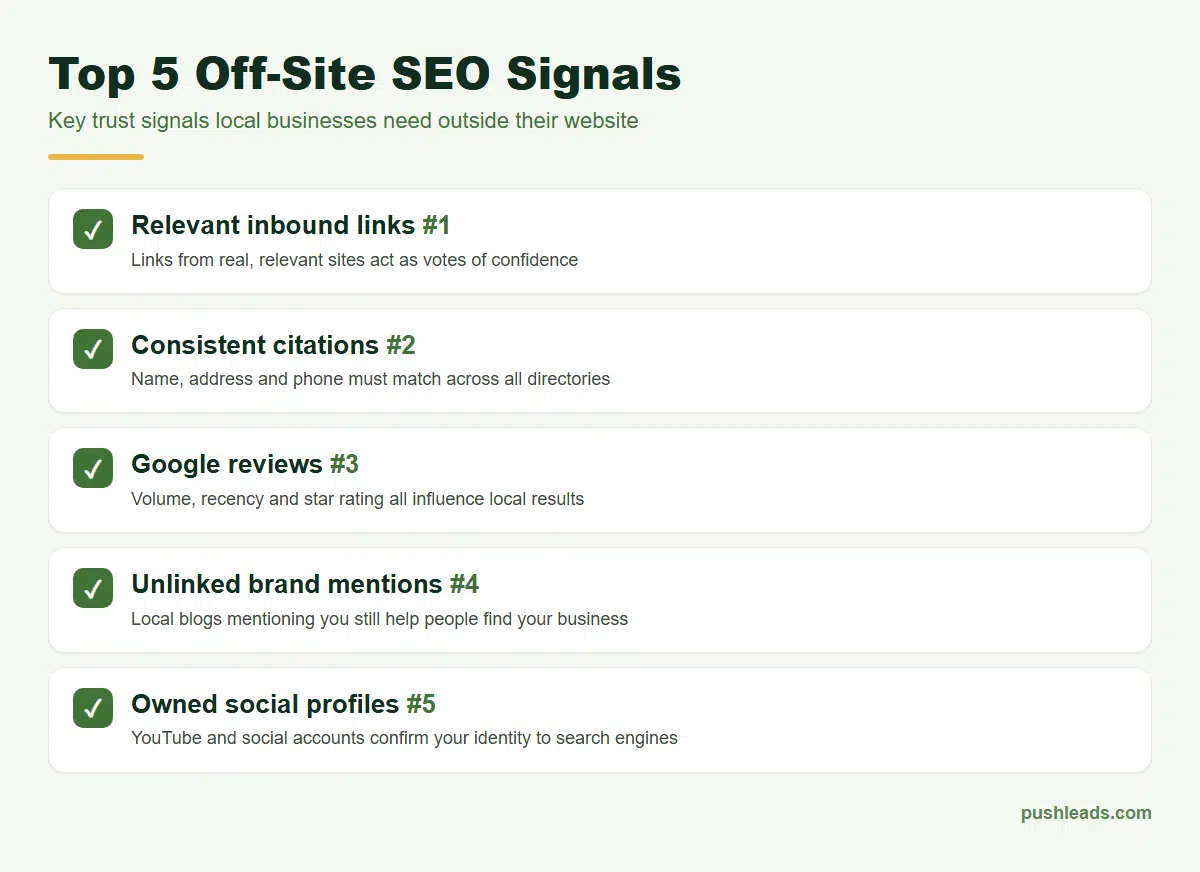
For a local or home-service business, five signals do most of the work: links from relevant sites, consistent business listings, reviews, brand mentions and a few well-kept profiles. Focus on these before anything more exotic.
A link is a vote of confidence from another site. The vote counts for more when the linking site is real, has its own audience, and has a logical reason to point at you. A local supplier, a chamber of commerce or a neighborhood news site all fit.
Citations are mentions of your business name, address and phone number on directories, maps and data sources. Their job is consistency. If your name, suite number or phone differs from site to site, search engines have a harder time confirming which business is yours.
Reviews are an off-site signal because the content comes from customers, not from you. Volume, recency, ratings and the words customers use all matter. A review that mentions the service and the town helps customers and search engines at once.
Sometimes a local blog or news story mentions your company but doesn’t link to it. These unlinked mentions still help people find you, and they are easy to convert: a polite note often gets a link added.
Your YouTube channel, social profiles and other accounts you control help confirm your identity and give people more ways to find you. Treat them as proof of a real business, not as a link factory. Links from pages you fully control carry little weight on their own.
A link is worth having when a real person could plausibly click it and when the page it sits on exists for a reason beyond linking. Run every opportunity through the checklist below before you spend time or money on it.

| Link type | Typical value | Risk level | Notes |
|---|---|---|---|
| Local chamber, trade association or civic group | High | Low | Often needs a membership or sponsorship, which is a real relationship. |
| Local news or community blog feature | High | Low | Earned by being useful or newsworthy. |
| Supplier or manufacturer “find a dealer” page | Medium to high | Low | Ask your account rep; many suppliers list certified installers. |
| Quality industry directory | Medium | Low | Useful mainly when real customers use it. |
| Guest article on a relevant site | Medium to high | Low to medium | Must be genuinely useful, not a thin article built for a link. |
| Self-published blog or profile pages you control | Low | Low | Fine for brand presence; don’t expect them to move rankings by themselves. |
| Networks of sites built mainly to pass links | Unreliable | High | This is the pattern Google’s link spam policies target. |
| Bulk directory submissions to low-quality sites | Very low | Medium to high | Adds clutter and can create inconsistent listings. |
If you’ve been told your site needs a large volume of submissions or secondary sites, that’s worth a second look. Google’s guidance has long been that links should be earned or placed because they’re useful. Our piece on quality in search indexing goes into why quality now outweighs volume.
You can build a solid off-site foundation in 90 days by cleaning up what exists, then earning new signals each month. The first 90 days set up the foundation; rankings usually respond over a longer window.

The best local links come from relationships you already have: suppliers, partners, customers, community groups and local media. Start there before looking at any outreach tool.
Keep it brief and specific. Say who you are, where the two of you already connect, what page you’re referring to and why it helps their readers. Don’t ask for a particular anchor text, and don’t send the same email to fifty people.
Local context matters. A business serving the Blue Ridge region has different natural link sources than one in the Upstate. If you’re in Western North Carolina, our guide to effective Asheville marketing for local businesses shows how neighborhood and community connections can support your visibility.
AI assistants like ChatGPT, Gemini, Perplexity and Google’s AI Overviews tend to rely on sources they can find and cross-check, so the same off-site signals that help in classic search also help you get mentioned in AI answers. Nobody outside those companies knows the exact weighting, so focus on clear, consistent facts rather than chasing a trick.
Expect early movement within roughly three to six months, and more competitive markets can take six to twelve months or longer. Anyone promising a fixed result by a fixed date is promising something no one outside Google controls.
Costs vary with the market, the scope and who does the work. Doing it yourself costs mainly time, plus any membership or sponsorship fees. Agency campaigns for local businesses commonly run from a few hundred to a few thousand dollars per month, depending on how competitive your area is and what’s included.
Be wary of pricing based on link counts alone. A price per link tells you nothing about whether the link is useful. A better question is what the work will actually involve each month and how it ties to calls, form fills and booked jobs.
| Approach | Typical monthly effort | Best for |
|---|---|---|
| Do-it-yourself basics | 2-4 hours | Single-location owners in low-competition niches |
| Part-time help with a checklist | 4-8 hours plus modest fees | Growing businesses with a defined service area |
| Full agency campaign | Ongoing, with reporting | Competitive markets or multi-location businesses |
Most off-site problems come from chasing volume, ignoring consistency or using tactics that look like manipulation. Avoid these and you’re ahead of many competitors.
In this video
Full transcript: SEO Services Greenville SC | Rank Higher & Get Leads
Measure off-site SEO by business outcomes first and ranking signals second. Rankings matter only if they lead to calls, requests and booked work.
Ask for a one-page report that shows what was done, what was earned, what moved and what’s planned next. If a report only shows activity (links built, submissions sent) without outcomes, push for more. For more on what a good partner provides, see our guide on how to hire the best search engine company.

A repeatable monthly checklist keeps off-site work steady and easy to review. Use it whether you do the work or an agency does.
A good provider can explain exactly where your links will come from and why each one is safe. If answers are vague, treat that as a warning.
In this video
Local knowledge also counts. A provider who understands your market can name the community organizations, suppliers and local media worth approaching. If you’re comparing options in the Carolinas, our pages on working with an SEO company in Asheville, Asheville search engine optimization and search engine optimization companies nc explain how we approach regional work.
Off-site SEO is one part of a larger local strategy and works best alongside a strong site and a clear understanding of why search matters to your business. If you’re still weighing the case for investing, our list of reasons your business needs local SEO is a good starting point.
If you’d like a second opinion on your current links, listings and reviews, we’re happy to look at them with you and tell you what’s helping, what’s neutral and what’s worth fixing. You can talk with the PushLeads team whenever you’re ready, with no pressure to commit.
Off-site SEO does not operate in isolation. Search engines use signals from both inside and outside your website to decide where to rank a page. On-site work covers what you control directly: page structure, content relevance, titles, and technical health. Off-site work covers what others say about you: links, citations, reviews, and brand mentions.
Neither side compensates fully for a weak effort on the other. A strong off-site profile pointing to a poorly organized website loses much of its value, and a well-built site that nobody references can remain invisible for a long time. For home-service businesses, the practical takeaway is that both deserve attention, though the right balance depends on where your biggest gaps are. Common areas where on-site factors support your off-site efforts include:
There is no magic number. What matters is having more relevant, trustworthy links than the competitors you’re trying to outrank in your area. Look at the top local results for your main service, see where their links come from, and plan to earn links from comparable sources.
Yes, but only the right ones. Major platforms, data aggregators and respected industry or local directories help with consistency and discovery. Submitting to dozens of low-quality directories adds little and can create conflicting information about your business.
Yes, if it involves manipulative tactics. Links that exist mainly to influence rankings, such as purchased links or networks built to pass authority, can be ignored or lead to penalties under Google’s spam policies. Earned links from real, relevant sites carry little risk.
Most local businesses see early movement in about three to six months, though competitive markets can take longer. Results depend on your starting point, your competition and how consistently the work continues. Be cautious about any promise of a guaranteed first-page position in a set number of days.
Indirectly. Social profiles help people find and verify your business, and posts can drive visits and mentions, but links from social platforms usually don’t pass meaningful ranking credit. Treat social as a way to build awareness and attract the kind of attention that leads to real links and reviews.
Yes. Google has said that review count, score and the quality of your Business Profile information are part of how local results are determined, alongside relevance, distance and prominence. Reviews also influence whether a searcher chooses you once they see you.
You can handle the basics yourself, including listings, review requests and supplier outreach, if you have a few hours a month. Hiring makes sense when your market is competitive, your time is limited or you need outreach and reporting handled consistently. Either way, keep ownership of your accounts and ask to see exactly where links are placed.
Want more customers from Google & AI search?
Get a free SEO audit of your site — see exactly what to fix first.
Your path · SEO Services
Want this done for you?
 Continue to Part 2