

In this video
- 0:00 Why Asheville Visibility Gaps Cost Revenue
- 0:20 Who Jeremy and PushLeads Are
- 0:38 Asheville Market Stats That Drive Urgency
- 1:02 Why Generic SEO Fails Asheville Businesses
- 1:28 Local Pack Mechanics Relevance and Prominence
- 1:52 Google Business Profile Optimization Essentials
- 2:21 GBP Features That Separate Ranked Profiles
- 2:49 Citations NAP Consistency and Local Backlinks
- 3:27 Review Strategy for Local Pack Placement
- 4:00 Mobile Speed and Core Web Vitals
- 4:28 ROI Tracking and Monthly Data Sets
- 5:06 What PushLeads Builds for Asheville Businesses
Full transcript: How do Asheville businesses dominate local SEO rankings?
The Baseline Asheville SEO Timeline
Part of our The Asheville Small Business SEO Guide: How to Rank Higher on Google and Get More Local Customers. Want it done for you? See our local SEO services.
Here’s the framework that describes what most Asheville businesses experience when starting an Asheville SEO campaign from scratch: Days 1 to 30: Foundation and indexing The first 30 days of Asheville SEO are about getting your foundation in place so Google starts correctly understanding your business. GBP optimization, technical fixes, NAP citations, and initial on-page optimization happen here. Google re-crawls your site and begins updating its understanding of your business. You’re unlikely to see dramatic ranking changes in the first 30 days. What you should see: your Google Business Profile impressions start increasing as optimization takes effect, and Search Console begins showing a broader set of queries your site appears for — even if you’re ranking at positions 30 to 50. Days 31 to 90: Early signals and momentum This is when Asheville SEO starts to show early proof points. For less competitive terms — long-tail keywords, community-specific searches, informational queries — you may start moving into the top 20 rankings. New content indexed during this period begins accumulating impressions. GBP improvements start producing more calls and direction requests. This period is also when many business owners get impatient. Traffic hasn’t dramatically increased. Phone calls from organic search look similar to before. This is normal, and it’s precisely when consistency in execution matters most. Months 3 to 6: Meaningful ranking improvements This is the window where Asheville SEO investments typically start producing business outcomes visible without specialized tools. Primary service keywords begin moving into page one (positions 1 to 10). Map pack visibility improves for multiple service keyword variations. Blog content published in months one and two begins generating regular organic impressions. Phone calls and form submissions from organic search typically start increasing meaningfully in this window. For most Asheville businesses, this is when the investment starts feeling real. Months 6 to 12: Compounding returns Asheville SEO compounds over time because each piece of content you publish, each citation you build, each review you earn adds to a growing foundation of local authority. By month 12 of consistent execution, businesses typically see:- Multiple primary service keywords ranking in top 5 positions
- Map pack visibility across multiple geographic variations
- 20 to 50+ pieces of indexed content driving organic traffic
- Monthly organic leads that represent a meaningful portion of their new business
What Affects Asheville SEO Realistic Timeline: The Key Variables
Knowing the baseline realistic timeline is useful, but specific variables in your situation will accelerate or slow your results.Your Starting Point
A business with an existing website, claimed GBP, 30+ reviews, and some existing rankings starts from a much better position than a brand new business starting from zero. For established Asheville businesses, the Asheville SEO realistic timeline compresses because the authority foundation already exists — you’re optimizing, not building from scratch. For new Asheville businesses, add three to six months to the baseline realistic timeline. Building your first 25 to 30 reviews, establishing citation consistency, and earning your first backlinks takes time that an established business doesn’t need to invest.Your Industry’s Competitive Intensity
Not all Asheville SEO competitive landscapes are equal. Some categories are intensely contested by multiple well-funded businesses all actively investing in SEO. Others have surprisingly low competition where a few well-executed pages can reach page one in weeks. High competition Asheville SEO categories (longer realistic timelines): emergency restoration, downtown restaurants, hotels and lodging, HVAC companies, personal injury attorneys. Lower competition Asheville SEO categories (faster timelines): many trades businesses serving specific neighborhoods, professional services outside downtown, specialty retail, niche service providers. The Asheville competitor SEO analysis guide helps you understand exactly where your competitive position sits so you can set realistic timeline expectations based on your specific situation rather than generic averages.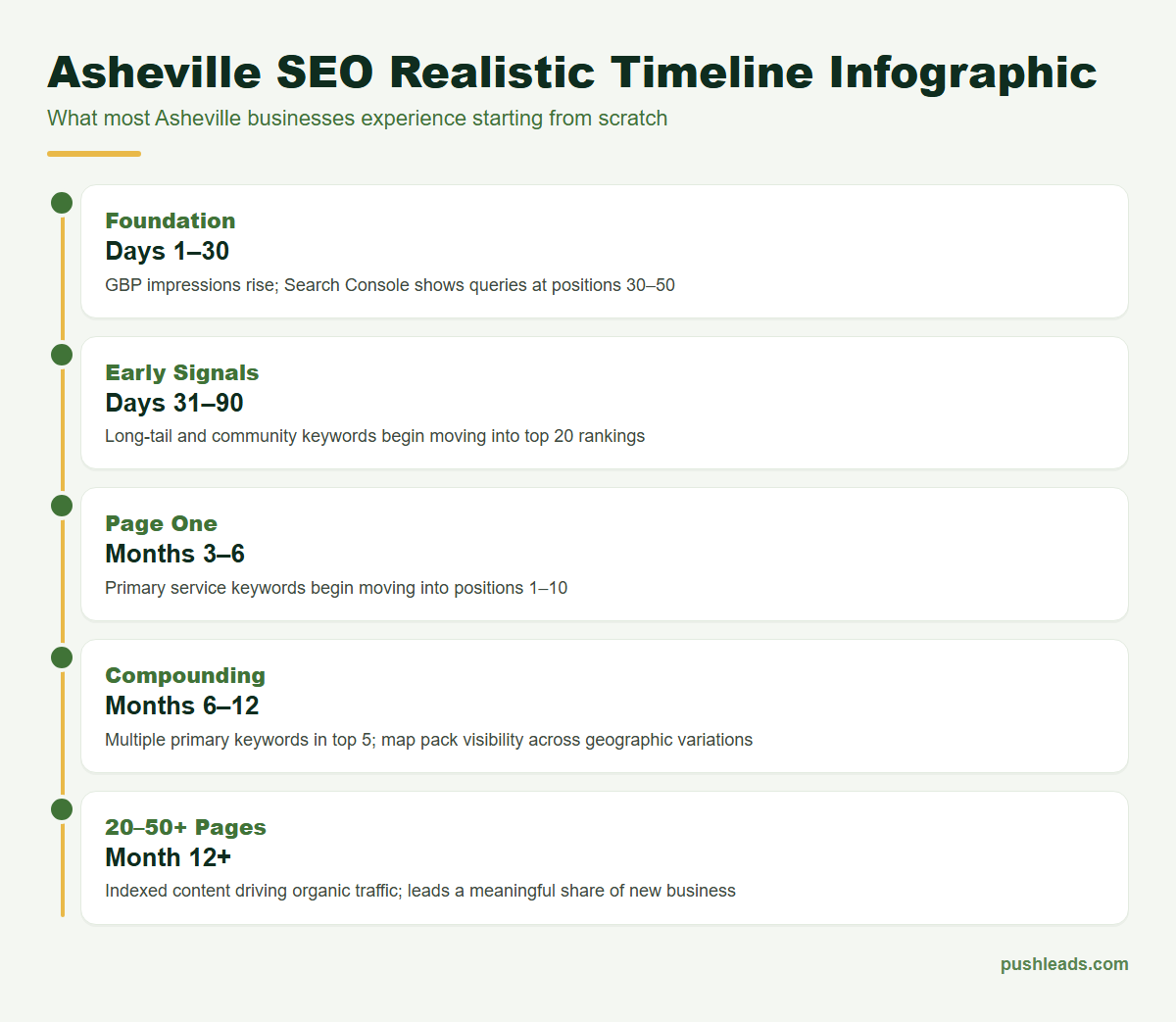
Technical Foundation Quality
Technical issues that prevent Google from properly crawling and indexing your site can extend your Asheville SEO realistic timeline significantly. A site with serious technical problems — duplicate content, broken redirect chains, crawl errors, or extremely slow load times — needs those issues resolved before content and link building investments pay off. If you start Asheville SEO without addressing technical issues first, you’re building on sand. The 50-point Asheville website SEO audit identifies the specific technical problems that are most commonly slowing Asheville business websites.Execution Consistency
Inconsistent execution is the most common reason Asheville SEO realistic timelines extend unnecessarily. Publishing three blog posts and then stopping for two months. Generating five reviews and then forgetting about the process. Optimizing your GBP once and never updating it. Asheville SEO works on compound interest logic — consistent monthly effort produces dramatically better results than sporadic bursts. Asheville SEO Timeline by Business Type Restaurant or hospitality business: Typically 3 to 5 months to meaningful map pack improvement for neighborhood searches. 6 to 9 months for competitive tourism-driven keywords like “best restaurants Asheville.” Home services contractor: 3 to 4 months for neighborhood-specific searches. 5 to 7 months for competitive category keywords in the main Asheville market. Professional services: 4 to 6 months for initial organic traction. Longer realistic timelines are typical because professional service SEO often relies more heavily on content authority, which compounds more slowly. Retail business: 2 to 4 months for location-specific searches. Faster timelines are possible when targeting specific product keywords with low competition. New business (less than 12 months old): Add two to four months across all categories for the additional time needed to build foundational authority.Want more customers from Google & AI search?
Get a free SEO audit of your site — see exactly what to fix first.
Using Paid Advertising to Bridge the Asheville SEO Gap
The most practical approach to managing the Asheville SEO realistic timeline for businesses that need leads now is layering paid advertising alongside the organic campaign. Google Local Service Ads can generate phone calls within 24 to 48 hours of launch. Google Search Ads fill keyword coverage gaps while organic rankings build.
Can Asheville SEO produce results in 30 days?
Rarely in terms of organic rankings. However, Google Business Profile optimization can produce measurable increases in GBP calls and direction requests within 30 days. Paid advertising can produce leads immediately. For pure organic SEO, plan for 60 to 90 days before the needle moves meaningfully.Does Asheville SEO ever stop working if I stop investing?
Results don’t disappear overnight, but they do degrade over time without ongoing investment. Rankings that took 12 months to build can erode over 6 to 12 months without maintenance if competitors continue actively improving their Asheville SEO. The content and citations you build remain, but their effectiveness slowly diminishes without fresh signals.What if I’m not seeing results after 6 months of Asheville SEO?
That’s a signal to audit your strategy, not abandon it. Common reasons for flat results at 6 months: unresolved technical issues suppressing rankings, content that doesn’t match actual search intent, insufficient review acquisition, or targeting keywords that are too competitive for your current authority level. A freshFree SEO Audit at the 6-month mark helps identify what’s blocking progress.Key Takeaways
- Leading indicators such as impressions, query breadth and GBP actions usually move weeks before calls and form fills do, so track them from month one.
- Asheville’s tourist seasons, spread-out neighborhoods and surrounding towns change which keywords you target first, and that changes how quickly you see wins.
- The fastest gains usually come from fixing your Google Business Profile, service pages and tracking before you publish anything new.
- Judge your campaign at set checkpoints (day 45, day 90, day 180) against specific signals, not a gut feeling about traffic.
- Rushed shortcuts such as bought links, copied location pages and constant site changes tend to add months rather than save them.
How Asheville’s Market Shapes Your Timeline
Asheville is a seasonal, tourism-influenced market with distinct neighborhoods and nearby towns, so your timeline depends partly on where and when your customers search. The same service can behave very differently across the city and the surrounding area.
A plumber targeting West Asheville and Haw Creek is competing in a narrower field than one chasing “plumber Asheville” at the city level. A restaurant near downtown faces visitor-driven searches that change by season. A contractor serving Weaverville, Black Mountain or Arden may find less competition than the city core, which is often where early wins come from.
Local searches with a tourist angle
Visitor searches are often made on a phone, close to the moment of purchase, and they lean heavily on the map results. For lodging, dining and activities, your reviews and profile completeness often matter as much as your website. That makes profile work your first lever and website content your second.
Resident searches with a home-service angle
Residents searching for roofers, HVAC techs or electricians tend to compare several businesses and read reviews before calling. These searches are steadier through the year, though weather can spike demand. Because a single job can be worth a lot, even modest ranking gains can pay back noticeably.
Seasonal timing of your launch
Starting before your busy season gives rankings time to build, but starting during it is still better than waiting. Plan so your best content and profile updates are live a month or two before demand peaks. If your slow season is coming, use it to fix the technical and content gaps that you had no time for when busy.
Which Signals Move First, and Which Move Last
Some SEO signals improve within weeks, while the ones that pay your bills take months. Knowing the order keeps you from calling a working campaign a failure at day 60.
| Signal | Type | Typically moves | What it tells you |
|---|---|---|---|
| Pages indexed in Search Console | Leading | Days to a few weeks | Google can find and read your pages |
| Number of queries you appear for | Leading | Weeks 3 to 8 | Your pages are being matched to more searches |
| GBP views, calls and direction requests | Leading | Weeks 3 to 10 | Profile changes are working |
| New reviews per month | Leading | Starts as soon as you ask | Your review process is producing |
| Average position for target keywords | Middle | Months 2 to 5 | Rankings are climbing |
| Clicks from organic search | Middle | Months 3 to 6 | Rankings are high enough to earn visits |
| Calls and forms from organic search | Lagging | Months 3 to 8 | The campaign is producing business |
| Booked jobs and revenue | Lagging | Months 4 to 12 | The real return on the investment |
These ranges are general patterns, not guarantees. A business with a strong starting profile can move faster, and a site with technical problems can move slower.

What to Work On in the First Six Months
The order of work matters as much as the amount. Do the things that unblock everything else first, then build content on top of a clean foundation.
Month 1: Fix what blocks progress
- Confirm your business name, address and phone number match across your site and major listings.
- Claim and complete your Google Business Profile, including categories, services, hours and photos.
- Set up Search Console, analytics and call tracking so you have a baseline.
- Fix crawl errors, broken pages and slow-loading templates.
If your profile is incomplete, our guide to Google Business Profile optimization for Asheville walks through the fields that matter most.
Month 2: Map keywords to pages
Give each core service and each major service area its own page with a clear purpose. Decide which terms each page targets before writing anything. Our guide to Asheville SEO keyword research shows how to find the phrases local customers actually type.
Month 3: Rewrite the pages that earn money
Update titles, headings, service descriptions, internal links and calls to action on your top service pages. Use the on-page SEO checklist for Asheville businesses to avoid missing basics. Include local proof such as neighborhoods served, real project photos and customer questions you hear often.
Months 4 to 6: Add depth and proof
- Publish content that answers specific customer questions, such as cost factors, timing and what to expect from a job.
- Keep asking every satisfied customer for a review, and reply to each one.
- Earn local mentions from suppliers, chambers, sponsorships and community organizations.
- Review Search Console monthly and improve pages that get impressions but few clicks.
How to Measure Progress Before Calls Increase
You can tell whether SEO is working before your phone rings more by watching a short list of leading indicators every month. Write the numbers down at the start so you have something to compare against.
- Search Console impressions: Are they rising for service and location terms, not just your business name?
- Query breadth: Is the number of distinct searches that show your site growing?
- GBP actions: Are calls, website clicks and direction requests trending up month over month?
- Review count and recency: Are you adding fresh reviews every month, not in one burst?
- Tracked calls and forms: Can you tell which came from organic search versus ads or direct visits?
- Local rank checks: Do your target terms show better positions from several points around Asheville, not just your office?
Rankings differ depending on where the searcher is standing, so one position number can mislead you. Check a few locations and look at the trend, not a single day.
Mistakes That Add Months to the Timeline
Most delays come from avoidable decisions, not from Google being slow. These are the ones we see most often with small local businesses.
- Cloning location pages: Swapping the town name on identical pages gives Google little reason to rank any of them. Each page needs unique details.
- Changing too much at once: If you redo the site, URLs, titles and profile in the same week, you cannot tell what helped or hurt.
- Skipping redirects in a redesign: Moving pages without redirecting old URLs can throw away the authority you earned.
- Buying cheap links: Low-quality links can be ignored at best and can create a cleanup project at worst.
- Chasing the wrong keywords: Ranking for terms that never lead to a sale looks good in a report but does not help the business.
- Ignoring conversion: If your page loads slowly or buries the phone number, extra traffic will not turn into calls.
- Not tracking calls: Without call tracking, a working campaign can look like it is doing nothing.

Judging the Return: A Simple Break-Even Check
The most useful way to judge your timeline is to work out how many new customers you need to cover your monthly SEO spend. That turns a vague question into a number you can monitor.
Take your average profit per new customer, not revenue. Divide your monthly SEO cost by that profit. The result is the number of extra customers per month you need to break even. As an illustration, if a job nets you a few hundred dollars in profit and your monthly spend is in the low thousands, you need several extra jobs a month to break even. If one job nets several thousand, the same spend breaks even with one or two.
This also explains why timelines feel different by industry. A business with high-value jobs can afford a longer runway, while a low-margin business needs to prioritize quick wins, such as profile fixes and the pages closest to a purchase.
When to Check In and What to Expect
Set formal checkpoints so you evaluate the campaign on evidence instead of mood. Each checkpoint has a different question.
| Checkpoint | Question to ask | Healthy answer |
|---|---|---|
| Day 45 | Is the foundation finished? | Tracking works, profile is complete, major technical issues are fixed |
| Day 90 | Are leading indicators rising? | More queries, more impressions, GBP actions trending up |
| Day 180 | Are rankings turning into leads? | Target terms on page one or close, tracked calls rising |
| Day 365 | Is the channel paying for itself? | Organic leads cover the cost and the trend is still rising |
If a checkpoint misses, ask which signal is lagging and why. A stalled impression count points to indexing or content. Rising impressions with few clicks points to titles and snippets. Plenty of clicks with few calls points to the page itself.
Choosing Help That Matches Your Timeline
Whoever you work with should be able to show you what happens in each month and which numbers will move first. Be cautious of anyone promising a specific ranking by a specific date, because Google does not allow anyone to guarantee that.
Ask for a written plan, access to your own accounts and reports that include leads, not only rankings. You can see how we approach this in our Asheville SEO services, and our local SEO mastery guide goes deeper on the tactics behind each phase. If you want the full picture of how the pieces fit, start with the Asheville small business SEO guide.
If you would like a straight answer on where your business sits and how long your own timeline is likely to be, you can talk with the PushLeads team. We will look at your profile, site and competitors and tell you what we see, even if the answer is that you should fix a few things yourself first.
In this video
- 0:00 Why Asheville Businesses Miss the Map Pack
- 1:19 Hidden Address Suppresses GBP Visibility
- 1:55 Three Google Local Ranking Signals Explained
- 2:29 What Asheville Competitors Are Not Doing
- 2:56 How Long GBP Gains Actually Take
- 3:32 Review Recency Beats Review Volume
- 4:15 How Google AI Reads Your Profile
- 4:49 Six Steps from Position 17 to Top Three
- 6:03 Video Verification and NAP Consistency
- 6:37 GBP vs Website SEO Priority Order
- 7:24 Three Advanced Moves Competitors Skip
Full transcript: How do you optimize a Google Business Profile in Asheville?
Frequently Asked Questions
Does Google Business Profile ranking take less time than website ranking?
Often yes, because profile changes such as categories, services, photos and reviews can affect map results sooner than new website pages affect organic results. Competitive categories still take months. Treat the profile as your quickest lever and the website as the longer-term asset.
How long until a new blog post or service page ranks?
A new page is commonly indexed within days to a few weeks, but it can take a few months to settle into a stable position. Pages for specific, low-competition searches tend to move first. Pages aimed at broad, competitive terms need supporting content, internal links and authority before they climb.
Do Asheville’s tourism seasons change when I will see results?
Seasons change when searches happen, not how fast Google responds to your work. If your demand peaks in a particular season, aim to have your key pages and profile updates live one to two months earlier. Results from work done during a slow season will often show up when the busy season arrives.
Can posting more content or buying links speed things up?
Not reliably. More content helps only if each piece targets a real search and adds something useful, and purchased links can create risk rather than progress. Fixing weak service pages, earning reviews and getting relevant local mentions usually does more than raw volume.
How do I know SEO is working before I get more calls?
Look at leading indicators: Search Console impressions, the number of queries you appear for, GBP calls and direction requests, and review growth. If those are rising month over month, calls usually follow. Make sure call tracking is set up so you can attribute them.
Does a website redesign reset my SEO timeline?
It can if it is handled poorly. Changing URLs without redirects, removing pages that rank or rewriting content without keeping search intent can erase earlier progress. A careful redesign that keeps your URL structure, redirects old pages and preserves the content that performs should cause only a brief dip, if any.
Should I wait to start SEO until my website is perfect?
No, start with the issues that block progress and improve the rest as you go. Waiting for perfection costs you months of compounding. Fix tracking, your profile and your core service pages first, then refine from there.
Keep Reading
Want more customers from Google & AI search?
Get a free SEO audit of your site — see exactly what to fix first.
Your path · The Asheville Small Business SEO Guide
2 articles. About 30 minutes.
 Up nextOn-Page SEO for Asheville Businesses: A Step-by-Step Checklist
- You’re hereHow Long Does SEO Take in a Market Like Asheville? Realistic Timelines for Local Businesses

Want this done for you?
Scan your site. See the gaps. Decide with numbers.
- Rankings, Google Business Profile and site-speed teardown
- Report lands in your inbox in about a minute
- No obligation · 4.9 from 67 Google reviews
 Continue to Part 1
