
Building a Healthy Backlink Profile to Boost Website Visibility

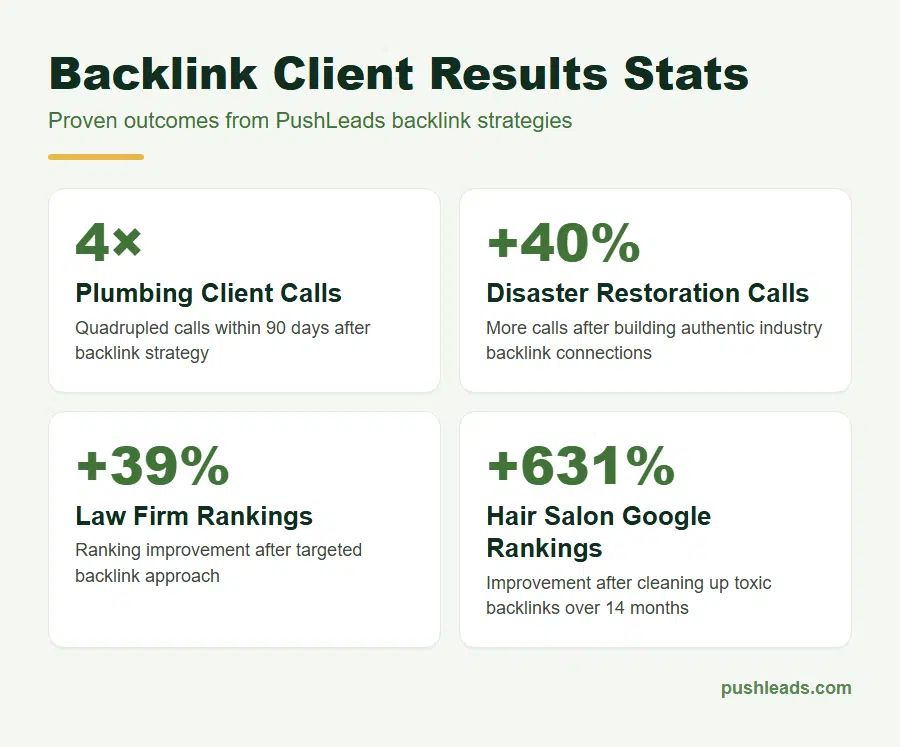
Is your website struggling to gain traction in search results? The problem might be hiding in your backlink profile. Backlinks remain one of Google’s top ranking factors, acting as “votes of confidence” from other websites to yours. But not all backlinks are created equal – quality trumps quantity every time. At PushLeads, we’ve helped countless Asheville businesses overcome backlink profile weaknesses to achieve remarkable visibility improvements. One plumbing client quadrupled their calls within just 90 days after implementing our backlink strategy. Let’s explore how building a healthy backlink profile can transform your online presence and drive sustainable growth.
Why Your Backlink Profile Matters
Want it done for you? See our contractor web design.
Think of backlinks as digital recommendations. When reputable websites link to your content, they signal to search engines that your information is valuable and trustworthy. This directly impacts your domain authority and search visibility. However, the wrong kinds of backlinks can do more harm than good.
Common backlink profile weaknesses include:
- Too many links from low-quality or spammy domains
- Unnatural link patterns that trigger Google penalties
- Over-optimized anchor text that appears manipulative
- Lack of diversity in linking domains
- Too few authoritative links from industry-relevant sources
Strategies for Building a Strong Backlink Profile
Create Link-Worthy Content
The foundation of any successful backlink strategy is exceptional content that naturally attracts links. Develop comprehensive guides, original research, industry reports, or interactive tools that provide genuine value to your audience. When you solve problems or offer unique insights, other websites naturally want to reference your work.
Build Relationships, Not Just Links
Forget about transactional link-building. Focus instead on developing meaningful relationships with industry partners, complementary businesses, and content creators. Our disaster restoration client generated 40% more calls after we helped them build authentic industry connections that resulted in quality backlinks.
Leverage Local Opportunities
For Asheville businesses, local backlinks carry significant weight. Get listed in local business directories, chamber of commerce websites, and industry associations. Participate in community events and secure coverage from local news outlets. These geographically relevant backlinks help establish your local authority.
Guest Posting With Purpose
Contributing valuable content to respected industry publications can generate quality backlinks while positioning you as a thought leader. Focus on sites with genuine audiences and relevance to your industry rather than generic “guest post farms.” One law firm client saw a 39% improvement in rankings after implementing this targeted approach.
Monitor and Disavow Toxic Links
Regularly audit your backlink profile to identify and disavow harmful links. This proactive approach protects your site from potential penalties and maintains your search visibility. After cleaning up toxic backlinks, a hair salon client experienced a remarkable 631% improvement in Google rankings within 14 months.
In this video
- 0:00 Guest Blog Backlinks Driving Local SEO Results
- 0:52 What a Guest Blog Backlink Actually Is
- 1:50 Domain Authority and Why Link Quality Matters
- 2:44 Keyword Rankings Jump from 14 to 46 Terms
- 4:07 Visibility Score Climbs from 5 to 14 Percent
- 5:20 Tracking Rankings Across South Asheville
- 6:07 Citywide Asheville Rankings Starting to Move
- 7:30 Next Steps and Who This Strategy Fits

Want more customers from Google & AI search?
Get a free SEO audit of your site — see exactly what to fix first.
Transform Your Backlink Profile With PushLeads
Ready to strengthen your website’s backlink profile and boost your visibility? At PushLeads, we develop customized backlink strategies that align with your business goals and industry requirements. Our proven approach has helped numerous Asheville businesses achieve significant improvements in rankings, traffic, and conversions.
Contact us today for a comprehensive backlink audit and discover how we can help you be visible and grow in your market.
Get Your Free Backlink AuditWhat makes a backlink profile healthy?
A healthy backlink profile consists of diverse, relevant, and authoritative links that come from reputable websites in your industry. Quality indicators include links from domains with high authority, contextual links within relevant content, natural anchor text variations, and a steady growth pattern rather than sudden spikes. Healthy profiles avoid toxic links from spammy sites, paid link schemes, and excessive exact-match anchor text.
How can I identify toxic backlinks to my website?
Identify toxic backlinks by using tools like Google Search Console, Ahrefs, or SEMrush to review your backlink profile. Warning signs include links from irrelevant or spammy websites, links from sites with low domain authority, links with over-optimized anchor text, links from known link farms or private blog networks (PBNs), and any sudden, unnatural increases in backlink quantity. Regular audits help catch these issues before they impact your rankings.
Strategies for Building a Strong Backlink Profile
Create Link-Worthy Content
The foundation of any successful backlink strategy is exceptional content that naturally attracts links.ry time. At PushLeads, we’ve helped countless Asheville businesses overcome backlink profile weaknesses to achieve remarkable visibility improvements. One plumbing client quadrupled their calls within just 90 days after implementing our backlink strategy. Let’s explore how building a healthy backlink profile can transform your online presence and drive sustainable growth.Why Your Backlink Profile Matters
Think of backlinks as digital recommendations. When reputable websites link to your content, they signal to search engines that your information is valuable and trustworthy. This directly impacts your domain authority and search visibility. However, the wrong kinds of backlinks can do more harm than good.
Common backlink profile weaknesses include:
- Too many links from low-quality or spammy domains
- Unnatural link patterns that trigger Google penalties
- Over-optimized anchor text that appears manipulative
- Lack of diversity in linking domains
- Too few authoritative links from industry-relevant sources
Strategies for Building a Strong Backlink Profile
Create Link-Worthy Content
The foundation of any successful backlink strategy is exceptional content that naturally attracts links. Develop comprehensive guides, original research, industry reports, or interactive tools that provide genuine value to your audience. When you solve problems or offer unique insights, other websites naturally want to reference your work.
Build Relationships, Not Just Links
Forget about transactional link-building. Focus instead on developing meaningful relationships with industry partners, complementary businesses, and content creators. Our disaster restoration client generated 40% more calls after we helped them build authentic industry connections that resulted in quality backlinks.
Leverage Local Opportunities
For Asheville businesses, local backlinks carry significant weight. Get listed in local business directories, chamber of commerce websites, and industry associations. Participate in community events and secure coverage from local news outlets. These geographically relevant backlinks help establish your local authority.
Guest Posting With Purpose
Contributing valuable content to respected industry publications can generate quality backlinks while positioning you as a thought leader. Focus on sites with genuine audiences and relevance to your industry rather than generic “guest post farms.” One law firm client saw a 39% improvement in rankings after implementing this targeted approach.
Monitor and Disavow Toxic Links
Regularly audit your backlink profile to identify and disavow harmful links. This proactive approach protects your site from potential penalties and maintains your search visibility. After cleaning up toxic backlinks, a hair salon client experienced a remarkable 631% improvement in Google rankings within 14 months.
Transform Your Backlink Profile With PushLeads
Ready to strengthen your website’s backlink profile and boost your visibility? At PushLeads, we develop customized backlink strategies that align with your business goals and industry requirements. Our proven approach has helped numerous Asheville businesses achieve significant improvements in rankings, traffic, and conversions.
Contact us today for a comprehensive backlink audit and discover how we can help you be visible and grow in your market.
Get Your Free Backlink AuditWhat makes a backlink profile healthy?
A healthy backlink profile consists of diverse, relevant, and authoritative links that come from reputable websites in your industry. Quality indicators include links from domains with high authority, contextual links within relevant content, natural anchor text variations, and a steady growth pattern rather than sudden spikes. Healthy profiles avoid toxic links from spammy sites, paid link schemes, and excessive exact-match anchor text.
How can I identify toxic backlinks to my website?
Identify toxic backlinks by using tools like Google Search Console, Ahrefs, or SEMrush to review your backlink profile. Warning signs include links from irrelevant or spammy websites, links from sites with low domain authority, links with over-optimized anchor text, links from known link farms or private blog networks (PBNs), and any sudden, unnatural increases in backlink quantity. Regular audits help catch these issues before they impact your rankings.
Key Takeaways
- Audit your backlinks in Google Search Console first, then sort every linking domain into keep, improve, or ignore before you build anything new.
- Relevance and editorial trust matter more than raw link counts, so one link from a respected local or industry site beats dozens from directories nobody reads.
- Most local businesses can earn solid links through suppliers, sponsorships, partners, and unlinked brand mentions without writing a single guest post.
- Keep anchor text mostly branded and natural, and never buy links that pass ranking credit without the proper rel attributes.
- Expect backlink work to show results over months, not days, because links must be found, crawled, and weighed by Google.
How to Audit Your Backlink Profile Step by Step
A backlink audit is a structured review of who links to you, which pages they link to, and whether those links help or hurt. You can run a useful first pass in an afternoon with free tools.
- Export your links. In Google Search Console, open the Links report and download your top linking sites, top linked pages, and top anchor text. Our guide to using Search Console data for diagnosis covers how to get comfortable in that dashboard.
- Group linking domains by type. Label each as local business, news or media, directory, supplier or manufacturer, industry association, blog, or unknown. This shows you where your profile is lopsided.
- Check relevance. Ask whether a real person reading that page would plausibly click through to your site. If the answer is no, the link is weak, even if it is harmless.
- Review which pages earn links. If every link points to your homepage, your service pages and guides are not pulling their weight. That is a content problem as much as a link problem.
- Scan anchor text. Look for repeated exact-match phrases like “best plumber Greenville SC” across many unrelated sites. That pattern looks manufactured.
- Flag suspicious links. Mark links from obvious spam, foreign-language junk pages, hacked sites, and link networks. Do not act on them yet.
- Compare against two or three competitors. Use a paid or free-trial backlink tool to see which sites link to competitors but not to you. Those are your most realistic targets.
Save the spreadsheet. You will use it again at 90 days to see what changed.
Good Links vs. Risky Links: A Quick Comparison
A good link is editorial, relevant, and placed where a human would click it. A risky link is placed mainly to influence rankings. This table helps you sort links quickly.
| Signal | Healthy link | Risky link |
|---|---|---|
| Source | Local chamber, supplier, news outlet, industry association | Unknown site with no audience or contact details |
| Placement | Inside relevant body copy or a curated resource list | Footer, sidebar, or hidden among dozens of unrelated links |
| Anchor text | Brand name, URL, or natural phrase | Repeated exact-match commercial keyword |
| Intent | Added because the page is useful | Added because someone paid or traded for it |
| Site quality | Real content, real traffic, real authors | Thin, templated, or auto-generated pages |
| Pattern | Arrives gradually, from varied sources | Arrives in sudden bursts from similar sites |
Most links fall between the two columns. Those middle links are usually fine to ignore rather than chase.

Link Opportunities Most Local Businesses Overlook
The easiest links usually come from relationships you already have. Start with people who know your business, then widen out.
Suppliers, manufacturers, and certifications
If you install, repair, or sell branded products, check whether the manufacturer has a “find a pro” or dealer page. Certifications from training programs and trade groups often include a member listing with a link. These links are relevant and hard for competitors without the credential to copy.
Sponsorships and community involvement
Youth sports teams, charity runs, school fundraisers, and local festivals often thank sponsors on their websites. Choose sponsorships because you want to support the cause, then ask politely that the thank-you page link to your site. Costs vary widely, from a small donation to a few thousand dollars for a major event.
Unlinked brand mentions
Search Google for your business name in quotes, plus variations of your owner’s name. When a local blog or news story mentions you without linking, send a short, friendly note thanking them and asking if they would add a link. This is often the highest-response outreach you can do.
Partner and referral pages
Realtors, insurance agents, contractors, and wedding vendors often keep trusted-vendor lists. If you already refer customers to a business, offer to list each other where it makes sense for customers. Keep it to genuine partners, not a swap with fifty strangers.
Broken and outdated resource links
Local resource pages sometimes link to a business that closed or a page that moved. If you have a relevant page that fills the gap, tell the site owner about the dead link and suggest yours as a replacement. This works best when your page truly matches the original.

Customer-facing content worth citing
Seasonal checklists, local cost guides, permit explainers, and neighborhood-specific advice give others something to reference. Organizing these into a cluster helps, and a local SEO content hub gives linkers an obvious, well-structured page to point to.
How to Keep Anchor Text Natural
Natural anchor text mostly consists of your business name, your web address, and generic or descriptive phrases. You rarely control it, and that is the point.
When you ask for a link, do not dictate wording. Let the other site describe you in its own words. If you are submitting a profile you control, such as an association listing, use your business name rather than a keyword phrase.
A profile with nothing but brand-name anchors looks a little unusual too, but it is far less risky than one dominated by commercial keywords. Variety comes naturally when links come from real editors and real partners.
Make Sure Your Own Site Can Use the Links You Earn
Links only help if Google can crawl, index, and understand the pages they point to. Before spending time on outreach, confirm that your best pages are not blocked or buried.
Run through crawlability and indexing fixes so linked pages are actually eligible to rank. Then pass that authority around your site with contextual internal links from your strongest pages to the service pages that drive revenue.
If the pages earning links are weak, outreach gets harder too. Other sites rarely link to pages that look empty, so review thin content issues on the pages you want to promote.
Realistic Costs and Timelines
Backlink work is slow and its cost depends on how much of it you do yourself. Anyone who promises a fixed number of links in a fixed number of days is selling volume, not quality.
- First audit and cleanup plan: a few hours to a couple of days, depending on how large your profile is.
- Quick wins (citations, supplier pages, partner listings): often 2 to 6 weeks to secure, since they depend on other people replying.
- Content-led and outreach-led links: commonly 2 to 4 months before a meaningful number appear.
- Visible ranking movement: frequently 3 to 6 months or longer, especially in competitive markets like Greenville or Asheville home services.
- Budget: doing it yourself costs mainly time plus any sponsorship or tool fees; agency retainers vary widely based on scope and market.
These are general planning ranges, not guarantees. Your starting point, competition, and site health change the picture.

Backlink Mistakes That Cost Local Businesses Rankings
Most backlink damage comes from shortcuts, not from bad luck. These are the mistakes we see most often.
- Buying links that pass ranking credit. Google’s spam policies treat paid links as a violation unless they carry the appropriate rel attribute, such as sponsored or nofollow.
- Mass directory submissions. A handful of accurate, relevant listings helps. Hundreds of random ones add noise.
- Disavowing too aggressively. Google’s guidance says the disavow tool is for cases where you have a manual action or a large volume of unnatural links likely to cause one. Disavowing ordinary low-quality links can waste time and may remove links that were neutral.
- Chasing metrics instead of relevance. A high-authority site with no connection to your industry or region rarely beats a relevant local link.
- Ignoring link loss. If a page that earned links is deleted or its address changes without a redirect, those links stop helping.
- Treating links as a substitute for on-page work. Weak titles, thin pages, and poor structure limit what links can do, so review your on-page SEO elements alongside your outreach.
If a real penalty is behind your drop in traffic, the steps in this website recovery roadmap put cleanup in the right order.
A 90-Day Backlink Checklist
A simple 90-day plan keeps the work moving without overwhelming a small team. Adjust the pace to the hours you can realistically commit each week.
Days 1 to 30: Audit and fix
- Export links from Search Console and sort linking domains by type.
- Note which pages earn links and which important pages earn none.
- Fix redirects for any linked pages that were deleted or moved.
- Claim or correct core listings: Google Business Profile, chamber, and key industry directories.
Days 31 to 60: Ask and publish
- Request links from suppliers, manufacturers, and partners you already work with.
- Search for unlinked mentions and send polite requests.
- Publish one genuinely useful local resource that others could cite.
Days 61 to 90: Expand and review
- Pursue one or two sponsorships or community partnerships you actually care about.
- Pitch your resource to relevant local sites and associations.
- Re-export your link data and compare it with your day-one spreadsheet.
- Decide what to repeat, what to drop, and where to aim next.
Want a Second Set of Eyes on Your Links?
If you would rather not sort through exports and outreach on your own, we can review your profile and tell you what is worth fixing first. Talk with the PushLeads team and we will walk you through what we find.
Frequently Asked Questions
How many backlinks do I need to rank locally?
There is no fixed number. What you need depends on how many relevant links your top local competitors have and how strong your site is otherwise. Compare your profile with the businesses ranking above you and aim to close the quality gap first, not the count gap.
How long does it take for new backlinks to improve rankings?
Most businesses should expect several months. Google has to discover the link, crawl the page, and factor it in alongside everything else about your site. Small local markets can move faster than competitive ones, but plan on at least a quarter before judging results.
Is it okay to buy backlinks?
Not if the links are meant to pass ranking credit. Google’s link spam policies treat that as manipulation, and sponsored placements should carry a sponsored or nofollow attribute. Paying for a sponsorship or an ad is fine, but paying for a hidden “dofollow” placement is risky.
Do nofollow links have any value?
Yes, they can. Google treats nofollow as a hint, and such links still send referral traffic, build brand visibility, and make your link profile look natural. Do not turn down a relevant local mention just because it is nofollow.
Do I need to use the disavow tool?
Usually not. Google’s guidance says the tool is for situations where you have a manual action or a large number of unnatural links that could trigger one. Google is generally good at ignoring spammy links on its own, so avoid disavowing links simply because they look low quality.
Can a new business build backlinks without content or a big budget?
Yes, start with relationships and local presence. Complete your Google Business Profile, join your chamber of commerce, ask suppliers for dealer or installer listings, and get your partners to link to you. These cost little and give a new site its first relevant links.
Where can I read more about why my site isn’t showing up on Google?
Links are only one possible cause. Our complete troubleshooting guide to Google visibility walks through indexing, content, technical, and local issues so you can find the real bottleneck.
Keep Reading
Want more customers from Google & AI search?
Get a free SEO audit of your site — see exactly what to fix first.
Your path · Why Isn’t My Website Showing Up on Google? Complete Troubleshooting Guide
12 articles. About 190 minutes.
 Evaluating Your Website for Thin Content: Why Quality Matters for SEO
- You’re hereBuilding a Healthy Backlink Profile to Boost Website Visibility
- Up nextLocal SEO Guide: Why Your Business Isn’t Showing Up in “Near Me” Searches
- Google Search Console: Using Data to Diagnose Website Visibility Problems




Want this done for you?
Scan your site. See the gaps. Decide with numbers.
- Rankings, Google Business Profile and site-speed teardown
- Report lands in your inbox in about a minute
- No obligation · 4.9 from 67 Google reviews
 Continue to Part 8
