What is my HVAC business worth?
Most HVAC businesses sell for two to five times their annual EBITDA. A $300,000 EBITDA business is worth $600,000 at a two-times multiple or $1.5 million at five times. The spread depends entirely on recurring revenue, owner dependency, clean financials, and your digital presence — all factors within your control.
What multiple do HVAC businesses sell for?
HVAC businesses trade at two to three times EBITDA when they are smaller or owner-dependent, and four to five times when they have recurring maintenance revenue, real management in place, and clean books. Private equity roll-ups will pay above five times if the business fits their acquisition platform.
Want more customers from Google & AI search?
Get a free SEO audit of your site — see exactly what to fix first.
How do I value an HVAC business?
Multiply your EBITDA by the appropriate multiple for your business profile. EBITDA is your profit before interest, taxes, depreciation, and amortization — essentially what the business generates running without you. A $300,000 EBITDA at a four-times multiple equals $1.2 million. Clean books, recurring contracts, and low owner dependency push that multiple higher.
How to sell an HVAC business
Start three to five years before your target date to fix structural issues. Build maintenance agreement revenue, reduce owner dependency, clean up financials across multiple tax years, and strengthen your Google presence. Then hire a broker who specializes in home service businesses and can run a competitive process with multiple buyers simultaneously.
What is EBITDA for an HVAC company?
EBITDA is earnings before interest, taxes, depreciation, and amortization — the cash your HVAC business generates after it runs without you daily. It excludes truck loans and owner salary because those change when ownership changes. Buyers multiply this number by a multiple to set your sale price, so maximizing it directly raises what you receive.
How much is an HVAC company worth?
An HVAC company is worth two to five times its annual EBITDA. On $300,000 in EBITDA, that ranges from $600,000 to $1.5 million. Businesses with more than 40% of revenue in recurring maintenance contracts consistently reach the top of that range. Real estate is valued separately and is not part of the EBITDA multiple calculation.
How to increase the value of my HVAC business before selling
Focus on four things: build recurring maintenance agreement revenue, reduce owner dependency by promoting a service manager, clean up financials over multiple tax years so books match tax returns, and strengthen your Google Business Profile with consistent reviews and posts. These actions directly lower buyer-perceived risk and push your multiple toward four or five times.
What do buyers look for when buying an HVAC business?
Buyers look for predictable recurring revenue, management that runs daily operations without the owner, clean financials that match tax returns, a maintained fleet, and a strong Google presence with consistent reviews. They are buying future cash flow at a discount, so anything that makes future revenue uncertain — like owner dependency or customer concentration — gets priced against you.
0:00 Intro
0:38 What EBITDA Actually Means for HVAC Owners
1:30 Where the Two-to-Five Range Actually Comes From
2:11 The Revenue Mix That Buyers Actually Want
3:54 What Kills Valuation Before You Even Get to the Table
4:55 Why Your Google Presence Is Part of Your Valuation
5:49 The Owner Dependency Problem, Solved
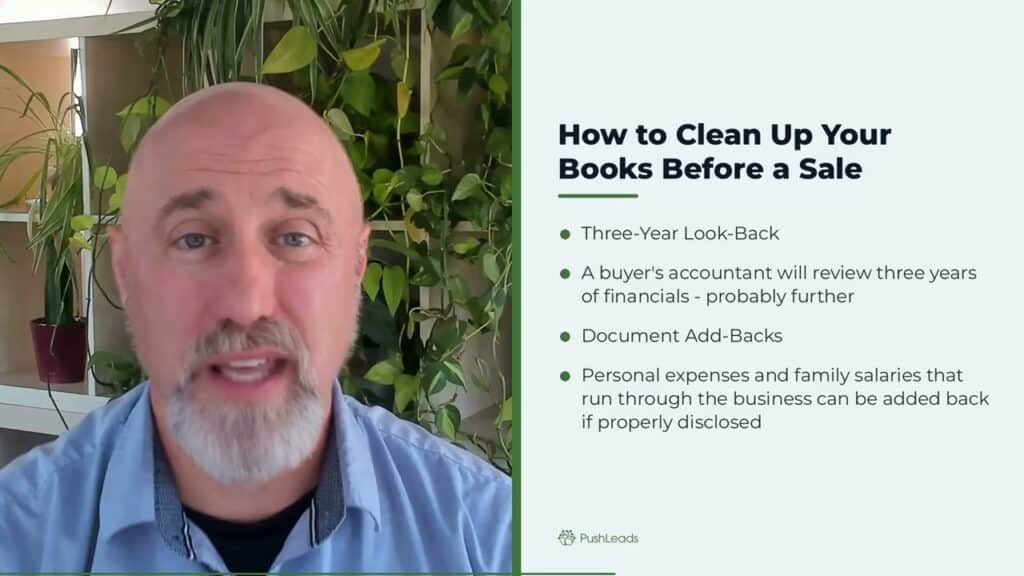
6:47 How to Clean Up Your Books Before a Sale
7:29 What Buyers Are Actually Buying in an HVAC Business
8:18 The Maintenance Agreement Math
9:02 The Timeline That Gets You the Best Price
9:42 Choosing the Right Broker or M and A Advisor
10:32 What to Do Right Now
Full transcript
0:00 Intro
I’ll give you the numbers straight. Most HVAC businesses sell for two to five times their annual EBITDA, and the spread between two and five is entirely within your control. I’m Jeremy Ashburn, and in this video, I’m walking you through exactly how buyers calculate that number, what kills your multiple before you ever get to the table, and what you can do right now to be worth more when the time comes. If you want to skip ahead, there’s a free valuation teardown link below, but stick with me because the mistakes I’m going to show you cost owners hundreds of thousands of dollars every single time. EBITDA stands for earnings before interest,
0:38 What EBITDA Actually Means for HVAC Owners
taxes, depreciation, and amortization. I know that sounds like a accountant language. Here’s the plain version. It’s your profit before the stuff that changes when the business changes hands. When a buyer looks at your business, they don’t care what you paid yourself. They don’t care about your truck loans. They care how much cash the business generates after it runs without you in it every day. That number is your EBITDA, and that number times the multiple equals your sale price. So if your EBITDA is $300,000 and a buyer offers you a three times multiple, you walk away with $900,000. If that same EBITDA gets you a four times multiple because your business looks cleaner and more scalable, that’s $1 .2 In my experience working with home service businesses,
1:30 Where the Two-to-Five Range Actually Comes From
buyers and brokers use a simple framework when they land on a multiple. Smaller businesses under $1 million in EBITDA tend to trade in the two to three times range. Businesses with strong recurring revenue, real management in place, and clean books push toward four and five times. Private equity groups chasing HVAC roll -ups will pay above five times if the business fits their platform. But here’s what most owners don’t realize. The buyer isn’t just buying your profit, they’re buying their risk. A higher multiple means they see less risk. Less risk means you get more money. So everything we talk about from here is really about de -risking your business
2:11 The Revenue Mix That Buyers Actually Want
in the buyer’s eyes. Not all revenue is equal to a buyer. This is one of the most important ideas in this whole video. Maintenance agreement revenue is worth more than new install revenue. Service contracts are worth more than one -time jobs. Here’s why. If your business is mostly new installs, a buyer has to go in every dollar next year. If your business has 3,000 active maintenance agreements generating monthly recurring cash that revenue rolls forward automatically, buyers pay for predictability. Unpredictable revenue gets discounted. Predictable revenue gets a premium. In my experience, businesses with more than 40% of revenue tied to recurring maintenance contracts consistently land at the top of their multiple range. If you don’t have a strong maintenance program, building one now is one of the highest return investments you can make before a sale. I said I’d give you numbers. So here are three. First, 57.5%. That’s the click -through rate on the search query, how to value a heating and air conditioning business in our data. Nearly six in 10 people who see that result click it. Owners are serious when they search that phrase. They’re ready to act. You’re probably one of them. Second, two to five times EBITDA. That’s the real range buyers use for HVAC businesses. Two is where troubled or owner -dependent businesses land. Five is where clean, scalable, recurring revenue businesses land. Third, $400,000. That’s the difference on a $300,000 EBITDA business between a three times and a four times multiple. Those three numbers are your starting point. Let me be direct here.
3:54 What Kills Valuation Before You Even Get to the Table
There are five things that crater HVAC business value faster than anything else. One, owner dependency. If you’re the primary technician, the main salesperson, and the one every customer calls by name, a buyer can’t buy a business. They’re buying a job. Two, no clean financials. If your books are messy, if personal expenses run through the business, if your revenue doesn’t match your tax returns, buyers discount hard or walk. Three, customer concentration. If one commercial client is 20% of your revenue, that client leaving is a disaster. Buyers see it and they price for the risk. Four, deferred maintenance on your fleet and equipment. Buyers inspect. They find it. They subtract more than it costs to fix. Five, no online presence or reputation. This one surprises owners, but it shouldn’t. Buyers do diligence on your digital footprint. Week Google presence. Low review counts. No consistent posting history. These signal that future customer acquisition is expensive and uncertain.
4:55 Why Your Google Presence Is Part of Your Valuation
I want to spend a minute on this because most owners don’t connect these two things. A buyer is buying future cash flow. Future cash flow depends on customer acquisition. Customer acquisition in HVAC in 2026 runs through Google. If your Google Business Profile is optimized, if you’re posting consistently, if you have 300 reviews at a 4.8, a buyer sees a machine that generates leads without you standing in a Home Depot parking lot. If your profile is half filled out and your last review was eight months ago, a buyer sees customer acquisition risk and they price it in. Our data shows nearly 2,000 impressions on searches around Google business profile optimization. Buyers and sellers both know it matters. The owners who win on valuation treat their digital presence like infrastructure, not marketing infrastructure. Let me give you a real worked example on the owner dependency issue because
5:49 The Owner Dependency Problem, Solved
it’s the most common valuation killer I see. Imagine two HVAC businesses, both due $2 million in revenue, both have $300,000 in EBITDA. Business A, the owner runs every sales call. The owner handles all commercial relationships. Three techs all paid hourly. No one in a lead role. Business B, a service manager runs daily operations. A lead tech handles commercial accounts. The owner reviews financials and strategy. A buyer offering three times multiple for business A is being generous. That same buyer might offer four to four and a half times for Business B. Same revenue, same EBITDA. $300,000 to $450,000 difference at the closing table. The fix is not complicated. Hire or promote a service manager. Document your processes. Let someone else run the Tuesday morning meeting. Do it two years before you sell. A buyer’s accountant will go back three years, probably further.
6:47 How to Clean Up Your Books Before a Sale
Here’s what they’re looking for. They want to see revenue that matches the tax returns. They want to see expenses that are business expenses. They want to see consistent margins year over year. The two biggest mistakes owners make running personal vehicles, meals, and travel through the business as expenses and paying family members salaries that don’t reflect real work. Both of those can be added back. That’s called an add back and it’s legitimate. But only if it’s documented and disclosed. Get your CPA to prepare a proper quality of earnings summary before you go to market. A good broker will require it anyway. Having it ready signals professionalism and speeds up the process.
7:29 What Buyers Are Actually Buying in an HVAC Business
Let me reframe this because it changes how you think about everything. A buyer is buying future cash flow at a discount to what they’d pay to build it from scratch. They’re buying your customer list. They’re buying your technician team. They’re buying your maintenance contract base. They’re buying your reputation. They’re buying your Google presence and reviews. They’re buying your brand in your market. They are not buying your trucks. They’re not buying your tools. They’re not paying extra for the building you own. Real estate is valued separately. Equipment is valued at market, not at what you paid. The intangible assets, your recurring relationships, your reputation, your systems, that’s what commands a premium multiple. Build those, protect those, document those, and you will get paid for those. Let me show you the math on maintenance agreements because this one is concrete.
8:18 The Maintenance Agreement Math
Say you have 500 maintenance agreement customers, average contract value of $200 a year. That’s $100,000 in recurring revenue. At a four times multiple applied to the margin on that revenue, assuming 50 % margin, that’s $200,000 of enterprise value sitting in your maintenance program. If you have zero maintenance agreements that $200,000 doesn’t exist at closing. Now imagine building to 1,000 agreements over the next three years. That’s $400,000 added to your sale price at a four times multiple on 50% margins. The math works. The time to start is not the year before you sell. The time to start is right now.
9:02 The Timeline That Gets You the Best Price
Most owners wait too long to think about this. In my experience, the optimal preparation window is three to five years. That gives you time to build recurring revenue, reduce owner dependency, clean up your books over multiple tax years, and grow your online presence to a point buyers find credible. One year out is not enough time to fix structural problems, but one year out is enough time to get organized, find a good broker, and run a competitive process. Three to five years out, you can actually change what kind of business you are. If you’re thinking about this now, even if you’re 10 years from selling, the actions you take today compound into a much higher number at the table.
9:42 Choosing the Right Broker or M and A Advisor
This is not a DIY process. A good HVAC business broker knows how to run a competitive process. That means getting multiple buyers at the table at the same time. Competition between buyers is the single biggest lever on your final price. A broker who specializes in home service businesses will know who the active buyers are. They’ll know which private equity groups are rolling up HVAC companies. They’ll know what the current market multiples look like. They typically take eight to 12% of the sale price. On a million dollar deal, that’s 80 to $120,000. On a $2 million deal, that’s 160 to 240,000. It’s real money, but a good broker running a competitive process regularly gets sellers a higher multiple than they would have gotten on their own. The fee pays for itself.
10:32 What to Do Right Now
Here’s your action list. Not in five years right now. One, calculate your real abit doll. Get with your CPA and get the actual number. Two, assess your owner dependency honestly. If you left for 90 days, what would break? Three, look at your maintenance agreement count. If it’s under 5% of your customer base, start building. Four, audit your Google Business Profile. Is it fully filled out? Are you posting? Are you getting new reviews regularly? Five, call us. The link below gets you a free visibility tear down. We look at your digital presence, tell you exactly where buyers will see weakness, and give you a real plan to fix it. The number is 828 -348 -7686 or go to SEO .PushLeads .com slash audit. It’s free. And if you’re serious about selling your business someday, knowing where you stand costs you nothing. You control the multiple two times or five times on $300,000 in abita is the difference between $600,000 and $1.5 million. That $900,000 spread is not about luck. It’s not about the market. It’s about the decisions you make in the years before you sell. Build recurring revenue, reduce owner dependency, clean your books, build your digital presence. Those four things push you to the top of the range. I’ll see you in the next one.
▶ Watch on its own page (12:06), with the transcriptMore videos in the library →
Key Takeaways
Most HVAC businesses sell for two to five times annual EBITDA, and every point of that spread is within your control. The difference between a three-times and a four-times multiple on $300,000 in EBITDA is $300,000 at closing. Recurring maintenance contracts, clean books, reduced owner dependency, and a strong Google presence are the four factors that push you toward the top of the range. Start building them now, not the year before you sell.
- HVAC businesses trade at two to five times EBITDA; the multiple reflects how much risk a buyer sees, not just how profitable you are.
- Maintenance agreement revenue commands higher multiples than install or one-time service revenue because it is predictable.
- Owner dependency is the single most common valuation killer; buyers discount hard when the owner is the business.
- Clean, documented financials with a quality of earnings summary speed up the sale and protect your price.
- Your Google Business Profile and review count are part of buyer due diligence; weak digital presence signals customer acquisition risk.
- The ideal preparation window is three to five years before you want to sell, not one year.
- A specialized HVAC broker running a competitive process typically earns sellers more than the eight to twelve percent fee costs them.
What Your HVAC Business Is Actually Worth Right Now
Most HVAC businesses sell for two to five times annual EBITDA, and the entire spread between those two numbers is controlled by decisions you make before you ever talk to a buyer. EBITDA stands for earnings before interest, taxes, depreciation, and amortization. In plain terms, it is the cash your business generates after it runs without you standing over it every day. A buyer takes that number, multiplies it by a multiple they assign based on how risky and scalable your business looks, and that product is your sale price.
Here is why the multiple matters so much. If your EBITDA is $300,000 and a buyer offers three times, you walk away with $900,000. If that same $300,000 in EBITDA earns a four-times multiple because your business looks cleaner and more scalable, you walk away with $1.2 million. Same profit. $300,000 difference. Stretch that to a five-times multiple and the number becomes $1.5 million, a $600,000 gap from the low end. That spread is not luck or market timing. It is the result of specific, fixable things about how your business is structured and presented.
At PushLeads we work with home service businesses on the digital-presence side of their operations, and I talk to HVAC owners regularly who are five to ten years from selling but have never thought about what a buyer will actually evaluate. The goal of this post is to give you the same framework buyers and brokers use so you can start making decisions today that pay off at closing.
How Buyers Calculate the EBITDA Multiple for HVAC Companies
Buyers assign multiples based on perceived risk: a business that looks like it will keep generating cash without much disruption gets a higher multiple than one that feels fragile or owner-dependent. Smaller HVAC businesses with EBITDA under $1 million typically trade in the two-to-three-times range. Businesses with strong recurring revenue, real management infrastructure, and clean books push toward four and five times. Private equity groups actively rolling up HVAC companies will sometimes pay above five times when a business fits their acquisition platform.
What does a buyer mean when they say they are buying risk?
A buyer paying four times your EBITDA is betting that the business will produce that cash flow for at least four years after they own it. Every uncertainty they find, an owner who handles all the sales calls, a top customer who represents 20 percent of revenue, books that do not match tax returns, reduces their confidence in that future cash flow and drops the multiple they are willing to pay. Reducing buyer-perceived risk is the core job of sale preparation.
How do private equity roll-ups value HVAC businesses differently than individual buyers?
Private equity groups buying multiple HVAC companies to merge into a larger platform can afford to pay above-market multiples because they are getting operational synergies and a bigger combined entity they can resell at an even higher multiple later. If your business is large enough, recurring enough, and clean enough to appeal to a PE group, you may be able to run a process that brings those buyers to the table alongside individual buyers, which creates competition that raises your price.
See also our guide on Why Your HVAC Phone Isn’t Ringing (3 Fixes That Cost Nothing).
Is EBITDA the same as net profit on my tax return?
EBITDA and the net income on your tax return are almost never the same number. Your tax return is written to minimize taxable income, which is legally smart but makes your business look less profitable to a buyer. A quality of earnings analysis prepared by a CPA restates your financials to show true operating cash flow, adds back legitimate owner expenses, and gives buyers and brokers a number they can actually work with. That document is the foundation of your valuation conversation.
The Revenue Mix That Pushes You Toward a Five-Times Multiple
Not all revenue is equal in a buyer’s eyes, and the difference between recurring and non-recurring revenue is one of the most important valuation levers you have. Maintenance agreement revenue is worth more than new installation revenue. Service contract revenue is worth more than one-time repair jobs. The reason is simple: predictable revenue rolls forward automatically, while installation and one-time revenue has to be re-earned every single year.
In my experience working with home service businesses, HVAC companies with more than 40 percent of revenue tied to active recurring maintenance contracts consistently land at the top of their multiple range. If your business is mostly new installs, a buyer has to assume every dollar of next year’s revenue is uncertain. If your business has 3,000 active maintenance agreements generating consistent monthly cash, a buyer sees a revenue base that will still be there after closing.
How much is a maintenance agreement worth at the time of sale?
The math is concrete. Say you have 500 maintenance agreement customers at an average contract value of $200 per year. That is $100,000 in recurring revenue. Applied to a four-times multiple at 50 percent margin, that maintenance program represents $200,000 of enterprise value. Scale to 1,000 agreements over the next three years, and at the same assumptions you have added $400,000 to your sale price. That math does not work if you start building the program the year before you sell.
Why do buyers discount one-time installation revenue?
Installation jobs are project-based, which means they require continuous customer acquisition to maintain. A buyer inheriting an install-heavy business is inheriting the obligation to keep marketing, keep selling, and keep closing at the same rate you did, with no guarantee they can. Recurring maintenance contracts remove that uncertainty because the relationship is already established and the customer has already agreed to pay annually. Buyers pay for the certainty, not the volume.
What is a realistic maintenance agreement goal before selling my HVAC business?
A practical starting target is having active maintenance agreements with at least 10 to 15 percent of your total customer base, and ideally enough contracts that maintenance revenue exceeds 40 percent of total company revenue. If you currently have fewer agreements than that, building toward those numbers over three to five years is one of the highest-return investments you can make. The cost is a structured outreach program and administrative time. The payoff is a materially higher multiple at closing.
Five Things That Kill Your HVAC Valuation Before You Reach the Table
Five specific problems crater HVAC business value faster than anything else, and every one of them is fixable if you have enough runway. Understanding them clearly is the first step to addressing them systematically before you go to market.
The first is owner dependency, covered in its own section below. The second is messy or inconsistent financials. If personal expenses run through the business, if your revenue does not match your tax returns across multiple years, or if your margins swing wildly year to year without explanation, buyers discount hard or walk entirely. The third is customer concentration: if one commercial client represents 20 percent or more of your revenue, buyers price in the risk of losing that client the moment ownership changes. The fourth is deferred fleet and equipment maintenance. Buyers do physical inspections. They find deferred maintenance and subtract more from the offer than it would cost you to fix it ahead of time. The fifth is a weak digital and online presence.

How does customer concentration affect my HVAC sale price?
A single commercial client representing 20 percent or more of your revenue is a red flag in any due diligence process. Buyers assume that client relationship is partly personal, tied to your name and relationships rather than to the business itself. They will either discount the offer to account for potential revenue loss or require an earnout structure where part of your payment is contingent on that client staying after closing. Spreading revenue across more smaller customers, or locking large clients into long-term service contracts before a sale, addresses this problem directly.
What happens if my books are messy when a buyer looks at them?
Messy books trigger one of two outcomes: the buyer applies a much lower multiple to account for the uncertainty, or they walk away from the deal entirely and tell other buyers in their network why. Even if your actual profitability is strong, a buyer cannot verify it without clean records, and unverifiable profitability is worth nothing in a negotiation. Getting your CPA to prepare a three-year restated income statement and a quality of earnings summary before you go to market is not optional if you want a serious offer at a fair multiple.
Does deferred maintenance on my trucks really affect the sale price?
Deferred fleet and equipment maintenance affects the sale price in two ways. First, buyers subtract the estimated cost of repairs from the offer, and their estimates are almost always higher than your actual cost to fix the problem. Second, it signals to buyers that operational discipline may be lacking in other areas of the business they cannot easily inspect. Addressing fleet maintenance proactively, and having service records to prove it, removes both the financial adjustment and the signal problem.
Why Your Google Presence Is Part of Your Business Valuation
A buyer purchasing your HVAC business is buying future cash flow, and future cash flow in a local service business depends entirely on continued customer acquisition. In 2026, customer acquisition for HVAC companies runs through Google. That means your Google Business Profile, your review count and rating, your posting history, and your rankings in local search are not just marketing metrics. They are indicators of how expensive and uncertain customer acquisition will be for the next owner.
If your Google Business Profile is fully optimized, you are posting consistently, and you have 300 reviews at a 4.8 rating, a buyer sees a lead-generation system that works without the owner standing in a Home Depot parking lot. If your profile is half filled out and your last review came in eight months ago, a buyer sees a customer acquisition problem they will have to solve with their own money after closing, and they price that risk into the offer.
What does a buyer look for in an HVAC company’s online presence during due diligence?
During due diligence, a buyer or their advisor will look at your Google Business Profile completeness, your review volume and recency, your ranking for primary service keywords in your market, your website traffic and lead sources, and your consistency of posting activity over the past 12 to 24 months. Gaps in any of these areas suggest that your customer acquisition was partly relationship-based or owner-driven rather than systematic, which increases perceived risk and reduces the multiple they are willing to pay.
How many Google reviews should my HVAC business have before selling?
There is no universal number, but in competitive markets buyers will notice immediately if your review count is significantly lower than the competitors in your area. More important than a specific number is recency and consistency: a business with 150 reviews and five new ones per month looks healthier than a business with 400 reviews and none in the past six months. A steady stream of new reviews signals an active customer base and a functional review-request process, both of which a buyer can expect to continue after closing.
Is local SEO something I should invest in before putting my business on the market?
Investing in local SEO two to three years before a sale is one of the highest-leverage preparation steps an HVAC owner can take. Rankings that are established and stable look like infrastructure to a buyer, not a marketing experiment. A business that ranks on the first page for its primary service and location keywords in a competitive market demonstrates that customer acquisition is systematic and scalable, which directly supports a higher multiple. We at PushLeads do exactly this work for home service businesses, and the ROI at sale time can dwarf the monthly cost.

The Owner Dependency Problem and How to Fix It
Owner dependency is the most common valuation killer I see in HVAC businesses, and it is the one that costs owners the most money at the closing table. If you are the primary technician, the main salesperson, and the person every commercial client calls by name, a buyer is not buying a business. They are buying themselves a job, and they will pay accordingly.
Consider two HVAC businesses, both doing $2 million in revenue, both generating $300,000 in EBITDA. In the first business, the owner runs every sales call, handles all commercial relationships personally, and manages three hourly technicians with no one in a lead role. In the second, a service manager runs daily operations, a lead technician handles commercial accounts, and the owner reviews financials and sets strategy. A buyer offering three times for the first business is being generous. That same buyer might offer four to four and a half times for the second. Same revenue, same EBITDA, and a $300,000 to $450,000 difference at closing.
How do I reduce owner dependency in my HVAC business?
Reducing owner dependency starts with two concrete steps: promoting or hiring a service manager who can run daily operations, and documenting your processes so that the knowledge that lives in your head exists on paper. The service manager does not need to be a new hire. Often the right person is already on your team. Let them run the Tuesday morning meeting. Let them handle the commercial account follow-up calls. Step back gradually over 18 to 24 months so the transition is credible when a buyer reviews your organizational structure.
How far back will a buyer look at my operations when doing due diligence?
A buyer’s accountant will typically review three years of financial records, and their operational review will cover a similar window. That means if you promote a service manager 90 days before going to market, there is no history to support the claim that the business runs without you. Changes to organizational structure need time to show up in financial performance and in operational track record. Three years is the ideal window to make structural changes that will be credible and visible during buyer diligence.
What specific roles should I hire or develop before selling my HVAC company?
The most important role to establish before a sale is a service manager or operations lead who handles daily scheduling, technician management, and customer escalations without involving you. The second most important is a lead technician or account manager who owns your commercial relationships. Beyond those two, having documented standard operating procedures for dispatch, invoicing, warranty handling, and new customer onboarding shows a buyer that the business has systems, not just a capable owner.

Cleaning Up Your Books Before Going to Market
A buyer’s accountant will go back at least three years through your financial records, and what they find will either support your asking price or give them ammunition to push it down. The two most common problems I see are personal expenses running through the business, including personal vehicles, meals, and travel, and family member salaries that do not reflect real work performed. Both of these can be added back to EBITDA as legitimate owner adjustments, but only if they are clearly documented and properly disclosed.
An add-back is an adjustment that says: this expense benefited the owner personally and would not exist for a new owner, so it should be added back to show true operating profit. Brokers and buyers understand add-backs. What they do not accept is undisclosed or poorly documented adjustments that surface mid-diligence. Those make buyers nervous and often kill deals entirely.
What is a quality of earnings report and do I need one?
A quality of earnings report is a document prepared by a CPA that restates your financial performance over multiple years, normalizes for owner adjustments, and presents your true operating cash flow in a format buyers and their lenders can rely on. Most serious buyers will require one before they finalize an offer. Having it prepared before you go to market, rather than waiting for a buyer to demand it, signals professionalism, speeds up the process, and reduces the chance that unexpected findings during buyer-ordered diligence derail the deal.
How should I handle personal expenses that ran through my HVAC business?
Personal expenses that ran through the business need to be identified, quantified, and disclosed as add-backs in your quality of earnings summary. Common examples include personal vehicle expenses, phone bills, meals not related to client entertainment, and home office expenses. Each add-back increases your stated EBITDA, which increases your sale price. The key is documentation: your CPA needs to be able to show a buyer exactly what each add-back represents and why it would not be a cost for the new owner.
Should I stop running personal expenses through the business before I sell?
Stopping personal expenses through the business one to two years before going to market simplifies the quality of earnings process and makes your financials easier for a buyer to read. It also means you have fewer items to explain and defend during diligence, which speeds the process. If you plan to sell in three to five years, cleaning up expenses now means your last three years of financial records will be straightforward and credible when a buyer’s accountant reviews them.

The Maintenance Agreement Math Every HVAC Owner Should Run
The value locked inside a strong maintenance agreement program is concrete and calculable, and most HVAC owners underestimate it significantly. Here is the math laid out clearly. If you have 500 active maintenance agreement customers paying $200 per year, that is $100,000 in recurring annual revenue. Assuming a 50 percent margin on that revenue, the operating profit contribution is $50,000 per year. At a four-times multiple, that program represents $200,000 of enterprise value at closing.
Now scale that forward. If you build from 500 to 1,000 maintenance agreements over the next three years, holding the same $200 average contract value and 50 percent margin, you have added $200,000 to your sale price. That is $200,000 sitting in a program that also makes your business stickier, generates service revenue between contract renewals, and gives your technicians a steady workload that reduces seasonal swings. The time to start is not the year you decide to sell.
What is a realistic price for an HVAC maintenance agreement?
Maintenance agreement pricing varies by market, but a common structure in residential HVAC is $150 to $250 per year for a two-visit plan covering one heating and one cooling tune-up, with priority scheduling and a parts discount. At $200 per agreement, 1,000 agreements generates $200,000 in recurring annual revenue before any additional service work those visits generate. The agreements also tend to produce three to four times more service revenue per customer annually than non-agreement customers, which further improves your EBITDA and your multiple.
How do I build a maintenance agreement program from scratch?
Building a maintenance agreement program starts with making an offer to your existing customer base. A simple direct mail or email campaign to customers who have had service in the past two years, offering a clear annual agreement with defined benefits, is the fastest way to get started. Equip your technicians to present the agreement at the end of every service call. Track enrollment monthly and set a specific goal for the year. The program does not need to be complicated. It needs to be consistent and systematically offered at every customer touchpoint.
The Preparation Timeline That Gets You the Best Price
Most HVAC owners start thinking about selling too late to change the things that matter most. The optimal preparation window is three to five years before you plan to go to market. That window gives you time to build recurring revenue to a level buyers find credible, reduce owner dependency over multiple years so it shows up in operational history, clean up your books across three tax years, and grow your online presence to a point that demonstrates systematic customer acquisition.
One year out is not enough time to fix structural problems, but it is enough time to get organized, find a good broker, and run a competitive sale process. If you are one year out and have not addressed recurring revenue or owner dependency, you will sell at the lower end of the range and spend the rest of your life doing the math on what the number could have been. Three to five years out, you can actually change what kind of business you are.
What should I do five years before selling my HVAC business?
Five years out, focus on building the structural elements that take time to establish: a maintenance agreement program with growing enrollment, a service manager or operations lead who can run the business independently, and a consistent local SEO and review-generation process. Also begin working with your CPA to prepare clean financials with documented add-backs. Five years is enough runway to move from the low end of the multiple range to the high end, which on a $300,000 EBITDA business is the difference between $600,000 and $1.5 million.
What should I do one year before putting my HVAC business on the market?
One year before going to market, focus on the preparation steps that do not require years of history: get a quality of earnings report prepared by your CPA, audit your Google Business Profile and fix any gaps, document your key processes and organizational structure, resolve any deferred fleet maintenance, and begin interviewing HVAC-specialized brokers. This is also the time to make sure your maintenance agreement count is being tracked and presented clearly, since a buyer will want to see current enrollment numbers and renewal rates.
Does it matter when during the year I put my HVAC business up for sale?
Timing within the year matters less than preparation, but going to market in late summer or early fall, after a strong cooling season has posted to your financials, tends to present the best trailing twelve-month EBITDA for most HVAC businesses. Avoid going to market immediately after a weak season or during a period when your key management has recently turned over. Buyers look at trailing twelve months heavily, so the season that just closed is the one that will anchor the initial valuation conversation.
Choosing the Right Broker or M&A Advisor to Sell Your HVAC Business
Selling your HVAC business is not a process to manage alone, and the right broker is worth considerably more than their fee. A good HVAC business broker knows how to run a competitive process, which means getting multiple buyers looking at your business at the same time. Competition between buyers is the single biggest lever on your final sale price. A broker who specializes in home service businesses will know which private equity groups are actively buying HVAC companies, what current market multiples look like, and how to structure the deal to protect you.
Broker fees typically run eight to twelve percent of the sale price. On a $1 million sale that is $80,000 to $120,000. On a $2 million sale it is $160,000 to $240,000. That is real money, but a specialized broker running a competitive process regularly delivers sellers a higher multiple than they would have achieved selling directly to the first buyer who called. The fee earns itself back in most well-run processes.
How do I find a broker who specializes in HVAC business sales?
Look for brokers who specifically list home service or HVAC businesses in their transaction history, not general business brokers who handle everything from restaurants to retail. Ask prospective brokers how many HVAC transactions they have closed in the past three years, who the active buyers in the market are right now, and whether they have relationships with any PE groups currently rolling up home service businesses. Request references from sellers who went through their process and ask those sellers directly whether the competitive process produced multiple offers.
What is the difference between a business broker and an M&A advisor for an HVAC sale?
Business brokers typically work on smaller transactions, often below $2 million in sale price, and operate on a success-fee model. M&A advisors or investment bankers typically work on larger transactions and may charge a retainer plus a success fee. The line between them is not always clear, but for HVAC businesses selling in the $1 million to $5 million range, a specialized business broker with a strong home service track record is usually the right choice. For businesses above $5 million in sale price, an M&A advisor who runs a formal auction process may generate significantly better outcomes.
Frequently Asked Questions
What multiple should I expect when selling my HVAC business?
Most HVAC businesses sell in the two-to-five-times EBITDA range. Smaller businesses with under $1 million in EBITDA and limited recurring revenue tend to land at two to three times. Businesses with strong maintenance contract programs, documented management infrastructure, and clean financials push toward four to five times. Private equity buyers pursuing roll-up acquisitions occasionally pay above five times for businesses that fit their platform. The multiple your business earns is determined by how much risk and scalability a buyer perceives, not by your revenue alone.
How long does it take to sell an HVAC business?
From the time you engage a broker to the time you close, a well-prepared HVAC business sale typically takes six to twelve months. Getting a letter of intent from a qualified buyer usually takes two to four months if the broker runs an effective process. Due diligence, financing, and legal documentation account for the remaining time. Businesses that go to market without a quality of earnings report or with unresolved financial issues frequently experience deals falling apart mid-process, which resets the clock and damages your position with the next buyer.
Can I sell my HVAC business if I am the main technician?
You can sell an owner-operated HVAC business, but you will sell it at the low end of the multiple range, and many qualified buyers will pass entirely. A buyer purchasing a business where the owner is the primary technician is really purchasing a job, not a business asset. If you are currently the main technician and plan to sell in the next few years, the most important investment you can make is training or hiring someone who can fill that production role before you go to market.
What documents do I need to sell my HVAC business?
The core documents for an HVAC business sale include three years of tax returns, three years of profit and loss statements, a quality of earnings report prepared by a CPA, a list of active maintenance agreements with enrollment and renewal data, an equipment and fleet inventory with maintenance records, a customer list with revenue history, key employee information and compensation, and a summary of any long-term supplier or subcontractor relationships. Your broker will typically help you compile these into a confidential information memorandum presented to qualified buyers.
Does my building affect my HVAC business valuation?
Real estate is valued and transacted separately from the operating business in most HVAC sales. Buyers are purchasing the business as a cash-flow asset, not the real property. If you own the building, you can either sell it separately, include it in the transaction at a separately negotiated price, or lease it back to the new owner after closing. A sale-leaseback arrangement, where you sell the business and then lease the building to the buyer, is a common structure that lets owners realize value from both the business and the property while giving the buyer a stable location.
How do I know if my HVAC business is ready to go to market?
Your business is ready to go to market when you have at least three years of clean, consistent financials with documented add-backs, a quality of earnings report prepared by a CPA, a management structure that does not depend entirely on you, a growing maintenance agreement base, a strong and active Google presence with consistent reviews, and a clear understanding of your EBITDA and the multiple range your business realistically falls into. If any of those elements are missing, you are better served spending another year preparing than going to market and accepting a discounted offer.
What is an earnout and should I accept one when selling my HVAC business?
An earnout is a deal structure where part of your sale price is paid after closing, contingent on the business hitting specific performance targets under new ownership. Buyers propose earnouts when they are uncertain about revenue sustainability, often due to owner dependency or customer concentration. Accepting an earnout means part of your payment depends on a business you no longer control. In general, the stronger your preparation, the less likely a buyer is to require an earnout. Clean books, recurring revenue, and reduced owner dependency are the best defenses against earnout structures.
How does my online reputation affect my HVAC business sale price?
Your online reputation, specifically your Google review count, rating, and recency, directly affects how buyers evaluate customer acquisition risk. A business with 300 current reviews at a 4.8 rating and a steady flow of new reviews signals a healthy, active customer base with a functional follow-up process. A business with few reviews or a long gap since the last review signals that customer acquisition may have been relationship-driven rather than systematic. Buyers price customer acquisition risk into the multiple they offer, so a strong online reputation translates directly into a higher number at closing.
Start Building Your HVAC Business Value Before You Need To
The owners who get the best prices when they sell are not the ones who scrambled to clean everything up in the final 12 months. They are the ones who ran their business for years as if a buyer were watching, because in a sense a buyer always is. The decisions you make today about your maintenance agreement program, your management structure, your financial documentation, and your digital presence will compound into your final sale price.
On a $300,000 EBITDA business, the difference between a two-times and a five-times multiple is $900,000. That is not a market condition. That is the result of specific, fixable decisions made in the years before the sale. Build recurring revenue. Reduce owner dependency. Clean your books. Build your digital presence. Those four actions push you from the bottom of the range to the top.
At PushLeads, we help HVAC and home service businesses build the kind of Google presence that buyers evaluate during diligence, and we can show you exactly where you stand right now. We offer a free visibility teardown that looks at your digital footprint and tells you specifically where the gaps are. No obligation. You can request it at https://pushleads.com/contact/ or call us at 828-348-7686. If you are serious about selling your business at the best possible price someday, knowing where you stand costs you nothing and changes everything about the decisions you make between now and closing day.
Keep Reading
Want more customers from Google & AI search?
Get a free SEO audit of your site — see exactly what to fix first.
Your path · Emergency Service Marketing for Home Service Contractors
Keep going: read these next

- Up nextSoutheast HVAC Emergency Marketing: How Contractors Win in the Country’s Fastest-Growing Market
- Yelp Advertising for Emergency Contractors: Is It Worth It in 2026?
- Emergency HVAC Marketing: How to Capture High-Intent Calls Year-Round




Want this done for you?
Scan your site. See the gaps. Decide with numbers.
- Rankings, Google Business Profile and site-speed teardown
- Report lands in your inbox in about a minute
- No obligation · 4.9 from 67 Google reviews
 Continue reading