0:00 Intro
0:35 What the Study Actually Found
1:23 Why This Myth Exists
2:07 How AI Decides What to Cite
4:11 The Airbnb Misconception in Detail
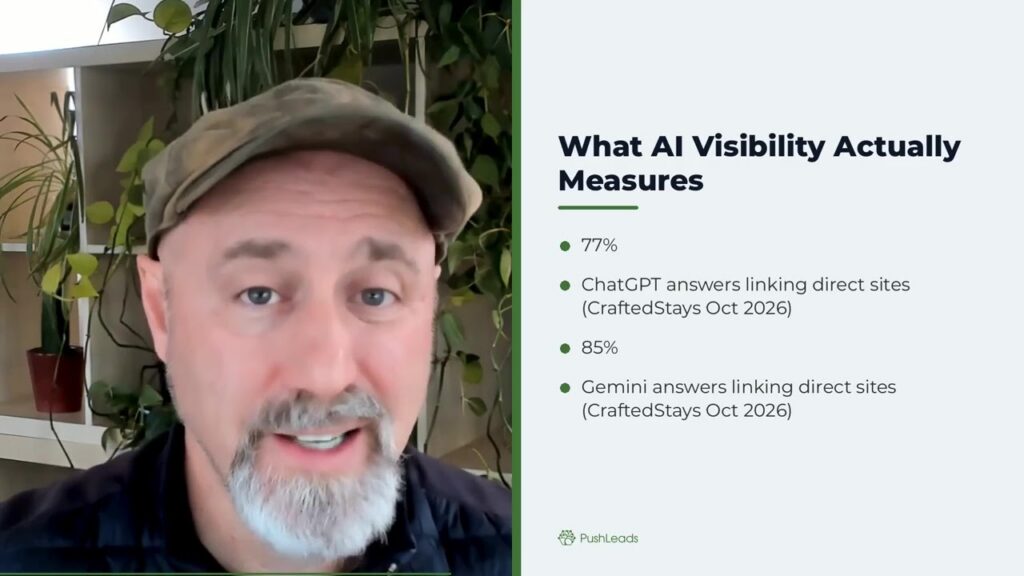
4:52 What AI Visibility Actually Measures
5:35 Why Direct Site Links Matter More Than You Think
6:15 The Content Gap Most Managers Miss
7:07 A Worked Example: How the Math Can Work
8:14 Common Mistakes That Kill Your Chances
9:19 What to Do First
10:22 Why This Will Only Get More Important
11:05 Get Your Free AI Visibility Check
Full transcript
0:00 Intro
Here is the short answer. No, it does not. Crafted Stays tested one thousand four hundred and seven AI answers across ten US markets, and seven in ten linked directly to a property manager’s own website. That is not a fluke. That is a pattern worth understanding. So in this video, I am going to show you exactly what that data found, why some managers get cited and others get skipped, what the cited ones have in common, and what you can do about it today. Let us get into it.
0:35 What the Study Actually Found
Crafted Stays ran this test in October twenty twenty-six. One thousand four hundred and seven AI-generated answers, ten US markets, two models: ChatGPT and Gemini. Here is what surprised most people. Seven in ten answers linked a property manager’s own site, not just Airbnb, not just VRBO, the manager’s own domain. ChatGPT linked direct sites in seventy-seven percent of its answers. Gemini did it in eighty-five percent. That is the data. Crafted Stays is clear this is vendor research and a snapshot, so I am not gonna overstate it, but those numbers are consistent enough to pay attention to.
1:23 Why This Myth Exists
Most property managers assume AI works like a referral to a big platform. They figure ChatGPT just says, "Go check Airbnb," the same way Google used to send everyone to Yelp. That assumption made sense a few years ago. The big listing platforms had all the content, all the reviews, all the authority, but AI does not work the way a directory does. AI is trying to answer a specific question from a specific traveler. Best pet-friendly cabin rentals near Asheville, quiet beach houses that sleep ten in the Outer Banks. To answer that well, the model needs content that actually addresses it, and a lot of that content lives on manager websites, not on platform listing pages.
2:07 How AI Decides What to Cite
AI models pull from sources they can read and trust. That means publicly crawlable web content, pages with clear topic signals, and sites that other credible sources link to or mention. It is not random. It is not pay to play. It is closer to who wrote the most useful answer to this question before the guest even asked it. If your site has a detailed page on pet-friendly rentals near Asheville with amenity lists, local tips, and clear availability context, that page is a candidate. If your site is a thin homepage with six photos and a booking widget, it is not. Seven in ten answers pointed to the same type of manager. Crafted Stay studied which managers kept getting mentioned. Those managers shared several clear traits. Their sites had specific location-rooted content, not just broad phrases like luxury vacation rentals. Think mountain cabins with hot tubs near Boone, NC. They answered real guest questions directly on their pages. Check-in logistics were explained clearly and completely. Pet policies were spelled out without ambiguity. Nearby attractions were listed with actual distances. These managers had earned mentions on outside sites. Local tourism pages linked back to their properties. Regional travel blogs referenced their listings by name. Chamber of commerce directories included their business information. Technical basics were also handled well across the board. Pages loaded fast on every device tested. Mobile-friendly design was standard, not optional. Schema markup helped AI read each page accurately. None of this requires anything close to magic. It mirrors what made managers visible in Google searches. Now it applies to a model answering travel questions. That happens before a guest ever opens a browser.
4:11 The Airbnb Misconception in Detail
Here is why the myth is sticky. Airbnb does show up in AI answers. I am not telling you it does not, but it shows up as a platform option, not as the final destination. An AI answer to best vacation rental managers in Smoky Mountains often looks like this. It names two or three specific management companies, links their direct sites, then adds a line that says you can also search Airbnb and VRBO. The platforms are the afterthought. The specific credible operator is the lead. That is a real shift from how search used to work, and most managers have not caught up to it yet.
4:52 What AI Visibility Actually Measures
Visibility in AI is different from a Google ranking. You do not have a position one or position three. What you have is a citation probability. How likely is it that when someone asks a relevant question, your name or your URL shows up in the answer? You can get a rough read on this yourself. Open ChatGPT. Type, "Who are the best vacation rental managers in," followed by your market. Try a few variations. Pet-friendly cabin rentals managed by a local company near Gatlinburg. Who manages luxury beach rentals in 30A, Florida? If your name is not showing up, that is your baseline. Now you know what you are working with.
5:35 Why Direct Site Links Matter More Than You Think
A citation to your Airbnb profile is not the same as a citation to your own domain. When AI links your site, the guest lands where you control the experience, your brand, your trust signals, your direct booking path. No platform fee on that booking. No competing listings on the same page. The economics matter here. Every booking that comes through a platform costs you a platform fee. A direct booking at the same rate eliminates that cut. If AI is already linking direct sites seven times out of ten, the question is not whether it is possible. The question is whether your site is set up to be one of them.
6:15 The Content Gap Most Managers Miss
Here is the specific problem I see most often. A manager has great properties. They have strong reviews on Airbnb. They have been in business for years, but their own website has five pages: a homepage, a contact page, a generic About Us, maybe a blog post from two years ago. That site cannot compete for AI citations because it has nothing to cite. AI has no specific, useful, crawlable content to pull from. The managers who get cited are the ones who have published real content, area guides that are actually useful, property-specific pages that answer real guest questions, FAQ pages that address the stuff guests search at midnight. That content is what gets pulled. That content is what gets linked.
7:07 A Worked Example: How the Math Can Work
Picture a property management company running forty units in a mid-size mountain market. They are doing fine. Most bookings come through Airbnb and Vrbo. Their own site gets maybe two hundred visits a month. They spend three months building out content. One area guide per neighborhood they serve, updated property pages with real detail, FAQ that covers the top twenty guest questions, a handful of mentions from local tourism sites. Now, when someone asks ChatGPT who manages cabins near Blowing Rock, their site is in the answer. Say that drives fifty additional direct booking inquiries a year. At an average booking value of one thousand five hundred dollars, that is seventy-five thousand dollars in potential direct revenue. No platform, no commission cut. I am using round numbers here to show how the math works, not to predict your exact result. But the direction of the math is real, and the opportunity is sitting there for managers who build the content that earns the citation.
8:14 Common Mistakes That Kill Your Chances
A few things I see managers do that actively hurt their AI citation probability. First, putting all their content on the platform listings. Detailed descriptions on Airbnb, thin generic copy on their own site. AI cannot cite your Airbnb listing as your website. Second, ignoring schema markup. If your site does not use structured data, AI models have a harder time understanding what properties you manage, where, and for what guest type. Third, skipping local directory listings. I am not talking about mass submitting to hundreds of sites. I mean the legitimate local ones: your regional tourism board, your local chamber, relevant travel publications that cover your market. Those links and mentions are part of the trust signal. Fourth, writing content for search engines from two years ago. Keyword-stuffed pages with thin actual information do nothing for AI visibility. Write for the question the guest is actually asking.
9:19 What to Do First
If you want to improve your AI citation probability, here is where to start. Do the manual test I described. Spend twenty minutes in ChatGPT and Gemini asking the questions your guests actually ask. See who shows up. See what their sites look like. Then look at your own site honestly. How many pages do you have? How specific is the content? Does it answer real guest questions? Build one strong area guide for your primary market, not a list of attractions copied from TripAdvisor. An actual useful guide that reflects your local knowledge. That single piece of content can start earning citations. Get on the legitimate local directories you are missing. Your regional tourism board likely has a free listing. That is an afternoon of work. And get your technical basics right. Page speed, mobile experience, schema markup. These are table stakes.
10:22 Why This Will Only Get More Important
Right now, most of your competitors have not thought about this yet. Most of them still assume AI just points to Airbnb. You just watched this video. You know that is not what the data shows. The Crafted Stays snapshot is from October twenty twenty-six. AI answer engines are being used by more travelers every month, not fewer. The share of travel research that starts with an AI question is going in one direction. The managers who build this foundation now will be the ones getting cited when that shift accelerates. The ones who wait will be catching up later against managers who already have the content and the authority built.
11:05 Get Your Free AI Visibility Check
If you want to know exactly where you stand right now, go to PushLeads.com/check or call eight two eight three four eight seven six eight six. We will run a free AI visibility check on your site, show you which questions you are showing up for, which ones you are missing, and what the gap looks like. It takes about fifteen minutes to review together. No cost, no obligation. Go to PushLeads.com/check and get yours today.
Key Takeaways
Crafted Stays tested 1,407 AI-generated answers across ten US markets using ChatGPT and Gemini in October 2026. Seven in ten answers linked directly to a property manager’s own website, not to Airbnb or VRBO. The managers who got cited had specific location-rooted content, answered real guest questions, and had earned mentions on outside sites. If your website is thin and generic, AI has nothing to cite, and your competitors with real content will fill that gap instead.
- ChatGPT linked direct property manager sites in 77% of answers; Gemini did it in 85%.
- AI cites the most useful, crawlable answer to a guest’s specific question, not the biggest platform.
- Managers who get cited share common traits: specific local content, answered guest questions, and outside mentions.
- A direct booking from an AI citation eliminates platform commission fees entirely.
- Schema markup, page speed, and local directory listings are table-stakes technical requirements.
- Most competitors still assume AI just points to Airbnb, so the content gap is real and closeable now.
- Running your own manual test in ChatGPT takes 20 minutes and gives you an honest baseline.
What 1,407 AI Answers Actually Showed About Vacation Rental Citations

Seven in ten AI-generated answers about vacation rentals linked directly to a property manager’s own website, not to Airbnb, not to VRBO, and not to any other listing platform. Crafted Stays ran this test in October 2026, pulling 1,407 answers across ten US markets using two models: ChatGPT and Gemini. ChatGPT linked direct sites in 77% of its answers. Gemini did it in 85%. Those numbers were consistent enough across markets that the pattern holds up, even accounting for the fact that this is vendor research and a single snapshot in time.
I want to be honest about what that means. This is not a guarantee that your site will get cited automatically, and Crafted Stays is upfront that this is their own research. But the direction of the data is clear, and it lines up with what we see at PushLeads when we run AI visibility checks for clients in service-based industries. AI answer engines are not functioning like a directory that routes everyone to the dominant platform. They are functioning more like a knowledgeable friend who has read a lot about your market and is trying to give a specific, useful answer to a specific question.
In this video
- 0:00 ChatGPT Sent Me a Real Client
- 1:22 What the Prospect Actually Asked AI
- 2:24 Why AI Changes the Referral Game
- 3:57 Person vs Faceless Agency Signals
- 5:16 Four Reasons ChatGPT Recommended Me
- 7:12 Consistency Builds AI Confidence
- 8:08 Why YouTube Transcripts Matter to AI
- 9:12 How to Get AI to Recommend You
Full transcript: Can ChatGPT Send You Clients? It Just Sent Me One (Here’s Why)
The practical implication is significant. If a traveler asks ChatGPT who manages pet-friendly cabins near Asheville, the model is not going to say “check Airbnb” and stop there. It is going to try to name a few operators, link their sites, and add the platforms as a secondary option. That changes what it means to compete for guest attention at the very top of the research funnel, before anyone has opened a booking platform at all.
Want more customers from Google & AI search?
Get a free SEO audit of your site — see exactly what to fix first.
Why Property Managers Assumed AI Just Routes Everyone to Airbnb

The assumption that AI would mirror Google’s old behavior and funnel travelers to dominant platforms made complete sense based on how search worked five years ago. Google sent users to Yelp, TripAdvisor, and Airbnb because those platforms had the most content, the most reviews, and the most inbound links. Small operator websites could not compete with that authority, and most stopped trying.
How did Google’s old platform-first behavior shape what managers expected from AI?
When a small vacation rental manager watched their own site disappear from Google results in favor of Airbnb and VRBO listings, the logical takeaway was that the platforms owned search. That lesson got baked into how managers allocated time and money. Put your best content on your Airbnb listing. Build your reviews on the platform. Do not bother with your own website beyond a basic placeholder. That approach worked well enough when Google was the only game in town, but it built a blind spot that is now hurting managers in AI search.
Why does AI answer engines work differently than a search directory?
A search directory matches keywords to pages ranked by authority. An AI answer engine is trying to construct a useful, specific response to a question asked in natural language. Those are fundamentally different tasks. When a traveler types “quiet mountain cabin for a family of six that allows dogs near Boone NC,” a directory surfaces ranked pages. An AI model looks for content that actually addresses those specific requirements: family size, pet policy, location, and character of the property. That specificity usually lives on operator websites, not on platform listing pages that are formatted for browsing rather than answering.
What does Airbnb’s actual role look like in AI answers?
Airbnb does appear in AI answers, and I am not suggesting otherwise. The pattern the Crafted Stays data showed is that platforms appear as secondary options rather than primary citations. A typical AI answer to a vacation rental question names two or three specific management companies with links to their own domains, then closes with a note that the traveler can also search Airbnb and VRBO for additional options. The platforms become the afterthought. The local operator with real content becomes the lead recommendation.
How AI Models Decide Which Sites to Cite

AI models cite sites that have publicly crawlable content, clear topic signals, and credible outside mentions. That is the short version. The longer version involves understanding that AI is not running a live search when it answers a question. It is drawing on what it learned during training, combined in some models with real-time web retrieval. Either way, your site needs to be readable, relevant, and trusted enough to be treated as a credible source.
What makes a vacation rental website crawlable and readable by AI?
Crawlability is the baseline. If your site blocks crawlers, loads so slowly that bots time out, or hides key content behind a booking widget with no surrounding text, AI has nothing to work with. Beyond that, readability means your content is structured in a way that lets a model understand what your business does, where you operate, what property types you manage, and what guest questions you answer. Schema markup is a practical tool here. It tells AI and search engines explicitly: this is a vacation rental business, these are the locations served, this is the type of guest experience offered.
How do outside mentions affect whether AI cites your site?
Outside mentions work as trust signals. When a regional tourism board links to your company, when a local travel blog names your properties, when a chamber of commerce directory includes your business information, those signals tell AI models that you are a recognized operator in your market, not just a website that claims to be one. This is the same logic that makes backlinks valuable in traditional SEO, but the bar here is quality over quantity. A mention from your regional tourism board is worth more than fifty submissions to generic directories.
Does the type of content on your page actually change whether AI cites you?
Yes, and this is where most operators have the biggest gap. AI models need content that actually answers specific guest questions. A page titled “Pet-Friendly Cabins Near Asheville” that lists your properties, explains your pet policy clearly, notes any size or breed restrictions, and includes proximity to dog-friendly trails is a strong candidate for citation. A generic homepage that says “luxury vacation rentals in Western NC” with six photos and a booking widget is not. The specificity of the content is what gets pulled into an AI answer, because the specificity is what answers the guest’s actual question.
What the Cited Property Managers Had in Common

Managers who consistently appeared in AI citations across the Crafted Stays data shared four clear traits: specific location-rooted content, direct answers to guest questions on their pages, earned mentions from outside sources, and solid technical fundamentals. No single one of those is optional if you want to compete for citations reliably.

What does specific location-rooted content actually look like in practice?
Location-rooted content goes beyond putting a city name in a title tag. It means your pages reflect genuine local knowledge. A page on mountain cabins near Boone, NC should include which neighborhoods or areas you operate in, what guests typically ask about those areas, what makes the experience different from a cabin in another market, and what local context a traveler needs to plan their trip. “Luxury vacation rentals in the mountains” is a category. “Dog-friendly cabins with hot tubs within 10 miles of downtown Boone” is an answer to a question someone actually asks.
How important are guest FAQ pages for AI citation probability?
FAQ pages are one of the highest-value content types for AI citation because they are structured around questions, which is exactly how AI retrieval works. If a guest types a question into ChatGPT and your FAQ page contains a clear, well-written answer to that question, your page is a natural candidate to be cited. The topics that perform well are the ones guests actually search at midnight when they are anxious about a trip: check-in logistics, pet policies, what happens if the hot tub is broken, parking situations, nearest grocery store. Write those answers like you are texting a guest, not like you are filing paperwork.
Why do local directory listings still matter for AI visibility?
Local directory listings matter because they create the kind of consistent, verifiable outside mentions that AI models use to confirm a business is real and established. I am not talking about mass-submitting to hundreds of generic sites. The ones that count are your regional tourism board, your local chamber of commerce, and legitimate travel publications that cover your specific market. Getting listed on those takes an afternoon of work and can be done at no cost in most markets. That afternoon of work contributes to a trust profile that influences whether AI treats your site as a credible source.
The Content Gap Most Vacation Rental Managers Are Sitting On

The most common situation I see when we do an AI visibility check for a vacation rental manager is a business with great properties, strong Airbnb reviews, years of experience, and a website with five pages. A homepage, a contact page, a generic About Us, an empty blog, and a booking widget. That site cannot compete for AI citations because there is nothing specific enough to cite. AI has no useful, crawlable content to pull from, so it pulls from someone else who does.
Why does strong Airbnb content not carry over to AI citations for your own site?
Your Airbnb listing is on Airbnb’s domain. When AI cites it, the citation goes to Airbnb, not to you. The traveler lands on a platform page surrounded by competing listings, Airbnb’s branding, and a booking flow that includes a platform fee. Even if your listing is excellent, the citation does not build your brand or drive traffic to a site you control. That content effort goes entirely to building Airbnb’s authority, not yours. The managers getting direct-site citations have invested the same care in content on their own domain.
What is the minimum content investment needed to become citable?
Starting from a thin five-page site, the minimum meaningful investment is one strong area guide for your primary market, updated property pages that answer real guest questions rather than just listing amenities, and a FAQ that covers the 15 to 20 questions guests ask most often. That is probably 8 to 12 pieces of real content. It is not a small lift, but it is not an impossible one either, and right now most of your competitors have not done it. The window to build this content while the field is still open is real, and it will not stay open indefinitely.
How should a vacation rental area guide be different from a typical tourist page?
A useful area guide reflects actual local knowledge, not content copied from TripAdvisor. It answers the questions a property manager who has fielded thousands of guest calls would know: which grocery store is closest to the cabin clusters you manage, which trails are dog-friendly with parking, what the cell coverage situation is in certain areas, which local restaurants accommodate large groups without reservations. That kind of specific, experience-based content is what gets extracted by AI as a genuinely useful source. Generic attraction lists do nothing because every other site already has them.

How the Math Works When AI Starts Citing Your Site

A direct booking that comes from an AI citation eliminates the platform commission fee entirely. At the same booking rate, that is a materially different margin on every transaction, and the math compounds quickly as citation frequency increases.
What does the revenue opportunity actually look like for a mid-size property manager?
Picture a property management company running 40 units in a mountain market, doing fine on Airbnb and VRBO, with their own site drawing maybe 200 visits a month. They spend three months building out content: one area guide per neighborhood they serve, updated property pages with real detail, a FAQ covering the top 20 guest questions, and a handful of mentions from local tourism sites. Now, when someone asks ChatGPT who manages cabins near a specific area, their site appears in the answer. If that drives 50 additional direct booking inquiries a year at an average booking value of $1,500, that is $75,000 in potential direct revenue with no commission cut. I am using round numbers to show how the math works, not to promise a specific result, but the direction of the math is real.
Why does a citation to your own domain beat a citation to your Airbnb profile?
When AI links your site, the guest lands where you control everything: your brand presentation, your trust signals, your direct booking path, and your ability to capture their contact information for future marketing. No competing listings on the same page. No platform fee on the booking. No algorithm deciding whether to show your property or bump a competitor. To understand what factors influence whether a guest books at all, the review rating AI recommends is worth understanding alongside the content work, because both factors influence citation probability and guest conversion once they land on your page.
How should a manager think about the time investment compared to the return?
The content work needed to become citable is a one-time investment that compounds over time. A well-written area guide does not expire. A thorough FAQ page keeps answering guest questions without you having to answer them individually. The technical improvements like schema markup and page speed are set-and-maintained, not rebuilt monthly. Compare that to platform fees, which are paid on every single booking forever. The break-even on a reasonable content investment, measured against even a modest increase in direct bookings, happens faster than most managers expect when they actually run the numbers.
Common Mistakes That Reduce AI Citation Probability

Four specific mistakes consistently reduce the chance that AI will cite a vacation rental manager’s site, and all four are fixable without a large budget or a technical team.
Why does putting your best content on platform listings hurt your own site?
Platform listings and your own website are competing for the same content investment. When managers write detailed, specific, compelling descriptions for their Airbnb listings and leave their own site with thin placeholder copy, they are building authority for Airbnb’s domain rather than their own. AI cannot cite your Airbnb listing as your website. The citation goes to Airbnb.com. The effort that went into that listing description should be on a page you own, in a format you control, on a domain that builds your brand equity with every citation it earns.
What does keyword-stuffed content do to AI citation chances?
Content written for search engines from several years ago, with keyword phrases repeated awkwardly and thin actual information padded out to hit a word count, performs poorly for AI citation. AI models are evaluating usefulness, not keyword density. A page that says “Asheville vacation rentals Asheville NC Asheville cabins Asheville mountain rentals” twelve times and provides no real information is not useful to a model trying to answer a specific guest question. Write for the question the guest is actually asking. Clear, specific, honest answers to real questions are what get cited. To learn more about how to get recommended by AI for your specific business type, the principles apply across service industries, not just vacation rentals.
How does skipping schema markup affect how AI reads your site?
Schema markup is structured data that tells AI and search engines explicitly what your page is about. Without it, a model has to infer from your content what type of business you are, what locations you serve, and what property types you manage. With it, that information is stated clearly in a format the model can read directly. For vacation rental managers, relevant schema types include LocalBusiness, LodgingBusiness, and FAQ schema for question-and-answer pages. It is not glamorous work, but it reduces the ambiguity that causes AI to pass over your site in favor of one that is easier to read and categorize.
Where to Start If You Want to Improve Your AI Citation Probability

Start with the manual test, because it gives you a real baseline in 20 minutes without spending anything. Open ChatGPT and type the questions your guests actually ask. “Who are the best vacation rental managers near Gatlinburg?” “Who manages pet-friendly cabins in the Smokies?” “What local company handles luxury beach rentals in 30A?” Note who shows up and what their sites look like when you visit them.
How do you audit your own site to see where the content gaps are?
After you run the manual test and look at your competitors’ sites, look at your own with the same eyes. Count your pages. Read the actual content on each one. Ask honestly: does this page answer a specific question a guest would actually ask? Does it reflect genuine local knowledge? Does it explain policies clearly? Does it load fast on a phone? Most managers who do this exercise realize within ten minutes that their site has the basics but not the substance needed to earn citations. That gap is fixable, but only if you see it clearly first.
What is the single highest-impact first content piece to build?
One strong, genuinely useful area guide for your primary market is the highest-impact first piece because it covers the broadest range of guest questions in one place and signals to AI that you have local authority in that specific area. It should include neighborhood character, proximity information with actual distances, pet policies if relevant to your properties, what to know before arrival, and local context that only someone who operates there would know. That single piece of content, done well, can start earning citations and can be expanded and updated as your operation grows.
Which local directories should a vacation rental manager prioritize?
Prioritize directories that are legitimate, locally recognized, and manually reviewed rather than automated aggregators. Your regional tourism board is usually free and highly authoritative for your market. Your local chamber of commerce directory is another afternoon of work with real trust signal value. If there are established regional travel publications or blogs that cover your specific market and accept business listings or editorial mentions, those are worth pursuing. The goal is a small number of high-quality mentions, not a large number of irrelevant ones.
Frequently Asked Questions
Does ChatGPT really link to property manager websites instead of Airbnb?
Yes, according to the Crafted Stays data from 1,407 AI-generated answers across ten US markets, ChatGPT linked directly to property manager websites in 77% of answers and Gemini did so in 85% of answers. This does not mean Airbnb never appears. It means platforms tend to appear as secondary options while specific local operators with detailed, crawlable content are cited as the primary recommendations. The data is a vendor snapshot, but the pattern is consistent enough to act on.
How long does it take for new content to start showing up in AI citations?
There is no published timeline, and it varies by model and how frequently a site is recrawled. As a practical frame, the content work needs to exist and be indexed before it can be cited. For sites that are already crawled regularly, new substantive pages can begin influencing AI outputs within weeks to a few months. The technical fundamentals like schema markup, page speed, and local directory listings support faster recognition. Building a handful of quality outside mentions alongside new content tends to accelerate the process.
Can a small vacation rental manager with 5 properties compete with large operators for AI citations?
Yes, because AI citation is based on content relevance and credibility, not on business size. A small operator who has published a detailed area guide, answered guest questions thoroughly on well-structured pages, and earned a few legitimate local directory mentions can outcompete a large operator with a thin website. The managers who get cited consistently are the ones with the most useful content for the specific question being asked, regardless of how many units they manage or how long they have been in business.
Do I need to hire an SEO agency to improve my AI visibility?
Not necessarily to get started. The manual test in ChatGPT costs nothing. Building one strong area guide, updating property pages with real detail, and getting listed on your regional tourism board are all things a motivated manager can do without outside help. Where an agency adds value is in technical implementation like schema markup and page speed, in identifying content gaps systematically across your market, and in tracking citation probability over time as AI models update. The initial diagnostic and content audit are reasonable DIY starting points.
What is the difference between AI visibility and traditional SEO rankings?
Traditional SEO gives you a rank position on a search results page, like position one or position eight for a given keyword. AI visibility is better described as citation probability: how likely is it that when someone asks a relevant question, your name or URL appears in the AI-generated answer? There is no position one in an AI answer the same way there is in Google results. What matters is whether your content is specific enough, credible enough, and well-structured enough to be pulled as a source for a given question. The underlying content work overlaps significantly with traditional SEO but the measurement is different.
Should I still optimize my Airbnb listing if I am also building my own site?
Yes. Platform listings still drive bookings and your Airbnb reviews contribute to your overall credibility as an operator. The point is not to abandon platform listings but to stop treating them as a substitute for your own site’s content. The best approach is to maintain strong platform listings for the bookings they generate while simultaneously building the content and authority on your own domain that earns AI citations and direct bookings. Those two efforts are not in conflict. They serve different parts of the booking funnel.
How do I know if my site is currently being cited in AI answers?
The quickest method is the manual test: open ChatGPT and Gemini and type the questions your guests actually ask, using your market name and your property types. Run five to ten variations and note whether your domain appears. This gives you a rough, free baseline. For a more systematic view, an AI visibility check from an agency like PushLeads tests a broader set of relevant questions, compares your citation rate against competitors in your market, and identifies which content gaps are most likely responsible for missing citations. That kind of structured audit shows you exactly where you stand.
Will AI citation opportunities disappear as the technology changes?
The specific mechanics of how AI models retrieve and cite sources will evolve, but the fundamental principle that credible, specific, well-structured content earns citations is unlikely to reverse. The share of travel research starting with an AI question is increasing month over month. Managers who build content and authority now are positioning themselves for a channel that is growing, not shrinking. The managers who wait until AI search becomes impossible to ignore will be building from scratch against competitors who already have the content and the citation history established.

Build Your AI Citation Foundation Before Your Competitors Do
Most vacation rental managers in your market are still operating on the assumption that AI just routes travelers to Airbnb. The data shows that is not what is happening. Seven in ten AI answers already link directly to operator sites. ChatGPT at 77% and Gemini at 85% are both pointing to managers who did the work of building real content on their own domain. That content gap is real, and it is closeable right now because most of your competitors have not started.
The steps are not complicated. Run the manual test in ChatGPT today and see where you stand. Look at your own site honestly and count how many pages have specific, useful content that answers real guest questions. Build one strong area guide for your primary market. Get listed on the legitimate local directories you are missing. Get your technical fundamentals right: page speed, mobile experience, schema markup. Each of those steps moves the needle on your citation probability.
At PushLeads, we run a free AI visibility check that shows you exactly which questions you are appearing for, which ones you are missing, and what the content gap looks like compared to competitors in your market. It takes about 15 minutes to review together and there is no cost or obligation. If you want to know where you stand before your competitors figure this out, reach out to us at https://pushleads.com/contact/ and we will get you that visibility check.
Keep Reading
Want more customers from Google & AI search?
Get a free SEO audit of your site — see exactly what to fix first.
Your path · AI
Keep going: read these next

- Up nextThe AI Search Revolution: How 2 Billion People Are Finding Information in 2025
- Zero-Click SEO and AI Overviews: The Complete Guide to Winning When Users Never Visit Your Website
- AI-SEO: How Artificial Intelligence is Revolutionizing Search Rankings in 2026



Want this done for you?
Scan your site. See the gaps. Decide with numbers.
- Rankings, Google Business Profile and site-speed teardown
- Report lands in your inbox in about a minute
- No obligation · 4.9 from 67 Google reviews
 Continue reading