

✓Are You Ready to Market Hoarding Cleanup?8 quick questions · about 1 minuteStart
0:00 Hoarding Cleanup Marketing Overview
0:34 Why Hoarding Cleanup Is Not a Niche
1:34 Certifications and Equipment Required
2:54 Pricing Ranges by Hoarding Level
3:41 Building Referral Networks
4:29 Compassionate Language Requirements
5:14 Local SEO for Hoarding Cleanup
6:12 Paid Ads and LSA Strategy
7:44 On-Site Staff Training
8:51 Independent Advantages Over Franchises
9:44 Six-Step Launch Sequence
Full transcript
Google Ads for water restoration connects your company with homeowners searching for emergency help the moment disaster strikes. This guide covers Local Service Ads setup, cost-per-lead expectations, the Google Guaranteed badge verification process, and optimization strategies so your restoration company captures high-intent leads and maximizes ROI from every dollar spent.
0:34 Why Hoarding Cleanup Is Not a Niche
Stepping back for a second, I'm Jeremy. PushLeads is my agency, and restoration company owners are the people I answer to. My first sites hit Google's first page back in 2007, and I never stopped. Today we're covering hoarding cleanup marketing. A meta -analysis in the Journal of Effective Disorders puts hoarding prevalence at roughly one in 40 adults. That is not a niche. That is a substantial growing market. Most restoration companies skip this work or handle it insensitively, missing consistent revenue and deep referral networks. Hoarding disorder became a distinct DSM -5 diagnosis in 2013. A mental health condition, not a character flaw, up to 40 percent of individuals with hoarding disorder live in poverty, and the condition commonly co -occurs with depression, anxiety, OCD, autism spectrum disorder, and ADHD. Understanding that context drives every marketing decision you will make here.
1:34 Certifications and Equipment Required
Before spending a dollar on marketing, get operations in order. You need OSHA Bloodborne Pathogen Training, legally required for level four and five work. You need ICRC Fire and Smoke Restoration Certification to validate odor remediation and support Zactimate line items. You need respirators, Tyvex suits, HEPA negative air machines, ozone generators, and licensed biohazard waste transport, and you need a CRM that tracks hoarding jobs separately from standard restoration. That separation lets you measure true margin and identify which referral sources produce your best work. The Institute for Challenging Disorganizations 5 -level clutter hoarding scale guides professional assessments. Level one is minimal impact, standard cleaning works. Level two is moderate clutter requiring deep cleaning with minor remediation. Your marketing target begins at level three, one bedroom unusable, heavy dust, light rodent activity, potential biohazard protocols, level four adds visible mold, rotting food, heavy pest infestation, and full OSHA requirements. Level five means structural damage, no functioning utilities, hazardous materials, and equipment most competitors cannot match. That is your competitive moat.
2:54 Pricing Ranges by Hoarding Level
Publish pricing ranges on your website. Families need to know professional help is financially possible before they call. Hiding pricing increases bounce rates. Level three jobs typically run twenty five hundred to seventy five hundred dollars. Level four runs seventy five hundred to twenty five thousand dollars or more. Level five ranges from fifteen thousand to fifty thousand dollars or higher when demolition and extensive remediation are required. Biohazard certification requirements add twenty five to fifty percent to base pricing. Animal hoarding with feces, remediation commands, premium rates, rush timelines for eviction deadlines at additional fees, use exactimate on every job, even cash pay work to document scope professionally and protect against disputes.
3:41 Building Referral Networks
The highest value leads come from professional referral sources at near zero ongoing cost. Once relationships are established, start with Adult Protective Services, APS offices investigate unsafe conditions for vulnerable adults, and hoarding triggers their involvement regularly, contact mental health practices, and local hoarding support groups. Offer a short presentation on how your process supports therapeutic progress. Build relationships with code enforcement officers who need reliable contractors to restore compliance fast, add estate attorneys and fiduciaries for post -death cleanups, and commercial property managers for eviction situations. Search your county name plus hoarding task force, a task force member, see you work, trust your approach, and refer you for everything.
4:29 Compassionate Language Requirements
Compassionate language is a direct business requirement. Social workers, therapists, and APS caseworkers talk to each other. One insensitive interaction gets shared across the county's entire professional network. One genuinely compassionate job can produce referrals for years, never use hoarder homes, use hoarding situations, or cluttered environments, never use disgusting, gross, or crazy, removed before and after photos that sensationalize conditions, lead with phrases like restoring safe living conditions with dignity, professional discrete clean -up services, and working alongside mental health professionals. Address the emotional complexity of letting go. Not just the physical labor.
5:14 Local SEO for Hoarding Cleanup
Local SEO for hoarding cleanup follows a clear checklist. First, claim and fully optimize your Google Business Profile. List hoarding cleanup as a name service, and collect reviews mentioning hoarding work specifically. BrightLocal data shows businesses with more than 10 reviews rank meaningfully higher in local pack results. Second, build a location -specific service page with at least 600 words covering process, certifications, and pricing context. Third, target primary keywords like hoarding cleanup plus your city. Plus, long -tail terms like level five hoarding cleanup and compassionate hoarding help. Fourth, add local business and service schema markup. Search engine land has documented that structured data improves click -through rates even without ranking changes. Fifth, publish educational blog content answering what families and referral professionals search. Sixth, link hoarding pages to mold, water damage, and biohazard pages to build topical authority.
6:12 Paid Ads and LSA Strategy
Paid advertising accelerates lead generation while SEO builds. Hoarding cleanup queries carry high commercial intent. Someone searching hoarding cleanup near me is ready to hire. Google Local Services Ads appear above standard paid results. Operate on a paper lead model, and carry the Google guaranteed badge. That badge matters because clients and families are making emotionally charged high -stakes decisions. For search campaigns, lead with compassion and credentials, discrete certified hoarding cleanup, free on -site assessment, add negative keywords for TV show, DIY, and documentary to block irrelevant clicks. Start with $1,500 to $3,000 per month in a midsize market. Hoarding cleanup jobs average $5,000 to $20,000. So one close lead monthly more than covers spend, set up Google conversion tracking. It is free and takes about 30 minutes through Google Tag Manager. Comparing lead channels, referral networks from adult protective services, therapists, and code enforcement produce the highest quality leads at near zero ongoing cost. They just take time to build. Google Local Services Ads and search ads produce high quality fast leads at roughly $60 to $200 per lead. Local SEO and your Google Business Profile deliver high quality leads at low ongoing cost after a three to nine month ramp.
7:44 On-Site Staff Training
Facebook ads work best as awareness and retargeting complement to Google, not a replacement because intent is lower on social. Companies that win in hoarding cleanup run at least three of these channels simultaneously rather than betting on one. Your team's behavior on site directly determines whether referral relationships grow or collapse. Train staff to recognize trauma responses. Hoarding often connects to grief and loss, requiring patience, not pressure, establish a clear valuable item protocol, identify documents, jewelry, cash, and sentimental objects before anything is removed. Train staff to navigate family dynamics professionally. Conflicting opinions are common when therapists or social workers are involved. Understand appropriate communication channels and never undermine clinical relationships. Use unmarked vehicles and confidential job handling. Referral sources like APS case workers and therapists watch how you operate. And one reported incident of insensitivity ends that referral relationship permanently.
8:51 Independent Advantages Over Franchises
Independent restoration companies have real advantages over franchises like Spalding Decon and Bio One. Spalding Decon has grown to over 50 locations since franchising in 2015 with investment ranges of $163,000 to $205 ,000 and 8% royalty fees. That royalty drag limits pricing flexibility. You have no royalty fees enabling competitive pricing on every job. More importantly, you have genuine local relationships built over years. A franchise owner elsewhere cannot replicate trust developed with local APS offices, code enforcement, and mental health practices, emphasize local presence, personal accountability, and integration with your water or fire and mold services. Those connected services increase job value and referral flow from the same professional network,
9:44 Six-Step Launch Sequence
your launch sequence. Step one, obtain OSHA Bloodborne Pathogen Training and IICRC Credentials before marketing level four or five work. Step two, build your first two referral relationships, one with a local APS contact and one with a mental health practice. Step three, fully optimize your Google Business Profile for hoarding cleanup and collect reviews naming the work specifically. Step four, launch Google Local Services Ads with compassionate credential forward copy. Step five, publish three to five educational blog posts answering what families and referral professional search levels of hoarding, cost, timelines, insurance, and what to expect. Step six, track every call, form fill, and close job by source in your CRM, then double down on the two channels producing your highest margin work. Build one channel at a time, a layer, and track hoarding revenue separately from day one. Hoarding cleanup is a high value out recession resistance service line. Most restoration companies ignore or handle poorly companies that market it well with compassionate messaging, active referral development, targeted paid ads, and solid local SEO, build revenue streams producing both high dollar cleanup jobs and downstream water, fire, and mold work from the same referral relationships. PushLeads specializes in marketing for restoration companies, including hoarding cleanup lead generation. See exactly where your visibility stands with a free teardown. Find the link in the description or call 828 -348 -7686.
By Jeremy Ashburn, Founder of PushLeads · Last updated August 26, 2026
TL;DR: Google Local Service Ads charge per lead (not per click) and appear above all other search results with a Google Guaranteed badge. Lead costs run $60-200 each for restoration work. A single closed job at $5,000-20,000 covers months of ad spend, making LSAs one of the highest-ROI channels for restoration companies right now.
Contents
- How Google Local Service Ads Work for Restoration Companies
- Google Ads for Water Restoration: LSAs vs. Traditional Campaigns
- What LSA Lead Costs Actually Mean for Your Bottom Line
- Setup Requirements and Google Guaranteed Badge
- Google Ads Strategy for Fire Damage Restoration
- Storm Damage Restoration: Layering LSAs with Other Channels
- What a Google Ads Agency Does for Restoration Companies
- Quick Recap
- Frequently Asked Questions

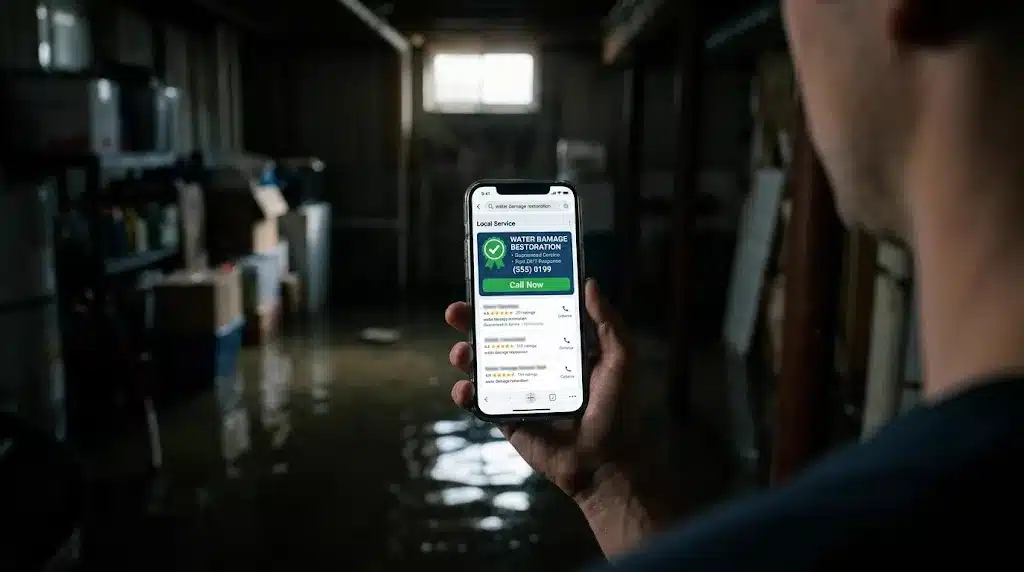
When a homeowner wakes up to a flooded basement at 3 AM, they grab their phone and search "water damage restoration near me." The first result they see is a Google Local Service Ad for a restoration company showing a Google Guaranteed badge, a star rating, and a tap-to-call button. For restoration companies in Asheville, NC and across the country, that top placement is where emergency leads are won or lost.
Google Local Service Ads (LSAs) run on a pay-per-lead model, not a pay-per-click model. You are only charged when a potential customer contacts your business directly through the ad. LSAs tend to convert at higher rates than traditional pay-per-click campaigns. That gap, combined with placement above every other search result, makes LSAs one of the highest-ROI advertising channels available to restoration companies right now.
By Jeremy Ashburn, founder of PushLeads, an Asheville, NC SEO and digital marketing agency for contractors and home-service businesses.
How Google Local Service Ads Work for Restoration Companies
Part of our Restoration SEO: The Complete Restoration Company SEO Guide. Want it done for you? See our restoration SEO and marketing agency.
Google Local Service Ads appear above standard Google Ads, the Map Pack, and all organic listings. When someone searches for restoration services in your area, your LSA displays your business name, phone number, hours, service area, star rating, and the Google Guaranteed badge. The pay-per-lead structure changes the economics entirely compared to traditional advertising.
With standard Google Ads for restoration keywords costing $40-80 per click, and many clicks never turning into a call, LSAs charge you only when someone actually contacts your business. The average LSA cost per lead varies widely depending on location, competition, and service type. For water damage restoration specifically, plan for lead costs in the $40-85 range. Fire damage and mold remediation typically fall in a similar band.
See also our guide on Google analytics 4 courses.
What makes LSAs especially valuable for emergency services is intent. Research indicates that a large share of people who search for local services on mobile call within 24 hours. These are not people browsing options for a future project. They have water on the floor right now and need a company that answers the phone.
Google Ads for Water Restoration: LSAs vs. Traditional Campaigns
Google Ads for water restoration can mean two very different things: traditional keyword-based search campaigns or Local Service Ads. Both work. Both generate leads. But the mechanics, costs, and conversion rates differ significantly.
| Feature | Local Service Ads (LSA) | Traditional Google Ads |
|---|---|---|
| Placement | Above all other results | Below LSAs, above organics |
| Billing Model | Pay-per-lead | Pay-per-click |
| Cost per Lead | $60-200 | $40-80 per click, higher cost to convert |
| Google Guaranteed Badge | Yes | No |
| Phone Number Display | Always visible | Depends on ad format |
| Conversion Rate | Higher (intent-driven searchers) | Moderate to lower |
Setting up Google conversion tracking, which is free and takes about 30 minutes through Google Tag Manager, is essential for measuring which channel produces actual jobs. Without it, you cannot tell if your LSA spend is driving real revenue or just generating calls that never close.
In this video
- 0:00 Pay Per Click Costs for Restoration Companies
- 0:36 Cost Per Click vs Cost Per Lead
- 1:46 Quality Score Explained
- 2:35 Campaign Structure and Why It Matters
- 3:21 Ad Rank Five Real Inputs
- 3:59 Negative Keywords Done Right
- 4:47 Match Types Exact Phrase Broad
- 6:12 Landing Page Experience and Speed
- 6:48 Retargeting for Restoration Companies
- 7:27 Benchmark Numbers for Every Campaign
- 8:09 Ad Extensions and Ad Rank
- 9:07 Building Campaigns That Lower CPC
Full transcript: Pay Per Click for Restoration Companies: Full Strategy
Want more customers from Google & AI search?
Get a free SEO audit of your site — see exactly what to fix first.
What LSA Lead Costs Actually Mean for Your Bottom Line
LSA leads for restoration companies run roughly $60 to $200 per lead. A reasonable starting search ad budget in a midsize market is $1,500 to $3,000 per month. Given that restoration jobs can average $5,000 to $20,000, one closed job per month typically covers the full monthly ad spend.
This is the number that matters most. If your average water damage job brings in $8,000 in revenue and your LSA spend is $2,000 per month generating two leads, and you close one of those, you just spent $1,000 per job to acquire it. For a job worth $8,000, that is a 12.5% customer acquisition cost, which is sustainable and scalable.

Pay-per-click search ads for restoration generate high-quality leads quickly at roughly $60 to $200 per lead. The math is the same: a single closed lead each month more than covers the ad spend. The difference is that traditional Google Ads demand much heavier management. Keyword selection, negative keywords, bid strategy, and ad copy all directly affect your cost per click. A poorly managed traditional campaign can waste 40-50% of spend on irrelevant clicks.
LSAs remove that waste because you only pay when someone actually contacts you.
Related: Google Ads for Restoration Companies.
Setup Requirements and Google Guaranteed Badge
To run Google Local Service Ads, your restoration company needs a few things in place. You must have a Google Business Profile that is verified and current. You must pass a background check. You need to carry appropriate insurance (proof required). Many restoration companies also benefit from having business citations on trusted platforms like the Better Business Bureau.
The Google Guaranteed badge is what separates LSAs from other paid channels. It signals to homeowners that Google has vetted your business, you carry insurance, and you stand behind your work. That badge is especially powerful in emergency situations. A homeowner dealing with a burst pipe does not have time to research five companies. They see the badge and they call.
Setting up LSAs is done through the Google Local Services Ads platform. You answer questions about your service area, services offered, hours, and background information. Google reviews your application. Once approved, you begin receiving leads. Simple as that.

Google Ads Strategy for Fire Damage Restoration
Google Ads produce high-quality fire damage restoration leads quickly because search queries carry high commercial intent. Someone searching for fire damage cleanup is ready to hire. Combining LSAs with standard search campaigns, using credential-forward copy, and adding negative keywords for irrelevant terms keeps cost per lead in a manageable range.
Fire damage searches carry even higher urgency than water damage. People are not comparison shopping. They want to know if you are licensed, insured, and available. Your LSA and ads should lead with those credentials. In your ad copy, mention that you are licensed and insured. Include response time. Use phrases like "available 24/7" or "arrive within 2 hours" if true.
Negative keywords matter here. Add terms like "how to" or "DIY" to prevent your ads from showing to people looking for damage assessment guides rather than restoration services. You are paying per lead, so filtering out the wrong intent early saves money.
Storm Damage Restoration: Layering LSAs with Other Channels
Storm damage restoration ads should lead with credentials and response speed to match urgent searcher intent. Layering Google Local Service Ads above standard search campaigns maximizes visibility. Companies that run at least three lead channels simultaneously, rather than betting on one, consistently outperform those relying on paid ads alone.
Three lead channels might look like this: Google Local Service Ads, standard Google Ads, and SEO focused on local terms. During storm season, your LSA budget might double. Your standard Google Ads run consistently. And your organic rankings for terms like "storm damage cleanup Asheville" continue driving free traffic from people researching their options.

This layering approach protects you. If one channel underperforms in a given month, you still have two other sources of leads. A prepared storm season strategy includes budget for all three channels plus a clear process for handling surges in lead volume.
What a Google Ads Agency Does for Restoration Companies
A Google Ads agency for water damage restoration manages campaign structure, bidding, ad copy, and conversion tracking so jobs, not just clicks, are measured. They should set up Google conversion tracking, which takes about 30 minutes through Google Tag Manager, and track every call and form fill back to the channel that produced it.
This is part of our SEO for restoration companies guide.
A good agency does more than set up campaigns and let them run. They audit your Google Business Profile to ensure it is complete and optimized. They review your existing customer reviews and ratings. They help you understand which service areas are generating the most profitable leads. They adjust bids and budgets based on performance data, not guesswork.
For a restoration company, an agency should also help you understand seasonal demand. Spring brings water damage claims. Summer brings storm damage. Fall and winter bring fire damage and heating issues. A skilled agency adjusts your ad strategy to match these patterns rather than running the same spend every month.
Quick Recap
- Google Local Service Ads charge per lead, not per click, and appear above all other search results.
- LSA lead costs range from $60-200 depending on location and service type.
- A single $5,000-20,000 restoration job covers months of LSA spend.
- The Google Guaranteed badge builds trust during urgent, high-stakes decisions.
- Setup requires a verified Google Business Profile, background check, and insurance documentation.
- Layering LSAs with traditional Google Ads and organic SEO creates a stable, multi-channel lead pipeline.
- Conversion tracking is free and essential for measuring true ROI.
- Seasonal demand matters: adjust budgets for spring water damage, summer storms, and winter fire damage.
LSA Profile and Budget Decisions That Affect Lead Quality
A few operational choices inside your LSA account have an outsized effect on whether the leads you receive are worth paying for.
- Service area sizing: Setting your coverage zone slightly tighter than your maximum drive range keeps leads geographically qualified and reduces disputes. Including ZIP codes you rarely serve produces unqualified leads that eat budget.
- Capacity-matched budgets: Your weekly budget should reflect how many jobs your crew can actually handle, not an arbitrary spend ceiling. Generating more leads than your team can respond to quickly works against your LSA ranking because Google factors response rate into ad placement.
- Seasonal timing: Budget increases make the most sense ahead of frozen-pipe season in winter, spring flooding periods, and hurricane and storm season in fall. Coordinating LSA spend increases with those windows concentrates dollars when demand and lead intent are both high.
- Profile photos: Uploading before-and-after project photos alongside a team photo meaningfully improves conversion rates compared to profiles that show only a logo.
How the Google Guaranteed Badge Builds Trust With Emergency Callers
For restoration companies, the Google Guaranteed badge carries weight beyond just ad placement. Homeowners contacting a restoration company are often in a stressful, high-stakes situation, and the badge signals that Google has already screened the business for licensing, insurance, and background requirements. That pre-verified credibility can be the deciding factor when someone is choosing between several companies at the top of the results page.
A few profile decisions directly affect how the badge performs for your business once it is active:
- Keeping license and insurance documentation current prevents automatic ad pauses that cut off lead flow during your busiest seasons.
- Accurate business hours tied to actual phone coverage protect your responsiveness score, which influences where your ad ranks within the LSA block.
- Disputing leads that fall outside your service area or scope is a legitimate way to lower your effective cost per acquisition over time.
These operational details matter because the LSA ranking algorithm weighs profile quality and responsiveness alongside bid amounts. Restoration companies that treat every inbound lead as a priority and keep their verification documents up to date tend to hold stronger positions in the LSA block than competitors relying on budget alone.
Frequently Asked Questions
How do Google Local Service Ads work for water restoration companies?
Google Local Service Ads appear above standard paid search results and operate on a pay-per-lead model rather than pay-per-click. They also carry the Google Guaranteed badge, which matters because restoration clients are making emotionally charged, high-stakes decisions. LSA leads for restoration work typically cost roughly $60 to $200 per lead.
What is pay per click for restoration companies and is it worth it?
Pay-per-click search ads for restoration generate high-quality leads quickly at roughly $60 to $200 per lead. A midsize market starting budget of $1,500 to $3,000 per month is reasonable. Because restoration jobs average $5,000 to $20,000, a single closed lead each month more than covers the ad spend.
How much do Local Service Ads cost for restoration companies?
LSA leads for restoration companies run roughly $60 to $200 per lead. A reasonable starting search ad budget in a midsize market is $1,500 to $3,000 per month. Given that restoration jobs can average $5,000 to $20,000, one closed job per month typically covers the full monthly ad spend.
Are Google Ads effective for fire damage restoration?
Google Ads produce high-quality fire damage restoration leads quickly because search queries carry high commercial intent. Someone searching for fire damage cleanup is ready to hire. Combining LSAs with standard search campaigns, using credential-forward copy, and adding negative keywords for irrelevant terms keeps cost per lead in a manageable range.
How do Google Ads work for water damage restoration?
Water damage restoration search ads work on a pay-per-click model, while Local Service Ads above them charge per lead instead. Both capture high-intent searchers ready to hire. Setting up Google conversion tracking, which is free and takes about 30 minutes through Google Tag Manager, is essential for measuring which clicks produce actual jobs.
What Google Ads strategy works for storm damage restoration?
Storm damage restoration ads should lead with credentials and response speed to match urgent searcher intent. Layering Google Local Service Ads above standard search campaigns maximizes visibility. Companies that run at least three lead channels simultaneously, rather than betting on one, consistently outperform those relying on paid ads alone.
What is LSA marketing for restoration companies?
LSA marketing places restoration companies in Local Service Ads, which appear above all standard paid results on Google. Leads are charged per contact rather than per click, and the Google Guaranteed badge is displayed with every listing. Restoration leads through this channel typically cost $60 to $200 each.
Contact us today to set up your Google Local Service Ads
Google Local Service Ads are one of the fastest ways to generate qualified leads for your restoration business in Asheville, NC. The setup is straightforward, the costs are predictable, and the ROI speaks for itself. A single closed job pays for weeks of advertising.
At PushLeads, we manage the entire process: application, optimization, conversion tracking, and ongoing performance management. We handle the technical side so you focus on answering calls and closing jobs.
Contact us today to get your restoration company in front of homeowners who are searching for help right now.
Keep Reading
Want more customers from Google & AI search?
Get a free SEO audit of your site — see exactly what to fix first.
Your path · Restoration SEO
Keep going: read these next
 You’re hereGoogle Local Service Ads for Restoration Companies
- Up nextLocal SEO for Restoration Companies: Dominate Your Service Area
- What Does a Restoration Company Actually Do? The Complete Service Process Explained
- Cost Per Lead for Restoration Companies: Google Ads vs. LSAs vs. SEO vs. Referrals Compared



Want this done for you?
Scan your site. See the gaps. Decide with numbers.
- Rankings, Google Business Profile and site-speed teardown
- Report lands in your inbox in about a minute
- No obligation · 4.9 from 67 Google reviews
 Continue reading
