
Hiring a franchise restoration company gives you instant brand accountability and a proven process. Hiring a local independent often gets you faster on-site response, a single point of contact, and lower cost. Neither model automatically does better work. Your result depends on the specific crew, their certifications, and how fast they answer the phone at 2 a.m.
Should I buy a restoration franchise or start independent?
Start independent if you have capital under $100,000, an existing customer base, or a horizon of fifteen or more years — the math favors it every time. Buy a franchise if you need to reach stable income within six to twelve months, have no adjuster relationships, and plan to exit within ten years.
How much does it cost to start a restoration franchise?
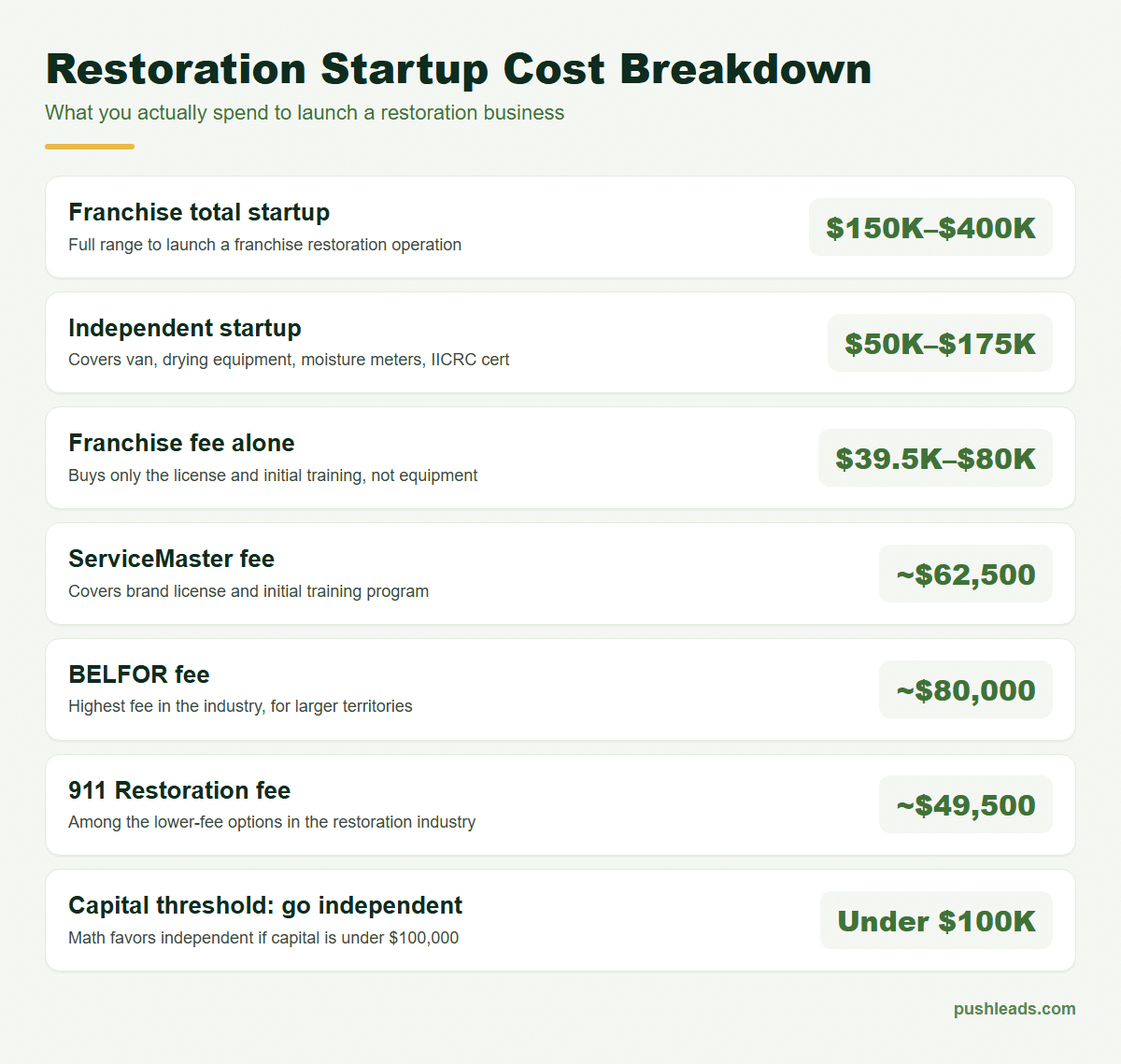
Launching a franchise restoration operation costs between $150,000 and $400,000. The franchise fee alone runs $39,500 to $80,000 depending on the brand and buys only the license and initial training — not a truck, a dehumidifier, or a moisture meter.
Want more customers from Google & AI search?
Get a free SEO audit of your site — see exactly what to fix first.
What is the profit margin for a restoration company?
At maturity, franchise restoration operations net 8 to 12 percent after royalties and fees. Independent restoration companies net 12 to 18 percent at maturity because they pay zero royalties and control their own marketing budget, sourcing equipment on the open market rather than through approved suppliers.
How much does a ServiceMaster franchise cost?
ServiceMaster Restore’s franchise fee runs approximately $62,500. Like all restoration franchise fees, that covers the brand license and initial training only. Equipment, vehicles, and working capital are separate costs, putting total startup investment well above the fee itself.
What is the best restoration franchise to own?
No single brand is objectively best — the right choice depends on your market, capital, and timeline. BELFOR carries the highest fee near $80,000 for larger territories. 911 Restoration sits near $49,500. Experienced operators consistently report the franchise delivered the most value when they were new to the industry.
How do restoration companies get customers?
Local search visibility drives most customer acquisition — specifically Google Business Profile rankings and review volume. Independent companies with 200 five-star reviews outperform franchise locations with 40 mixed reviews in local search results. Franchises also benefit from national insurance preferred vendor agreements that can accelerate job volume early on.
0:00 Franchise vs Independent Restoration: Which Wins?
0:32 Two Models, Very Different Starting Costs
1:06 Franchise Fees Across the Major Brands
1:36 Franchises Hit $1M Revenue Faster
2:09 Franchise vs Independent: The Full Scorecard
2:58 What Royalties Actually Cost Over Time
3:31 IICRC Certification: The Real Quality Signal
4:14 Response Speed: Model Doesn’t Decide It
5:11 Profit Gap at the Same Revenue
5:53 Break-Even Timeline: What to Expect
6:45 The Caveat Experienced Owners Cite
7:20 Who Should Buy a Franchise?
8:18 Local Search Is Where the Decision Gets Made
Full transcript
0:00 Franchise vs Independent Restoration: Which Wins?
Franchise or independent restoration company — which one should you hire, and which one should you own? The answer is not what the sales pitch on either side tells you. In this video we run the real numbers side by side: startup cost, profit margins, how fast each model reaches a million dollars in revenue, and the one factor that actually decides your outcome whether you’re the property owner filing a claim or the operator writing the business plan.
0:32 Two Models, Very Different Starting Costs
Start with money in the door. Launching a franchise restoration operation costs between one hundred fifty thousand and four hundred thousand dollars. Launching an independent costs between fifty thousand and one hundred seventy-five thousand. That’s a gap of roughly two to three times — and the franchise fee alone, running thirty-nine thousand five hundred to eighty thousand dollars depending on the brand, buys you brand access. It does not buy equipment, vehicles, or working capital. The independent owner puts that same capital directly into revenue-generating assets.
1:06 Franchise Fees Across the Major Brands
Let’s look at the major franchise fees by brand. Nine-one-one Restoration sits near forty-nine thousand five hundred at the midpoint. Restoration one lands around sixty-two thousand. Paul Davis runs about fifty-five thousand. ServiceMaster Restore comes in near sixty-two thousand five hundred. BELFOR tops out near eighty thousand for larger market territories. Every one of those fees buys the brand license and initial training. None of them include a truck, a dehumidifier, or a moisture meter.
1:36 Franchises Hit $1M Revenue Faster
Here’s the strongest argument for paying the franchise fee: speed. The International Franchise Association’s two thousand twenty-five Restoration Franchise Report shows franchise operations reach one million dollars in revenue eight to twelve months faster than independents on average. Independents typically take twelve to eighteen or more months to hit that mark. Brand recognition and insurance preferred-vendor relationships front-load job volume in ways a cold-start independent simply can’t replicate. That speed is real — and it’s what the franchise is actually selling you.
2:09 Franchise vs Independent: The Full Scorecard
Now the full scorecard, both sides honest. Franchises charge six to ten percent in annual royalties plus two to four percent in annual marketing fees. Their net profit margin at maturity runs eight to twelve percent. Equipment costs run forty to fifty percent higher through approved suppliers. When you sell, you get three to four times EBITDA. You get immediate brand recognition and exclusive territory protection. Independents pay zero royalties, control their own marketing budget, net twelve to eighteen percent margins at maturity, source equipment on the open market, and sell at four to five point five times EBITDA. They build reputation from zero with no territory protection. Both models work. The difference shows up in what you keep per dollar earned.
2:58 What Royalties Actually Cost Over Time
Run the royalty math on a real business. At one point five million dollars in annual gross revenue, eight percent royalties cost one hundred twenty thousand dollars per year. Three percent marketing fees add forty-five thousand more. Technology fees, insurance premiums, and annual training add roughly another nineteen thousand. Over ten years, cumulative royalty payments alone total between four hundred eighty thousand and nine hundred sixty thousand dollars. That is the number every prospective franchise buyer needs to write down before signing.
3:31 IICRC Certification: The Real Quality Signal
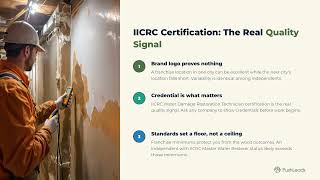
One thing neither model guarantees: work quality. A ServiceMaster Restore or PuroClean location is independently owned and operated. The franchisor sets training standards, but the owner hires the technicians and runs the jobs. A franchise in one city can be excellent while the location in the next city falls short. The same variability exists among independents. The real quality signal is IICRC certification — specifically the Water Damage Restoration Technician credential. Ask any company, franchise or independent, to show those certifications before work begins. Franchise brand standards set a floor, not a ceiling. An independent owner with IICRC Master Water Restorer status almost certainly exceeds that floor.
4:14 Response Speed: Model Doesn’t Decide It
Response speed is the other thing the brand name cannot tell you. A single-truck independent two miles from your property arrives faster than a franchise location thirty miles away — every time. When you’re searching at two a.m. with water on the floor, ask any company directly: how fast can you have a crew on site? Get a number in minutes. Any company that can’t answer that question doesn’t have the answer. On large losses over fifty thousand dollars, ServiceMaster and Paul Davis national preferred-vendor agreements with major insurers can speed claim authorization — that’s a real franchise advantage. On a typical water loss under twenty thousand dollars, the local crew’s competence decides your experience. And according to BrightLocal research, an independent with two hundred five-star reviews beats a franchise with forty mixed reviews in local search results. Customers follow reviews, not logos.
5:11 Profit Gap at the Same Revenue
The profit gap at identical revenue is the number independent advocates always lead with. At one point five million dollars in gross revenue, a franchise owner nets one hundred twenty thousand to one hundred eighty thousand dollars after royalties, marketing fees, technology costs, insurance, and training fees. An independent at the same revenue nets one hundred eighty thousand to two hundred seventy thousand dollars. That’s a forty-five thousand to ninety thousand dollar annual difference. Compounded over ten years at similar growth rates, that gap accumulates to four hundred fifty thousand to nine hundred thousand dollars in additional lifetime earnings for the independent owner.
5:53 Break-Even Timeline: What to Expect
The timeline tells the whole story in five stages. Years one and two: the franchise leads on job volume because brand recognition and lead systems are already working while the independent is building from scratch. Years two and three: both approach profitability, with franchises typically breaking even in eighteen to thirty-six months. Years three to five: a well-run independent with strong local SEO, an active Google Business Profile, and adjuster relationships reaches equivalent volume. Year five and beyond: the independent out-earns the franchise owner on margin every single year because the royalty obligation never expires. And on the day you sell, the independent commands four to five point five times EBITDA versus three to four times for a franchise — buyers pay less for a business that carries permanent royalty obligations.
6:45 The Caveat Experienced Owners Cite
Here’s the pattern experienced operators consistently report. Restoration professionals who built independents before buying franchises say the franchise benefited them most when they were new to the industry — when they needed the training curriculum, the lead system, and the brand credibility to win their first jobs. After five years in business, most of those same owners say they would have been better off independent. The franchise delivers the most value to operators who need it most: new entrants without existing relationships, market knowledge, or digital marketing capability.
7:20 Who Should Buy a Franchise?
So who should actually buy a franchise? Three conditions make the fee worth paying. First: you have two hundred thousand dollars or more available and you want to reach stable income within six to twelve months. Speed matters more to you than maximum lifetime earnings. Second: you have no existing customer base, no insurance adjuster relationships, and no digital marketing background. The franchise system provides early lead flow you genuinely cannot generate on your own yet. Third: you plan to operate fewer than ten years and then sell. The cumulative royalty disadvantage matters less over a shorter horizon, and the brand-built revenue ramp helps at exit. If none of those three conditions describe you — if you have capital under one hundred thousand dollars, an existing customer base, or a fifteen-plus-year operating horizon — the independent model wins on the math every time.
8:18 Local Search Is Where the Decision Gets Made
Here’s what it comes down to for every restoration company, franchise or independent: the homeowner searching at two a.m. clicks the first result with strong reviews. They are not comparing royalty structures. Local search visibility — your Google Business Profile, your review volume, your on-page signals — decides whether that call comes to you or your competitor. PushLeads works with restoration companies on exactly those local ranking factors. See exactly where your visibility stands with a free teardown at seo dot pushleads dot com slash audit, link in the description, or call eight two eight, three four eight, seven six eight six.
▶ Watch on its own page (9:05), with the transcriptMore videos in the library →
–>

What’s the Difference Between a Franchised and an Independent Restoration Company?
A franchised restoration company pays upfront fees and ongoing royalties to use a national brand’s name, training, and lead systems. An independent restoration company owns its own brand outright, keeps 100% of revenue, and builds its reputation from scratch. The International Franchise Association’s 2025 Restoration Franchise Report shows franchise operations reach $1M in revenue 8–12 months faster than independents on average. Once established, independents maintain 12–18% higher net profit margins because they pay no royalties.
Does the brand name tell you anything about work quality?
Not reliably. A ServiceMaster Restore or PuroClean location is independently owned and operated. The franchisor sets training standards and brand guidelines, but the owner hires the technicians and runs the jobs. A franchise location in one city can be excellent while a location in the next city falls short. The same variability exists among independents. Check IICRC certification (the Institute of Inspection Cleaning and Restoration Certification) for individual technicians regardless of which type of company you call. That credential is a real quality signal. A brand logo is not.
Who actually shows up at your property?
With both models, local technicians arrive. Franchises don’t dispatch crews from a national headquarters. The franchise owner hires locally, just like an independent does. The practical difference is that a franchise owner has completed the brand’s training curriculum, which typically runs 1–2 weeks, while an independent owner may have more or less training depending on their background. Ask any company, franchise or independent, to show you their IICRC certifications before they start work.
What Are the Real Pros and Cons of Franchise vs Independent Business?
Choosing between a franchise and an independent restoration operation determines your initial investment, ongoing costs, operational freedom, and long-term equity. Here’s how the numbers stack up side by side.
| Factor | Franchise Model | Independent Model |
|---|---|---|
| Initial Investment | $150K–$400K | $50K–$175K |
| Time to $1M Revenue | 8–12 months | 12–18+ months |
| Annual Royalties | 6–10% of gross revenue | 0% |
| Annual Marketing Fees | 2–4% of gross revenue | You control the budget |
| Net Profit Margin (established) | 8–12% | 12–18% |
| Operational Freedom | Limited by brand standards | Complete control |
| Brand Recognition | Immediate national brand | Build from zero |
| Lead Generation | Franchise system plus your local effort | 100% your responsibility |
| Territory Protection | Yes, exclusive territory | No protection |
| Equipment Sourcing | Approved suppliers, higher cost | Open market, flexible pricing |
| Business Sale Multiple | 3–4x EBITDA | 4–5.5x EBITDA |
What does franchise vs independent really mean for a hiring customer?
From your seat as the property owner filing a claim, the model matters less than you’d think. You care about response time, clear communication with your adjuster, documented drying logs, and a dry house. Both franchise and independent companies can deliver that. The franchise brand gives you one extra layer: a corporate complaint channel if the local owner fails you. That matters most on large losses where disputes arise. On a typical water loss under $20K, the local crew’s attitude and competence decides your experience, not who owns the brand.
Which model responds faster in an emergency?
Response speed comes down to crew availability and geographic proximity, not the business model. A single-truck independent two miles from your house will beat a franchise location 30 miles away every time. When you search for a restoration company, note where the business address is and ask directly: how fast can you have a crew on site? Any company that can’t give you a number in minutes doesn’t have the answer.
ServiceMaster Restore vs a Local Independent: Who Should You Hire?
This is the most common real question homeowners and property managers ask. ServiceMaster Restore locations carry $145K–$285K in franchise investment, operate under 4–10% sliding royalties, and use national brand recognition as their primary marketing asset. Local independents compete on personalized service, faster response in their specific ZIP code, and pricing flexibility that franchises can’t always match.

How does ServiceMaster handle insurance claims vs a local company?
ServiceMaster Restore has national preferred-vendor agreements with several major insurers. That means your adjuster may already have their contact in the system, which can speed up claim authorization. Local independents can work with any insurer but may need to establish a relationship with your specific adjuster from scratch. If you have a large loss over $50K, the preferred-vendor status can smooth paperwork. On smaller losses, an experienced local independent navigates the same process just as well. Ask the independent company directly: have you worked with my insurance carrier before?
What about PuroClean, Paul Davis, and BELFOR?
PuroClean uses a sliding royalty structure that starts at 10% and steps down to 8%, 6%, 4%, and 3% as volume increases. That sliding scale means higher-volume franchise owners pay less per dollar of revenue than smaller operators. Paul Davis charges $45K–$65K in franchise fees. BELFOR, which operates a mix of company-owned and franchise locations, is known for large commercial losses. For residential water damage, any of these brands performs about as well as a certified independent with similar equipment. The key question remains: who holds the IICRC Water Damage Restoration Technician (WRT) certification on the crew arriving at your door?

What Do 911 Restoration Franchise Reviews Say?
911 Restoration franchises cost $95K–$175K upfront and charge a 6% royalty, putting them among the lower-fee options in the industry. The brand’s rapid-response positioning helps new owners acquire jobs faster than cold-start independents in the same market. Franchise owner reviews consistently praise the speed of initial setup and the brand’s marketing materials. Mixed feedback appears around lead quality from the corporate system and the brand’s smaller national footprint compared to ServiceMaster or Paul Davis. If you’re evaluating a 911 Restoration location as a customer, check their local Google reviews and verify IICRC credentials. The national brand doesn’t guarantee the local owner’s quality.
Is 911 Restoration a good franchise to own?
It’s a reasonable entry point if your capital is limited and you want brand support. The lower initial fee is real. The tradeoff is less national brand recognition than ServiceMaster, which means you may rely more heavily on local marketing to win jobs. Owners with strong community ties and willingness to invest in local SEO and Google Business Profile optimization tend to do better than owners who depend primarily on the corporate lead system.
Franchise vs Company-Owned Operations: What Changes for You?
Franchise operations offer brand support and proven systems but give up operational control and a portion of every dollar earned. Company-owned independent operations require building everything from scratch but keep all revenue and make all decisions in-house. Independent restoration owners can change pricing the same day market conditions shift. A franchise owner has to stay within brand guidelines even when local competition drops prices or a new service type emerges in their market.
Do franchise brand standards actually protect customers?
They provide a floor, not a ceiling. Franchise standards require certain equipment, training completion, and documentation practices. That’s genuinely useful on your first hire where you have no local reviews to guide you. But those standards are minimums. An independent owner with 15 years of experience and IICRC Master Water Restorer status almost certainly exceeds franchise brand standards. Standards protect you from the worst outcomes. They don’t identify the best operators.
For the bigger picture, see our SEO for restoration companies guide.
What Do Restoration 1 Franchise Reviews Say?
Restoration 1 franchise owners report solid initial training and a reasonable support structure. The franchise fee of $49.5K–$74.5K lands mid-range among major franchisors. Franchisees appreciate the brand’s residential water damage focus and its lower entry cost. Some report challenges in markets where ServiceMaster or Paul Davis already dominate both customer awareness and insurance preferred-vendor lists. As a customer hiring a Restoration 1 location, the same rules apply: check local Google reviews, ask for IICRC certifications, and get a written scope of work before any mitigation begins.
How Much Do Restoration Companies Actually Make?
Established restoration companies average $1.2M–$2.5M in annual revenue within 2–3 years of launch. Net profit margins run 8–18% depending on overhead control and job mix. A $1.5M restoration company nets $120K–$270K in annual profit before owner salary. Franchises sit toward the lower end of that range because royalty and fee obligations reduce take-home earnings. Review restoration company financial benchmarks and KPIs for your market to understand what margins are realistic given your local labor and overhead costs.
Does the franchise model produce more revenue or less?
More revenue, faster, in most cases. The brand recognition and insurance preferred-vendor relationships accelerate job volume in years 1–2. By year 4–5, well-run independents with strong local SEO, active referral programs, and solid Google Business Profile ratings catch up on volume while maintaining higher margins. BrightLocal’s Local Consumer Review Survey consistently shows that online reviews influence hiring decisions as much as brand name for local service businesses. That finding applies directly here: an independent with 200 five-star reviews beats a franchise with 40 mixed reviews in most local search results.
How Much Do Restoration Franchise Owners Make?
A restoration franchise owner hitting $1.5M in gross revenue takes home roughly $120K–$180K in annual profit after paying 8% royalties ($120K), 3% marketing fees ($45K), technology costs ($15K), insurance premiums ($5K), and annual training fees ($4K). That leaves an 8–12% net margin. An independent at the same revenue keeps $180K–$270K, a $45K–$90K annual difference. Over ten years, that difference compounds to $450K–$900K in additional earnings for the independent owner, assuming both businesses grow at similar rates.
How much do restoration franchise owners make vs independent owners long term?
The franchise advantage is speed, not total earnings. Franchises reach profitability faster because lead flow starts on day one. Independents who invest in local SEO, Google Business Profile optimization, and insurance adjuster relationships close the gap within 3–4 years and then out-earn franchise counterparts for every subsequent year. The question isn’t which model makes money. Both do. The question is whether the speed advantage in years 1–2 is worth the permanent royalty obligation through the entire contract term.
Is a restoration franchise profitable at all?
Yes. An 8–12% net margin on $1.5M in revenue is a real business. Many franchise owners earn more than they would as employees and build a saleable asset. The issue is comparison. Independent owners in the same market, at the same revenue, keep more of every dollar. If your goal is maximum lifetime earnings, independent wins. If your goal is fastest path to a stable income with brand support, franchise wins.
How Do You Finance a Restoration Franchise?
Most restoration franchise owners finance $100K–$250K through SBA 7(a) loans with 7–10 year terms at roughly 6–8% interest. Personal savings typically cover 20–40% of the down payment. Equipment financing handles $25K–$50K of the package separately. Lenders evaluate the franchisor’s track record when underwriting franchise loans, so established brands like ServiceMaster, Paul Davis, and BELFOR improve approval odds over newer or smaller franchisors. Some franchisors maintain relationships with preferred lenders who offer franchise-specific programs with marginally better terms than conventional business loans. Always compare both options before committing.
Is starting an independent restoration business cheaper than buying a franchise?
Significantly cheaper upfront. An independent start costs $50K–$175K, covering a used extraction van, drying equipment, moisture meters, IICRC training, liability insurance, and initial marketing. A franchise costs $150K–$400K for the same operational capability plus the franchise fee, which buys brand access rather than physical assets. If you can generate leads independently through SEO, referrals, and adjuster relationships, the $100K–$225K difference in startup cost funds years of marketing or equipment upgrades.
Is a Restoration Franchise Worth It?
A restoration franchise is worth the investment if you prioritize speed to profitability and want ongoing brand support, or if you operate in a market where franchise name recognition drives meaningful customer preference. It’s not worth it if you have existing customer relationships, can generate leads through SEO and local marketing, or plan to operate for 10 or more years where cumulative royalty payments ($480K–$960K over a decade on $1.5M annual revenue) exceed the value the franchise system delivers.
What’s the best restoration franchise to own?
That depends entirely on your capital, market, and goals. BELFOR suits operators targeting large commercial losses. ServiceMaster Restore and Paul Davis are better fits for residential and mid-size commercial work with strong insurance relationships. 911 Restoration and Restoration 1 offer lower entry costs for operators in smaller markets. Read the Franchise Disclosure Document (FDD) for any brand you consider seriously. The FDD contains audited financials, litigation history, and actual owner earnings data that no sales presentation will volunteer. Ask to contact current franchisees in markets similar to yours before signing.
What Do Franchise Owner Reviews Actually Reveal?
Franchise owner reviews across platforms consistently cite training quality, technology support, and brand-driven lead generation as real benefits, especially in years 1–3. The recurring complaints center on royalty rates that feel steep once the business matures, limited ability to experiment with new services or pricing, and territory restrictions that cap geographic growth. Experienced restoration professionals who built independents before buying franchises often say the franchise benefited them most when they were new to the industry. After 5 years in business, most say they’d have been better off independent.
How do restoration franchises get customers beyond brand recognition?
Insurance preferred-vendor programs drive significant volume for established franchises. Franchisors negotiate relationships with adjusters at the national level, and local franchise owners benefit from those relationships in their territories. Beyond that, franchises rely on the same channels independents use: Google Business Profile, local SEO, paid search ads, direct outreach to property managers and plumbers, and review generation. Search Engine Land has documented repeatedly that local pack rankings in Google depend heavily on proximity, review volume, and on-page signals, not on whether a business is a franchise or independent. PushLeads works with restoration companies on exactly those local ranking factors.
Should You Buy a Restoration Franchise or Start Independent?
Buy a franchise if you have $200K or more in capital available, want to launch within 6–12 months, lack existing customer relationships or marketing expertise, and value ongoing operational support over maximum profit retention. Skip the franchise if you’re starting with under $100K, already operate a related service business with an existing customer base, can manage digital marketing independently, or plan a 15-plus-year operation where cumulative royalties exceed the franchise system’s value by a wide margin.
How do national mold remediation franchises compare to independent contractors locally?
For mold remediation specifically, certifications matter more than brand. Look for IICRC Applied Microbial Remediation Technician (AMRT) certification regardless of whether the company is a franchise or independent. National mold remediation franchises carry insurance and follow documented containment protocols that may satisfy your insurance carrier’s documentation requirements more easily. Independent mold contractors with the same certifications and a documented containment protocol deliver the same result. Verify credentials, not logos.
What’s the restoration franchise profit margin vs home cleaning franchises?
Restoration franchises carry higher revenue per job ($3K–$30K average) and higher margins per job than home cleaning franchises, where jobs run $100–$400 and competition is intense. Home cleaning franchise margins at maturity often land at 10–15% net. Restoration franchise margins at maturity run 8–12% net after royalties. On a per-job basis, restoration wins clearly. On total business complexity, restoration is also harder, requiring licensed technicians, expensive equipment, and active insurance relationships. Higher revenue per job comes with higher operational demands.
Quick Recap
- Franchise restoration costs $150K–$400K upfront versus $50K–$175K for an independent, making franchises 2–3x more expensive to launch.
- Franchises reach $1M revenue 8–12 months faster due to brand recognition and established lead systems.
- Ongoing franchise costs total roughly $165K–$189K annually on $1.5M revenue (8% royalty plus 3% marketing plus technology, insurance, and training fees).
- Independents maintain 12–18% net profit margins versus 8–12% for franchises, recovering the initial investment cost difference after 3–5 years.
- Key franchise fees: ServiceMaster $50K–$75K, Paul Davis $45K–$65K, 911 Restoration $39.5K–$59.5K, Restoration 1 $49.5K–$74.5K.
- Franchise advantage diminishes after year 3–5 as independents build their own reputation and referral networks.
- Equipment packages cost 40–50% more through franchise-approved suppliers versus open market sourcing.
- Territory restrictions cap franchise expansion but protect exclusivity within a defined area.
- Technology fees ($650–$1,700/month) typically run higher for franchises than independent alternatives.
- For customers hiring: check IICRC certifications and local Google reviews. Brand name is secondary to crew credentials and response time.
- PushLeads helps restoration companies, both franchise and independent, build local search visibility that drives inbound calls before a homeowner ever considers brand name.
Frequently Asked Questions
What’s included in a restoration franchise fee?
Franchise fees ($39.5K–$80K depending on franchisor) include exclusive territory rights, initial training (typically 1–2 weeks), operations manuals, brand licensing, initial marketing support, and access to technology platforms. The fee does not include equipment, vehicles, working capital, or real estate. Always read the Franchise Disclosure Document, which franchisors must provide under FTC rules, before signing.
Can I operate a restoration business independently in Asheville, NC?
Yes. Asheville’s growing population and severe weather events create strong demand for restoration services. Independent operators compete effectively on personalized service, faster local response, and pricing flexibility. Strong local SEO, Google Business Profile optimization, and consistent review generation let independents out-rank national franchise pages in local search results.
How long does it take to break even on a restoration franchise?
Most franchise owners break even within 18–36 months if they achieve $1.2M or more in annual revenue. Franchises reach profitability faster than independents due to accelerated lead flow, but higher upfront costs mean absolute profit dollars may be lower for the first 2–3 years compared to bootstrapped independents starting in the same market at the same time.
What’s the difference between royalties and marketing fees?
Royalties (6–10% of gross revenue) go to the franchisor for ongoing support, systems, and brand maintenance. Marketing fees (2–4% of gross revenue) fund national advertising campaigns and brand awareness that theoretically benefit all franchisees. You have limited control over how those marketing dollars get allocated, which means local campaigns still fall on you to fund separately.
Do franchise owners make more money than independent operators?
No. Independent operators typically net 12–18% margins versus 8–12% for franchises earning similar revenue. A $1.5M independent operation nets $180K–$270K versus $120K–$180K for a franchise, a $45K–$90K annual difference. Over a decade, cumulative royalties often total $480K–$960K, which exceeds the early revenue advantage franchises typically provide to new operators.
Which restoration franchises have the best reviews?
ServiceMaster Restore, Paul Davis Restoration, and BELFOR receive consistent praise for training quality and brand recognition. 911 Restoration and Restoration 1 appeal to budget-conscious owners entering smaller markets. Review third-party sources including Franchise Disclosure Documents and speak directly with existing franchisees in comparable markets before committing to any brand agreement.
What happens if I want to sell my restoration franchise?
Franchise agreements typically allow a sale with franchisor approval, and many require new buyers to complete the brand’s certification program first. Franchise businesses sell at lower multiples than independents, typically 3–4x EBITDA versus 4–5.5x for an independent, because buyers inherit ongoing royalty obligations and operational restrictions that permanently reduce future cash flow and operational freedom.
How do restoration franchises get customers?
Franchises rely on national brand advertising, insurance preferred-vendor programs, franchisor-managed lead platforms, and local digital marketing. The insurance preferred-vendor channel drives significant volume for established brands. Independents build the same insurance relationships locally without paying a percentage of each job back to a franchisor, which improves per-job margins. BrightLocal research shows online review volume and rating influence local service hiring as much as brand recognition.
You now know what separates a franchise from an independent restoration company on price, response, margins, and claim handling. The next question is where your business stands in local search right now. PushLeads audits restoration company visibility and shows you exactly what’s costing you calls. See exactly where your visibility stands with a free teardown at seo.pushleads.com/audit or call 828-348-7686.
Watch: Franchise vs Independent Restoration Company: Which Should You Hire?
What this video covers
- 0:00 — Franchise vs Independent Restoration Overview
- 0:28 — Who Jeremy Is and Why This Matters
- 0:51 — Startup Costs Franchise vs Independent
- 1:56 — Speed to Revenue the Franchise Advantage
- 2:29 — Full Scorecard Royalties Margins and Exit Value
- 3:15 — Royalty Math on a Real Business
- 3:48 — Work Quality Response Speed and Reviews
- 5:29 — Profit Gap at Identical Revenue
- 6:10 — Five Stage Timeline Side by Side
- 6:58 — Who Should Actually Buy a Franchise
Full video transcript
Franchise or independent restoration company — which one should you hire, and which one should you own? The answer is not what the sales pitch on either side tells you.
In this video, we run the real numbers side by side: startup costs, profit margins, how fast each model reaches a million dollars in revenue, and the one factor that actually decides your outcome — whether you’re the property owner filing a claim or the operator writing the business plan.
A quick word on who I am. I’m Jeremy. I run PushLeads, and I’ve built my career on getting homeowners — the ones deciding who to call after damage — ranked and called. I’ve watched every Google shift since 2007, and the fundamentals I’m sharing survived all of them.
So let’s get into it. The name on the truck doesn’t guarantee the crew in your house. Here’s what actually matters.
Start with money in the door. Launching a franchise restoration operation costs between $150,000 and $400,000. Launching an independent costs between $50,000 and $175,000. That’s a gap of roughly two to three times. The franchise fee alone — running $39,500 to $80,000 depending on the brand — buys you brand access. It does not buy equipment, vehicles, or working capital. The independent owner puts that same capital directly into revenue-generating assets.
Let’s look at the major franchise fees by brand. 911 Restoration sits near $49,500 at the midpoint. Restoration 1 lands around $62,000. Paul Davis runs about $55,000. ServiceMaster Restore comes in near $62,500. BellFor tops out near $80,000 for larger market territories. Every one of those fees buys the brand license and initial training. None of them include a truck, a dehumidifier, or a moisture meter.
Here’s the strongest argument for paying the franchise fee: speed. The International Franchise Association’s 2025 restoration franchise report shows franchise operations reach $1 million in revenue eight to twelve months faster than independents on average. Independents typically take twelve to eighteen or more months to hit that mark. Brand recognition and insurance preferred vendor relationships front-load job volume in ways a cold-start independent simply can’t replicate. That speed is real, and it’s what the franchise is actually selling you.
Now the full scorecard, both sides honest. Franchises charge 6 to 10 percent in annual royalties, plus 2 to 4 percent in annual marketing fees. Their net profit margin at maturity runs 8 to 12 percent. Equipment costs run 40 to 50 percent higher through approved suppliers. When you sell, you get three to four times EBITDA. You get immediate brand recognition and exclusive territory protection.
Independents pay zero royalties, control their own marketing budget, net 12 to 18 percent margins at maturity, source equipment on the open market, and sell at four to 5.5 times EBITDA. They build reputation from zero with no territory protection. Both models work. The difference shows up in what you keep per dollar earned.
Run the royalty math on a real business. At $1.5 million in annual gross revenue, 8 percent royalties cost $120,000 per year. Three percent marketing fees add $45,000 more. Technology fees, insurance premiums, and annual training add roughly another $19,000. Over ten years, cumulative royalty payments alone total between $480,000 and $960,000. That is the number every prospective franchise buyer needs to write down before signing.
One thing neither model guarantees: work quality. A ServiceMaster Restore or PuroClean location is independently owned and operated. The franchisor sets training standards, but the owner hires the technicians and runs the jobs. A franchise in one city can be excellent while the location in the next city falls short. The same variability exists among independents.
The real quality signal is IICRC certification — specifically the Water Damage Restoration Technician credential. Ask any company, franchise or independent, to show those certifications before work begins. Franchise brand standards set a floor, not a ceiling. An independent owner with IICRC Master Water Restorer status almost certainly exceeds that floor.
Response speed is the other thing the brand name cannot tell you. A single-truck independent two miles from your property arrives faster than a franchise location thirty miles away, every time. When you’re searching at 2 a.m. with water on the floor, ask any company directly: how fast can you have a crew on site? Get a number in minutes. Any company that can’t answer that question doesn’t have the answer.
On large losses over $50,000, ServiceMaster and Paul Davis national preferred vendor agreements with major insurers can speed claim authorization. That’s a real franchise advantage. On a typical water loss under $20,000, the local crew’s competence decides your experience. And according to BrightLocal research, an independent with 200 five-star reviews beats a franchise with 40 mixed reviews in local search results. Customers follow reviews, not logos.
The profit gap at identical revenue is the number independent advocates always lead with. At $1.5 million in gross revenue, a franchise owner nets $120,000 to $180,000 after royalties, marketing fees, technology costs, insurance, and training fees. An independent at the same revenue nets $180,000 to $270,000. That’s a $45,000 to $90,000 annual difference. Compounded over ten years at similar growth rates, that gap accumulates to $450,000 to $900,000 in additional lifetime earnings for the independent owner.
The timeline tells the whole story in five stages. Years one and two: the franchise leads on job volume because brand recognition and lead systems are already working while the independent is building from scratch. Years two and three: both approach profitability, with franchises typically breaking even in eighteen to thirty-six months. Years three to five: a well-run independent with strong local SEO, an active Google Business Profile, and established adjuster relationships reaches equivalent volume. Year five and beyond: the independent out-earns the franchise owner on margin every single year because the royalty obligation never expires. And on the day you sell, the independent commands four to 5.5 times EBITDA versus three to four times for a franchise. Buyers pay less for a business that carries permanent royalty obligations.
Here’s the pattern experienced operators consistently report. Restoration professionals who built independents before buying franchises say the franchise benefited them most when they were new to the industry — when they needed the training curriculum, the lead system, and the brand credibility to win their first jobs. After five years in business, most of those same owners say they would have been better off independent. The franchise delivers the most value to operators who need it most: new entrants without existing relationships, market knowledge, or digital marketing capability.
So who should actually buy a franchise? Three conditions make the fee worth paying. First, you have $200,000 or more available and you want to reach stable income within six to twelve months — speed matters more to you than maximum lifetime earnings. Second, you have no existing customer base, no insurance adjuster relationships, and no digital marketing background — the franchise system provides early lead flow you genuinely cannot generate on your own yet. Third, you plan to operate fewer than ten years and then sell — the cumulative royalty disadvantage matters less over a shorter horizon, and the brand-built revenue ramp helps on exit.
If none of those three conditions describe you — if you have capital under $100,000, an existing customer base, or a fifteen-plus-year operating horizon — the independent model wins on the math every time.
Here’s what it comes down to for every restoration company, franchise or independent. The homeowner searching at 2 a.m. clicks the first result with strong reviews. They are not comparing royalty structures. Local search visibility — your Google Business Profile, your review volume, your on-page signals — decides whether that call comes to you or your competitor.
PushLeads works with restoration companies on exactly those local ranking factors. See exactly where your visibility stands with a free teardown at seo.pushleads.com/audit — link in the description — or call 828-348-7686.
Keep Reading
Want more customers from Google & AI search?
Get a free SEO audit of your site — see exactly what to fix first.
Your path · Restoration SEO
Keep going: read these next

- Cost Per Lead for Restoration Companies: Full Channel




Want this done for you?
Scan your site. See the gaps. Decide with numbers.
- Rankings, Google Business Profile and site-speed teardown
- Report lands in your inbox in about a minute
- No obligation · 4.9 from 67 Google reviews

