
Your Google Business Profile generates more emergency calls than your website does. According to BrightLocal’s 2024 Local Consumer Review Survey, the average local business pulls in 1,260 monthly views through GBP alone. For restoration companies, that number matters even more because homeowners searching “emergency water damage” at 2 AM see your GBP listing first. Your hours, reviews, and photos decide whether they call you or the next contractor on the list.
0:00 GBP Optimization for Restoration Companies
0:22 GBP Delivers One Thousand Calls Worth of Visibility
0:53 Three Signals Google Reads Right Now
1:27 After-Hours Searches Are Where Jobs Are Won
1:60 Photos and Services Seal the Deal
2:42 Photo Priority Order That Drives Calls
3:08 Where Competitors Are Losing to You
3:45 Month-by-Month Optimization Roadmap
4:28 The Review Standard for Emergency Trust
5:07 Get Into the Map Pack
Full transcript
0:00 GBP Optimization for Restoration Companies
Your Google Business Profile generates more emergency calls than your website — and most restoration companies have no idea how much revenue they’re leaving on the table by leaving it half-configured. This deck breaks down every optimization signal that moves the needle: categories, hours, photos, reviews, and AI search.
0:22 GBP Delivers One Thousand Calls Worth of Visibility
The average local business pulls one thousand two hundred sixty monthly views through Google Business Profile alone, per BrightLocal’s twenty twenty-four survey. For restoration companies that number hits harder — a homeowner searching ’emergency water damage’ at two in the morning sees your GBP before your website. Your hours, reviews, and photos decide in seconds whether they call you or scroll. The map pack is the first call. Period.
0:53 Three Signals Google Reads Right Now
Three signals drive most map pack position. First, hours configuration — Sterling Sky’s twenty twenty-four study found hours settings account for eight percent of local pack signals, critical for after-hours emergency placement. Second, review signals drive sixteen percent of ranking weight, third only to proximity and relevance. Third, listing ‘Water Damage Restoration Service’ as your primary category outperforms the generic ‘Restoration Service’ by roughly forty percent for water damage searches. Fix these three first.
1:27 After-Hours Searches Are Where Jobs Are Won
Forty-two percent of restoration-related searches happen outside normal business hours, per PlePer’s emergency service research. Nearly half of all revenue-generating searches fire when most companies aren’t answering. That two A-M call is worth three thousand to eight thousand dollars for water damage alone. If your listing isn’t configured as open twenty-four hours — and you genuinely answer around the clock — you’re invisible to those searchers. Miss the configuration, miss the call.
1:60 Photos and Services Seal the Deal
Photos and service depth are where most restoration companies get beaten. BrightLocal data shows listings with one hundred or more photos receive five hundred twenty percent more calls than average listings. The typical restoration company has fewer than twenty. Close that gap fast — shoot every job, upload five to ten images weekly. Sterling Sky’s testing found profiles with fifteen or more specific services show thirty-two percent higher click-through rates than profiles with five or fewer. ‘Basement flooding restoration, burst pipe cleanup, sewage backup cleanup, structural drying’ — that is a service list.
2:42 Photo Priority Order That Drives Calls
When uploading photos, sequence matters. Lead with dramatic before-and-after shots — they prove capability instantly. Follow with equipment-in-action images: truck mounts, air movers, dehumidifiers, thermal cameras. Round out with team photos in branded uniforms and credential shots. Google confirms listings with diverse photo types consistently receive higher engagement than single-category image sets. Shoot everything. Caption it. Upload weekly.
3:08 Where Competitors Are Losing to You
Audit yourself against these benchmarks now. Your target is one hundred fifty or more total reviews. Weak competitors have fewer than thirty; strong competitors sit between one hundred and three hundred. Most restoration companies are weakest on photo count, Q-and-A entries, and review response rate — the three fastest gaps to close. Pull the map pack for your top five emergency search terms and score yourself against the top three results. Every signal a competitor beats you on is a priority fix.
3:45 Month-by-Month Optimization Roadmap
GBP results come faster than traditional SEO but require consistency. Month one: verify info, set precise categories and accurate twenty-four-seven hours, upload twenty to thirty photos, seed eight to twelve Q-and-A entries, post weekly. Expect five to fifteen percent visibility gains. Months two and three: request reviews within twenty-four hours of job completion — ReviewTrackers shows same-day requests produce sixty-two percent higher response rates than requests sent three to seven days later. Months four through twelve: consistent execution yields fifty to one hundred percent total visibility improvement. Track impressions, direction requests, and direct calls monthly.
4:28 The Review Standard for Emergency Trust
Darren Shaw, founder of Whitespark, said it plainly: a homeowner facing water damage at midnight won’t call a company with six reviews when the next listing shows eighty-plus reviews and a four-point-seven-star rating. Reviews are trust currency in emergency services. Target three to five new reviews monthly in smaller markets, five to eight in competitive metros. Respond to every single review — Harvard Business School research shows businesses that respond see twelve percent higher conversion rates. Negative reviews responded to within twenty-four hours actually help you.
5:07 Get Into the Map Pack
GBP optimization is the fastest path to more emergency calls for restoration companies. Every signal — categories, hours, service listings, photos, reviews, posts, Q-and-A entries — tells Google whether you’re a real twenty-four-seven operation worth showing a panicked homeowner at two in the morning. Every week those signals stay incomplete, a competitor captures calls that should be yours. PushLeads works specifically with restoration companies on GBP optimization, local SEO, and lead generation built around how emergency searches actually behave. See exactly where your visibility stands with a free teardown — find the link in the description, or call eight two eight, three four eight, seven six eight six.
–>
This page covers every GBP optimization step that actually moves the needle for restoration company SEO performance. We’re covering emergency service signals, trust markers, review generation, photo strategies, service configurations, AI search signals, and franchise management, all aimed at putting your listing in front of panicked homeowners at any hour.


By Jeremy Ashburn, founder of PushLeads, an Asheville, NC SEO and digital marketing agency for contractors and home-service businesses.
How Do Your GBP Settings Control Emergency Search Visibility?
Part of our Restoration Lead Generation: Build a Predictable Pipeline Beyond Emergency Calls. Want it done for you? See our restoration SEO and marketing agency.
Your GBP configuration tells Google whether you’re a real 24/7 emergency operation or just another contractor. Hours, categories, and business name accuracy control which searches trigger your listing. According to Sterling Sky’s 2024 GBP ranking factors study, hours configuration alone accounts for 8% of local pack ranking signals. That’s a significant factor when you’re competing for after-hours emergency service calls.
“Reviews are the currency of trust in emergency services,” says Darren Shaw, founder of Whitespark. “Homeowners facing water damage at midnight won’t call a company with six reviews when there’s a competitor with 80+ reviews and a 4.7-star rating.”
Get Your Business Name Right
Your GBP business name needs to match your legal business name exactly. No keyword stuffing. Don’t list yourself as “ABC 24/7 Emergency Water Damage Restoration” when your actual name is “ABC Restoration Services LLC.” According to BrightLocal, roughly 23% of GBP suspensions in 2024 came from business name violations. A suspension takes 4 to 8 weeks to recover from, and you’re invisible in local map pack results the entire time.
Configure Your Address Correctly
Use your physical business address to create a proximity relevance center point. According to Whitespark’s Local Search Ranking Factors survey, proximity to the searcher accounts for about 19% of map pack ranking weight. If you serve customers at their locations, you can hide your street address while setting service areas, but visible addresses typically produce better rankings. Each physical location needs its own verified listing, and your name, address, and phone details need to stay consistent across all local citation sources.
Pick Categories That Actually Match Your Services
Categories heavily influence which searches show your business. “Water Damage Restoration Service” as your primary category outperforms the generic “Restoration Service” by roughly 40% for water damage searches, according to Sterling Sky’s category testing. You’ll want to learn how to choose the right GBP categories for your specific service mix.
Set your primary category to the service that generates the most revenue, then add secondary categories for everything else you offer. A restoration company doing water, fire, and mold work should list all three as separate categories. Every category creates new ranking opportunities for related searches. Mold remediation in particular benefits from its own category because “mold remediation” queries carry high commercial intent and often arrive outside peak hours.
What Hours and Emergency Settings Drive After-Hours Calls?
Hours settings directly control whether you show up when it counts most. According to PlePer’s emergency service search study, 42% of restoration-related searches happen outside normal business hours. A homeowner searching “emergency water extraction near me” at 3 AM only sees businesses configured as “Open 24 hours” or currently open.
Only set 24/7 hours if you genuinely answer calls around the clock. Misrepresenting availability destroys trust when a stressed homeowner calls at 2 AM and hits voicemail. They’ll call the next listing, and that competitor gets the $3,000 to $8,000 water damage job.
If you’re a smaller operation, configure regular hours but add a Q&A entry explaining emergency availability. Also set special hours for holidays. According to Grade.us research, profiles updated within the past 30 days show 18% higher engagement rates. That means touching your profile, whether through a new post, updated photo, or Q&A response, every single week.
Why Do Q&A Entries Matter for Emergency Callers?
The Q&A section on your GBP listing lets you pre-answer the questions panicked homeowners ask before they call. Seed 8 to 12 questions yourself. Cover response time, service area, insurance coordination, 24/7 availability, IICRC certification, and payment options. Each answer should be 40 to 80 words and include a natural mention of your main service. Anyone can post questions publicly, so monitor this section weekly and answer new questions within 24 hours. Unanswered questions from the public make your listing look neglected and cost you calls.
Want more customers from Google & AI search?
Get a free SEO audit of your site — see exactly what to fix first.
How Should You Structure Service Listings?
Create 15 to 20 specific service items instead of 3 or 4 generic ones. According to Sterling Sky’s GBP service testing, profiles with 15 or more specific services show 32% higher click-through rates than profiles with 5 or fewer.
Someone whose basement just flooded doesn’t search “water damage restoration.” They search “basement flooding repair” or “burst pipe emergency.” List every variation: emergency water extraction, basement flooding restoration, burst pipe cleanup, sewage backup cleanup, appliance leak repair, storm damage water removal, and structural drying. Do the same for fire damage restoration services and mold remediation.
Write 200 to 300 word descriptions for each service. Include emergency availability, geographic targeting, IICRC certifications, equipment mentions, and insurance coordination details. These descriptions feed both Google’s understanding of your relevance and AI-generated summaries in search results, which is covered in a later section.
You may also find this useful: Google Ads for Restoration Companies.
Which Services Should Be Listed First?
Order matters. Put your highest-revenue service as the first item. For most restoration companies that’s water damage, followed by fire and smoke damage, then mold remediation, then specialty services like sewage backup or storm damage. Google displays services in the order you set them on mobile, and mobile is where most emergency searches happen. A homeowner on a phone at a flooded property sees your top three services before they scroll. Make those three count.

What Photo Strategy Actually Generates Calls?
Photos drive calls. BrightLocal’s research shows GBP listings with 100 or more photos receive 520% more calls than average listings. But quality matters just as much as quantity. Blurry phone photos won’t outperform a competitor with 50 well-lit project images.
Here’s the reality: most restoration companies have 15 to 20 photos total. You can pull ahead of local competitors just by photographing every job and uploading 5 to 10 images weekly.
“GBP call metrics tell you everything about emergency conversion performance,” says Mike Blumenthal, founder of Local University. “If you’re getting 500 profile views but only five calls monthly, something’s broken. Usually it’s inadequate photos, no reviews, or unclear emergency availability signals.”
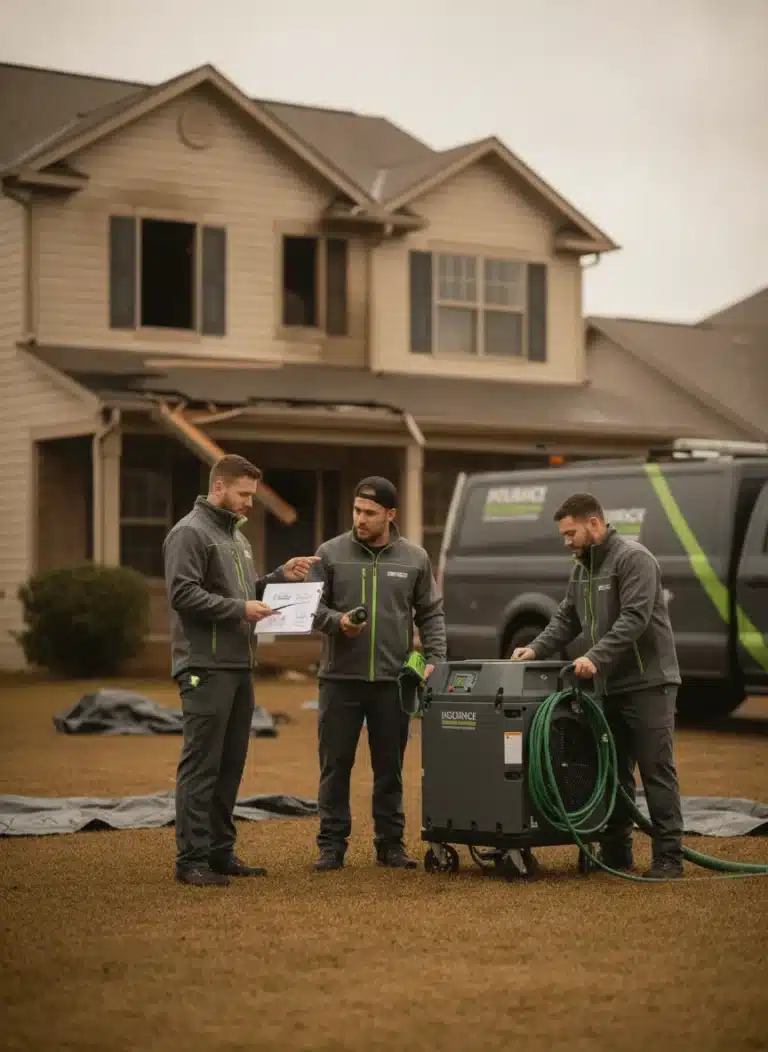
Focus on before-and-after project shots first because they prove capability. Equipment-in-action photos show professional-grade tools. Team photos build trust. Upload consistently rather than in batches. According to Podium’s GBP engagement study, profiles with weekly photo uploads show 28% higher visibility in map pack results.
For every job, photograph moisture readings, equipment setup, containment barriers, and completion results. Include brief captions with job type and location. Avoid dark shots, blurry photos, and anything showing customer belongings without permission.
What Photo Types Get the Most Engagement?
Rank your photo uploads in this priority order. First, dramatic before-and-after shots of water-damaged or fire-damaged rooms. Second, equipment photos showing truck mounts, air movers, dehumidifiers, and thermal cameras because they signal professional capability. Third, team photos in branded uniforms at job sites. Fourth, any certifications, awards, or industry affiliations photographed in your office. Fifth, exterior shots of your vehicles and facility. Google’s own guidance confirms that listings with diverse photo types receive higher engagement than listings with only one photo category.
How Do Reviews Impact Rankings and Conversions?
Reviews influence both where you rank and whether homeowners pick you. According to BrightLocal’s 2024 survey, 98% of consumers read online reviews for local businesses, and 87% won’t consider businesses fewer than 3 stars. For emergency services, a 4.8-star company with 150 reviews typically outranks a 5.0-star competitor with 12 reviews.
Review management strategies matter more than most restoration companies realize. Whitespark’s Local Search Ranking Factors study shows review signals account for about 16% of local pack ranking factors, making reviews the third most important element after proximity and relevance.

Target 3 to 5 new reviews monthly in smaller markets and 5 to 8 in competitive metros. Request reviews within 24 hours of job completion. According to ReviewTrackers, same-day requests show 62% higher response rates than requests sent 3 to 7 days later. Keep prompts natural and never script reviews or offer incentives.
For negative reviews, respond within 24 hours. Acknowledge the concern, take accountability, and offer to resolve things offline. Our guide on handling negative reviews during a crisis covers detailed response frameworks. According to Harvard Business School research, businesses that respond to reviews show 12% higher conversion rates.
How Do You Get Reviews From Emergency Customers?
Emergency customers are your best reviewers because the emotional relief after a crisis produces detailed, authentic feedback. Text a direct review link within 2 hours of job completion while the homeowner is still grateful. Your text should be 2 sentences: one thanking them and one asking for honest feedback with the link. Follow up once by email 48 hours later if they haven’t posted. Don’t follow up a third time. That cadence produces the highest conversion without annoying customers. Build the review link into your completion paperwork and job wrap-up checklist so techs prompt it automatically on every call.
What Google Posts Strategy Works for Emergency Services?
Most restoration companies don’t post on GBP at all, so posting weekly puts you ahead of 80% of local competitors. According to Sterling Sky testing, profiles with weekly posts show roughly 14% higher click-through rates. Rotate through four post types monthly: emergency availability reminders, recent project success stories, seasonal preparation tips, and certification spotlights.
See also our guide on Restoration company lead generation.
Every post needs a headline under 60 characters, your phone number, a quality image, and 150 to 300 words. Posts with images show 42% higher engagement. Emergency availability posts work especially well in the days before and after major storms, freeze events, or heavy rain seasons because search volume spikes and your updated profile signals relevance at exactly the right moment.
Seasonal posts also answer the “improving search rankings for restoration” question directly. Spring flooding prep posts in March and April, hurricane readiness posts in June, and frozen pipe warnings in November all align with when homeowners are thinking about these risks, not after they’ve already flooded.
How Does Service Area Configuration Affect Visibility?

List specific cities, towns, and neighborhoods individually rather than using radius settings. According to Sterling Sky’s service area testing, specific city lists outperform radius settings by about 25% for searches in named locations. Your local SEO for service businesses improves when Google gets clear signals about exactly where you operate.
Base your service area list on actual emergency response capability. A 2 to 3 person crew shouldn’t claim 50 communities. A solo operator or small team should list 10 to 15 communities within 30 minutes. A company with 5 to 10 people can reasonably cover 20 to 30 communities within 45 minutes. Larger operations with multiple response teams might cover 30 to 50 or more areas.
Mismatching your claimed service area with your actual response capability creates a trust problem. If you list a city 90 minutes away and a homeowner calls expecting a 1-hour response, you lose that customer and likely get a negative review. Only list what you can actually reach within a competitive emergency window.
How Should Restoration Franchises Manage Multiple GBP Listings?
Franchise restoration companies face a specific challenge. Each physical location needs its own verified GBP listing with a unique local phone number, location-specific photos, and individual review profiles. A shared toll-free number across all locations weakens every listing’s local relevance signal.
Google’s guidelines require that franchise locations each represent a distinct, staffed place of business. You can’t create listings for territories without offices. A franchisor managing GBP for multiple locations should use Google Business Profile Manager to control all listings from one dashboard. Assign location managers so local staff can upload photos and respond to reviews without accessing the master account.
Each location listing needs customized service descriptions that mention local neighborhoods and response areas. A generic national description copied across 20 locations tells Google nothing about local relevance. Photos should show local teams and local job sites, not stock images or corporate photos from another market. Review velocity matters per location. A franchise location with 8 reviews ranks poorly even if the brand overall has thousands of reviews nationally.
What’s the Right GBP Setup for a Single-Territory Franchise?
A single-territory franchise location follows the same rules as an independent restoration company. One verified listing at your physical address or, if you operate from home, a hidden-address service-area listing. Categories, hours, and service listings all need to match your actual local operation. The franchise brand name typically must appear in your business name per most franchise agreements, but check with your franchisor about GBP name formatting before creating your listing to avoid a suspension triggered by name inconsistency.
How Does AI Search Optimization Change GBP Strategy?
AI-generated answers in Google Search, including AI Overviews, pull from GBP data, your website, and structured data. A restoration company with a well-optimized GBP listing gets cited in AI responses when homeowners ask questions like “who does emergency water damage repair near me” or “best mold remediation company in [city].”
Google’s AI systems look for consistency. Your GBP service descriptions, your website service pages, and your Schema.org structured data all need to say the same things about what you do, where you do it, and when you’re available. According to Schema.org documentation, LocalBusiness schema with emergency service attributes helps search systems understand 24/7 availability. Adding the correct schema to your website reinforces what your GBP says.
Write GBP service descriptions in direct, specific language. “We extract standing water within 60 minutes in Asheville, NC using truck-mounted extraction units” gives AI systems a concrete, citable claim. “We provide comprehensive water damage solutions” gives them nothing usable. The more specific your GBP content, the more likely AI answers pull from your listing rather than a competitor’s.

Does GBP Content Feed AI Search Answers Directly?
Yes. Google’s AI Overviews draw from multiple sources including GBP listings, and Search Engine Land has documented cases where GBP business descriptions appear verbatim in AI-generated local answers. This means your 750-character GBP business description is no longer just a summary for human readers. It’s a data input for AI systems deciding which company to recommend. Write it to answer the most common emergency question directly: what you do, what area you cover, how fast you respond, and what certifications you hold. Update it every 60 to 90 days because fresh content signals an active business to both Google and AI systems.
How Do You Compare GBP Strength Against Local Competitors?
Before you optimize, you need to know where you stand. Pull up the map pack for your top 5 emergency search terms and record what you see for each competitor. The table below shows the key signals to audit.
In this video
- 0:00 Why Google Ignores Restoration Companies
- 0:27 Who Jeremy Is and Why It Matters
- 0:50 The Local Search Opportunity for Restoration
- 1:22 Four Channels That Build a Lead Pipeline
- 2:05 Why Referrals Alone Cannot Scale Your Business
- 3:09 Google Business Profile Six-Step Optimization
- 4:27 Service City Pages and Search Appearance Growth
- 5:41 Local Services Ads Cost and Close Rates
- 7:24 AI Overviews and Schema Markup Visibility
- 8:56 Attribution Tracking Every Channel Needs
- 9:31 Reconstruction Leads and High-Value Buyers
- 10:12 Correct Build Sequence Step by Step
Full transcript: Restoration Company Marketing: Why Google Ignores You (And the Fix)
| GBP Signal | Your Goal | Weak Competitor Typical Score | Strong Competitor Typical Score |
|---|---|---|---|
| Total reviews | 150+ | Under 30 | 100 to 300+ |
| Average star rating | 4.7 or higher | Under 4.2 | 4.6 to 5.0 |
| Total photos | 100+ | Under 20 | 50 to 200+ |
| Services listed | 15 to 20 | 3 to 5 | 10 to 20 |
| Posts per month | 4+ | 0 to 1 | 2 to 6 |
| Q&A entries | 8 to 12 | 0 to 2 | 5 to 15 |
| Hours set to 24/7 | Yes, if true | No or inaccurate | Yes |
| Review response rate | 100% | Under 30% | 80 to 100% |
Score yourself against the top 3 map pack results in your market. Any signal where a competitor beats you is a priority fix. Most restoration companies are weakest on photo count, Q&A entries, and review response rate. Those three gaps are also the fastest to close.
How Long Does GBP Optimization Take to Show Results?
GBP optimization produces results faster than website SEO for small businesses, but it still requires consistency. According to PlePer testing, most improvements appear within 30 to 90 days.
Month 1 focuses on foundations: verify business info, set categories and hours, upload 20 to 30 photos, seed Q&A entries, and start posting weekly. Expect 5% to 15% visibility gains. Months 2 and 3 build trust through review generation, continued uploads, and consistent posting for another 10% to 20% boost. By months 4 through 12, most companies see 50% to 100% total visibility improvement.
Track progress through local SEO metrics and KPIs monthly. If views climb but calls stay flat, your trust signals need work. See what these improvements look like in practice in our disaster restoration case study.
What Metrics Tell You GBP Optimization Is Working?
Watch three numbers inside your GBP performance dashboard weekly. First, search impressions, meaning how many times your listing appeared. Second, direction requests, which indicate homeowners are locating your business. Third, calls placed directly from GBP. Calls are your most important metric because they represent real revenue opportunities. If impressions rise but calls don’t, your listing is visible but not convincing. That gap points to review count, photo quality, or unclear service availability as the weak link. Set a monthly benchmark and compare month over month, not week over week, because weekly data fluctuates with local weather and news events.
Frequently Asked Questions
How long does Google Business Profile verification take?
Postcard verification takes 5 to 14 days. Phone or email verification completes within minutes when available. Video verification takes 3 to 5 business days. Start immediately because you can’t rank well until verification completes. If your verification postcard doesn’t arrive within 14 days, request a new one through your GBP dashboard. Don’t create a duplicate listing while waiting. That triggers a spam flag and can get both listings suspended.
Can I create multiple GBP listings for one restoration company?
Only with separate physical locations and different staff. A company serving three counties from one office gets one listing. A franchise with offices in multiple cities maintains separate listings per location. Creating duplicate listings for the same location is a policy violation that triggers suspension. Learn more about GBP setup best practices for your situation before creating additional listings.
Is GBP more important than website SEO for restoration companies?
For emergency services, GBP is often equally or more important. According to BrightLocal, 76% of local searches result in same-day contact. A homeowner with a flooded basement at midnight calls the first 24/7 company in map results, not the one with the best website. Both matter, and they reinforce each other. Your website builds the domain authority signals that help your GBP rank, and your GBP drives the calls that produce the revenue.
What should I do if my GBP gets suspended?
Submit a reinstatement request immediately through the GBP support portal. Common causes include keyword-stuffed business names, fake reviews, duplicate listings, and addresses that don’t match official records. Recovery takes 2 to 6 weeks and typically costs $5,000 to $15,000 in lost emergency call revenue during that window. Read our GBP suspension prevention guide for detailed steps and how to document your business for a faster reinstatement decision.
How do I catch up to competitors with 100+ reviews?
There aren’t legitimate shortcuts. A restoration company completing 30 jobs monthly should request reviews from all 30, generating 5 to 8 monthly at a 20% response rate. That reaches 60 to 96 reviews annually. It takes 12 to 24 months to close a large gap, but the trust these reviews build compounds over time. Consistency beats any shortcut strategy because Google’s systems detect sudden review spikes and may filter or suppress them.
How do I manage GBP when I’m running jobs at 3 AM?
Delegate to your office manager or outsource GBP management for $300 to $500 monthly. It takes 2 to 3 hours weekly when done consistently. Have techs photograph jobs and send images to the office for uploading. Build photo uploads and review requests into your job completion checklist so they happen automatically. Companies that treat GBP like HVAC contractors optimize their profiles, through systematic delegation and weekly routines, see the best long-term results.
Does mold remediation need its own GBP category?
Yes. “Mold Remediation Service” is a distinct GBP category separate from water damage restoration. Adding it as a secondary category creates ranking eligibility for mold-specific searches that your water damage primary category won’t capture. Mold queries often come days or weeks after an initial water event when homeowners discover a secondary problem, so ranking for both expands your capture window significantly across the full restoration lifecycle.
Which SEO agencies are best for restoration companies?
Look for agencies with documented restoration industry experience, GBP management as a specific service line, and transparent reporting on map pack rankings and call volume. Generalist agencies often lack the restoration-specific knowledge to configure service listings, emergency hour signals, and review velocity correctly. PushLeads specializes in restoration company SEO and GBP management for restoration and contractor clients. Ask any agency candidate to show you before-and-after map pack ranking results from actual restoration clients before signing a contract.
Get Your Restoration Company Into the Map Pack
GBP optimization is the fastest path to more emergency calls for restoration companies. Your categories, hours, service listings, photos, reviews, and posts all signal to Google whether you’re a real 24/7 operation worth showing to a panicked homeowner at 2 AM. Every week you leave these signals incomplete, a competitor captures those calls instead.
PushLeads works specifically with restoration companies on GBP optimization, local SEO, and lead generation strategies built around how emergency searches actually behave. See exactly where your visibility stands with a free teardown at seo.pushleads.com/audit or call 828-348-7686.
Keep Reading
Want more customers from Google & AI search?
Get a free SEO audit of your site — see exactly what to fix first.
Your path · Restoration Lead Generation
10 articles. About 160 minutes.
 TPA Marketing: Understanding Third-Party Administrator Programs for Restoration Companies
- Up next24/7 Emergency Marketing for Restoration Companies: Capturing Urgent Searches When Customers Need You Most
- Video Marketing for Restoration Companies: Build Trust Before Customers Ever Call
- Independent vs. Franchise Restoration Marketing: How Local Companies Can Compete and Win


Want this done for you?
Scan your site. See the gaps. Decide with numbers.
- Rankings, Google Business Profile and site-speed teardown
- Report lands in your inbox in about a minute
- No obligation · 4.9 from 67 Google reviews
 Continue to Part 4
