


Video Review Case Study
Want it done for you? See our restoration SEO and marketing agency.
Video Transcription
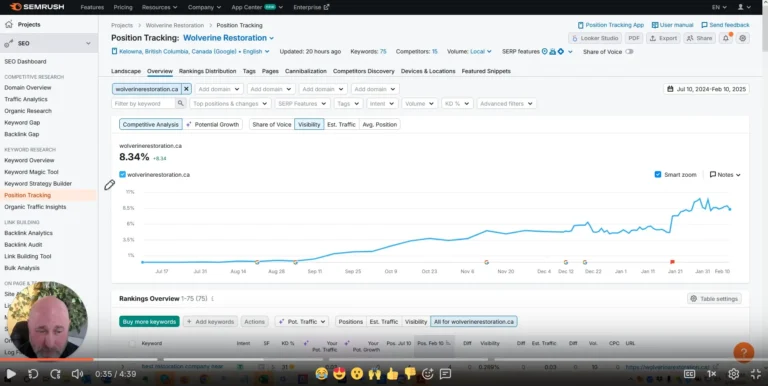
Hey Dustin and Wade, I just wanted to make you a quick video to show you the results I’ve been getting for you over the past three or four months.
We started with 0% visibility—not showing up at all in Google—and after about four to five months of work, visibility has increased to around 8%. Currently, terms like Best Restoration Company Near Me, Water Damage Remediation, Disaster Restoration, Fire Restoration, Flood Restoration, Damage Restoration, Flood Remediation, Restoration Companies Near Me, Contractors, and Water Remediation are on the middle or bottom of Google’s first page. In plain English, we now have about 50 terms on Google’s first page.

My ask is for 90 more days to push as many of these terms to the very top. We’ve seen some breakthroughs, like Water Damage Remediation hitting position three recently, but it hasn’t stayed there due to high competition. To address this, I want to switch to a new team that’s been delivering stronger results through high-quality guest blogs.
Here’s what that looks like: over a 30–60 day period with this new team, we improved visibility from 7% to 14%. In real terms, that’s going from six top Google rankings to 54. The difference is the use of high-quality guest connections. These blogs aren’t from restoration companies but from related industries like home addition remodelers. For example, a blog about Home Addition Contractors linked to one of our client sites, and because the link was high quality, Google gave it strong weight.
We built 10 of these links, and using a tool that measures link strength, some scored as high as 30 and 48. By contrast, a random blog link would usually score close to zero. That’s why these results are significant.

Reputation metrics also confirm growth. Your domain rating increased from 11 to 19, and homepage authority rose from around 10 to 29. Backlinks have also grown—475 new connections from 276 new domains, showing strong link-building progress. Before February, you had around 100 referring domains; now that’s up to 340. These higher-quality links are boosting credibility and rankings.
My recommendation is to create 10 of these high-quality links per month over the next 90 days. That should raise visibility into the 10–12% range and eventually closer to 19%, which is where Total Restoration currently sits. ServPro, by comparison, is around 8%, neck-and-neck with you. Investing in PPC strategies for restoration companies can also enhance your online presence and attract more clientele. Tailoring your ads to target specific demographics and utilizing local SEO will further amplify your efforts. As a result, you could see a significant boost in lead generation and conversion rates. When focusing on effective review acquisition techniques, consider encouraging satisfied clients to share their experiences across multiple platforms. This organic outreach can significantly enhance your brand’s reputation and credibility in the market. Additionally, implementing strategies to showcase positive reviews can create a strong trust factor for potential customers.
So my ask is simple: give me another 90 days to implement this plan and push more keywords to the top—and keep them there. Thanks. During this period, we can also analyze competitor strategies to refine our approach and increase our chances of success. It’s crucial for us to understand what is search engine optimization, as this knowledge will help us identify the most effective tactics. By leveraging the latest trends and algorithms, we can ensure sustained visibility in search results. Additionally, we should explore fire restoration costs for homeowners to understand how our offerings can be tailored to meet their budgetary needs. By addressing common concerns related to fire damage and reconstruction, we can position ourselves as a trusted resource in the market. This approach not only emphasizes our expertise but also helps build long-term relationships with clients navigating difficult situations.
Want more customers from Google & AI search?
Get a free SEO audit of your site — see exactly what to fix first.
What’s Your SEO Score?
Enter the URL of any landing page or blog article and see how optimized it is for one keyword or phrase. This tool can help you identify key areas for improvement, ensuring that your content ranks higher in search engine results. By analyzing factors such as keyword density, meta tags, and backlinks, you can implement effective vacation rental SEO strategies to enhance your online visibility. Optimizing your landing pages will not only attract more visitors but also increase the likelihood of converting them into satisfied customers. Additionally, it’s vital to assess how your organic efforts stack up against paid advertising initiatives. Implementing effective SEO and PPC comparison strategies can provide insights into which methods yield the best return on investment. By continually refining both approaches, you can maximize your overall marketing performance and drive sustained growth for your business.
Key Takeaways
- Moving from no visibility to a first-page footprint is real progress, but the jobs come from top-three positions and the map pack, so judge the work by calls and booked jobs as well as rankings.
- Guest links from related trades, such as remodelers and contractors, carry more weight than links from random blogs, but only when the site is real, relevant and read by actual people.
- A restoration company should plan on 90 to 180 days of steady work before competitive terms like water damage remediation hold the top spots.
- Rankings, backlinks and authority scores are leading indicators; phone calls, form fills and booked jobs are the only numbers that pay the bills.
- Your Google Business Profile, service-area pages and 24/7 call handling matter as much as link building in an emergency-driven industry.
What This Case Study Does and Does Not Prove
It shows that a restoration company starting from nothing in Google can build a meaningful first-page footprint in a few months, and that targeted, relevant links can speed up the climb. It does not prove that any one tactic guarantees top rankings in your market.
Every market is different. A restoration company in a small metro faces fewer entrenched competitors than one competing with national franchises in a major city. The percentages in the video came from one site, one set of competitors and one time period, so treat them as a pattern to learn from rather than a promise.
Here is what you can reasonably take away:
- Link quality beats link quantity. A small number of relevant, well-placed links can move more than a large batch of weak ones.
- Rankings move in stages. Terms usually climb from deep pages to the bottom of page one, then the middle, then the top, and they often bounce on the way.
- Competitors set the ceiling. Your target is usually the strongest competitor in your area, not a number in the abstract.
- Consistency matters. Gains hold best when new links, content and local signals keep arriving month after month.
If you want to see how the same thinking plays out in a different trade, the roofing SEO case study from page 4 to page 1 shows what a faster, narrower win looks like.
How to Read Visibility Scores and Ranking Positions
A visibility score estimates how much of the available search traffic for a set of tracked keywords your site is capturing. It is useful for comparing yourself to competitors over time, but it is not a count of leads.
Different rank-tracking tools calculate visibility differently, so only compare numbers from the same tool and the same keyword list. If someone shows you a visibility figure, ask which keywords are in the set and whether they include your actual service area.
Why position matters so much
Clicks fall off quickly as you move down the page. A term sitting at the bottom of page one gets far fewer clicks than the same term in the top three, and in restoration the map results often sit above the regular listings. That is why a long list of page-one terms can still produce few calls.
Why rankings bounce
When a keyword reaches position three and then slips, it usually means a competitor with stronger links or a better page pushed back, or Google is testing your page in that spot. It rarely means something is broken. The fix is more relevant authority and a page that better matches what searchers want.
Metrics worth tracking together
| Metric | What it tells you | What it does not tell you |
|---|---|---|
| Keyword positions | Whether target terms are moving up | Whether those terms bring buyers |
| Visibility score | Your share of search exposure versus competitors | Phone calls or booked jobs |
| Referring domains | How many unique sites link to you | The quality of those sites |
| Domain and page authority | A rough third-party strength estimate | Anything Google itself measures |
| Calls and form fills | Real demand from search | Which keyword drove the lead, unless you track it |
| Booked jobs and revenue | Actual return on the work | Needs your intake team to log sources |
Why Restoration SEO Is Harder Than Most Home Services
Restoration is harder because searches are urgent, the jobs are high value and national franchises spend heavily to appear everywhere. You are competing for people who are stressed, ready to call the first credible result and often guided by their insurance company.
Several factors make this niche unusual:
- Emergency intent. Someone with water on the floor does not browse. They tap a call button, often from a map listing.
- Franchise pressure. Large brands have strong domains and many location pages, so local companies must win on relevance, reviews and proximity.
- Many service types. Water, fire, smoke, mold, storm and sewage each have their own search terms and need their own pages.
- Insurance influence. Many customers ask about claims and direct billing before they choose, so your content should answer those questions plainly.
- Seasonality. Storms, freezes and heavy rain create spikes, and pages need to be ready before the surge, not during it.
For a wider look at what drives jobs in this industry, the disaster restoration marketing guide breaks down the channels that tend to matter most.
What Makes a Guest Link Worth Having
A good guest link comes from a real, relevant website that publishes useful content for an audience that overlaps with yours, and it appears naturally inside that content. Relevance and editorial quality matter more than any single authority score.
Related trades are a smart source because their readers are homeowners dealing with the same properties. Think remodelers, roofers, plumbers, HVAC companies, flooring installers, real estate professionals and home inspectors. Their sites make sense as a place to mention restoration.
A quick checklist before you accept a link
- Is the site real? It should have an actual business or publisher behind it, with a working address, contact page and recent content.
- Is it relevant? The topic should connect to homes, property, construction, safety or local services.
- Does it get traffic? A site with no visitors rarely passes much value, whatever its score says.
- Is the content useful? The article should be something a homeowner would read, not a thin page built to hold a link.
- Is the anchor natural? Mix brand names, plain URLs and descriptive phrases instead of repeating an exact keyword every time.
- Is the page indexed? A link on a page Google has not indexed does little.
- Is the site free of obvious link-selling signs? Be wary of pages that carry dozens of outbound links to unrelated businesses.
Google Search Central guidance is clear that links meant to manipulate rankings can violate its spam policies. The safest approach is earning links through content that deserves to be cited, even if that content is written collaboratively with a partner.
What a score does and does not mean
Third-party strength scores are helpful for screening, because a site with a very low score and no traffic is usually not worth your time. They are not a Google metric. Use them as one filter and then read the site yourself.
A 90-Day Plan for a Restoration Company
A workable 90-day plan fixes your foundation in the first month, builds authority and service pages in the second, and pushes your best terms upward in the third. Stack the work in that order so new links point to pages that are ready to convert.
Days 1 to 30: foundation
- Audit your Google Business Profile for the correct primary category, services, hours, service areas and photos.
- Confirm your name, address and phone number match across major directories.
- Make sure every core service has its own page: water damage, fire and smoke, mold, storm, sewage and flood.
- Add a visible click-to-call button and a short emergency form to every key page.
- Set up call tracking and form tracking so you can tie leads to sources.
- Record baseline rankings for your 30 to 60 most important terms.
Days 31 to 60: authority and local relevance
- Start earning relevant guest links from related trades and local organizations.
- Build or improve city and neighborhood pages for the areas you actually serve, with real details rather than swapped city names.
- Publish helpful guides on topics like what to do in the first hour after a pipe burst or how a drying process works.
- Ask recent customers for reviews while the experience is fresh, and reply to every review.
Days 61 to 90: push and protect
- Identify terms sitting between positions four and ten, because they are the cheapest to move upward.
- Point new links and internal links toward those pages and strengthen them with better content, photos and FAQs.
- Compare your visibility with your top two local competitors and note the gap.
- Review calls and booked jobs, then decide where to double down.
Expect 90 days to show direction, not a finished result. For competitive terms, plan for a second 90-day cycle.
Content That Helps Restoration Pages Rank and Convert
The content that works best answers urgent questions clearly and proves you are local and qualified. Thin pages with a keyword and a phone number rarely hold rankings against better-built competitors.
Strong restoration pages usually include:
- A plain description of what happens, step by step, from first call to final walkthrough.
- Response-time language you can honestly stand behind.
- Licensing, certifications and insurance information.
- Notes about working with insurance adjusters, without promising outcomes you cannot control.
- Real project photos with short captions, and genuine customer reviews.
- A short FAQ at the bottom of each service page.
Preparedness content also earns attention and links, because homeowners, agents and local groups share it. A resource like the home disaster preparedness and response guide is the kind of page other sites are comfortable linking to, and it builds trust before a disaster happens.
Comparing Marketing Channels for Restoration
SEO, paid search and map listings do different jobs, and most restoration companies need a mix. SEO builds durable visibility, paid ads fill gaps quickly, and your map listing often captures the most urgent calls.
| Channel | Speed | Cost pattern | Best use |
|---|---|---|---|
| Organic SEO | Slow, usually months | Ongoing work; costs do not scale per click | Long-term lead flow and lower cost per job |
| Google Business Profile and map pack | Weeks to months | Mostly time and review effort | Urgent, near-me searches |
| Paid search (PPC) | Immediate | You pay for every click, and emergency terms can be pricey | Storm surges and gaps while SEO builds |
| Local Services Ads | Fast once approved | Pay per lead, subject to eligibility and verification | Top-of-page presence with a trust badge |
| Referral partners | Slow to build | Relationship time | Steady jobs from agents, plumbers and property managers |
The same layered thinking applies in other trades. The plumbing and HVAC SEO case study shows how emergency-driven service businesses grow when search and local signals work together.
Mistakes to Avoid When Building Authority
The biggest mistakes are chasing scores, buying cheap links in bulk and ignoring the pages those links point to. Each one wastes budget, and the first two can create real risk.
- Buying link packages with no site list. If a vendor will not tell you where links will appear, assume the sites are weak.
- Using the same anchor text repeatedly. Over-optimized anchors look unnatural.
- Sending every link to the homepage. Spread links to service pages and useful guides, too.
- Ignoring conversion. Rankings without a fast, clear page and a working phone number produce few jobs.
- Judging results too early. Changing strategy every few weeks resets the clock.
- Neglecting reviews. A company with strong rankings and thin reviews often loses the call to a competitor with more social proof.
- Skipping call tracking. Without it, you cannot tell which work earns money.
The Lane Roofing video case study is a useful companion read if you want to see how another home-service business weighed results before deciding on next steps.
How Long Results Take and What to Budget For
Most restoration companies should expect first signs of movement in 30 to 60 days, meaningful page-one coverage in 3 to 6 months, and stable top-three positions on competitive terms in 6 to 12 months or more. Faster results happen mostly in smaller or less competitive markets.
| Timeframe | What you can reasonably expect |
|---|---|
| Weeks 1 to 4 | Cleaner profile, tracking in place, pages improved, baseline recorded |
| Months 2 to 3 | Early ranking movement, new links appearing, more impressions in Search Console |
| Months 3 to 6 | More terms on page one, a few top-five positions, more calls from organic and map results |
| Months 6 to 12 | Stronger hold on competitive terms, steadier lead flow, lower dependence on paid ads |
Costs vary widely by market and scope, so rely on structure rather than a single number. Your budget typically covers on-page work, content, link building, review management and reporting. Ask any provider for a line-by-line breakdown, the number and type of links per month, and how they report on leads rather than just rankings.
Preparing for AI Search as Well as Google
AI assistants tend to quote businesses that are clearly described, consistently listed and referenced by credible sources. The same signals that help you in Google, such as strong service pages, reviews and relevant links, also make you easier for AI tools to recommend.
Practical steps include writing short, direct answers at the top of service pages, keeping your business details consistent everywhere, and adding FAQs that mirror real customer questions. You can see how this was measured in practice in the AI search mentions case study.
Next Steps
Start by listing your top 20 revenue-producing services and cities, check where you rank for each, and compare those positions with your strongest competitor. That gap tells you where relevant links and better pages will do the most good.
If you would like a second set of eyes on your numbers, you can talk with the PushLeads team about your market, and you can browse more PushLeads client case studies to compare approaches.
Frequently Asked Questions
How long does restoration SEO take to work?
Most companies see early movement within 30 to 60 days and meaningful page-one coverage in 3 to 6 months. Competitive terms like water damage remediation can take 6 to 12 months or longer to hold the top spots. Your market size, competitors and starting point all affect the timeline.
Are guest blog links safe for a restoration company?
They can be safe when the links come from real, relevant sites and appear naturally inside useful content. Links bought in bulk from sites that exist only to sell them carry risk and can violate Google’s spam policies. Always ask where links will appear before you agree to any package.
Is a higher domain rating always better?
No, it is a rough third-party estimate and not something Google uses directly. It is helpful for comparing yourself with competitors and screening link sources, but calls, leads and booked jobs are the real measures. A rising score with flat leads means something else needs attention.
Should I run PPC while my SEO builds?
Often yes, especially if you need leads now or want to cover storm surges. Paid ads deliver immediate visibility but stop when your budget stops, while SEO builds more slowly and lasts longer. Many restoration companies use PPC to fill gaps and reduce it as organic rankings grow.
Why did my keyword reach the top three and then drop?
Rankings bounce because Google tests pages in different positions and competitors keep improving. A drop usually means a rival has stronger links or a better-matching page, not that you did something wrong. More relevant authority and a stronger page typically help the keyword settle.
What matters more, rankings or Google Business Profile?
Both matter, but for urgent near-me searches the map listing often drives the first call. Your profile depends on accurate categories, strong reviews, photos and proximity, while organic rankings depend on page quality and links. Working on both gives you more places to be found.
How do I know if my SEO is producing jobs?
Set up call tracking and form tracking, then ask your intake team to log where each caller found you. Review leads, booked jobs and revenue by source each month alongside rankings. If rankings rise and jobs do not, check your pages, phone handling and reviews.


Keep Reading
Want more customers from Google & AI search?
Get a free SEO audit of your site — see exactly what to fix first.
Your path · Case Study
8 articles. About 105 minutes.

- You’re herePart 2 · 18 minDisaster Restoration Case Study
- Up nextPart 3 · 6 minMSP Case Study
- Part 4 · 7 minVacation Rental National SEO Case Study
- Part 5 · 9 minLane Roofing Video Case Study



Up next
MSP Case Study
6 min read · SEO progress boosted visibility to 18%, with 58 top Google rankings. New AI-driven silos aim to drive higher traffic and stronger keyword growth.
Want this done for you?
Scan your site. See the gaps. Decide with numbers.
- Rankings, Google Business Profile and site-speed teardown
- Report lands in your inbox in about a minute
- No obligation · 4.9 from 67 Google reviews
Continue to Part 3→ 
