
Managed repair programs route insurance claims to pre-approved contractors before homeowners can choose. Most MRP contractors accept 15–30% price cuts and strict TPA rules in exchange for volume. Whether that math works depends on how close you already are to the 60% rule.
0:00 MRP Myth vs. Reality: Win Without the Network
0:25 Who this is for
0:48 The Myth: MRP Volume Equals Business Security
1:20 Belief vs. Reality Inside MRP Programs
1:59 The 60% Rule Every Owner Needs to Know
2:34 The Margin Math That Ends the Myth
3:13 What TPA Documentation Really Demands in the Field
3:53 Gross Margin Gap: MRP vs. Independent Shops
4:18 Why Carriers Built These Programs — And Keep Expanding Them
4:54 The Homeowner Has More Power Than Carriers Admit
5:26 Independent Advantages Carriers Can’t Replicate
6:09 Building Adjuster Relationships Outside the Network
7:03 Replace MRP Volume With Owned-Channel Jobs
8:03 SEO vs. PPC: Use Both, Own the Funnel
8:43 MRP vs. Independent: The Full Comparison
9:31 Win Before the Carrier Makes the Offer
Full transcript
0:00 MRP Myth vs. Reality: Win Without the Network
If you run an independent restoration company, you’ve heard the pitch: join a managed repair program, get steady referrals, stop worrying about marketing. We’re breaking down why that story is a myth — and showing you the numbers that prove it. We’ll cover how these programs work, what they actually cost your margins, and the specific moves that let independent restorers compete and win without ever joining the network.
0:48 The Myth: MRP Volume Equals Business Security
Managed repair programs feel like security. Carriers promise guaranteed job flow, so owners stop building their own pipeline. The fifteen to thirty percent price cuts seem manageable. The assumption is volume makes up the difference. But each belief has a hidden flaw. When steady volume comes from a single carrier’s program, one policy change or network restructuring can collapse your monthly revenue overnight. The myth is that MRP volume equals business security. The reality is it’s the opposite.
1:20 Belief vs. Reality Inside MRP Programs
Owners believe program volume replaces marketing spend — in reality, you quietly lose pricing power across every job. They believe rate cuts are small — in reality, traditional overhead and profit, the ten-ten giving you ten percent overhead and ten percent profit, gets limited or eliminated inside most programs. They believe they still control their business — but TPA approval is required before adding a single line item outside the original estimate. They believe documentation is normal paperwork — in reality, real-time portal requirements stretch payment cycles from thirty days to sixty or ninety while items are disputed.
1:59 The 60% Rule Every Owner Needs to Know
The single most important number is sixty percent. That is the informal industry benchmark beyond which you have lost pricing power across your entire business. Once MRP jobs exceed sixty percent of total revenue, you cannot raise rates, cannot walk away from bad jobs, and have effectively become an employee of the insurance company. The target most recommend is keeping MRP work at forty percent or below while building owned-channel revenue — direct calls, referrals, and search — to fill the rest. That mix protects you when a carrier changes program terms.
2:34 The Margin Math That Ends the Myth
MRP contractors accept pricing fifteen to thirty percent below standard Xactimate rates. Many programs also limit or eliminate the traditional ten-ten — ten percent overhead, ten percent profit — included on every independent estimate. Remove that twenty percent, then discount line-item pricing another fifteen to twenty percent on top, and per-job profit shrinks fast. According to the twenty twenty-five Cleanfax Benchmarking Survey, for most companies below two million in annual revenue, higher volume at lower margins does not produce more profit than fewer jobs at full market rates. The math doesn’t lie — it just takes a spreadsheet to see it.
3:13 What TPA Documentation Really Demands in the Field
Programs like Accuserve use a web-based portal where technicians must log moisture readings in real time every single day. Inspectors review submissions remotely and can flag a job for audit before releasing payment. Every drying phase requires staged photos, signed homeowner acknowledgment forms, and scope approvals before performing a single line item outside the original estimate. Companies that succeed inside TPA programs typically add a dedicated coordinator just to manage portal entries, photo uploads, and approval requests. That coordinator is a real overhead cost — inside pricing already cut fifteen to thirty percent.
3:53 Gross Margin Gap: MRP vs. Independent Shops
According to Cleanfax twenty twenty-five Benchmarking data, MRP-heavy shops run gross margins of twenty to thirty-five percent — roughly twenty-seven at the midpoint. Owned-channel shops run forty to sixty percent gross margins — roughly fifty at the midpoint. That is nearly double. The question every owner must answer before signing a program agreement is: which business am I building?
4:18 Why Carriers Built These Programs — And Keep Expanding Them
Carriers get cost predictability — fixed pricing lets them reserve accurately and close claims faster, which the Insurance Information Institute links directly to higher policyholder satisfaction. TPA-managed workflows cut average claim cycle time twenty to thirty percent versus non-program claims, according to Crawford and Company’s published performance data. Pressure to expand these programs intensified after Hurricane Helene and Milton combined for one hundred thirteen billion dollars in losses in twenty twenty-four. Carriers are not slowing down. Your strategy has to accelerate too.
4:54 The Homeowner Has More Power Than Carriers Admit
Homeowners can request their own contractor at any point, even after an MRP contractor has been dispatched. The carrier may limit reimbursement to network pricing, meaning the homeowner pays the difference out of pocket. But when homeowners already know your name, trust your reviews, and have heard about you before the loss, they will request you specifically — and accept that out-of-pocket difference without hesitation. Your local reputation is the mechanism that intercepts the MRP offer before it even lands.
5:26 Independent Advantages Carriers Can’t Replicate
Three numbers tell the story. First: independents can have a crew on-site within thirty minutes because no TPA dispatch protocol stands between you and the homeowner. In water damage restoration, the twenty-four to forty-eight hour window before mold growth begins makes that speed a genuine differentiator. Second: ninety-eight percent of consumers used the internet to find a local business last year, according to BrightLocal’s twenty twenty-five Local Consumer Survey. Third: seventy-two percent of consumers say positive reviews make them trust a local business more. Your four-point-eight star rating with two hundred reviews is a stronger referral than any carrier dispatch.
6:09 Building Adjuster Relationships Outside the Network
Adjusters recommend contractors when homeowners ask for alternatives to the network. To earn that recommendation: submit clean, well-documented estimates the first time. Respond to adjuster calls the same day. Put scope disagreements in writing with photos and IICRC standards citations — never argue on the phone. Attend local claims association events and PLRB regional meetings. Bring a one-pager with your certifications, response time commitments, and service area. Follow up within forty-eight hours. Twelve to eighteen months of this consistency builds the informal preferred status that routes non-MRP jobs your way without program pricing restrictions. Your Water Damage Restoration Technician, Applied Structural Drying, and Applied Microbial Remediation Technician credentials should be on your website, your trucks, and every estimate you submit.
7:03 Replace MRP Volume With Owned-Channel Jobs
Six moves that replace MRP volume with owned-channel jobs. First, optimize your Google Business Profile with location-specific service pages so your star rating surfaces before any network listing. Second, run pay-per-click campaigns around the clock — emergency searches happen at two in the morning. Third, budget at least fifteen hundred to three thousand dollars per month in a mid-size market; cost per click runs fifteen to forty-five dollars depending on competition. Fourth, build independent agent referrals — visit agencies, leave a branded card with your twenty-four-hour emergency line, offer to present what clients should do in the first hour after a loss. Fifth, capture reviews after every job and add LocalBusiness schema markup so Google surfaces your rating in search results for free. Sixth, keep MRP participation below forty percent so program volume handles slow seasons while owned channels carry the margin weight all year.
8:03 SEO vs. PPC: Use Both, Own the Funnel
PPC and SEO solve different parts of the same problem, and the strongest independent restorers run both. PPC captures homeowners at the exact moment of need — someone searching ‘water damage restoration near me’ at two AM sees your ad above every organic result. But PPC stops generating calls the moment the budget stops. Restoration SEO builds organic rankings that keep generating calls without paying per click — but takes six to twelve months to compound. Companies that grow past three million in revenue run both simultaneously. Neither channel is available to MRP contractors through the program itself. That’s your structural opening.
8:43 MRP vs. Independent: The Full Comparison
MRP contractors accept fifteen to thirty percent below Xactimate rates. Independents bill full market rates. MRP shops run twenty to thirty-five percent gross margins. Owned-channel shops run forty to sixty percent. Inside the program, overhead and profit is limited or eliminated. Outside, the traditional ten-ten is yours to keep. MRP contractors must contact within one hour and be on-site within four — at program pricing many describe as razor-thin. Independents set their own response commitments. Inside the program, the TPA controls homeowner communication. Outside, you own that relationship directly. Every row on this table favors the independent restorer who has built an owned pipeline.
9:31 Win Before the Carrier Makes the Offer
Managed repair programs are here to stay. Carriers have too much financial incentive to keep expanding them, especially after the losses of twenty twenty-four. But the programs are only powerful when homeowners don’t already know who to call. Your website, your reviews, your local search visibility, and your adjuster relationships are the infrastructure that intercepts the MRP offer before it’s ever made. When a homeowner already knows you and trusts you, they request you specifically when filing a claim. That is how independent restorers win. PushLeads works exclusively with restoration contractors to build that digital presence and local search strategy. See exactly where your visibility stands right now with a free teardown — link in the description, or call eight two eight, three four eight, seven six eight six.

Table of Contents
Part of our Restoration Company SEO: Why You’re Not Showing Up. Want it done for you? See our restoration SEO and marketing agency.
- What Is MRP in Insurance
- How Managed Repair Programs Actually Work
- How TPA Programs Like Accuserve Affect Documentation
- The Margin Reality and the 60% Rule
- Why Carriers Love These Programs
- How to Become a Preferred Contractor
- How Independent Restorers Can Compete
- How a Restoration Company Can Market to Insurance
- Pay Per Click for Restoration Companies
- Quick Recap
- Frequently Asked Questions
What Is MRP in Insurance
Managed repair programs (MRPs) are networks of pre-approved contractors that insurance carriers use to control claim costs, standardize quality, and speed up policyholder service. If you run an independent restoration company, these programs are reshaping how work gets distributed in your market, and you need a strategy for competing against them.
The programs go by different names depending on the carrier and third-party administrator. Contractor Connection (owned by Crawford & Company), Accuserve, Alacrity Solutions, and carrier-specific networks like State Farm’s Premier Service Program all operate on similar principles. They route claims directly to network contractors, often before homeowners even know they have a choice. MRP, direct repair program, TPA restoration, managed repair contractor network — these all describe the same basic arrangement.
Understanding what MRP means in insurance is the first step. The second step is deciding what to do about it.
Want more customers from Google & AI search?
Get a free SEO audit of your site — see exactly what to fix first.
How Managed Repair Programs Actually Work
When a policyholder files a property damage claim, the carrier’s claims system can automatically assign the job to an MRP contractor rather than letting the homeowner choose their own company. The third-party administrator (TPA) manages the relationship between the carrier, the contractor, and the homeowner.
What does the claim assignment process look like?
The assignment happens before most homeowners realize they have options. The claims representative offers to dispatch a “preferred contractor” or “network partner.” If the homeowner agrees, the TPA assigns the job to a contractor in their network. That contractor must then follow the TPA’s pricing guidelines, documentation standards, and timeline requirements.
Here’s the basic flow: homeowner calls carrier. Carrier offers a network contractor. Homeowner accepts or declines. If accepted, the TPA dispatches and manages the job through completion. The contractor invoices the TPA, not the homeowner. Payment follows the program’s approved pricing schedule, not the open market.

Which carriers run the biggest managed repair networks?
State Farm’s Premier Service Program, Allstate’s Good Hands Repair Network, and USAA’s network through Contractor Connection are among the largest. Crawford & Company’s Contractor Connection serves dozens of carriers simultaneously. Accuserve and Alacrity Solutions act as TPAs for multiple programs. Each network has its own portal, documentation system, and pricing rules — so joining three programs means managing three separate sets of requirements.
According to industry analyst Phillip Rosebrook of CR Magazine, insurance carriers are aggressively expanding managed repair programs as a cost-control strategy. The trend accelerated after Hurricane Helene and Milton combined for $113 billion in losses in 2024, pushing carriers to find every possible efficiency.

How TPA Programs Like Accuserve Affect Documentation Requirements
TPA programs like Accuserve impose strict documentation standards that go well beyond what most independent restoration companies track on a standard job. These requirements aren’t optional — failing to meet them means delayed payment or removal from the network.
What documentation does a TPA actually require?
Most TPA restoration programs require moisture mapping at defined intervals, photo documentation at each drying stage, daily moisture logs with calibrated equipment readings, signed homeowner acknowledgment forms, and scope approval before any line item outside the original estimate is performed. Some programs integrate directly with Xactimate and require estimates submitted through their own portal rather than emailed or faxed.
Accuserve specifically uses a web-based platform where technicians log readings in real time. Inspectors review documentation remotely and can flag jobs for audit before payment releases. If your crew isn’t trained on the platform, your payment cycle stretches from the industry-average 30 days to 60 or 90 days while items are disputed.
How do documentation requirements affect field operations?
They require more admin time per job. Crews that run lean — one tech doing mitigation and documentation simultaneously — struggle with TPA programs. Companies that succeed in MRP networks typically assign a separate coordinator role to manage portal entries, photo uploads, and approval requests. That’s an overhead cost the reduced pricing has to absorb. Build that cost into your break-even math before you sign any program agreement.
For independent restoration companies investing in marketing and SEO strategies, understanding MRP documentation burdens is critical. These hidden costs are rarely discussed when a network recruiter pitches the program.
The Margin Reality and the 60% Rule
Joining an MRP sounds appealing because you get a steady stream of referrals, reducing your marketing spend. But the math tells a more complicated story — and the 60% rule is where most owners stop doing the math too early.
What is the 60% rule in managed repair programs?
The 60% rule is an informal industry benchmark: if MRP jobs represent more than 60% of your total revenue, you’ve lost pricing power across your whole business. You can’t raise rates, you can’t walk away from bad jobs, and a single program change or carrier switch can crater your monthly revenue overnight. Owners who cross that threshold often describe feeling like employees of the insurance company rather than entrepreneurs running a business.
The target most experienced restorers recommend is keeping MRP work at or below 40% of total jobs while building owned-channel revenue — direct calls, referrals, and search — to cover the rest. That mix keeps volume steady while protecting margins.
Does the margin math actually work?
MRP contractors typically accept pricing 15–30% below standard Xactimate rates. State Farm’s Premier Service Program requires contractors to meet specific response time commitments — contact within 1 hour, on-site within 4 hours — while accepting program pricing that many restoration owners describe as razor-thin. The overhead and profit debate gets worse inside MRPs. Many programs limit or eliminate the traditional 10-10 (10% overhead, 10% profit) that independent contractors include in estimates. Remove that 20% and then discount line-item pricing another 15–20%, and per-job profit shrinks fast.
A 2025 Cleanfax Benchmarking Survey found that restoration companies in managed repair programs reported lower per-job margins but higher overall utilization rates. The question every owner needs to answer: does higher volume at lower margins actually produce more profit than fewer jobs at full margin? For most companies below $2M in annual revenue, the answer is no.
| Factor | MRP Contractors | Independent Restorers |
|---|---|---|
| Pricing Level | 15–30% below Xactimate | Full market rates |
| Overhead & Profit | Limited or eliminated | Traditional 10-10 included |
| Per-Job Margin | Low | Higher |
| Job Volume | Guaranteed higher volume | Depends on marketing |
| Response Time Requirements | Contact 1 hr, on-site 4 hrs | Flexible |
| Documentation Standards | Strict TPA portal requirements | Standard industry practices |
| Scope Flexibility | TPA approval required for add-ons | Bill for all work completed |
| Customer Relationship | Carrier/TPA controls communication | Direct homeowner relationship |
Why Carriers Love These Programs
Insurance companies aren’t building MRPs to hurt contractors. They’re solving real business problems.
What do carriers actually gain from managed repair networks?
Cost predictability. When carriers know exactly what a water extraction job costs in a given market, they reserve more accurately and close claims faster. The Insurance Information Institute reports that faster claim resolution correlates directly with higher policyholder satisfaction scores.
Quality standardization. MRP contractors must meet training, certification, and equipment requirements. This reduces the carrier’s risk of paying for substandard work that leads to supplemental claims or litigation.
Cycle time reduction. TPA-managed workflows cut the average claim cycle time by 20–30% compared to non-program claims, according to Crawford & Company’s published performance data. Faster cycle times mean lower loss adjustment expenses.
Fraud reduction. Structured pricing and documentation requirements make it harder for bad actors to inflate claims. After the storm damage events of 2024, carriers reported increased fraud attempts, making program controls more valuable.
Knowing why carriers value MRPs also tells you what you need to demonstrate as an independent contractor to earn their trust outside the program. Speed, documentation quality, and audit-ready records are the same things adjusters look for in both channels.
How to Become a Preferred Contractor for Insurance Companies
Getting preferred contractor status with a carrier doesn’t always require joining a formal MRP. Some carriers maintain informal preferred lists based on adjuster relationships and documented performance.
How do insurance carriers choose restoration vendors?
Carriers and their adjusters look for contractors with current IICRC certification, clean license and insurance records, documented response times, and a track record of clean supplemental submissions. Adjusters who know your work personally are your best referral source inside any carrier. Build those relationships at local claims association meetings, PLRB conferences, and through consistent follow-up after jobs close.
IICRC certification is the baseline. Water Damage Restoration Technician (WRT), Applied Structural Drying (ASD), and Applied Microbial Remediation Technician (AMRT) are the credentials adjusters recognize first. Carry them on every technician and display them on your website, truck graphics, and estimates.
Which homeowners insurers offer emergency contractor referrals?
Most major carriers offer some form of emergency contractor referral after declared disasters. USAA, State Farm, Allstate, and Travelers all maintain formal networks. Regional carriers often contract through Alacrity Solutions or Contractor Connection rather than building proprietary networks. After hurricane damage, carriers like Citizens in Florida and NC Farm Bureau in the Carolinas have historically activated preferred contractor lists to speed assignments. Contact each carrier’s vendor management team directly — the application process is separate from the standard claims line.
How Independent Restorers Can Compete
Competing against MRPs doesn’t mean fighting the insurance industry. It means building a direct relationship with homeowners so they choose you before the carrier dispatches a network contractor.
What advantages do independent restorers have over MRP contractors?
Speed without bureaucracy. MRP contractors follow TPA dispatch protocols. You can answer the phone and have a crew on-site in 30 minutes. In water damage restoration, every hour matters. The 24–48 hour window before mold growth begins makes rapid response a genuine differentiator.
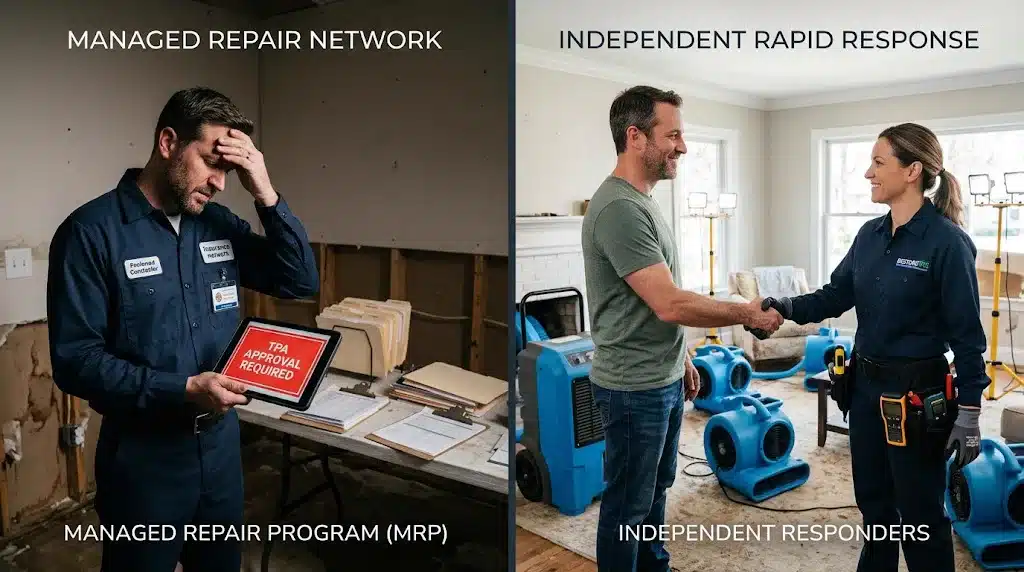
Local relationships. You know the building inspector, the local plumber who refers work, and the insurance agents who trust your company. MRP contractors rotating through a market can’t build those connections.
Advocacy for the homeowner. MRP contractors work for the carrier’s network. You work for the homeowner. That distinction matters when there’s a disagreement about scope or pricing — and homeowners increasingly understand this dynamic.
Flexibility in scope. MRP programs often limit what contractors can do. If a fire damage job needs additional scope outside the program’s parameters, you don’t need TPA approval to do the right thing for the property.
How do reviews and reputation factor in?
Online reviews are your strongest weapon against MRP programs. According to BrightLocal’s 2025 Local Consumer Survey, 98% of consumers used the internet to find local businesses, and 72% say positive reviews make them trust a local business more. When a homeowner Googles “restoration company reviews” in your market, your 4.8-star rating with 200+ reviews outweighs any MRP assignment.
Your company branding and reputation become the reason homeowners specifically request you when filing claims. Build systems to capture reviews after every job, and respond to every piece of feedback promptly. Schema.org’s LocalBusiness markup, when added to your website, helps Google surface your rating in search results directly — free visibility that MRP network listings don’t get.
Does specialization help against network contractors?
Yes. MRP programs assign generalist contractors who handle whatever comes in. Your advanced training in specific damage types becomes a differentiator. IICRC-certified specialists in water, mold, and fire restoration give homeowners a reason to choose you over a generalist network contractor. Specialized knowledge also translates to faster claim resolution and better outcomes, which both homeowners and insurance adjusters recognize.
How a Restoration Company Can Market to Insurance
Marketing to insurance carriers is different from marketing to homeowners. Both matter, and they require separate strategies.
What’s the best way to build insurance adjuster relationships?
Adjusters are gatekeepers on non-MRP claims. They recommend contractors when homeowners ask for help finding someone outside the network. To earn adjuster trust, you need to make their job easier. Submit clean, well-documented estimates the first time. Respond to adjuster calls the same day. Don’t argue scope on the phone — put your case in writing with photos and IICRC standards citations. Adjusters remember contractors who make claims close smoothly.
Attend local claims association events and PLRB regional meetings. Bring a clear one-pager with your certifications, response time commitments, and service area. Follow up with adjusters you meet by email within 48 hours. Consistency over 12–18 months builds the informal preferred status that routes non-MRP jobs your way.
How do independent agents factor into restoration marketing?
Independent insurance agents refer contractors when their clients call panicking after a loss. Agents want to give their clients a name they trust, not just tell them to call the carrier. Visit local independent agencies, drop off branded leave-behinds with your 24-hour emergency line, and ask agents directly if they have a go-to contractor. Offer to present at an agency team meeting about what their clients should do in the first hour after a water or fire loss. That positions you as the expert and keeps your name top of mind when the call comes in.
How PPC and SEO Work Together for Restoration Companies
PPC and SEO solve different parts of the same problem, and independent restorers who grow past a certain revenue threshold typically run both at the same time rather than choosing one or the other.
- PPC captures homeowners at the exact moment of need, placing your listing above every organic result during late-night emergency searches, but traffic stops the moment the budget stops.
- Restoration SEO builds organic rankings that keep generating calls without a cost per click, though results compound over several months rather than appearing immediately.
- Neither channel is available to MRP contractors through the program itself, which means running both is a structural advantage that only independent shops can use.
Pay Per Click for Restoration Companies
Pay-per-click advertising is one of the fastest ways to reach homeowners at the exact moment they need help — before the carrier ever dispatches an MRP contractor.
How does PPC work for water damage and fire restoration?
When someone searches “water damage restoration near me” at 2 AM, Google serves paid ads above organic results. If your ad is running, your phone number shows up before any organic listing. Restoration PPC campaigns typically target high-intent phrases like “emergency water damage,” “burst pipe restoration,” and “sewage cleanup near me.” Cost per click in the restoration category runs $15–$45 depending on market size and competition, according to data tracked by Search Engine Land industry verticals reporting.
Water damage PPC advertising captures homeowners actively searching for help right now, before MRP programs can intervene. The key is running campaigns 24/7 with call extensions active — most emergency calls come outside business hours. Budget at least $1,500–$3,000/month in a mid-size market to generate meaningful call volume. Track every call to source so you know exactly what each lead costs.
Is SEO or PPC better for restoration companies?
Both serve different parts of the funnel. PPC captures demand immediately but stops when the budget stops. Water Damage Restoration SEO builds organic rankings that keep generating calls without paying per click, but it takes 6–12 months to build. The strongest independent restoration companies run both. PPC fills the pipeline now while SEO compounds over time. Neither of these channels is available to MRP contractors through the program — that’s your opening.
According to BrightLocal’s 2025 Local Consumer Survey, 98% of consumers used the internet to find local business information. Google Business Profile rankings, website content, and local search visibility are infrastructure MRP programs can’t build for you. PushLeads works specifically with restoration contractors to build both channels together.

Quick Recap
- MRPs are insurance contractor networks that route claims to pre-approved companies, bypassing homeowner choice in many cases.
- MRP participation means accepting 15–30% price cuts and strict TPA documentation requirements in exchange for guaranteed volume.
- The 60% rule: if MRP work exceeds 60% of revenue, you’ve lost pricing power and business independence.
- Lower per-job margins at higher volume don’t always equal higher profit than fewer jobs at full rates.
- Insurance carriers use MRPs for cost predictability, quality control, faster cycle times, and fraud reduction.
- Independent restorers compete by building direct homeowner relationships before claims are filed.
- Local search presence, reputation management, PPC, and speed are your strongest competitive advantages.
- Adjuster relationships and independent agent referrals are the two best paths to non-MRP insurance work.
- Specialization, certification, and digital presence differentiate you from network contractors.
- Homeowners who already know and trust your company will request you specifically when filing claims.
Frequently Asked Questions
How do managed repair programs for insurance claims work?
A homeowner files a claim, and the carrier’s representative offers to dispatch a pre-approved contractor from their managed repair network. If the homeowner agrees, the TPA assigns the job, manages documentation, approves scope changes, and releases payment to the contractor based on program pricing schedules. The homeowner doesn’t see the contractor’s invoice — the TPA settles directly. Homeowners can always decline the assigned contractor and hire their own, though the carrier may only pay program-rate pricing.
Can I join an MRP and still run an independent business?
Yes. Many restoration companies participate in multiple MRPs while also taking direct customer work. The challenge is managing two workflows with different documentation systems and pricing logic. Some owners find steady MRP volume helps during slow seasons. Others find the low margins and TPA requirements aren’t worth it. Keep MRP revenue below 40–60% of total jobs so you retain pricing power and don’t become dependent on a single program’s assignment volume.
How do TPA programs like Accuserve affect documentation requirements?
TPA programs require real-time moisture logs, staged photo documentation, signed homeowner acknowledgments, and scope approvals before any additional work is performed. Accuserve uses a web portal where technicians log readings daily. Inspectors review submissions remotely and can hold payment pending clarification. Companies that succeed in these programs typically dedicate a coordinator role to portal management. That’s a real overhead cost that has to fit inside already-reduced program pricing.
What happens if a homeowner insists on hiring me instead of the MRP contractor?
Homeowners can request their own contractor at any point, even after an MRP contractor is offered or dispatched. The carrier may limit reimbursement to their network pricing, meaning the homeowner pays the difference out of pocket. This is exactly why building your local reputation matters. When homeowners already know your name and trust your reviews, they’ll request you specifically and accept the out-of-pocket difference if needed.
How do insurance carriers choose roofing and restoration vendors for managed repair programs?
Carriers look for current IICRC or RIA certification, clean license and insurance records, geographic coverage that matches their claim volume, documented response times, and a history of clean estimate submissions with few supplements. Carriers also evaluate TPA portal compliance — contractors who document well and close claims fast get more assignments. Apply directly through each carrier’s vendor management portal or through third-party networks like Contractor Connection and Alacrity Solutions.
How do restoration companies make money without MRP programs?
Through direct-to-consumer marketing: Google Business Profile rankings, local SEO, PPC advertising, and referral networks with plumbers, property managers, real estate agents, and independent insurance agents. These channels deliver homeowners who call you directly before involving the carrier, giving you full pricing authority. Restoration companies with strong owned-channel pipelines typically run 40–60% gross margins compared to 20–35% for MRP-heavy shops, according to Cleanfax Benchmarking data.
Should I stop marketing if I join an MRP?
No. Even MRP participants need direct work to maintain healthy margins. MRP volume feels steady, but it comes at discounted rates with strict rules. Marketing to direct customers keeps your margins healthy, gives you negotiating leverage with TPAs, and protects your business if a carrier changes program terms or drops contractors. Never let any single referral source — including an MRP — control more than 60% of your revenue.
What is the best way to market a restoration company in 2025?
The strongest combination is a well-optimized Google Business Profile, a website with location-specific service pages, consistent review generation after every job, and PPC campaigns running 24/7 for high-intent emergency searches. Adjuster relationships and independent agent referrals add a second layer of insurance-routed work without MRP pricing restrictions. Most companies that grow past $3M in revenue have all three of these systems running simultaneously rather than depending on any single channel.
Build Owned Jobs Before the Next Storm Season
Managed repair programs are here to stay. Carriers have too much financial incentive to keep expanding them, especially after the losses of 2024. But managed repair programs restoration companies fear most are only powerful if homeowners don’t already know who to call.
Your website, your reviews, your local search visibility, and your adjuster relationships are your competitive edge. When a homeowner already knows you and trusts you, they request you specifically when filing a claim. That’s how independent restorers win against MRP networks — before the carrier ever gets to make the offer.
PushLeads works with restoration contractors to build the digital presence and local search strategy that brings homeowner-directed work to your door. See exactly where your visibility stands with a free teardown at seo.pushleads.com/audit or call 828-348-7686.
Keep Reading
Want more customers from Google & AI search?
Get a free SEO audit of your site — see exactly what to fix first.
Your path · Restoration Company SEO
Keep going: read these next


Want this done for you?
Scan your site. See the gaps. Decide with numbers.
- Rankings, Google Business Profile and site-speed teardown
- Report lands in your inbox in about a minute
- No obligation · 4.9 from 67 Google reviews

