

Full transcript
0:00 From 0:00
Hey, good morning Brent. Hope you’re doing well You’re working remotely or you’re on vacation either way. I hope you’re having a good time So when they give you a quick update here, so ever since we started this is sort of like our Visibility growth since we started we had around eight at the top of giggle in January And we actually hit a high of 72 or 73 at the top around May 12 And we currently have 58 at the top And so and we also have 68 terms on Google on Google’s total first page and aren’t at the top So let’s take a look at what is kind of been moving up here visibility has really gone from this one to about 18% So so essentially we have the Baton Rouge cyber security and security companies now there’s no traffic for this But cyber security service we have basically that’s at the top Of course, let’s see here Let’s secure Okay, so the ones that have moved to the top to have traffic are cyber security company professional services Security company and let’s see here security firms IT managed services near me IT I T managed support services IT support IT managed support services and then a whole bunch of these sort of MSP keywords here managed IP local IT support
1:33 From 1:33
managed IT services managed IT services near me MSP Baton Rouge tech support company and and and then And then some of these terms have showed up on Google’s basically on Google’s bottom Google’s first page IT managed service provider near me and Then Louisiana managed IT services So the ones here that have the most traffic are moving up on the moon on Google second page here So managed IT Louisiana managed IT services, Louisiana So we have basically third we have essentially 50 people looking for managed IT services, Louisiana and then and then the other big one is managed IT services Baton Rouge So when we get these ones to the top that have 480 or 50 or 40 people looking for them that will really kind of start converting the leads and so basically A lot of the bottom line here is we have had a fair amount of ones that have moved to the top But these ones even here that are number three like managed IT services near me. This is number three. So if we look here in the maps We essentially are below turnkey and info tech So even just moving this one to number two or eventually number one Will basically
3:04 From 3:04
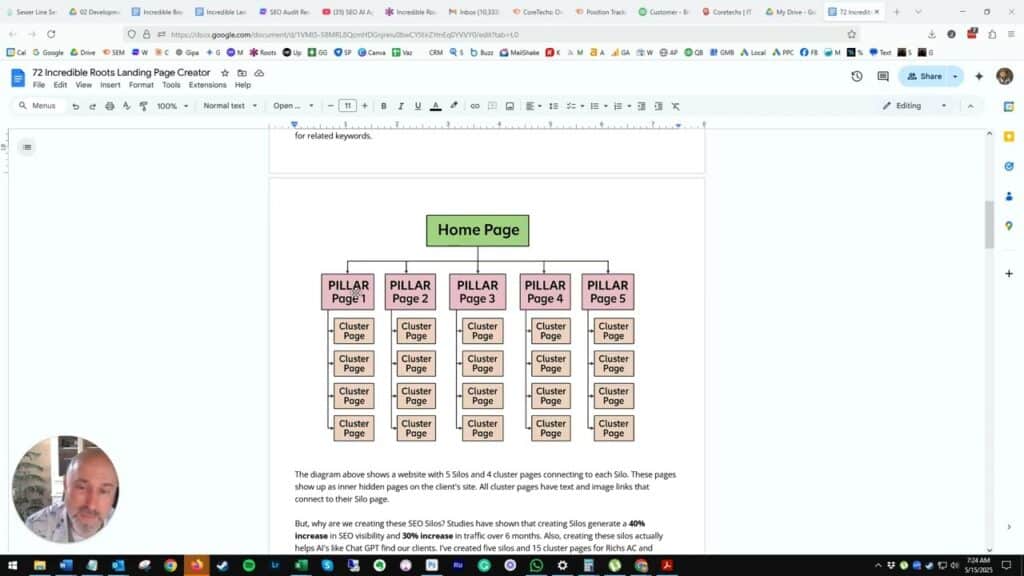
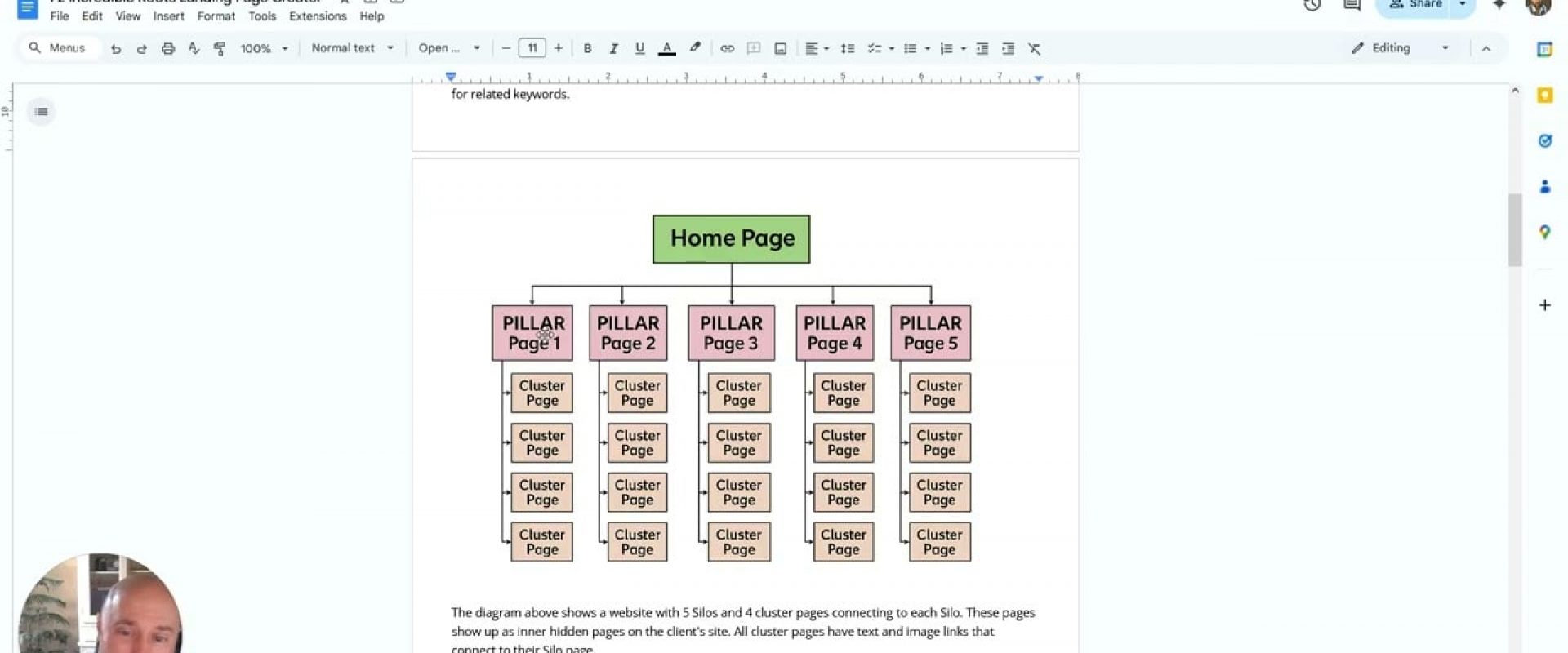
make that make it to where you’re more available. You’re more visible So what I wanted to show you was something I have been working on So I have built my second AI agent and with this thing does the thing is called is this thing is called incredible roots And what it does is it builds an SEO silo. So I’m gonna do one for you We’re putting some finishing touches on this. So I’m hoping to have this in front of you today or tomorrow soon to get some finishing touches on it But essentially creating an SEO silo is an organizational strategy Where we make groups of content that are organized into what’s called we call silos and essentially what you have in each silo what’s what’s called a pillar page and a cluster page and The pillar page is a long piece of content about 3,000 -4,000 words long and then a cluster page is around a thousand words of content and so the main sort of long page is like essentially a lot of it’s covering like a comprehensive guide like your guide to investing to working with an MSP in Louisiana, right? And it really works when it’s a really long page and then basically the smaller little pages here are related to that And so essentially what this kind of basically reminds me of is it like a tree root system
4:36 From 4:36
and If we just take this kind of into like the natural world and the natural world right You know trees had to have roots extend out and the deeper the roots The further they go the more resilient the tree is so the same thing happens with the online world So that the more roots we build the more silos we build the more root clusters What do you want to call it? That turns into growth and actually studies have shown that it’s about a 40 % increase in SEO visibility and a 30% increase in traffic in about six months and the other thing I’ve noticed is that testing this with a couple clients Means that the set means that people start finding you using ChatGPT And there’s a whole bunch of people that think that basically in some near future Between two and five or ten years. We won’t even go into Google and doing searches We’ll just be interacting with chatbots hard to believe that if that’s the case essentially making silos now Essentially means that the ais will find you and I’ve been working with this one company in Florida Called riches AC and this is them their HVAC And I started building these silos mainly I was building some of these for you But I wasn’t doing it to the same extent Really for these guys it’s been it’s really competitive So I started building all these inner pages around keywords and what I really found was that
6:06 From 6:06
within Basically about four weeks of doing this really extensively That they someone found them using chat Bt and it turned into a $2 ,500 or $2,000 sale So they made back about half of their investment with me in the first quarter just with an AI so So I’m like wow, I wasn’t even trying to do that. So when I have here is incredible roots is what I’m calling this product and You can go here. I’m gonna try to do this right now and Essentially what this will do is build an SEO silo. You’re just gonna verify the email address here Okay, and then we’re just gonna put our name and info in here Okay, so you just put your name the business name and the URL here This will actually do an SEO audit and then you can essentially customize this if you want to have a silo or pillar page like the main page you’re going back to This here if you want to have that as it with a certain topic or subtopic We’re gonna leave it blank now. We’re gonna generate a pillar page with five sections and three landing pages and Then this takes about five to ten minutes And what I will do is send this to you and essentially what this does is it makes a Google Doc of all this
7:37 From 7:37
content So here’s an example of one of these here just to show you what I’m talking about So here’s one I did yesterday for a company that What they do is their home renovation remodeling contractor So it comes up with an audit basically of their business type the primary services the content strengths and weaknesses a structure analysis SEO performance and A lot of them other things here technical SEO improvements In this case it we gave it a specific thing So it essentially came up with We this is our our pillar keyword Airbnb co -hosting for luxury cabins and Asheville and then and then we basically worked on these here and We’ve essentially created these cluster keywords and then basically what it did was a generator this entire long article here and And so it makes it makes an intro page and makes basically Or an intro section and then multiple sections here So I’m gonna make one for you and send it to you and let me know what your thoughts are But I think realistically what we need to be doing to in order to get our visibility up into the
9:07 From 9:07
really 20 and 30 40% and also get these high traffic ones that are like 480 people looking for it. We really need a whole bunch of more of these silos. So that’s what I’m gonna be doing And building those out for you and it probably build five or ten in this next month So let me know what your thoughts are and that along with will probably switching over to doing full much more many more guest blogs Is what our focus is? So that should help us get up there for the higher terms. All right, let me know your thoughts and we’ll talk soon thing
▶ Watch on its own page (9:42), with the transcriptMore videos in the library →
Key Takeaways
Coretechs started with 8 keywords ranking at the top of Google and grew to 73 at peak, settling at 58 top-of-page rankings with 68 terms on the first page overall. The next phase focuses on content silo architecture and guest blogging to push high-traffic terms like “managed IT services Baton Rouge” from page two to page one, with the added benefit of appearing in AI-powered search tools like ChatGPT.
- Keyword rankings climbed from 8 to a peak of 73 at the top of Google since the campaign launched in January.
- High-value terms like “managed IT services Baton Rouge” (480 monthly searches) are on page two and represent the biggest near-term opportunity.
- Content silo structure groups pillar pages (3,000-4,000 words) with cluster pages (about 1,000 words) around core service themes.
- Studies cited show silo architecture produces roughly a 40% increase in SEO visibility and a 30% traffic increase within six months.
- One HVAC client in Florida earned back half of a quarterly retainer from a single AI-search lead within four weeks of building out silos.
- Guest blogging is being added alongside silos to build authority for the higher-competition terms.
- AI search tools like ChatGPT are already surfacing local businesses, making silo content a near-term necessity, not a future project.
Where Coretechs Stands Right Now in Google Rankings
Coretechs has grown from 8 keywords ranking at the top of Google in January to a current count of 58 top-of-page rankings, with 68 terms appearing somewhere on the first page. That is real, measurable momentum. Visibility as a percentage has moved from roughly 1% to about 18%, which means the site is genuinely competing now in the Baton Rouge managed IT and cybersecurity space.
The terms that have already climbed to position one include “cybersecurity company professional services,” “security company,” “security firms,” “IT managed services near me,” “IT managed support services,” “IT support,” “MSP Baton Rouge,” and “tech support company.” Those are wins worth acknowledging. The stickier challenge is the cluster of high-traffic terms that are sitting on page two or just outside the top two map pack positions. “Managed IT services Baton Rouge” draws around 480 searches per month, and “managed IT services Louisiana” pulls about 50. Moving those from position three or four to position one is where the real lead volume lives.

For a more detailed look at how we document this kind of progress with clients, our SEO progress report example walks through exactly how we track and present ranking improvements over time. The Coretechs numbers fit a pattern we see consistently: early wins on lower-competition terms build the authority needed to crack the harder, higher-traffic keywords.
Want more customers from Google & AI search?
Get a free SEO audit of your site — see exactly what to fix first.
Why Moving from Position Three to Position One Actually Matters
Moving from rank three to rank one in the Google Maps pack is not a marginal improvement. It can double or triple the number of phone calls a business receives from a single keyword because click-through rates drop sharply below the first result. For Coretechs, ranking third for “managed IT services near me” means appearing below Turnkey and InfoTech in the local pack, which is a significant visibility gap worth closing.
How much traffic difference is there between rank one and rank three in local search?
The top map pack result captures a disproportionate share of clicks compared to positions two and three. While exact percentages vary by search type and location, the pattern is consistent: most people click the first result they see. For a keyword with 480 monthly searches, the difference between rank one and rank three could mean dozens of additional qualified visitors per month, each of them already looking for a managed IT provider.
What does ranking on Google page two mean for lead generation?
Ranking on page two of Google for a high-traffic keyword is almost the same as not ranking at all for lead-generation purposes. The vast majority of searchers never scroll past page one. That is why the current Coretechs priority is getting “managed IT services Baton Rouge” and “managed IT services Louisiana” from their current page-two positions up into the top three organic spots. Once those move up, the conversion math changes significantly because the people searching those terms have buying intent.
Which Coretechs keywords have the highest traffic and where are they now?
The highest-traffic keywords currently outside the top positions are “managed IT services Baton Rouge” with approximately 480 monthly searches, “managed IT services Louisiana” with around 50, and “Louisiana managed IT services” with a similar volume. These terms are on page two or ranking third in the map pack. Winning those positions is the primary goal of the silo-building and guest-blogging strategy we are rolling out over the next 30 to 60 days.
What a Content Silo Is and Why It Works for MSP SEO
A content silo is an organizational strategy where a website groups related pages together under a single topical theme, with one long pillar page supported by several shorter cluster pages, all linking back to the pillar. For a managed IT services company in Baton Rouge, a silo might center on a pillar page titled something like “Your Complete Guide to Working with an MSP in Louisiana,” supported by cluster pages covering specific services, industries, or questions related to that theme.
What is a pillar page and how long should it be for SEO?
A pillar page is the central, authoritative piece of content for a given topic, typically 3,000 to 4,000 words long. It covers the subject comprehensively enough that search engines recognize it as the go-to resource for that theme. For Coretechs, this means writing detailed, useful content about managed IT in Louisiana, not just stuffing keywords onto a short page. The length signals depth, and the internal links from cluster pages signal topical authority.
What is a cluster page and how does it support the pillar?
A cluster page is a shorter supporting article, usually around 1,000 words, that covers a specific subtopic related to the pillar. It links back to the pillar page and receives a link from it, creating a closed loop of topical relevance. For an MSP, cluster pages might cover topics like “What is a managed firewall?” or “How to choose IT support in Baton Rouge.” Each cluster page targets a narrower keyword while feeding authority back to the broader pillar. Building out a full content silo structure is what moves a site from occasional rankings to sustained visibility across a topic area.
How many silos does Coretechs need to see meaningful traffic growth?
The plan is to build five to ten silos over the next month for Coretechs. Each silo typically includes one pillar page and three or more cluster pages. Based on data cited in the planning session, silo architecture is associated with roughly a 40% increase in SEO visibility and a 30% increase in traffic within about six months. Five to ten silos gives the site enough topical coverage to compete for the broader set of managed IT and cybersecurity terms in the Louisiana market.

The AI Tool We Built to Create These Silos Faster
We built an AI agent called Incredible Roots that automates the research and drafting process for silo content. The tool takes a business name, URL, and optional topic focus, runs an SEO audit, and then generates a full silo package: a pillar page outline with multiple sections and up to three supporting landing pages, all delivered as a Google Doc. What used to take a week of manual research and writing can now be drafted in five to ten minutes, then refined by our team before it goes live.
What does Incredible Roots actually produce in its output?
The output includes a business type summary, primary services identification, content strengths and weaknesses, a site structure analysis, SEO performance notes, technical SEO improvement suggestions, a primary pillar keyword recommendation, cluster keyword suggestions, and a full draft of the pillar article broken into an introduction and multiple detailed sections. For a home renovation contractor used as a demo example, the tool identified “Airbnb co-hosting for luxury cabins in Asheville” as a pillar keyword and built out the full content structure around it.
How do I customize the silo topic if I have a specific keyword in mind?
The tool allows you to specify a topic or subtopic before generating. If Coretechs wanted a silo specifically around cybersecurity for healthcare businesses in Louisiana, that direction can be set upfront. If the field is left blank, the tool uses its audit findings to recommend the best available topic based on the site’s existing authority and keyword gaps. Either way, the resulting Google Doc gives us a concrete starting point rather than a blank page.
Is AI-generated content good enough to actually rank on Google?
The AI output is a first draft, not a finished product. Our team reviews every document, adds client-specific details, adjusts the tone, and verifies accuracy before anything gets published. Google’s guidance focuses on whether content is helpful and accurate, not on whether a human or machine produced the first version. The combination of AI speed and human editorial review is what makes the approach practical at scale without sacrificing quality.
How AI Search Tools Like ChatGPT Are Already Sending Leads
ChatGPT and similar AI assistants are already being used by real buyers to find local service providers, and the businesses that have structured, topically deep content on their websites are the ones showing up in those answers. This is not a theoretical future scenario. One of our HVAC clients in Florida received a ChatGPT-sourced lead within four weeks of launching an aggressive silo-building effort, and that lead converted to a sale worth approximately $2,000 to $2,500.
How does a local business get found in ChatGPT results?
AI answer engines pull from indexed web content, and they favor sources that have clear, comprehensive, well-organized information on a topic. A site with a strong content silo around “managed IT services in Louisiana” is more likely to be cited when someone asks ChatGPT for MSP recommendations in that area than a site with thin, scattered pages. Building that content now puts Coretechs ahead of competitors who are still ignoring AI search entirely. For a deeper look at this mechanism, our post on the visibility flywheel strategy explains how content, social signals, and AI citations reinforce each other.
How quickly can silo content start showing up in AI search responses?
Based on the Florida HVAC example, meaningful AI visibility can appear within about four weeks of publishing well-structured silo content. That is faster than traditional Google ranking gains for competitive keywords, which often take three to six months. The reason is that AI models can index and reference new content relatively quickly, especially when it is organized clearly and covers a topic thoroughly. This makes silo-building one of the faster-return activities in the current SEO environment.
Should I track whether my business is appearing in AI Overviews and ChatGPT answers?
Yes, tracking AI visibility is increasingly important alongside traditional rank tracking. Google’s AI Overviews are appearing for a growing percentage of searches, and appearing in those boxes delivers significant visibility even when the user does not click through to your site. We have a specific process for helping clients track AI Overview visibility so you can see whether your content investments are paying off in this newer channel.
Guest Blogging as the Second Pillar of the Next Phase
Guest blogging on relevant, authoritative websites remains one of the most effective ways to build the backlink authority needed to rank for competitive terms. For Coretechs, the higher-traffic keywords like “managed IT services Baton Rouge” require more than on-site content alone. They require external signals that tell Google other sites consider Coretechs an authoritative source on managed IT in Louisiana. Guest posts on technology publications, local business sites, and industry blogs serve exactly that purpose.
What makes a good guest blog target for an MSP in Louisiana?
A useful guest blog target has genuine traffic of its own, is topically relevant to IT services or business technology, and ideally has local or regional relevance to Louisiana or the Gulf Coast. Publications that cover small business, cybersecurity, or technology for professional services firms are strong candidates. The goal is a contextually relevant link, not just any link. A link from a technology publication saying “Coretechs provides managed IT services in Baton Rouge” carries more weight than a link from an unrelated site.
How many guest posts per month does it take to move competitive keywords?
There is no universal number because it depends on the competition level for the target keywords and the authority of the sites providing the links. For keywords in the 400 to 500 monthly search range in a regional market like Baton Rouge, a consistent cadence of several high-quality guest posts per month alongside on-site silo content is a reasonable starting point. The goal is steady accumulation of authority over three to six months, not an overnight spike.
Can guest posts also help with AI search visibility?
Guest posts contribute to AI visibility in two ways. First, the backlinks they generate improve the overall authority of the Coretechs domain, which makes the site’s content more likely to be pulled into AI-generated answers. Second, the guest post articles themselves can be indexed and cited by AI tools if they contain useful, specific information. We also pay attention to how YouTube citations in AI search work alongside written content, since video and text together create a stronger topical footprint.
In this video
- 0:00 High Authority vs Low Authority Guest Posts
- 0:52 Core Comparison Link Farms vs Real Sites
- 1:36 Why One Strong Placement Beats Ten Weak
- 2:06 Four Signals a Site Has Real Authority
- 2:43 The Domain Rating Metric Trap
- 3:17 Local Publications as Legitimate Authority
- 3:55 How Many Placements to Target Per Quarter
- 4:24 Six Steps to Manually Verify Any Site
- 5:08 Three Ways to Find Guest Post Opportunities
- 5:57 News Placements and HARO as Link Sources
- 6:28 Five Elements of a Pitch That Gets a Yes
- 7:02 Handling Rejections and Adjusting Your Angle
- 7:42 Spotting Manipulated Metrics Before You Pay
- 8:25 Weekly Outreach Rhythm for Consistent Results
Full transcript: High-Authority Guest Posts: How to Find & Land Them in 2025
The Roadmap for Coretechs Over the Next 30 to 60 Days
The near-term plan for Coretechs is clear: build five to ten content silos using Incredible Roots, publish the resulting pillar and cluster pages on the site, and simultaneously increase the volume of guest blogging to build external authority. These two activities together address both sides of the ranking equation: on-site topical depth and off-site credibility signals.

What should Coretechs expect to see in the next 60 to 90 days?
Based on typical silo implementation timelines, the first signals of movement on the high-traffic keywords should appear within 60 to 90 days of publishing. Some of the lower-competition cluster keywords may rank faster, within 30 to 45 days. The map pack positions for terms like “managed IT services near me” may respond to the authority increases from guest blogging within a similar timeframe. The full impact on terms like “managed IT services Baton Rouge” is more likely a three to six month process.
How will we measure whether the silo strategy is working?
We track ranking positions for all target keywords on a weekly basis and monitor which terms are moving up, staying flat, or slipping. Beyond rankings, we watch organic traffic to the new pillar and cluster pages directly to see whether Google is sending visitors to them. For service businesses, lead volume and conversion from organic traffic are the ultimate metrics. If a term like “managed IT services Baton Rouge” moves from position six to position two, the traffic increase should show up in both analytics and, eventually, inbound inquiries. Tracking restoration company KPIs follows a similar logic, and our guide on restoration company KPIs illustrates how we connect SEO activity to business outcomes for service contractors, a framework we apply across industries including IT services.
When does adding more silos stop making sense?
Adding silos stops making marginal sense when you have covered all the meaningful topical areas relevant to your services and geography. For an MSP serving Louisiana businesses, that might eventually mean silos covering cybersecurity, cloud services, network management, IT support for specific industries like healthcare or legal, and managed services by city. That is likely 10 to 20 silos over the course of a year. Before that point, each new silo adds a new cluster of rankable pages and strengthens the overall topical authority of the site.
Frequently Asked Questions
How long did it take Coretechs to go from 8 to 58 top-of-Google rankings?
The growth from approximately 8 top-of-page rankings in January to a peak of 72 or 73 and a current count of 58 happened over roughly four to five months. This timeline reflects a combination of on-page optimization, content additions, and technical SEO improvements made during that period. Reaching the higher-traffic, more competitive keywords will take longer because those require additional domain authority from guest blogging and silo content.
What is the difference between a pillar page and a regular service page?
A service page is typically a shorter, conversion-focused page that describes what a company offers and invites the visitor to contact them. A pillar page is a much longer, educational resource, usually 3,000 to 4,000 words, that covers a topic comprehensively enough to serve as the authoritative reference for that subject on your site. Service pages and pillar pages can coexist, and ideally the pillar page links to relevant service pages so visitors can take action after reading.
Does content silo structure require rebuilding the entire website?
No, building content silos does not require a full website rebuild. In most cases, it means adding new pages and a clear internal linking structure without changing the existing site architecture. The pillar page and cluster pages are created as new content, and links are added between them as well as from relevant existing pages. The process is additive rather than disruptive, which means the site can continue operating normally while the new content is built out.
Why is “managed IT services Baton Rouge” harder to rank for than “tech support company”?
“Managed IT services Baton Rouge” is harder to rank for because it has significantly higher monthly search volume (around 480 searches) and more direct commercial intent, which means more competitors are investing in ranking for it. “Tech support company” and similar terms with lower search volume face less competitive pressure. Higher-value keywords require more total authority, more content depth, and more external links pointing to the site before Google is willing to rank a business prominently for them.
Can AI-generated silo content hurt a site’s Google rankings?
AI-generated content that is low-quality, repetitive, or factually inaccurate can hurt rankings and user experience. The key is treating AI output as a first draft that gets reviewed, edited, and enriched with real business details before publishing. Content that is genuinely helpful and accurate is what Google rewards, regardless of whether a human or an AI produced the original draft. Our process at PushLeads always includes editorial review before any AI-drafted content goes live on a client’s site.
How do guest blogs and content silos work together for SEO?
Content silos build topical depth and internal linking structure on your own site, giving Google a clear signal that you are an authority on a subject. Guest blogs on external sites build the backlink authority that tells Google other people agree you are an authority. Neither approach works as well alone as they do together. The silo gives Google something authoritative to rank on your domain, and the guest posts give Google the external validation needed to push those pages into competitive positions.
How soon after publishing a new pillar page will it start to rank?
A new pillar page on a site with existing domain authority can begin showing up in search results within a few weeks of publication, particularly for lower-competition cluster keywords. Ranking for the target pillar keyword, especially a competitive one, typically takes three to six months of consistent link-building and content expansion. The timeline is shorter for sites with stronger existing authority and longer for newer domains with fewer backlinks.
Is the Incredible Roots tool available to other businesses or just Coretechs?
Incredible Roots is an internal tool we have developed at PushLeads to accelerate content silo creation for clients. It is not a self-serve public product at this stage. Clients who work with us on content SEO campaigns benefit from the silo-building process it enables, but the tool runs as part of our managed service rather than as something businesses access independently. If you are interested in having us build silos for your site, reaching out to PushLeads is the right starting point.
Ready to Push Your Rankings Up Where They Actually Generate Leads
The Coretechs story so far is a good one: 8 keywords at the top of Google growing to 58, visibility climbing from under 2% to about 18%, and a clear path to the high-traffic terms that will bring in real inquiries. But the work is not done. The keywords with 480 monthly searches are still sitting on page two, and the competitors in the map pack are still ahead of where they should be.
The next phase is concrete: five to ten content silos built and published, a ramped-up guest blogging cadence, and tracking in place to catch every movement in the rankings. If you are running a managed IT, cybersecurity, or any other local service business and your rankings look like Coretechs did in January, that is exactly where we start.
If you want to see what this kind of visibility growth looks like for your business, I would be glad to take a look at where you stand today. Reach out to us at PushLeads and we can put together a clear picture of your current rankings, what is holding the high-traffic terms back, and what a realistic path forward looks like.
Keep Reading
Want more customers from Google & AI search?
Get a free SEO audit of your site — see exactly what to fix first.
Your path · What Is SEO? The Complete Guide to Search Engine Optimization for Businesses
Keep going: read these next

- SEO Analytics and Reporting Research Report: Measuring Success That Actually Drives Business Results
- AI-SEO: How Artificial Intelligence is Revolutionizing Search Rankings in 2026



Want this done for you?
Scan your site. See the gaps. Decide with numbers.
- Rankings, Google Business Profile and site-speed teardown
- Report lands in your inbox in about a minute
- No obligation · 4.9 from 67 Google reviews