Full transcript
0:00 From 0:00
Hey, I’m Jeremy with story power the director of SEO and just wanted to give you a progress report of ramping up the SEO in the last six months and what kind of results we’ve been able to achieve so let’s get into it So the first thing I want to remind you about before we kind of get into any numbers here is something called visibility And this is what we measure essentially. What kind of visibility are we getting over time? And so what we’re looking at here on this report is when someone’s on a mobile phone in the cashier’s area what kind of visibility do we have and what we’re looking at here is our current visibility is around 14 and a half percent or so and Really what we do is just measure this we measure this where we before we kind of ramp things up to where we are now And so back in around February 12th, we had around 7% visibility and Currently we have about 14.38% Visibility and what happens is this visibility number goes up when we have more at the top of Google so in cashiers I can scroll down and see that Some of the new terms that are showing up at the top of Google are country club sports country clubs and NC and if I look at this one specifically This one is position two in cashiers, right? So basically what we’re looking at here is
1:30 From 1:30
We have basically Google Maps where you know You’re seeing the country club of Sapphire Valley highlands and that kind of thing and you’re seeing then that the country club in North Carolina And here we are the second one down in the results. Okay, and so that’s technically position two And basically for this term country clubs and NC when we started it was zero It wasn’t showing up at all and this one has been at the top of Google for a fair amount of time So country clubs and NC is the top Also, we noticed that you’re we as we’re doing the work. We saw your name shoot up in Google So Berlin game we started really on Google’s fourth page for anyone searching for the name Berlin game And now we’re the third one down on the list And then other things that have moved up have been Berlin gang fishing Berlin gang tennis lessons the country club of Sapphire Valley and Then another one is Sapphire golf course private country club country club wellness golf courses near cashiers as Well as country clubs in North Carolina. These are at the bottom of Google’s first page Cashiers country clubs, so we started on Google’s second page for that and now we’re in the middle or towards the bottom of Google’s first page other terms that are moving up have been cut golf courses in cashiers and Sapphire club Sapphire club in general, right? So that’s kind of the growth with what that we’ve seen in cashiers
3:01 From 3:01
Again going from a 7% visibility to 14% What that basically translates to in plain English is we started with around Nine of the top of Google and now we have 20 searches at the top of Google in cashiers All right, so let’s take a look here in Sapphire What kind of visibility growth that we see in that area so we started with around? 9.3% and now we have about 15% visibility that basically translates into roughly 16 at the top of Google and about 30 or so at the top of Google in Right there in Sapphire, right? And of course, this is where you guys are based out of so I would expect to see, you know Pretty strong improvement which we have seen because it’s real close to where you guys you guys are based out of Sapphire And essentially what we’ve seen here in Sapphire is the Berlin game country club membership Berlin game golf center As well as country club sports Also, your name moved up Berlin game moved up to position three Berlin game tennis lessons as well as the same kind of terms the country club Sapphire Valley country club wellness Sapphire NC golf And some of these other terms moving up are the cashers country club cashers NC country club as Well as country clubs in North Carolina So pretty excited about this term here country clubs in North Carolina because we started with not showing up at all
4:32 From 4:32
And we’ve been basically hovering around on sometimes at the top of Google But anywhere from the middle to the top of Google depending on the day You know progress for that other terms golf courses in cashers cashers NC golf All right, so next I want to look at here is our visibility our visibility by looking at competition and we call this rankings distribution and when we started we had around 8% or so visibility and With 16 at the top of Google right there in Sapphire and then what we have now is 15% visibility with about 30 at the top of Google right there in Sapphire and we have moved up Previously yet Yelp and NC living in Zillow were at the top And these like Zillow had 12 % of the market Yelp had 5% NC living had 5% and now we have 15% of the overall market think of that as our sort of SEO market share And so we have 15% Yelp has 11% And this other company there this Sapphire national has 11% and then Zillow has really gone down a little bit to 10 % And some of these other ones have dropped as well This graph here shows us how many Keywords nationwide are moving up over time.
6:02 From 6:02
So remember that some of these terms Are going to be showing up higher or lower nationwide depending on where you are So we started with around 26th at the top of Google in July 26th of 28 and now we have 22 nationwide And so my point here is that obviously that’s slightly lower But some of these terms were really not the best terms. So like Sapphire NC golf that kind of thing But the main progress that we have seen here nationwide is that we have 49 searches In the middle of Google’s first page back in July of 24 And now we have 67 terms on Google’s first page So slightly less the top nationwide But but a lot more have that I moved up to the middle of Google’s first page And in the next six months we can probably expect that to go to about 30 or 35 at the top of Google and And that kind of progress will keep happening Alright, so the next thing I’m going to show you here is Progress on our overall visibility and our growth Invisibility in Google and also what kind of you know results were getting from link building Okay, so the first thing I want to point out to you is these numbers here this DR and this UR Okay, so all websites has a have a number and a scale of one to a hundred A brand new website if I were to make one today build
7:33 From 7:33
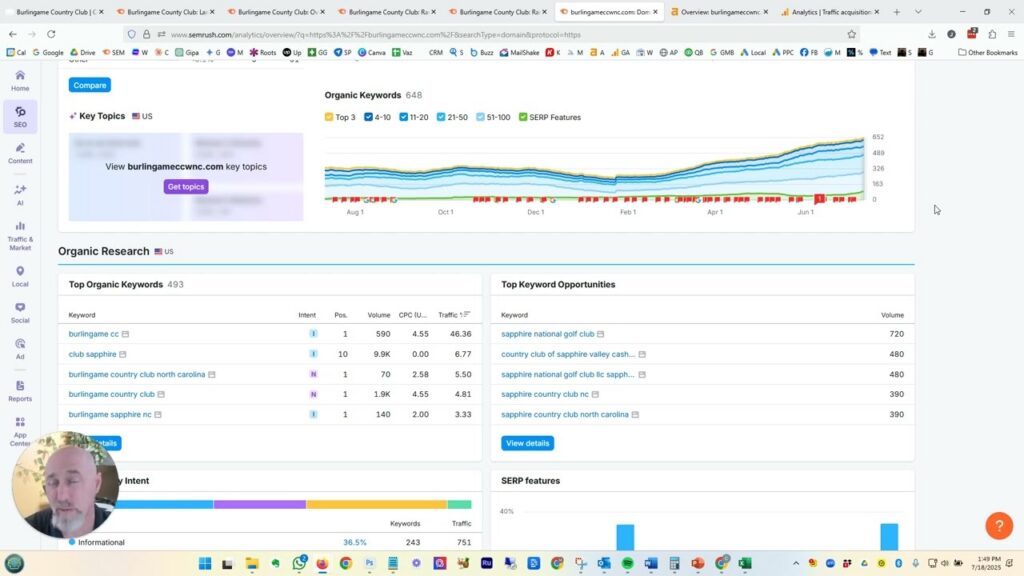
what I make one today. We would have a zero and then as this goes up Um as our number increases we show up at the top of Google for more and more terms So we have seen this overall reputation number this DR or domain rating your overall reputation Go from Basically 11 to 19 So this means that SEO is happening an increased amount of SEO is happening because obviously around February or so we started Increasing our current SEO efforts and I can show you you know that we can see here that we’re getting good results from that So from 11 to 19 And then our home page reputation Started with around 10 or 11 or so and that has gone to 29 So as the home page reputation has gone up and the overall reputation has gone up We can see here that we are showing up for nationwide another 82 keywords here And we have built or this tool is showing 475 new Connections to your website backlinks From 340 other from 276 new domains So realistically if I scroll down here This blue line here Is how many other connections are you getting it for time? And you can see here we had around 60 to around 100 or so before we started ramping up SEO And then roughly around February 1 we go from 104 Up to 340 other connections from other websites
9:06 From 9:06
And so this blue line is just showing that hey We’re doing the work that the increased SEO work that you guys are paying for And we can scroll down and see here that our overall positions have actually gone up here We have 254 positions at the top of Google Versus like 155 a year ago And this graph is slightly different than the other one I showed you the scm rush graph where we had 26 and 22 or whatever Um, this is a more of an accurate tool and generally speaking We refer to this tool when we’re looking at rankings visibility So we really we had basically 10 at the top of Google with you know for um back in july And now we have um, you know 11 according to this nationwide as well Um, all right, so and then this is um, what kind of progress we’re making with the traffic from Google over time Um, and so what i’m doing is just looking at a snapshot of this month versus last month Um, and it does look like the height of your season is october So looking here, we essentially have seen an 8% increase Um in the last 30 days we had around 2,100 visitors In may to june and that’s gone up to 2,300 visitors Um in the last 30 days on average these people are spending about a little less than a minute on the site And I can see here that they are doing
10:37 From 10:37
14% more actions on the site that we call event count Versus 15,000, I um, you know 30 days ago So that’s kind of the overview. Let me know if you have any questions And obviously bill is here to answer any questions And uh, thanks a lot and i’ll talk to you guys soon. Thanks
▶ Watch on its own page (10:57), with the transcriptMore videos in the library →
Key Takeaways
Over a six-month SEO ramp-up, a private country club in the Cashiers and Sapphire, NC area nearly doubled its local search visibility, going from around 7% to over 14% in Cashiers and from 9.3% to 15% in Sapphire. Domain rating climbed from 11 to 19, backlinks grew from roughly 100 connections to over 340, and site traffic increased 8% month over month with 14% more user actions recorded on the site.
- Local visibility in Cashiers grew from 7% to 14.38%, meaning the site went from appearing at the top of Google for about 9 searches to 20 searches in that area.
- Visibility in Sapphire grew from 9.3% to roughly 15%, representing a jump from 16 top-of-Google appearances to around 30.
- The site’s domain rating (DR) climbed from 11 to 19, and the homepage’s URL rating rose from around 10-11 to 29 over the same period.
- Backlinks grew from approximately 100 connections before the ramp-up to over 340 referring domains, with 475 new backlinks tracked in total.
- Nationally, the site moved from 49 first-page keyword positions to 67, with overall top positions rising from 155 to 254 year over year.
- Organic traffic increased 8% month over month, from roughly 2,100 visitors to 2,300 visitors in a 30-day window.
- Terms like “country clubs in NC” went from zero presence to regularly appearing on the first page, while the brand name moved from page four to position three nationally.
What Six Months of SEO Actually Looks Like for a Private Club
Six months of consistent SEO work can take a business from scattered rankings across pages two, three, and four of Google to genuine first-page visibility across dozens of relevant search terms. That is exactly what we tracked for this client, a private country club in the Cashiers and Sapphire Valley area of North Carolina. We measure progress primarily through a metric called visibility, which represents the percentage of relevant searches in a given geographic area where your business appears near the top of Google. When we started, that number sat around 7% in Cashiers. After six months of intentional work, it was sitting at 14.38%. In Sapphire, where the club is actually located, it went from 9.3% to 15%. Those percentages translate directly into real search appearances. In Cashiers, going from 7% to 14% means going from showing up at the top of Google for about 9 searches to showing up for about 20. In Sapphire, 9.3% to 15% means roughly 16 top-of-Google appearances growing to about 30. These are not vanity numbers. When your business shows up at the top of Google in your local area for terms people are actually searching, that drives phone calls, form fills, and revenue. The goal of this report is to walk you through exactly what moved, why it moved, and what you can reasonably expect next.
Want more customers from Google & AI search?
Get a free SEO audit of your site — see exactly what to fix first.
How We Measure Local Search Visibility
Visibility, in the way we use it at PushLeads, is the percentage of tracked keyword searches in a specific location where your business appears in a top Google position, typically in the Google Maps pack or in the top organic results. It gives you one clean number to watch over time instead of trying to manually check dozens of keywords every week. When that percentage goes up, it means more people searching relevant terms in your area are seeing your business listed prominently. When it goes down, it usually means a competitor outranked you or Google reshuffled results after an algorithm update. Understanding how visibility works is connected to how SEO works fundamentally, because the whole system is built around earning Google’s trust through signals like content quality, links, and consistent business information. For this client, we track visibility separately in Cashiers and in Sapphire because these are two distinct geographic pockets where potential members are searching, and performance can vary significantly between them.
Why does visibility percentage matter more than just checking one keyword ranking?
Checking a single keyword gives you a narrow snapshot that can be misleading on any given day. Visibility percentage covers all your tracked terms at once in a real geographic area and smooths out daily fluctuations. For this client, we track dozens of terms across two locations, so visibility gives us a reliable overall picture of whether the SEO work is gaining ground or losing it. A single term can bounce around, but visibility trending upward over months tells a clear story.
How do you separate visibility by location, and why does that matter for a business like a country club?
We set up visibility tracking grids around specific towns or zip codes, simulating what someone on a mobile phone in that area would see when they search relevant terms. For a private club in Sapphire Valley, someone searching from Cashiers a few miles away sees different results than someone searching from a Sapphire address. Tracking both separately lets us see where the business is strongest and where there is still room to grow, rather than lumping everything together and missing those geographic differences.
What is a realistic starting visibility percentage for a small business that has not done SEO before?
A small or mid-size business that has done little to no SEO often starts in the 5% to 12% range depending on competition and how long the website has been around. This client started at 7% in Cashiers and 9.3% in Sapphire, which is a reasonable baseline for a business in a niche market with some existing online presence. From those starting points, a well-run SEO campaign can realistically double visibility within six to twelve months, which is exactly what happened here.

Which Keywords Actually Moved and Why It Matters
Ranking improvements are most meaningful when they happen on terms people are actually searching. For this client, the most exciting keyword movements were on terms like “country clubs in NC,” which went from zero presence at all to appearing consistently on the first page. That is a brand-new traffic source that did not exist before the campaign started. Equally important was the improvement on branded search. The client’s name, Berlin Game, was showing up on Google’s fourth page when someone typed the actual name of the club into search. Now it is in the third position. That matters because if someone already knows you and searches your name, you absolutely should be near the top of those results. Losing branded searches to third-party directories like Yelp or Zillow is a common problem and a fixable one. Terms like “Berlin Game fishing,” “Berlin Game tennis lessons,” “country club wellness,” “golf courses near Cashiers,” and “Cashiers country clubs” all moved up during this period as well. Some moved from page two to page one. Some that were already on page one moved from the bottom toward the middle. If you want to understand how to interpret these shifts as they appear in your own reporting, the post on reading your SEO report walks through exactly what to look at and what to ignore.
Why did branded keyword rankings start so low in the first place?
Branded keywords rank low when a business’s website has weak authority compared to well-established directories like Yelp, TripAdvisor, or Zillow. Those platforms have extremely high domain ratings built over years, so Google naturally shows them first for local business name searches. Building up your own domain rating through content and backlinks gradually shifts the balance so your own website outranks the directories when someone searches your name directly, which is where you want them to land anyway.
What does position two in Google Maps mean for actual click traffic?
Position two in the Google Maps pack, the three-business listing that appears below the map on mobile and desktop, captures a significant share of local intent traffic. Position one gets the most clicks, but position two still earns meaningful traffic from people who scroll past the first listing or who are comparison shopping. For “country clubs in NC” at position two in the Cashiers area, this is a keyword with genuine purchase intent attached to it, meaning people searching it are likely evaluating membership or visits, not just doing casual research.
How long before new keywords start appearing at the top of Google after starting SEO?
New keywords typically begin showing movement within two to four months of starting consistent SEO work, but appearing at the true top of results for competitive terms usually takes six to twelve months. This client’s “country clubs in NC” term went from not appearing at all to first-page placement within the six-month window we are reporting on. For a broader perspective on timelines, the resource on how long SEO takes to work covers this in detail.
Understanding Domain Rating and Why Your Website’s Reputation Score Matters
Every website on the internet has a domain rating, or DR, which is a score on a scale from zero to 100 that represents how authoritative Google considers your site to be. A brand new website starts at zero. A massive publication or established brand might sit at 70 or 80. The higher your domain rating, the more likely Google is to rank your pages in competitive search positions. For this client, the domain rating started at 11, which is typical for a small business site that has not done much active link building. After six months of SEO work, it climbed to 19. That is not a huge number in absolute terms, but the direction matters more than the raw number at this stage, and the jump from 11 to 19 represents a meaningful increase in Google’s trust in the site. Alongside the overall domain rating, we also track the URL rating of the homepage specifically, since the homepage tends to carry the most weight. That number went from around 10 or 11 up to 29, which is a strong gain in a six-month window. To see a detailed breakdown of how these kinds of authority gains play out for a contractor-type business, you can look at the real SEO case study results we published from an Asheville contractor campaign.
What is the difference between domain rating and URL rating, and which one should I focus on?
Domain rating measures the overall authority of your entire website based on the quality and quantity of backlinks pointing to any page on your site. URL rating measures the authority of a specific page, usually your homepage. Both matter, but domain rating is the better indicator of your site’s overall SEO health. URL rating tells you how well a specific page is positioned to rank on its own. Ideally you want both climbing together, which is what happened in this campaign when DR went from 11 to 19 and homepage URL rating went from 10-11 to 29 simultaneously.
How many backlinks do you actually need to move the needle on domain rating?
There is no fixed number, because the quality of backlinks matters far more than the count. One link from a high-authority regional publication can outweigh fifty links from low-quality directories. That said, for a small business site starting at DR 11, building several dozen genuinely relevant backlinks from real websites over six months is usually enough to push the DR into the high teens or low twenties. This client went from around 100 total backlink connections to over 340, with 475 new backlinks tracked across 276 new referring domains, and the DR moved from 11 to 19 as a result.
Does a higher domain rating automatically mean more traffic?
Not automatically, but they tend to move together when the link building is done correctly. A higher domain rating gives your pages more authority to rank, which means more of your target keywords can crack the first page of Google. For this client, the DR climbing from 11 to 19 coincided with the number of first-page keyword positions rising from 49 to 67 nationwide, and overall top positions growing from 155 to 254 year over year — all metrics we track inside our client dashboard for AI visibility and SEO results. The authority gains are what make the ranking gains possible.
Backlink Growth: What the Blue Line on the Graph Actually Represents

When I show clients a backlink growth graph, the blue line represents the number of other websites linking back to their site over time. Before we ramped up SEO for this client in February, they had somewhere between 60 and 100 backlink connections. By the time we pulled this report, that number had grown to over 340 connections from 276 unique referring domains. That jump is visible as a clear upward move in the graph right around the first of February, which is when we increased the SEO effort. I show clients this graph specifically so they can see that the work is actually happening. Link building is one of those SEO activities that is invisible to the business owner unless you have a reporting tool that surfaces it. The graph makes it concrete. It also helps explain why DR and rankings move together, because all those new connections are what push the authority score higher and give Google more reason to trust the site. For businesses that want to understand the cost side of this kind of effort relative to what they get back, the breakdown on SEO ROI for contractors puts the numbers into plain terms that apply beyond just that industry.
What kinds of websites should be linking to a private country club or resort business?
For a business like this, the most valuable backlinks tend to come from regional tourism sites, local chambers of commerce, golf-related publications, outdoor recreation directories, Western NC lifestyle websites, and news sources that cover the Cashiers and Sapphire Valley area. Links from Yelp and similar directories have some value but are not sufficient on their own. The goal is to build a backlink profile that looks like a genuinely well-connected business in its region, not a list of paid or low-quality links.
Can I see which specific sites are linking to my business?
Yes. Tools like Ahrefs and SEMrush let you see every referring domain linking to your site, along with each domain’s authority score and the anchor text used in the link. We review this list regularly to make sure the links being built are from credible sources and that no problematic links are dragging the profile down. If you are ever on a monthly call with us at PushLeads and want to go through your backlink list line by line, that is something we are happy to do.
How do I know if my competitor is building backlinks faster than I am?
The same tools that show your backlink profile also let you pull your competitor’s profile. If a competitor’s DR is climbing faster than yours or if they are appearing in positions you used to hold, a backlink gap analysis usually reveals why. In this client’s case, we could see that Yelp held 5% of the local search market and Zillow held 12% when we started, partly because of their massive backlink profiles. By the end of the reporting period, our client had grown to 15% market share while Zillow dropped to 10%.
National Rankings Versus Local Rankings: What Each Number Tells You
One of the things I want clients to understand is that local rankings and national rankings are two different measurements that can move in different directions at the same time, and that is perfectly normal. For this client, we saw the number of terms ranking at the very top of Google nationally drop slightly, from 26 to 22, over the reporting period. But at the same time, the number of terms on Google’s first page nationally grew from 49 to 67. What that means in practical terms is that some terms moved from the top positions down slightly while a larger group of terms moved up from pages two and three onto page one. The page-one growth is the more important story for a business like this, because most people never go past the first page. They are either finding you there or they are not finding you at all. The SEO progress we documented for a similar regional business in our restoration company SEO progress update shows a similar pattern, where local visibility gains lead the way before national positioning fully catches up.
Why would national keyword positions drop while local visibility goes up?
Google shows different results depending on where the searcher is located. A term like “Sapphire NC golf” might rank well for people searching from Cashiers but rank lower for someone searching from Charlotte or Atlanta. As we optimize more aggressively for local geographic terms, the local results get stronger. Some of the national-level positions may shift in the process as Google recalibrates which version of a page to show for which type of searcher. The local gains matter more for a business with a physical location that draws primarily regional visitors.
Should a private club in a mountain resort area focus more on local SEO or national SEO?
For a private country club in Cashiers or Sapphire Valley, the primary focus should be local and regional SEO, because your prospective members and guests are either already in the area, searching before a trip from within driving distance like Charlotte, Atlanta, or Greenville, or looking for properties in the mountains during a relocation search. Terms like “country clubs in NC” or “private golf courses in North Carolina” capture that regional intent well. Pure national SEO makes more sense for e-commerce businesses or services that can serve customers anywhere in the country.
What is a realistic national ranking target for a small regional business after six to twelve months of SEO?
A realistic target depends heavily on keyword competition. For niche terms tied to a specific region, like “private country club Cashiers NC,” reaching the top three nationally within six to twelve months is achievable. For broader competitive terms, page one nationally is a meaningful milestone in that timeframe. This client went from 49 first-page national positions to 67 in six months, and we projected reaching 30 to 35 top-of-Google positions nationally in the next six months if the same work pace continued.
Traffic Growth and On-Site Engagement: What the Google Analytics Data Shows
Rankings and visibility are leading indicators. Traffic and engagement are where those rankings turn into real business activity. For this client, organic traffic from Google grew 8% in a single 30-day window, going from roughly 2,100 visitors to 2,300 visitors per month. The data also showed a 14% increase in what we call event count, which is essentially any meaningful action a visitor takes on the site, like clicking a phone number, submitting a contact form, or watching a video. These engagement gains matter because they show the traffic is not just showing up and bouncing immediately. Visitors are spending time on the site and taking actions. We also noted that October appears to be the peak of this client’s season based on historical traffic patterns, so the gains being made now in the spring and early summer are building a strong foundation heading into that high-traffic period. Understanding what these numbers mean in the context of your investment is something we think about carefully when setting up campaigns, and if you want to understand local SEO pricing expectations relative to what you get back, that resource breaks it down clearly.
Is an 8% monthly traffic increase from SEO considered strong or average?
Month-over-month organic traffic growth of 8% is solid, particularly for a business that is not in the middle of its peak season. SEO traffic tends to compound over time rather than spike immediately, so consistent 5% to 10% monthly gains early in a campaign typically accelerate as more keywords reach the first page and domain authority keeps climbing. A single month’s 8% gain is meaningful, but the more important trend is whether that growth sustains and accelerates over the next six to twelve months.
What does event count measure and why does a 14% increase in events matter?
Event count in Google Analytics 4 tracks specific actions visitors take beyond just loading a page. Depending on how tracking is set up, events can include phone number clicks, form submissions, scroll depth milestones, button clicks, or file downloads. A 14% increase in events means the people arriving from Google are engaging with the site more actively than they were the previous month. That is a sign the traffic quality is improving, not just the volume, which is exactly what you want to see from an SEO campaign that is working as intended.
How do I know if traffic from SEO is actually generating leads or just inflating a vanity number?
You track conversions, not just sessions. A conversion is a specific action that matters to your business, like a phone call, a membership inquiry form, or a tee time booking. If your analytics setup is not tracking those specific actions, you are flying blind on whether the traffic is valuable. We set up conversion tracking for clients so that every month we can see not just how many people visited but how many of those visits turned into an identifiable lead or contact. If traffic goes up but conversions do not, that is a signal the landing pages need work, not necessarily that the SEO is failing.
What Competing Against Directories Looks Like and How to Win Market Share Back

One of the most common frustrations I hear from small business owners is that when someone searches their business name, a Yelp page or a Zillow listing shows up before their own website. That is not accidental. Those platforms have spent years building massive domain authority, and Google trusts them as reliable sources of business information. When we started working with this client, Zillow held 12% of the local search market for relevant terms, Yelp held 5%, and NC Living held 5%. By the end of the six-month period, our client had grown to 15% market share, Yelp had dropped to 11%, Zillow had dropped to 10%, and Sapphire National, a competitor, held 11%. This shift happened because we were building authority for the client’s own site at a faster rate than those directories were growing in this specific niche. We were not outranking Yelp globally. We were outranking them for specific terms in specific locations that matter to this client’s business. That is a winnable game for most small businesses, and it is the heart of what local SEO is designed to do. If you want to see how we track these kinds of shifts over time for clients who also want to measure their presence in AI-generated answers, the post on track AI visibility growth covers that layer of measurement as well.
Can a small business website realistically outrank Yelp or Zillow for local searches?
Yes, for specific local terms it happens regularly. Yelp and Zillow have massive overall domain authority, but Google also weights local relevance heavily for searches with clear geographic intent. A business website that is optimized for specific local terms, has a complete and accurate Google Business Profile, earns local backlinks, and produces relevant content can outrank directory pages for the terms that matter most to that specific business. We see it happen consistently for clients in niches where the directory content is thin or generic.
What is SEO market share and how is it calculated?
SEO market share, in the way we use it, is the percentage of first-page appearances your business holds across all tracked keywords in a given area, compared to all other businesses and websites also appearing in those results. If we track 100 relevant keyword searches and your business shows up in the top results for 15 of them while Yelp shows up in the top results for 11 of them, your market share is 15% and Yelp’s is 11%. It is a useful way to visualize how you stack up against competitors and directories without getting lost in individual keyword rankings.
How long does it take to reclaim search visibility from a major directory like Yelp or Zillow?
Reclaiming visibility from major directories for specific local terms typically takes six to eighteen months depending on how competitive the space is. This client went from trailing Yelp and Zillow by a significant margin to surpassing both of them in local market share within six months. That is a faster result than average, partly because the geographic niche is specific enough that we could build targeted authority efficiently without competing against the directories on their strongest terms.
Frequently Asked Questions
How do you measure SEO success for a local business?
We measure SEO success through a combination of local visibility percentage, keyword ranking positions, organic traffic growth, domain rating increases, and on-site conversions. Visibility percentage is the most useful single number because it represents how often your business appears near the top of Google across all relevant searches in your target area. Traffic and conversion data then confirm whether those rankings are producing actual business activity. For this client, visibility nearly doubled in six months while traffic grew 8% month over month.
What is a good domain rating for a small business website?
A domain rating between 20 and 40 is a solid range for a local small business website competing in a regional market. Starting out, most small businesses sit in the 5 to 15 range, and getting into the twenties over the first year of active SEO work is a realistic goal. At DR 19 after six months, this client is right on the edge of that productive zone and should expect to see accelerating ranking results as the number climbs through the twenties over the next several months.
How many backlinks does a local business need to rank on page one?
There is no fixed number because it depends entirely on your competitors and the specific keywords you are targeting. For low-competition local terms, even a handful of quality backlinks can be enough to rank on page one. For more competitive terms, you may need dozens of strong referring domains. The key is building backlinks consistently from relevant, credible sites over time rather than trying to hit a specific number. This client went from 100 connections to 340 in six months while moving from 49 to 67 first-page positions.
Why does my business show up differently on different days in Google?
Google continuously runs experiments and adjusts rankings based on user behavior, algorithm updates, competitor changes, and personalization signals. A business can be in position two on Tuesday and position five on Thursday without anything changing on the site itself. This is normal and expected. That is why we measure visibility over time rather than checking a single keyword on a single day. Trends over weeks and months are what reveal whether SEO is working, not any individual snapshot check.
When should I expect to see results from an SEO campaign?
Most businesses start seeing measurable movement in local visibility and some keyword rankings within the first two to four months. Meaningful first-page rankings for competitive terms typically come between months four and nine. Traffic growth that is clearly tied to SEO usually becomes visible between months three and six. The campaign in this report showed enough movement to report on clearly at the six-month mark, with visibility nearly doubling and traffic growing 8% month over month, which aligns with what a well-run campaign typically produces.
What happens to my SEO results if I stop doing SEO?
Rankings and visibility earned through SEO do not disappear overnight when you stop, but they do erode over time as competitors continue building links and content while you stop. The domain authority gains you have made tend to be relatively durable, but individual keyword positions can slip within weeks if competitors are actively optimizing. For most small businesses, maintaining at least a baseline level of ongoing SEO activity is necessary to hold the gains that a more intensive ramp-up period produced.
Does SEO help with AI search answers like Google’s AI Overviews?
Yes. Strong SEO signals, including high-quality content, good domain authority, and accurate business information, also make your business more likely to be cited in AI-generated search answers. Google’s AI Overviews and tools like ChatGPT and Perplexity pull from well-established, authoritative sources. A business that ranks well in traditional search is generally better positioned to appear in AI-generated answers as well. Tracking that AI visibility separately from traditional rankings is something we now include in client reporting.
How much does local SEO cost for a small business or private club?
Local SEO for a small business typically ranges from a few hundred dollars per month for basic maintenance-level work to a few thousand per month for an active campaign involving link building, content production, and regular reporting. The right investment depends on the competitiveness of your market and how aggressively you want to grow. For a private club competing against directories like Yelp and Zillow, a more active campaign like the one described in this report is usually necessary to move the needle in a meaningful timeframe.
What to Do With This Progress and Where to Go Next
Six months of SEO work produced real, measurable results for this client. Visibility in Cashiers nearly doubled. Visibility in Sapphire grew by more than half. Domain rating climbed from 11 to 19. Backlinks more than tripled. First-page keyword positions grew from 49 to 67 nationally. Traffic was up 8% month over month with 14% more on-site actions. These are concrete, documented gains tied directly to the work we did. The next six months should produce continued improvement. Based on the trajectory we are on, reaching 30 to 35 top-of-Google positions nationally is a reasonable projection, and local visibility numbers in both Cashiers and Sapphire should continue climbing as well. If you are a small business owner or run a service company and you have been watching your competitors show up at the top of Google while your website sits on page three, this kind of progress is achievable for your business too. It takes consistent effort and realistic timelines, but the path is clear. If you want to talk through what this would look like for your specific business, reach out to us at PushLeads and we will start with a free SEO audit to show you exactly where you stand today. You can contact us at https://pushleads.com/contact/.
Keep Reading
Want more customers from Google & AI search?
Get a free SEO audit of your site — see exactly what to fix first.
Your path · What Is SEO? The Complete Guide to Search Engine Optimization for Businesses
Keep going: read these next

- Up nextSEO Analytics and Reporting Research Report: Measuring Success That Actually Drives Business Results
- AI-SEO: How Artificial Intelligence is Revolutionizing Search Rankings in 2026
- Visual and Video SEO: The definitive guide to optimizing for image and video search in 2026




Want this done for you?
Scan your site. See the gaps. Decide with numbers.
- Rankings, Google Business Profile and site-speed teardown
- Report lands in your inbox in about a minute
- No obligation · 4.9 from 67 Google reviews
 Continue reading