Full transcript
0:00 From 0:00
Hey, Mona, how are you doing well? I just wanted to record a little video and show you kind of results. I’m getting from one of my clients and we’re doing high quality guest blogs, high quality connections from other websites that are actually creating really great visibility and growth in Google. So what we’re specifically talking about today is SEO, showing up in a search without paying for Google ads, without paying for ads. So this is a picture or this is a website I designed for a local builder in the Asheville area. And you can see here that they do kitchen and bathroom remodels, home additions, and they do these really beautiful home addition kind of work. And so beautiful website and and what I want to just show you is the results I’m getting for them. So what we’re doing is we’re doing this. So this is what’s called a guest blog post. So think of this as a high quality connection from another website online. So what we’re looking at here is just a blog on a website. And this blog basically essentially is a blog post that’s relevant to what my client is. My client is a general contractor. And essentially you’ve seen these kind of blogs before, it’s essentially just, you know, the benefits of working with one and you can see the whole article here. It’s like 500 or 1000 words. And then in the article, there’s a link here to on there’s a link to my client’s website.
1:30 From 1:30
And on this link, it says, Asheville home remodeling. And then on the link itself, what if I click it, it goes to my client, right? So this is a link that’s super valuable. And the reason why this blog is valuable is this, what we’re looking at here is a website that tells me how strong this website connection is, how strong this link is, okay? And so what I’m specifically looking at here is this, this link, the overall reputation of this website is a 47. And so because this number is relatively high, then Google pays attention to this link on this website and what anything that happens on this link, Google pays extra attention to. And so if you were to go anywhere online and make a brand new blog and connect that link somewhere, that link would be a zero, right? So this link is like 47 times more powerful than just a random blog on a random website, right? And so what we basically have been doing is we’ve done 10 of these in December and January and these 10 links from 10 other places online have made a huge impact on this local builder. So what we’re looking at here is the yellow in this little diagram is how many are at the top of Google.
3:00 From 3:00
And so we went with like, we had initially like, I think five or six terms at the top of Google about a month ago, going back and scroll down here on January 2nd, we had 14 terms at the top of Google around January 2nd or so, the end of December. And then now we have 46 terms at the top of Google. So what I mean is 15 terms here, and then 46 terms at the top of Google here. And so really what it comes down to is how many different searches are at the top of Google as you get more searches to the top of Google as it goes from 14 to 19 to 38 to we had as much as 65 terms at the top of Google, but now there’s around 46 as there’s more searches to the top of Google than this translates into people seeing you and people saying, Hey, I’m really looking for this service or product you offer. And this translates into more leads and more visibility for your business. So again, from fit from 14 to 46 searches at the top of Google in 30 days, I don’t normally see this kind of growth, normally it’ll go from 15 to 20 or 15 to 25. And so this here is a measure of what’s called visibility. And this is basically, we essentially have gone from this 5% visibility to visibility are you in Google as you get more searches in the at the
4:33 From 4:33
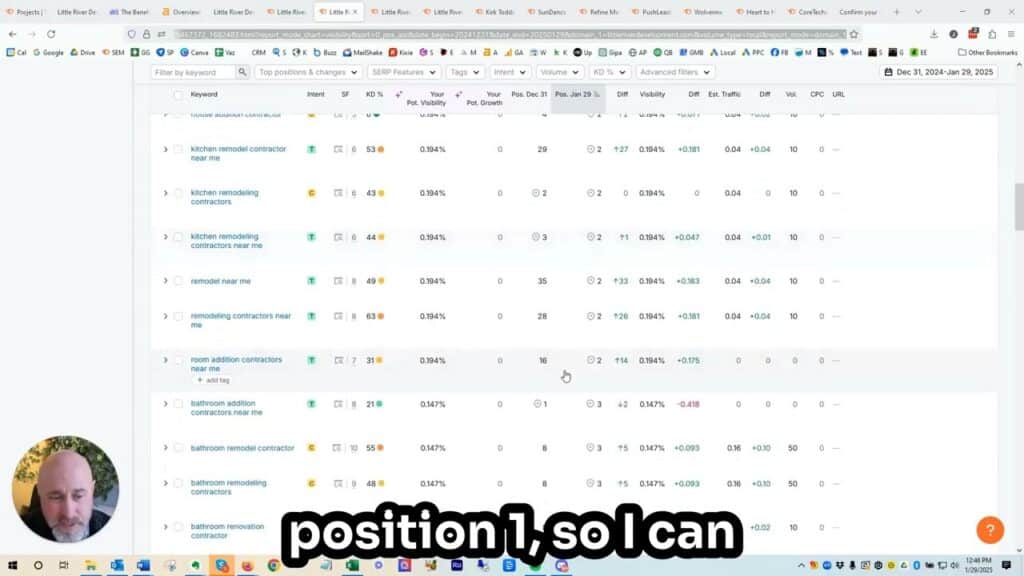
top of Google, this visibility goes up. So you can see it was around 5% and then it’s gone up to about 14%, right? Whoa, that’s me trying to write 14%. And so I can specifically see what has moved up. And now these are these guys are home renovation contractors. So the searches we’re going that we’re wanting to move up are kitchen bath remodeling contractors. This particular term was at the bottom Google’s first page. There’s 10 positions on the page, it was at the bottom Google’s first page, and this went from seven, sort of the bottom Google’s first page to position one, which is the top of Google. And this one up six positions. And there are 10 people a month looking for this term in South Asheville. So this one term moved up basically six positions. Now, this one here remodelers near me move from Google’s seventh page to the top of Google and moved up 59 positions in 30 days, which is kind of insane. There’s some people a month looking for that. So I can go down this list and see what exactly moved up. So some of the terms moved up near the top of Google, which is position two. Some of these were home remodeling near me, so this one went from Google’s third page to the top of Google, you know, position one, two or three. So I can see all of these terms moved up and and, you know, it’s been pretty awesome. Like home edition near me, home remodeled contractor or home remodeling contractors. So all of these terms totally moved up and we’re actually tracking an area
6:05 From 6:05
or tracking essentially on a mobile phone in south of Asheville, the area where I’m based out of. So there is a fair amount of people in this area, but by look here in Asheville, which is the actual large city, not South Asheville, which is Arden in Asheville, which is a larger metropolitan area on a mobile phone. We went from about 0.5% visibility to 4% visibility on the entire area. So again, visibility is how high are you? And we went from 0.5 to 4% here and here’s the 0 .5 or 0.4 up to 5%. So I can look here and see. Now, we’re tracking an entire city versus a small part of a city. So this is going to take longer for that to move up, but I can see our major terms addition contractor near me went from Google’s, you know, third page. The top is technically one, two or three. And we’re seeing basically going near the top, which is position four. And so addition contractor near me, I can see that this term basically showed up around January 24th and it stayed at the top the last couple of weeks. And so I can see all of these terms that have moved up addition near me, home addition builder, home addition builders near me, home addition near me, addition builders near me. So we’re basically looking at in all of Asheville, we’re looking at around 15 terms or so that are on
7:35 From 7:35
Google’s first page and aren’t at the top. And if I look at a 30 day period, we started with basically nothing. We started with nothing on Google’s first page on January 2nd. And now we have 15 terms on Google’s first page, not at the top. They’re not yellow yet yellow is at the top, but we have 15 terms that have moved up to the middle of Google’s first page or near the top. And basically with the next month or so, we’re going to get all these terms that are near the top, addition contractor near me and get that to move to position three, two or one home addition builder near me, addition near me. So all of these will continue to move up. So all I have to say, this strategy of doing high quality links from other websites really works and I’ve been trying to find a team that will do this for a while, like I mentioned to you on the phone and I’m really happy with this new team. And this is making me reach out to you and other people I worked with in the past and saying, hey, this actually works. So if you come across a home, you come across anybody that does home additions that wants this kind of growth, that’s awesome remodelers, home additions, but also cancer non -profits like yourself or other kind of companies out there that want visibility, this is working and I’d like to bring on five new clients in the next quarter that are really competitive where it’s really challenging to move them up. And with this new team, with this new strategy, I can definitely get them to the top of Google. It’ll probably take 90 to 120 days doing 10 links, 10 connections a month,
9:07 From 9:07
but I know it can do it. All right, talk to you soon. I’m Jeremy with Pushleys. Thanks.
Key Takeaways
Want it done for you? See our local SEO services.
Building high-quality backlinks from authoritative websites can move a local contractor from near-zero Google visibility to ranking for dozens of search terms in about 30 days. This case study covers exactly how we did it for an Asheville home remodeling and addition contractor, what metrics we tracked, and what realistic timelines look like for your own business.
- Ten high-quality guest blog backlinks with a domain authority around 47 drove the bulk of this growth in roughly 30 days.
- First-page keyword rankings jumped from 14 terms to 46 terms at the top of Google in a single month.
- Google visibility score rose from about 5% to 14% in the tracked local area during the same period.
- Individual terms moved dramatically, including “remodelers near me” climbing 59 positions from page 7 to page 1.
- Tracking both a small local zone and the broader city gives a clearer picture of where you stand and where growth is happening.
- Expect 90 to 120 days and roughly 10 strong backlinks per month to move competitive terms consistently to the top.
- Link authority matters far more than link volume. A site with a domain rating of 47 is exponentially more valuable than a brand-new blog.
What Actually Moved the Needle for This Asheville Contractor
Ten high-quality backlinks built over December and January were the primary driver that took this local general contractor from roughly 14 tracked keywords at the top of Google to 46 in about 30 days. That is the short answer. The longer answer is that not all links are equal, and most business owners waste time chasing links from websites that carry almost no weight with Google.
I designed the website for this client, an Asheville-area builder specializing in kitchen and bathroom remodels and home additions. The site looked great, but looking great does not make the phone ring. What makes the phone ring is showing up when someone in South Asheville types “kitchen bath remodeling contractor” or “home addition near me” into Google. To get there without paying for ads, you need Google to trust your website more than your competitors’ websites. One of the strongest trust signals Google recognizes is a link pointing to your site from another site that already has a solid reputation.
We measure that reputation using a metric called domain rating, which runs on a scale from zero to one hundred. The guest blog post I placed for this client came from a site with a domain rating of 47. A brand-new blog you create today would have a domain rating of zero. That means the link from a 47-rated site carries vastly more weight than a link you could generate yourself for free. We placed ten of these in two months, and the rankings responded quickly, faster than I typically see, which is why I wanted to document this case study.
Want more customers from Google & AI search?
Get a free SEO audit of your site — see exactly what to fix first.
How Guest Blog Backlinks Work in Plain English
A guest blog backlink is an article published on someone else’s website that includes a link pointing to your site, and the article and the host website both need to be genuinely relevant and credible for Google to care about it. Think of it as a referral in the real world. A referral from a well-known industry professional carries more weight than a referral from a stranger on the street.
What does a guest blog post actually look like?
A guest blog post is a full written article, typically 500 to 1,000 words, published on a website that is not yours. The article covers a topic relevant to your industry. In this contractor’s case, that meant an article about the benefits of working with a general contractor. Somewhere within that article there is a linked phrase, in this case “Asheville home remodeling,” that clicks through to my client’s website. The article reads like normal editorial content because it is. It is not a spammy directory listing or a paid advertisement. Google can tell the difference.
Why does the domain rating of the linking site matter so much?
Domain rating is a third-party score, calculated by tools like Ahrefs, that estimates how authoritative a website is based on how many other credible sites link to it. Google does not publish its own version of this score, but the underlying concept, called PageRank, has been central to how Google ranks pages since the beginning. When a high-authority site links to yours, Google interprets that as a vote of confidence. A site with a domain rating of 47 passes significantly more of that confidence than a site rated at five or ten.
Is one strong backlink enough to rank in a competitive market?
One strong backlink is rarely enough on its own. For this contractor we built ten links over two months, and we plan to continue at roughly ten per month. A single strong link can nudge a ranking, but consistent, ongoing link building compounds over time, much like interest in a savings account. The more credible links you accumulate pointing to your site, the more authority Google assigns to your domain overall, which lifts all of your pages, not just the ones the links point to directly.
Reading the Ranking Data: What the Numbers Actually Mean
Keyword ranking reports can look confusing if you have never used them before, but the core idea is simple: for each search phrase you care about, the report tells you what position your website holds in Google’s results on any given day, and you can watch that position change over time.
What does “terms at the top of Google” mean in a ranking report?
In the ranking tool I use, yellow bars represent keywords where my client’s website appears in positions one through three on Google, which is what most people mean when they say “the top of Google.” Green or lighter colors typically represent page-one appearances that are not yet in the top three. Going from 14 yellow terms to 46 yellow terms in 30 days means that 32 more searches now trigger my client’s website to appear in that prime real estate at the very top of the results page.
How do I know if a keyword ranking improvement is actually significant?
Position changes are meaningful when they move you from a page where almost no one clicks to a page where people do. Studies consistently show that the vast majority of clicks go to results on page one, and a large share of those go to the top three positions. Moving from page seven to page one, which is what happened with “remodelers near me” in this case, moving up 59 positions, is the difference between being invisible and being findable. Moving from position seven on page one to position one is also substantial because click-through rates drop sharply as you go lower on the page.
What is a visibility score and why should I track it?
Visibility score is a single percentage that summarizes how often your website appears at the top of Google across all the keywords you are tracking. It combines rank position and search volume for each term into one number. For this contractor, visibility in the South Asheville tracking zone went from about 5% to 14% in a month. In the broader Asheville city tracking zone it moved from roughly 0.4% to about 5%, a smaller jump in percentage terms but still meaningful because the city-wide zone covers far more competitive searches and a much larger geographic area.
Tracking Two Geographic Zones: Local vs. City-Wide
Tracking a small neighborhood and an entire city simultaneously gives you two useful data sets: one that shows fast early wins and one that shows your longer-term competitive progress. Both matter, and confusing the two leads to unrealistic expectations.
Why does the same keyword rank differently in different parts of a city?
Google personalizes local search results based on where the searcher is located. A contractor based in South Asheville, specifically in the Arden area, will typically rank more easily for searches made by people physically close to that location. Tracking that smaller zone first shows you what is possible and gives you faster feedback on whether your strategy is working. Tracking the larger city zone shows you how competitive the full market is and how much more authority you still need to build.
How long does it take to rank in a larger city versus a small local area?
In a concentrated local zone you can start seeing meaningful movement in 30 to 60 days with strong link building. In a full city-wide competitive market, realistic expectations are 90 to 120 days before you consistently hold page-one positions for the most competitive terms. This contractor went from zero first-page appearances in the Asheville city zone on January 2nd to 15 terms on page one within about a month, with most of those terms still moving toward the top three as the authority continues to build.
Should I track mobile rankings separately from desktop rankings?
Yes, and this client’s data was pulled specifically from mobile searches in the tracked areas. Mobile and desktop rankings can differ because Google runs slightly different algorithms for each, and local searches skew heavily toward mobile since people are often searching while out and about. For home service contractors especially, tracking mobile is important because a large portion of “near me” searches happen on a phone. We track both but prioritize mobile for reporting purposes with local service businesses.
Specific Keywords That Moved and What That Tells Us
Looking at individual keyword movements gives you concrete proof that a strategy is working and tells you which service areas or neighborhoods still need attention. Here are the specifics from this contractor’s data.
Which search terms moved the most for this remodeling contractor?
“Remodelers near me” moved from page seven all the way to page one, a jump of 59 positions in 30 days. “Kitchen bath remodeling contractors” moved from position seven on page one to position one, a six-position improvement. “Home remodeling near me” climbed from page three to the top positions on page one. Terms related to home additions, including “addition contractor near me,” “home addition builder,” and “home addition builders near me,” all moved onto page one in the Asheville city-wide zone, with “addition contractor near me” appearing consistently near the top starting around January 24th.
Does moving from page 7 to page 1 actually bring in more leads?
Almost no one clicks past page one of Google. Research on click behavior consistently shows that page two and beyond receive a fraction of the traffic that page one gets, and pages further back get almost nothing. So moving from page seven to page one is the difference between zero organic leads from a keyword and a real flow of inquiries. The contractor in this case study had people searching for “remodelers near me” every month, and none of those searches were converting to website visits before the rankings moved. After the move, those searches now reach the site.
How many keywords do I need to rank for to see a real business impact?
There is no universal number, but the more specific terms you rank for, the more touchpoints you create for potential customers to find you. This contractor went from about 14 top-three rankings to 46 in a month. Each of those 46 terms represents a slightly different way a potential customer might search. Someone might type “home addition near me” while someone else types “addition builders near me.” Ranking for both means you capture both searchers. Collectively, even terms with modest monthly search volumes add up to a meaningful stream of targeted traffic.
What Makes a Backlink High Quality vs. Low Quality
A high-quality backlink comes from a site with real authority, real content, and a real audience in a relevant topic area, and it links to your site using relevant anchor text. A low-quality backlink comes from a site built purely to sell links, with thin or irrelevant content and a domain rating near zero.
How can I tell if a backlink is going to help or hurt my rankings?
The three things I look at are domain rating, relevance, and editorial context. Domain rating should ideally be above 30 for a link to carry meaningful weight, and the higher the better. Relevance means the site and the article are topically related to your business, so a construction-related article on a home improvement site is relevant for a contractor, while a random tech blog is not. Editorial context means the link appears naturally within real written content, not in a footer, sidebar, or list of paid links. A link that passes all three checks is one worth building.
What anchor text should I use when building backlinks to my site?
Anchor text is the clickable words in a link. For this contractor, the anchor text was “Asheville home remodeling,” which tells Google exactly what the linked page is about and where it is geographically relevant. Using descriptive, keyword-relevant anchor text helps Google understand the context of your page. That said, you do not want every link to use the exact same phrase. A natural backlink profile includes a mix of branded anchor text, like your business name, descriptive phrases, and even generic text like “click here” occasionally. An over-optimized anchor text profile can trigger Google’s spam filters.
Are paid guest posts against Google’s guidelines?
Google’s guidelines say that paying for links intended to manipulate rankings violates their policies. In practice, the line is drawn at whether the content is genuinely useful and editorially placed. Thin, irrelevant content placed purely for link value is what Google penalizes. High-quality, substantive guest articles on relevant sites with real audiences occupy a different category. The key is that the content provides genuine value to readers, not just a link for Google’s benefit. The approach we use prioritizes quality content placement on legitimate sites with real domain authority.
The 90-to-120-Day Timeline: Setting Realistic Expectations
SEO results take time, and anyone who promises first-page rankings in a week is not being honest with you. That said, with the right strategy and consistent execution, you can see meaningful progress in 30 days and significant competitive positioning within 90 to 120 days.
How long does it take to see SEO results from link building?
The first signs of movement typically appear within 30 to 60 days of building strong backlinks. This contractor saw rankings move within about four weeks of the first ten links going live. Full competitive positioning in a larger city market generally takes 90 to 120 days of consistent work, meaning roughly 10 high-quality links per month over that period. Google needs time to crawl the new links, assign authority, and rerank the competing pages. The process is not instant, but it is measurable and predictable when the inputs are consistent.
What happens to rankings if I stop building links?
Rankings do not disappear overnight when you stop, but they will gradually erode if your competitors continue building links while you do not. Think of it as a slow-moving competition. The sites that consistently add authoritative links over time tend to hold and improve their rankings, while sites that stop eventually get passed. For most local contractors, a maintenance phase after the initial push, perhaps five to seven strong links per month rather than ten, is enough to hold top positions once you have achieved them. But stopping entirely puts you at risk of losing ground.
Is 10 links a month realistic for a small business budget?
It depends on what you mean by realistic and what quality of links you are targeting. Low-quality links can be generated cheaply and in bulk, but they provide little value and can occasionally cause harm. High-quality links from sites with domain ratings in the 40-to-60 range require real effort and cost, either in time or money. For the contractor in this case study, ten high-quality links per month produced the results shown here. Whether that investment makes sense depends on the value of the leads in your market. For a contractor winning home addition projects worth tens of thousands of dollars each, the math tends to work out clearly in favor of the investment.
How This Approach Compares to Paying for Google Ads
Google Ads can put you at the top of search results immediately, but you pay for every click, and the moment you stop paying the traffic stops. Organic SEO through link building takes longer to show results but creates a more durable asset that continues to generate traffic without a per-click cost.
Should a home service contractor use SEO, Google Ads, or both?
Many contractors benefit from running both simultaneously, especially early on. Google Ads provide immediate visibility while SEO builds over 90 to 120 days. Once your organic rankings are solid, you can reduce your ad spend because the organic traffic covers more of your lead flow. Some businesses choose to run ads only for highly competitive terms they have not yet ranked for organically, and rely on organic traffic for the rest. The right mix depends on your budget, your market competitiveness, and how quickly you need leads flowing in right now.
What is the cost difference between SEO and Google Ads for a local contractor?
Google Ads costs vary widely by market and keyword competitiveness, but home service keywords in mid-size cities like Asheville can cost anywhere from a few dollars to well over twenty dollars per click. If you are getting a few hundred clicks a month, that adds up fast. Organic SEO has a fixed monthly investment that does not scale with click volume. Once you rank, additional clicks cost nothing extra. Over a 12-month horizon, organic SEO almost always delivers a lower cost per lead than paid ads for businesses that stick with it long enough to see results.
Frequently Asked Questions
How many keywords should a local contractor try to rank for?
Start with 15 to 30 keywords that directly match the services you offer and the areas you serve. For a remodeling contractor, that means combinations of service terms like “kitchen remodel” and “home addition” paired with location terms like “Asheville” or “near me.” As your domain authority grows, you will naturally start ranking for additional related terms without specifically targeting them. The contractor in this case moved from tracking a focused list to holding 46 top-three positions, and additional terms continue to appear organically as authority builds.
Does my website design affect how well link building works?
Yes, your website needs to be technically sound and contain relevant, well-organized content for backlinks to have full effect. A link pointing to a slow, poorly structured website gives Google something credible to discover but then a poor experience to rank. We always review the on-page fundamentals before investing heavily in link building. Service pages need to clearly describe what you do and where you do it, load quickly on mobile, and be easy for Google to crawl and index. Link building amplifies what is already there. It does not fix a broken foundation.
How do I know if my current SEO agency is actually building quality links?
Ask them for a monthly backlink report showing the domain rating of every site they linked from, the URL of the page containing the link, and the anchor text used. Any reputable agency should be able to provide this. Then check a few of those URLs yourself and look at whether the content is real, whether the site looks legitimate, and whether the domain rating matches what they reported. Tools like Ahrefs and Moz offer free limited lookups that let you verify domain authority independently without needing a paid subscription.
Will SEO work for a business that serves multiple cities or counties?
Yes, but the strategy needs to account for geographic targeting. You typically need separate service pages for each major area you serve, each optimized with location-specific content. Backlinks should ideally reference those specific locations in the anchor text and point to the relevant service pages. The contractor in this case serves both the South Asheville and broader Asheville market, and we track each zone separately because the competitive landscape is different in each. Covering a wider territory takes more time and more consistent link building, but the approach is the same.
How do I track whether my SEO is working if I do not have a ranking tool?
Google Search Console is free and gives you data directly from Google showing which search terms your site appeared for, how many times it was clicked, and your average position. It is not as detailed as a paid rank tracker, but it shows real trends over time. If your average position for key terms is declining and your click count is flat or falling, something is wrong. If both are rising month over month, your strategy is working. I recommend every small business owner set up Google Search Console even if they are working with an agency, so they have independent visibility into their own data.
Can link building help a business that is not in a major city?
Smaller markets are often easier to compete in, not harder, because there are fewer businesses investing in serious SEO. A contractor in a smaller town or rural area might reach page-one rankings faster and with fewer links than a contractor in a large metro area. The same principles apply: credible links from authoritative sites, relevant content, and consistent effort over time. In smaller markets you may also find that even moderate domain authority sites, those rated in the 20 to 35 range, carry enough weight to produce meaningful ranking improvements.
What types of businesses besides contractors can benefit from this strategy?
Any business that relies on local search traffic to generate leads can benefit from high-quality link building. In the video, I mention that nonprofits looking for visibility are also good candidates. The approach works well for medical and dental practices, law firms, real estate agents, landscapers, HVAC companies, plumbers, electricians, and retailers with a strong local customer base. The key is that your business depends on people in your area finding you through search. If that describes you, then improving your authority through quality backlinks will improve your visibility in that search.
How do I get started with link building for my business?
The first step is understanding where you stand right now. A baseline audit of your current keyword rankings, your domain authority, and the backlink profile you already have will tell you how much ground you need to cover and which competitors you are up against. From there you can set realistic targets for how many links you need per month and which keywords to prioritize first. Trying to build links without that baseline is like starting a road trip without knowing your starting location. The audit shapes the entire strategy that follows it.
Start Growing Your Organic Rankings Before Your Competitors Do
The contractor results I walked through here, jumping from 14 top-three keyword rankings to 46 in about 30 days, came from a focused, consistent strategy: ten high-quality backlinks per month from sites with real domain authority, placed in genuinely relevant content. No ad spend required. No shortcuts. Just the kind of steady work that compounds into durable rankings over time.
I do not see growth this fast every month. But I see it often enough with the right link sources and a solid underlying website to know this approach is reliable. If you are a home service contractor or a local business in the Asheville area, and you are tired of watching competitors rank above you while you pay for ads that stop the moment the budget runs out, this is worth a serious look.
At PushLeads we work with a limited number of clients at a time so we can give each campaign real attention. If you want to see where your site stands today and what it would take to move your most important keywords to the top of Google, reach out to us at https://pushleads.com/contact/ and we will take a look at your current rankings and put together an honest assessment of what is possible.
Keep Reading
Want more customers from Google & AI search?
Get a free SEO audit of your site — see exactly what to fix first.
Your path · The Asheville Small Business SEO Guide
Keep going: read these next

- Up nextHow Long Does SEO Take in a Market Like Asheville? Realistic Timelines for Local Businesses
- On-Page SEO for Asheville Businesses: A Step-by-Step Checklist


Want this done for you?
Scan your site. See the gaps. Decide with numbers.
- Rankings, Google Business Profile and site-speed teardown
- Report lands in your inbox in about a minute
- No obligation · 4.9 from 67 Google reviews
 Continue reading