0:00 Intro
0:13 Why does my keyword tool say 9,900 people search for my service when I only get
2:17 Why Keyword Tools Default to National Numbers
3:56 How to Pull City-Level Volume the Right Way
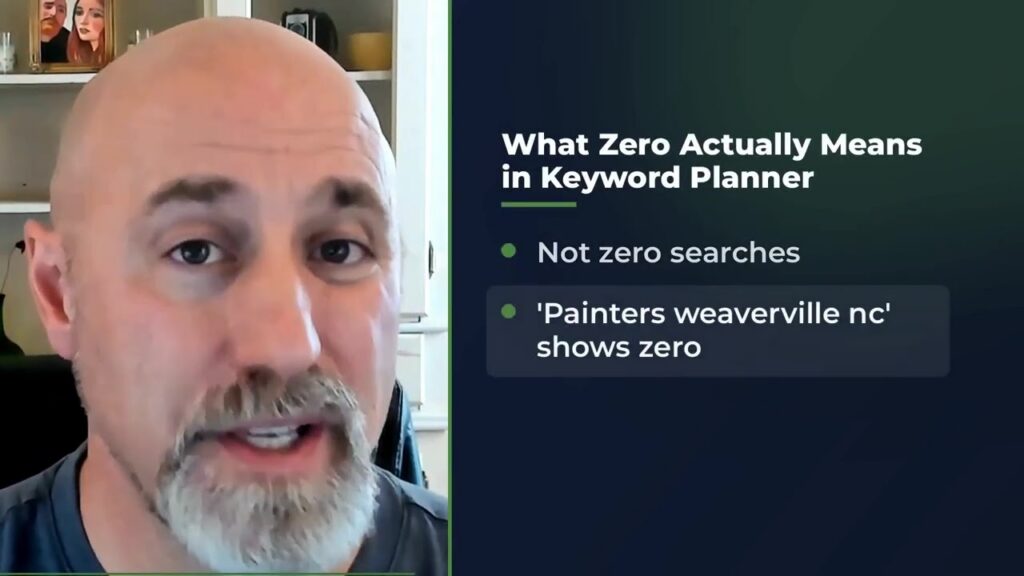
4:56 What Zero Actually Means in Keyword Planner
6:03 Why Low-Volume Local Terms Are Still Worth Chasing
7:17 ‘Near Me’ Terms and the Map Pack
8:23 A Worked Example: How the Math Plays Out
10:51 What You Should Do With Your Current Keyword List
Full transcript
0:00 Intro
Here’s where keyword tool lies for local contractors. Most SEO keyword tools show you the whole country by default. So if you’re a painter in Asheville, North Carolina,
0:13 Why does my keyword tool say 9,900 people search for my service when I only get
you’re not obviously competing with the whole country. You’re just competing for a small portion of the entire country searches. So you’re probably competing for one hundred and fifty searches a month, not three hundred thousand, right? That gap is why your phone isn’t ringing the way an agency told you it would. So let me tell you exactly what this looks like, how to fix it, and what to ask any agency before you hand them a dollar. The number that breaks everything. Here’s a real example that started this video. There’s a painting company in Asheville, North Carolina, that came into our system, brand new client, and we added them to the dashboard. And what happened was we have our own SEO dashboard, and it first pulled national numbers. So one of the searches, cabinet painting near me, showed nine thousand nine hundred searches per month, right? Sounds great. If you’re a painter and you’re showing up for a search that has ninety-nine hundred searches a month, that sounds awesome. But that number is US-wide. In Asheville, that number gets ten searches a month. That’s right, ten searches. So painters near me showed a hundred and ten thousand nationally, but in Asheville, that’s fifty per month because Asheville, we’re a tertiary market. We’re not Charlotte or Atlanta or a major area. When we looked at all fifty keywords tracked for that business, the national total was three hundred thousand two hundred and seventy searches per month, but the Asheville total was one thousand and fifty per month. So that’s two hundred and eighty-six times different between these two numbers. So one number makes you feel like you’re sitting in a goldmine. The other number tells you what your phone can actually produce. Why keyword tools default to national numbers. So SEO keyword tools are built for everyone, and they serve national brands, e-commerce stores, content marketers, and enterprise SEO teams. And the default location is almost the entire United States.
2:17 Why Keyword Tools Default to National Numbers
So nobody building the tool is thinking about a painting contractor who’s serving a thirty-mile radius in western North Carolina. And that’s not a criticism of the tools. It’s just how they’re designed. The problem happens when a local contractor or the agency they hired looks at national volume and treats it like a local volume, and that mistake flows downstream into everything. Once you have the wrong numbers at the source, then it goes everywhere, right? Your budget, your traffic estimates, your leads, your ROI projections, all of it. What distorts your budget and expectations. When an agency shows you a keyword with nine thousand nine hundred monthly searches, and they promise you a certain percentage of that traffic, the math sounds compelling. But if the real local search volume is ten times smaller, ten searches per month, then no ranking on page one is gonna deliver what they’re projecting. And that’s not that the SEO they’re doing doesn’t work. It’s that the forecast was built on the wrong number. And this is one of the most common ways that agencies inflate numbers to get promises. It’s not always intentional. Sometimes the person building the proposal just never changed the location setting. But either way, you’re the one who ends up frustrated. How to pull city-level volume the right way. The fix is straightforward. You need to change location settings before you trust any number. In the Google Keyword Planner, after you pull a list of keywords, you can look for the location filter at the top of the results. By default, it’s gonna say United States. Click that, and you can change it to your city.
3:56 How to Pull City-Level Volume the Right Way
If your city is too small to show the data, you can try your metro area, or you can show the county area, right? But if that’s too sparse, you can also try your state. Then look at the numbers again. So for a city like Asheville, many searches that look enormous with national numbers drop to a single or double digit. So anything, say, a thousand searches nationwide might be fifty people searching for that in Asheville, right? Or even ten. That’s the real market you’re working with. What zero actually means in the Keyword Planner. Here’s something important to understand. When the Google Keyword Planner shows zero for a keyword, it does not mean that nobody is ever searching for that term. The Keyword Planner rounds very small numbers down. So when a keyword gets fewer than ten searches a month, it usually shows up as zero when the range is really between zero to ten. Some months it might be zero, some months two to five, maybe eight some months, and some months up to ten, but generally not more
4:56 What Zero Actually Means in Keyword Planner
than ten. So a keyword like painters Weaverville, NC might show zero in the tool, but real people in Weaverville are still typing that same exact phrase. So if you serve Weaverville and you wanna rank for that term, you just can’t see the exact precise count. But don’t let zero scare you off a keyword that describes exactly what you do and where you do it. The split in Asheville where the volume actually lives. Let me walk you through what the Asheville keyword data actually looked like once we switched to the city-level reporting. The biggest local keywords were the Asheville painters group. The top term in that group came in at one hundred and ten searches per month, and that’s the biggest pool of local search volume for a painter in that market. About one hundred and ten searches a month came in for the top local terms, such as painters Asheville. Not a hundred thousand, not even ten thousand, one hundred and ten searches. And that’s the real addressable market on top of the local search. Why low-volume local terms are still worth chasing.
6:03 Why Low-Volume Local Terms Are Still Worth Chasing
One hundred and ten searches per month sounds small, but think about what those searches mean. If someone’s typing painters Asheville NC, they’re not browsing. They’re actually looking to hire a painter. So the intent behind that search is as high as it gets. Compare that to someone searching for how to paint kitchen cabinets, which might show thousands of monthly searches nationally, but is going to convert at almost no calls for a painting company, right? Because that’s a DIY term. If someone’s searching how to this or how to that, that’s a DIYer. They’re generally not looking for a painting company. They’re going to be doing it on their own. So volume is not the same as value is our takeaway here. Ten high intent local searches are worth more than ten thousand informational searches from people who have no intention of hiring anyone. Near me terms and the map pack. There’s another layer here that makes local volume more valuable. When someone searches for painters near me, Google serves them the local map pack results. So there are three businesses that show in the box above and the regular search results. So if you rank in the map pack for even a handful of local keywords, your map listing can pick up a real share of these
7:17 ‘Near Me’ Terms and the Map Pack
local searches. You don’t need to be showing up in a hundred thousand searches. You need to be the most visible business when the right fifty to one hundred and ten people are searching for you in your city. And that’s a completely different goal than what the national volume numbers suggest. The near keyword trap. Here’s one more wrinkle worth explaining. Painters near me shows one hundred and ten thousand searches nationally, but near me searches don’t work like regular GEO-targeted keywords. Google uses the searcher’s device location to determine the near me results. That means that every single person searching for painters near me gets a result based on where they are standing in the city or where they’re positioned. A painter in Asheville only benefits from users who happen to be in or near Asheville when they’re searching. So you cannot rank nationally for painters near me and have it deliver Asheville customers from across the country. The keyword is location agnostic in the term, but hyperlocal at the
8:23 A Worked Example: How the Math Plays Out
point of delivery. So that one hundred and ten thousand number is completely irrelevant to any single local business. A work example, how the math plays out. Let me put some of this together as an illustration. Picture a typical painting company doing about twenty calls a month and trying to grow to about forty calls a month. If an agency shows them a keyword plan built on three hundred thousand monthly searches and projects a one percent click-through rate, that’s three thousand visitors a month. At a one percent conversion rate from visitor to call, that’s thirty calls. So it sounds like the math works on the front end, but if the actual local volume is one thousand fifty per month, the same math produces ten visitors and less than one call. So the problem isn’t SEO. The problem is that the projection was nearly three hundred times too large before the first dollar was spent. The right goal for that business in Asheville is to own the one thousand and fifty monthly searches, convert a meaningful share of them, and grow from there. And that’s honest, achievable, and produces real calls. The one question to ask any agency. Before you sign anything with an SEO agency, ask them this single question. Which location is this keyword volume pulled for? If they say United States, you probably want to just run away, right? Or you could also ask them to rerun the report for your city. But if they’re giving you the national volume, they don’t know what they’re doing. So if they can’t or they won’t, that’s a signal worth taking seriously. They’re probably not really that educated, and they don’t know what they’re doing. Any agency doing real local SEO knows that national volume is irrelevant to a local business. They should be working with city level or metro level numbers from day one. Other questions that catch problems early. Here’s a few more questions worth asking. Are you tracking keywords at the city level or the national level in your reporting? When you show me a traffic forecast, what location is the volume based on? Do you separate map pack rankings from regular search rankings? How do you handle keywords that show zero volume but are still locally relevant? Good answers to these questions sound specific. Vague answers that redirect to case studies or guarantees are worth a lot more scrutiny, and you might want to walk away. What you should do with your current keyword list.
10:51 What You Should Do With Your Current Keyword List
If you have a current keyword list right now, here’s what to do before anything else. Go to Google Keyword Planner and put your top five to ten keywords in there and change the location to your city and then write down the new numbers and then compare them to whatever else you were shown before. If they’re dramatically lower, that’s not bad news. That’s accurate news. You now know the real size of your market and you can build a strategy around what’s actually there. One thousand and fifty monthly searches in a local market is a winnable game. Three hundred thousand is not yours to win. What to do next. If you want someone to pull your actual local keyword numbers, the ones filtered to your city, not the US wide default, we do that as part of our free SEO audit at pushleaves.com backslash SEO audit. And you’ll see exactly what your real addressable market looks like, which terms have the highest intent in your area and where you stand against local competitors right now. So go to pushleaves.com slash SEO audit or call eight two eight three four eight seven six eight six. The number your keyword tool is showing you is probably not your number. Let’s find out what the number actually is. I’m Jeremy Ashburn with Push Leaves helping small businesses get more leads without struggle and frustration. Talk soon.
Key Takeaways
Want it done for you? See our local SEO services.
Keyword tools default to national search volume, which can be 286 times larger than what actually exists in your local market. A painting company in Asheville sees 300,000 monthly searches nationally but only 1,050 locally. That gap is why your phone is not ringing the way an agency promised. Local intent keywords with low volume still produce real calls because the people behind those searches are ready to hire, not just browsing.
- Most keyword tools default to United States-wide data, not your city or metro area.
- National volume figures can be nearly 300 times larger than your real local search market.
- A keyword showing zero in Google Keyword Planner does not mean zero searches; it means fewer than ten per month.
- High local intent with low volume beats high national volume with no intent every time.
- “Near me” searches are resolved by the searcher’s device location, not keyword geography, so national numbers are irrelevant to any single local business.
- Always ask an agency which location their keyword volume is pulled for before you sign anything.
- One thousand local searches a month is a winnable market; three hundred thousand national searches is not yours to win.
The Number That Makes Your Phone Quiet
Keyword tools overstate what a local contractor can realistically capture because they report national search volume by default, not what people in your city are actually searching. When I pulled data for a painting company we took on as a new client in Asheville, North Carolina, the tool first showed 9,900 monthly searches for “cabinet painting near me” and 110,000 for “painters near me.” Those numbers look exciting until you filter them to Asheville. At the city level, “cabinet painting near me” drops to 10 searches per month, and “painters near me” drops to 50. Across all 50 keywords we tracked for that business, the national total was 300,270 monthly searches. The Asheville total was 1,050. That is a 286-to-1 ratio between the number an agency might pitch you and the number your business can actually compete for.
That gap is not a minor rounding error. It is the difference between a forecast that sounds like a business is about to blow up and reality, where the phone barely rings despite months of SEO spend. The tools themselves are not broken. They are built for national brands, e-commerce stores, and content marketers, none of whom care about a 30-mile service radius in western North Carolina. The problem is when a local contractor or the agency they hired reads national volume and treats it like local volume. Everything downstream from that mistake is built on a wrong foundation: budget, traffic estimates, lead projections, all of it.
Once you understand what your real local market looks like, 1,050 searches per month in Asheville, the goal becomes owning that market rather than chasing a number that was never yours to begin with. That is an honest, achievable goal that produces actual calls.
Want more customers from Google & AI search?
Get a free SEO audit of your site — see exactly what to fix first.
Why Keyword Tools Were Never Built for Local Contractors
Keyword tools default to national data because the companies that build them serve a broad audience, and the majority of their users are national brands, media publishers, and large e-commerce operations who need country-wide or global data. No one on the product team is thinking about a painter working a 30-mile radius in western North Carolina when they set the default location to “United States.”
Who actually uses keyword tools at scale?
The primary users of enterprise keyword tools are national advertisers and content teams that publish to a country-wide audience. For those users, national volume is exactly the right data point. A national hardware chain running a blog about painting tips genuinely competes for 110,000 monthly “painters near me” searches because their content can appear for searchers anywhere. A single painting contractor in Asheville serves none of those searchers outside their region, so the number is meaningless as a planning figure.
Why does the wrong default setting hurt a local business so much?
When you or your agency pulls keywords at the national level, the error compounds at every step. A keyword showing 9,900 monthly searches gets assigned an estimated click-through rate, which produces a projected traffic number, which gets used to forecast leads, which becomes the revenue number in a proposal. Each of those steps assumes the volume is real for your market. By the time the forecast reaches your inbox, it looks airtight because the math is internally consistent. The only broken part is the first number, and that is enough to make everything else wrong. I have seen this happen with well-meaning agencies that simply never changed a location setting, not because they were trying to deceive anyone, but because they did not know to look.
Is this a problem unique to small markets like Asheville?
No, but it is worse in smaller markets. Asheville is what I call a tertiary market. It is not Charlotte, it is not Atlanta, it is not a top-50 metro area by population. So the ratio between national and local volume is much larger here than it would be in, say, Houston or Phoenix. A painter in Houston might see a national keyword of 110,000 drop to 2,000 or 3,000 locally. A painter in Asheville sees it drop to 50. The smaller your city, the more misleading the national number is, and the more important it is to filter before you plan anything.
How to Pull City-Level Volume the Right Way
The fix for getting accurate local keyword data is straightforward: change the location setting in Google Keyword Planner before you trust any number. After you pull a keyword list, look for the location filter at the top of the results page. By default it says “United States.” Click it and change it to your city. If your city is too small to show data, try your metro area, then your county, then your state. Write down what the numbers look like after you make that change.
What do I do if Google Keyword Planner shows no data for my city?
If Keyword Planner shows no data at the city level, work outward. Try the metro statistical area, then the county, then the state. The goal is to find the smallest geographic unit that returns meaningful numbers. For most tertiary markets like Asheville, the city level will return at least some data for the highest-volume terms, even if many keywords show as zero. Use the state level as a ceiling estimate, then apply a reasonable fraction based on your city’s share of state population. That is not a perfect method, but it is far more useful than national volume for planning purposes.
How different will the numbers look once I filter to my city?
In our Asheville painting example, a keyword showing 9,900 nationally dropped to 10 locally. That is a 99-percent reduction. Not every keyword drops that far, but dramatic reductions are normal for smaller markets. A keyword showing 1,000 nationally might be 50 people searching in Asheville, or even 10. When I first showed this to the painting client, their initial reaction was disappointment. But the right reaction is relief, because now you know what you are actually working with and you can build a plan that reflects reality rather than a number that felt good on a slide deck.
Should I do this check on my own or have an agency do it?
You should do it yourself first so you have a baseline to compare against whatever an agency shows you. It takes about 15 minutes to pull your top 10 keywords in Keyword Planner, switch the location to your city, and write down the new figures. If an agency later presents you with numbers significantly higher than what you found, ask them point-blank which location their data is filtered to. This is one of the core reasons I wrote about why keyword tools overestimate search volume for local businesses specifically. Understanding this before you hire anyone puts you in a much stronger position.
What Zero Actually Means in Keyword Planner
When Google Keyword Planner shows zero for a keyword in your city, it does not mean nobody searches for that phrase. It means the tool rounds down any volume below 10 searches per month. The real range for a “zero” keyword is somewhere between 0 and 10 searches monthly, and it varies by month. Some months it might be 2, some months 8, occasionally as many as 10, occasionally none at all.
Should I skip keywords that show zero volume?
No, and this is one of the most common mistakes I see local contractors and even some agencies make. A keyword like “painters Weaverville NC” might show zero in the tool, but real people in Weaverville type that exact phrase. If you serve Weaverville and you rank for that term, you will get calls from it even though the tool cannot give you a precise monthly count. The intent behind a zero-volume local keyword is often extremely high because the person typing it knows exactly what they want and where they want it. Skipping those keywords to focus only on terms with measurable volume means abandoning some of your most valuable traffic.
How do I decide which zero-volume keywords are worth targeting?
Ask whether the keyword describes exactly what you do and exactly where you do it. “Cabinet painters Weaverville NC” is worth targeting even at zero volume if you do cabinet painting and you serve Weaverville. The logic is simple: ranking costs you content and time, not money, and even one or two calls per month from a highly specific local term pays back that investment quickly. Where I would skip a zero-volume keyword is when it describes a service you do not offer or a geography you do not serve. Otherwise, treat it as a legitimate target and build a service-area page or a location-specific page around it.
Does Google still index and rank pages for zero-volume keywords?
Yes. Google indexes content based on relevance and quality, not on whether a keyword hits a volume threshold in a planning tool. The Keyword Planner is a sampling tool. It captures aggregate data from Google Ads and rounds small numbers, but it does not reflect every query that Google processes. Some searches are genuinely rare or seasonal and still deliver real traffic when you rank for them. Do not let a planning tool’s floor of zero convince you that a phrase nobody searches for. It just means not many people search for it, and in a local market, not many people is often exactly the right audience size to serve profitably.
Why Low-Volume Local Terms Produce More Calls Than High-Volume National Terms
Local intent keywords with 50 to 110 monthly searches in your city will convert to calls at a far higher rate than informational keywords with thousands of national searches, because the people behind local searches are ready to hire and the people behind informational searches usually are not. Someone typing “painters Asheville NC” is not browsing. They are looking for a phone number to call today.
What is the difference between local intent and informational intent?
A local intent keyword signals that the searcher wants to hire someone. “Painters Asheville NC,” “painting company near me,” “exterior painters Weaverville” all fit that category. An informational keyword signals that the searcher wants to learn something. “How to paint kitchen cabinets,” “best paint colors for small rooms,” “how to prep walls before painting” all fit this second category. Informational keywords can have huge national volume, but they convert to virtually no calls for a painting company because the person typing them plans to handle it themselves or is just exploring. I see agencies pitch informational keywords to contractors all the time because the volume numbers look impressive. The calls never follow because the intent was never there.
How do I know if a keyword has the right intent for my business?
The simplest test is to read the keyword and ask: would someone typing this phrase pick up the phone and call a contractor? If yes, it is a commercial or local intent keyword worth pursuing. If the answer is “maybe they would read a blog post,” it is informational. For a home-service contractor, your target list should be almost entirely commercial and local intent keywords. A few informational pieces can support your overall site authority over time, but your core keyword targets should all pass the phone call test. When I build keyword lists at PushLeads, I start by filtering out anything that does not pass that test before I even look at volume numbers.
Can low-volume keywords really move the needle on monthly calls?
Yes, and understanding what to measure before calls arrive helps you track progress during the months when volume is building. A painting business in a market like Asheville with 1,050 total monthly local searches across 50 keywords does not need to rank for all 50. If you rank on page one for the top 10 to 15 local intent terms and capture even 20 to 30 percent of those searches, you are generating 200 to 300 visitors per month from people who want to hire a painter. At a reasonable conversion rate of 5 to 10 percent from visitor to call, that is 10 to 30 calls per month from SEO alone. That is a real business impact from a market that looked disappointingly small at first glance.
“Near Me” Terms and How the Map Pack Changes Everything
“Near me” search terms are resolved by the searcher’s physical location at the time of the search, not by any geographic modifier in the keyword itself, so the national volume number for a “near me” term is completely irrelevant to any single local business. What matters is whether you appear in the local map pack when someone in your service area runs that search.
What is the map pack and why does it matter more than regular rankings?
The map pack is the box of three local business listings that appears near the top of Google search results for location-based queries. When someone searches “painters near me” on their phone in Asheville, Google shows them three local businesses in a prominent position above the regular organic results. Those map pack listings capture a significant portion of clicks before most searchers ever scroll to the organic results. Optimizing your Google Business Profile is the primary lever for earning one of those three map pack spots, and it is often the fastest path to more calls for a local service business.
Why can’t a local painter rank for “painters near me” and get customers from across the country?
Because Google uses the device location of the person searching, not the location keywords in the query, to determine which businesses to show. Someone in Atlanta searching “painters near me” will never see a painting company in Asheville, no matter how well-optimized that Asheville business is. The phrase “near me” is agnostic as text, but it is hyperlocal at delivery. That 110,000 monthly national search number for “painters near me” represents millions of different local searches happening in thousands of different cities simultaneously. Each local painter only benefits from the searches happening within or near their own service area. For Asheville, that is 50 searches per month.
How should I think about “near me” keywords in my local strategy?
Include them in your keyword list because they represent genuine local demand, but understand that ranking for them happens through local SEO signals, not traditional page-one organic SEO. Your Google Business Profile completeness, your review count and recency, your proximity to the searcher, and your overall local citation consistency all determine whether you appear in the map pack for “near me” searches. Building your website content around city and neighborhood keywords runs parallel to this. Both efforts reinforce each other, but they operate through different mechanisms, and confusing one for the other leads to misaligned strategy.
A Worked Example: How the Math Plays Out in a Real Market
When you run the numbers at the local level instead of the national level, the entire ROI projection for an SEO campaign changes by a factor of hundreds, and understanding that math before you spend a dollar protects you from a frustrating and expensive mistake. Here is exactly how the numbers work using the Asheville painting example.
What does an agency proposal look like when it uses national volume?
Picture an agency presenting a keyword plan built on 300,000 monthly searches. They project a 1 percent click-through rate, which gives you 3,000 visitors per month. At a 1 percent conversion rate from visitor to call, that is 30 calls per month. The math is internally consistent and the forecast sounds achievable. A painter trying to grow from 20 calls a month to 40 would look at that projection and think they found their answer. But the projection was built on national volume that has nothing to do with Asheville. When you run the same math against the real Asheville volume of 1,050 monthly searches, 1 percent click-through is about 10 visitors, and 1 percent conversion is less than one call. That is not a minor miss. It is a 286-to-1 difference in projected outcome before you have spent a single dollar.
What does a realistic SEO plan look like for a local painting company?
The right goal is to own the 1,050 monthly local searches rather than chase a national number. If you rank on page one for the highest-intent local keywords and capture 20 to 30 percent of those searches, you are generating 200 to 300 visitors per month. If those visitors convert to calls at 5 to 10 percent, that is 10 to 30 calls per month. The upper end of that range doubles the business from its current baseline of 20 calls per month. That is honest, that is achievable, and it compounds over time as rankings strengthen and your review profile grows. It is also worth noting that understanding a realistic timeline for SEO leads keeps expectations calibrated so you do not abandon a working strategy too early.
How does the math change if I operate in a larger city?
In a larger market like Charlotte or Atlanta, the local volume numbers are higher, so the ceiling on calls from SEO is higher, but the competitive landscape is also more crowded. A painter in Charlotte might see 500 to 1,000 monthly local searches for top terms instead of 50 to 110, but there are also more established competitors fighting for those spots. The fundamental principle does not change: plan against local volume, not national volume, and build your projections from what your city actually produces. The ratio between national and local volume is simply less dramatic in a large metro than in a tertiary market like Asheville.
The One Question That Exposes a Bad SEO Agency
Before you sign anything with an SEO agency, ask them this: “Which location is this keyword volume pulled for?” A correct answer names your city or metro area. An answer of “United States” or any hedge that avoids naming a specific geography is a signal worth taking seriously, because any agency doing real local SEO works with city-level or metro-level numbers from the first day of planning.
What should I do if an agency shows me national volume numbers?
Ask them to rerun the report filtered to your city and present the updated numbers. If they can and do, that is a recoverable situation. It may have been an oversight rather than intentional inflation. But if they push back, explain that national volume is “directional,” or tell you the local numbers do not matter because “intent is the same everywhere,” walk away. Local volume is not directional for a local business. It is the entire market you are competing in, and an agency that does not understand or acknowledge that difference does not understand local SEO. I cover a full framework for vetting an SEO agency properly that goes beyond just this one question, but this question alone will filter out a significant portion of bad fits quickly.
What other questions should I ask before hiring an SEO agency?
Four questions I recommend asking every agency before you sign: Are you tracking keyword rankings at the city level or the national level in your monthly reports? When you show me a traffic forecast, what location is the volume based on? Do you separate map pack rankings from organic rankings in your reporting, since they represent different types of visibility? How do you handle keywords that show zero volume in the tool but are still locally relevant to our service area? Good answers are specific. Vague answers that redirect to case studies, guarantees, or trust-us language deserve more scrutiny, not less. If an agency cannot answer these questions clearly in the sales conversation, they will not answer them clearly in the monthly report either.
Are there other red flags to watch for in an agency proposal?
Yes. Watch for traffic forecasts that are not tied to keyword rankings. Watch for lead projections based on industry-average conversion rates applied to inflated traffic numbers. Watch for keyword lists that mix informational content keywords with commercial local keywords without distinguishing between them. Watch for reporting that shows impressions and clicks in Google Search Console without showing which keywords are driving those numbers or at what position. Any of these patterns suggest the agency is either not doing real local SEO or is not planning to show you the data that would reveal whether their work is producing results.
What to Do With Your Current Keyword List Right Now
If you already have a keyword list from a current or past agency, you can verify it yourself in about 15 minutes using Google Keyword Planner. Pull your top five to ten keywords into the tool, change the location filter to your city, write down the new numbers, and compare them to whatever you were shown before. If the numbers are dramatically lower, that is not bad news. It is accurate news, and accurate news is what you need to build a plan that works.
What should I do with the corrected local numbers?
Rank your keywords by local monthly volume, highest to lowest. The top three to five terms by local volume are your primary targets for page-one optimization. The terms that show low or zero volume but describe specific services and locations you serve are your secondary targets for service-area pages or neighborhood-specific content. Remove from your active list any keywords that are informational or that do not pass the phone-call intent test. What you are left with is a focused, honest picture of your local market that you can actually build a strategy around. A list of 10 well-chosen local intent keywords in a market with 1,050 monthly searches is more valuable than a list of 50 keywords padded with national informational terms.
How do I know if my current SEO campaign is targeting the right keywords?
Ask your agency for a ranking report filtered to your city and ask them to show you which keywords are currently ranking in the top 10 organic results and which are appearing in the map pack. Then cross-reference those keywords against your city-level volume numbers. If the keywords you are ranking for have little or no local volume, the rankings are not generating calls and the campaign needs to be refocused. If you are ranking for the right high-intent local terms but still not getting calls, the problem may be in your Google Business Profile, your website conversion elements, or your review count relative to competitors, all of which are fixable with specific tactics.
How long will it realistically take before I see calls from local SEO?
For most local contractors in mid-size or smaller markets, meaningful call volume from organic SEO typically builds over three to six months. Map pack visibility can appear faster if your Google Business Profile is well-maintained and you are actively generating reviews. The first signs of progress are usually ranking improvements and increased impressions in Search Console, which precede traffic and calls by weeks to months. Setting realistic expectations about timing before you start keeps you from pulling the plug on a strategy that is working but has not yet delivered calls. The math in a market like Asheville is tight enough that every ranking gain matters, so patience combined with consistent execution is what produces results.
Frequently Asked Questions
Why does my keyword tool show 9,900 searches when I only get a few calls per month?
The tool is showing you the national search volume for that keyword, not the volume in your city. For a local service business, the relevant number is how many people in your specific market search that term monthly. For a painter in Asheville, a keyword showing 9,900 nationally might represent only 10 searches per month locally. That gap between national and local volume explains why the phone activity does not match what you were told to expect when the campaign started.
How do I find the actual search volume for my city in Google Keyword Planner?
Open Google Keyword Planner, enter your keywords, and look for the location filter at the top of the results page. It defaults to United States. Click it and change it to your city. If your city is too small to show data, try your metro area or county. Write down the numbers at the most local level that returns results. Those figures are your real addressable market and should form the foundation of any SEO plan or agency proposal you evaluate.
Does a keyword showing zero volume in Keyword Planner mean nobody searches for it?
No. Google Keyword Planner rounds any volume below 10 searches per month down to zero. A zero-volume keyword in your city could receive anywhere from 0 to 10 searches monthly. For locally specific terms like “painters Weaverville NC,” real people are typing that phrase even when the tool cannot quantify it precisely. Do not abandon a keyword that accurately describes what you do and where you serve just because it shows zero in a planning tool.
Are “near me” searches worth targeting if the national volume is so misleading?
“Near me” searches are worth targeting, but through local map pack optimization rather than traditional organic SEO. Google determines “near me” results based on the searcher’s device location, so a business in Asheville only benefits from users searching within or near Asheville. The path to appearing for “near me” searches runs through your Google Business Profile completeness, review volume, and local citation consistency, not through the national volume number the keyword tool reports.
How do I know if an SEO agency is using national or local keyword data?
Ask them directly: “Which location is this keyword volume pulled for?” A trustworthy agency will name your city or metro area without hesitation. If they say “United States” or give a vague answer about directional data, ask them to rerun the report filtered to your city. If they cannot or will not, that agency does not understand local SEO at a practical level and you should not pay them to manage your local visibility.
How many local searches per month do I need to build a viable SEO strategy?
There is no universal threshold, but 1,000 to 1,500 local monthly searches across your keyword set is enough to build a sustainable SEO strategy for most home-service contractors. The Asheville painting example had 1,050 monthly local searches across 50 keywords. Capturing 20 to 30 percent of those searches and converting at 5 to 10 percent produces 10 to 30 calls per month. That math scales with your market size, but even small markets support real growth when the keyword strategy is built on accurate local data.
What is the difference between map pack rankings and regular organic rankings?
Map pack rankings appear in the box of three local business listings that Google shows near the top of results for location-based searches. They are driven primarily by your Google Business Profile signals, reviews, and proximity. Regular organic rankings appear below the map pack and are driven by your website content, backlinks, and technical SEO. Both types of visibility matter for a local contractor, they operate through different mechanisms, and a good agency tracks and reports them separately rather than bundling them together as a single “ranking” metric.
How long does it typically take for local SEO to produce calls for a contractor?
For most local contractors, noticeable call volume from SEO builds over three to six months. Map pack improvements can appear in as little as four to eight weeks when your Google Business Profile is properly set up and you are consistently collecting reviews. Organic page-one rankings for competitive local terms typically take three to six months to establish. During that period, the leading indicators of progress are ranking position improvements and rising impressions in Google Search Console, which both precede actual call volume.
Start With the Right Numbers and Build From There
The single most useful thing you can do today is pull your top keywords in Google Keyword Planner, switch the location to your city, and write down what you actually see. If the numbers drop dramatically from what you were shown by an agency or what a tool showed you on default settings, that is not a reason to give up on SEO. It is a reason to plan accurately. A local market with 1,050 monthly searches is a real, winnable market when you approach it with the right strategy. A forecast built on 300,000 national searches is not yours to win and never was.
At PushLeads, we filter keyword data to your city from the first conversation, not after you have already signed and paid. We show you what your real local market looks like, which terms have genuine commercial intent in your area, and where you stand against the competitors you are actually up against, not some national benchmark. If you want to see those numbers for your own business before making any decisions, reach out to us at pushleads.com/contact and we will pull the local data for your market.
Keep Reading
Want more customers from Google & AI search?
Get a free SEO audit of your site — see exactly what to fix first.
Your path · Emergency Service Marketing for Home Service Contractors
Keep going: read these next
 You’re hereWhy does my keyword tool say 9,900 people search for my service when I only get a few calls?
- Up nextEmergency Electrical Contractor Marketing: How to Capture More Urgent Service Calls
- Emergency Appliance Repair Marketing: How to Get More Same-Day Service Calls
- Emergency Pool and Spa Marketing: How to Win Repair and Service Calls in the Most Competitive Home Service Niche



Want this done for you?
Scan your site. See the gaps. Decide with numbers.
- Rankings, Google Business Profile and site-speed teardown
- Report lands in your inbox in about a minute
- No obligation · 4.9 from 67 Google reviews
 Continue reading