0:00 Intro
0:26 Expect Consistent Leads in Six to Twelve Months for Most Contractors
1:17 Month One Through Three: Technical Foundation and Content Creation
2:19 Month Four Through Six: First Rankings Appear for Long-Tail Service Keywords
3:03 Month Seven Through Nine: Map Pack Visibility Begins in Your Primary Service Area
4:10 Month Ten Through Twelve: High-Intent Keywords Start Converting to Phone Calls
4:48 Why Emergency Services See Faster Results Than Remodeling
5:50 How Competitive Markets Like Roofing Delay the Timeline by Three to Six Months
7:47 Red Flags If You See Zero Movement After Six Months
8:40 How to Measure Progress Before Leads Arrive
9:38 SEO vs Paid Ads Timeline Comparison for Contractor Leads
10:34 When to Expect ROI Positive and How to Calculate It
Full transcript
0:00 Intro
Most contractors start seeing consistent leads from SEO between six and 12 months in that timeline feels long But here is exactly what happens at each stage and what you can do to move faster I am going to walk you through the full roadmap Month by month what to expect what can slow you down and how to know if your SEO is actually working before the phone starts ringing
0:26 Expect Consistent Leads in Six to Twelve Months for Most Contractors
Six to 12 months that is the honest answer for most contractor businesses not two months not overnight Six to 12 months before SEO becomes a reliable lead source. I know that is not what most people selling SEO will tell you they will talk about quick wins and early momentum and Yes, you will see early signals before 12 months But a consistent predictable flow of phone calls from organic search that takes the better part of a year The reason is simple Google does not trust new or recently optimized sites quickly It tests them. It watches how people interact with your pages It compares your site against every competitor in your market that process takes time and there are no shortcuts around it The good news is the results compound paid ads stop the moment you stop paying SEO builds an asset that keeps generating leads Long after the initial
1:17 Month One Through Three: Technical Foundation and Content Creation
work is done The first three months are the least exciting and the most important. This is when you fix everything Google cannot ignore site speed mobile performance crawl errors duplicate pages Missing title tags thin content if your site is slow Google notices if your pages are hard to read on a phone Google notices if you have duplicate service pages with nearly identical text Google will not rank any of them alongside the technical cleanup This is when you start building out your content service pages for every major service you offer City pages for every area you serve blog content that answers the specific questions your customers type into Google You are not going to see rankings in month one. You are not going to see rankings in month two or three What you will see is Google starting to crawl your pages more frequently, which tells you the foundation is working track Impressions in Google search console even if clicks are near zero rising impressions mean Google is indexing your pages and starting to understand what you do
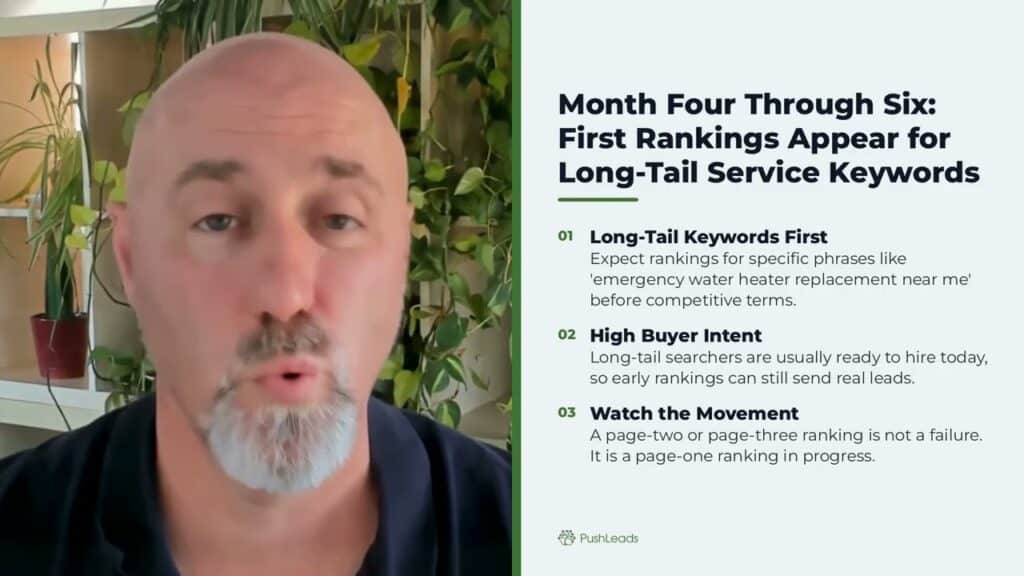
2:19 Month Four Through Six: First Rankings Appear for Long-Tail Service Keywords
Around month four you start seeing your first real rankings not for your biggest keywords not for HVAC’s Contractor in a major city you will rank for longer more specific phrases first things like emergency water heater replacement in your town or Attic insulation contractor near your area. These are called long tail keywords lower search volume But very high buyer intent someone searching that specific phrase is usually ready to hire someone today These early rankings matter for two reasons first they can send you actual leads even before you crack the competitive keywords Second they build the authority Google needs to eventually rank you for the bigger terms do not dismiss a ranking on page two or page three Watch it. It is moving page one is next if you keep the work going
3:03 Month Seven Through Nine: Map Pack Visibility Begins in Your Primary Service Area
Month seven through nine is when local SEO starts to pay off visibly This is when you start appearing in the Google Maps pack the three listings that show up with a map at the top of local search results Map pack visibility is one of the biggest lead drivers for contractors our query data shows Google Maps SEO for contractors gets 39 Impressions with a nearly 40 % click -through rate that is a high -intense search from contractors who know the map pack is where the calls come from To get there you need three things firing together your Google Business Profile needs to be fully built out with services Photos service areas and a consistent posting schedule your citation data needs to be clean meaning your name address and phone number match Exactly across every directory on the internet and you need reviews real ones recent ones with responses from you Our data shows how to get more contractor reviews has a forty two percent click -through rate That tells me contractors already understand reviews matter the ones who collect them consistently hit the map pack faster than those who do not By month ten through twelve if the
4:10 Month Ten Through Twelve: High-Intent Keywords Start Converting to Phone Calls
foundation was done right you start ranking for the keywords that actually drive calls Emergency plumber in city roof replacement estimate city mold remediation contractor city These are the terms people search when they have a problem and they need someone now Ranking for these is where SEO becomes a real revenue channel This is also when you can start to measure cost per lead from SEO and compare it against what you spend on paid ads Once you are ranking for high -intense terms the cost per lead often drops significantly the content and the authority you built are now Working for you around the clock
4:48 Why Emergency Services See Faster Results Than Remodeling
Not every contractor sees the same timeline Emergency service businesses move faster through the SEO curve think about why someone searches for a plumber or a restoration company They have a burst pipe. They have water in their basement They are searching right now, and they are calling the first result They trust the search volume for emergency services tends to be local specific and high -intense Google rewards pages that clearly match that intent if your content and your Google Business Profile are Optimized for it. You can hit the map pack faster than a remodeler would Remodeling searches are different someone thinking about a kitchen remodel might search a dozen times over six months before they call anyone Google takes longer to connect those informational searches to a business ready to do the work Restoration contractors sit in the emergency lane our data shows digital marketing for restoration contractors at 78 impressions With a 38 % click -through rate that is a niche that is actively looking for lead solutions because the need is real and the jobs are valuable
5:50 How Competitive Markets Like Roofing Delay the Timeline by Three to Six Months
If you are a roofer in a major metro plan for the longer end of the timeline add Three to six months to what I described roofing is one of the most competitive contractor niches in SEO Established companies have been building authority for years Some markets have lid aggregators spending hundreds of thousands on content every month that does not mean SEO does not work for roofers It means you need a longer runway and a more aggressive strategy More content more backlinks more reviews more geographic specificity in your pages The same is true for HVAC in large cities General contractors and competitive suburbs and any niche where there are already dozens of well optimized competitors The strategy is to get hyper local rank for the neighborhoods and suburbs before you go after the city -wide terms Build up from the edges. It is slower to hear about but it works Three things consistently move the SEO timeline faster reviews accelerate map pack rankings directly Google treats steady recent positive reviews as a trust signal aim for at least two new reviews per month minimum Four new reviews per month is an even stronger target respond to every single one you receive Citations are your business name address and phone number. These must be listed correctly on directories like Yelp and Angi The Better Business Bureau is another important citation source Inconsistent citations are one of the most common contractor problems One listing may include a sweet number and another may not one listing might still show an old phone number Google sees the inconsistency and reduces confidence in your listing Content velocity means how fast you publish new relevant pages One blog post a month is not velocity aim for four pieces of content per month as a floor Eight pieces per month is a stronger target to pursue Cover real customer questions and local service topics consistently that level of publishing is what actually moves the needle
7:47 Red Flags If You See Zero Movement After Six Months
Six months in with zero movement is a problem not a wait and see situation a problem Here is what zero movement looks like impressions and Google search console are flat or declining Your Google Business Profile has fewer than 10 reviews Your site is not indexed for any of your service keywords You have never gotten a single citation audit if that is where you are at six months One of a few things is happening your technical SEO has unresolved errors blocking Google from crawling your site Your content is too thin or too generic to compete Your Google Business Profile is incomplete or in a suppressed state Or you are in a market where the competitor gap is bigger than your current strategy addresses Do not just wait diagnose it pull your search console data Check your Google Business Profile for suppressions or violations Run a site audit find the blockage because there always is one
8:40 How to Measure Progress Before Leads Arrive
The mistake most contractors make is using phone calls as the only measure of SEO progress Phone calls are a lagging indicator. They come last here is what to measure while you’re building toward that point Impressions and Google search console even with zero clicks rising impressions mean Google is seeing your pages for more searches Keyword rankings track 20 to 50 target keywords moving from not ranking to page 3 to page 2 is real progress Even if traffic has not changed yet Google Business Profile actions Calls direction requests and website clicks from your profile are early indicators that local visibility is increasing Organic sessions watch the trend month over month a site that grows from 40 to 80 to 160 organic visits per month is on the right curve Even before leads show up set a monthly reporting cadence review these numbers every 30 days You will see the momentum building three to four months before the calls
9:38 SEO vs Paid Ads Timeline Comparison for Contractor Leads
start Paid ads give you leads in week one SEO gives you leads in month nine or ten That is the core trade -off our query data shows Google Local Services Ads for contractors at 178 impressions with a 36 percent click -through rate Contractors want both channels that makes sense Here’s how I think about the split use paid ads to generate leads now while SEO builds in the background Do not stop ads the moment you start an SEO campaign They serve different functions at different time horizons Paid ads have a cost per lead that stays roughly constant if a lead costs 75 dollars in month one It usually still costs 75 dollars in month 12 SEO cost per lead decreases over time Because the content asset keeps working without ongoing ad spend by month 12 to 18 of a solid SEO Campaign the blended cost per lead across both channels is usually lower than paid alone That is when SEO becomes the more efficient channel
10:34 When to Expect ROI Positive and How to Calculate It
ROI positive for most contractors happens somewhere between month nine and month 18 It depends on your average job value and your close rate Here is how the math works picture a garage door company doing 10 calls a month from their website average job value is $600 that is $6 ,000 in monthly revenue from SEO if the SEO investment is $1,500 a month The program is ROI positive the moment it generates more than two and a half jobs per month from organic search Apply that same math to your own numbers take your average job value Multiply by your close rate on inbound leads Divide your monthly SEO cost by that number that tells you exactly how many leads per month you need to break even For most contractors that break even point is two to five jobs a month Once SEO is delivering consistently Most established programs well past 12 months are delivering More than that the compounding effect is what makes it valuable long -term every piece of content you publish every review you collect every citation You clean up adds to an asset that keeps generating leads even if you pause the work for a month Go get your free AI visibility check at PushLeads dot com slash check or call 828 -348 -7686 We will show you exactly where you stand right now and what it will take to get you moving
Key Takeaways
Want it done for you? See our local SEO services.
Most contractors start seeing consistent leads from SEO between six and twelve months in. The timeline feels long, but every month builds on the last. Technical cleanup happens first, then rankings appear for specific phrases, then map pack visibility grows, and finally high-intent calls start coming in. Understanding what to measure at each stage keeps you from quitting too early or assuming your campaign is broken when it is actually working.
- Consistent, predictable leads from organic search typically arrive between month nine and month twelve for most contractor businesses.
- Months one through three are spent on technical cleanup, service pages, and city pages. You will not see rankings yet, but impressions in Google Search Console should start rising.
- Long-tail keywords like “emergency water heater replacement in [your town]” rank first around month four and can send real leads before competitive terms move.
- Map pack visibility usually begins in months seven through nine and requires a fully built-out Google Business Profile, clean citations, and a steady stream of recent reviews.
- Emergency service businesses move through the timeline faster than remodelers because search intent is immediate and Google rewards urgent, locally specific content.
- Competitive niches like roofing in a major metro add three to six months to the timeline. The strategy is to rank in neighborhoods first, then expand to city-wide terms.
- ROI-positive typically lands between month nine and month eighteen depending on average job value, close rate, and monthly SEO investment.
What the Six-to-Twelve-Month SEO Timeline Actually Means for Contractors

Six to twelve months is the honest window before SEO becomes a reliable, repeatable source of contractor leads. That is not a hedge or an excuse. It reflects how Google actually evaluates sites. Google does not trust a newly optimized site right away. It tests the site, watches how visitors interact with pages, and compares it against every competitor already ranking in your market. That process cannot be rushed, and anyone who promises otherwise is not being straight with you.
The good news is that SEO compounds in a way paid advertising never does. When you stop running ads, leads stop immediately. When you build organic rankings, the content and authority you created keep working. A service page you published in month two can still be sending calls in month thirty-six without any additional spend. That compounding effect is what makes the wait worthwhile for most contractors once they understand it.
I want to be clear about what “consistent leads” means in this context. You will likely see early signals well before month nine. Impressions rise in Search Console. A long-tail keyword cracks page two. Your Google Business Profile starts logging more direction requests. Those are real indicators of progress. But a steady, predictable volume of inbound phone calls from organic search, the kind you can plan your schedule around, that arrives closer to the nine-to-twelve-month mark for most markets and most trades.
If you want a detailed look at what to expect after 6 months of an SEO campaign, I cover that separately, including which metrics should be moving and which ones can lag further behind than people expect.
Want more customers from Google & AI search?
Get a free SEO audit of your site — see exactly what to fix first.
Months One Through Three: Technical Foundation and Content Creation

The first three months of an SEO campaign are the least exciting and the most important. This phase is about fixing everything Google cannot ignore before any ranking work has a real chance of succeeding.
What technical SEO issues actually block contractor sites from ranking?
Site speed, mobile performance problems, crawl errors, duplicate service pages, and missing title tags are the most common blockers on contractor websites. If your site loads slowly, Google notices. If your pages are hard to navigate on a phone, Google notices. If you have two or three nearly identical service pages, Google will not rank any of them because it cannot determine which one is the right answer. Every one of these issues needs to be resolved before content work pays off. A fast, crawlable, mobile-friendly site is not a bonus, it is the floor.
During this phase we also run a full site audit to find any indexing problems or penalties. Sometimes a site has pages accidentally blocked from Google via the robots.txt file. Sometimes there are redirect chains leftover from a previous redesign. These issues are invisible to the business owner but obvious to Google, and they can quietly suppress every ranking effort you make until they are fixed.
How many service pages and city pages should a contractor build in the first three months?
You need a dedicated page for every major service you offer and a separate page for every city or area you serve. That means if you do HVAC installation, HVAC repair, and HVAC maintenance across four service areas, you likely need a minimum of twelve pages just to cover those combinations adequately. Generic “we serve the whole metro area” pages do not rank well. Specific pages built around a service and a location give Google a clear signal about exactly what you offer and exactly where you serve. For contractor website setup for leads, the page structure matters as much as the content on those pages.
What should I track in month one if I am not seeing any rankings yet?
Track impressions in Google Search Console. Even with zero clicks, rising impressions tell you Google is crawling your pages and starting to associate them with relevant searches. Month one impressions are often very low, but seeing that number increase from week to week confirms the foundation is working. You are not looking for leads yet. You are looking for indexation signals. Set up Search Console on day one if it is not already running, because you need that data accumulating from the start.
Months Four Through Six: First Rankings Appear for Long-Tail Keywords

Around month four, you start seeing your first real rankings. Not for your biggest, most competitive keywords, but for longer, more specific phrases that carry high buyer intent.
What are long-tail keywords and why do they matter for contractors?
Long-tail keywords are specific multi-word phrases like “emergency water heater replacement in [your town]” or “attic insulation contractor near [your area]” that have lower search volume but very high buyer intent. Someone typing that specific phrase is usually ready to hire someone today, not just browsing. These keywords are also less competitive, which means a site with a few months of authority behind it can crack page one faster than it could for a broad term like “HVAC contractor.” Early rankings on long-tail terms can send you actual leads before you ever touch the competitive keywords.
Should I be worried if I am ranking on page two or page three?
No. A page two or page three ranking at month four or five is a signal to keep going, not a reason for concern. Rankings move in stages. A keyword sitting on page three in month four often moves to page one by month eight if the work continues. What you want to watch is whether the ranking is moving at all. A keyword that is stuck at the same position for three months in a row is worth investigating. A keyword climbing from position twenty-two to fourteen to nine over the same period is exactly what progress looks like before the clicks start arriving.
How does content published in months one through three affect rankings in months four through six?
Content published early in the campaign starts accumulating signals that Google uses to assign rankings a few months later. Google indexes pages quickly but evaluates them slowly. It watches engagement signals, compares the page against competing content, and gradually moves the page up or down based on that data. This is why content velocity in months one through three directly influences where you rank in months four through six. Waiting until month three to start publishing means your first rankings appear closer to month seven. Front-loading content work pays off.

Months Seven Through Nine: Map Pack Visibility in Your Primary Service Area

Months seven through nine are when local SEO starts to become visible in a way that directly drives phone calls. This is when contractors typically begin appearing in the Google Maps pack, the three business listings that appear with a map at the top of local search results.
Why does the Google Maps pack matter more than organic rankings for contractors?
The map pack is where most contractor calls come from because it appears above organic results and shows ratings, phone numbers, and location at a glance. Our query data shows Google Maps SEO for contractors generates impressions with a nearly forty percent click-through rate, which is high for search. That click-through rate reflects the intent behind the search. Someone looking at the map pack is not researching. They are ready to call. Getting into the top three map pack positions in your primary service area is one of the highest-leverage outcomes of an SEO campaign for a local contractor.
What does it take to rank in the Google Maps pack?
Three things need to work together to rank in the map pack. Your Google Business Profile needs to be fully completed with services, photos, service area settings, and a consistent posting schedule. To optimize your Google Business Profile correctly, every field matters, not just the basics. Your citation data, meaning your business name, address, and phone number, needs to match exactly across every directory where you are listed. And you need reviews, real ones, recent ones, with responses from you on each one. Inconsistency in any of these three areas reduces Google’s confidence in your listing and pushes you down in map results.
How do Google reviews affect map pack rankings directly?
Google treats a steady stream of recent positive reviews as a trust signal for the map pack algorithm. The operative word is steady. A contractor who collected forty reviews two years ago and has collected none since is at a disadvantage compared to a competitor with twenty reviews but four new ones every month. Aim for a minimum of two new reviews per month. Four per month is a stronger target. Respond to every single review you receive, positive or negative, because Google tracks that engagement. For a detailed breakdown of Google reviews and search visibility, including specific numbers by trade, that resource covers what the data actually shows.

Months Ten Through Twelve: High-Intent Keywords Converting to Phone Calls

By months ten through twelve, if the foundational work was done correctly, you start ranking for the keywords that drive the most valuable calls. These are terms like “emergency plumber in [city],” “roof replacement estimate [city],” and “mold remediation contractor [city].” These are searches from people with an active problem who need someone now.
What does “high-intent keyword” mean for a contractor SEO campaign?
A high-intent keyword is a search phrase typed by someone who is ready to hire, not just gather information. “How much does a new roof cost” is an informational query. “Roof replacement contractor [city] free estimate” is a high-intent query. The person searching the second phrase has already done their research and is now selecting a contractor. Ranking for high-intent terms is where SEO transitions from a traffic exercise into a revenue channel. These keywords are also the most competitive, which is why they come last in the ranking progression.
How do I measure whether my SEO is producing real revenue at month twelve?
At month twelve, you should be able to calculate cost per lead from organic search and compare it against what you spend on paid ads. Take the total amount spent on SEO over twelve months, divide by the number of leads attributed to organic search, and you have your SEO cost per lead. For most established campaigns, this number is lower than paid search cost per lead by this point and continues to decrease as the content asset keeps performing without additional investment per click. Set up call tracking from the start so you have clean data at this point.
When does SEO become ROI-positive for a typical contractor?
ROI-positive typically lands somewhere between month nine and month eighteen depending on average job value and close rate. Here is the math with a concrete example. A garage door company doing ten calls a month from their website with an average job value of six hundred dollars generates six thousand dollars in monthly revenue from SEO. If the SEO investment is fifteen hundred dollars per month, the program breaks even the moment it produces more than two and a half jobs per month from organic. Apply that math to your own numbers: take your average job value, multiply by your close rate on inbound leads, and divide your monthly SEO cost by that result. That calculation tells you exactly how many leads per month you need to break even.

Why Emergency Services Rank Faster Than Remodeling Contractors

Not every contractor sees the same timeline. Emergency service businesses move through the SEO curve faster than remodeling contractors, and that difference is rooted in how people search and what Google rewards.
Why does Google rank emergency plumber or restoration pages faster than remodeling pages?
Someone searching for a plumber or a restoration company has a burst pipe or water in their basement right now. That search intent is immediate, local, and specific. Google is built to match urgent searches to relevant local businesses quickly. If your content and your Google Business Profile are optimized for emergency service language, you can hit the map pack faster than a remodeler would because the signals Google looks for, geographic specificity, service clarity, and review volume, are easier to align with emergency service content. Remodeling searches are different because someone considering a kitchen remodel might search a dozen times over six months before they call anyone.
How does restoration contracting compare to remodeling for SEO timelines?
Restoration contractors sit firmly in the emergency lane. Our query data shows digital marketing for restoration contractors generating impressions with a thirty-eight percent click-through rate. That is a niche actively looking for lead solutions because the need is urgent and the jobs are valuable. Water damage restoration, fire remediation, and mold removal all carry the same high-intent search behavior as emergency plumbing. If you work in restoration and you are not seeing map pack results by month eight or nine, that is a signal worth investigating. Emergency-adjacent trades should see results on the faster end of the six-to-twelve-month window.
What accounts for slower SEO results in service businesses with longer sales cycles?
Longer sales cycles mean the connection between a search and a hire is spread across weeks or months. Google takes longer to associate informational research searches with businesses ready to do the work. A homeowner browsing kitchen remodel inspiration is not generating the same purchase signals as someone searching “water heater not working.” Content strategy for remodeling contractors needs to cover both informational and transactional queries, using blog content to capture early-stage searchers and service pages to convert late-stage buyers. That two-track approach works, but it adds time to the ranking cycle.

How Competitive Markets Delay the Timeline by Three to Six Months

If you are a roofer in a major metro or an HVAC contractor in a dense suburban market, plan for the longer end of the timeline and add three to six months to what I described above.
Why is roofing one of the hardest contractor niches for SEO?
Roofing is one of the most competitive contractor niches in SEO because established companies have been building authority for years. Some markets have lead aggregators spending hundreds of thousands of dollars on content every month. When you are competing against sites with years of backlinks, thousands of pages, and enormous review counts, a new or recently optimized site needs a longer runway and a more aggressive content strategy. That does not mean SEO does not work for roofers. It means the expectations need to be calibrated correctly from day one.
What is the hyper-local strategy for breaking into competitive contractor markets?
The hyper-local strategy means ranking for neighborhoods and suburbs before going after city-wide terms. Instead of targeting “roofing contractor Atlanta,” you target “roofing contractor Decatur GA” and “roofing contractor Marietta GA” and “roofing contractor Smyrna GA.” You build authority in the edges of the market first. Each neighborhood win adds to your domain authority, and that accumulated authority eventually supports ranking for the broader city term. It takes longer to describe than to execute, but it consistently outperforms trying to rank for the most competitive term right away when your site is still building trust.
How many backlinks and reviews do I need to compete in a saturated contractor market?
There is no universal number, but the right question is how your profile compares to the contractors already ranking in your market. Pull the top three map pack listings in your area and check their review counts, their review recency, and the number of pages on their websites. That gap analysis tells you what you are working against. In highly competitive markets, you likely need more than the standard two to four reviews per month, more content published per month, and a more intentional approach to earning backlinks from local publications, supplier sites, and trade associations. Understanding SEO package costs and ROI is useful context here, because a more competitive market usually requires a higher level of investment to close the gap in a reasonable timeframe.
Red Flags If You See Zero Movement After Six Months

Six months into an SEO campaign with zero movement is a problem, not a situation to wait through. Zero movement has specific, diagnosable causes.
What does “zero movement” look like in a contractor SEO campaign at six months?
Zero movement means impressions in Google Search Console are flat or declining, your Google Business Profile has fewer than ten reviews, your site is not indexed for any of your service keywords, and you have never had a citation audit run on your listings. If that is where you are at six months, something is actively blocking your campaign, not just slowing it down. Common blockers include unresolved technical errors that prevent Google from crawling your site, content that is too thin or too generic to compete in your market, a Google Business Profile that is incomplete or in a suppressed state, or a competitor gap that is bigger than your current strategy can bridge.
How do I find out what is blocking my SEO after six months of no progress?
Pull your Search Console data first and look for coverage errors, manual actions, or any pages marked as excluded. Then check your Google Business Profile directly for any suppression notices or policy violations. Run a full site audit using a crawler to find broken links, redirect chains, duplicate content, or missing metadata. Finally, audit your citations by searching your business name in major directories and checking whether your name, address, and phone number are consistent across all of them. There is always a blockage. The work is finding it, not waiting for it to resolve on its own.
What content problems cause SEO stagnation for contractor websites?
Thin content and generic content are the two most common problems. Thin content means pages with fewer than three hundred words that do not answer the questions a potential customer would have. Generic content means pages that could apply to any contractor in any city, using language like “we provide quality service to the entire region.” Google compares your pages against every competing page for a given search and ranks the most specific, most useful answer. If your service pages do not name the specific neighborhoods you work in, describe the specific problems you solve, and answer the questions customers actually search for, they are unlikely to rank regardless of how long the campaign runs.
How to Measure SEO Progress Before the Leads Arrive
Phone calls are a lagging indicator of SEO success. They come last. Using calls as your only measure of whether SEO is working means you will often call a campaign a failure right before it was about to pay off.
What leading indicators tell me my SEO campaign is on track before I get calls?
Four metrics tell the story before calls arrive. Impressions in Google Search Console show how many times your pages appeared in search results even with no clicks. Keyword rankings tracked across twenty to fifty target terms show movement from unranked to page three to page two, which is real progress even before traffic changes. Google Business Profile actions including calls, direction requests, and website clicks from your profile show local visibility growing. And organic session volume month over month, even at low numbers, shows whether the trend line is moving in the right direction. A site growing from forty to eighty to one hundred sixty organic visits per month is on the correct trajectory even if no leads have arrived yet.
How often should I review my SEO metrics as a contractor?
Review your numbers every thirty days on a fixed schedule. Monthly reporting gives you enough data to see trends without overreacting to week-to-week noise. The goal of monthly reviews is to track the direction of each metric, not just the number. Impressions up, rankings moving up, GBP actions increasing, organic sessions growing. If all four of those are moving in the right direction at month four or five, the campaign is working even if the phone is not ringing yet. Set a cadence at the start of the campaign and stick to it. You will typically see clear momentum three to four months before the calls start coming in consistently.
What content publishing pace actually moves the needle for a contractor SEO campaign?
One blog post per month is not enough. Aim for four pieces of new content per month as a floor. Eight pieces per month is a stronger target if you can sustain it. Those pieces should cover real customer questions and local service topics: “how much does a new water heater cost in [city],” “what causes attic mold in [climate],” “how to choose a licensed roofer in [county].” That level of publishing builds topical authority, which Google uses to decide how much of your site to rank. Content velocity is one of the three factors that consistently accelerates the SEO timeline along with reviews and citation cleanup.
SEO Versus Paid Ads for Contractor Lead Generation
Paid ads deliver leads in week one. SEO delivers leads in month nine or ten. That is the core difference between the two channels, and understanding it helps you decide how to budget across both.
Should a contractor run paid ads while SEO is building?
Yes, running paid ads while SEO builds is the right approach for most contractors, not an either-or decision. Use paid ads to generate leads now while organic authority grows in the background. Do not turn off ads the moment you start an SEO campaign. They serve different functions at different time horizons. Our query data shows Google Local Services Ads for contractors generating impressions with a thirty-six percent click-through rate, which confirms contractors are actively searching for both channels. The mistake is treating them as substitutes when they are actually complements.
How does the cost per lead compare between SEO and paid ads over twelve months?
Paid ads have a cost per lead that stays roughly constant. If a lead costs seventy-five dollars in month one, it usually still costs seventy-five dollars in month twelve. SEO cost per lead decreases over time because the content asset keeps working without ongoing ad spend per click. By month twelve to eighteen of a solid SEO campaign, the blended cost per lead across both channels is usually lower than paid alone. That is when SEO becomes the more efficient channel and when it makes sense to shift budget emphasis, though not necessarily to eliminate paid ads entirely.
What is the break-even calculation for a contractor SEO investment?
Take your average job value and multiply it by your close rate on inbound leads. That gives you your revenue per inbound lead. Divide your monthly SEO cost by that number and you get the exact number of leads per month required to break even. For most contractors, that break-even point is two to five inbound jobs per month from organic search. Once SEO is delivering consistently, most established programs well past month twelve deliver more than that, and the value keeps growing because the content and authority continue working without proportional increases in cost.
Frequently Asked Questions
How long does SEO take to generate consistent contractor leads?
Most contractors see consistent, predictable leads from organic search between month nine and month twelve. Early signals like rising impressions and long-tail keyword rankings appear closer to month four. Map pack visibility typically begins around month seven or eight. The full twelve months are needed for high-intent, high-competition keywords to consistently convert into phone calls. Emergency service businesses often reach that point a few months faster than remodeling contractors.
What is the fastest way to speed up contractor SEO results?
Three activities consistently accelerate results: collecting reviews at a steady pace of at least four per month, cleaning up citation inconsistencies across all directories, and publishing four or more pieces of relevant content per month. These three levers compound against each other. Reviews improve map pack trust. Clean citations improve Google’s confidence in your listing. Regular content builds topical authority. Running all three simultaneously moves the timeline faster than any single tactic alone.
Why does Google take so long to rank a new contractor site?
Google treats trust as something earned over time through consistent signals, not something granted immediately. It crawls your pages, evaluates how visitors interact with them, compares your content against competing pages, and monitors review velocity and citation consistency before assigning stable rankings. This evaluation process typically takes several months. There is no way to shortcut it. Sites that try to speed it up with low-quality backlinks or artificial engagement often receive penalties that add more time to the process.
How many Google reviews does a contractor need to rank in the map pack?
There is no fixed number required, but review recency and consistency matter as much as total count. A contractor with fifteen reviews collected over the past six months will often outrank a competitor with fifty reviews all collected two years ago. Aim for a minimum of two new reviews per month and four per month in competitive markets. Responding to every review you receive adds an engagement signal that Google tracks as part of the map pack algorithm.
What should I measure to know if my SEO is working before I get leads?
Track four things monthly: impressions in Google Search Console, keyword rankings across twenty to fifty target terms, Google Business Profile actions including calls and direction requests, and total organic sessions. These are leading indicators. Phone calls are a lagging indicator and come last. If impressions, rankings, and profile actions are all trending upward in months three through six, the campaign is working even if inbound calls have not started yet. Set a monthly review schedule from the beginning.
Is SEO worth it for contractors in highly competitive markets like roofing?
SEO is worth it in competitive markets but requires a longer runway and a more aggressive strategy. Add three to six months to the standard twelve-month timeline for roofing in major metros or HVAC in dense suburban markets. The right approach is to rank for specific neighborhoods and suburbs first before targeting city-wide terms. Building authority at the edges of a competitive market is slower to describe but consistently effective. Competing head-to-head with established sites on broad terms from month one rarely works.
When does contractor SEO become ROI-positive?
ROI-positive typically arrives between month nine and month eighteen depending on average job value and close rate. The break-even calculation is straightforward: divide your monthly SEO cost by the revenue generated per inbound lead. For a contractor with a six-hundred-dollar average job and a fifteen-hundred-dollar monthly SEO investment, breaking even requires fewer than three jobs per month from organic search. Most established campaigns well past month twelve deliver more than that, and the cost per lead continues decreasing as the content asset matures.
What red flags indicate my SEO campaign is not going to work?
Six months in with flat or declining impressions, fewer than ten Google reviews, no indexed service pages, and no citation audit completed is a clear red flag. The most common causes are unresolved technical errors blocking crawling, content too thin or generic to compete, a suppressed or incomplete Google Business Profile, and a competitor gap larger than the current strategy addresses. The right response is to diagnose the specific blockage rather than wait it out. There is always a specific, findable cause for stagnation.
Start Measuring Your SEO Progress the Right Way
The biggest mistake I see contractors make is waiting for the phone to ring before they evaluate whether their SEO campaign is working. By the time calls arrive, months of diagnostic opportunity have already passed. Set up Google Search Console on day one. Track twenty to fifty keywords from the start. Review your Google Business Profile actions every thirty days. These numbers tell you whether the campaign is on track months before the revenue shows up.
The six-to-twelve-month timeline is real, but every month inside that window is productive if the work is being done correctly. Technical cleanup in month one pays off in rankings in month four. Content published in month two drives map pack authority in month eight. Reviews collected in month three accelerate visibility in month seven. The months are connected, and the compounding effect is what makes SEO the more efficient long-term channel for most contractors compared to running ads indefinitely.
If you are not sure where you stand right now, whether your foundation is solid, whether your citations are clean, or whether your Google Business Profile is set up to compete, the right first step is to find out. Contact us at PushLeads and we will show you exactly where you stand and what it will take to get you moving toward consistent organic leads.
Keep Reading
Want more customers from Google & AI search?
Get a free SEO audit of your site — see exactly what to fix first.
Your path · Emergency Service Marketing for Home Service Contractors
Keep going: read these next

- Up nextEmergency Electrical Contractor Marketing: How to Capture More Urgent Service Calls
- Zero-Click Searches: How Emergency Service Contractors Can Protect Their Leads
- Midwest Storm Belt Contractor Marketing: How to Capture Emergency Demand Across Tornado Alley




Want this done for you?
Scan your site. See the gaps. Decide with numbers.
- Rankings, Google Business Profile and site-speed teardown
- Report lands in your inbox in about a minute
- No obligation · 4.9 from 67 Google reviews
 Continue reading