


Tier Upgrade ROI Calculator
Run the same math the video uses to see whether moving to a higher agency tier makes financial sense for your shop.
This is the difference in influenced revenue minus the difference in agency spend — the same math the video runs: at 30 leads closing 40% at $3,000 average that’s $36,000 influenced; at 80 leads it’s $96,000 — a $60,000 difference against only $1,300 more in spend.
Red Flags & Readiness Check
Score your current agency relationship — or vet a new one — against the warning signs and must-haves the video calls out.
Pick your situation
Jump to the part of the video that answers it.
Just starting out on a tight budget · 0:50Small business ready to grow · 1:34Figuring out if the cost is worth it · 4:54Spotting agency red flags · 6:32Running the numbers on a tier upgrade · 7:310:00 Intro
0:22 Why Package Pricing Is All Over the Map
1:32 Tier One: The Starter Package (Five Hundred to Fifteen Hundred a Month)
2:21 Tier Two: The Growth Package (Fifteen Hundred to Three Thousand Five Hundred a Month)
3:20 Tier Three: Aggressive Growth (Three Thousand Five Hundred to Seven Thousand a Month)
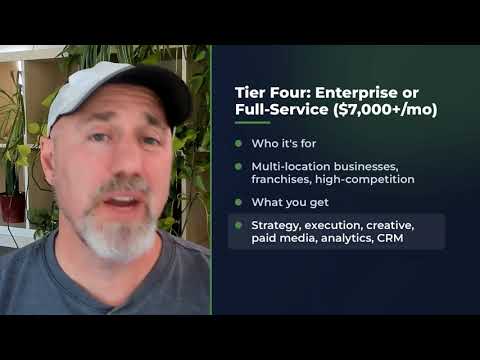
4:13 Tier Four: Enterprise or Full-Service (Seven Thousand and Up)
4:56 The Three Numbers That Actually Matter
5:41 What Compensation Models Look Like Beyond Flat Retainers
6:33 Red Flags at Every Tier
7:27 A Worked Example: How the Math Plays Out
8:37 How to Evaluate a Package Before You Sign
9:18 What to Do Right Now
Full transcript
0:00 Intro
Most agencies charge somewhere between five hundred and ten thousand dollars a month, depending on the tier, and the difference in what you actually get is massive. I'm gonna break that down for you today tier by tier with real numbers and honest ROI expectations at each level. No fluff, no "it depends" and "call us." Let's get into it.
0:22 Why Package Pricing Is All Over the Map
The reason you see such a wide range is that digital marketing is not one service. It's a bundle. SEO, paid search, content, social, reputation management, website work, tracking, reporting. Some agencies sell you two of those things and call it a package. Others sell you all eight and still charge the same price. So before you compare prices, you need to know what's actually in the box. That's what this video is for. In my experience, most agency pricing clusters into four buckets. Tier one, starter, roughly five hundred to fifteen hundred a month. Tier two, growth, roughly fifteen hundred to three thousand five hundred a month. Tier three, aggressive, roughly three thousand five hundred to seven thousand a month. Tier four, enterprise or full service, seven thousand and up, sometimes ten thousand or more. Those numbers are industry ballpark based on what I see in the market and what our own clients have come from. Each tier has a different scope, a different timeline to results, and a very different ROI expectation. Let's go through each one.
1:32 Tier One: The Starter Package (Five Hundred to Fifteen Hundred a Month)
At this level, you are typically getting one or two services, usually basic on-page SEO, maybe a little content, maybe a Google Business Profile setup. You are not getting a full-time strategist. You are not getting active paid search management. You are probably not getting conversion tracking that actually closes the loop on revenue. ROI expectation at this tier, slow and modest. Think six to twelve months before you see meaningful organic movement. If your average job is worth three hundred dollars, this might pencil out. If you're a restoration contractor and your average job is eight thousand dollars, you are leaving money on the table staying at this tier. Common mistake at tier one, paying for it and then switching agencies after three months because it's not working. Organic SEO takes time.
2:21 Tier Two: The Growth Package (Fifteen Hundred to Three Thousand Five Hundred a Month)
If you signed up for it, give it the runway it needs. This is where things start to make sense for most small businesses. At this tier, a good agency is running active SEO, some paid search or Local Services Ads, content creation, and reporting that actually means something. Timeline to results drops. You might see traction in three to six months. ROI expectation, positive if your close rate and average ticket are solid. Picture a typical garage door company doing around fifty calls a month. If their cost per call from organic is running forty dollars and this tier gets that to twenty-five dollars, the math on even ten extra calls a month is significant. That kind of improvement is possible at tier two. Not guaranteed, but in a typical case, yes. The key at this tier is accountability. You should be getting a monthly report that shows calls, leads, cost per lead, and revenue influence. If your agency at this tier can't tell you your cost per lead, that's a red flag.
3:20 Tier Three: Aggressive Growth (Three Thousand Five Hundred to Seven Thousand a Month)
Now we're talking a real team, dedicated strategists, active paid search with real budget optimization, ongoing technical SEO, link building, content, reputation management, and conversion rate work on your site. Timeline to results. You should see movement in thirty to ninety days on paid and meaningful organic gains in four to six months. ROI expectation at this tier. This is where revenue positive campaigns live for service businesses doing real volume. Restoration companies, HVAC contractors, law firms, healthcare practices, anyone where one new client is worth thousands of dollars. This tier makes sense. The risk at tier three, paying for it with a website that converts at one percent. If your site sends everyone to a contact form that nobody fills out, even the best traffic strategy won't save you. Fix the conversion problem first or alongside the traffic work.
4:13 Tier Four: Enterprise or Full-Service (Seven Thousand and Up)
At this level, you're getting either a very large scope or a very competitive market or both. Multi-location businesses, franchises, companies going after high competition keywords in major metros. The agency is functioning as your outsourced marketing department. You get strategy, execution, creative paid media management, analytics, and often integrations with your CRM or call tracking platform. ROI expectation. Enterprise budgets require enterprise revenue. If your business does under a million a year, you probably don't need this tier yet. If you're at five million and growing, this is where you stop piecing things together and start running a real marketing operation. Forget the monthly retainer for a second.
4:56 The Three Numbers That Actually Matter
The three numbers that determine whether any package is worth it are these. Number one, cost per lead. What does it actually cost to generate one inbound call or form fill? Number two, close rate. What percentage of those leads do you actually close? Number three, average ticket or lifetime value. What is a closed customer worth to you? If your cost per lead is sixty dollars, you close thirty percent and your average job is four thousand dollars. The math is obvious. If your cost per lead is sixty dollars, you close five percent and your average job is two hundred dollars, no agency tier will save that business model. Know your numbers before you sign a contract.
5:41 What Compensation Models Look Like Beyond Flat Retainers
Not every agency charges a flat monthly fee. Some agencies charge performance-based, meaning you pay per lead or per call. Some charge a percentage of ad spend, typically ten to twenty percent industry ballpark. Some do hybrid models, a lower base retainer plus a performance kicker. Each model has trade-offs. Flat retainer is predictable, but the agency gets paid whether results are good or bad. Performance-based aligns incentives but can get expensive fast if volume is high. Percentage of spend keeps the agency motivated to scale what's working, but can create pressure to increase your ad budget even when it doesn't make sense. Ask any agency you talk to, "How do you make more money if I make more money?" The answer tells you a lot about how they'll behave. A few red flags show up regardless of price point.
6:33 Red Flags at Every Tier
First, look for clear reporting on your cost per lead. If you cannot see that figure every month, walk away. Watch out for lock-in contracts longer than twelve months. You should not need to sign for two years to test anything. That is especially true for a five hundred dollar a month retainer. Some agencies sell impressions as their primary success metric. Impressions do not pay your rent. Leads and revenue are what actually matter. Be cautious of any guaranteed first page rankings promise. Nobody can guarantee rankings, and anyone claiming otherwise is misleading you. They may also be planning tactics that get your site penalized. Vague scope in a contract is another serious warning sign. If it just says social media management, that tells you almost nothing. You need to know how many posts are included. You also need to know which platforms and what content strategy applies. Without those details, you are essentially signing a blank check.
7:27 A Worked Example: How the Math Plays Out
Here is how the math works for a typical shop. They handle around one hundred calls a month. Currently, they run tier one at twelve hundred dollars a month. That tier generates around thirty leads from digital. The cost per lead comes out to forty dollars. Now they move up to tier two at twenty-five hundred a month. Paid search gets added to the mix at that tier. Leads jump to eighty a month at that point. The new cost per lead is thirty-one dollars a month. That works out to an additional twenty-five cents per lead. Their close rate holds steady at forty percent. The average ticket sits at three thousand dollars. At thirty leads, they close twelve jobs. Those twelve closes influence thirty-six thousand in revenue. At eighty leads, they close thirty-two jobs. Those thirty-two closes influence ninety-six thousand in revenue. The difference in agency spend is thirteen hundred a month. The difference in influenced revenue is sixty thousand a month. That is not a guaranteed outcome for every shop. Every market is different, and every close rate is different. Run this math before deciding a higher tier costs too much. Ask for a sample report before you sign anything.
8:37 How to Evaluate a Package Before You Sign
If the agency can't show you what your reporting will look like, that's a red flag. Ask who specifically will work on your account, not just the company. Ask what tools they use for tracking. Call tracking, Google Analytics for a CRM integration. Know the stack. Ask for references from businesses in your industry or a comparable industry. Ask what the first thirty days look like. A good agency has a clear onboarding process, not a we'll get started handshake. And ask, what does success look like at ninety days, six months, one year? If they can't answer that with specifics, they don't have a real strategy. They have a template. If you're trying to figure out which tier is right for your business,
9:18 What to Do Right Now
the fastest way is to know where you actually stand online right now. Not where you think you stand, where you actually stand. We do a free visibility teardown that shows you your current organic footprint, your paid search exposure if you're running ads, and where the gaps are compared to whoever is beating you in your market. No pitch, no pressure. You walk away with real data. Go to SEO.PushLeads.com/audit and get yours, or call us directly at eight two eight three four eight seven six eight six. Talk soon.
Key Takeaways
Digital marketing packages in 2026 range from $500 to $10,000 or more per month, but price alone tells you almost nothing. What matters is what services are actually included, what your cost per lead works out to, and whether the revenue math supports the investment. This post breaks down each pricing tier with real numbers, explains the compensation models agencies use, and gives you a checklist for evaluating any package before you sign.
- Four pricing tiers exist in the market: Starter ($500-$1,500), Growth ($1,500-$3,500), Aggressive ($3,500-$7,000), and Enterprise ($7,000+), each with a different scope and timeline.
- Cost per lead, close rate, and average ticket value are the three numbers that determine whether any package is actually worth paying for.
- A bad website will kill even the strongest traffic strategy, so conversion rate problems need to be fixed at or before the same time as scaling ad spend.
- Compensation models go beyond flat retainers: performance-based, percentage of ad spend, and hybrid models all carry different incentive structures.
- Red flags appear at every price point: missing cost-per-lead reporting, contracts longer than 12 months, guaranteed ranking promises, and vague scope language.
- The math on moving from one tier to the next often justifies the higher spend, but you need to run the numbers for your specific market and close rate.
- Always ask for a sample report, ask who works on your account, and get a clear definition of what success looks like at 90 days, 6 months, and one year.

What Digital Marketing Packages Actually Cost in 2026 and Why the Range Is So Wide
Digital marketing packages cost anywhere from $500 to $10,000 or more per month in 2026, and the difference in what you actually receive at each price point is enormous. Most small business owners see that range and assume the cheaper options are a bargain and the expensive ones are overpriced. Neither assumption is reliably true. The real question is what services are bundled into the package, whether those services match your business stage, and whether the agency can connect their work to actual revenue in your market.
The reason the range is so wide is that digital marketing is not a single service. It is a bundle that can include on-page SEO, technical SEO, link building, content creation, Google Business Profile management, paid search, Local Services Ads, social media, reputation management, website work, conversion rate optimization, call tracking, and reporting. Some agencies put two of those items in a package and charge $1,200 a month. Other agencies include all of them and charge the same price, or charge more for genuinely more work. You cannot compare prices without first knowing what is in the box.
I have seen firsthand how clients come to us after paying for months of service that never included the components needed to actually move revenue. Before you sign anything, you need a clear line-item scope, not a category name like "SEO services." A good starting point is to review a what a real agency quote includes so you know exactly what questions to ask. The sections below walk through each pricing tier, the compensation models behind them, and a worked example of how the math actually plays out.
Want more customers from Google & AI search?
Get a free SEO audit of your site — see exactly what to fix first.
Tier One: The Starter Package ($500 to $1,500 Per Month)
At the starter tier, you are typically getting one or two services, most commonly basic on-page SEO, a Google Business Profile setup, and possibly a small amount of content work, with no active paid search management and limited conversion tracking. This tier is built for businesses with small budgets that are willing to accept a longer runway to results.
The honest ROI expectation here is slow and modest. Organic SEO at any tier takes time, and at this budget level there is rarely enough capacity to run the technical work, content volume, and link acquisition needed to accelerate things. Realistically, expect six to twelve months before you see meaningful organic movement. That is not a criticism of the tier. It is just the nature of organic search at a constrained budget.
Is a $500/month SEO package worth it for a small contractor?
A $500 per month SEO package can be worth it for a contractor whose average job value is relatively low, perhaps $200 to $400, because the math on even modest lead increases still works. If your average job is worth $300 and the package generates 10 extra leads a month at a 30 percent close rate, you are adding $900 in revenue for a $500 spend. That pencils out. However, if you are a restoration contractor with an average job value of $8,000 or more, staying at this tier is leaving significant money on the table because the volume and speed of this tier will not produce enough leads to match your opportunity cost.
What is the biggest mistake businesses make at the starter tier?
The most common mistake at the starter tier is switching agencies after two or three months because results are not visible yet. Organic SEO requires runway. If you signed up for it, you need to give it the full six to twelve months the timeline requires, with the exception of genuine red flags like zero reporting or zero communication. Jumping from agency to agency at the starter tier resets the clock every time and guarantees you never see results from anyone.
What should a starter package actually include?
A legitimate starter package should include at minimum: a completed and optimized Google Business Profile, on-page title and meta optimization across your core service pages, a basic keyword report showing what you are targeting and why, and a monthly report that shows ranking movement and any leads attributed to organic traffic. If you cannot get those four things in writing as part of the scope, you are paying for activity, not outcomes. For a broader look at what you should expect at each investment level, the 2026 pricing guide for services breaks it down clearly.

Tier Two: The Growth Package ($1,500 to $3,500 Per Month)

The growth tier is where digital marketing starts to make sense for most small businesses, because at this budget level a good agency is running active SEO, some paid search or Local Services Ads, real content creation, and reporting that connects back to actual leads and revenue, not just traffic numbers.
Timeline to results shortens considerably at this tier. Rather than waiting six to twelve months for organic movement, you can typically see traction from paid channels in the first thirty to sixty days while organic gains build alongside it over three to six months. That combination is what gives this tier a meaningfully better ROI profile than the starter level, assuming your close rate and average ticket support the spend.
How does tier two actually reduce my cost per lead?
At tier two, adding active paid search and Local Services Ads alongside organic SEO creates multiple lead sources instead of one, which both increases total lead volume and reduces average cost per lead through competition between channels. A garage door company running only organic SEO at $40 per lead can often see that figure drop to $25 or below when paid channels are layered in, because the increased volume spreads fixed agency costs across more leads. That kind of improvement is realistic at tier two, though not guaranteed, since markets vary significantly in competitiveness and cost per click.
What reporting should I expect at the growth tier?
At the growth tier, you should receive a monthly report that shows, at minimum: total calls and form fills by channel, cost per lead broken down by organic versus paid, any ranking movement on your target keywords, and an indication of revenue influenced by the marketing activity. If your agency at this tier cannot give you a cost-per-lead figure every single month, that is a serious red flag. That one number is the most important signal of whether the investment is working, and any agency charging $1,500 or more per month should be tracking it without being asked.
What does accountability look like at the growth package level?
Accountability at this tier means a named strategist who you can reach, a consistent monthly reporting cadence, and a clear written scope that specifies exactly what is being done each month. It also means the agency is proactively flagging problems, not waiting for you to notice a drop in leads. If you are three months in and you have never received an unsolicited heads-up about something they caught and fixed, that is a sign the account is being managed reactively rather than strategically. You can use a resource like compare marketing package tiers to benchmark what you should be getting at each level before your next agency conversation.

Tier Three: Aggressive Growth ($3,500 to $7,000 Per Month)

At the aggressive growth tier, you are working with a real team that includes dedicated strategists, active paid search management with genuine budget optimization, ongoing technical SEO, link building, content creation, reputation management, and conversion rate work on your website, all running at the same time rather than one or two services in isolation.
This is the tier where revenue-positive campaigns live for service businesses doing serious volume. Restoration companies, HVAC contractors, law firms, healthcare practices, and any business where a single new client is worth thousands of dollars have the ticket size to support this investment and the most to gain from the speed and volume it produces.
What timeline should I expect at the aggressive growth tier?
At the aggressive growth tier, you should see paid search movement within the first 30 to 90 days and meaningful organic gains within four to six months. The paid channels move fast because they are live traffic from day one of the campaign. Organic growth still takes time regardless of spend level, but at this budget the technical work, link acquisition, and content production happen in parallel rather than sequentially, which compresses the organic timeline compared to lower tiers. Any agency quoting you this tier but telling you to expect 12 months before any results is either underselling their work or overselling their timeline to protect themselves from accountability.
What is the biggest risk at the tier three price point?
The biggest risk at tier three is paying for high-quality traffic strategy when your website converts at one percent or less. If your site sends everyone to a generic contact form that nobody fills out, or if your page load times are slow, your mobile experience is poor, or your calls to action are buried, even a well-run paid and organic campaign will produce disappointing lead numbers. Fix the conversion problem first, or at minimum alongside the traffic work. You can read more about this problem in the context of contractor businesses specifically in the local SEO pricing breakdown, which addresses why some contractors spend more and get less than others in the same market.
Which business types actually need the aggressive tier?
Businesses that consistently benefit from the aggressive tier are those with high average ticket values, meaningful competition in their local market, and enough monthly job volume to absorb and act on a high lead flow. Restoration contractors, roofing companies, HVAC businesses, and legal practices are common examples. For restoration in particular, the cost per lead math is striking because a single water damage job can be worth $8,000 to $15,000, which means even an expensive lead generation program at this tier produces strong returns. If you want to understand how that math plays out specifically, the cost per lead for restoration page walks through real numbers.
Tier Four: Enterprise and Full-Service ($7,000 Per Month and Up)

At the enterprise tier, the agency functions as your outsourced marketing department, handling strategy, execution, creative work, paid media management, analytics, and often integrations with your CRM and call tracking platform, typically for businesses operating across multiple locations or in highly competitive metro markets.
This tier is not appropriate for every business, and it is worth being direct about that. If your business generates under $1 million per year in revenue, you almost certainly do not need a full-service $7,000 per month engagement. At that revenue level, the spend-to-revenue ratio does not support it, and there are more efficient ways to grow. If you are at $5 million and scaling, this is the tier where you stop piecing together individual services from different vendors and start running a coordinated marketing operation under one roof with unified data.
What do you actually get for $7,000 to $10,000 a month in digital marketing?
At a legitimate enterprise engagement in the $7,000 to $10,000 per month range, you should be getting a full strategic team that includes an account director, an SEO strategist, a paid media manager, a content producer, and reporting tied directly to your CRM and revenue data, not just traffic and impressions. You should also expect regular strategy sessions, not just monthly reporting calls, and proactive market analysis showing where competitors are gaining or losing ground relative to your business. If the deliverables at this tier look like a beefed-up version of a $2,000 retainer with more blog posts, ask harder questions about what the additional spend is actually funding.
How do I know if my business has outgrown a lower tier?
You have likely outgrown a lower tier when your current marketing spend is producing a solid cost per lead and close rate but you are running out of capacity to handle more leads, or when your market has become more competitive and your current coverage is slipping. Another signal is adding locations or service areas, because multi-location businesses have fundamentally different SEO and paid search needs than single-location operations. The right move at that stage is not simply spending more money on the same strategy. It is rebuilding the strategy around your actual footprint, which is what an enterprise engagement is designed to do.
What does a full-service agency integration with my CRM actually look like?
A CRM integration at the enterprise tier means the agency's tracking connects to your customer management system so you can see not just which marketing channel generated a call, but which of those calls became closed jobs and what revenue they produced. That closes the loop in a way that lower-tier reporting cannot. Instead of seeing "we generated 80 leads this month," you see "we generated 80 leads, 32 closed, and those jobs produced $96,000 in revenue." That is the difference between activity reporting and revenue reporting, and it is worth paying for once your business volume makes the data actionable.

The Three Numbers That Determine Whether Any Package Is Worth Paying For
Cost per lead, close rate, and average ticket or lifetime customer value are the three numbers that determine whether any marketing package at any tier is actually worth the spend, and you need to know all three before signing a contract with any agency at any price point.
These three numbers interact in a way that makes certain business models fundamentally incompatible with certain marketing investments. If your cost per lead is $60, your close rate is 30 percent, and your average job is $4,000, the math is straightforward and positive at nearly every tier. If your cost per lead is $60, your close rate is 5 percent, and your average job is $200, no agency, no tier, and no budget can make that business model work through marketing alone.
How do I calculate my cost per lead from a marketing package?
Your cost per lead from a marketing package equals your total monthly agency spend divided by the number of inbound leads generated from that agency's work in the same month. If you spend $2,500 with an agency and they generate 80 tracked leads, your cost per lead is $31.25. The key word is "tracked," because if your agency is not using call tracking software and attributing form fills to specific channels, you are dividing by an unreliable number. Set up call tracking before or at the same time as starting any paid program, not afterward. You can reference the resource on what SEO should cost for benchmarks on what reasonable cost-per-lead figures look like in common service industries.
What close rate do I need for digital marketing to be profitable?
There is no universal threshold because close rate profitability depends entirely on your average ticket and your cost per lead. A 10 percent close rate is fine if your average job is $15,000. A 40 percent close rate is insufficient if your cost per lead is $200 and your average job is $300. The simplest framework is to calculate your revenue per lead: take your average ticket, multiply it by your close rate, and compare that to your cost per lead. If revenue per lead is at least three to four times your cost per lead, the math supports continued investment and potentially scaling up. If it is below two times, you have a problem worth solving before spending more.
Why does average ticket matter more than lead volume?
Average ticket matters more than lead volume because it determines the ceiling on your acceptable cost per lead. A business with a $500 average ticket cannot sustain a $60 cost per lead at a 20 percent close rate, because revenue per lead works out to $100 against a $60 lead cost, leaving almost no margin after operating expenses. A business with a $5,000 average ticket and the same close rate produces $1,000 in revenue per lead against that same $60 cost, which is a completely different picture. Agencies that focus their reporting on lead volume rather than lead value are often obscuring a cost-per-lead problem they do not want you to focus on.
Compensation Models Beyond the Flat Monthly Retainer

Not every agency charges a flat monthly retainer, and understanding the other compensation models helps you evaluate whether an agency's incentives actually align with your business outcomes or work against them.
The three most common alternative models are performance-based pricing, percentage of ad spend, and hybrid models. Each has real trade-offs that affect how the agency will behave over time, and knowing what to expect from each one helps you ask better questions before signing anything. You can also review how typical agency pricing models compare across the industry to understand where the norms are and where the outliers show up.
How does performance-based agency pricing work?
In a performance-based model, you pay the agency per lead or per call rather than a flat monthly fee. The incentive alignment is strong in theory because the agency only earns when they deliver. The risk is that at high lead volumes, your total monthly cost can rise well above what a flat retainer would have been, and there can be disputes about lead quality if the agency is optimizing for call volume rather than qualified call volume. Before agreeing to a performance model, establish a clear definition of what counts as a billable lead, including minimum call duration, geographic source, and whether the caller reached a live person or a voicemail.
What does percentage-of-spend agency pricing mean for my budget?
In a percentage-of-spend model, the agency charges a fee equal to a percentage of your advertising budget, typically 10 to 20 percent of monthly ad spend based on common market rates. The upside is that the agency is motivated to optimize what is working because a larger performing ad program means larger fees. The risk is a subtle pressure to increase your ad budget even in situations where the incremental spend is not producing incremental return. Always separate your agency management fee from your media spend in your budget tracking, and ask the agency explicitly how they decide when to recommend a budget increase versus when to hold or reduce it.
What is a hybrid pricing model and when does it make sense?
A hybrid model combines a lower base retainer with a performance component, such as a bonus fee per closed job or per lead above a certain monthly threshold. This model can align incentives well when both the base scope and the performance triggers are defined clearly in writing. It tends to work best at the tier two and tier three levels where the agency has enough scope to run meaningful strategy while also being motivated to push for volume. The question to ask any agency offering a hybrid model is "How do you make more money if I make more money?" If the answer is clear and contractually defined, that is a good sign. If the answer is vague, the hybrid label may just be a way to charge a retainer with a theoretical performance upside that rarely triggers.
Red Flags to Watch For at Every Pricing Tier

Certain warning signs appear regardless of which tier you are evaluating, and knowing them in advance protects you from spending money on packages that will not deliver results at any price point.
These red flags are not always signs of a dishonest agency. Some are signs of an inexperienced one. Some are signs of a template-based agency that is not set up to serve your specific type of business. Either way, they represent real risk to your investment. If you want to run Google Ads for contractors specifically, you should also know what warning signs look like in paid search management, which the page on Google Ads for contractors covers in detail.
What does it mean when an agency reports impressions instead of leads?
When an agency's primary reporting metric is impressions, it means they are showing you how many times your content or ads were displayed rather than how many people contacted your business as a result. Impressions do not pay your rent. They are a vanity metric that is easy to inflate and hard to connect to revenue. A legitimate agency at any tier above $500 per month should be able to tell you how many calls and form fills their work generated, broken down by channel. If the first question on your monthly report is "here's how many people saw your brand this month," ask the follow-up question every time: how many of those people called or submitted a form?
Why should I be concerned about contracts longer than 12 months?
Contracts longer than 12 months at the starter or growth tier are a significant warning sign because they eliminate your leverage to leave if results do not materialize. A well-run agency should not need to lock you in for 24 months to protect themselves from churn. If their work is producing results, you will stay. If it is not, you should have the ability to exit. For testing any new marketing relationship, 6 to 12 months is a reasonable commitment that gives organic strategies enough runway while keeping you protected. Any agency requiring a 24-month contract for a $1,200 per month SEO package is prioritizing contract security over your confidence in their results.
How do I spot vague scope language in a marketing contract?
Vague scope language typically uses category terms without specifics, such as "social media management" without specifying how many posts per month, which platforms, what type of content, or what approval process applies. Another common version is "SEO services" with no breakdown of whether that includes technical audits, link building, content creation, or just meta tag updates. Before signing any contract, ask for a deliverables list that answers: how many of this thing, on which platforms or pages, delivered by what date, and measured by what metric. If the agency cannot or will not produce that level of specificity, the contract will not protect you when disputes arise about whether they delivered what you paid for.

A Worked Example: How the Tier Math Actually Plays Out
Running the actual numbers on a tier upgrade is the most convincing way to evaluate whether the higher spend is justified, and the example below is based on a realistic scenario for a small service business rather than an idealized case.
Start with a shop running 100 calls per month. They are on tier one at $1,200 per month. That tier generates roughly 30 leads from digital sources. Their cost per lead works out to $40. Their close rate is 40 percent. Their average ticket is $3,000. At 30 leads, they close 12 jobs. Those 12 closes influence $36,000 in revenue. Now that same shop moves to tier two at $2,500 per month and adds paid search alongside their existing organic work. Lead volume jumps to 80 per month. The new cost per lead is $31.25. At the same 40 percent close rate and $3,000 average ticket, they now close 32 jobs. Those 32 closes influence $96,000 in revenue.
What is the actual dollar difference between tier one and tier two in this example?
In this example, the additional agency spend from tier one to tier two is $1,300 per month. The additional influenced revenue is $60,000 per month. That is a 46-to-1 return on the incremental spend, which is a compelling case for the tier upgrade in a business with this close rate and average ticket. The important caveat is that "influenced revenue" is not the same as profit, and not every market or business type will see this magnitude of change. The purpose of running this math is not to promise a specific outcome but to show that a higher monthly fee is not automatically more expensive if the volume and value increase proportionally.
How do I run this calculation for my own business before signing a contract?
To run this calculation for your own business, you need four inputs: your current monthly agency spend, your current monthly lead volume from digital, your close rate, and your average ticket. Divide your spend by your lead volume to get your current cost per lead. Multiply your average ticket by your close rate to get revenue per lead. Then ask the agency you are evaluating what lead volume they expect to produce at their proposed tier, and run the same calculation at that volume. If the revenue per lead at the new volume exceeds the cost per lead by at least three to four times, the investment is supportable. If the numbers do not work on paper, they will not work in practice either.
What variables can break the math even when it looks good on paper?
The most common variables that break the math are website conversion rate, lead quality, and market seasonality. If your website converts poorly, the increased traffic from a higher tier produces fewer leads than the model predicts. If the new leads are lower quality, your close rate drops and the revenue figure collapses. If your market has strong seasonal swings, the monthly average may not hold across all 12 months. When you evaluate any agency proposal with worked numbers, ask them to build the model using your off-peak month as a baseline, not your best month, because that is the scenario where the investment needs to still make sense.
In this video
- 0:00 What Digital Marketing Actually Costs
- 0:52 Four Pricing Models Agencies Use
- 2:15 Retainer vs Project Which Fits You
- 3:25 Local SEO Pricing Breakdown
- 4:06 Full Service Category Price Table
- 5:26 Three Factors That Move Your Quote
- 6:14 Freelancer vs Agency Tradeoffs
- 7:00 How to Compare Proposals Fairly
- 7:49 PPC Management Fees Explained
- 8:26 Link Building Costs and Red Flags
- 9:12 Web Design Tiers and Maintenance
- 9:53 Four Agency Red Flags to Avoid
- 10:41 Set Goals Before You Set a Budget
- 11:18 Content and Social Media Pricing
Full transcript: Cost of Digital Marketing Services: 2026 Pricing Guide
How to Evaluate a Package Before You Sign
Evaluating a marketing package before signing requires asking specific, non-negotiable questions, and a good agency will welcome those questions rather than deflect them, because concrete answers build the kind of trust that leads to long-term client relationships.
Start by asking for a sample report from an existing client in a comparable industry, with identifying information removed if necessary. The structure of that report will tell you more than any sales presentation about what you will actually receive each month. If the report is full of traffic graphs and impression counts with no cost-per-lead or revenue attribution, that is what you will be looking at every month.
What questions should I ask about who actually works on my account?
Ask directly who will work on your account by name, not what team or department. Ask whether that person will be on your monthly calls or whether calls are handled by an account manager who relays information to the actual strategist. Ask what their experience is with businesses in your industry or comparable industries. At many agencies, the salesperson presenting your proposal is not the person who will execute the work, and the gap between what a skilled strategist and an inexperienced one delivers is wide enough to determine whether a campaign succeeds or fails at any tier.
What does a good agency onboarding process look like in the first 30 days?
A solid agency onboarding process in the first 30 days includes a structured intake call covering your business goals and historical performance data, an audit of your existing digital assets including website, Google Business Profile, and any existing ad accounts, a written strategy document outlining what will be done and in what order, and a baseline report establishing your starting metrics so future results can be measured against something real. If the onboarding process you receive is a "we'll get started" handshake followed by a week of silence, that is a preview of how the engagement will be managed throughout the contract.
What should success look like at 90 days, 6 months, and one year?
Success definitions should be specific to your business, not generic. At 90 days, you should expect paid channels to be live and producing tracked leads, baseline organic rankings to be established, and any critical technical issues on your site to be resolved. At 6 months, organic rankings on your priority keywords should be improving and organic lead volume should be measurably higher than at baseline. At one year, your cost per lead should be lower than it was when you started and your total lead volume should be meaningfully higher. If an agency cannot answer the question "what does success look like at each of these milestones?" with specifics for your market, they are selling a process, not a strategy. That distinction matters when it comes time to evaluate whether you are getting what you paid for.
Frequently Asked Questions
How much should a small local business spend on digital marketing per month?
A small local business with an average job value under $1,000 can often start at the $500 to $1,500 tier and see reasonable returns if they give the organic work enough time. A business with an average job value above $2,000 will typically see faster and larger returns at the $1,500 to $3,500 tier because the ticket size supports a higher cost per lead. The right number is the one where the revenue math works, not the lowest number that feels comfortable. Start with your three core numbers: cost per lead, close rate, and average ticket, and let those drive the decision.
Can I see results from digital marketing in the first 30 days?
You can see results from paid search and Local Services Ads within the first 30 days because those channels generate live traffic from the day a campaign launches. Organic SEO results take longer regardless of budget level, with meaningful ranking movement typically appearing in three to six months at the growth tier and six to twelve months at the starter tier. Any agency promising significant organic ranking improvements in the first 30 days is either misleading you or referring to very low-competition keywords that may not drive meaningful traffic volume.
What is included in a typical digital marketing package?
A typical digital marketing package at the growth tier ($1,500 to $3,500) includes active on-page and technical SEO, Google Business Profile management, some form of paid search or Local Services Ads management, content creation on a defined schedule, and monthly reporting with cost-per-lead tracking. Starter packages usually include only one or two of those components. Enterprise packages add link building at scale, CRM integration, reputation management, creative production, and dedicated strategists for each channel. The word "typical" is doing a lot of work here because scope varies widely by agency, which is why a written deliverables list is non-negotiable before signing.
Why do some agencies charge flat retainers and others charge per lead?
Flat retainers are predictable for both the agency and the client, which makes budgeting easier, but they create a situation where the agency is paid the same amount regardless of monthly results. Performance-based per-lead pricing aligns the agency's earnings with your outcomes, but costs can spike unexpectedly at high lead volumes. Percentage-of-spend models work well for paid search because they keep the agency motivated to optimize, but they can create pressure to increase budgets beyond what is productive. Most experienced clients eventually prefer a hybrid model that combines a base retainer with a defined performance component.
How do I know if my agency is actually driving the leads or if they are coming from somewhere else?
Call tracking software is the most reliable way to attribute inbound calls to specific marketing channels. Services like CallRail assign unique phone numbers to each traffic source, so a call from a Google organic visitor, a Google Ads click, and a Local Services Ads click each ring a different tracking number before forwarding to your main line. Combined with form tracking in Google Analytics or a similar platform, this gives you a full picture of which channel produced which contact. If your agency has not set up call tracking on your account, you are flying blind on attribution and your cost-per-lead figures are estimates at best.
What is the difference between a marketing package and a custom marketing strategy?
A marketing package is a predefined bundle of services at a set price that is built to serve a broad category of clients. A custom marketing strategy is built around your specific market, competitive landscape, average ticket, and growth goals. Most agencies sell packages because they are easier to scope, price, and deliver at scale. Custom strategies require more upfront analysis but tend to allocate budget more precisely to the channels that will actually move the needle for your specific situation. At the growth and aggressive tiers, a good agency will adjust their standard package significantly based on your intake data, which makes it effectively a custom strategy delivered through a package framework.
How long should I commit to a digital marketing agency before evaluating results?
For organic SEO-heavy packages, commit to at least six months before making a final judgment on the channel's effectiveness, with the understanding that you should be seeing positive directional movement in rankings and traffic by months three to four if the work is being executed correctly. For paid search, results are visible within the first 60 to 90 days and you should see clear cost-per-lead data before the 90-day mark. If you are past the 90-day mark on a paid program and your agency cannot tell you your cost per lead, that is a problem worth addressing immediately regardless of the remaining contract length.
Are digital marketing agencies that publish their pricing more trustworthy?
Agencies that publish their pricing publicly are demonstrating a level of transparency that is relatively uncommon in the industry, and it does tend to indicate that the agency is not building their pricing around what they think each individual client will accept. Published pricing also allows you to have a more informed first conversation because you arrive knowing the general scope and cost range rather than starting from zero. That said, published pricing should still be verified against a written deliverables list before you sign anything. Transparency about price ranges does not automatically guarantee transparency about scope, quality, or what happens when results fall short of expectations.
Know Your Numbers, Choose the Right Tier, and Hold Your Agency Accountable
The difference between a marketing package that builds your business and one that drains your budget comes down to three things: knowing your cost per lead, close rate, and average ticket before you sign anything; choosing the tier that the revenue math actually supports; and holding whatever agency you work with to specific, measurable deliverables from month one.
Price range alone tells you nothing. A $500 per month package can be appropriate for one business and a complete waste of money for another. A $5,000 per month engagement can be the most cost-effective decision a high-ticket contractor makes this year, or it can be an expensive lesson in what happens when you buy scope without accountability. The worked example in this post is not a guarantee of what you will experience, but it is a framework for thinking through whether a tier upgrade is justified before you spend the money rather than after.
If you want to know where you actually stand right now, not where you think you stand, we do a free visibility teardown at PushLeads. It shows your current organic footprint, your paid search exposure, and where the gaps are compared to whoever is outranking you in your market. No pitch attached to it. If you want real data on your current position and an honest conversation about whether and how digital marketing can move the needle for your business, reach out to us at https://pushleads.com/contact/ and we will get you that information.
Keep Reading
Want more customers from Google & AI search?
Get a free SEO audit of your site — see exactly what to fix first.
Your path · What Is SEO? The Complete Guide to Search Engine Optimization for Businesses
Keep going: read these next
 You’re hereWhat Do Digital Marketing Packages Actually Cost in 2026?
- SEO Analytics and Reporting Research Report: Measuring Success That Actually Drives Business Results
- AI-SEO: How Artificial Intelligence is Revolutionizing Search Rankings in 2026


Want this done for you?
Scan your site. See the gaps. Decide with numbers.
- Rankings, Google Business Profile and site-speed teardown
- Report lands in your inbox in about a minute
- No obligation · 4.9 from 67 Google reviews

