
0:00 Does letting AI bots in help you get cited?
0:41 The bot in Singapore that was choking my site
1:52 The question: should you open the doors to AI?
2:18 Three kinds of AI bots: search, training and user
2:49 The answer: search bots are a baseline requirement
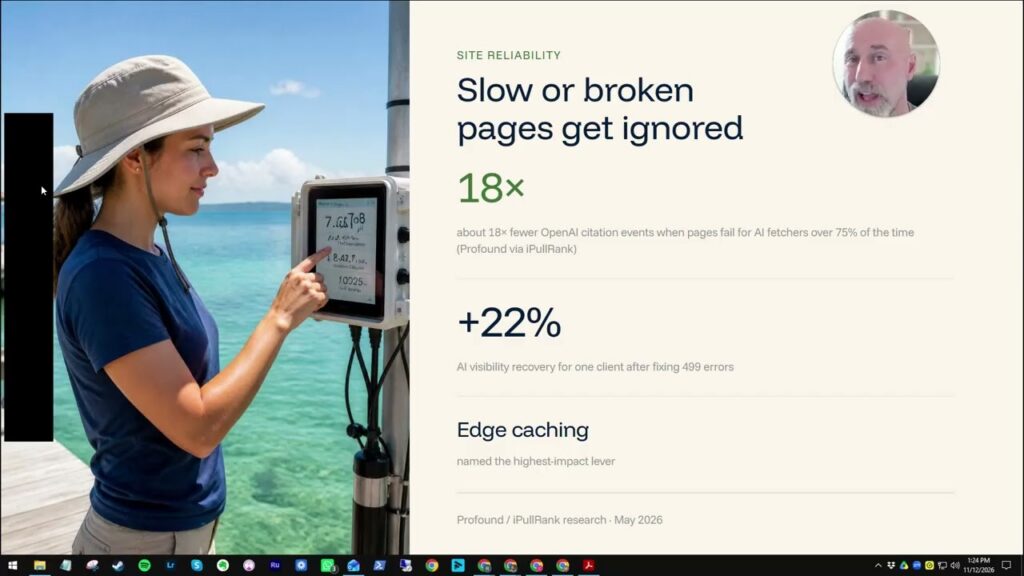
3:33 Slow or broken pages get ignored
4:13 Edge caching is the biggest lever
4:43 Blocking a bot hurts its own engine
5:28 Training bots: no proof they help
6:04 Third-party mentions drive brand recall
6:47 Local businesses: Yelp and Google Business Profile
7:14 What to do
7:53 How to measure whether it’s working
8:27 Wrap-up
Full transcript
0:00 Does letting AI bots in help you get cited?
Hey, I’m Jeremy with PushLeads and we help small businesses get more leads without struggle and frustration. And in this video, I’m going to ask, I’m going to answer the question, Does letting AI bots in help you get cited by AI? So, if you’ve been living under a rock, you probably don’t know that half of all searches now are AI searches, or at least for service people. Based businesses. so you’ve probably heard this, but if you haven’t, if you’re a contractor working, you probably don’t know it, but it’s gone from 6% to 45 or 50% in the last year. Searches for service based businesses, people using AI. So AI isn’t going away.
0:41 The bot in Singapore that was choking my site
The Pandora’s box is open. So I had a situation happen about a week ago. and a week and a half ago, I was working on redesigning my own site, and I noticed that it was a little slow. So I was asking Claude, my favorite AI, I said, Hey, why is my site slow? and it said, Oh, well, there’s a bot in Singapore that is choking your site to death. And I was like, what? and so what I realized is that my site essentially was open to anyone, anywhere. and so there were bots that were just choking the site, trying to scrape the site or hack the site. And so I later on moved to Cloudflare, which essentially allows you to put copies of the site out there, a cached copy of the site, just saved pages basically. And I also decided to block anything except US and Canada. Welcome. And then when I started thinking was, Hey, now that people, now that bots can see my site and now people can see my site more, does this mean that AI will start citing me more because we’re showing up for Google’s AI overview in some ChatGPT searches, but I was just wondering about that. So that’s what kind of what we’re going to do here is jump into this. So the very first question is,
1:52 The question: should you open the doors to AI?
will AI help you, So the very first question is, will AI recommend your business? Websites have this person, Websites have this simple switch and you can let AI bots crawl your site or you can lock them out altogether. And so we asked this question, does opening up your doors, does allowing your site, allowing it to be found by AI, does that make a difference? And let’s take a look at the answer.
2:18 Three kinds of AI bots: search, training and user
And before we go into the answer, we have to understand there are three kinds of bots out there, right? There are search bots, training bots, and user bots. So search bots are sort of these, you know, ChatGPT or Claude or OpenAI search bots that essentially want to see what your site’s about. Training bots are essentially bots that are getting better by looking at your website. And then user bots are basically when users are using ChatGPT or Claude and they’re fetching content.
2:49 The answer: search bots are a baseline requirement
And the simple answer is, yes. Turning on, opening up the site to crawlers and making it easier to be found by crawlers makes the helpers, allows the helpers to come in. So, allowing the search bots, is a baseline requirement to be cited. So, if your site is running slow or you’re on it and it seems to be choking at times, check with your web person and see if there’s a, a, a bot from Singapore that’s trying to choke your site to death. You may need to move yourself to Cloudflare, or ask your, web designer guy, a web hosting company to make sure that your site isn’t being slowed down by these bots. These bots in other countries that are trying to hack you. And so, so that the data says that it’s super important to do that.
3:33 Slow or broken pages get ignored
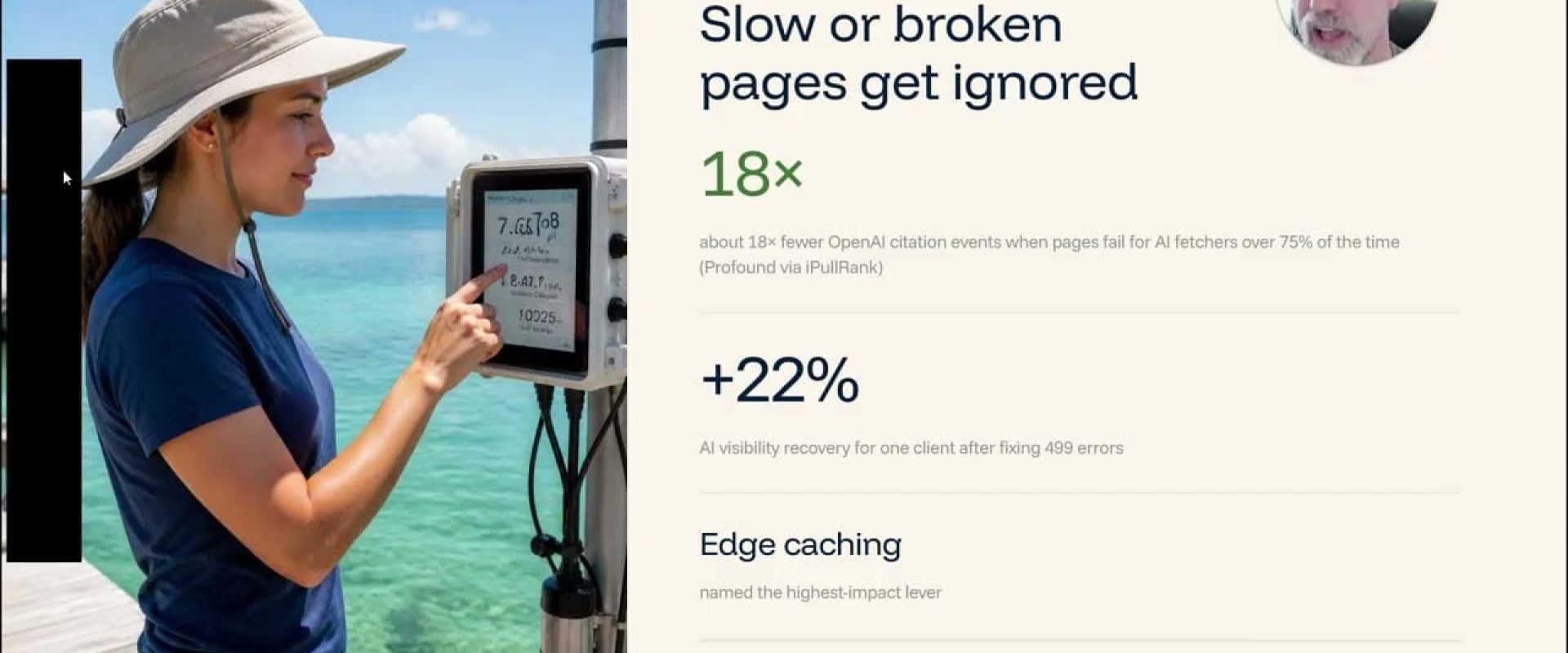
And what we found here was that slow or broken pages get ignored. So about 18x fewer citation events happen when pages are failing for AI searches. And that’s over 75% of the time. And this is from Profound via iPullRank. And then we saw a point, and then we saw a 22% visibility, recovery for a website that actually made their site findable. So why wasn’t I showing up in ChatGPT searches? Maybe because Singapore, somebody in Singapore decided to choke my site to death, right? Ugh, Singapore got me again. Just kidding. probably a great place to go to. But not to be hacked,
4:13 Edge caching is the biggest lever
and edge caching, which is really what, Cloudflare does is the highest impact lever. So it’s free to have your site, keep your site on its current hosting, but then, you know, have Cloudflare cache, try to cache me outside, have Cloud, have Cloudflare cache your pages. So basically that. you have copies of your pages for the bots to crawl, and then real people can go to those copy of the pages, or they can go to the real site when they’re actually on a contact form. So that’s super awesome.
4:43 Blocking a bot hurts its own engine
And the data says that blocking a bot hurts that bot’s own engine, right? So basically blocking ChatGPT dropped citations from 0.4 down to 0.0 0.0.0.0.3, according to the study, and blocking the Perplexity bot dropped the citation propensity to 0. So, I guess at this point I’m going to show up all over the place in ChatGPT, I’m super excited about that. and then 82 point, and then 88.2% of ChatGPT blockers were still cited, but it doesn’t prove that opening helps, so essentially, the bots are still going to try to get in, but it makes it easier if you let them in.
5:28 Training bots: no proof they help
So, training access, there’s no proof that it helps, there’s 0% measurable difference if you, care about letting a trainer bot in or not, and the only control, and the only control team, test, was they found that robots.txt made a 0, made a 0, and the only controlled test was, and the only, and the only controlled test really didn’t find a difference, and then there’s a separate crawler architecture for OpenAI and Anthropic, and they document that training bots are separate from live search, and then, third-parties, and then third-party mentions,
6:04 Third-party mentions drive brand recall
a bot, a model’s, and then third-party mentions do drive recall, a model’s ability to recall and recommend brand, and then third-party mentions, a model’s ability to recall and recommend a brand relies primarily on repeated mentions across the broader web, not on the site itself. So, basically, the, the data is saying that more crawling does not mean more citations, but can help, right? So, the Meta training crawler, the Cloudflare, blah, blah, blah, 64% of a thousand AI requests observed came, generated zero referral visits, right? So, it’s somewhat muddy data.
6:47 Local businesses: Yelp and Google Business Profile
For a local bot, Google Businesses, the citation is generally not on your website, it’s generally Yelp, or your own business website, or the Google Business Profile. BrightLocal found that businesses’ websites only represent about 42% of citations, while Yelp appears at 80%. And, if all this is muddy to you, you should be on YouTube. You should be making videos on YouTube, like I’m doing, because this is the huge path to showing up an AI request. So,
7:14 What to do
what to do? Should you allow the helpers, fix the errors? What should you do? So, it’s, regardless of what the data is saying, I think that making your site more visible to the right kinds of people, and the right kind of bots, mean that you’re going to be more cited, because you’ll be easy, because it’ll be easier for you to, because it’ll be easier for people to find you. So, you should allow the, so you should allow search and user bots, you should use edge caching, you should treat the training bots as valuable, and you should invest in your Google Business Profile, Yelp, and Apple Business Connect, and third-party mentions. And if you want to prove how it works,
7:53 How to measure whether it’s working
you can set a baseline and compare performance results across a four to eight-week window. We’ll be doing that in ourselves. The data is kind of saying it sort of helps, but then does it? you should inspect your logs and track the bot 2XX, and you can, and then you should inspect it, and then you should inspect your logs and track the bot 2XX success, and then you should audit your referrals, you should filter out the Google Analytics 4, and you should monitor SOV, you should run 50 to 100 fixed buyer queries weekly to measure the true recommendations share.
8:27 Wrap-up
So hopefully that was helpful. I’m Jeremy Ashburn with PushLeads, and I help small, so hopefully that was helpful. I’m Jeremy Ashburn with PushLeads, and I help small businesses get more leads without struggle and frustration. Talk soon.
Key Takeaways
Allowing AI search and user bots to crawl your site, and making sure those pages load fast, is the baseline requirement for getting cited by ChatGPT, Perplexity, Claude and Google AI Overviews. Training bots have no proven effect on citations. For local service businesses, your Google Business Profile, Yelp listing and third-party mentions across the web drive as much AI visibility as your website does, if not more.
- Three bot types exist: search/index bots, training bots and user-triggered fetchers. Only search and user bots have a documented connection to citations.
- Pages that fail AI fetches more than 75% of the time see roughly 18x fewer citation events, according to Profound data via iPullRank (May 2026).
- Blocking an engine’s own search bot tracks with near-zero citations in that engine. Blocking PerplexityBot dropped median citation propensity to zero in the cloro study (Jul 2026).
- Training bots show no measurable citation benefit. Fan et al. (COLM 2025) found robots.txt opt-outs made close to 0% difference to general model knowledge.
- Edge caching through a service like Cloudflare is the highest-impact technical lever for AI bot accessibility.
- BrightLocal (2026) found business websites account for about 42% of local AI citations, while Yelp appeared as a source in 80% of ChatGPT local answers.
- Measure results with a 4-8 week before-and-after baseline, track bot 2xx success in server logs, filter AI referrals in GA4 and run 50-100 fixed buyer prompts weekly for share of voice.
Do AI Bots Help You Get Cited? Here Is What the Research Actually Shows
Allowing AI search and user bots to access your site is a baseline requirement for getting cited, but letting training bots in has no proven effect on citations, and for local businesses, third-party platforms often matter more than the website itself. That is the short, honest answer to whether do AI bots help you get cited. The question sounds simple, but the research breaks down into three distinct bot categories, each with different roles, and the data for each tells a different story.
I started thinking hard about this after a bot based in Singapore was quietly choking my own site, pushleads.com, to the point where pages were slow to load. When I noticed the slowdown while redesigning the site, I asked Claude what was going on and got a clear diagnosis: an external crawler was hammering the server and degrading response times for everyone, including AI indexers. That sent me down a research rabbit hole, because if my pages were slow or timing out, was that hurting my chances of showing up in ChatGPT or Perplexity answers? The data says yes, pretty clearly. But the story gets more nuanced from there, especially once you separate search bots from training bots and start looking at what actually drives local AI citations. The rest of this post walks through each piece of the research so you can make decisions based on evidence rather than guesswork.
Want more customers from Google & AI search?
Get a free SEO audit of your site — see exactly what to fix first.
The Three Types of AI Bots and Why the Difference Matters
There are three distinct categories of AI bots, and treating them as one group leads to bad decisions about your robots.txt file and server configuration. Understanding which bot does what is the first step toward a strategy grounded in actual data rather than assumptions.
What are search and index bots, and which ones should I allow?
Search and index bots, such as OAI-SearchBot, Claude-SearchBot and PerplexityBot, crawl your pages so each AI engine can include your content in its retrieval layer when answering user queries. These are the bots with a direct, documented connection to citations. If you block OAI-SearchBot, OpenAI’s retrieval system cannot pull your pages into answers. If you block PerplexityBot, the cloro study (Jul 2026, 1,058 domains) found that median Perplexity citation propensity dropped to zero. The relationship is that straightforward: no access, no citation. Allowing these bots through your robots.txt and ensuring your server responds with a 200 status code quickly is the single most important technical step you can take for AI search visibility.
What do training bots like GPTBot and Google-Extended actually do?
Training bots, including GPTBot, ClaudeBot, Google-Extended and Meta-ExternalAgent, gather data to improve future model versions rather than to populate live search results. OpenAI and Anthropic document these as architecturally separate from their search and retrieval systems. Google states explicitly that Google-Extended does not affect Search inclusion or ranking. This distinction matters because a lot of content online conflates training crawlers with search crawlers, which causes business owners to block everything or allow everything without understanding which action actually influences citations. Training bots operate on a different pipeline, and the evidence for their impact on citations, as covered in a later section, is essentially zero.
What are user-triggered fetchers and when do they appear in my logs?
User-triggered fetchers such as ChatGPT-User, Claude-User and Perplexity-User appear in your logs when a person is actively using an AI tool and that tool fetches a URL in real time, often because the user shared a link or the AI is browsing on behalf of the user. These fetchers behave more like a live browser request than a background crawler. Because they fire during an active session, slow page loads or server errors during those moments directly affect the quality of information the AI retrieves and presents. Keeping your server response times low and your pages error-free covers both search bots and user fetchers simultaneously, which is why site performance is the foundation of everything else discussed here.
Why Slow and Broken Pages Kill Your AI Citation Chances
Pages that fail AI fetches more than 75% of the time see roughly 18x fewer citation events, according to Profound data published via iPullRank in May 2026. That number alone should reframe how you think about server performance in the context of AI visibility. It is not just about human visitors bouncing from a slow page; it is about AI crawlers silently skipping your content entirely because the server timed out or returned an error.
What do 499 timeout errors have to do with AI citations?
A 499 error means the client, in this case an AI bot, closed the connection before the server finished responding, usually because the server was too slow. In a client case documented through iPullRank (May 2026), fixing 499 timeout errors correlated with a 22% recovery in AI visibility. That is not a rounding error. If your site logs are full of 499s or 403 forbidden responses when AI bots try to crawl your pages, those pages are effectively invisible to AI retrieval systems regardless of how well-written or authoritative the content is. Fixing these errors is not glamorous work, but it has a measurable payoff.
How do I know if AI bots are failing to crawl my site?
Check your server logs and filter by known AI bot user-agent strings: OAI-SearchBot, Claude-SearchBot, PerplexityBot, ChatGPT-User and Claude-User. Look at the HTTP status codes returned for those requests. You want to see 2xx responses, meaning the page was served successfully. A high rate of 4xx or 5xx responses, or requests that never complete, signals a problem. If you do not have direct log access, ask your hosting provider or web developer to run the analysis. This is exactly the kind of audit that surfaced the Singapore bot issue on my own site, and it is worth doing before you invest time in content or citation-building strategies.
Can my hosting plan itself be the bottleneck for AI bot access?
Yes, shared hosting plans with limited resources can degrade response times under any heavy crawl load, whether from legitimate AI bots or malicious scrapers. The situation I ran into with pushleads.com is a good example of how infrastructure quietly undermines visibility. The malicious bot from Singapore was consuming server resources, slowing legitimate bot responses. Moving the site behind Cloudflare with edge caching resolved the slowdown and allowed me to restrict general traffic to the US and Canada while keeping verified AI bots accessible. If you are on a bare shared hosting plan and you see frequent slowdowns, your infrastructure may be the obstacle between you and AI citations, not your content.
Edge Caching Is the Highest-Impact Technical Lever
Edge caching, the practice of serving pre-built copies of your pages from servers located close to the requester, is the highest-impact technical lever for AI bot accessibility, according to the iPullRank analysis of Profound data. For most small businesses and contractors, Cloudflare is the practical way to implement this without changing hosting providers.
How does Cloudflare edge caching help AI bots index my site?
Cloudflare sits in front of your origin server and stores cached copies of your pages at data centers distributed around the world. When an AI bot requests a page, Cloudflare serves the cached version almost instantly rather than making the bot wait for your origin server to generate the page. This eliminates the timeout problems that cause 499 errors and improves the consistency of 200 responses. You can keep your existing hosting and simply route traffic through Cloudflare. The free plan is sufficient for most small business sites. The key configuration step is making sure that AI bot user agents are allowed through Cloudflare’s firewall rules, which I set up at the same time I restricted general traffic from outside the US and Canada.
Should I block non-US traffic to protect my site from bad bots?
Blocking general traffic from regions where you have no customers is a reasonable security measure, but you need to explicitly allow verified AI bot user agents regardless of their geographic origin. AI crawlers may operate from data centers in various countries. If your geographic firewall is too aggressive and catches legitimate search bots, you will recreate the same problem you were trying to solve. The correct approach is to allow known AI bot user agents by string matching before applying any geographic restrictions. If you are unsure how to set this up, your Cloudflare dashboard has firewall rule documentation that walks through the process, or ask a developer familiar with Cloudflare’s WAF configuration.
What specific errors should I prioritize fixing for AI bot access?
Fix 403 forbidden, 429 rate-limit and 499 timeout errors first. These are the response codes most likely to cause AI bots to give up and move on without indexing your page. A 403 often means your server or firewall is actively rejecting the bot. A 429 means you are rate-limiting the crawler. A 499 means the server was too slow. Each has a different fix: 403s usually require adjusting firewall or robots.txt rules, 429s require adjusting rate-limit thresholds for known bot user agents, and 499s typically require performance improvements or edge caching. After fixing these, track bot 2xx success rates in your logs over a 4-8 week period to confirm the improvements are holding. Understanding why contractors get zero AI citations often comes down to these exact infrastructure issues before you even get to content strategy.
Blocking a Search Bot Hurts Citations in That Engine
Blocking an AI engine’s own search bot tracks with near-zero citations in that engine, based on the cloro study published in July 2026 covering 1,058 domains. This is the clearest evidence that search bot access and citation rates are connected, though the relationship is not perfectly clean because sites blocking GPTBot often also block OAI-SearchBot, which is the actual retrieval crawler.
What happened to citation rates when sites blocked GPTBot?
The cloro study found that sites not blocking GPTBot had a median ChatGPT citation propensity of about 0.417 per organic appearance, compared to about 0.003 for sites blocking it. That is a dramatic difference, but the study authors note a likely confounding factor: sites that block GPTBot tend to also block OAI-SearchBot, which is the bot actually responsible for retrieval and citation. So the data may be measuring the effect of blocking OAI-SearchBot rather than GPTBot specifically. The practical takeaway is the same either way: allow both bots. Do not assume blocking one but not the other is a safe middle ground, because the two crawlers are often treated the same way by server configurations and robots.txt rules.
Does blocking GPTBot mean ChatGPT will never cite me?
Not necessarily. BuzzStream published research in March 2026 covering news sites and found that 88.2% of sites blocking GPTBot were still cited by ChatGPT. This is important context. It shows that blocking is leaky, AI engines find ways to access content through other means including third-party sources that have already indexed your content. However, the BuzzStream finding does not prove that opening your site helps; it only shows that blocking it does not completely eliminate citations. The two findings together suggest that allowing access improves your probability of citation without guaranteeing it, and blocking reduces it without eliminating it entirely. For most small businesses, the logical choice is to allow access and compete on content quality and third-party presence.
What does blocking PerplexityBot do to Perplexity citations?
The cloro study found that blocking PerplexityBot took median Perplexity citation propensity to zero. Unlike the ChatGPT situation where some citation leakage persisted, Perplexity appears to rely more heavily on its own crawler for retrieval. If you have blocked PerplexityBot in your robots.txt or through a firewall rule and you want to appear in Perplexity answers, removing that block is likely the single most direct action you can take. Check your robots.txt file for a Disallow rule targeting PerplexityBot and remove it. Then verify through your server logs that PerplexityBot is receiving 2xx responses when it crawls your pages.
Training Bots Have No Proven Effect on Citations
Allowing training bots such as GPTBot, ClaudeBot, Google-Extended and Meta-ExternalAgent to crawl your site has no proven positive effect on AI citations or recommendations. The controlled research available as of mid-2026 finds essentially zero benefit from training access, and the volume of training crawl traffic can actually create server load without producing any referral visits.
What did the controlled research find about training bots and citations?
Fan et al., published at COLM 2025, conducted a controlled training study and found that robots.txt opt-outs made close to 0% difference to general model knowledge. This is the most rigorous test available on the question, and the result is unambiguous: whether you allow or deny training crawlers, the model’s knowledge base and its likelihood of recommending your brand are essentially unchanged. OpenAI and Anthropic both document that their training bots operate on a separate architecture from their search and retrieval systems. Google states that Google-Extended does not affect Search inclusion or ranking. The practical implication is that you should treat training bots as optional rather than as a citation-building tool.
How much server load do training bots generate without any referral benefit?
A log study by QuickSEO tracked 100,351 AI bot requests over 35 days. Sixty-four percent of those requests came from Meta’s training crawler, Meta-ExternalAgent, which generated zero referral visits. That is a substantial share of server resources consumed by a crawler that sends no traffic and has no documented connection to citation rates. For a small business site on shared or budget hosting, that level of crawl volume can degrade performance for the bots that do matter. If your server is showing signs of strain from crawler traffic, auditing which bots are consuming resources and rate-limiting or blocking training-only crawlers is a legitimate performance optimization, not a risk to your citation prospects. Learning how AI local search ranking works helps put these crawl decisions in context.
Should I ever block training bots completely?
Blocking training bots is a defensible choice if they are creating server load problems, and there is no research suggesting it will hurt your citations. The more important question is whether blocking them through robots.txt is actually effective. Fan et al. found that robots.txt opt-outs made close to 0% difference to model knowledge, which suggests training crawlers may not fully honor disallow directives in every case. If you are concerned about server load from training crawlers, a firewall-level rate limit on their user agents is a more reliable enforcement mechanism than robots.txt alone. As always, verify through your logs that the rules are working as intended.
Third-Party Mentions Drive Brand Recall in AI Models
A model’s ability to recall and recommend your brand depends primarily on repeated mentions across the broader web, not on the content of your own site. This is one of the most practically important findings for small businesses because it shifts the focus from on-site optimization alone toward a broader presence-building strategy.
Why does my own website contribute less to brand recall than I expected?
AI language models build their understanding of a brand from every document they were trained on that mentions that brand, weighted by frequency and source diversity. Your own website is one source. Industry directories, review platforms, local news mentions, partner sites, blog posts referencing your work, and press coverage are additional sources. If your business appears frequently across a wide range of external sources, the model develops a stronger and more consistent representation of your brand than it would from your website alone. This is why investing in third-party mentions, citations and directory listings is not optional as an AI visibility strategy. It is arguably more important than perfecting your site’s on-page content, especially in the early stages of building AI presence.
What types of third-party mentions matter most for local service businesses?
For local contractors and service businesses, the platforms with the highest impact on AI citations are Google Business Profile, Yelp, Apple Business Connect and niche directories relevant to your trade. BrightLocal’s Local AI Visibility Study (2026) found that business websites account for about 42% of local AI citations, while Google Business Profile accounted for 28.5%. Yelp appeared as a source in 80% of ChatGPT local answers in BrightLocal’s August 2026 directory study. That is a striking number. If you have not claimed and fully optimized your Yelp listing, you are absent from a source that shows up in four out of five local ChatGPT responses. The same logic applies to Apple Business Connect, which feeds Siri and Apple Maps results.
How do I build third-party mentions beyond the main directories?
Getting cited by ChatGPT and Perplexity at a local level requires mentions that go beyond basic directory listings. Local news articles, home services blogs, neighborhood platforms like Nextdoor, and industry association directories all contribute to the pool of content that AI models draw on. Guest articles on local publications, mentions in neighborhood Facebook groups that get indexed, and coverage from local reporters or bloggers create the kind of repeated, varied mentions that strengthen brand recall. You can also look at whether your existing customers are leaving reviews on platforms beyond Google, since review text across multiple platforms adds to the volume of mentions associated with your business name. Research on how to get recommended by ChatGPT consistently points back to this distributed presence strategy.
What Local Businesses Should Do Right Now
Local contractors and home-service businesses should focus on a small number of high-leverage actions rather than trying to optimize every variable at once. The research points to a clear priority order based on what has measurable impact.
What should I fix on my site first to improve AI bot access?
Start by allowing search and user bots through your robots.txt file. The specific user agents to allow are OAI-SearchBot, Claude-SearchBot, PerplexityBot, ChatGPT-User and Claude-User. Then pull your server logs and look for 403, 429 and 499 errors associated with those user agents. Fix the errors in that order, since 403s and 429s are usually faster to resolve than performance issues causing 499s. If you are on shared hosting and cannot resolve the performance issues, moving to Cloudflare with edge caching is the most practical next step. Edge caching was identified as the highest-impact lever in the iPullRank analysis, and the Cloudflare free plan is sufficient for most small business sites. These steps also help AI-narrated videos and citations work better by ensuring the pages those videos live on are accessible to AI crawlers.
How important is Google Business Profile compared to my website for AI citations?
Google Business Profile is very important, accounting for 28.5% of local AI citations in the BrightLocal 2026 study. Combined with the 42% from business websites and the 80% Yelp appearance rate, the data is clear that local AI citations pull from multiple sources simultaneously. A complete, regularly updated Google Business Profile with photos, service categories, hours and responses to reviews gives AI systems more data points to work from when constructing answers to local queries. Treat your profile as a living document rather than a one-time setup. Add new services, update seasonal hours, respond to every review, and post updates at least monthly. The same applies to your Yelp and Apple Business Connect profiles.
Should I be making videos to improve my AI visibility as a local contractor?
Yes, YouTube content is a meaningful channel for AI visibility and is worth including in your strategy. Data on YouTube videos driving AI visibility shows that video content on YouTube gets indexed by multiple AI systems and can appear as a cited source in AI-generated answers. The barrier to entry for local contractors is lower than it appears. A simple explanation of a common problem you solve, filmed on a smartphone, can build topical authority and citation potential over time. YouTube videos sit on a platform that is both heavily indexed by search engines and directly processed by AI systems, which makes it a more efficient content format than many contractors realize when thinking about AI visibility.
How to Measure Whether Any of This Is Working
Measuring AI visibility requires a different approach than traditional SEO metrics because most AI citations do not appear as direct referral traffic in Google Analytics. You need a combination of log analysis, prompt testing and traffic filtering to get an accurate picture.
How do I track AI bot performance in my server logs?
Filter your server logs by the AI bot user agents listed earlier and track the percentage of requests that return 2xx status codes. This is your bot success rate. Run this analysis before making any changes to establish a baseline, then repeat it every week for four to eight weeks after making changes. A rising 2xx success rate for search bots, combined with declining 4xx and 499 rates, is a leading indicator that your site is becoming more accessible to AI retrieval systems. If you do not have direct log access, ask your hosting provider or web developer for a log export. Most control panels can generate one on request. Real data on YouTube AI visibility follows a similar before-and-after methodology that you can apply to your site performance tracking as well.
How do I filter AI referral traffic in Google Analytics 4?
In GA4, go to your Acquisition reports and look for sessions with source containing the domain names of AI tools, such as chat.openai.com, perplexity.ai and claude.ai. You can also create a custom segment or exploration that filters sessions by these source domains. This gives you a view of how much traffic AI engines are sending directly to your site. Keep in mind that this captures only the fraction of AI interactions where a user clicked through to your site. AI systems often answer questions without producing a click, so referral traffic underestimates your total AI citation exposure. That is why prompt testing is a necessary complement to traffic data.
What does running fixed buyer prompts mean and how do I do it?
Running fixed buyer prompts means identifying 50 to 100 specific questions your ideal customers would ask an AI tool, entering those questions into ChatGPT, Perplexity and Claude on a weekly basis, and recording whether your business or website is mentioned in the response. These prompts should reflect real buyer intent, things like “who is the best roofer in Asheville NC” or “what HVAC company should I call in Asheville.” Track your share of voice across those prompts week over week. Improvements in share of voice, measured as the percentage of prompts where you appear, are the most direct signal that your AI visibility strategy is working. This is the kind of monitoring that separates businesses actively managing their AI presence from those guessing at whether any of it matters.
Frequently Asked Questions
Does blocking GPTBot mean I will never show up in ChatGPT answers?
Blocking GPTBot does not guarantee you will never be cited, because BuzzStream found that 88.2% of sites blocking it were still cited in some form. However, the cloro study found that sites blocking GPTBot and OAI-SearchBot had a median citation propensity of about 0.003 compared to 0.417 for sites that allowed them. Allowing access dramatically improves your probability of citation. Blocking reduces it without eliminating it, largely because AI systems access content through third-party sources that have already indexed your pages.
Will allowing GPTBot and other training bots improve my citation rate?
No, allowing training bots has no proven effect on citation rates. Fan et al. (COLM 2025) found that robots.txt opt-outs made close to 0% difference to general model knowledge. OpenAI and Anthropic document their training bots as architecturally separate from their retrieval and search systems. Google states that Google-Extended does not affect Search or ranking inclusion. You can allow training bots as a neutral choice, but do not expect a citation benefit from doing so.
How much does page speed actually affect AI bot citations?
Profound data published via iPullRank in May 2026 found that pages failing AI fetches more than 75% of the time saw roughly 18x fewer citation events. A client case fixing 499 timeout errors saw a 22% AI visibility recovery. These numbers suggest that server performance is not a minor factor; it is one of the most direct levers you control. AI crawlers behave similarly to impatient users. If a page does not respond quickly and reliably, the crawler moves on and your content is not retrieved for answers.
Is Yelp really that important for showing up in ChatGPT local answers?
Yes. BrightLocal’s August 2026 directory study found that Yelp appeared as a source in 80% of ChatGPT local answers. That is a higher appearance rate than most business websites. If you have not claimed your Yelp Business page or if your listing has outdated information, you are missing from a source that feeds the majority of ChatGPT local responses. Claiming and optimizing your Yelp listing is one of the fastest, highest-return actions a local contractor can take for AI visibility.
Can I protect my site from bad bots while still allowing AI search bots?
Yes, and this is exactly the approach I took with pushleads.com. The key is to use firewall rules that identify bots by user agent string before applying geographic or rate-limit restrictions. In Cloudflare, you can create rules that explicitly allow OAI-SearchBot, Claude-SearchBot, PerplexityBot and similar verified crawlers while blocking general traffic from regions where you have no customers and rate-limiting unknown crawlers. The result is a site that is accessible to legitimate AI indexers while being significantly harder for malicious scrapers and attack bots to reach.
How long does it take to see improvement in AI citations after fixing bot access?
Set a measurement window of four to eight weeks before drawing conclusions. AI systems crawl and re-index content on their own schedules, and citation patterns do not shift overnight after a technical fix. Track bot 2xx success rates in your server logs weekly starting from the day you make changes, and run your fixed buyer prompts at the same time each week to monitor share of voice. Some businesses see improvements in a few weeks; others take longer depending on how heavily the AI systems weight recently crawled content versus what is already in their index.
Does my business website or my Google Business Profile matter more for AI citations?
Both matter, but they play different roles. BrightLocal’s 2026 study found business websites accounted for about 42% of local AI citations and Google Business Profile for 28.5%. Neither source dominates alone. Your website provides detailed content that AI systems can quote or summarize. Your Google Business Profile provides structured data about your business, location, hours and category that AI systems use to answer direct local queries. Optimizing both is more effective than focusing on one at the expense of the other, and adding Yelp and Apple Business Connect creates the multi-source presence that strengthens brand recall across AI models.
What is share of voice for AI search and how do I measure it?
Share of voice for AI search is the percentage of a fixed set of buyer-intent prompts where your business appears in the AI-generated answer. To measure it, write 50 to 100 prompts that reflect real customer questions in your market, enter them into ChatGPT, Perplexity and Claude weekly, and record how often your business name or website appears in the response. Divide the number of appearances by the total number of prompts to get your share of voice percentage. Tracking this week over week gives you a direct measure of whether your AI visibility efforts are producing results.
Start Auditing Your Site and Listings Before Another Bot Beats You to It
The research is clear enough to act on even where it is not perfectly clean. Allowing AI search and user bots, fixing the errors that cause crawl failures, and adding edge caching through Cloudflare are baseline steps that every small business and contractor should take now. These are not speculative bets; they are infrastructure fixes with documented citation impact. Beyond your website, claiming and fully optimizing your Yelp, Google Business Profile and Apple Business Connect listings addresses the platform layer that drives a large share of local AI citations independently of anything on your site.
Training bots are optional. Third-party mentions are not. And measurement, through server log audits, GA4 referral filtering and weekly prompt testing, is what tells you whether the work is paying off rather than leaving you guessing.
At PushLeads we work through exactly this kind of audit with local contractors and service businesses in Asheville and beyond. If you want a clear picture of where your AI visibility stands and what to fix first, reach out at https://pushleads.com/contact/ and we can walk through it together.
Related reading from PushLeads
- Why Local Contractors Are Getting Zero AI Citations (And How to Fix It This Week)
- Do AI-Narrated Videos Get Cited by AI Search? 493 Videos, Zero Citations
- Are YouTube Videos Driving Your AI Visibility? Our 4-Week Data
- Do YouTube Videos Help AI Visibility? 4 Weeks of Real Data
- How to Get Your Local Business Recommended by ChatGPT & Google AI (2026)
- how do you get your restoration company cited by ChatGPT and Perplexity?
- How AI Local Search Ranking for Service Businesses Actually Works: Why 68% of Google Maps Contractors Get Cut From AI Recommendations and Ho
Keep Reading
Want more customers from Google & AI search?
Get a free SEO audit of your site — see exactly what to fix first.
Your path · What Is SEO? The Complete Guide to Search Engine Optimization for Businesses
Keep going: read these next

- Up nextSEO Analytics and Reporting Research Report: Measuring Success That Actually Drives Business Results
- AI-SEO: How Artificial Intelligence is Revolutionizing Search Rankings in 2026
- Visual and Video SEO: The definitive guide to optimizing for image and video search in 2026




Want this done for you?
Scan your site. See the gaps. Decide with numbers.
- Rankings, Google Business Profile and site-speed teardown
- Report lands in your inbox in about a minute
- No obligation · 4.9 from 67 Google reviews
 Continue reading