
0:00 Bear Restoration $200K Revenue Result
1:56 Five-Step Restoration SEO Process
2:40 AI Visibility ChatGPT and AI Overviews
3:19 Cost Per Lead Across All Channels
4:29 Paid vs Organic Structural Comparison
5:10 Google Business Profile Local SEO
6:09 Storm and Hurricane Page Timing
6:42 Mold Remediation Content Strategy
8:02 Ranking Velocity Timeline Expectations
8:54 Weekly and Monthly Agency Deliverables
9:33 Financial Case for Restoration SEO
Full transcript
0:00 Bear Restoration $200K Revenue Result
If you run a water damage, mold, fire, image storm, or hurricane restoration company, this is the growth playbook that actually moves the needle in 2026. In this video, you’re going to see exactly how bear restoration added $200 ,000 in revenue in just 120 days, and you’re going to see the repeatable five -step system behind that result. My name is Jeremy Ashburn, and at PushLeads, we’ve built this process specifically for restoration contractors. Let’s get into the numbers. I’m Jeremy Ashburn. I started PushLeads to do one thing well. Turn searches into phone calls for restoration company owners. I’ve been ranking local businesses on the first page of Google since 2007. What we’re doing in this video is the full restoration SEO playbook, emergency intent, map pack, service pages, and AI answer visibility. Bear restoration started the engagement at $450 ,000 in annual revenue. 120 days later, they were tracking towards 650 ,000. That’s $200 ,000 in added revenue, not projected, not modeled actual growth measured during the campaign. The mechanism was simple. Google ads filled immediate pipeline while organic SEO compounded in the background. Neither channel alone produced this result. Running them together is the key insight, and we’ll come back to that throughout this playbook. Here’s the keyword progression that powered that revenue growth. Bear restoration entered the campaign with 127 first page keyword rankings. By day 120, they had 289 first page keywords and 515 total ranked keywords across Google. That’s more than four times the starting footprint. Each new ranked keyword represents a buyer searching for exactly the service Bear restoration offers and finding them instead of a competitor. So how does this actually work?
1:56 Five-Step Restoration SEO Process
The process follows five steps, and every step builds on the one before it. Step one is keyword research, finding exactly what buyers type before they call. Step two is optimizing your titles and meta descriptions to turn Google impressions into actual clicks. Step three is on page content and schema markup, which gives Google precise signals about what each page covers. Step four is publishing 20 to 40 new pages per month, and that scale of output is what expands your footprint fast. And step five is building roughly 100 internal links per month, which creates an authority structure that pushes your most important targets higher over time. There’s a new dimension to search that most restoration companies are
2:40 AI Visibility ChatGPT and AI Overviews
completely ignoring. AI visibility, Bear restoration’s owner found PushLeads through a ChatGPT recommendation. That’s not a future scenario. It’s happening right now, optimizing for AI tools like ChatGPT, Google AI overviews, and Perplexity requires longer, more structured content than traditional SEO. We’re talking 3 ,000 to 5 ,000 words per post, published one to four times per week, written to directly answer the questions AI systems retrieve when homeowners ask about restoration services. Companies that build this content now will dominate AI referred traffic as that channel grows.
3:19 Cost Per Lead Across All Channels
Let’s look at what this means for your cost per lead across channels. On Google ads, water damage keywords cost $40 to $80 per click. At a 10 % conversion rate that puts your cost per lead between $300 and $750. Google Local Services Ads are more efficient, roughly $80 to $200 per verified lead. Social media ads run $150 to $400 per lead, but purchase intent is low. Organic SEO delivers leads at $50 to $150 once your pages rank. That’s the channel where cost per lead actually falls over time instead of rising. Let’s put the paid ads math in concrete terms. A $3 ,000 monthly Google ads budget at $40 to $80 per click generates roughly 40 to 75 clicks. At a 10 % conversion rate, that’s four to seven leads at a maximum cost of $750 each. If your average job is $5 ,000 or more and your close rate is strong, that math can work. But you’re entirely dependent on the budget. The moment you pause, lead flow stops completely.
4:29 Paid vs Organic Structural Comparison
Organic SEO doesn’t work that way. Here’s the structural difference between paid and organic channels laid outside by side. Paid ads produce leads on day one, but costs reset to zero the moment you pause. And cost per lead rises as more competitors enter the auction. Organic SEO takes three to six months to build meaningful traffic. But once your pages rank, each click costs nothing. Cost per lead falls as domain authority grows. And by month 12, organic search should represent 30 to 60 % of your total inbound leads to a number that keeps improving in year two and beyond. The right strategy runs both simultaneously, then gradually reduces paid spend as organic stabilizes.
5:10 Google Business Profile Local SEO
Local SEO is the layer that national SEO doesn’t require. And for restoration companies, it’s often more important than organic rankings alone. BrightLocal research confirms that Google uses three primary factors to rank businesses in the map pack, proximity, relevance, and prominence. Your Google Business Profile is the primary signal for all three, your name, address, and phone number must match exactly across your GBP, your website, and every directory listing. Service categories must specifically match what you do, water damage restoration, fire damage restoration, and mold remediation, each need to appear. And reviews matter enormously, five to 10 new reviews per month, out ranks a competitor with 200 older reviews and no recent activity. Storm and hurricane damage restoration searches are among the highest intent queries in the industry. And the window to capture that traffic is narrow.
6:09 Storm and Hurricane Page Timing
The critical insight is this, build your storm and hurricane pages before the season, not during it. Google takes weeks to crawl, index, and rank new content. A page published the day a hurricane makes landfall will not rank during the search surge that follows. Search engine lands click distribution research shows the top five organic results capture roughly 68 % of all clicks. Moving from position 15 to position five like hurricane damage restoration can triple your click through rate. That improvement takes time to earn, start now.
6:42 Mold Remediation Content Strategy
Mold remediation is one of the highest value SEO specialties in the restoration industry. The primary keyword mold remediation draws 8 ,000 to 12 ,000 monthly searches nationally, and that’s before you account for dozens of related phrases. The buyers in this category are often worried about health effects, insurance coverage, and timelines, content that answers those questions before the phone rings ranks for all of them. A well -structured service page combined with two, two, three supporting blog posts covering costs by square footage, insurance questions, and remediation timelines creates a content cluster that strengthens your entire domain’s authority in this category. Here’s a side -by -side view of all four major channels and what they actually cost. Google Ads averages $525 per lead at the midpoint. Google LSA comes in around $140. Social media sits around $275, but purchase intent is low and results depend heavily on ongoing creative investment. Organic SEO lands at roughly $100 per lead at the midpoint and that number falls over time as your domain authority grows. No other channel improves its economics the longer you invest in it. That’s the compounding advantage that Restoration SEO builds.
8:02 Ranking Velocity Timeline Expectations
Understanding ranked velocity helps you set realistic expectations and communicate them to your team. In the first four weeks, Google indexes your new pages, but ranking changes are minimal. The foundation is being laid. In months two and three, lower competition geographic and long tail keywords start moving into the top 20. In months four through six, your primary city level service keywords begin appearing on page one as your internal linking structure matures and backlinks accumulate authority. In months seven through 12, competitive emergency keywords like water damage restoration plus your city name, move into the top five, bear restoration, compress this timeline because content publishing, internal linking, and backlink building all ran simultaneously at high volume from day one. A complete Restoration SEO engagement is active work, not a set and forget service.
8:54 Weekly and Monthly Agency Deliverables
On a weekly basis, your agency should be updating keyword rankings, monitoring traffic, and tracking which specific pages are generating phone calls. Monthly, they should be publishing 20 to 40 new pages, building 100 internal links, and earning relevant backlinks. The live dashboard is non -negotiable, keyword rankings updated weekly, organic traffic from Google Analytics, call volume tied back to individual pages, form submissions attributed to the campaign, and review counts with ratings. If you can’t see which pages are generating revenue, you cannot make intelligent decisions about where to invest next.
9:33 Financial Case for Restoration SEO
The financial case for Restoration SEO is straightforward once you run the numbers. Organic SEO produces leads at $50 to $150. A typical water damage job bills $3 ,000 to $15 ,000. Fire and mold jobs often run higher. If your campaign generates 20 organic leads per month at $100 each, that’s $2 ,000 in lead acquisition costs, producing the same pipeline as $8 ,000 to $15 ,000 in monthly ad spend. That difference, $6 ,000 to $13 ,000 per month, is the compounding advantage that Restoration companies with strong organic rankings hold over competitors who rely entirely on paid channels. Restoration SEO investment starts at $750 to $1 ,500 per month for a single location engagement in a moderate market. Competitive markets or multi -location operations typically run $3 ,000 to $5 ,000 per month on the SEO retainer alone. Combined SEO and Google Ads programs commonly add $3 ,000 to $7 ,000 in ad spend on top of that. An aggressive multi -channel regional dominance campaigns with $10 ,000 to $15 ,000 in ad spend makes sense for established companies targeting multiple markets. The right number is always the one that returns more revenue than it costs. And at an average job value of $5 ,000 to $15 ,000, that bar is achievable at nearly every investment level. Bear Restoration’s owner found PushLeads through ChatGPT, not Google, not a referral, an AI tool recommended our agency when he search for Restoration SEO help. That single fact tells you everything about where search is going. The companies building content that AI systems can cite, long form, structured, question answering content are going to own a channel that most of their competitors haven’t even started thinking about yet. Bear Restoration is now one of those companies. Here’s your next step. Your competitors are ranking for the searches your customers run every day, every month without a focused SEO strategy is another month of leads going to someone else. The five step process, keyword research, optimized titles, on page content, consistent publishing and backlink building is exactly what move Bear Restoration from $450 ,000 to $650 ,000 in 120 days. That same process applies to your market and your service area. See exactly where your visibility stands with a free teardown at SEO, PushLeads, come audit, the link is in the description or call 828 -348 -7686.
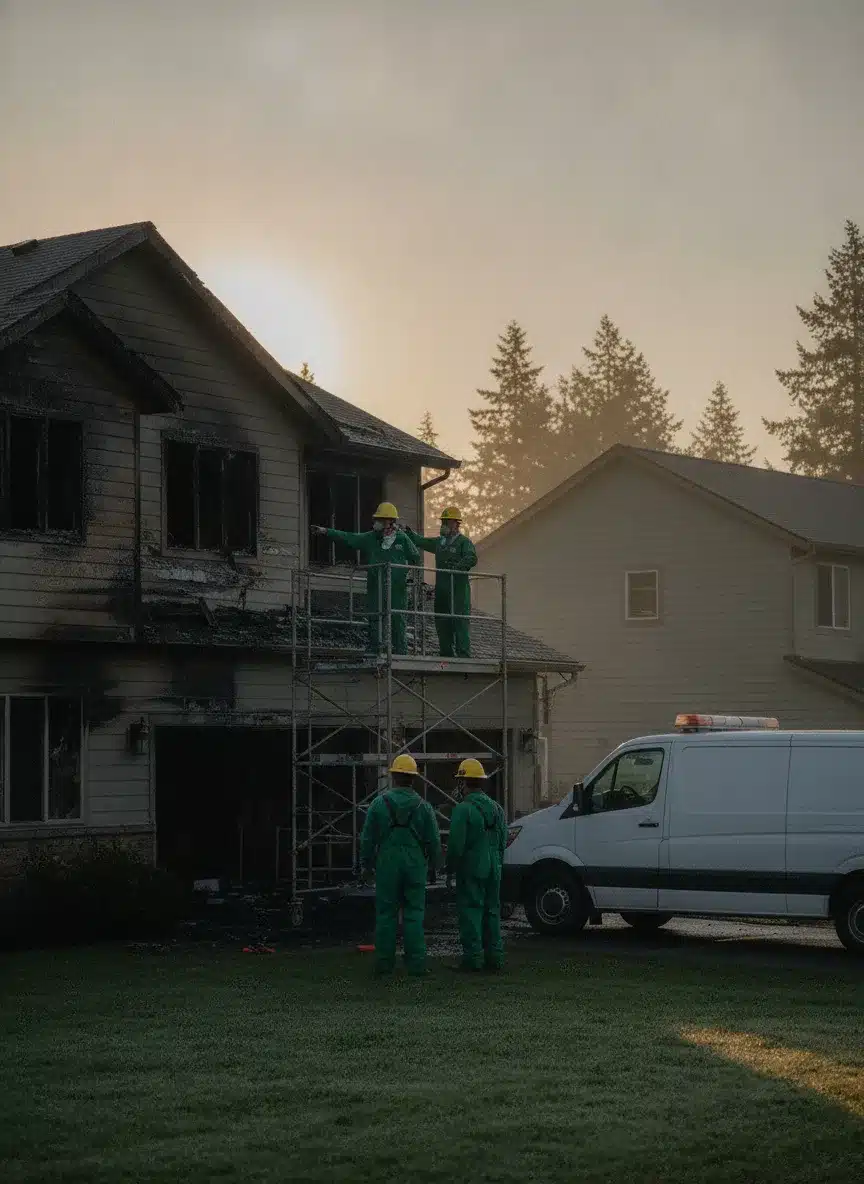

Local SEO for fire damage restoration companies is the difference between getting the call or watching a competitor get it. With fire damage PPC costs hitting $100 to $200+ per click (WordStream, 2024), organic local visibility delivers dramatically better ROI for restoration businesses. According to the National Fire Protection Association, a home fire happens every 88 seconds in the United States, creating 352,000 residential incidents and $11 billion in property damage each year (NFPA, 2024). Those homeowners search Google for help. This guide covers the specific local SEO strategies that put your fire damage restoration company in front of them.
Why Organic Rankings Beat Paid Ads for Fire Damage
Want it done for you? See our restoration SEO and marketing agency.
Fire damage keywords carry some of the highest PPC costs in the entire restoration company SEO space. Compare that to water damage restoration SEO, where clicks start around $31. The math is simple: organic rankings put you in front of the same searchers without the per-click cost.
“The restoration companies investing in local SEO are building an asset that generates leads for years,” says Joy Hawkins, founder of Sterling Sky and local SEO expert. “Paid ads stop the moment you stop paying.”
Here’s what makes fire damage keywords attractive for organic efforts. “Fire damage restoration service” pulls 18,100 monthly searches with low competition. “Fire damage restoration” adds another 14,800 searches. Combined fire damage keywords account for over 102,000 monthly searches nationally. Low keyword competition plus high commercial intent creates real opportunity for restoration companies willing to invest in SEO over PPC.
Google Business Profile: Your Most Important Local Asset
Your Google Business Profile (GBP) drives over 32% of local pack rankings, making it the single most important factor in local search visibility (Whitespark Local Search Ranking Factors, 2024). For fire damage restoration, proper GBP optimization decides whether you show up when a nearby homeowner searches at 2 AM after a kitchen fire.
Category Selection That Signals Google
Your primary category carries the most weight. If “Fire Damage Restoration Service” is available, use it. It sends the strongest, most specific signal to Google. Add secondary categories like “Water Damage Restoration Service,” “Smoke Damage Restoration,” “Emergency Service,” and “Contractor” to capture additional search variations.
Profile Completion Checklist
Google rewards complete profiles. According to Google’s own data, businesses with complete profiles are 2.7x more likely to be considered reputable (Google, 2024). Make sure yours includes:
- Accurate business name matching your legal name
- Local phone number (not toll-free)
- Business hours including 24/7 emergency availability
- Service area boundaries covering your full territory
- Individual service listings for fire damage restoration, smoke damage cleaning, soot removal, board-up services, content cleaning, odor elimination, and structural repair coordination
Each service listing creates another potential match for customer searches.
Photos That Drive Action
Businesses with photos get 42% more direction requests and 35% more website clicks (BrightLocal, 2023). Add optimized photos showing your team, completed restoration projects (with permission), before-and-after documentation, company vehicles, and certifications.
Want more customers from Google & AI search?
Get a free SEO audit of your site — see exactly what to fix first.
Building Reviews That Rank and Convert
Reviews influence 16% of local ranking factors and heavily impact whether a homeowner actually calls you (Whitespark, 2024). According to BrightLocal, 87% of consumers read online reviews for local businesses in 2024 (BrightLocal Consumer Review Survey, 2024).
“Reviews are the great equalizer for independent restoration companies,” says Mike Blumenthal, co-founder of GatherUp. “A local firm with 150 authentic reviews can absolutely outperform a national franchise with 40.”
Start your review generation strategy with these priorities. Request reviews within 48 hours of project completion. Make the process easy with direct links. Respond to every review, positive and negative. Encourage detailed reviews that mention specific services like smoke damage cleanup or emergency board-up. Recent reviews carry more weight than older ones, so consistency matters more than one big push.
Your review management approach should include responding to every review professionally. Thank customers for positive feedback. Address concerns constructively in negative reviews. Include relevant keywords naturally in your responses.
Local Content That Captures Emergency and Informational Searches
Local content supports your GBP rankings while pulling in additional search traffic from homeowners researching fire damage before and after emergencies.
Service Area Pages
Create dedicated service area pages that convert for each city or region you serve. A page targeting “[City] Fire Damage Restoration” should include specific mentions of the area, local fire statistics when available, references to local fire departments, customer testimonials from that area, and your response times to that location.
According to a 2024 Semrush study, 46% of all Google searches have local intent (Semrush, 2024). Don’t create thin, duplicated content across location pages. Each one needs unique value.
Fire Risk and Safety Content
Educational content pulls in homeowners before emergencies happen. NFPA data shows cooking causes 49% of home fires, heating equipment causes 13%, and electrical issues cause 8% (NFPA, 2024). Create localized content around seasonal fire risks, what to do immediately after a house fire, fire damage insurance claim processes, and protecting undamaged possessions. This builds brand awareness with the exact homeowners who may need you later.
Citation Building and NAP Consistency

Local citations reinforce your business information across the web. Build a strong citation foundation starting with Google Business Profile, Bing Places, Apple Maps, Yelp, Facebook Business, BBB, Angi, HomeAdvisor, and Thumbtack. Fire damage restoration companies should also claim listings in the IICRC certified firm directory, RIA member directory, and state contractor licensing boards.
NAP (Name, Address, Phone) consistency across every listing is critical. According to Moz, citation signals account for roughly 7% of local pack ranking factors (Moz Local Search Ranking Factors, 2024). Inconsistent information confuses search engines. Audit existing citations and fix inconsistencies before building new ones.
Technical Local SEO for Fire Damage Websites
Technical optimization supports everything else you’re doing.
Schema Markup
Implement LocalBusiness schema markup on your website including business name, address, phone, service area, and 24/7 hours of operation. Only 12.4% of domains use schema markup, so proper implementation gives you a real competitive edge (Ahrefs, 2024).
Mobile Speed for Emergency Searches
Eighty percent of emergency service calls come from mobile devices, and 88% of smartphone users who search locally visit or call within 24 hours (Google/Ipsos, 2023). Your site needs to load in under 3 seconds. Every extra second between 1 and 3 seconds increases bounce rates by 32% (Google, 2023).
A homeowner standing in their driveway at midnight watching smoke clear from their kitchen won’t wait for a slow page. Check your website speed and Mobile-First Indexing regularly.
Seasonal Patterns You Can Plan Around

Fire damage demand follows predictable seasonal patterns that smart restoration companies build into their marketing calendars.
NFPA data shows winter months produce 106,900 home fires (the highest volume), while summer drops to 75,000. Peak daily fire time runs from 4 to 9 PM, accounting for 33% of all fires (NFPA, 2024). Holiday periods create additional spikes: Thanksgiving brings cooking fires, December means candle and tree fires, and New Year’s Eve celebrations add risk.
Increase your content publishing and local link building efforts 4 to 6 weeks before peak periods. That gives Google time to index and rank your seasonal content before demand surges.

Tracking What Actually Matters
Measure results so you know what’s working and what needs adjustment.
Inside GBP Insights, track the search queries triggering your listing, how many discovery versus direct searches you get, and customer actions like calls, website visits, and direction requests. Monitor rankings for your priority terms like “fire damage restoration [city]” and “emergency fire restoration near me” in both the local pack and organic results.
The metric that matters most is lead attribution. Connect rankings to actual business results: phone calls from your GBP listing, form submissions from local landing pages, and conversion rates by source. According to industry data, the average fire damage restoration job ranges from $4,500 to $50,000+ depending on scope (IBISWorld, 2024). Even one additional organic lead per month can significantly impact your bottom line.
Frequently Asked Questions
In this video
- 0:00 Why Google Ignores Restoration Companies
- 0:27 Who Jeremy Is and Why It Matters
- 0:50 The Local Search Opportunity for Restoration
- 1:22 Four Channels That Build a Lead Pipeline
- 2:05 Why Referrals Alone Cannot Scale Your Business
- 3:09 Google Business Profile Six-Step Optimization
- 4:27 Service City Pages and Search Appearance Growth
- 5:41 Local Services Ads Cost and Close Rates
- 7:24 AI Overviews and Schema Markup Visibility
- 8:56 Attribution Tracking Every Channel Needs
- 9:31 Reconstruction Leads and High-Value Buyers
- 10:12 Correct Build Sequence Step by Step
Full transcript: Restoration Company Marketing: Why Google Ignores You (And the Fix)
How long does local SEO take to produce results for fire damage keywords?
Most fire damage restoration companies see measurable ranking improvements within 3 to 6 months. GBP optimization typically shows results faster than organic website rankings. In competitive markets, reaching the local pack may take 12+ months of consistent work. Check industry-specific SEO timelines for more detail.
Should I create separate GBP listings for each city I serve?
Only if you have a legitimate physical location in that city. Creating listings without actual offices violates Google’s guidelines and risks suspension. Use service area settings to cover multiple cities from one location, and build dedicated service area pages on your website instead.
How do I compete with national restoration franchises in local search?
Local signals favor genuinely local businesses. Highlight your local ownership, community involvement, and faster response times. Build relationships with local fire departments and insurance agents. National chains struggle to match the local authority that comes from strong community ties and consistent local link building.
Can I rank for fire damage keywords without a Google Business Profile?
You can rank in organic results, but you’ll miss the local pack, which dominates above-fold space for local service searches. GBP is essential for full local visibility.
How important are reviews compared to other local ranking factors?
Reviews directly influence 16% of local ranking factors. But their impact on conversion rates is even bigger. A business with fewer but higher-quality reviews can outperform competitors who have volume but poor ratings. Focus on quality and consistency.
What’s the single biggest local SEO mistake fire damage companies make?
Ignoring their Google Business Profile after claiming it. A stale profile with outdated hours, no photos, and no recent reviews sends the wrong signal to both Google and potential customers. Treat your GBP like your most important marketing asset, because it is.
Need help getting your fire damage restoration company ranking in local search? Contact PushLeads for a free SEO audit and strategy consultation.
Want more customers from Google & AI search?
Get a free SEO audit of your site — see exactly what to fix first.
Your path · Restoration SEO
Keep going: read these next
 You’re hereFire Damage Restoration Local SEO: How to Show Up When Homeowners Need You Most
- Who to Call First After Water, Fire, or Storm Damage: The Emergency Response Decision Tree



Want this done for you?
Scan your site. See the gaps. Decide with numbers.
- Rankings, Google Business Profile and site-speed teardown
- Report lands in your inbox in about a minute
- No obligation · 4.9 from 67 Google reviews

