

Local SEO Services for Asheville Businesses
TL;DR: Local SEO services help your business show up when nearby customers search for what you sell. They cover Google Business Profile optimization, citation building, review management, and location-targeted content. Done right, they drive more calls, more foot traffic, and more revenue from your local market.
This is part of our guide to Local paid search marketing.
Full transcript
Section 1
If you’re paying for GPT optimization and all you’re getting is a monthly PDF, you’re probably wasting your money. A real service runs $40 to $240 a month, and by the end of this video, you’ll know exactly what that buys, what red flags to watch for, and how to judge results by calls and map pack position, not reports, why GPT actually drives calls.
Section 2
calls. Your Google business profile is not just a listing, it’s the very first thing that local
Section 3
customers see whenever they touch your website. So when someone searches for garage door repair
Section 4
near me, Google shows a map pack and three businesses appear and the one that shows up
Section 5
there gets most of the clicks and most of the calls. So GPT optimization is the work that puts
Section 6
you in that map pack and keeps you there. If your profile is unclaimed, incomplete, or sitting still,
Section 7
you are handling those spots to competitors who are actively working their Google Business Profile.
Section 8
That’s the whole reason this service exists.
Section 9
The $40 to $200 range.
Section 10
Most small businesses should expect to pay between $40 and $200 a month for a managed DPT service.
Section 11
Where you land in that range depends completely on three things.
Section 12
One, how competitive your market is.
Section 13
Two, how much content work is included.
Section 14
And three, whether the agency is doing the work themselves or handing it to a software tool and simply walking away.
Section 15
At the low end, which is around $40 to $60, you’re getting basic maintenance, post scheduling, review monitoring, and maybe a photo upload here and there.
Section 16
At the mid-range, $75 to $150, you should expect post creation, keyword informed, profile edits, and a real human reviewing your performance monthly.
Section 17
monthly. At the high end, up to $200 expect competitive tracking, Q&A management, and
Section 18
citation work alongside the profile. Industry ballpark, anything above $200 a month for GPT
Section 19
alone with no additional SEO deliverables deserves a hard question. What the monthly work actually
Section 20
looks like. So here’s the core work a legitimate GPT service does every single month. Profile
Section 21
Well, attribute updates keep your hours, services, service area, and categories accurate.
Section 22
Category selection matters more than most people realize.
Section 23
Your primary category should match the exact service you want to rank for, not just your
Section 24
general industry.
Section 25
Google posts go out regularly, ideally two to four times a month, and these are short
Section 26
updates tied to offers, services, seasonal content, or answers to common questions.
Section 27
and they signal activity to Google and give searchers a reason to click.
Section 28
And photo uploads actually matter.
Section 29
Google rewards profiles with consistent real photos,
Section 30
not stock images, actual photos of your work, your team, or your jobs.
Section 31
And a good service will afford these or give you a simple upload process.
Section 32
Review response management means that someone is replying to every review,
Section 33
positive or negative, within a reasonable window.
Section 34
Google watches engagement. Unanswered reviews, especially negative ones, hurt
Section 35
your visibility and your conversion rate. Q&A monitoring catches questions that
Section 36
show up in your profile and makes sure they’re entered accurately before a
Section 37
competitor or stranger answers them for you. The keyword layer that most services
Section 38
skip. Your GPP is not just a contact card. It’s a search document and keywords
Section 39
belong in it. This includes your business description, your services sections, and
Section 40
your posts these should all use phrases that your customers actually type phrases like emergency
Section 41
plumber in asheville or best hvac tune up near me a real service does keyword research specific to
Section 42
your location and your services then works those phrases into your profile naturally they don’t
Section 43
stuff keywords they place them where google reads and where your customers scan if your agency has
Section 44
never mentioned keywords in the context of your gbp there is a gap citation consistency and why
Section 45
it matters citations are mentions of your business name address and phone number on other websites
Section 46
yelp apple maps and better business bureau local directories niche directories for your trade
Section 47
if your name address or phone number is inconsistent across those listings google gets
Section 48
it’s confused and your rankings suffer. A solid GPT service either includes citation cleanup or
Section 49
at least audits your citations and flags problems. This is not glamorous work, but it’s foundational.
Section 50
One address inconsistency can suppress your map visibility for months. What a work example looks
Section 51
like. Picture a garage door company doing around 30 calls a month from their current profile.
Section 52
They’ve got a claim profile, a few old photos, and they’ve never posted.
Section 53
They hire a service at $120 a month.
Section 54
In month one, the categories are corrected, description rewritten with local keywords,
Section 55
service area confirmed, and 20 new photos are submitted.
Section 56
In month two, four posts are published, citations on 12 directories are corrected, review response
Section 57
is started.
Section 58
In month three, map pack position for garage door repair near me moves from outside the
Section 59
the top 10 into the top three pack for the two target zip codes. Calls increased, not doubled
Section 60
overnight, but up meaningfully. The math works because the spend is small relative to even two
Section 61
or three extra jobs a month. This is how the math typically plays out for a service business in a
Section 62
mid-sized market. It’s an illustration, not a guarantee, but it’s a realistic picture of what
Section 63
the active work produces. The four red flags said watch out for. Red flag number one is when they
Section 64
only send you a report. If the monthly deliverable is a PDF with rankings and impressions and nothing
Section 65
else, ask what they actually did that month. Reports describe outcomes. They do not create
Section 66
them. Red flag number two is when they claim guaranteed rankings. No one can guarantee a
Section 67
a MAC pack position because Google controls the algorithm.
Section 68
Walk away from anyone who promises specific rank outcomes
Section 69
on a contract.
Section 70
Red flag number three is when they never ask
Section 71
for photos or access.
Section 72
Real optimization requires real assets.
Section 73
If your service provider has never asked you for photos,
Section 74
never requested profile access,
Section 75
and never asked about your services,
Section 76
they’re not doing the work.
Section 77
Red flag number four is when they don’t talk about reviews.
Section 78
reviews. Reviews are one of the strongest ranking signals in local search. If your agency is not
Section 79
helping you build a meaningful review strategy, they’re leaving your most powerful signal
Section 80
unmanaged. How to judge results. Calls and position, not reports. Here’s the only scorecard
Section 81
that matters. Are you getting more calls from your profile? Are you appearing in the map pack
Section 82
for more searches that actually drive business? Google Business Profile shows your calls directly
Section 83
in the dashboard. You can see how many people clicked to call, got directions, or visited your
Section 84
website from your profile. And those numbers should trend up over three to six months of
Section 85
active optimization. Map pack position for your core keywords is another check. Search for your
Section 86
name, service, plus city on a phone with the location turned on. If you’re not in the top
Section 87
three, ask your provider what the specific plan is to get you there and what the timeline looks
Section 88
looks like. In my experience, most GBP improvements start showing in position within 60 to 90 days
Section 89
when the work is consistent. If you’re six months in and nothing has arrived, the work isn’t there.
Section 90
What the service should never do. A few things should never appear on your invoice or in your
Section 91
contract. Fake reviews. Buying or incentivizing reviews in exchange for discounts is a terms of
Section 92
service violation and a Google suspension risk. Keyword stuffing in your business name. Some
Section 93
Some agencies add city names or keywords to your legal business name inside the profile.
Section 94
This violates Google’s guidelines and can get your listing suspended.
Section 95
Duplicate listing creation.
Section 96
If an agency proposes creating a second profile for a different city that you’ll physically serve, that’s a guideline violation.
Section 97
Geographic proximity is a real signal and fake addresses are a liability.
Section 98
Contracts and reporting minimums.
Section 99
Month-to-month contracts are reasonable at this price point.
Section 100
You shouldn’t need to sign a 12-month lock-in for a GBP management alone.
Section 101
Minimum reporting should include total profile views, search query breakdown showing what people typed to find you, call and direction clicks, and any post-engagement numbers.
Section 102
The data is all native to the Google Business Profile dashboard, and if your provider is showing you data that you can’t verify yourself inside your own Google account, ask where it’s coming from.
Section 103
Transparency is not optional.
Section 104
What to ask before you hire.
Section 105
Here’s three questions that separate real providers from resellers.
Section 106
1. Show me the last three months of posts and updates that you did for a current client.
Section 107
Not a screenshot, an actual live profile that you can look at.
Section 108
2. How do you handle a negative review in the first 24 hours?
Section 109
A real answer involves a specific response, process, and a note about escalation.
Section 110
A bad answer is, we monitor them.
Section 111
3. What happens to my profile if I cancel?
Section 112
You should own your Google Business Profile outright.
Section 113
Any service that requires you to give up ownership of your profile as a condition of their service is a hard no.
Section 114
What to do next?
Section 115
If you’re paying for a local SEO or GBT management and you’re not sure what you’re actually getting, start by pulling up your own profile and counting posts for the last 30 days.
Section 116
If there are none, there’s your answer.
Section 117
Then write a local search for your core service plus city on your phone.
Section 118
If you’re not in the map pack, that’s work that we do.
Section 119
You can get your free AI visibility check at pushleads.com slash check or call 828-348-7686
Section 120
and we’ll look at your profile, your map pack position, your local visibility, and where you
Section 121
are in AI search and tell you exactly where the gaps are. No pitch, just the numbers. I’m Jeremy
Section 122
Ashburn. I help small businesses get more leads without struggle and frustration. Talk soon.
How do I generate more SEO leads for my local service business?
The highest-leverage move is fully optimizing your Google Business Profile, then building a review system that earns at least one new review per week. After every completed job, send a one-tap text review request. Pair that with dedicated service and location pages on your website. Those two steps together drive the organic call volume that reduces paid ad dependency.
What is the best way to do SEO for a multi-location business?
Build a dedicated page for each city or zip code you serve — not one page listing twenty towns. Each location page needs the service and city in the page title, a matching header, at least 400 words of real local content, and a clear call to action. Claim and verify satellite locations in your Google Business Profile as well.
Want more customers from Google & AI search?
Get a free SEO audit of your site — see exactly what to fix first.
What is the best local SEO platform for small businesses?
For schema markup on WordPress sites, RankMath and Yoast handle local business, service, and FAQ schema without touching code. For citation auditing, BrightLocal and Whitespark find NAP inconsistencies across directories quickly. Neither replaces the foundational work — a complete Google Business Profile and consistent name, address, and phone number everywhere online.
What SEO services help small businesses compete locally?
Small businesses gain the most from three things: a fully completed Google Business Profile, a consistent citation profile where name, address, and phone number are identical on every directory, and a structured review system. These cost less than paid ads and compound over time, lowering cost per lead significantly compared to running cold ads alone.
What does ongoing SEO management actually include?
Ongoing management covers posting to your Google Business Profile at least twice a month, running a weekly review acquisition system, publishing one well-structured content piece per month, auditing citations at least once a year, and building backlinks from locally relevant sources like chambers of commerce, home builders, and local event sponsor pages.
How does local link building work for service businesses?
Local link building focuses on relevance over volume. Partner with home builders to get listed on their preferred vendor pages, join your local Chamber of Commerce which typically links to member websites, and sponsor local events or sports teams whose sponsor pages link back to you. Each link signals to Google that yours is a real, trusted local business.
What should a local SEO report actually show?
A useful local SEO report tracks Google Maps ranking position for your core service-plus-city keyword combinations, review count and velocity over time, organic call volume compared to paid call volume, and citation consistency. If cost per lead from organic search is not being measured alongside paid ad spend, the report is missing its most important business metric.
What is the difference between local lead generation and hiring an SEO agency?
Local lead generation sells you calls or leads at a fixed cost per lead, so you pay every time regardless of history. An SEO agency builds assets — optimized pages, citations, reviews, schema — that keep generating calls after the work is done. The transcript example shows cost per lead dropping substantially once the organic foundation compounds, unlike cold ads.

Local SEO Services That Put Asheville Businesses in Front of Ready-to-Buy Customers
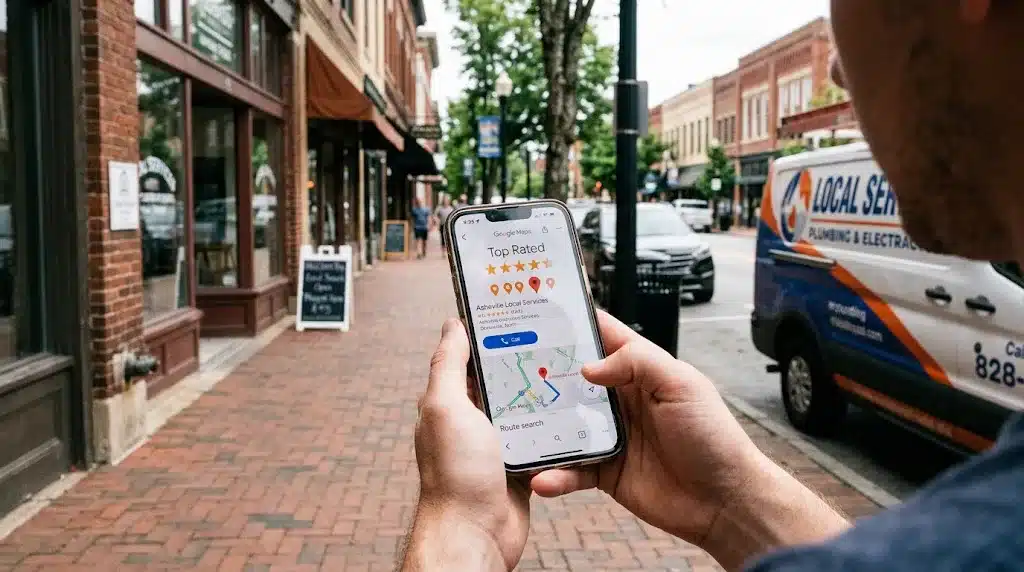
Local Business SEO Services help Asheville businesses show up when nearby customers search for what they sell. Google reports that 46% of all searches carry local intent, which means nearly half of everyone searching on Google is looking for something close by. PushLeads applies proven local SEO strategies to close the gap between where you rank now and where your customers are searching.
What Are Local SEO Services?
Local SEO services help businesses optimize their online presence to attract customers in a specific geographic area through search engines. Unlike broad national SEO, local SEO focuses on capturing buyers within your service area by targeting location-based searches, optimizing your Google Business Profile, building local citations, and managing online reviews. The goal is straightforward: when someone in Asheville searches for what you offer, your business shows up first.
Local SEO services encompass a comprehensive suite of tactics that work together: keyword research focused on local search terms, on-page optimization for location-specific content, technical SEO improvements, and integration with your broader digital marketing plan. This coordinated approach builds lasting visibility rather than short-term spikes. For Asheville service companies, eCommerce businesses, and creative professionals, that means more visibility in the Google Local Pack, stronger organic rankings, and more clicks from people who are ready to act.
In this video
- 0:00 Why Asheville Visibility Gaps Cost Revenue
- 0:20 Who Jeremy and PushLeads Are
- 0:38 Asheville Market Stats That Drive Urgency
- 1:02 Why Generic SEO Fails Asheville Businesses
- 1:28 Local Pack Mechanics Relevance and Prominence
- 1:52 Google Business Profile Optimization Essentials
- 2:21 GBP Features That Separate Ranked Profiles
- 2:49 Citations NAP Consistency and Local Backlinks
- 3:27 Review Strategy for Local Pack Placement
- 4:00 Mobile Speed and Core Web Vitals
- 4:28 ROI Tracking and Monthly Data Sets
- 5:06 What PushLeads Builds for Asheville Businesses
Emergency Service SEO: Rank When Customers Need You Now (full transcript)
What Is Local SEO and How Is It Different?
Local SEO is a specialized branch of search engine optimization that improves how your business ranks in location-based search results. It targets customers searching for businesses, products, or services in a specific city, neighborhood, or region rather than across the entire country. For a plumbing company in Asheville, that means showing up when someone types “plumber near me” or “Asheville emergency plumber.”
The core difference between local SEO and standard SEO comes down to intent and geography. Standard SEO tries to rank for broad topics in front of a national or global audience. Local SEO narrows the focus to the buyers who are physically close to your business and ready to make a decision today. That narrower focus produces higher-quality traffic because the people finding you are not browsing for general information. They are looking for a specific business in a specific place.
Google Business Profile optimization sits at the center of most local SEO strategies. Beyond that, a complete local SEO service includes citation management, review generation, local landing pages, and ongoing rank tracking so you always know where you stand. For Asheville businesses competing in a market with a strong mix of local operators and national chains, this level of precision gives you a real edge over competitors who are still relying on word of mouth alone.
What Are Organic SEO Services and Do You Need Them Too?
Organic SEO services improve your website’s visibility in non-paid search results by building relevance, authority, and technical strength over time. Where local SEO zeroes in on geography and proximity signals, organic SEO services address the broader factors that determine how search engines evaluate and rank any page on your site, regardless of location.
For most Asheville businesses, local SEO and organic SEO services work best together rather than as separate strategies. Local SEO captures the high-intent, near-me searches that drive immediate calls and visits. Organic SEO services build the underlying authority and content depth that make those local rankings stick and expand into additional search terms over time. A service company ranking in the Google Local Pack gets calls today. The same company with strong organic SEO services also attracts customers researching their options before they are ready to call, pulling them into the sales funnel earlier in the process.
The overlap matters too. On-page optimization, content quality, site speed, and link authority all influence both organic and local rankings. When you invest in organic SEO services that strengthen these fundamentals, your local rankings benefit as well. Local SEO also provides valuable long-term competitive advantages that help smaller Asheville businesses outperform larger national competitors right in their own backyard. Companies using coordinated local and organic SEO strategies often see 20 to 50% increases in local leads within the first six months of implementation.
Can SEO Services Help Improve Local Search Rankings?
SEO services can directly improve your local search rankings by fixing the technical, content, and authority gaps that hold your business back. Search engines rank local businesses based on three factors: relevance, distance, and prominence. A skilled SEO provider works all three angles simultaneously.
Relevance means your content and business categories match what local customers are actually searching for. Distance means your location data is accurate and consistent everywhere it appears online. Prominence means you have built the authority signals, including reviews, citations, and inbound links, that tell Google your business is credible. Businesses that rank in the top three local search results receive 44% of all clicks, according to BrightLocal. Getting into that top tier requires attention to all three ranking factors, not just one.
Related: Seo asheville nc.
For Asheville service companies, eCommerce businesses, and creative professionals, improved local rankings translate directly into more visibility in the Google Local Pack and higher positions in organic results. Those positions produce more clicks from people who are already looking to buy, which means a higher percentage of your website traffic converts into actual revenue. Local SEO also provides valuable competitive advantages that help smaller businesses outperform larger national chains in their own market.
Which Local SEO Services Deliver the Best ROI for Multi-Location Businesses?
For multi-location businesses, the local SEO services that deliver the best ROI are location-specific landing pages, Google Business Profile optimization for each location, and consistent citation management across all listings. These three tactics target customers closest to each location and give search engines the clear signals they need to rank each listing appropriately.
| Service | What It Does | Why It Drives ROI |
|---|---|---|
| Location-Specific Landing Pages | Creates unique pages targeting each service area | Captures hyper-local searches with high purchase intent |
| Google Business Profile Optimization (per location) | Optimizes each location’s Google listing | Puts each location in front of nearby searchers in Maps and local results |
| Citation Management | Ensures NAP accuracy across all directories for every location | Builds trust signals that improve rankings for each location |
| Review Management | Generates and responds to reviews per location | Improves local ranking factors and customer conversion rates |
| Local Link Building | Earns links from locally relevant websites | Boosts authority for each location in its specific market |
Local SEO cost per lead averages 61% lower than traditional marketing methods. For a business running multiple locations, that math compounds quickly across every service area. See how this works in practice for service businesses like plumbing companies that operate across multiple service areas.

Core Components of Local SEO Services
Effective local SEO services are built from four interconnected components: Google Business Profile optimization, citation building and management, on-page content for local search, and review management. Each component contributes to your overall local search authority, and they work best when managed together as a coordinated strategy rather than as isolated tactics.
Google Business Profile optimization forms the cornerstone of effective local SEO. This free tool serves as your primary listing in local search results and Google Maps. Professional optimization includes claiming and verifying your listing, ensuring accurate Name, Address, and Phone information, selecting the right business categories, and posting regular updates and photos. Businesses with complete Google Business Profiles are 2.7 times more likely to be considered reputable by consumers, according to BrightLocal research.
Citation building and management are equally important. Citations are online mentions of your business name, address, and phone number across directories, websites, and platforms. Consistent citations across high-authority directories signal to search engines that your business is legitimate and established. Local Business SEO Services audit existing citations for accuracy and build new ones strategically to strengthen your local search authority.
On-page optimization for local search means incorporating location-specific keywords naturally throughout your website content, meta descriptions, and title tags. This includes building dedicated landing pages for each service area and optimizing for “near me” searches that carry strong purchase intent. Review management rounds out the core components, since positive reviews directly influence both local rankings and the trust customers place in your business before they ever contact you. Google treats the volume, recency, and quality of your reviews as ranking signals for local search.

How Do Fully Managed SEO Providers Measure Success?
Fully managed SEO providers measure success through a combination of ranking improvements, organic traffic growth, lead volume, and conversion metrics that tie directly to business revenue. Impressions alone do not tell the full story. The metrics that matter are how many people found you through search, how many contacted you, and how many became paying customers.
Standard success metrics for local SEO include local keyword rankings, especially positions in the Google Local Pack, Google Business Profile actions like calls and direction requests, website traffic from organic search, and the number and quality of inbound leads generated each month. Monthly reports should translate these numbers into clear business outcomes so you always know what your investment is producing. If your provider cannot connect their activity to measurable business results, that is a problem worth addressing directly.
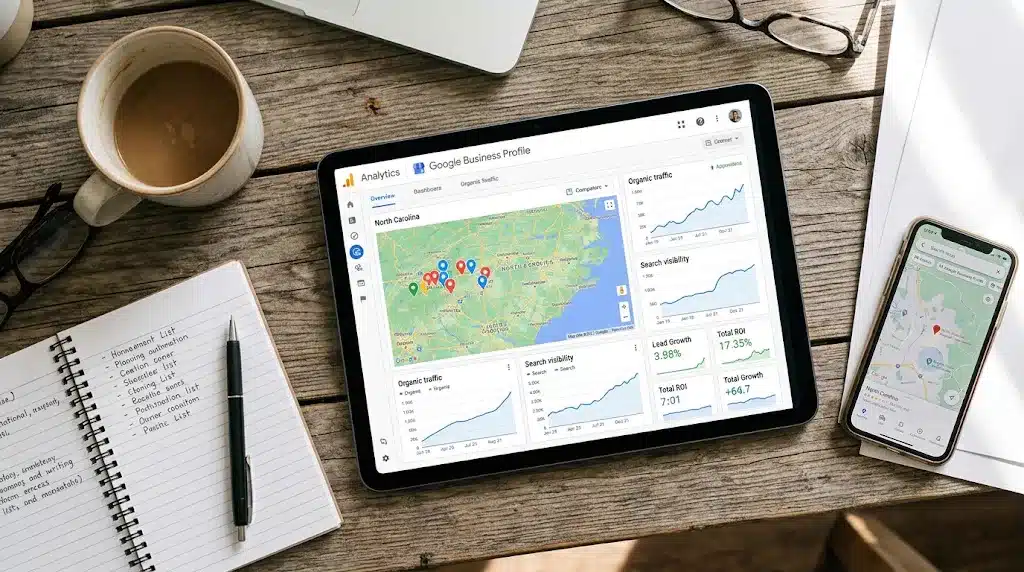
Quality providers also track competitive positioning so you can see not just where you rank, but whether you are gaining or losing ground against the other Asheville businesses competing for the same customers. A good provider adapts your strategy when Google algorithm updates roll out, protecting your rankings rather than scrambling to recover after the fact. They monitor performance data in real time, compare your results against benchmarks, and make proactive adjustments to your content, technical setup, and authority signals before problems develop.
Choosing the Right Local SEO Service Provider
The right local SEO provider has a clear methodology, a track record with businesses similar to yours, and transparent reporting that shows you exactly what your investment is producing. Look for providers who start with a comprehensive audit of your current local search performance and deliver a specific strategy before asking you to commit to anything.
Avoid providers who promise instant results or guarantee specific ranking positions. Legitimate local SEO takes consistent effort over time. What you should expect is a realistic timeline, clear explanations of what tactics will be used and why, and monthly reporting that connects SEO activity to actual business outcomes like calls, leads, and revenue. The provider should educate you on what they are doing, answer your questions in plain language, and adapt the strategy as your business grows.
The provider should also function as a strategic partner, not just a vendor. When Google rolls out an algorithm update, you want a team that is already monitoring the impact and adjusting your strategy, not one you have to call to ask what happened to your rankings. Contact us today to see how PushLeads approaches local SEO for Asheville businesses.

Quick Recap
- Local SEO services improve your visibility in location-based search results to attract nearby customers who are ready to buy.
- The core services are Google Business Profile optimization, citation building, review management, and local on-page content.
- 46% of all Google searches have local intent, making local SEO one of the highest-leverage investments for Asheville businesses.
- Businesses ranking in the top three local results capture 44% of all clicks in that search.
- Local SEO cost per lead averages 61% lower than traditional marketing methods.
- Organic SEO services and local SEO work best together: local SEO drives immediate calls while organic SEO builds long-term authority and reach.
- Multi-location businesses get the best ROI from location-specific landing pages, per-location Google Business Profile optimization, and consistent citation management.
- Fully managed SEO providers measure success through rankings, organic traffic, lead volume, and revenue impact, not just impressions.
- Companies using coordinated local SEO strategies often see 20 to 50% increases in local leads within the first six months.
- Local SEO also provides valuable long-term competitive advantages that help smaller businesses outperform larger national competitors in their own market.
Frequently Asked Questions
How long does it take to see results from local SEO services?
Most businesses begin seeing measurable improvements in local rankings and traffic within three to six months of consistent local SEO work. Competitive markets may take longer. Results build over time and compound as your authority grows, unlike paid ads that stop the moment your budget runs out. Businesses using coordinated local SEO strategies often see 20 to 50% increases in local leads within the first six months of implementation.
What is the difference between local SEO and regular SEO?
Regular SEO targets broad or national search audiences and focuses on ranking for topics across a wide geographic range. Local SEO focuses specifically on capturing customers within your geographic service area. Local SEO uses tactics like Google Business Profile optimization, local citation building, and location-specific landing pages that are not central to national SEO strategies. For Asheville businesses that serve a defined service area, local SEO delivers higher-intent traffic from buyers who are physically close and ready to act.
Do I need local SEO if I already run Google Ads?
Yes. Google Ads deliver paid traffic that stops the moment your budget runs out. Local SEO builds organic visibility that works continuously and typically costs 61% less per lead than paid advertising. The two strategies complement each other, but organic local SEO provides long-term value that paid ads alone cannot replicate. Many Asheville businesses find that local SEO produces a higher volume of qualified leads at a lower cost per acquisition over a 12-month period compared to running ads alone.
How does review management affect local SEO?
Reviews directly influence local search rankings and customer trust. Google treats the volume, recency, and quality of your reviews as ranking signals for local search. A business with consistently strong reviews will outrank a competitor with similar optimization but a weaker review profile, and will convert more of those searchers into actual customers. Active review management, including requesting reviews from satisfied customers and responding to all reviews, is one of the highest-impact tactics available for improving your local search position.
What local SEO services matter most for service businesses in Asheville?
For Asheville service businesses, Google Business Profile optimization and location-specific landing pages deliver the most immediate ranking impact. Citation consistency and review management support long-term ranking strength. When these tactics are combined into a coordinated local SEO strategy, the cumulative effect is significantly greater than any single tactic on its own. Service businesses like plumbers see strong results when all four core components work together under a single managed strategy.
In this video
- 0:00 Why Asheville Businesses Miss the Map Pack
- 1:19 Hidden Address Suppresses GBP Visibility
- 1:55 Three Google Local Ranking Signals Explained
- 2:29 What Asheville Competitors Are Not Doing
- 2:56 How Long GBP Gains Actually Take
- 3:32 Review Recency Beats Review Volume
- 4:15 How Google AI Reads Your Profile
- 4:49 Six Steps from Position 17 to Top Three
- 6:03 Video Verification and NAP Consistency
- 6:37 GBP vs Website SEO Priority Order
- 7:24 Three Advanced Moves Competitors Skip
The Ultimate Google Business Profile Guide: Dominate Local Search (full transcript)
How do I know if my local SEO provider is actually delivering results?
Your provider should send monthly reports showing local keyword ranking movements, organic traffic from search, Google Business Profile actions like calls and direction requests, and lead volume. If your provider cannot connect their work to measurable business outcomes, that is a problem worth addressing. A quality provider explains what each metric means in plain language and shows you how their activity is moving the numbers that matter to your revenue, not just impressions or click counts.
Is local SEO worth it for small businesses with limited budgets?
Yes. Local SEO is one of the highest-ROI marketing investments available to small businesses precisely because it targets customers who are already searching for what you sell. The cost per lead averages 61% lower than traditional marketing methods, and the results build over time rather than disappearing when your budget runs out. For Asheville small businesses competing against larger operators, local SEO levels the playing field by putting your business in front of buyers who are close by and ready to make a decision.
Ready to Rank Higher and Win More Customers in Asheville?
If you are a service company, eCommerce business, or creative professional in Asheville who is frustrated with your current SEO results, the path forward starts with a clear strategy built around your specific market. PushLeads works with local businesses to close the gap between where you rank now and where your customers are searching. Contact us today to start a conversation about what local SEO services can do for your business.
Watch: Best SEO for HVAC companies
What this video covers
- 0:00 — Why Google Maps 3-Pack Wins HVAC
- 0:20 — How Google Local Algorithm Works
- 1:10 — Google Business Profile Optimization
- 1:46 — Building a Review System That Works
- 2:18 — Service Pages and Location Pages
- 2:58 — Schema Markup for HVAC Sites
- 3:36 — AI Overviews and AEO Visibility
- 4:09 — Citations and NAP Consistency
- 4:38 — Keyword Strategy Service Plus City
- 5:05 — Content Calendar for HVAC Companies
- 5:50 — Backlinks from Local Sources
- 6:23 — What Results Actually Look Like
- 7:11 — Common HVAC SEO Mistakes to Fix
- 7:38 — Priority Order for HVAC SEO
Full video transcript
The single best SEO move an HVAC company can make right now is owning the Google Maps 3-pack in every city you serve. Everything else builds toward that. I’m going to walk you through exactly how to get there, what it actually costs to get wrong, and the specific steps that move the needle in 2026.
HVAC is a hyper-local business. When someone’s AC dies in July, they’re not browsing blogs. They type "AC repair near me" and they call whoever shows up first. That’s the whole game. Paid ads can get you in that moment, but organic local rankings get you there at a fraction of the ongoing cost. The companies winning on local search are not necessarily the biggest — they’re the most optimized.
Google’s local algorithm uses three main signals: relevance, distance, and prominence. You can’t control distance, so relevance and prominence are where you spend your energy. Relevance means your website and your Google Business Profile clearly say what you do and where you do it. Prominence means the internet corroborates your story — reviews, citations, backlinks, and content. Every tactic in this video maps back to one of those two signals.
If you do nothing else after watching this, go fully optimize your Google Business Profile. This is the highest-leverage 30 minutes in HVAC SEO. Choose the right primary category — HVAC contractor, air conditioning contractor, or heating contractor, depending on your main revenue. Fill out every service you actually offer. Add photos of your trucks, your techs, your work — real photos, not stock. Write a description that includes your city name and the specific services you provide. Post to your profile at least twice a month. Treat it like a second website, because that’s what it is.
Google uses review count and review velocity as ranking factors. In my experience with local service businesses, the companies in the top three positions typically have more reviews and more recent reviews than the companies ranked four through ten. That’s not an accident. Build a simple system: after every completed job, your tech sends a text, one tap, leaves a review. Aim for a minimum of one new review per week. Respond to every single review, good and bad. Responses show Google the profile is active, and they show potential customers that you actually care.
Your website has two jobs: one, signal to Google what you do and where; and two, convert visitors into calls. For the first job, structure matters. Build a dedicated page for every major service — air conditioning repair, furnace installation, duct cleaning. Each gets its own page. Then build dedicated location pages for every city or zip code you serve. Not one page that lists 20 towns — a real page for each one with real content about that specific area. Each page needs the service and city in the page title, a header that matches what people actually search, a minimum of 400 words of real content, and a clear call to action to call or book.
Schema markup is code you add to your website that tells search engines and AI tools exactly what your business is. Most HVAC websites don’t have it. That’s your opportunity. At minimum, you want local business schema with your name, address, and phone number; service schema on each service page; and FAQ schema on pages where you answer common questions. If you’re using a platform like WordPress, plugins like RankMath or Yoast make this manageable without touching code. If you’re on a custom site, your developer can add it in an afternoon. Schema is becoming more important as AI-powered search grows, not less.
This next area is new, and most HVAC companies are ignoring it. AI tools like ChatGPT, Perplexity, and Google’s AI Overviews are answering questions before people even click a link. If your site is not optimized for how AI reads content, you can be invisible in that layer entirely. The fix overlaps with good SEO: clear structure, strong schema markup, direct answers to common questions on your pages, and content that is specific and locally grounded. An AI visibility check can tell you exactly where you stand — more on that at the end.
Citations are mentions of your business on directories like Yelp, Angi, HomeAdvisor, the Better Business Bureau, and dozens of others. Your NAP — name, address, and phone number — needs to be identical everywhere. Not close, identical. "Street" versus "St." can create confusion in Google’s data model. Audit your citations at least once a year. Tools like BrightLocal or Whitespark can find inconsistencies fast. Getting this clean is unglamorous work, but it moves local rankings.
Stop trying to rank for "HVAC." That’s a national fight you will not win. Here’s the keyword structure that works: service plus city. Furnace repair Asheville. AC installation Hendersonville. Heat pump replacement Weaverville. Then add problem-based terms — "AC not cooling," "furnace won’t start," "heat pump freezing up" — so that you capture people searching the symptom, not the service name. If your content answers those symptom-based searches, you capture that traffic before they even know what they need.
You don’t need to publish every day. You need to publish the right things. Here’s what works for HVAC. Seasonal content published before the season hits — write your "get your furnace ready for winter" piece in September, not December. Google needs time to index and rank it. FAQ content that answers exactly what customers ask: "How long does an AC unit last?" "What size furnace do I need for a 1,500-square-foot home?" Before-and-after project pages with photos, the city name, and what was done — these pull local search traffic and they convert. One solid piece per month, well-structured at 400 to 800 words, focused on a real question from a real customer, will compound over time.
Backlinks — links from other websites pointing to yours — are still a major ranking signal. For HVAC, you don’t need links from the New York Times. You need links from locally relevant sources. Partner with home builders and get listed on their preferred vendor pages. Get active in your local Chamber of Commerce — most of them link to member websites. Sponsor a local event or sports team; the sponsor page usually links back to you. Submit to local business directories specific to your region. Each of these is a signal that says this is a real, trusted business in this community.
Picture a typical HVAC company doing roughly 400 calls a month across a metro area and three surrounding towns. Before optimizing, most of their calls are coming from paid ads, costing them somewhere around $60 to $90 per lead, and they’re invisible below position eight on maps. They work through this checklist — optimize the Google Business Profile, clean up citations, build out service and location pages, start the review system. In a typical case, within three to six months, they can start pulling meaningful organic call volume that costs far less per lead than the paid channel. Not zero cost — there’s time, content, and tools involved — but the cost per lead can drop significantly compared to running cold ads alone. That’s the compounding logic of SEO. You build it once and it keeps working.
Here are the common mistakes to avoid. Thin location pages with no real content — just the city name swapped into a template. No review system, so reviews trickle in by accident. Keyword stuffing that makes the page unreadable. Ignoring mobile load speed — most HVAC searches happen on a phone. Not claiming or verifying satellite locations when you serve multiple cities from one shop. And skipping schema markup entirely because it sounds technical. Every one of these is fixable in a focused afternoon with the right tools.
Here’s the priority order. One: Google Business Profile, fully complete. Two: review system, running every week. Three: website structure — service pages and location pages. Four: schema markup. Five: citations, clean and consistent. Six: content calendar, one piece per month. Seven: backlinks from local sources. Work the list in order. Don’t jump to backlinks when your profile is still half filled out. The foundation has to be there first.
Go get your free AI visibility check at PushLeads.com/check. It shows you exactly where your site stands for both traditional local SEO and the newer AI search layer. Or call us directly at 828-348-7686.
Want more customers from Google & AI search?
Get a free SEO audit of your site — see exactly what to fix first.
Your path · The Asheville Small Business SEO Guide
Keep going: read these next

- Up nextHow Long Does SEO Take in a Market Like Asheville? Realistic Timelines for Local Businesses
- On-Page SEO for Asheville Businesses: A Step-by-Step Checklist


Want this done for you?
Scan your site. See the gaps. Decide with numbers.
- Rankings, Google Business Profile and site-speed teardown
- Report lands in your inbox in about a minute
- No obligation · 4.9 from 67 Google reviews
 Continue reading
