


0:00 Intro
0:19 What You’re Actually Choosing Between
1:41 The Real Cost of Maps SEO for Garage Door
2:44 The Twelve-Month Math Side by Side
3:58 Why Most Owners Get This Backwards
5:09 What ‘Google Maps SEO’ Actually Means
6:04 The Google Business Profile Piece Specifically
6:48 Reviews: The Lever Everyone Underestimates
7:33 City Pages: Expanding Your Maps Footprint
8:17 The Worked Example: Twelve Months at a Real Company
9:29 Common Mistakes That Stall the Maps Results
10:19 What to Do Right Now
11:10 The Sequence in Plain English
Full transcript
0:00 Intro
Run Maps SEO first, then layer in Google Ads once your profile converts. That sequence cuts your cost per lead in half over 12 months. I’m going to show you the actual math on both channels. Walk through a real worked example, and give you a clear sequence so you stop burning money in the wrong order.
0:19 What You’re Actually Choosing Between
When a homeowner’s spring breaks at 7 in the morning, they grab their phone and search garage door repair near me. Two things show up above everything else, the Google Maps 3 -pack, and paid ads. Most owners treat these as competitors for the same budget dollar. They’re not. They’re two different machines with two different payback timelines. One is a monthly rent payment. One is an asset you build. Knowing which one to start with is the difference between a 12 -month break, even in a 12 -month money pit. Let’s talk numbers first. In my experience, garage door companies pay between 40 and 80 dollars per click on competitive keywords like garage door repair or garage door spring replacement. That’s not cost per lead. That’s cost per click. If your landing page converts at 10%, which is a solid number for a well -built service page, you’re paying 400 to 800 dollars per lead. If it converts at 5%, which is more common, you’re at 800 to 1600 dollars per lead. Your average ticket on a spring replacement might be 250 dollars. A full door install might run 1500 to 2500. So on repair calls, ads can actually cost you money on the first job before you ever factor in lifetime value or callbacks. Now, here’s the critical thing most agency salespeople won’t tell you. The moment you stop paying, the leads stop. Day one of no budget, zero impressions, zero calls, ads are rent. You never own anything.
This is part of our Google Business Profile guide.
1:41 The Real Cost of Maps SEO for Garage Door
Maps SEO is different. The work compounds. In my experience, a garage door company investing in maps SEO spends somewhere between 500 and 1500 dollars a month depending on how competitive their market is. That spend goes toward things like Google Business Profile optimization, local citation building, review generation systems, and localized content on the website. The payback curve looks like this. Months one through three, you’re mostly invisible. Months four through six, you start cracking the three pack for lower competition terms, like garage door repair plus your specific suburb. Months seven through 12, you’re competing for the main city terms. Once you’re in the three pack for your primary keywords, the cost per lead drops dramatically. Industry ballpark puts it between 20 and 60 dollars per lead from maps versus that 400 to 1600 from ads. And unlike ads, when you hit month 13 and stop paying, you still rank. Your profile doesn’t disappear overnight. The asset stays.
2:44 The Twelve-Month Math Side by Side
Let me put both scenarios next to each other. Scenario one, you go ads first. You spend 1500 dollars a month on ads plus management. That’s 18,000 dollars over 12 months. At an industry ballpark of 600 dollars per lead, you generate 30 leads. If you close 60 percent, that’s 18 jobs. Average ticket of 800 dollars gross across repairs and installs. That’s 14,400 in revenue. You spent 18,000 to make 14,400. You’re in the hole in year one. Year two looks no better because you’ve built no assets. So you spend 18,000 again. Scenario two, you go maps first. You spend 1000 dollars a month on maps SEO. That’s 12,000 dollars over 12 months. Months one through six, you generate maybe 20 leads total from maps as you build ranking. Months seven through 12, you’re generating 15 to 25 leads per month. Call it 110 leads over the year, 60 percent close rate, 66 jobs. Same $800 average ticket, 52,800 in revenue. Year two, you’re ranking holds. Your lead cost drops. The asset works for you. That’s the math the ad sales person doesn’t show you.
3:58 Why Most Owners Get This Backwards
There’s a very simple reason owners go ads first. Ads feel faster. You can have a campaign running tomorrow. The phone might ring this week. Maps SEO feels slow. The agency says give it six months and owners here, we don’t know. So owners write the check for ads because it feels like action. And six months later, they’ve spent $9,000 and they’re completely dependent on that spin continuing forever. I’m not saying ads are bad. I’m saying sequencing them wrong is expensive. There is one legitimate reason to start with ads. You just opened your doors for the very first time. You have zero reviews and no ranking history whatsoever. Your Google Business Profile is completely brand new. In that case, you genuinely need calls while SEO builds, run a small ads budget of $200 a month. 500 is the upper end of that range. That keeps the phone from going completely silent. But run it like a timer, not a long term strategy. Set a hard cut off date around month seven. At that point, you cut or reduce the ad spend. Then let your maps investment carry the full load. If you are not new, skip the ads phase entirely. Start maps optimization right now. Let me be specific because this term gets used loosely.
5:09 What ‘Google Maps SEO’ Actually Means
Google Maps ranking is driven by three things. First, relevance. Does your Google Business Profile and website tell Google clearly what you do, where you do it, and for whom? This means your categories, your services list, your website content, your target keywords in the right places. Second, proximity. How close is the searcher to your listed address? You can’t fake this, but you can expand your service area signals with city specific landing pages and localized content. Third, prominence. How many reviews do you have? How recent are they? How many other websites mention your business name and address? Are those mentions consistent? When people say maps SEO, they mean working all three of those levers over time systematically. It’s not a one time task. It’s a monthly process. Your Google Business Profile is the single highest leverage asset a local garage
6:04 The Google Business Profile Piece Specifically
door company has online. And most of them are set up wrong. Common mistakes. I see category set to home improvement instead of garage door supplier or garage door repair service. No services added. No photos added in the last 90 days. Description doesn’t include any city names. Review response rate under 50%. Each one of those is a ranking signal you’re leaving on the floor. One data point from the query data we look at, the phrase Google Maps SEO for garage door companies get 75 impressions with a 7.2% click through rate. Owners are searching for this. They know they need it. Most just don’t know what to do with it. Let me give you a worked example.
6:48 Reviews: The Lever Everyone Underestimates
Take two identical garage door companies. Same city, same services, same website quality. Company A has 42 reviews, 3.9 stars. Last review posted six weeks ago. Company B has 91 reviews, 4.7 stars. Last review posted three days ago. Company B wins the three pack every time, not even close. Reviews are a ranking signal and a conversion signal at the same time. When you rank and you have 4.7 stars, the homeowner calls you before they even look at anyone else. Your review strategy should be this simple. Text the customer a direct review link within two hours of finishing the job. That one change in my experience doubles your review velocity.
7:33 City Pages: Expanding Your Maps Footprint
Your Google Business Profile ranks strongest near your address, but most garage door companies serve a 20 to 40 mile radius. City specific landing pages are how you compete in every suburb even when your shop isn’t physically there. Each page targets a specific city or suburb, mentions the service clearly, uses that city name in the headline, the body, the meta title, and links back to your Google Business Profile naturally. In my experience, a garage door company with eight to 12 city pages out ranks competitors with zero city pages in those outer suburbs within four to six months. This is not complicated to build. It is boring and time consuming, which is why most don’t do it.
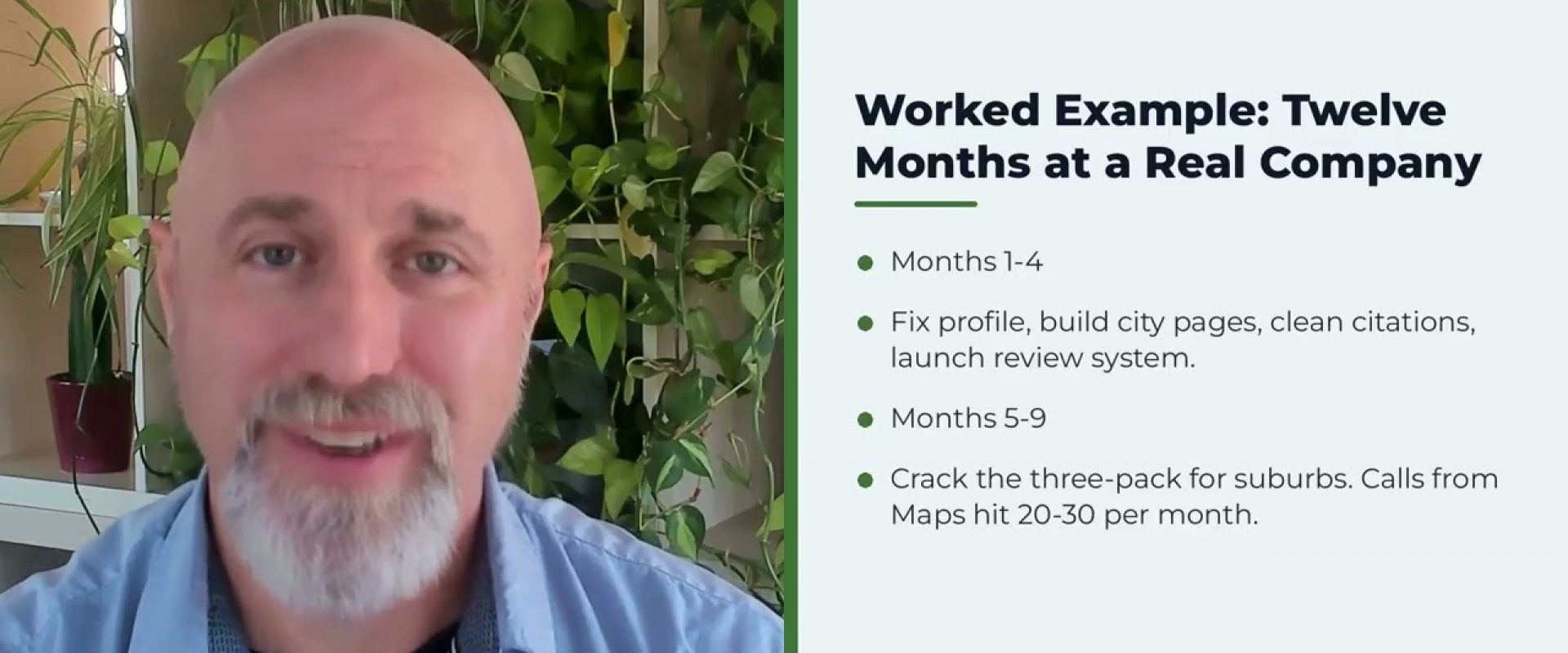
8:17 The Worked Example: Twelve Months at a Real Company
That’s your advantage. Let me walk you through a hypothetical but realistic scenario. Month one through two, fix the Google Business Profile, write categories, full services list, 35 new photos, get the review request system running, month three through four, build six city pages on the website, clean up the local citations, so the name, address, and phone number are consistent across the top 40 directories. Month five through six, you start cracking the three pack for suburb level searches. Phone starts ringing from maps for the first time. Maybe eight to 15 calls a month, month seven through nine, you’re showing for your main city terms intermittently. Reviews are at 60 plus and climbing, calls from maps hit 20 to 30 per month, month 10 through 12, stable three pack position for your main terms, 40 plus calls per month from maps alone, cost per lead under $50, total investment, $12,000, total leads from maps in year one, roughly 100 to 120, year two, the ranking holds, the cost per lead keeps dropping. That’s the asset mistake one, inconsistent in app.
9:29 Common Mistakes That Stall the Maps Results
Name, address, phone number spelled differently across directories. Google sees that as a trust signal problem, fix it early. Mistake two, ignoring the Q &A section on your profile. Seed it with the 10 most common questions customers ask. It adds keyword relevance and it genuinely helps conversion. Mistake three, using the same generic description on every city page, Google reads duplicate content as low effort. Each page needs its own paragraph with local specifics. Mistake four, stopping review outreach after month two, review velocity matters, older reviews decay and influence. This is a forever system, not a launch task. Mistake five, no photos of actual work. Stock photos do nothing. Real job photos, real doors, real driveways in your city. Post four to eight photos every single month.
10:19 What to Do Right Now
If you’re a garage door company owner watching this, here’s your next move. Pull up your Google Business Profile today. Check four things. One is your primary category, garage door supplier or garage door repair service. Not contractor, not home improvement. Be specific. Two, do you have a services section filled out with every service you offer? Spring replacement, cable repair, opener installation, panel replacement. List them all. Three, when was your last review? If it’s been more than two weeks, your review request system is broken. Four, search your own main keyword in your city right now. Are you in the three pack? If not, you know exactly what to work on. That audit takes 10 minutes. It shows you the gap and it tells you whether you need to start at the foundation or whether you’re close enough that a few months of focused
11:10 The Sequence in Plain English
work gets you over the top. Here’s the simple version. Start with maps, SEO, month one, run a small ads budget only if you’re brand new and need calls now, then cut it by month seven, build city pages, get reviews, fix the profile. By month 12, you have an asset that generates leads at $20 to $50 each. Then if you want to layer ads back in for peak season or to dominate above the three pack two, do it. But now the ads are an accelerant on top of a working foundation, not a life support system for a company with no organic presence. That’s the sequence. Maps first, ads second. If you want us to look at your specific profile and tell you exactly where you stand, go to SEO .PushLeads .com slash audit or call us at 828 -348 -7686. We’ll do a free visibility tear down and show you the gaps. No pitch, just the numbers.
Key Takeaways
Run Google Maps SEO first, then layer in Google Ads once your profile is converting. That sequence can cut your cost per lead from $400-$1,600 down to $20-$60 over 12 months. Ads stop the moment you stop paying. Maps rankings compound and stay. For most garage door companies that are not brand new, skipping straight to ads first is the most expensive sequencing mistake they make.
- Google Ads cost garage door companies $40-$80 per click, which translates to $400-$1,600 per lead at typical conversion rates.
- Maps SEO costs $500-$1,500 per month and builds a ranking asset that keeps generating leads even if you pause spending.
- The 12-month math: ads-first puts most companies in the hole; maps-first generates roughly 100-120 leads with a positive return.
- Your Google Business Profile categories, services, photos, and review velocity are the highest-leverage items to fix first.
- City-specific landing pages let you compete in suburbs 20-40 miles away where your physical address gives you no proximity advantage.
- Reviews are both a ranking signal and a conversion signal. Getting the review text within two hours of finishing a job roughly doubles your velocity.
- Only run a small ads budget ($200-$500/month) if you are truly brand new with zero reviews. Set a hard cut-off around month seven.
The Core Question: Google Ads or Google Maps SEO for a Garage Door Company?
Run Maps SEO first and layer Google Ads in later, once your Google Business Profile is already converting. That single sequencing decision is the difference between building an asset that compounds over time and paying rent on leads forever with nothing to show for it at the end of the year. Most garage door company owners get this backwards, not because they are careless, but because ads feel faster and agencies that sell ads have every incentive to keep you on that subscription.
When a homeowner’s spring snaps at 7 a.m., they grab their phone and search “garage door repair near me.” Two things appear above the organic results: the Google Maps 3-pack and paid ads. Those two placements look similar on screen but they operate completely differently underneath. Ads are a monthly rent payment. The moment you stop paying, you get zero impressions and zero calls, day one, no grace period. Maps rankings are an asset. The work you do in month three is still paying dividends in month 15.
Understanding which channel to fund first, and when to bring the other one in, is what this post is about. I will walk through the actual cost numbers on both sides, a realistic 12-month worked example, the specific tasks that build a Maps ranking, and the common mistakes that stall results. If you want to go deeper on a garage door SEO strategy that covers both emergency and planned-purchase intent, I have a separate breakdown on that as well.
Want more customers from Google & AI search?
Get a free SEO audit of your site — see exactly what to fix first.
What Google Ads Actually Cost a Garage Door Company
Garage door companies pay $40-$80 per click on competitive keywords like “garage door repair” or “garage door spring replacement,” and that is cost per click, not cost per lead. At a 10% landing page conversion rate, which is solid for a well-built service page, you are paying $400-$800 per lead. At 5%, which is more common for average pages, you land at $800-$1,600 per lead.
How does ad cost compare to the average job ticket?
A spring replacement ticket might run $250. A full door install might be $1,500-$2,500. So on a repair call, ads can literally cost you more than the job pays on the first visit, before you factor in parts, labor, and overhead. The only way ads pencil out immediately is if you are capturing a significant percentage of installs and have a strong follow-up system for repeat calls and referrals. Most owners do not have that system dialed in yet when they start running ads.
What happens to my leads if I pause Google Ads?
The moment your budget hits zero, your ads stop running. Day one of no spend means zero impressions and zero calls from that channel. There is no residual traffic, no gradual fade, just an immediate stop. That is the structural problem with leading with ads: you are never building toward anything. Every dollar you put in resets the clock. Twelve months of ad spend leaves you exactly as dependent on that spend as you were on day one.
Is there any scenario where starting with Google Ads makes sense?
Yes, one specific scenario. If you just opened your doors for the first time, have zero reviews, and your Google Business Profile is completely new, you genuinely need some calls while Maps SEO builds momentum. In that case, run a small budget, $200-$500 per month, and treat it like a timer, not a strategy. Set a hard cut-off date around month seven. After that, let your Maps investment carry the load. If you are not brand new, skip the ads phase and start Maps optimization now.

What Google Maps SEO Actually Costs and How It Compounds
A garage door company investing in Maps SEO typically spends $500-$1,500 per month depending on market competition, and that spend goes toward Google Business Profile optimization, local citation building, review generation systems, and localized website content. The payback curve is not linear: months one through three you are mostly invisible, months four through six you crack the 3-pack for lower-competition suburb terms, months seven through twelve you compete for main city terms.
What is the realistic cost per lead from Google Maps once you rank?
Once you are in the 3-pack for your primary keywords, industry ballpark puts cost per lead at $20-$60 from Maps, compared to $400-$1,600 from ads. That gap is not a rounding error. It is the difference between a channel that makes you money and one that costs you money on many repair calls. And unlike ads, when you hit month 13 and reduce your investment, you do not fall off the map overnight. The ranking asset stays.
How much total do I spend on Maps SEO in year one?
At $1,000 per month, which is a reasonable mid-market budget, you are spending $12,000 over 12 months. Months one through six might produce 20 leads total as you build ranking. Months seven through twelve, at 15-25 leads per month, gets you to roughly 110 leads over the full year. At a 60% close rate and an $800 average ticket, that is 66 jobs and $52,800 in revenue. Year two, your ranking holds and your lead cost keeps dropping. If you want to understand what to budget for your specific market, our page on local SEO pricing expectations breaks that down honestly.
How does the 12-month math compare when you go ads-first instead?
Ads-first scenario: $1,500 per month on ads plus management equals $18,000 over 12 months. At an industry ballpark of $600 per lead, you generate 30 leads. At a 60% close rate and $800 average ticket, that is 18 jobs and $14,400 in gross revenue. You spent $18,000 to make $14,400. You are in the hole, and year two looks identical because you built no asset. That is the math the ad salesperson does not volunteer.
The Three Ranking Factors That Drive Google Maps Results

Google Maps ranking is driven by three factors: relevance, proximity, and prominence. Relevance means your Google Business Profile and website clearly communicate what you do, where you do it, and for whom. Proximity is how close the searcher is to your listed address. Prominence is your review count, review recency, and how consistently your business name and address appear across the web.
What is “relevance” in Google Maps terms and how do I improve it?
Relevance means Google can match your profile to what the searcher typed. That requires your primary category to be accurate, your services list to be complete, your website content to include the right keywords in the right places, and your description to mention the cities you serve. Many profiles still show “Home Improvement” as the primary category instead of “Garage Door Supplier” or “Garage Door Repair Service.” That single error mutes your relevance signal for every search that matters. Researching the right commercial intent keywords for your specific services is part of the relevance work.
How does proximity work and can I rank in cities far from my shop?
Proximity measures how close the searcher is to your registered business address. You cannot fake or override that signal directly. What you can do is extend your competitive reach into suburbs and surrounding cities through city-specific landing pages on your website and localized content that gives Google clear geographic signals beyond your address. A garage door company serving a 30-mile radius has to build those pages to compete in the outer zones.
What counts as “prominence” and how quickly can I build it?
Prominence includes your review count, average star rating, recency of reviews, and the number of consistent name-address-phone mentions across directories and websites. You can build review velocity quickly with the right system. Citation consistency is a one-time cleanup that takes two to four weeks. The combination of both starts moving your prominence score within 60-90 days of focused work.
Fixing Your Google Business Profile: The Highest-Leverage Starting Point
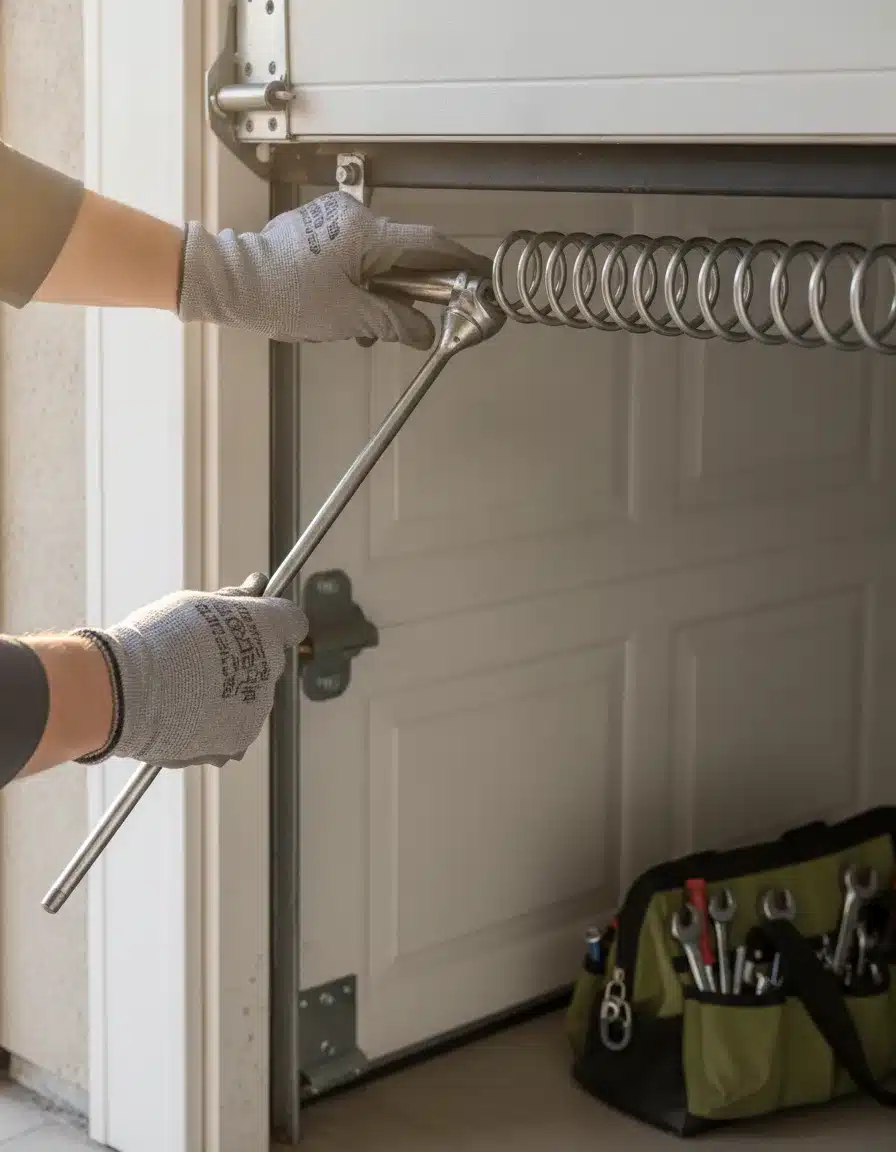
Your Google Business Profile is the single highest-leverage asset a local garage door company has online, and most of them are set up wrong. The most common errors I see: primary category set to “Home Improvement” instead of a specific garage door category, no services added, no photos posted in the last 90 days, a description with no city names, and a review response rate under 50%.
What categories should a garage door company use on Google Business Profile?
Your primary category should be “Garage Door Supplier” or “Garage Door Repair Service,” whichever matches your main revenue stream. Do not use “Contractor” or “Home Improvement” as your primary. Those are too broad and dilute your relevance for specific garage door searches. You can add secondary categories for related services, but the primary needs to be specific. That one change alone can move you in competitive markets within 30-60 days.
What should be in my Google Business Profile services section?
List every discrete service you offer: spring replacement, cable repair, opener installation, panel replacement, new door installation, emergency repair, commercial door service. Do not group them into one generic entry. Google uses the services list to match your profile to specific search queries. The more complete your list, the more searches you are eligible to appear for. Most profiles I audit have either no services listed or one vague entry.
How does the Q&A section on my profile affect rankings?
The Q&A section is a frequently ignored ranking signal. You can seed it yourself by adding the ten most common questions your customers ask, then answering each one. This adds keyword relevance to your profile in a natural format and genuinely helps potential customers before they even call. Questions like “Do you offer same-day spring replacement?” or “What brands of openers do you install?” are exactly the kind of content that lifts both relevance and conversion. Good Google My Business optimization covers this section as part of a complete profile setup.
Reviews: The Ranking Signal Most Owners Underestimate
Reviews are both a ranking signal and a conversion signal simultaneously. A profile with 91 reviews at 4.7 stars and a review posted three days ago will beat a profile with 42 reviews at 3.9 stars and a last review six weeks ago, every time in the 3-pack, in the same city, for the same services. That is not a close competition.
What is the fastest way to increase my Google review count?
Text the customer a direct review link within two hours of finishing the job. That single operational change roughly doubles review velocity in my experience. The timing matters. Within two hours, the job is fresh, the customer is satisfied, and they have their phone in their hand. Waiting until the end of the day, or sending an email two days later, cuts your response rate significantly. The message should be short: thank them, mention it helps the business, and include the direct link.
Does review recency matter as much as total review count?
Yes. A profile that earned 100 reviews over three years but has not gotten a new one in four months is losing ground to a competitor with 60 reviews but three in the last two weeks. Google weighs recency heavily because it signals that the business is still active and still satisfying customers. Review outreach is not a launch task you do for two months and then stop. It needs to be a permanent operational habit, the same way you send invoices or order parts.
How should I respond to negative reviews without hurting my ranking?
Respond to every review, positive and negative, within 24 hours. For negative reviews, acknowledge the issue specifically without being defensive, offer to make it right, and move the conversation offline with a phone number or email. Google sees your response rate and response time as engagement signals. Ignoring negative reviews is worse for your ranking and your conversion rate than responding professionally to them. A pattern of thoughtful responses to criticism actually builds trust with prospective customers reading your profile.
City Pages: Expanding Your Maps Footprint Beyond Your Address
City-specific landing pages are how a garage door company competes in suburbs 20-40 miles from their shop, where the proximity signal alone is not enough to get into the 3-pack. Each page targets one city or suburb, mentions the service clearly, uses the city name in the headline, the body copy, the meta title, and links back to your Google Business Profile naturally within the text.
How many city pages does a garage door company need to rank in the suburbs?
In my experience, eight to twelve city pages outranks competitors with zero city pages in those outer suburbs within four to six months. Start with the eight closest suburbs that generate meaningful search volume for garage door services. Each page should be genuinely unique, not a template with the city name swapped in. Write a paragraph with local specifics: mention landmarks, neighborhoods, or common housing types in that area. Google reads duplicate city pages as low-effort and ranks them accordingly.
What should each city page include to rank well in Maps?
Each city page needs: the target city name in the H1 headline, a unique introductory paragraph that references local context, a full services section with descriptions, a clear call to action with your phone number, your name-address-phone information in the footer consistent with your Google Business Profile, and an embedded Google Map. Internal links to your main services pages and a natural link back to your Google Business Profile help Google understand the geographic relationship between the page and your business location.
How long does it take for city pages to start generating calls?
For most garage door companies, city pages targeting suburbs with moderate competition start cracking the Maps results for those specific locations within four to six months of being indexed and with citations cleaned up. The pages that work fastest are the ones with the most specific local content and the cleanest site structure. Pages that are thin or templated take longer and sometimes never rank competitively. This is genuinely boring, time-consuming work, which is exactly why most competitors have not done it. That gap is your advantage.
The 12-Month Worked Example: What Progress Actually Looks Like
A realistic Maps SEO timeline for a garage door company in a mid-size metro looks like this: months one and two focus on foundation fixes, months three and four build geographic reach, months five and six produce the first measurable Maps traffic, and months seven through twelve build toward stable 3-pack position on primary terms.
What happens in months one and two of a Maps SEO campaign?
Month one through two is profile and citation work. Fix the Google Business Profile: correct categories, full services list, 35 or more real job photos, description updated with city names. Get the review request system running and send it to every job completed from that point forward. Clean up the local citations so your name, address, and phone number are spelled consistently across the top 40 directories. This work is mostly invisible to the outside world but it sets the foundation for everything that follows. Skipping it means the later work underperforms.
What does month five through nine look like in practice?
By months five and six, suburb-level searches start producing 3-pack appearances. The phone starts ringing from Maps for the first time, maybe eight to fifteen calls per month. By months seven through nine, you are appearing for your main city terms intermittently, reviews are at 60 or more and climbing, and calls from Maps hit 20-30 per month. This is also the point where, if you have been following up well on every call, you are starting to see that compounding effect of reputation plus ranking. If you want to make the most of those inbound calls, the process for converting phone calls to jobs matters as much as the ranking itself.
What does the end of month 12 look like and what does year two cost?
By months ten through twelve, a well-executed campaign produces stable 3-pack position for primary terms, 40 or more calls per month from Maps alone, and cost per lead under $50. Total Maps SEO investment over 12 months: around $12,000. Total leads from Maps in year one: roughly 100-120. In year two, the ranking holds, the cost per lead keeps dropping, and you have the option to layer Google Ads or Google Local Services Ads setup on top as an accelerant rather than a lifeline.
Common Mistakes That Stall Maps Results
The five most common mistakes that slow or stop Maps progress for garage door companies are inconsistent citations, ignoring the Q&A section, duplicate city page content, stopping review outreach after the first two months, and using stock photos instead of real job photos.
Why does inconsistent name-address-phone information hurt my ranking?
Google treats inconsistent citations as a trust signal problem. If your business name is spelled three different ways across 40 directories, or your old address is still listed on a dozen sites after you moved, Google has less confidence that the information is accurate. That lower confidence reduces your prominence score. Fix it early, before you build city pages or run any other content, because bad citation data can undermine everything built on top of it. The cleanup is a one-time project but it needs to be thorough.
Why do real job photos matter more than professional stock images?
Google Business Profile photos are a ranking signal and a conversion signal. Real photos of actual garage doors you installed or repaired, in real driveways in your service area, perform better on both dimensions. Stock photos contribute nothing to relevance and may actually signal low effort. Post four to eight new real job photos every single month. This is one of the simplest, lowest-cost actions on the entire list, and most profiles have not had a new photo posted in over 90 days.
What does stopping review outreach after two months actually cost me?
Review velocity matters to your ranking. Older reviews decay in influence over time. A business with 80 reviews but none in the last 60 days is effectively losing ground to a competitor with 45 reviews but five in the last two weeks. The customers you served in month eight, ten, and twelve of your campaign are just as capable of writing a review as the customers in month one. If your outreach stops, your velocity stops, and your ranking gradually softens. This is a permanent system, not a launch activity.
Frequently Asked Questions
How long does it take for a garage door company to rank in the Google Maps 3-pack?
Most garage door companies start appearing in the 3-pack for lower-competition suburb terms around months four through six, and for main city terms around months seven through twelve, assuming consistent work on the profile, citations, reviews, and city pages. Markets with fewer competitors can move faster. Dense metros with established competitors may take the full 12 months before you hold a stable primary position. There is no shortcut that reliably compresses this timeline without risking a penalty.
Should I run Google Ads and Maps SEO at the same time?
Running both at the same time makes sense in one scenario: you are brand new and need calls while SEO builds. In that case, keep the ad budget small, $200-$500 per month, and set a hard cut-off at month seven. For businesses that have been operating for more than a year, the more efficient path is to fund Maps SEO fully first, build the ranking asset, and then add ads as a seasonal accelerant once the organic foundation is generating leads at $20-$60 each.
What is the minimum monthly budget for Maps SEO for a garage door company?
In a smaller metro or low-competition market, $500 per month can move the needle if the work is focused. In a competitive mid-size city, $750-$1,000 per month is more realistic to cover profile optimization, citation management, review system setup, and city page content. In a major metro with strong competitors already established in the 3-pack, $1,200-$1,500 per month is the range where you can compete effectively within a 12-month window.
How many reviews does a garage door company need to rank in the 3-pack?
There is no fixed number, but in most markets, 60-100 reviews with a 4.5 or higher average and recent activity is enough to be competitive. The more important factor is the gap between you and your competitors. If the top three companies in your market all have 150 or more reviews, you need to close that gap. If they have 30-50, you can compete with a focused three-to-four month push. Audit your direct competitors’ review counts before setting a target.
Do Google Local Services Ads work better than regular Google Ads for garage door companies?
Google Local Services Ads can outperform regular search ads for garage door companies because you pay per lead rather than per click, and the “Google Guaranteed” badge increases call rates. They also appear above regular paid ads and the 3-pack in some queries. The trade-off is that you need a minimum number of reviews and must pass a background check to participate. Once your Maps SEO is established, Local Services Ads can be a strong addition for capturing demand above the organic results.
What is the biggest mistake garage door companies make with their Google Business Profile?
The most damaging single mistake is selecting a vague primary category like “Home Improvement” or “Contractor” instead of “Garage Door Supplier” or “Garage Door Repair Service.” That category error mutes your relevance signal for every specific garage door search. The second most damaging is not having a review request system that runs after every job. Both of those mistakes are fixable in under a week and produce visible ranking movement within 30-60 days of correction.
Can a garage door company rank in cities where they do not have a physical location?
Yes, with city-specific landing pages and consistent localized content. Proximity to the searcher is one of three Maps ranking factors, but relevance and prominence can compensate for it in suburbs where competitors have not done the content work. City pages that include genuine local specifics, clean citation signals pointing to your primary address, and a growing review count from customers in those areas all contribute to ranking beyond your immediate radius.
When should a garage door company add Google Ads on top of Maps SEO?
The right time to layer ads in is once your Maps presence is generating leads at $20-$60 each and your profile is converting reliably. At that point, ads become an accelerant during peak seasons or for targeting install keywords where the ticket size justifies higher click costs. Adding ads to a working organic foundation is fundamentally different from depending on ads before any organic presence exists. In the second scenario, ads amplify. In the first, they substitute for something you should have built instead.
Run the Audit on Your Profile Today, Then Build the Asset
Pull up your Google Business Profile right now and check four things. First, is your primary category “Garage Door Supplier” or “Garage Door Repair Service”? If it says anything else, change it today. Second, do you have a complete services section listing every service you offer, spring replacement, cable repair, opener installation, panel replacement, all of them? If not, fill it out this week. Third, when was your last review? If it has been more than two weeks, your review request system is not working. Fix the process before the end of this week. Fourth, search your primary keyword in your city right now. If you are not in the 3-pack, you know exactly what to build toward.
That audit takes ten minutes and shows you the gap clearly. Most garage door companies are closer than they think to cracking the 3-pack, or further than they realize and burning ad spend to cover the gap. Either way, knowing the actual number is better than guessing. If you want us to look at your specific profile and tell you exactly where you stand, reach out at https://pushleads.com/contact/ or call us at 828-348-7686. We will do a free visibility teardown and show you the gaps with real numbers, no pitch attached.
Keep Reading
Want more customers from Google & AI search?
Get a free SEO audit of your site — see exactly what to fix first.
Your path · Garage Door Company SEO
Keep going: read these next

- Up nextGarage Door Company Link Building: Local Citations and Industry Directories That Move Rankings
- Commercial Garage Door Marketing: How to Land Property Management and Warehouse Contracts Through SEO
- Garage Door Company SEO: The Complete Guide to Ranking for Emergency Repair and Installation Keywords



Want this done for you?
Scan your site. See the gaps. Decide with numbers.
- Rankings, Google Business Profile and site-speed teardown
- Report lands in your inbox in about a minute
- No obligation · 4.9 from 67 Google reviews
 Continue reading

