

Looking for IICRC training or certification? PushLeads is a marketing agency for restoration companies. We don’t offer IICRC classes or issue certifications. To get certified, start at iicrc.org.
Insurance carriers, property managers, and homeowners at 2 a.m. all ask the same question before they call your crew: are you certified? The right credentials determine whether State Farm’s Premier Service Program processes your vendor application, whether a property management company adds you to its list, and whether a homeowner signs a work authorization the night a pipe bursts. This page breaks down exactly which IICRC certifications move the needle, what they cost, and how to make them visible enough to drive inbound calls.
✓Is Your Company Ready to Win Carrier and Commercial Contracts?7 quick questions · about 1 minuteStart
Full transcript
0:00 From 0:00
In this video, we're going to walk you through the certifications that determine whether insurance carriers return your calls, whether property managers add you to their vendor lists, and whether homeowners sign a work authorization at two in the morning. If you run a restoration company and you're serious about growing revenue, understanding which credentials matter and how to leverage them is one of the highest return moves you can make. Let's get into it. I'm Jeremy Ashburn. I started PushLeads to do one thing well, turn searches into phone calls for local business owners. I spent nine years selling outcomes to business owners before I ever sold marketing. So I think in jobs booked, not impressions, what you're getting here is IICRC certifications and beyond, training programs that win more restoration contracts. The Institute of Inspection, Credentialing Body with over 60,000 certified technicians worldwide as of 2025. That number matters because it tells you this isn't a niche designation. It's the recognized standard that adjusters so property managers, young and homeowners have come to expect. When your technician walks onto a job site without it, they're walking in without the baseline credential the industry runs on. Why do certifications actually move the needle on revenue? Four reasons. First, carrier program access,
1:31 From 1:31
state farms premier service program, contractor connection, and accuser of all mandate minimum IICRC credentials before they'll even process a vendor application. Second, commercial vendor lists of property management companies require IICRC firm status as a standard entry requirement. Third, to a trust 72% of consumers check business credentials before hiring a service company, even when a pipe just burst in their basement. And fourth, certified companies close leads at rates 15 to 20% higher than non certified competitors. According to a 2025 service titan survey, the IICRC runs a two tier system and both tiers matter. Individual technicians earn certifications by completing approved courses and passing proctored exams. That's tier one. Tier two is IICRC certified firm status. Your company registers as a certified firm by employing at least one certified technician and paying an annual firm fee. Carriers and commercial property managers check both. They're not just looking at whether one tech on your crew is certified. They're looking at your company as a verified entity. Let's talk about the three credentials your crew absolutely cannot operate without. The water restoration technician certification, WRT, is the baseline. It's the most widely held restoration certification with over 35 ,000 active holders.
3:01 From 3:01
Every water damage tech needs it full stop. AMRT covers mold remediation and containment procedures and Florida, Texas and California have aligned their mold remediation licensing requirements closely with AMRT level training. Skip it and you've closed off an entire category of work and FSRT, the fire and smoke restoration technician credential is preferred or required by carriers that refer fire losses through TPA programs. Here's the full picture on the core IICRC credentials. WRT runs $350 to $600 and carries very high insurance program weight. AMRT and FSRT both run $400 to $650 and carry high weight. ASD applied structural drying goes deeper on drying science and psychometric calculations and carriers are increasingly recognizing it as a marker of technical depth. OCT covers odor control methods including hydroxyl generators and thermal fogging. HST handles health and safety planning for commercial bids where safety records get scrutinized. These six credentials cover the majority of residential and commercial restoration work your company will encounter. Now here's a designation most restoration owners don't talk about enough the IICRC master restore. Fewer than 2,000 technicians hold this designation nationally. Getting there requires WRT, FSRT, AMRT, ASD and additional coursework across multiple disciplines.
4:33 From 4:33
It's a multi -year investment but having a master restore on staff puts your company in a category most competitors simply can't reach. Carrier program managers notice, commercial property managers notice. It's not required anywhere but it's a differentiator that's almost impossible to commoditize. Let's talk real numbers so you can budget accurately. A technician pursuing the core three credential stack WRT, AMRT and FSRT will spend approximately $1,200 to $1,800 in course fees and add travel and lodging if training isn't available locally and that figure rises to $2,000 to $3,000 per technician total. Then factor in annual maintenance. The IICRC charges roughly $75 to $100 per active credential per year to keep certifications current. Let those labs and you can be disqualified from carrier programs mid -year. The certification process itself has four steps. First, find and approve training provider at ICRC, org and filter by credential, location and format. Never pay a provider not listed in the official directory. Non -approved courses don't result in IICRC certification regardless of what the marketing says. Second, register and complete the course which typically runs three to five days. Third, pass the written exam usually administered at the end of the course. Fourth, the provider submits your results to the IICRC and your credential appears
6:04 From 6:04
in the registry within a few business days. That's it. The process is straightforward. The key is starting it. Group training is where growing companies can significantly reduce the per -seat cost. If you send three or more technicians to the same course, many approved providers offer 10 to 15% off per seat. If you have eight or more technicians to certify at once, on -site delivery makes even more sense. Bring the provider to your facility, eliminate travel costs and schedule training around your call volume. Some providers also allow neighboring companies to share the delivery fee which drops your cost per seat further. Once you hit eight technicians to certify, get on -site delivery quotes before you book anything. Beyond IICRC, there are four specialty credentials worth serious consideration. The certified forensic operator certification covers fentanyl and methamphetamine contamination cleanup are in our magazine, identified forensic restoration as one of the fastest growing $50,000 or more. OSHA's 40 -hour haswoper is required for asbestos, lead, and chemical spill work. The EPA Lead Safe RRP certification is federally required for renovation work in homes built before 1978. If you do reconstruction, this is non -negotiable.
7:34 From 7:34
An exactimate level two and three proficiency, while not a formal certification, is increasingly recognized by carriers and helps estimators negotiate more effectively. This chart shows midpoint training costs for the six most common credentials. WRT and the specialty certifications like OCT are the most affordable entry points, AMRT and FSRT land in the middle range. The certified forensic operator training sits at the top end at roughly $2,250 at the midpoint. But remember, CFO certified technicians can access forensic clean -up jobs that average $5 ,000 to $50,000 or more per job. That's a revenue stream that simply doesn't exist for uncertified companies. The training cost becomes trivial relative to the first job it enables. How do IICRC credentials compare to the RICertified Restore designation? ICRC certifications are technical skill credentials required by most carrier programs available from entry level all the way to master restore and verifiable in a public registry. The RICertified Restore is a management and business acumen credential. It requires five years of industry experience and a comprehensive exam and it carries real weight and commercial and TPA circles where decision makers, not just adjusters, are evaluating your company. Most serious restoration companies need both tracks. ICRC for technician level credibility and the CR for management level commercial positioning, commercial property managers,
9:04 From 9:04
HOA management firms and facilities managers check credentials more carefully than most homeowners do. When you pitch a property management company, one credential sheet won't close the deal but not having one will lose it immediately. Bring a one -page document listing your IICRC firm status, each technician certifications, your insurance certificates, and any specialty credentials relevant to their portfolio, led say for older buildings, has woper for facilities with chemical storage areas. That document alone separates you from most competitors who show up with a business card and a price. And if your text can pull up drawing logs and certification records from a mobile device in the field, you look like a different category of company, three numbers that connect training investment directly to business performance. Certified service companies close leads at 15 to 20% higher rates than non -certified competitors. Companies that invest in average of $1 ,500 or more per employee annually in training report 24% higher profit margins than those that invest less, according to the Association for Talent Development in 2025. And for CFO certified technicians, individual forensic cleanup jobs can reach $50,000 or more work that is completely unavailable without the certification. The credential is the revenue. Here's how to think about building your training investment over time. Year one, spend $3,000 to $5 ,000 getting primary technicians
10:35 From 10:35
WRT certified. Add AMRT if you offer mold services. These are the table stakes credentials for any TPA or carrier program application. Year two, budget $5,000 to $8,000. Add FSRT for loss technicians. Send your lead estimator to exactimate level two training and start your most experienced tech on the master restore track. Year three, spend $5,000 to $10 ,000 pursuing specialty credentials that match your growth strategy. Then plan for $2,000 to $4,000 annually ongoing to maintain certifications. The IICRC requires 14 continuing education credits per year. And lapsed credentials can pull you from carrier programs at the worst possible time. Earning certifications is half the battle. The other half is making sure prospective clients and referral partners actually see them. Create a dedicated credentials page on your website listing every credential with IICRC logos, certification numbers, and plain language explanations of what each means for the homeowner. Then apply schema .org certification structure data markup to that page. Google can read and display your credentials and search results, which directly supports the experience, expertise, authoritativeness, and trustworthiness signals the search engine uses to rank service pages. Add your IICRC firm registration number to your Google Business Profile, your website footer, and every estimate. Display the IICRC logo on trucks and uniforms.
12:08 From 12:08
Every job site visit is a marketing opportunity for the neighbors watching from their windows. Here's the way one industry analysis put it. Carriers view certifications as risk reduction. A certified crew follows documented protocols, which reduces claim disputes and reduces callbacks. And that matters to an adjuster as much as your price does. When you apply to a carrier program or TPA network, your certifications tell the program manager that working with your company is lower risk than working with a competitor whose methods are undocumented. That's the framing that gets you into programs worth billions in annual restoration referrals. A few quick answers to the questions restoration owners search most often. How long does WRT take? Three to four days plus the exam hybrid options compress the in -person commitment to a single exam day. Our IICRC certifications legally required, not federally, but Florida, just Texas, and California, a line mold remediation licensing closely with AMRT level training. Check your state contractor licensing board before assuming you're covered. Can you get certified online? Yes, for select credentials, WRT and FSRT have hybrid options, but ASD and hands -on credentials still require in -person components. And do you need all state and major TPA networks require it or give
Start with the full SEO for restoration companies guide if you are new to the topic.
13:38 From 13:38
strong preference. And the annual fee is only $150 to $200. 72% of consumers check credentials before hiring. Google's quality radar guidelines weight experience, expertise, authoritativeness, and trustworthiness heavily for service pages. And BrightLocal data shows businesses with verifiable credentials mentioned in their videos without. That means every certification your company has earned needs to be visible in search results on your profile, in your reviews, and on your website, not just on a wall certificate in your office. Visibility and credentials work together. One without the other leaves revenue on the table. PushLeads work specifically with restoration companies to turn credentials, reviews, and service pages into search visibility that drives inbound calls from carriers, property managers, and homeowners who find you before they find anyone else. To see exactly where your certifications, your Google Business Profile, and your local citations stand against your top competitors, get a free restoration visibility teardown, get the link in the description, or call 828 -348 -748 -7686.
Why IICRC Certifications Directly Affect Revenue
Want it done for you? See our restoration SEO and marketing agency.
The IICRC — the Institute of Inspection, Cleaning and Restoration Certification — has over 60,000 certified technicians worldwide as of 2025. Adjusters, property managers, and homeowners treat it as the baseline standard. Walking onto a job without it means walking in behind competitors who do have it.
In this video
- 0:00 Two Credential Buckets Every Owner Needs
- 0:38 Framework Legal vs Credibility Credentials
- 1:25 OSHA Bloodborne Pathogens Standard Explained
- 2:31 HAZWOPER and Hazardous Waste Operations
- 3:15 DOT EPA Waste Transport Compliance
- 4:11 State Contractor Licensing Requirements
- 4:53 IICRC and ABRA Certifications That Win Jobs
- 7:20 What Each Buyer Type Actually Checks
- 8:14 Revenue Math on Institutional Calls
- 9:19 Common Credentialing Mistakes to Avoid
- 10:20 What to List on Your Website and Proposals
- 11:05 How Certifications Connect to Your SEO
Full transcript: What certifications does a biohazard cleanup company actually need?
Four reasons certifications translate to booked jobs:
- Carrier program access. State Farm's Premier Service Program, Contractor Connection, and Alacrity all mandate minimum IICRC credentials before processing a vendor application.
- Commercial vendor lists. Property management companies require IICRC firm status as a standard entry requirement, not a nice-to-have.
- Consumer trust. 72% of consumers check business credentials before hiring a service company, even when a pipe just burst in their basement.
- Close rates. Certified companies close leads at 15 to 20% higher rates than non-certified competitors, according to a 2025 ServiceTitan survey.
The IICRC runs a two-tier system. Individual technicians earn certifications by completing approved courses and passing proctored exams. Your company earns IICRC certified firm status by employing at least one certified technician and paying an annual firm fee of $150 to $200. Carriers and commercial property managers check both tiers. They want to see your company registered as a verified entity, not just confirm that one tech on your crew passed a class.
The Core IICRC Credentials and What Each One Unlocks
Six credentials cover the majority of residential and commercial restoration work. Three are non-negotiable for any crew operating today.
- WRT — Water Restoration Technician. The baseline credential with over 35,000 active holders. Every water damage tech needs it. Course fees run $350 to $600. Takes three to four days plus the exam.
- AMRT — Applied Microbial Remediation Technician. Covers mold remediation and containment. Florida, Texas, and California have aligned their mold remediation licensing requirements closely with AMRT-level training. Skip it and you close off an entire category of work. Course fees run $400 to $650.
- FSRT — Fire and Smoke Restoration Technician. Preferred or required by carriers that refer fire losses through TPA programs. Course fees run $400 to $650.
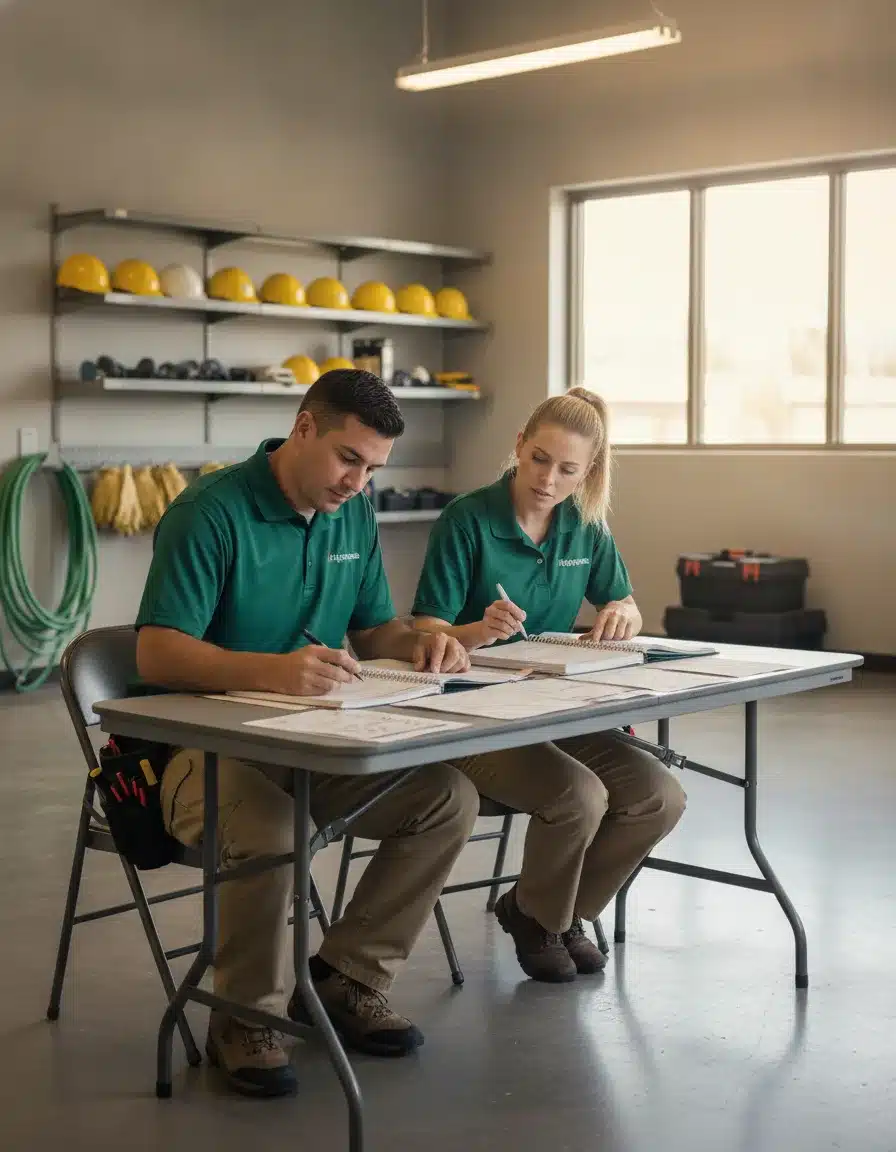
Three additional credentials that add technical depth and open commercial bids:
- ASD — Applied Structural Drying. Goes deeper on drying science and psychrometric calculations. Carriers are increasingly recognizing it as a marker of technical depth.
- OCT — Odor Control Technician. Covers hydroxyl generators and thermal fogging.
- HST — Health and Safety Technician. Handles safety planning for commercial bids where safety records get scrutinized before you're awarded work.
A technician pursuing WRT, AMRT, and FSRT will spend $1,200 to $1,800 in course fees. Add travel and lodging if training isn't available locally and the total rises to $2,000 to $3,000 per technician. Annual maintenance runs $75 to $100 per active credential per year. Let credentials lapse and carriers can disqualify your company from programs mid-year.
Fewer than 2,000 technicians nationally hold the IICRC Master Restorer designation. Reaching it requires WRT, FSRT, AMRT, ASD, and additional coursework across multiple disciplines. It's a multi-year investment, but having a Master Restorer on staff puts your company in a category most competitors can't reach. It is not required anywhere, but it is nearly impossible to commoditize.

Want more customers from Google & AI search?
Get a free SEO audit of your site — see exactly what to fix first.
Specialty Credentials That Open High-Value Revenue Streams
Four credentials outside the IICRC core deserve serious consideration based on revenue potential alone.
- Certified Forensic Operator (CFO). Covers fentanyl and methamphetamine contamination cleanup. Individual jobs average $5,000 to $50,000 or more. R&R Magazine identified forensic restoration as one of the fastest-growing service categories. Training costs roughly $2,250 at the midpoint. That cost becomes trivial relative to the first job it enables.
- OSHA 40-Hour HAZWOPER. Required for asbestos, lead, and chemical spill work. Without it, this category of job is unavailable to your crew entirely.
- EPA Lead-Safe RRP. Federally required for renovation work in homes built before 1978. If you do reconstruction, this is non-negotiable.
- Xactimate Level 2 and Level 3 Proficiency. Not a formal certification, but increasingly recognized by carriers. Estimators with this proficiency negotiate more effectively and reduce claim disputes.
The Certified Restorer (CR) designation is also worth separating from the IICRC track. It's a management and business acumen credential requiring five years of industry experience and a comprehensive exam. It carries real weight with commercial and TPA decision makers — not just adjusters — who are evaluating your company at an organizational level. Most serious restoration companies need both tracks: IICRC for technician-level credibility and the CR for management-level commercial positioning.
How to Get Certified and Reduce the Per-Seat Cost
The certification process has four steps. Find an approved training provider at IICRC.org and filter by credential, location, and format. Never pay a provider not listed in the official directory — non-approved courses don't result in IICRC certification regardless of what the marketing says. Register and complete the course, which typically runs three to five days. Pass the written exam, usually administered at the end of the course. The provider submits results to the IICRC and your credential appears in the registry within a few business days.
Group training cuts per-seat costs significantly. Send three or more technicians to the same course and many approved providers offer 10 to 15% off per seat. At eight or more technicians, on-site delivery makes more sense. Bring the provider to your facility, eliminate travel costs, and schedule training around your call volume. Some providers allow neighboring companies to share the delivery fee, which drops cost per seat further. Once you have eight technicians to certify, get on-site delivery quotes before booking anything.
A practical investment schedule for growing companies:
- Year one: $3,000 to $5,000. Get primary technicians WRT certified. Add AMRT if you offer mold services. These are the table-stakes credentials for any TPA or carrier program application.
- Year two: $5,000 to $8,000. Add FSRT for fire loss technicians. Send your lead estimator to Xactimate Level 2 training. Start your most experienced tech on the Master Restorer track.
- Year three: $5,000 to $10,000. Pursue specialty credentials that match your growth strategy — CFO, HAZWOPER, Lead-Safe RRP.
- Ongoing: $2,000 to $4,000 annually. The IICRC requires 14 continuing education credits per year. Lapsed credentials can pull you from carrier programs at the worst possible time.
Making Certifications Visible in Search Results and on Job Sites
Earning certifications is half the work. The other half is making sure prospective clients and referral partners see them. Companies that invest $1,500 or more per employee annually in training report 24% higher profit margins than those that invest less, according to the Association for Talent Development in 2025. That margin improvement only materializes if the credentials are generating leads and closing deals — which requires visibility.

Build a dedicated credentials page on your website listing every credential with IICRC logos, certification numbers, and plain-language explanations of what each means for the homeowner. Apply schema.org certification structured data markup to that page. Google can read and display your credentials in search results, which directly supports the E-E-A-T signals — experience, expertise, authoritativeness, and trustworthiness — that the search engine uses to rank service pages. Add your IICRC firm registration number to your Google Business Profile, your website footer, and every estimate. Display the IICRC logo on trucks and uniforms. BrightLocal data shows businesses with verifiable credentials mentioned in their profiles and on their websites convert at meaningfully higher rates than those without.
When pitching commercial property managers and HOA management firms, bring a one-page document listing your IICRC firm status, each technician's certifications, your insurance certificates, and specialty credentials relevant to their portfolio — Lead-Safe RRP for older buildings, HAZWOPER for facilities with chemical storage. That document alone separates you from competitors who show up with a business card and a price. If your techs can pull up drying logs and certification records from a mobile device in the field, you look like a different category of company entirely.

PushLeads works specifically with restoration companies to turn credentials, reviews, and service pages into search visibility that drives inbound calls from carriers, property managers, and homeowners. To see exactly where your certifications, Google Business Profile, and local citations stand against your top competitors, get a free restoration visibility teardown at pushleads.com or call 828-348-7686.
Want more customers from Google & AI search?
Get a free SEO audit of your site — see exactly what to fix first.
Your path · Restoration Company SEO
Keep going: read these next
 You’re hereIICRC Certifications for Restoration Companies: Win More Contracts


Want this done for you?
Scan your site. See the gaps. Decide with numbers.
- Rankings, Google Business Profile and site-speed teardown
- Report lands in your inbox in about a minute
- No obligation · 4.9 from 67 Google reviews

