
Restoration Leads: Fill Your Pipeline Year-Round
Restoration leads are inquiries from property owners or insurance professionals who need water, fire, mold, or storm damage services right now. The contractors who win consistently treat lead generation as a system, combining local SEO, insurance relationships, and fast follow-up to build a predictable pipeline year-round.
0:00 Restoration Leads: Fill Your Pipeline Year-Round
0:24 Who this is for
0:40 The Myth vs. The Reality
1:08 Urgency Changes Everything
1:34 Four Lead Categories, Four Different Journeys
2:03 Where Restoration Leads Actually Come From
2:41 Three Pillars of Local SEO Rankings
3:28 Pay-Per-Call vs. Pay-Per-Lead
3:57 Channel Cost vs. Conversion Reality
4:47 The Response Window That Kills Most Leads
5:20 What Insurance Adjusters Actually Want
6:00 The Documentation Standard That Wins Referrals
6:26 Storm Surge: Prepare Before the Season
7:08 Build a Follow-Up System That Actually Works
7:49 Restoration Lead Channel Comparison
8:35 Your Pipeline Doesn’t Have to Be Unpredictable
Full transcript
0:00 Restoration Leads: Fill Your Pipeline Year-Round
If your restoration company swings from slammed to silent with no warning, you’re not alone — but you’re not stuck. We’re breaking down the myth that restoration leads are unpredictable and replacing it with the system consistently full-pipeline contractors actually use: local SEO, insurance relationships, follow-up speed, and the real numbers behind what converts.
0:40 The Myth vs. The Reality
The belief holding most restoration companies back: leads are unpredictable. Wait for a storm, hope the phone rings, run ads when things slow down. The reality is the opposite. Contractors who dominate their markets have systems — not luck. Organic search, referral networks, and fast follow-up compound month after month. A well-optimized local company outranks national franchises in Maps results all the time.
1:08 Urgency Changes Everything
Ninety-eight percent of people used the internet to find local businesses in twenty twenty-three, per BrightLocal. Emergency service searches sit at the top of search-to-call rates across every category. A homeowner with three inches of standing water isn’t comparing options — they call the first credible contractor they find. If you aren’t showing up fast and looking trustworthy, someone else gets that job. Your system has to be always on.
1:34 Four Lead Categories, Four Different Journeys
One of the most expensive mistakes restoration companies make is treating every lead the same. There are four distinct categories, each with a different buyer, referral source, and follow-up requirement. Emergency residential calls are urgency-driven. Insurance claims work is adjuster-driven and documentation-heavy. Commercial damage involves property managers and longer decisions. Mold remediation comes from research-stage buyers who found you through content. Build your system around all four.
2:03 Where Restoration Leads Actually Come From
Where do restoration leads actually come from? Google search and Maps account for the majority of emergency searches — when a pipe bursts at midnight, homeowners type water damage restoration near me. More than twenty percent of flood insurance claims come from properties outside high-risk zones, per FEMA, so local visibility matters in every market. Insurance adjuster referrals represent forty to seventy percent of total revenue for established companies. One property manager relationship covering two hundred units generates recurring work for years without touching a lead marketplace.
2:41 Three Pillars of Local SEO Rankings
Local SEO is the engine behind organic restoration leads. Three pillars drive rankings. First, your Google Business Profile — select Water Damage Restoration Service as your primary category, post weekly, and build toward fifty-plus reviews at four-point-five stars. Second, service-specific pages matching exact buyer searches: a page titled basement flood cleanup Asheville pulls different traffic than a generic restoration services page. Third, consistent citations and schema markup for each damage type. Companies publishing ten to twenty targeted pages in the first ninety days routinely outrank competitors with static five-page sites and see meaningful lead increases within four to six months.
3:28 Pay-Per-Call vs. Pay-Per-Lead
Pay-per-call versus pay-per-lead form fills: the data is clear. Pay-per-call water damage leads convert at thirty to fifty percent. Form fill leads convert at five to fifteen percent — a two-to-five times difference. In a category driven by urgency, being in the conversation at the moment the decision gets made is an enormous advantage. Pay-per-lead can still work, but only if your follow-up system responds within five minutes, which most restoration companies simply don’t have.
3:57 Channel Cost vs. Conversion Reality
How channels compare on cost and conversion: Google Local Services Ads run fifty to one hundred fifty dollars per lead, converting at twenty-five to forty percent — solid, but they stop when budgets stop. Pay-per-call networks run seventy-five to two hundred dollars per call at thirty to fifty percent conversion. Organic SEO runs near-zero marginal cost once rankings are established, converting at fifteen to thirty percent, built over four to six months. Lead aggregators cost twenty to eighty dollars per lead but convert at five to fifteen percent on shared contacts. Insurance adjuster referrals convert at sixty to eighty percent. Property manager referrals at fifty-five to seventy-five percent. Those two channels are the long-term anchors of a stable pipeline.
4:47 The Response Window That Kills Most Leads
Most restoration companies generate more leads than they realize — they’re just losing them. The number one reason is slow response time. Harvard Business Review found companies responding within one hour were seven times more likely to qualify a lead. In restoration, that window is even shorter. Companies lose up to fifty percent of inbound leads simply by responding too slowly. A homeowner calls at ten PM, gets voicemail, and dials the next number within sixty seconds. The fix: an answering service for after-hours calls and an automated text within two minutes of any form fill.
5:20 What Insurance Adjusters Actually Want
Insurance adjuster referrals convert at sixty to eighty percent — the highest rate of any channel. Adjusters want three things: speed, documentation, and clear communication through the claims process. An adjuster managing dozens of open claims remembers the partner who showed up fast, photographed everything, provided moisture mapping and equipment logs, and communicated clearly. IICRC certifications are a baseline requirement: Water Damage Restoration Technician for water jobs, Applied Microbial Remediation Technician for mold, Fire and Smoke Restoration Technician for fire work — credentials that signal you belong on a preferred vendor list.
6:00 The Documentation Standard That Wins Referrals
The IICRC’s guidance on S-five hundred water damage standards puts it plainly: proper documentation from the start of a claim — including moisture mapping and equipment logs — is what separates contractors who get paid smoothly from those who face disputes. The best marketing in the world brings a lead to your door. Performance on the job turns one adjuster relationship into a referral stream that compounds for years.
6:26 Storm Surge: Prepare Before the Season
Storm events are a category unto themselves. A major weather event can spike inquiry volume five hundred percent or more in twenty-four to forty-eight hours. Most restoration companies aren’t ready. The ones who are can generate more revenue in two weeks than in a slow quarter. Preparation happens before storm season: update your Google Business Profile with storm-specific keywords, have overflow phone coverage ready, and pre-load ad campaigns to activate in affected zip codes the moment a storm hits. Mold begins growing within twenty-four to forty-eight hours of water exposure, per EPA guidance — the urgency for homeowners is real and immediate.
7:08 Build a Follow-Up System That Actually Works
A working follow-up system has six components: an after-hours answering service so midnight calls don’t go to voicemail; an automated text within two minutes of any form fill; a five-touch follow-up sequence over seventy-two hours adding value at every step; four core metrics tracked by damage type — cost per lead, response time in minutes, lead-to-estimate rate, and estimate-to-close rate; call tracking through a platform like CallRail; and a target of fifty-plus reviews at four-point-five stars, because seventy-nine percent of consumers trust online reviews as much as personal recommendations. Six old reviews from four years ago will cost you jobs.
7:49 Restoration Lead Channel Comparison
The full channel picture: Google Local Services Ads and pay-per-call generate leads in days but stop when spending stops — medium long-term value. Organic SEO takes four to six months but compounds to near-zero marginal cost — the highest long-term value channel you can build. Aggregators deliver immediate leads at the lowest cost but convert at five to fifteen percent on shared contacts — low long-term value. Insurance adjuster and property manager referrals convert at sixty to eighty percent and fifty-five to seventy-five percent respectively, take three to twelve months to build, and deliver the highest long-term pipeline value. The goal: sixty to seventy percent of leads from organic sources within eighteen to twenty-four months of structured SEO investment.
8:35 Your Pipeline Doesn’t Have to Be Unpredictable
The contractors who fill their schedules consistently aren’t lucky. They’ve built systems that generate leads from multiple channels at once, convert those leads faster than their competitors, and keep referral relationships warm year-round. If your biggest gap is local search visibility, faster lead response, or insurance adjuster relationships, every piece of this system can be measured and improved. See exactly where your visibility stands today with a free restoration audit at seo dot pushleads dot com slash audit — link in the description, or call eight two eight, three four eight, seven six eight six.

Key Takeaways
Want it done for you? See our restoration SEO and marketing agency.
Restoration leads are the lifeblood of any water, fire, or storm damage company. The contractors who win consistently treat lead generation as a system, not a lucky break. By combining local SEO, insurance relationships, and smart follow-up, restoration companies can build a predictable pipeline without depending entirely on paid ads.
- Most restoration leads come from Google search, insurance adjuster referrals, and storm-triggered demand spikes, so you need systems for all three.
- Pay-per-call leads typically convert at 2 to 5 times the rate of pay-per-lead form fills because the prospect is already on the phone.
- Restoration companies lose up to 50% of inbound leads simply by responding too slowly, with the first 5 minutes being critical.
- Local SEO and Google Business Profile optimization can generate organic restoration leads at near-zero marginal cost over time.
- Building relationships with insurance adjusters and property managers creates referral streams that compound month after month.
What Restoration Leads Actually Are and Why They’re So Hard to Get
Restoration leads are inquiries from property owners, property managers, or insurance professionals who need water damage, fire damage, mold, or storm damage services right now. Unlike most service businesses, restoration is driven by urgency. A homeowner with three inches of standing water in their basement is not browsing options for three weeks. They call the first credible contractor they find, and if you’re not showing up fast, someone else is getting that job.
That urgency is a double-edged reality. It means conversion rates can be extremely high when you reach the right person at the right moment. But it also means your lead generation system has to be always on. According to BrightLocal’s local consumer research, 98% of people used the internet to find information about local businesses in 2023, and service businesses with emergency needs see some of the highest search-to-call rates of any category.
The restoration industry is fragmented. You have national franchises, regional independents, and one-truck operators all competing for the same calls. The companies that win over the long haul are not always the biggest. They’re the ones with the most consistent lead generation systems. PushLeads has worked with service contractors across the Asheville, NC region and has seen firsthand how a structured approach to digital visibility can shift a restoration company’s pipeline from feast-and-famine to steady and scalable.
For restoration contractors, the categories of leads break down roughly like this: emergency residential calls (water, fire, sewage), insurance-driven claims work, commercial property damage, and mold remediation. Each category has a different buyer journey, a different referral source, and a different follow-up requirement. Treating them all the same is one of the most common and costly mistakes restoration companies make.
Want more customers from Google & AI search?
Get a free SEO audit of your site — see exactly what to fix first.
The Biggest Sources of Restoration Leads in 2025
Understanding where your leads actually come from is step one. There’s no universal answer, but data from across the industry points to several consistent high-volume channels that restoration contractors should be actively working.
Is Google still the most important channel for restoration leads?
Yes, by a significant margin. Google search and Google Maps together account for the majority of emergency service searches. When a pipe bursts at midnight, the homeowner opens Google and types “water damage restoration near me” or “emergency flood cleanup.” According to FEMA’s flood risk data, more than 20% of flood insurance claims come from properties outside high-risk zones, meaning flood restoration leads and water damage restoration leads surface in every market, not just obvious flood areas. That broad geographic spread means local search visibility matters enormously for mid-sized cities and rural markets alike.
Your Google Business Profile is your most important digital asset for capturing these searches. It needs to be fully filled out, actively managed with recent photos and posts, and loaded with genuine reviews. Companies with 50-plus reviews and a 4.5-star average get dramatically more calls than competitors with thin profiles.
In this video
Start with the full SEO for restoration companies guide if you are new to the topic.
- 0:00 LSA Cost Range for Contractors
- 0:36 Pay Per Lead Not Per Click
- 1:28 Your Cost Depends on Three Factors
- 2:08 Google Guaranteed Badge Placement Impact
- 2:43 How LSA Bidding Works in 2025
- 3:46 Speed to Lead Kills or Converts
- 4:35 Three Numbers You Must Know
- 5:28 Real HVAC Contractor Example
- 6:52 Four Mistakes That Burn Budget
- 9:01 Starting Budget Framework
- 9:53 Habits of High-Performing LSA Contractors
Google Local Services Ads for Contractors: Setup, Cost & Optimization (full transcript)
Do insurance referrals still drive real volume for restoration companies?
Absolutely. Insurance restoration leads can represent 40 to 70% of total revenue for established restoration companies. The referral chain typically runs from homeowner to insurance adjuster to preferred vendor list to restoration contractor. Getting onto adjuster preferred lists, building relationships with independent agents, and staying visible to claims departments is a long-term play, but it pays consistently once you’re in. Fire damage restoration leads and water damage restoration leads both run heavily through this channel because most residential losses trigger a claim.
What role do property managers play in steady restoration lead flow?
Property managers are an underrated referral source. A single property management company overseeing 50 to 200 units will need restoration work multiple times a year. Showing up with a clear vendor packet, liability documentation, and a fast response commitment can lock in a relationship that generates recurring work for years. This is relationship-based selling, not digital marketing, but it compounds over time and produces direct restoration leads that never touch a lead marketplace.

Local SEO: The Engine Behind Organic Restoration Leads
Paid ads can generate restoration leads quickly, but organic local SEO generates leads at a much lower long-term cost. According to BrightLocal’s annual industry survey, local SEO consistently ranks as one of the highest-ROI marketing channels for service businesses. For restoration contractors, organic search visibility means showing up in the Google Map Pack and on page one of local results without paying per click.
What does a restoration company need to rank locally?
Three pillars drive local rankings: your Google Business Profile, on-page content on your website, and local citations. Your GBP needs complete categories (select “Water Damage Restoration Service” as primary), consistent NAP information, and weekly activity. Your website needs service pages that match the specific searches buyers use, like “basement flood cleanup Asheville” rather than just “restoration services.” Citations mean your business name, address, and phone number appearing consistently across directories like Yelp, Angi, and industry-specific platforms.
Schema.org’s LocalBusiness markup helps Google connect your website to your service area and damage-type keywords. Adding structured data for each service type (water damage, fire damage, mold) signals relevance to Google for those specific searches.
For a deeper look at how local SEO for contractors works as a full system, that resource breaks down the technical and content pieces in detail.
How long does it take for local SEO to generate restoration leads?
Most restoration companies see meaningful organic lead increases within 4 to 6 months of consistent effort. Publishing content that targets specific damage types, service areas, and homeowner questions accelerates this timeline. A company that publishes 10 to 20 targeted pages and blog posts in the first 90 days will outrank a competitor with a static 5-page site, almost every time.
Pay Per Call vs. Pay Per Lead: Which Works Better for Restoration?
This is one of the most practical questions restoration contractors ask when they’re ready to invest in paid lead generation. The difference is significant, and the right answer depends on your team’s ability to handle volume and convert inquiries quickly.
What is pay per call and why do restoration companies prefer it?
Pay-per-call means you pay for an inbound phone call from a potential customer, usually one that meets a minimum duration (often 60 to 90 seconds). Because the prospect is already on the phone when you receive the lead, conversion rates are dramatically higher than form fills. Industry estimates suggest pay-per-call water damage restoration leads convert at 30 to 50%, compared to 5 to 15% for typical pay-per-lead form submissions. For restoration, where urgency drives decisions, being on the phone is a massive advantage.
When does pay per lead make sense for restoration contractors?
Pay-per-lead models, where you buy a name and contact form submission, work best when you have a structured follow-up system in place. If you can respond within 5 minutes of a form fill, you can still win a meaningful percentage of those leads. The problem is that most restoration companies don’t have that system. Research from the Harvard Business Review found that companies responding within an hour were 7 times more likely to qualify a lead than those responding even an hour later. In the restoration world, that window is even shorter.
Are restoration lead aggregators worth the cost?
Platforms like HomeAdvisor, Angi, and Thumbtack can generate volume, but the leads are usually sold to multiple contractors simultaneously. You’re racing other companies to the same phone number. The economics can work if your close rate and average job value are high enough, but many restoration contractors find that investing the same dollars in owned assets like SEO and their own Google ads produces better long-term returns.
| Channel | Typical Cost Per Lead | Conversion Rate | Time to First Lead | Long-Term Value |
|---|---|---|---|---|
| Google Local Services Ads | $50–$150 | 25–40% | Days | Medium. Stops when budget stops. |
| Pay-Per-Call Networks | $75–$200 | 30–50% | Days | Medium. Volume depends on spend. |
| Organic Local SEO | Near $0 marginal | 15–30% | 4–6 months | High. Compounds over time. |
| Lead Aggregators (Angi, etc.) | $20–$80 | 5–15% | Immediate | Low. Shared leads, price competition. |
| Insurance Adjuster Referrals | Relationship time | 60–80% | 3–12 months | Very high. Recurring, trusted source. |
| Property Manager Referrals | Relationship time | 55–75% | 3–9 months | Very high. Multi-unit repeat work. |
How Insurance Adjuster Relationships Drive Consistent Referrals
The restoration contractors who build the most stable, recession-resistant businesses are the ones who invest in insurance relationships. This is not a quick win. It takes months to build and years to fully capitalize on. But the payoff is referral streams that don’t depend on ad budgets or algorithm changes.
How do you get on an insurance adjuster’s preferred vendor list?
Start with introductions. Attend local insurance industry events, reach out to independent agents in your area, and ask for introductions to claims adjusters. When you meet with them, lead with documentation: your licensing, your IICRC certifications, your liability coverage, and your average response time. According to IICRC certification standards, trained and certified technicians are a baseline expectation for any serious restoration company working insurance claims. Having those credentials documented and ready signals professionalism. Fire restoration leads and water damage restoration leads that run through insurance adjusters go to the vendors those adjusters trust most.
What do adjusters actually want from restoration partners?
Speed, documentation, and communication. Adjusters are managing dozens of claims at a time. A restoration partner who shows up fast, documents the damage thoroughly with photos and moisture readings, and communicates clearly through the claims process makes the adjuster’s job easier. That experience is what gets you referred again. It has nothing to do with your website or your ads. It’s performance-based relationship building.
“Proper documentation from the start of a claim, including moisture mapping and equipment logs, is what separates contractors who get paid smoothly from those who face disputes,” notes the IICRC’s guidance on S500 water damage standards.
Fire Damage and Water Damage Leads: Key Differences
Fire damage restoration leads and water damage restoration leads both come through Google search and insurance channels, but they behave differently and need separate strategies.
Why are fire damage restoration leads different from water damage leads?
Fire damage jobs are typically larger, more complex, and involve longer insurance claim timelines. A homeowner searching “fire damage restoration” right after a house fire is in a different emotional state than someone with a flooded basement. They’re often displaced and overwhelmed. The contractor who arrives quickly, explains the process calmly, and coordinates directly with the adjuster wins the job. Average fire restoration jobs run significantly higher than water jobs, so fire damage restoration leads carry a higher revenue value per conversion.
Water damage restoration leads, including flood restoration leads, are more time-sensitive. Mold growth begins within 24 to 48 hours of water exposure, according to the EPA’s mold guidance. Homeowners know this, which means the urgency is immediate and response time is your biggest competitive edge.
Should fire and water restoration be marketed separately on your website?
Yes. Separate service pages for fire damage restoration and water damage restoration let you target each keyword cluster precisely. A page titled “Fire Damage Restoration in [City]” ranks for fire-specific queries. A page titled “Water Damage and Flood Cleanup in [City]” captures flood restoration leads and water restoration leads. Combining them into one generic “restoration services” page dilutes both. Google rewards specificity, and so do buyers who want to confirm you handle their exact problem.
Converting Storm Damage Inquiries Into Booked Jobs
Storm events are a category of their own. When a major weather event hits your market, inquiry volume can spike 500% or more in 24 to 48 hours. Most restoration companies are not set up to capture and convert that volume. The ones who are can generate more revenue in two weeks than they do in a slow quarter.
How do you prepare your lead system for storm surges?
Before a storm season, make sure your phone system can handle overflow, your response scripts are ready, and your Google Business Profile and website are updated with storm damage keywords. After a major event, update your GBP post, run targeted Google Local Services Ads in affected ZIP codes, and make sure your team can answer and follow up within minutes. According to Insurance Information Institute data, wind and hail claims represent a massive share of homeowner insurance losses annually, meaning storm lead volume is predictable at a seasonal level even if the timing of specific events is not.
What’s the fastest way to turn a storm inquiry into a signed job?
Answer the phone, show up the same day, and bring a camera and a moisture meter. Homeowners in the immediate aftermath of damage are anxious and confused. The contractor who arrives quickly, explains the process clearly, and gives a written scope within 24 hours wins the job. Have your authorization forms ready on a tablet. Many experienced restoration salespeople close on the first visit by walking the homeowner through what the insurance process looks like and removing uncertainty.
Why Restoration Companies Lose Leads and How to Fix It
Here’s the uncomfortable truth: most restoration companies are generating more leads than they realize. They’re just losing them before those leads ever become jobs. The problem is almost never the marketing. It’s what happens after the lead comes in.
What are the top reasons restoration leads don’t convert?
Slow response time is number one. If a homeowner calls and gets voicemail at 10 PM on a Tuesday, they’re calling the next number within 60 seconds. Lack of a clear follow-up sequence is number two. Most companies make one call back and then let the lead go cold. Absence of reviews and social proof is number three. A homeowner checking out your company while they wait for a callback will look at your Google reviews. If they see 6 reviews from 4 years ago, doubt creeps in. According to BrightLocal’s consumer research, 79% of consumers say they trust online reviews as much as personal recommendations from people they know.
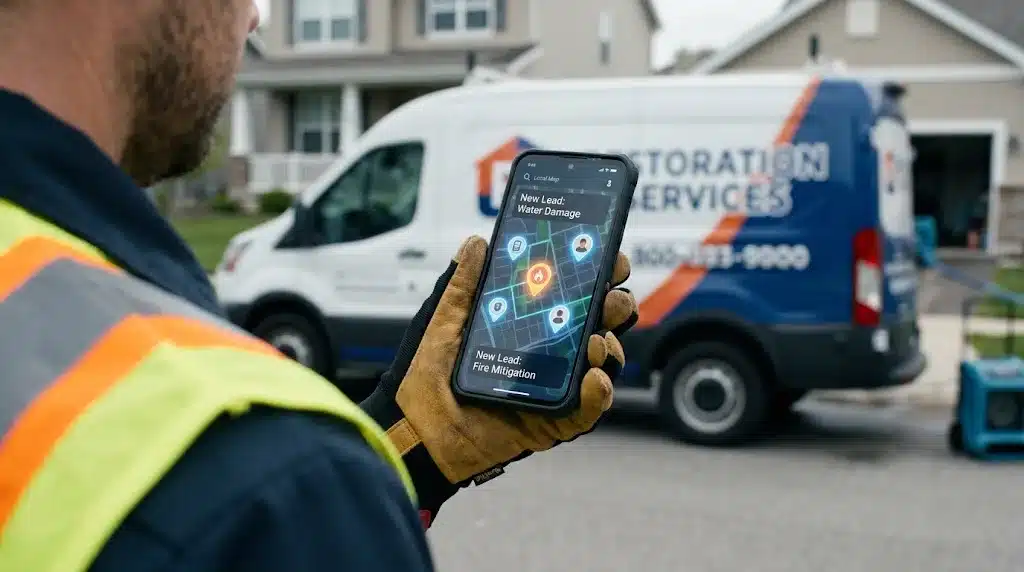
How do you build a lead follow-up system that actually works?
The minimum viable system looks like this: an answering service or virtual assistant for after-hours calls, an automated text sent within 2 minutes of any form fill, and a 5-touch follow-up sequence over the first 72 hours. Every touch should offer something useful, like a timeline of what the restoration process looks like or a checklist for immediate steps the homeowner can take. This positions you as the expert and keeps you top of mind until the decision is made.

For a broader view of restoration SEO strategy and how it feeds into your lead pipeline, that resource covers the full picture from search visibility to conversion.
Tracking and Measuring Your Restoration Lead Pipeline
You can’t improve what you don’t measure. Most restoration companies have almost no idea which marketing channel is generating leads, how fast those leads are being followed up on, or what their actual close rate is by channel. Without that data, you’re guessing.
What metrics should a restoration company track for lead generation?
Start with these four: cost per lead by channel, lead response time in minutes, lead-to-estimate rate, and estimate-to-close rate. Cost per lead tells you where to put your money. Response time tells you if your system is working. Lead-to-estimate rate tells you if your sales process is qualifying right. Estimate-to-close rate tells you if your pricing and presentation are effective. Tracking these numbers separately for water damage restoration leads, fire restoration leads, and storm leads lets you see which damage type is most profitable in your market.

What tools work best for tracking restoration leads?
Call tracking platforms like CallRail let you assign different phone numbers to different marketing channels, so you know whether a call came from Google, your website, or a yard sign. A simple CRM like Jobber or ServiceTitan lets you log every lead, track follow-up status, and measure close rates. The key is consistency. Pick a system and use it every day. Even a spreadsheet is better than nothing when it’s updated in real time. Google Search Console shows you which queries are driving impressions and clicks to your site, so you can see if your content is actually pulling in the right searches.
For contractors looking at the full picture of SEO reporting for contractors, understanding how to connect organic traffic data to actual lead and revenue numbers is a skill that separates high-performing companies from average ones.
Building a Long-Term Restoration Lead Generation System
Short-term tactics generate short-term results. The restoration companies that dominate their markets 5 years from now are the ones building systems today that compound over time. That means combining organic SEO, referral networks, paid channels, and conversion optimization into one connected machine rather than running each piece in isolation.

How do you balance short-term paid leads with long-term organic growth?
Think of paid ads as the accelerator and organic SEO as the engine. In the first 6 months, lean on Google Local Services Ads and pay-per-call to generate immediate volume while your SEO foundation gets built. As your organic rankings climb, you can reduce paid spend and let the compounding effect of content and reviews take over. Most well-run restoration companies aim to have 60 to 70% of their leads coming from organic sources within 18 to 24 months of a structured investment in SEO. Google Ads water restoration leads can fill gaps during slow seasons while organic builds.
What role does content marketing play in restoration lead generation?
Content answers the questions homeowners are asking before they call. Pages that explain what to do in the first hour after a pipe bursts, or how long water damage restoration takes, or whether mold is covered by insurance, capture buyers at the research stage and build authority with Google at the same time. According to the EPA’s mold guidance, mold growth begins within 24 to 48 hours of water exposure. That fact, presented in a well-optimized page about mold risk after water damage, can attract search traffic from homeowners trying to understand their situation. Content like that generates home restoration leads without any ad spend.
Understanding search engine marketing for contractors as a complement to organic SEO gives restoration companies a full-funnel approach rather than depending on any single channel.
For specific scenarios, see our coverage of: How to Get More Water Damage Leads Without Paid Ads, Best Lead Generation Sources for Restoration Contractors, How Insurance Adjuster Relationships Drive Restoration Referrals, Pay Per Call vs Pay Per Lead for Restoration Companies, How to Convert Storm Damage Inquiries Into Booked Jobs
Frequently Asked Questions
How Many Restoration Leads Does a Typical Company Need Per Month?
The right number depends on your crew size, average job value, and close rate. A two-crew operation with a 40% close rate and a $4,000 average job needs roughly 25 to 35 qualified leads per month to hit $40,000 to $50,000 in revenue. Larger companies with multiple crews scale those numbers proportionally. The key is knowing your own metrics so you can reverse-engineer a realistic lead volume target rather than chasing volume without a benchmark.
What Is the Average Cost Per Lead for Restoration Companies?
Costs vary significantly by channel and market. Google Local Services Ads typically run $50 to $150 per lead in most markets. Pay-per-call water damage restoration leads from lead networks run $75 to $200 per call, depending on damage type and geography. Organic SEO-generated leads have a near-zero marginal cost once rankings are established, though the upfront investment in content and optimization is real. Insurance and adjuster referrals cost relationship-building time rather than direct dollars.
How Fast Should a Restoration Company Respond to a New Lead?
Within 5 minutes for any inbound lead during business hours. After hours, an automated text acknowledging the inquiry and confirming a callback in the morning keeps the lead warm. Research consistently shows that response speed is the single biggest predictor of lead conversion in high-urgency service categories. For water damage specifically, homeowners are often in a panic, and the first contractor who communicates clearly and quickly earns enormous goodwill before anyone has even seen the property.
Are Google Local Services Ads Worth It for Restoration Companies?
For most restoration companies, yes. LSAs show at the very top of Google search results above traditional paid ads and organic listings. They feature a Google Guaranteed badge, which increases consumer trust. You pay per lead rather than per click, and you can dispute invalid leads for a refund. The main requirements are passing a background check, maintaining active licensing and insurance, and collecting reviews through the LSA platform. According to Google’s Local Services Ads documentation, verified businesses with the Google Guaranteed badge see higher click-through rates than standard search ads in most local service categories.
What IICRC Certifications Help Restoration Companies Win More Jobs?
The Water Damage Restoration Technician (WRT) certification is the baseline. For mold work, the Applied Microbial Remediation Technician (AMRT) credential matters to insurance adjusters and property managers. Fire and smoke restoration work benefits from the Fire and Smoke Restoration Technician (FSRT) cert. According to IICRC standards documentation, these certifications signal to insurance companies and end clients that your technicians follow established industry protocols, which can be a deciding factor when adjusters are choosing preferred vendors for fire damage restoration leads and water damage claims.
How Do Storm Chasers Affect Local Restoration Lead Competition?
Out-of-market storm chasers move into an area after a major weather event and compete aggressively for leads, often through door-to-door canvassing and aggressive online advertising. Local companies that have established Google rankings, strong review profiles, and existing insurance relationships hold a significant advantage because they appear as trusted, established options. Building your digital presence before storm season is the best defense against being crowded out by temporary competitors who disappear after the insurance checks clear.
Can a Small Restoration Company Compete With National Franchises for Leads?
Yes, and local companies often have specific advantages. National franchises have brand recognition, but they also have corporate overhead and slower local decision-making. A well-optimized local company can outrank a franchise in Google Maps results because local relevance signals like reviews, proximity, and local content matter more than brand size in local search. Homeowners dealing with water and mold damage want fast, local help. A local company that answers the phone, shows up quickly, and has genuine community reviews will often win over a franchise with a bigger brand name but slower local response.
What Should a Restoration Company’s Website Include to Convert More Leads?
Every restoration website needs a phone number visible above the fold on every page, a clear list of services with individual pages for each damage type, genuine customer reviews pulled from Google, before and after photos of real jobs, and a simple contact form that works on mobile. Service area pages targeting specific cities and neighborhoods improve local search visibility. A clear explanation of what the insurance claims process looks like, written in plain language, reduces homeowner anxiety and builds trust before the first call even happens.
Ready to Build a Restoration Lead Pipeline That Works Every Month
Restoration leads don’t have to be unpredictable. The contractors who fill their schedules consistently aren’t lucky. They’ve built systems that generate leads from multiple channels at once, convert those leads faster than their competitors, and keep referral relationships warm year-round. Whether your biggest gap is local search visibility, faster lead response, or insurance adjuster relationships, every piece of this system can be measured and improved. See exactly where your visibility stands with a free teardown at seo.pushleads.com/audit or call 828-348-7686.
Keep Reading
Want more customers from Google & AI search?
Get a free SEO audit of your site — see exactly what to fix first.
Your path · Restoration SEO
Keep going: read these next

- Restoration Lead Generation: Build a Predictable Pipeline Beyond Emergency Calls


Want this done for you?
Scan your site. See the gaps. Decide with numbers.
- Rankings, Google Business Profile and site-speed teardown
- Report lands in your inbox in about a minute
- No obligation · 4.9 from 67 Google reviews

