
What to Know Before Hiring Commercial Restoration Companies
Key Takeaways
Part of our Restoration SEO: The Complete Restoration Company SEO Guide. Want it done for you? See our restoration SEO and marketing agency.
Commercial restoration companies handle water, fire, mold, and structural damage in business properties, working faster and at larger scale than residential crews. Choosing the right company means checking certifications, response times, and industry-specific experience before disaster strikes. Businesses that pre-qualify a restoration partner recover faster and lose less revenue during downtime.
- Commercial restoration differs from residential work in scope, equipment, and coordination with insurance adjusters.
- Response time inside the first four hours determines how much secondary damage your property sustains.
- IICRC-certified firms follow documented standards that protect your insurance claim and liability position.
- Water, fire, flood, mold, and structural damage each require different crews, equipment, and drying protocols.
- Digital visibility matters: most facility managers search online before calling, so the companies that rank locally get the calls.
What Commercial Restoration Companies Actually Do
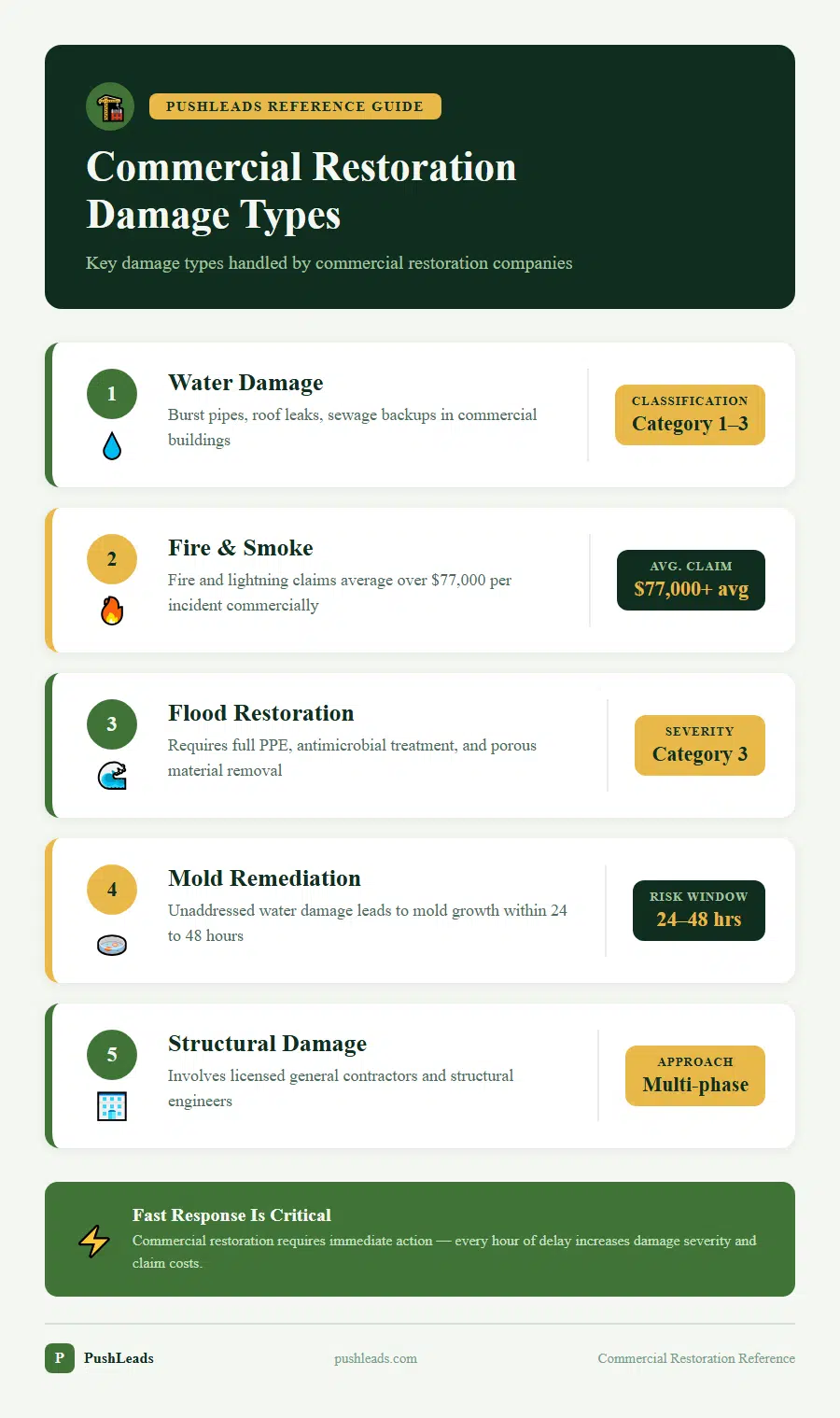
Commercial restoration companies respond to property damage at businesses, office buildings, warehouses, retail spaces, and multi-unit properties. They do more than clean up a mess. They extract standing water, dry structural materials, remove smoke residue, remediate mold, and rebuild damaged sections so a business can reopen as quickly as possible. The work is technical, time-sensitive, and directly tied to how much revenue a business loses while its doors are closed.
The difference between commercial and residential restoration is not just building size. Commercial jobs involve occupied tenant spaces, complex HVAC systems, ADA compliance requirements, and coordination with property managers, insurance adjusters, and sometimes local code officials. A flooded server room, a fire-damaged restaurant kitchen, or a burst pipe in a hotel lobby each demands a specialized response that a residential crew is rarely equipped to handle. According to the IICRC water damage standards, commercial drying projects require psychrometric calculations and documentation that go well beyond household restoration work.
PushLeads works with restoration contractors across the industry and has observed that the companies getting the most commercial calls are the ones showing up on the first page of Google when facility managers search terms like “commercial water damage restoration near me” or “emergency commercial flood cleanup.” That digital visibility is not accidental. It is built through deliberate SEO strategy targeting commercial-specific keywords.
When a pipe bursts at 2 a.m. in a 40,000-square-foot warehouse, the facility manager is not flipping through a binder. They are searching on a phone. The company that answers that search wins the job.
Want more customers from Google & AI search?
Get a free SEO audit of your site — see exactly what to fix first.
Types of Damage Commercial Restoration Companies Handle
Commercial restoration is not a single service. It is a cluster of specialized disciplines that often overlap on the same job site. Understanding what each category involves helps business owners and property managers know exactly what to ask for when they call.
What does commercial water restoration actually involve?
Commercial water restoration covers damage from burst pipes, appliance failures, roof leaks, and sewage backups. Crews use truck-mounted extraction units, industrial air movers, and commercial-grade desiccant dehumidifiers to pull moisture out of concrete, drywall, insulation, and flooring systems. According to the FEMA flood guidance resources, water damage that is not addressed within 24 to 48 hours leads to secondary mold growth, which significantly increases restoration costs and timelines. Large commercial jobs are often divided into drying zones, each monitored with moisture meters and thermal imaging cameras until readings reach acceptable levels per IICRC S500 standards.
How does commercial fire restoration differ from water cleanup?
Fire restoration involves smoke odor removal, soot cleaning, structural assessment, and often coordination with a licensed contractor for rebuild phases. The chemistry of smoke residue varies depending on what burned, whether that is synthetic materials, wood, or electrical components, and each type requires a different cleaning agent and technique. Commercial fire restoration teams also manage the water damage left behind by fire suppression systems, which means a single fire event often triggers both water and fire protocols simultaneously. The Insurance Information Institute reports that fire and lightning claims average over $77,000 per incident for commercial properties, making professional restoration documentation essential for claim recovery.
What separates commercial flood restoration from standard water damage work?
Flood damage introduces contaminants that standard water damage does not. Category 3 water, which includes groundwater, sewage, and stormwater, requires full personal protective equipment, antimicrobial treatments, and in many cases complete removal of porous materials like drywall and carpet rather than drying them in place. According to CDC mold information, floodwater exposure increases mold risk dramatically, and materials that appear dry on the surface can harbor active colonies inside wall cavities. Commercial flood restoration also triggers environmental reporting requirements in some jurisdictions, particularly when contaminated water reaches storm drains or neighboring properties.
How to Evaluate Commercial Restoration Companies Before You Need One
The worst time to evaluate a restoration company is at midnight during an emergency. Facility managers and property owners who pre-qualify vendors before a loss event recover faster, spend less, and avoid the pressure of making a high-stakes decision under duress.
What certifications should a commercial restoration company carry?
The baseline credential in the industry is IICRC certification, specifically the Water Damage Restoration Technician (WRT) and Applied Structural Drying (ASD) designations for water work, and the Fire and Smoke Restoration Technician (FSRT) certification for fire jobs. Mold remediation should involve technicians holding the Applied Microbial Remediation Technician (AMRT) credential. Beyond technician-level certs, ask whether the company holds a contractor’s license in your state and whether they carry general liability and workers’ compensation insurance with limits adequate for commercial work. According to OSHA workplace safety guidelines, restoration work involving mold, sewage, or structural hazards requires specific safety protocols that certified companies are trained to follow.
How fast should a commercial restoration company respond?
Industry standard for emergency commercial response is two to four hours for initial crew arrival. Any company quoting longer windows for emergency services is not positioned for commercial work. Ask specifically about their large-loss division or commercial team, because some companies operate strong residential crews but do not have the equipment inventory or staffing to handle a commercial job running across multiple floors or 10,000-plus square feet. Request references from past commercial clients, not homeowners, and ask how the company handled jobs that ran more than two weeks.
Does a preferred vendor relationship with insurers help or hurt?
Some restoration companies hold preferred vendor agreements with insurance carriers, which can speed up claims processing and reduce documentation disputes. However, these relationships do not guarantee the lowest cost or the best scope of work for the property owner. Business owners should understand that they have the right to choose their own restoration contractor regardless of what their insurer recommends. The key is selecting a company that documents damage thoroughly using industry-standard moisture logs, photo documentation, and written scope reports, because that paperwork directly affects how much the insurance company pays.

Commercial Water Restoration: Costs, Timelines, and What to Expect
Commercial water damage costs range from a few thousand dollars for a contained pipe leak to several hundred thousand dollars for a multi-floor flooding event. The primary cost drivers are the affected square footage, the water category (clean, gray, or black), the materials involved, and how long the water sat before extraction began. According to BrightLocal research, 87% of consumers read online reviews before selecting a local service provider, and facility managers follow the same behavior when sourcing commercial vendors, meaning a company’s online reputation directly affects how many commercial calls it receives.
How long does commercial drying typically take?
Standard drying timelines for Category 1 (clean water) commercial jobs run three to five days under controlled drying conditions. Category 2 and Category 3 jobs take longer because contaminated materials often require removal rather than drying in place, adding demolition and rebuild phases. Concrete slab drying is the slowest variable. A four-inch concrete slab can take 30 or more days to reach acceptable moisture levels depending on HVAC support and ambient conditions. Restoration companies should provide daily moisture readings and a projected drying completion date backed by psychrometric data, not guesses.
This is part of our restoration company SEO guide.
What hidden costs catch commercial property owners off guard?
In this video
- 0:00 Intro Jeremy and Bear Restoration
- 0:42 How to Search for a Restoration Company
- 1:04 Using Google Reviews to Vet Companies
- 1:25 Corporate vs Family Restoration Companies
- 2:00 Customer Service Differences to Expect
- 2:38 Owner Involvement at Family Companies
- 3:23 Bear Restoration Website and Phone Number
The costs that surprise property owners most are temporary power, equipment rental for scaffolding or lifts, contents manipulation (moving inventory or equipment out of the work zone), and temporary climate control when building HVAC is offline. Industrial dehumidifiers consume significant electricity, and on a large commercial job the power cost alone can run thousands of dollars per week. Ask for a written scope of work before signing any authorization and confirm which costs are included in the base estimate versus billed as time-and-material overages.
Commercial Fire Restoration: What the Process Actually Looks Like
A commercial fire restoration project typically runs in three phases: emergency stabilization, cleaning and deodorization, and reconstruction. The stabilization phase happens first and involves boarding windows, tarping roof damage, removing standing water from suppression systems, and securing the structure against further damage or unauthorized entry. This phase often begins within hours of the fire department clearing the scene.
How is smoke damage assessed in a commercial building?
Smoke travels through HVAC ductwork, wall cavities, and ceiling plenum spaces, depositing residue far beyond the fire origin point. Restoration technicians use air quality meters and surface sampling to map smoke contamination, and in many commercial buildings the HVAC system itself becomes a secondary contamination source that requires cleaning before the building can be reoccupied. According to EPA indoor air quality guidance, post-fire air quality testing should confirm that particulate levels and volatile organic compounds are within safe limits before employees return to work.
Can a commercial building operate partially during fire restoration?
Partial occupancy during restoration is common in large commercial buildings where the fire was contained to one wing or floor. Restoration companies use containment barriers with negative air pressure machines to isolate work zones from occupied areas, preventing cross-contamination from dust, odor, and construction debris. This approach requires coordination with local building officials who may need to inspect and approve the separation before occupied areas can remain open. The logistics are complex but the alternative, closing the entire building, is often far more expensive in lost revenue than the containment setup costs.
Mold Remediation as Part of Commercial Restoration
Mold remediation is frequently a downstream consequence of water and flood damage that was not fully dried or that went undetected in wall cavities and ceiling assemblies. According to EPA mold guidance, mold begins growing within 24 to 48 hours of moisture exposure, and commercial buildings with complex wall systems give mold ample hidden space to establish before visible signs appear. A musty odor, increased employee illness complaints, or visible staining on ceiling tiles are all early indicators.
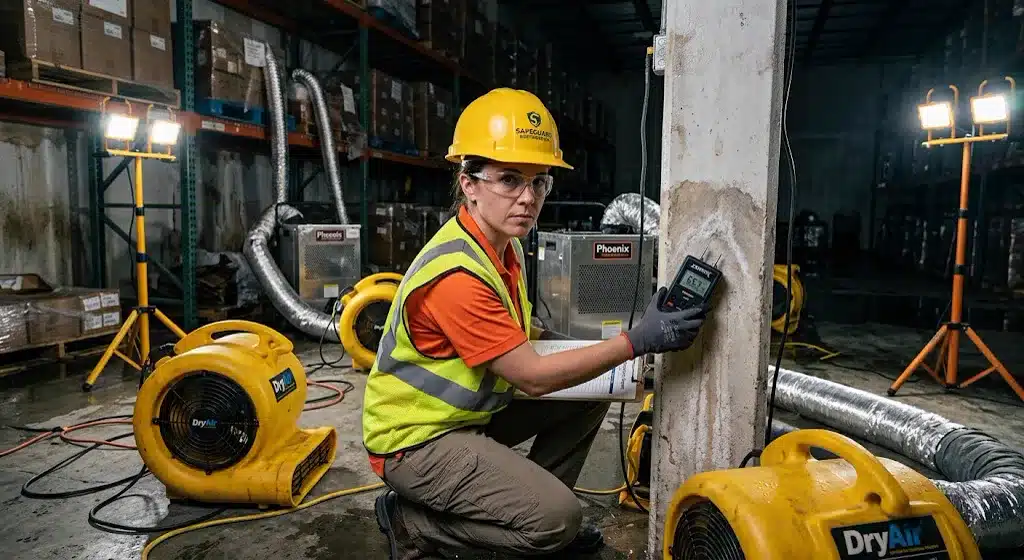
What standards govern commercial mold remediation?
The IICRC S520 Standard for Professional Mold Remediation governs how certified contractors should assess, contain, remove, and verify mold in commercial settings. The standard requires pre-remediation air testing, physical containment with negative air pressure, HEPA filtration during removal, and post-remediation clearance testing by an independent industrial hygienist. Property owners should be skeptical of any remediation company that skips post-clearance testing, because without third-party verification, there is no documented proof the job was completed successfully, which creates liability exposure if employees later report health issues.
How does mold affect a commercial property’s insurance coverage?
Most commercial property insurance policies include limited mold coverage, often capped at $15,000 to $50,000, which is rarely enough for a significant commercial remediation project. Mold that results from a covered water loss may be included in the water damage claim, but mold discovered independently, without a linked covered cause, is frequently excluded. The Insurance Information Institute recommends that commercial property owners review their policy mold endorsements annually and consider adding broader fungal coverage if their building has a history of moisture issues.
Commercial Building Restoration After Structural Damage

Structural damage restoration goes beyond cleanup and drying. It involves licensed general contractors, structural engineers, and in many cases local building department permits and inspections. Commercial restoration companies that offer full-service rebuild capabilities, from mitigation through reconstruction, reduce the coordination burden on property owners and often compress the total project timeline.
When does commercial restoration cross into reconstruction?
The line between restoration and reconstruction blurs when damage is extensive enough to require removing and replacing structural components. Removing a damaged load-bearing wall, replacing a fire-compromised roof deck, or rebuilding a flooded basement floor slab moves the project into licensed construction territory. Property owners should confirm that their restoration contractor holds a general contractor’s license or works with licensed subcontractors under a formal subcontract arrangement, not an informal referral. This matters because unlicensed reconstruction work can create permit violations that surface during future property sales or refinancing inspections.
How do commercial restoration companies manage large-loss coordination?
Large-loss commercial jobs involve daily coordination calls between the restoration project manager, the property owner or facility manager, the insurance adjuster, and sometimes a public adjuster hired by the property owner. Documenting every scope change, material substitution, and timeline adjustment in writing protects all parties. Restoration companies experienced in large-loss commercial work typically assign a dedicated project manager rather than rotating supervisors, which reduces communication gaps and speeds decision-making on a job where delays cost real money every day.
How Commercial Restoration Companies Get Found Online
A technically skilled restoration company that does not show up on Google for commercial damage keywords is invisible to the facility managers and property managers who are searching for help right now. According to BrightLocal’s Local Consumer Review Survey, 98% of people used the internet to find information about a local business in 2023, and commercial buyers search the same way. Ranking for terms like “commercial water restoration Asheville NC” or “commercial fire damage cleanup” requires a different content and SEO strategy than ranking for residential terms.
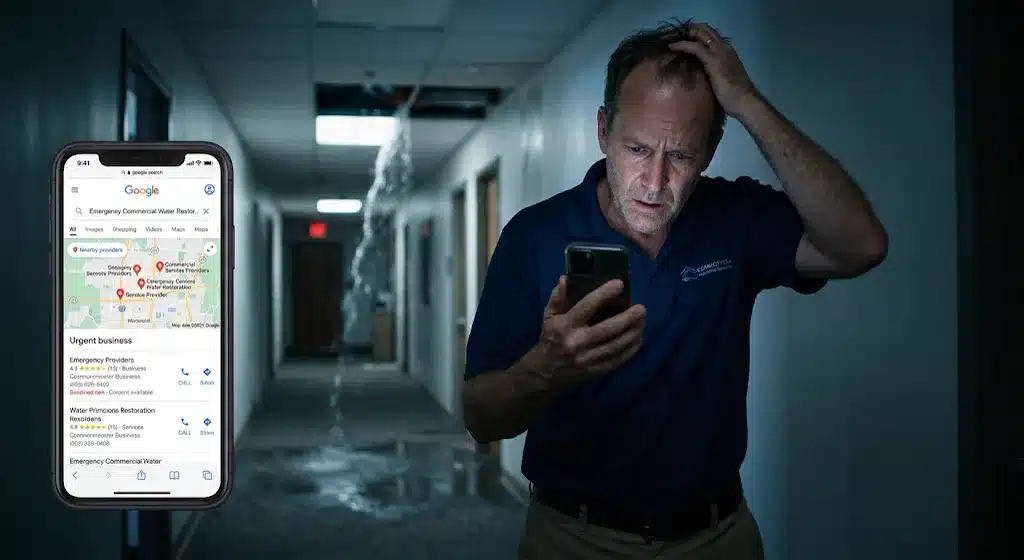
The restoration companies that consistently win commercial contracts are building content authority around commercial-specific topics, earning citations in commercial directories, and maintaining Google Business Profiles optimized for commercial services rather than generic damage restoration. That online presence functions as a 24/7 sales channel that generates calls even when the sales team is not working. For restoration contractors who want to grow the commercial side of their business, investing in search visibility pays returns every time a facility manager types a damage-related query into Google at 3 a.m. For specific scenarios, see our coverage of: Commercial Damage Restoration: What Businesses Need to Know, Commercial Water Restoration: What Business Owners Must Know, Commercial Flood Restoration: What Businesses Need to Know, Commercial Fire Restoration: What Business Owners Must Know, Commercial Property Restoration: What Businesses Need to Know
“Restoration contractors who invest in content marketing and local SEO see their commercial lead volume increase substantially because they are capturing searches that competitors simply are not showing up for,” notes the IICRC in its guidance on professional development for restoration businesses.
Frequently Asked Questions
How Do Commercial Restoration Companies Differ From Residential Ones?
Commercial restoration companies carry heavier equipment, larger crew capacity, and experience coordinating with insurance adjusters, building officials, and property management teams. Residential crews are set up for single-family homes with standard drying conditions. Commercial jobs involve larger square footage, complex building systems, liability documentation requirements, and often partial-occupancy scenarios where some areas must stay operational while others are being restored. The certifications, insurance limits, and project management structures are also different at the commercial scale.
What Should I Do Immediately After Commercial Water Damage?
Stop the water source if it is safe to do so, then call a commercial restoration company immediately. Every hour of delay increases secondary damage and drying time. Notify your insurance carrier and document conditions with photos before any cleanup begins. Do not run building HVAC over wet materials without consulting the restoration crew, because this can spread contaminants and disrupt drying calculations. Move electronics and sensitive inventory out of wet zones if it is safe to do so, and restrict access to the damaged area until professionals assess structural safety.
How Long Does Commercial Fire Restoration Take?
Timeline depends on fire scope. A contained kitchen fire with smoke damage to adjacent spaces might take two to three weeks. A fire that damages structural components, activates suppression systems across multiple floors, and requires permit-approved reconstruction can run three to six months. Insurance documentation and adjuster approval cycles often extend timelines beyond the physical work itself. Companies that pre-authorize emergency mitigation work before the full claim is settled can reduce delays in the first critical days.
Are Commercial Restoration Companies Available 24/7?
Reputable commercial restoration companies maintain 24/7 emergency dispatch because damage does not follow business hours. Confirm this before signing a preferred vendor agreement, and ask specifically whether the after-hours crew has the same certifications and equipment access as the day crew. Some companies use a smaller on-call team after hours and dispatch larger crews the next morning, which can be adequate for non-emergency situations but problematic when Category 3 water or active fire suppression discharge requires immediate heavy extraction.
Does My Commercial Insurance Cover Full Restoration Costs?
Most commercial property policies cover sudden and accidental damage from covered perils like fire, burst pipes, and weather events. Coverage limits, deductibles, and exclusions vary significantly by policy. Mold, flood, and earthquake are frequently excluded or sub-limited. The restoration company’s documentation, including moisture logs, photo evidence, and written scope, directly affects what the insurer pays. A public adjuster can represent the property owner’s interests during large or disputed claims, and their fee is typically a percentage of the final settlement.
What Is the IICRC and Why Does It Matter for Commercial Restoration?
The Institute of Inspection Cleaning and Restoration Certification is the primary credentialing body for the restoration industry. According to the IICRC standards library, their S500, S520, and S770 standards define the technical requirements for water damage, mold remediation, and fire and smoke restoration respectively. Hiring an IICRC-certified firm means the crew follows documented, peer-reviewed protocols rather than informal procedures. This matters for insurance claims because adjusters recognize IICRC documentation as industry-standard evidence of proper scope and methodology.
How Do I Know If a Commercial Restoration Company Is Qualified for Large-Loss Work?
Ask directly for references from commercial jobs over 10,000 square feet or with claims exceeding $250,000. Ask about their equipment inventory, specifically how many commercial desiccant dehumidifiers and large-capacity extractors they own versus rent. Rented equipment takes time to mobilize and may not be available during regional disaster events when demand spikes. Qualified large-loss companies also carry higher insurance limits, often $5 million or more in general liability, and have documented relationships with licensed general contractors for the reconstruction phase.
How Can a Restoration Company Improve Its Commercial Lead Generation?
Commercial leads come primarily through organic search, referral networks with commercial insurance agents, and relationships with property management companies. SEO investment targeting commercial-specific keywords, paired with a Google Business Profile optimized for commercial services, builds a consistent inbound pipeline. Restoration contractors who publish educational content around commercial damage scenarios rank for the queries facility managers are asking during and after loss events. Working with a digital marketing partner who understands the restoration industry accelerates this process significantly compared to general-purpose SEO agencies.
Get More Commercial Restoration Calls Starting Now
Commercial restoration is a high-stakes, high-value market. Facility managers and property managers are searching for qualified vendors right now, and the companies showing up at the top of those searches are capturing contracts that others never even know exist. If your restoration company has the crews, certifications, and equipment to handle commercial work but is not ranking for commercial keywords, you are leaving real revenue on the table. PushLeads specializes in helping restoration contractors build the kind of search visibility that generates consistent commercial inbound leads in markets like Asheville, NC and beyond. You can learn more about our approach through our work on restoration SEO agency strategy, our guidance on local SEO for contractors, and our detailed breakdown of SEO reporting for contractors. Contact us today.
In this video
- 0:00 Why Commercial Restoration Revenue Dwarfs Residential
- 1:36 Know Your Buyers Property Managers to Adjusters
- 2:07 12-Month Commercial Acquisition Calendar
- 3:24 Decisions Happen Before Disasters
- 4:30 Three Revenue Numbers That Make the Case
- 5:09 Three Pillars Every Commercial Plan Needs
- 5:58 Targeting by Facility Type and Timing
- 6:59 LinkedIn Sequencing and Cold Outreach
- 7:43 PPC and Retargeting for Commercial Accounts
- 8:41 The Real Cost of Missing a Window
- 9:50 Owned Assets That Compound Over Time
- 10:33 Six to Eight Touches Close Commercial Deals
Keep Reading
Want more customers from Google & AI search?
Get a free SEO audit of your site — see exactly what to fix first.
Your path · Restoration SEO
Keep going: read these next

- Up nextIn-House Marketing Hire vs. Agency for Restoration Companies
- Commercial Restoration Marketing: How to Win Property Manager and Facility Manager Accounts
- Video Marketing for Restoration Companies: YouTube, TikTok, and Before/After Content



Want this done for you?
Scan your site. See the gaps. Decide with numbers.
- Rankings, Google Business Profile and site-speed teardown
- Report lands in your inbox in about a minute
- No obligation · 4.9 from 67 Google reviews
 Continue reading
