

TL;DR: Hiring in-house costs $85,000-140,000 annually all-in; agencies cost $24,000-96,000 yearly. Choose in-house if you have revenue above $3 million and established marketing needs. Choose an agency if you’re under $3 million, need specialized restoration SEO skills, or want flexibility without employee overhead.
By Jeremy Ashburn, founder of PushLeads, an Asheville, NC SEO and digital marketing agency for contractors and home-service businesses.
What is the difference between a restoration SEO agency and a marketing system?
Part of our Restoration SEO: The Complete Restoration Company SEO Guide. Want it done for you? See our restoration SEO and marketing agency.
An agency manages your marketing for you, while a marketing system is a set of processes and tools you run yourself or hand off. The key distinction is ownership and dependency. With an agency, verify you own all accounts and assets outright, because losing access to conversion history and audience data when you leave can set you back significantly.
How do restoration companies market to insurance agents?
The transcript does not cover insurance agent outreach tactics directly, but it notes that restoration leads from insurance claims behave completely differently than residential remodels. Any agency you hire should understand that distinction and track cost per booked job on insurance work, not just raw lead volume or clicks.
Want more customers from Google & AI search?
Get a free SEO audit of your site — see exactly what to fix first.
How does SEO lead generation actually work for a restoration company?
Legitimate restoration SEO gets your website ranking so people find you first during emergency searches, while paid ads fill the gaps during the three-to-six month period before organic traffic builds meaningful traction. A qualified agency tracks cost per booked job, not just impressions, because contractor leads have different sales cycles and seasonality than other industries.
What should I look for in a restoration digital marketing service?
Confirm the agency ranks for its own target keywords before trusting them with yours. Require full login access to your Google Ads, Analytics, Search Console, and Business Profile at all times. Make sure your contract states you own every account, all website content, and all data outright if you ever decide to leave.
How do I find a good SEO company for my restoration company?
Ask any agency to screen-share their Google Search Console and show you exactly what keywords they rank for. Request phone numbers of two or three contractor clients you can call directly and ask whether lead volume rose, lead quality improved, and whether they would sign again. Agencies that deflect either request are not worth hiring.
What digital marketing services do restoration companies actually need?
Restoration companies need organic SEO to capture emergency searches, paid ads to fill volume gaps, and a Google Business Profile managed under their own account. Beyond that, insist on a dedicated contact person, monthly reports covering leads generated, cost per lead, and ranking movement, plus clear ownership of every platform and asset from day one.
Is there a legit PPC company that specializes in restoration companies?
A legitimate PPC company for restoration should understand that contractor leads behave differently than other industries and should focus on cost per booked job rather than cost per click. Always confirm that your Google Ads account is created under your own login with your own billing, so your conversion history stays with you if you switch.
What is the ROI I should expect from restoration marketing?
No honest agency can guarantee a specific ranking or promise a fixed number of jobs, because Google’s algorithm has hundreds of signals and markets shift. What you should track is cost per booked job, not impressions or clicks. Paid ads can generate leads faster than SEO, but even paid campaigns need optimization time before results stabilize.
Table of Contents
- Restoration SEO Agency vs. Marketing System: Which Delivers Steady Emergency Jobs?
- Which Digital Marketing Agencies Are Best for Restoration Companies?
- The True Cost of an In-House Marketing Hire
- The True Cost of a Marketing Agency
- When an In-House Hire Makes More Sense
- When an Agency Makes More Sense
- The Hybrid Approach: What Most Smart Companies Do
- Quick Recap
- Frequently Asked Questions
At some point, every growing restoration company faces this question: should we hire a marketing person, or should we work with an agency? It’s a decision worth getting right, because the wrong choice costs you 6-12 months of wasted budget and stalled growth.
In this video
- 0:00 How Much Restoration Companies Should Spend
- 0:46 Where the 3 to 10 Percent Range Comes From
- 1:46 Start With Revenue Target Not Budget
- 2:54 Real World Example a 2 Million Company
- 4:15 Five Variables That Shift Your Number
- 5:41 What Channels Actually Eat the Budget
- 7:05 Common Mistake Spending Before Funnel Is Ready
- 7:59 What a Healthy Budget Allocation Looks Like
- 8:55 When to Increase or Hold Your Budget
- 9:34 The One Number to Calculate Right Now
The honest answer is that both options work, but they work best in different situations. According to the Content Marketing Institute’s 2025 B2B report, 56% of small to mid-size businesses use a combination of in-house staff and external agencies. For restoration companies specifically, the right choice depends on your revenue, growth stage, and what kind of marketing support you actually need.
Restoration SEO Agency vs. Marketing System: Which Delivers Steady Emergency Jobs?
A restoration marketing agency delivers faster, more reliable results for steady emergency job flow compared to building a marketing system from scratch with one in-house hire, especially if you’re under $3 million in revenue. Agencies bring pre-built processes, restoration-specific keyword knowledge, and proven systems that start generating leads within 60-90 days. An in-house person building from zero takes 90-180 days just to understand your market before producing results.
When you need consistent leads—especially emergency service leads that come at unpredictable times—an agency handles the technical setup immediately. They optimize your local Google Business Profile, build your SEO foundation, and run PPC campaigns while an in-house marketer is still learning your customer acquisition channels.
The trade-off: agencies cost more monthly ($2,000-8,000), but you see measurable lead flow faster. In-house is cheaper long-term only if you have the revenue to justify full-time dedication and the patience to wait for ramp-up.
Which Digital Marketing Agencies Are Best for Restoration Companies?
The best agencies for restoration companies are industry-specialized firms that focus on home services or emergency services, not generalist digital agencies, because they understand restoration-specific lead generation and your seasonal cash flow patterns. Look for agencies with proven expertise in restoration SEO, insurance-related content, and local emergency service ranking strategies.
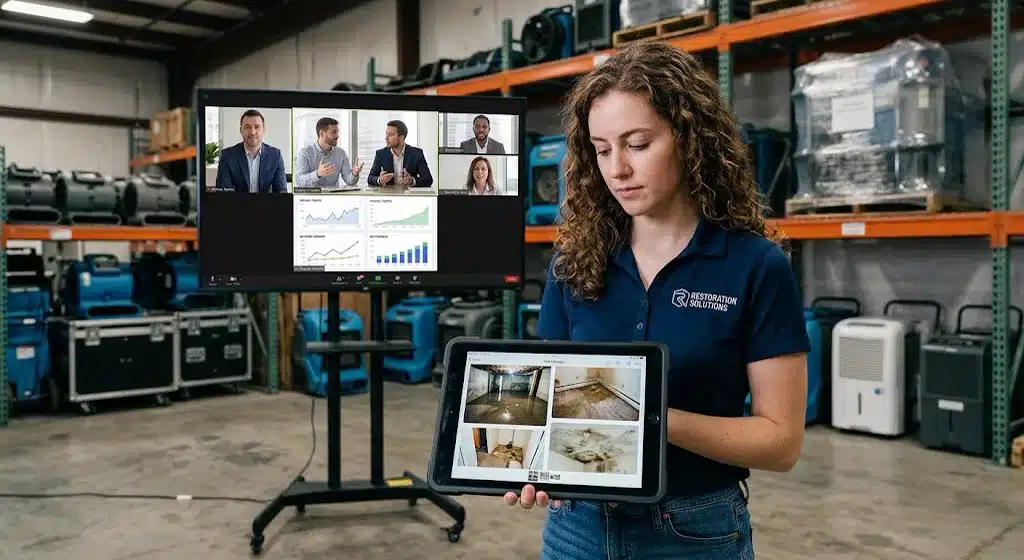
Industry-specialized agencies charge $3,000-8,000 per month because their expertise is worth more. They already know:
- How to rank for emergency keywords like “water damage Asheville” and “mold remediation near me”
- How to build relationships with insurance companies through content and local authority
- How to manage reputation during high-volume seasons (like after storms)
- The seasonal patterns specific to restoration work in your region
General digital marketing agencies charging $2,000-5,000 per month may deliver basic SEO and social media, but they don’t understand emergency service lead timing or restoration-specific sales cycles. They’ll waste time learning your industry.
The best approach: start with an industry-specialized agency that has reputation management expertise for handling reviews during high-stress situations. As your revenue scales past $3 million, add an in-house coordinator to manage day-to-day execution while the agency handles specialized strategy.
The True Cost of an In-House Marketing Hire
When restoration owners think about hiring a marketer, they often only consider salary. The actual cost is significantly higher.
A marketing manager with enough experience to run a restoration company’s digital marketing independently typically commands $55,000-85,000 in annual salary, depending on your market. In major metros, that number can reach $90,000-110,000 for someone with SEO, PPC, and content marketing skills.
But salary is just the starting point. Add these costs:
- Benefits and payroll taxes: 25-35% on top of salary ($14,000-30,000)
- Marketing tools and software: Semrush or Ahrefs ($1,200-2,400/year), email marketing platform ($600-1,200/year), social media management ($300-600/year), design tools ($200-500/year)
- Training and development: Conferences, courses, and certifications ($2,000-5,000/year)
- Recruiting costs: 15-20% of first-year salary through a recruiter ($8,000-17,000 one-time)
- Management time: Your time overseeing their work has a cost, even if you don’t track it
According to the Society for Human Resource Management, the average cost per hire in the U.S. is $4,700, and it takes an average of 36 days to fill a position. For a specialized marketing role in the restoration industry, expect longer timelines and higher costs.
Total year-one cost for a marketing hire: $85,000-140,000 all-in.

The True Cost of a Marketing Agency
Agency pricing varies widely based on scope, specialization, and geography. For restoration companies, here’s what to expect:
General digital marketing agencies charge $2,000-5,000 per month for a standard package including SEO, some content creation, social media management, and monthly reporting. Annual cost: $24,000-60,000.
Industry-specialized agencies that focus on home services or restoration specifically charge $3,000-8,000 per month, with some enterprise packages running higher. The premium buys industry expertise, restoration-specific keyword knowledge, and familiarity with how the business works. Annual cost: $36,000-96,000.
PPC management is often an additional fee, typically 10-20% of ad spend or a flat management fee. For a restoration company spending $5,000-10,000/month on Google Ads, PPC management adds $500-2,000/month.
Most agencies don’t require benefits, recruiting costs, or software investments from you. The total cost is the fee, period.
A 2024 HubSpot survey found that businesses using marketing agencies report 15% faster time-to-results compared to those building in-house capabilities from scratch. The agency already has processes, tools, and expertise in place; they don’t need 90 days to get up to speed.
| Cost Category | In-House Hire | General Agency | Specialized Agency |
|---|---|---|---|
| Monthly Cost (Year 1) | $7,100-11,700 | $2,000-5,000 | $3,000-8,000 |
| Annual Total (Year 1) | $85,000-140,000 | $24,000-60,000 | $36,000-96,000 |
| Ramp-Up Time | 90-180 days | 30-60 days | 30-60 days |
| Ongoing Software Costs | You pay | Included | Included |
| Turnover Risk | High (avg 2.3 years) | None | None |
When an In-House Hire Makes More Sense
Hiring internally works best when you have the revenue to support it and the marketing volume to keep someone busy full-time.
Revenue above $3 million. Below this threshold, most restoration companies don’t generate enough marketing work to justify a full-time dedicated person. Your marketer will end up doing admin tasks, answering phones, or staring at their screen waiting for the next project.
Related: Marketing agency niche identification.
Established brand presence. If your Leveraging Google Business Profile for Local Service Companies, website, and basic digital infrastructure are already built, an in-house person can maintain and grow what exists. Building everything from scratch requires skills most single-hire marketers don’t possess.
Need for daily content. Companies running active social media accounts, producing weekly blog content, creating video, and managing community relationships benefit from someone embedded in the business who can capture stories and content opportunities in real time.
Multi-location operations. If you’re managing marketing across three or more locations, the coordination demands often justify dedicated staff. Each location needs localized content, separate Google Business Profile management, and market-specific advertising.
The biggest risk with in-house: if your one marketer leaves, your marketing stops. According to the U.S. Bureau of Labor Statistics, marketing manager positions have a median tenure of 2.3 years. Budget for turnover.
When an Agency Makes More Sense
Agencies deliver stronger results in specific situations:

Revenue under $3 million. An agency provides fractional access to SEO, content, PPC, and design expertise at a fraction of the cost of hiring individual specialists. You get a team for the price of a portion of one employee.
Need for specialized skills. Restoration SEO requires specific knowledge: emergency service keyword targeting, insurance-related content, local pack optimization, and industry-specific link building. Agencies that specialize in this niche bring years of accumulated knowledge that a generalist hire would need months to develop.
Scaling up or down quickly. Seasonal businesses (restoration is inherently seasonal) benefit from agency flexibility. You can increase spend during storm season and scale back during slow months without hiring and firing staff.
Accountability through data. Good agencies operate on measurable deliverables: keyword rankings, organic traffic growth, leads generated. If they don’t perform, you can transition to another agency without the complications of firing an employee.
When you don’t want to manage another employee. If you’re already managing 10-20 field technicians, adding a marketing employee means more HR, more oversight, and more management time. Agencies manage themselves.
The Hybrid Approach: What Most Smart Companies Do
The most successful restoration companies above $2-3 million in revenue often use a hybrid model: one in-house person handling day-to-day marketing coordination, social media, and content capture, plus an agency handling specialized work like SEO, PPC, and web development.

This hybrid works because it plays to each option’s strength. Your in-house person knows the business, captures real-time content, manages your Google Business Profile day-to-day, and handles outbound relationship building. The agency brings specialized expertise, manages your technical SEO and PPC strategy, and provides data-driven reporting without you needing to hire five different specialists.
Cost for hybrid: roughly $50,000-70,000 for the in-house coordinator, plus $2,000-4,000 monthly for agency partnership. Total: $74,000-118,000 annually. You’re paying less than a solo full-service hire while getting better results.
This structure also protects you: if your in-house coordinator leaves, the agency keeps your marketing running. If you’re unhappy with the agency, you can replace them while your in-house team maintains continuity.
In this video
- 0:00 Restoration Leads Google Ads vs Organic SEO
- 1:01 Four Reasons You Disappear from Local Search
- 2:23 Why Paid Ads Create Structural Fragility
- 3:41 Organic SEO Month-by-Month Progression
- 4:16 Cost Comparison Over 24 Months
- 5:29 Independent Operators Local Search Advantage
- 6:09 Underexploited Keyword Opportunities Restoration
- 6:56 Full Head-to-Head Channel Comparison
- 7:39 Reviews GBP and Post-Job Follow-Up
- 8:14 Three Questions to Vet an SEO Agency
- 9:07 Which Channel to Lead With and When
- 10:11 Free SEO Audit Next Step
Show transcript
When a pipe bursts at 2 in the morning, a homeowner is not browsing options. They are on Google, clicking the first credible result and making one call.
We are putting two lead generation strategies head-to-head: Google Ads and organic SEO. We will show you how each works for restoration companies, where each wins, and which builds a business that keeps the phone ringing without writing a check every month.
Before we go further, I’m Jeremy Ashburn. I run PushLeads, an agency built around one thing — leads for restoration company owners not getting found in local search. I’ve been doing this for over 20 years, long before AI made it fashionable. This video is about the specific reasons a restoration company disappears from local search results and the order to fix them in.
Here is the landscape you are competing in. The disaster restoration market hit $41.3 billion in 2023 and grows at 6.7% every year. That revenue flows to companies homeowners find first. The buying cycle in restoration is unlike any other service business. There is no comparison shopping. The crisis compresses the entire sales process into seconds. Whoever ranks highest gets the job.
Let us compare the two channels on factors that actually matter. Google Ads delivers leads fast — days after launch — but every lead costs money. When your budget stops, visibility disappears completely. Nothing carries over. Organic SEO takes 3 to 6 months to build traction, but once you rank, clicks cost nothing. The leads keep arriving. The asset keeps working. Those are fundamentally different business models, and understanding the difference changes how you allocate every marketing dollar.
The cost-per-click gap stops restoration owners cold. Google Ads for water damage and fire restoration keywords runs $50 to $100 per click, and many clicks do not convert. Your actual cost per acquired job is significantly higher than cost per click alone. At $75 per lead, 30 leads a month — that is $2,250 in monthly ad spend just to sustain current call volume. The same leads through organic search carry zero marginal cost per click once rankings are established.
Before comparing channels in depth, here are four fixable problems behind almost every restoration company’s invisibility in local search.
An incomplete or unverified Google Business Profile gives Google no confidence your business is active. Thin or missing service pages provide no specific signals about what you do or where you work. Inconsistent citations — different phone numbers or addresses across Yelp, Angi, and the BBB — suppress map pack eligibility. And too few recent reviews: a company with 12 reviews from three years ago consistently loses map pack position to a competitor with 60 reviews from the past six months.
Paid ads have a legitimate role. Be honest about what it is. If you need calls this week while organic rankings build, or during a demand surge, pay-per-click delivers. It is fast and controllable. The problem is structural fragility. The day you cut budget, every dollar of rented visibility evaporates. No residual effect, no compounding return, no asset. Because restoration is competitive, keyword costs trend upward over time. The longer paid ads remain your primary channel, the more expensive each lead becomes.
Organic SEO follows a predictable month-by-month progression. Month one: technical fixes, Google Business Profile verification, and core service pages with emergency-intent keyword targeting. Months two and three: local citations, location-specific content, and systematic review acquisition tied to job closeout. By months four through six, map pack rankings move for primary keywords and organic lead volume rises. Beyond six months: secondary service categories, link building, and competitor monitoring. The effort is front-loaded. The returns are not.
Here is the cost difference over time. Spending $2,250 every month on Google Ads to generate 30 water damage leads — and that number stays constant or rises as competition increases. Month 12: $27,000 spent, owning nothing. Month 24: $54,000, still renting. An SEO retainer for a single-location restoration company in a moderate market runs $1,000 to $3,500 per month, and authority built in month one is still working in month 24. The lines cross, then keep diverging.
Three numbers define the SEO advantage. Zero dollars per click once service pages rank and your Google Business Profile sits in the map pack. Three to six months is the realistic timeline to first qualified organic leads — faster in less competitive markets, particularly for map pack placement, which can improve ahead of organic rankings. And $1,000 to $3,500 per month is the typical retainer range for restoration-specific SEO. A single water damage job averaging $5,000 means one additional inbound job per month pays for the program. Most operators see multiples of that within the first year.
Independent restoration operators carry a structural advantage in local search that most of them underestimate. Every review from a customer in your service area strengthens local authority directly. Every piece of content about your specific market adds geographic relevance. Every citation reinforces that your business is genuinely embedded locally. A national franchise is one node among hundreds. Its Google Business Profile competes against other franchise locations in the same brand. Its content strategy is dictated corporately and lacks the local specificity Google rewards. Deep local signals beat big budgets in local search more often than most owners expect.
Two keyword opportunities are genuinely underexploited in restoration SEO. Smoke and soot cleanup is one of the most underoptimized service categories in the vertical. While competitors fight over broad fire damage terms, phrases like "smoke smell removal," "soot cleanup cost," and "air quality after fire" rank faster, face less competition, and frequently expand into larger fire restoration projects once a technician is on site.
Hurricane damage content is the other. Surge traffic after a major storm goes entirely to companies already ranked before landfall. A page published the week before a storm never indexes in time. Build storm damage content months ahead of season and treat it as a permanent SEO foundation.
Here is the full head-to-head across every factor a restoration operator should weigh. Cost per click: $50 to $100 or more for paid ads versus zero for organic once ranked. Lead continuity: paid ads stop when budget stops; organic leads continue after the work is done. Time to first lead: days for paid, 3 to 6 months for SEO. Long-term cost trend: paid costs rise with competition; SEO costs fall as authority compounds. Asset value: paid ads build nothing; SEO builds a durable lead generation asset. Best use case: paid ads for immediate volume and gap coverage; SEO for consistent, scalable inbound lead generation.
BrightLocal’s local consumer review survey found that 98% of people used the internet to find a local business in the past year. Your Google Business Profile is the first thing they encounter — near-universal behavior. BrightLocal data also shows businesses with more than 50 recent reviews earn significantly higher consumer trust than those with fewer. Review volume and recency are direct ranking factors. A post-job follow-up text sent within 48 hours of completion, consistently after every job, is one of the highest-return activities in restoration marketing.
When evaluating a restoration SEO agency, three questions separate specialists from generalists. First, ask them to show specific restoration companies they have ranked in the map pack with actual lead volume numbers — not traffic reports. Second, ask them to explain the difference between "water damage repair" intent and "water damage restoration cost" intent, and how their content strategy addresses both differently. Third, ask whether reporting includes cost per lead and cost per acquired customer. If reporting stops at impressions and clicks without connecting to revenue, they are not measuring the right things for a restoration business.
Who should lead with which channel? Paid ads make sense when you need leads immediately while organic rankings build, or when a seasonal surge demands volume you cannot wait for SEO to deliver. Organic SEO makes sense as the primary channel when per-click costs erode job margins, when you want to outrank franchise competitors locally, and when consistent inbound volume over time matters more than speed.
The most successful restoration companies run both. SEO is the foundation, generating leads at no marginal cost. Paid ads fill gaps and cover peak demand. The mistake is running paid ads without building the organic foundation underneath.
If your restoration company is not showing up when homeowners near you search for water damage, fire restoration, or mold removal, you are losing jobs to competitors who rank ahead of you right now. PushLeads builds a custom SEO teardown around your specific service area, your keywords, and your revenue goals. You will see exactly where your visibility stands, every gap holding you back, and a clear fix for each one. Get your free audit at pushleads.com/audit — link in the description — or call 828-348-7686.
Ranking in local search is not a mystery. It is a system, and every gap has a fix. If you have been relying on paid ads to keep the phone ringing and want to build something that compounds over time, start with a clear picture of where you stand today. Your free SEO audit gives you that picture. No guesswork, no generic advice — a specific look at your market, your competitors, and exactly what it takes to move your company to the top of results when it matters most. The link is in the description.
Quick Recap
- In-house hire costs $85,000-140,000 year-one; makes sense above $3M revenue with established systems and multi-location needs
- General agencies cost $24,000-60,000 yearly; good for basic digital marketing but lack restoration industry expertise
- Specialized restoration agencies cost $36,000-96,000 yearly; deliver 15% faster results and understand emergency service lead flow
- Hybrid model ($74,000-118,000 annually) is what most successful companies choose: in-house coordinator plus specialized agency
- If revenue is under $3M, an agency is more cost-effective; you get a full team for less than one salary
- Agencies scale with your seasonal needs; in-house staff creates fixed overhead year-round
- Turnover risk is real: average marketing manager stays 2.3 years; agencies have continuity
Frequently Asked Questions
How long does it take an agency to generate leads compared to hiring in-house?
Agencies typically start generating leads within 60-90 days because they already have SEO foundations, PPC templates, and proven processes in place. An in-house hire takes 90-180 days just learning your market, customer pain points, and competitive landscape before producing meaningful results. This is the biggest practical advantage of agencies for companies under $3 million revenue.
What happens to my marketing if my in-house marketer quits?
Your marketing stops or significantly slows down. You lose institutional knowledge, ongoing campaigns pause, and you’re back to square one recruiting a replacement. This typically costs 30-60 days and an additional $8,000-17,000 in recruiting fees. With an agency, they seamlessly hand off your account to another team member and continue running campaigns without interruption.
Can a single in-house marketer really handle all my restoration company’s marketing?
Not well if your revenue is under $3 million. One person can’t do expert-level SEO, PPC management, content creation, social media, web design, and local reputation management simultaneously. Most single hires become generalists who do everything adequately but nothing exceptionally. Agencies bring specialized teams; you get strategists, developers, and PPC specialists even though you’re paying one monthly fee.
Is it cheaper to hire in-house after the first year?
Potentially, yes, but only if you account for turnover, training, and opportunity cost of your management time. After year one, ongoing in-house costs drop to $70,000-120,000 annually (no recruiting or ramp-up fees). An agency remains $36,000-96,000 yearly. In-house becomes cheaper on pure salary around year three if the person stays and you have sustained, consistent marketing needs. But most restoration companies value the flexibility and results an agency provides, even if the long-term per-year cost is higher.
Should I start with an agency and hire in-house later?
Yes, this is the smart progression. Start with an agency for 12-18 months while you validate that consistent marketing spending generates measurable ROI. Once you hit $3+ million revenue and understand your marketing needs deeply, hire an in-house coordinator to manage day-to-day execution while the agency handles specialized strategy. This hybrid gives you best-in-class results without the risk of hiring too early or the waste of in-house overhead before you’ve proven the business case.
What’s the difference between a general digital agency and one specialized in restoration?
Specialized restoration agencies know emergency service keyword patterns, insurance lead flow, seasonal business cycles, and local emergency service ranking strategies specific to your market. A general agency treats restoration like any other small business, missing crucial nuances. For example, they might not understand that most of your leads come in surges after storms, or that you need Google Business Profile optimization for emergency response time. You’ll pay more for specialization, but you’ll see better lead quality and faster ROI.
Can I do a hybrid approach with a different in-house hire and agency?
Yes, absolutely. Hire an in-house person who excels at operations, social media, and content coordination (not necessarily deep SEO or PPC expertise). Pair them with an agency that handles your technical SEO, PPC strategy, and web development. This combo is cheaper than hiring five specialized staff and better than a solo in-house generalist. Your in-house person becomes an extension of the agency; they work together seamlessly to scale your results.
Contact us today to discuss whether an in-house hire, agency partnership, or hybrid approach makes sense for your restoration company’s growth stage and revenue.
Watch: How do I know if a digital marketing agency for contractors is legit?
What this video covers
- 0:00 — Thirty-Minute Due Diligence Framework
- 0:23 — Do They Rank for Their Own Keywords
- 1:04 — Contractor Industry Experience Matters
- 1:52 — References You Can Actually Call
- 2:13 — Full Account Access Non-Negotiable
- 2:47 — You Must Own Your Ad Accounts
- 3:34 — Lead Quality vs Raw Lead Volume
- 4:26 — AI Visibility as an Authority Check
- 5:11 — Plain Language Over Agency Jargon
- 5:58 — Red Flags Guarantees and Secret Methods
- 6:50 — Audit Their Own Online Presence
- 7:27 — Read the Contract Before You Sign
- 8:17 — Communication and Reporting Standards
- 9:39 — Final Test Before You Sign Anything
Full video transcript
You can tell in about thirty minutes of due diligence if you know exactly what to ask and what to look for. This video gives you the full checklist. I’m going to walk you through thirteen things to verify before you sign anything or hand over a dollar. Most contractors get burned not because they were careless, but because nobody told them what the warning signs were. So let’s fix that right now.
The first question you should ask any agency is simple: what do you rank for yourself? If an agency is telling you they can get you to the top of Google, they should be able to do it for their own business first. Go to Google right now and search something like "SEO agency near me" or "SEO company near me." Those keywords have real commercial intent. Real agencies show up in those results. The data I’m looking at shows "SEO agency near me" pulling over one hundred and twenty impressions with an average position of seventy-one. That means most agencies are buried on page seven or eight for the very keywords they claim to dominate. If an agency can’t rank on the first page for their own target terms, why would they perform better for yours?
Ask them to screen share their Google Search Console. Ask them to show you the keywords they rank for and what position they’re in. If they deflect, that’s your answer.
Marketing a law firm is not the same as marketing a plumber. Marketing an e-commerce store is not the same as marketing a restoration contractor or a garage door company. Contractor leads behave differently. The sales cycle is different. The seasonality is different. The job sizes are different. The way Google Maps and Local Services Ads interact is different. You need proof that the agency has worked with someone in your trade in a real market with real results.
Ask for two or three references from contractors they’ve worked with — not testimonials they wrote on their own website, but actual phone numbers of real business owners you can call. When you call those references, ask them three things. One, did your lead volume actually go up? Two, did the quality of leads improve, meaning fewer tire kickers? Three, would you sign with them again? If the agency hesitates to give you references, or if they say their clients don’t want to be contacted, walk away.
You should be able to log in at any time and see exactly what’s happening with your money. That means your Google Ads account, your Google Analytics account, your rank tracking dashboard — all of it. You should not have to ask for a report. You should not have to wait until your monthly call. You should be able to pull it up on your phone on a Sunday morning if you want to. Agencies that don’t offer this are hiding something. Sometimes they’re hiding bad performance. Sometimes they’re hiding what they’re actually spending versus what you’re paying them. Full access is non-negotiable. Put it in writing before you sign.
This is one of the most common traps in this industry. An agency sets up your Google Ads account under their own account. You run ads for twelve months. You build up conversion history, audience data, bid history. Then you decide to leave, and they say, "Sorry, the account stays with us." You lose everything — every dollar of optimization history, every conversion, every audience list. You start from zero with the next agency.
The right setup is this. You create the Google Ads account. Your billing information is attached to it. You invite the agency as a manager. If they leave or you fire them, you remove their access and everything stays with you. The same goes for your Google Analytics property, your Google Search Console, and your Google Business Profile. You own it. They manage it. Period. If an agency insists on creating these accounts under their umbrella, that is a red flag, full stop.
Here’s a real thing that happens. An agency brags that they generated you two hundred leads last month. You look at the actual leads. Forty percent are out of your service area. Twenty percent are looking for a service you don’t offer. Thirty percent are price shoppers who want the cheapest option in town. That leaves about sixty leads that were worth talking to.
A legitimate agency understands this. They talk about cost per booked job, not just cost per click. They understand that a garage door installation has a different value than a garage door spring repair. They understand that restoration leads from insurance claims behave completely differently than residential remodels. Ask them directly, "How do you qualify leads for a contractor like me?" Ask them, "What metrics do you track beyond lead volume?" If they look at you blankly or pivot back to impressions and clicks, they don’t understand your business well enough to help it.
This is a newer question, but it’s becoming a real one. A growing share of people are searching by typing their question into an AI assistant instead of Google. They ask something like, "What’s the best digital marketing agency for contractors?" If an agency is genuinely authoritative in their space, they show up in those answers. Go test it right now. Open ChatGPT or Perplexity. Type, "What digital marketing agencies specialize in contractor SEO?" See who comes up.
This is not the whole picture. AI results are still inconsistent, but it tells you whether an agency has built enough authority online that even a large language model recognizes them as relevant. It’s one more data point to stack on the others.
If you can’t understand what they’re selling you, that’s a problem. Jargon is often used to make simple things sound complicated. When something sounds complicated, you’re more dependent on the agency. When you’re more dependent, you’re less likely to ask hard questions. That dynamic works in their favor, not yours.
A legitimate agency should be able to explain their entire strategy in plain language. Not, "We leverage omni-channel attribution modeling." More like, "We get your website ranking so people find you first. We run ads to fill the gaps, and we track which ones turn into jobs." You should walk away from a sales call understanding exactly what they’re going to do every month and why. If you feel confused and just decide to trust them anyway, that’s a setup for a bad outcome.
If an agency guarantees you a number one Google ranking, run. Google has said directly and repeatedly that no one can guarantee rankings. Search algorithms have hundreds of signals. Competition shifts. Markets change. Anyone guaranteeing a specific position is either lying or planning to use tactics that could get your site penalized.
The same goes for anyone promising fast results. Legitimate SEO is typically a three to six month process at minimum before you see meaningful organic traction. Paid ads can generate leads faster, but even those need optimization time. And watch out for the proprietary system pitch. Some agencies say they have a secret method they can’t share with you because it’s their competitive advantage. Legitimate strategy isn’t secret. It’s just consistent, well-executed work. There’s no magic. There’s just doing the right things well over time.
Go look at their Google Business Profile. How many reviews do they have? What do the reviews actually say? Are there responses to negative reviews, and do those responses look professional? Look at their own website. Is it fast? Does it rank? Does the content actually help someone, or is it generic filler? Look at their portfolio if they have one. Ask to see websites they’ve built for contractors. Call those contractors and ask if the site performs, not just if it looks nice. An agency’s own online presence is a working sample of their work. If their own house is a mess, don’t pay them to fix yours.
Read the contract before you sign it. Specifically look for three things. One, contract length. Twelve-month minimums are common, but you should understand what you’re locked into. Shorter terms or month-to-month arrangements are possible with the right agency. Two, setup fees. Some setup fees are legitimate, but ask this: if I leave after three months, do I keep everything that was built — the website, the content, the ad structure, all of it? If the answer is no, that fee was really a ransom deposit. Three, ownership clauses. Any contract should clearly state that you own your website, your content, your accounts, and your data. If you don’t see that in writing, ask for it explicitly. A fair agency has nothing to lose by giving you ownership of your own assets.
You should know before you sign exactly who you’re going to hear from, how often, and what they’re going to tell you. At minimum, you should get a monthly report that covers leads generated, cost per lead, rankings movement, and what work was done that month. You should have a dedicated contact — not a support ticket queue, but a person who knows your account. Quarterly calls to review strategy are reasonable. Any time something significant changes, you should hear about it before you notice it on your own. If an agency goes quiet for weeks and only surfaces when it’s billing time, that’s not a partnership. That’s a subscription you forgot to cancel.
A lot of agencies sell you one thing and deliver another. The salesperson is sharp and sounds very experienced. The person actually doing your work may be an intern. They might be an overseas contractor working from a checklist. They may have no context about your business at all. Ask directly who will work on your account day to day. Ask how many accounts that person manages at one time. Ask if they have worked with trade contractors before. If they cannot give you a name and a background, be cautious. If your account is one of a hundred, attention suffers. That lack of attention directly affects the quality of your results. You are not buying a software product here. You are buying someone’s time and their expertise. Make sure you know exactly whose time you are buying.
Here’s how I’ll leave you. Before you sign with any agency, run this test. Get the full proposal, the contract, the pricing breakdown — all of it. Sit down with whoever else has a stake in your business: your spouse, your partner, your accountant. Walk through every piece of it with them. If the agency has been straight with you, that conversation should be easy. Everything should check out. Nothing should require defending or explaining away.
If you catch yourself saying things like, "I know it sounds weird, but they said it’s normal," or "They said I just have to trust the process," that’s not a green flag dressed up in patience. That’s a red flag dressed up in patience. A legitimate agency gives you a proposal you can defend to anyone because every line of it makes sense. That’s the standard. Hold every agency to it.
If you want us to look at your current visibility and tell you honestly where you stand, get a free visibility teardown at SEO.PushLeads.com/audit or call us at 828-348-7686. No pitch, just the data.
Keep Reading
Want more customers from Google & AI search?
Get a free SEO audit of your site — see exactly what to fix first.
Your path · Restoration SEO
Keep going: read these next
 You’re hereIn-House Marketing Hire vs. Agency for Restoration Companies
- Up nextCommercial Restoration Marketing: How to Win Property Manager and Facility Manager Accounts
- Email Marketing for Restoration Companies: Templates and Automation That Generate Repeat Business




Want this done for you?
Scan your site. See the gaps. Decide with numbers.
- Rankings, Google Business Profile and site-speed teardown
- Report lands in your inbox in about a minute
- No obligation · 4.9 from 67 Google reviews
 Continue reading
