Key Takeaways
Want it done for you? See our restoration SEO and marketing agency.
For most restoration companies under five million in annual revenue, an SEO agency almost always wins on cost and skill coverage over a single in-house hire. Marketing is a stack of specialized skills that one person rarely covers at a professional level. The right choice depends on your revenue, your current SEO foundation, how fast you need results, and whether you can manage an employee versus a vendor relationship.
- Marketing is a stack of skills including technical SEO, content, link building, paid ads, and reputation management. One hire almost never covers all of them well.
- An in-house marketing coordinator runs seventy thousand to eighty-five thousand dollars all-in annually when you factor salary, benefits, tools, and management time.
- A reputable contractor SEO agency typically costs fifteen hundred to four thousand dollars per month, or eighteen thousand to forty-eight thousand dollars per year.
- Agency ramp time is shorter on the technical side because a restoration-focused agency already knows the keyword landscape for water damage, fire damage, and mold.
- A hybrid model, a part-time or full-time coordinator handling execution plus an agency handling technical SEO, often works best for shops doing two to ten million per year.
- Someone must own accountability for rankings, leads, and calls, whether that is an employee or an agency with reporting built into the contract.
- AI search visibility in tools like Google AI Overviews, ChatGPT, and Perplexity is a newer layer most in-house hires are not yet trained on, while a focused agency should already be working on it.
Key moments (13)
0:20 The Core Question: What Are You Actually Buying?
1:03 What One In-House Person Actually Covers
1:52 The Ramp Time Nobody Talks About
2:35 The Real Cost Comparison
3:38 What the Agency Actually Delivers
4:25 When In-House Actually Makes Sense
5:08 When an Agency Makes Sense
6:22 The Management Load Question
7:04 What to Ask Before You Hire Either
8:11 What PushLeads Does
8:52 The Mistake to Avoid
10:19 What to Do Next
Full transcript
0:00 Intro
For most restoration companies under about five million in annual revenue, an agency almost always wins on cost and skill coverage. But there are real exceptions, and I want to walk you through the full picture so you can make the right call for your business. I’m Jeremy Ashburn. Let’s get into it.
0:20 The Core Question: What Are You Actually Buying?
Before you post a job listing or sign an agency contract, you need to get clear on what marketing actually requires. It is not one skill; it is a stack of skills. SEO alone covers technical audits, content writing, link building, local citation management, keyword research, and analytics reporting. Then add paid ads, reputation management, social media, and email follow-up sequences. One person almost never covers all of that at a professional level. That is not an insult to anyone. It is just how specialized the work has become. So when you say you want to hire someone for marketing, you need to ask which parts of marketing and at what depth.
1:03 What One In-House Person Actually Covers
Let’s be honest about what a single marketing hire can realistically do well. They can handle maybe two or three of these disciplines at a professional level. They can coordinate vendors for the rest. They can be a point of contact for your agency. What they usually can do: respond to phone leads, respond to reviews, post to social media, run simple email campaigns, and manage your agency relationship. What they usually cannot do at a high level on their own: technical SEO, link acquisition, content strategy across dozens of pages, conversion rate testing, and paid search optimization simultaneously. If you hire someone and expect them to cover all of it, you are going to be disappointed, and so are they. Here is a number that matters:
1:52 The Ramp Time Nobody Talks About
ramp time. A new in-house hire, even a skilled one, typically takes three to six months before they are producing work that moves rankings or generates leads. They need to learn your brand, your service area, your competitors, your past content, your CRM, and your reporting tools. An agency with a restoration focus walks in already knowing the keyword landscape for water damage, fire damage, and mold. They have done this for other shops. They are not learning the category on your dime. That does not mean an agency is always faster. It means their ramp is shorter on the technical side, while your ramp is about onboarding them to your specific business.
2:35 The Real Cost Comparison
Both take time. One starts closer to ready. Let me give you the ballpark numbers, so this is not abstract. An in-house marketing coordinator in most markets runs somewhere between forty-five thousand and sixty-five thousand dollars a year in salary before benefits, payroll taxes, software tools, training, and management time. You are often looking at seventy thousand to eighty-five thousand dollars all in when you count the full loaded cost. A reputable SEO agency for a small restoration company typically runs somewhere between fifteen hundred and four thousand dollars a month, depending on scope. That is eighteen thousand to forty-eight thousand dollars a year. The agency number does not include someone managing your phones, posting your stories, or sitting in your team meetings. The in-house number does not include the depth of technical output a full agency team delivers. You are not comparing apples to apples. You are comparing two different sets of capabilities at two different price points.
3:38 What the Agency Actually Delivers
A focused contractor SEO agency handles the work your in-house person probably cannot: technical site audits, fixing crawl errors, improving page speed, building out location pages for every service area, writing optimized content for your core services, earning backlinks from local and industry sources, and tracking keyword rankings, calls, and form fills in a dashboard you can read. One thing worth noting, in my experience, restoration companies that show up in AI search results, like Google’s AI Overviews and tools like ChatGPT and Perplexity, get significantly more inbound calls without any extra ad spend. That is a newer layer of the game that most in-house hires are not trained on yet, and a good agency should already be working on it.
4:25 When In-House Actually Makes Sense
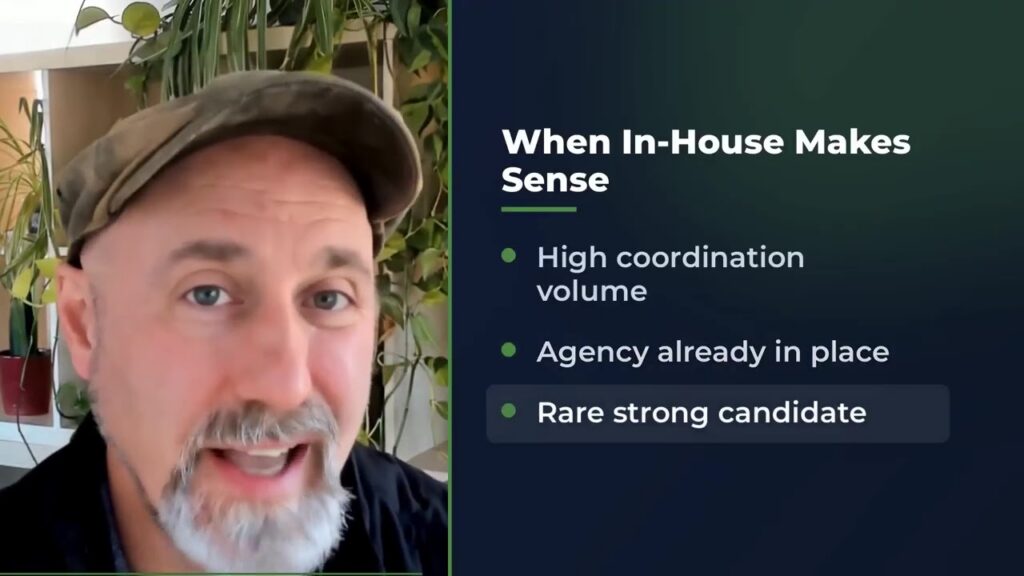
I am not here to sell you on agencies across the board. In-house makes sense when your company is large enough to need a full-time marketing coordinator just to manage the volume of content, reviews, and coordination work. You already have an agency handling the technical SEO, and you want someone in-house to execute the daily tasks and serve as the liaison. You have found a rare candidate who is genuinely strong in both content and analytics, has worked specifically in home services or restoration before, and you are prepared to give them the tools and time they need. That person exists. They are just not common, and they typically command a salary at the higher end of that range I mentioned.
5:08 When an Agency Makes Sense
An agency is usually the better first move when you are under about five million in revenue and you cannot yet justify a fully loaded marketing salary. You need results faster than a new hire can deliver them. Your SEO is basically starting from zero, and you need technical foundation work done before anyone does content. You want accountability and reporting built into the relationship rather than having to build that management structure yourself. Here is what I see working well for restoration companies in the growth phase. You hire a part-time or full-time marketing coordinator, someone in the thirty-five thousand to fifty thousand dollar range, whose job is execution, coordination, and customer communication. They manage reviews, they respond to leads fast, they post to social, and they feed information to your agency. Your agency handles the technical SEO, the content strategy, the keyword targeting, the link building, and the reporting. The two work together. You get coverage across both sides without asking one person to be an entire team. This costs more than one or the other alone, but for a shop doing two to ten million, it is often the right answer.
6:22 The Management Load Question
One thing owners underestimate with both options, someone has to manage this. With an in-house hire that is you or a manager on your team, you are doing performance reviews, setting goals, buying tools, and making judgment calls on marketing decisions every week. With an agency, you are reviewing reports, giving feedback on content, and making sure the work aligns with your business goals. Neither one runs itself. The agency model typically requires less of your time week to week, maybe an hour or two versus ten or fifteen hours managing a marketing employee, but you still have to stay engaged. If you sign with an agency and go dark, you will not get great results.
7:04 What to Ask Before You Hire Either
Whether you are interviewing an agency or a marketing hire, ask the same kinds of questions. For an agency, how many restoration or contractor clients do you actively work with right now? What does a typical month of work look like and how is it reported? How many organic keywords are you typically targeting for a site like mine and over what timeframe? That last question matters because a search data point I track shows restoration and contractor owners are actively searching phrases like "How many organic keywords should my agency be targeting?" and "How many keywords should a website have?" The honest answer is that a small to mid-size restoration company should realistically be targeting somewhere in the range of fifty to two hundred keywords with priority focus on the top ten to twenty that drive actual calls. If an agency promises you five hundred ranking keywords in sixty days, walk away. For an in-house candidate, what tools have you used? Show me work you have produced. What does a site audit look like to you? What would you do in your first ninety days?
8:11 What PushLeads Does
PushLeads is an SEO and content agency built specifically for contractors. That includes restoration companies. What it actually does, technical site work, location page builds, service page content, keyword tracking, and AI search optimization, specifically helping you show up in the AI-generated results that more and more homeowners are relying on to find service companies. It is not a full-service generalist agency. It is built for the contractor model where local search and AI visibility drive most of your inbound volume. If you are comparing options, it is worth knowing what they do and what they do not do so you can compare honestly.
8:52 The Mistake to Avoid
The biggest mistake I see restoration owners make, they hire an in-house person, give them no tools and no budget for content, and expect Google rankings to follow. Or they sign with a cheap agency, hand over their website login, and never look at a report. Marketing only works if someone is accountable for the output, the rankings, the leads, the calls, and if that accountability is baked into how you structure the relationship. Picture a typical restoration company doing about three million a year in revenue, running mostly on referrals and some paid ads. They want to reduce their cost per lead by leaning more on organic search. If they hire an in-house marketing person at fifty-five thousand in salary plus tools and overhead, call it seventy thousand total, they might see meaningful SEO movement in nine to twelve months if that person is skilled and focused. If they sign with a contractor SEO agency at twenty-five hundred a month, that is thirty thousand a year, and they can often see initial ranking movement in four to six months on their core service pages. The gap in time and cost is real. The in-house hire offers more daily presence and flexibility. The agency offers faster technical lift at lower total cost. Neither is wrong. The right one depends on what that owner needs most right now. Here is the simplest path forward.
10:19 What to Do Next
Before you hire anyone or sign anything, get a clear picture of where your site stands today. You can get a free AI visibility check at PushLeads.com/check. It shows you how your restoration company shows up in AI search results, where the gaps are, and what needs to happen first. That gives you something concrete to bring to any agency conversation or to give to a potential in-house hire as their starting point. The number is eight two eight three four eight seven six eight six.
Restoration SEO Agency vs In-House: What You Are Actually Buying

For restoration companies under about five million in annual revenue, an SEO agency almost always wins on cost and skill coverage compared to a single in-house marketing hire. The reason is simple: before you post a job listing or sign an agency contract, you need to understand that marketing is not one skill. It is a stack of skills. SEO alone covers technical audits, content writing, link building, local citation management, keyword research, and analytics reporting. Then you layer on paid ads, reputation management, social media, and email follow-up sequences. One person almost never covers all of that at a professional level, not because they are not talented, but because the work has become that specialized.
When restoration owners tell me they want to hire someone for marketing, the first question I ask is: which parts of marketing, and at what depth? A marketing coordinator can handle two or three of these disciplines well and coordinate vendors for the rest. That is a real and valuable role. But if you expect one hire to run your entire marketing operation at a high level, you are going to be disappointed, and so are they. Understanding what each option actually delivers is the only way to make a smart decision on the restoration SEO agency vs in-house question for your specific business right now.
In this video
- 0:00 Why Generic Agencies Fail Restoration Companies
- 0:20 Restoration Services Require Specialist SEO Knowledge
- 1:05 Emergency Intent vs Research Intent Keywords
- 2:02 TPA and Insurance-Driven Search Behavior
- 2:45 Service Area Pages Done Right
- 3:44 GBP Categories for Restoration Companies
- 4:29 Call Tracking and Attribution That Actually Matters
- 5:21 Questions to Ask Before Hiring Any SEO Agency
- 6:13 Proof to Demand Before You Sign
- 6:42 Red Flags That Should End the Conversation
- 7:35 Keyword Strategy for Service Pages and Blog Posts
- 8:05 Monthly Reporting Benchmarks for Restoration SEO
- 8:41 How PushLeads Works With Restoration Companies
Want more customers from Google & AI search?
Get a free SEO audit of your site — see exactly what to fix first.
What One In-House Marketing Person Can Realistically Cover

A single in-house marketing hire can professionally manage two or three disciplines, coordinate vendors, and serve as your internal point of contact for outside partners. That is genuinely useful, but it is not the same as a full marketing team. Being honest about the boundaries up front saves a lot of frustration on both sides.
What tasks does an in-house marketing coordinator actually do well?
An in-house coordinator is typically strong at the execution and communication layer of marketing. They can respond to phone leads and online inquiries quickly, manage and respond to Google reviews, post to social media channels, run simple email campaigns to past customers, and manage the relationship with your outside agency. These tasks matter a lot for a restoration company where speed of response and reputation are part of how you win jobs. A coordinator who does these things consistently frees you up from daily communication tasks and keeps your brand presence active without requiring deep technical knowledge.
The key is matching expectations to reality. A good coordinator is a force multiplier when they have an agency partner handling the technical side. They become a bottleneck when they are asked to do everything.
What marketing work is typically beyond one in-house person?
Technical SEO, link acquisition, content strategy across dozens of service and location pages, conversion rate testing, and paid search optimization are the areas where a single hire almost always falls short when asked to manage all of them simultaneously. Each of these areas requires deep, current knowledge. Technical SEO alone changes constantly. Keeping up with crawl error fixes, page speed improvements, schema markup, and Core Web Vitals is a full-time specialty on its own. Link building from local and industry sources requires outreach relationships and processes that take months to build. Content strategy for a restoration company covering water damage, fire damage, mold, and storm services across multiple service areas means managing dozens of pages at once. Expecting one person to own all of that alongside their daily coordination tasks sets them up to fail.
How should a restoration owner set expectations with a marketing hire?
Be specific in the job description about which two or three areas this person will own, and be clear that they will coordinate outside vendors for the rest. Define what success looks like in the first ninety days with concrete deliverables: response time to leads, review response rate, number of social posts per week, and reporting cadence with your agency. A focused role with clear metrics is fair to the hire and productive for the business. A vague role with unlimited scope is how you burn through marketing employees and marketing budgets at the same time.
The Ramp Time Nobody Talks About When Hiring In-House

A new in-house marketing hire, even a skilled one, typically takes three to six months before their work is moving rankings or generating leads. During that period you are paying full salary while results are still months away. That gap is real and it is worth pricing into your decision before you post the job listing.
Why does in-house ramp time take so long for a restoration company?
Your new hire needs to learn your brand voice, your service area geography, your competitors, your past content, your CRM, and your reporting tools before they can produce work that matters. For a restoration company, that also means understanding how water damage, fire damage, and mold jobs differ in search intent, in customer urgency, and in the words people actually type. Skipping that learning phase produces generic content that ranks for nothing. Doing it right takes time, and that time costs money even before the first piece of content goes live.
How fast does a restoration-focused agency ramp compared to an in-house hire?
A contractor or restoration-focused agency walks in already knowing the keyword landscape for your core services. They have worked with other restoration companies, they know that “water damage restoration near me” and “emergency water extraction” have different search volumes and different user intents, and they have templates and processes built around the contractor model. Their ramp on the technical side is shorter because they are not learning the category on your budget. What does take time is onboarding them to your specific business: your service area boundaries, your differentiators, your past reviews, and your existing site. That onboarding period is real, but it starts from a closer position to ready. For more context on when the timing makes sense, there is a full breakdown of when to hire an agency versus waiting that covers this in detail.
What is a realistic timeline for seeing SEO results from either option?
With a contractor SEO agency, initial ranking movement on core service pages often appears in four to six months. With an in-house hire who is skilled and focused, meaningful SEO movement typically takes nine to twelve months. That four-to-six-month difference matters when you are trying to reduce dependence on paid ads or referrals. The timeline for SEO results is never instant regardless of which path you choose, but the starting point is different depending on the experience your chosen option brings to the table.

The Real Cost Comparison Between an Agency and an In-House Hire

An in-house marketing coordinator in most markets costs seventy thousand to eighty-five thousand dollars per year all-in, while a reputable SEO agency for a small restoration company typically runs eighteen thousand to forty-eight thousand dollars per year. These numbers are not directly comparable because each option delivers a different set of capabilities, but the gap is real and worth understanding before you make a commitment either way.
What does an in-house marketing hire actually cost when you count everything?
Salary for a marketing coordinator in most markets runs between forty-five thousand and sixty-five thousand dollars per year. That is before you add employer payroll taxes, health benefits, software tool subscriptions, training, and the management time it takes to supervise, review, and develop that employee. When you count the full loaded cost, you are typically looking at seventy thousand to eighty-five thousand dollars per year. That is a real investment, and it needs to produce a real return. If your company is doing three million per year on referrals and paid ads with almost no organic SEO foundation, spending seventy thousand dollars on one person who cannot build that foundation quickly is a slow and expensive path to organic growth.
How much does a contractor SEO agency cost per month?
A reputable SEO agency focused on contractors and restoration companies typically runs between fifteen hundred and four thousand dollars per month depending on scope, which works out to eighteen thousand to forty-eight thousand dollars per year. For context on what that buys at different price points, there is a detailed breakdown of digital marketing package costs that shows what is typically included at each tier. The agency cost does not include someone managing your phones, posting your social stories, or sitting in your team meetings. That is the gap the in-house coordinator fills. These are two different things at two different price points, not the same thing at two different costs.
How should a restoration owner compare these two numbers honestly?
The comparison is not agency cost versus in-house salary. It is agency capabilities versus in-house capabilities at their respective costs. An agency at twenty-five hundred per month delivers technical site work, content production, link building, and keyword tracking that one coordinator at fifty-five thousand per year almost certainly cannot replicate. The coordinator at fifty-five thousand delivers daily execution, review management, lead response speed, and coordination that an agency does not provide. If you try to get everything from one and pay the price of the other, you will be underwhelmed by the result. Price both against what they actually deliver, not against each other as if they are substitutes.

What a Restoration-Focused SEO Agency Actually Delivers

A contractor SEO agency handles the technical work your in-house person probably cannot: site audits, crawl error fixes, page speed improvements, location and service page builds, optimized content, link earning from local and industry sources, and keyword and call tracking in a readable dashboard. That is the technical foundation that makes organic search work for a restoration company.
What specific SEO tasks should a restoration agency handle each month?
On the technical side: monitoring and fixing crawl errors, managing page speed, maintaining schema markup, and keeping your Google Business Profile optimized. On the content side: writing and publishing service pages for water damage, fire damage, mold, and storm services, building out location pages for every city and community in your service area, and creating supporting content that answers the questions your customers are typing before they call. On the authority side: earning backlinks from local directories, trade associations, and relevant industry sources. On the reporting side: tracking keyword rankings, phone calls, and form fills in a dashboard that shows whether the work is producing real business results. Restoration company SEO agencies that are built specifically for the contractor model have systems for all of this rather than building it from scratch for each client.
How does AI search visibility fit into what an agency should deliver?
Restoration companies that show up in AI-generated results, including Google AI Overviews and tools like ChatGPT and Perplexity, receive significantly more inbound calls without additional ad spend. This is a newer layer of local search that most in-house hires are not yet trained on. A good agency should already be optimizing your content and site structure to appear in these AI-sourced answers. That means writing content in a format that AI engines can extract and cite, ensuring your entity information is consistent across the web, and building the kind of authoritative content that AI tools surface when someone asks “who does water damage restoration in Asheville?” If your agency is not talking about AI visibility, it is behind on where search is going.
How do I know who is actually doing the SEO work at the agency?
This is one of the most important questions to ask before signing anything. Some agencies sell work and then outsource it to low-cost contractors overseas with no industry knowledge. Others have dedicated specialists in-house who handle restoration and contractor accounts specifically. Ask directly: who handles my account day to day, what is their background, and can I speak with them before I sign? Understanding who does the SEO work at any agency you are considering will tell you a lot about whether the results they promise are realistic.

When In-House Actually Makes Sense for a Restoration Company

In-house marketing makes sense when your company is large enough to need a full-time coordinator managing content volume, reviews, and coordination work alongside an existing agency partner handling the technical SEO. It is not an either-or decision at that stage; it is an addition to an existing agency relationship, not a replacement for one.
What revenue level justifies a full-time in-house marketing hire?
A rough threshold is somewhere around five million in annual revenue, though it depends more on marketing volume than revenue alone. If you are running multiple Google Business Profile locations, generating enough review volume to require daily management, producing enough content to need a dedicated writer and coordinator, and already have an agency handling technical SEO, then a full-time in-house hire starts to pay for itself. Below that threshold, the loaded cost of a full-time employee typically exceeds what that employee can produce in organic growth, especially compared to what an agency at a fraction of the cost can deliver technically.
What does the rare strong in-house marketing candidate look like?
The candidate who actually works at a high level in-house is strong in both content creation and analytics, has worked specifically in home services or restoration before, understands local SEO at a practical level, and is comfortable working independently with minimal tool and budget constraints. That person exists. They are just not common, and when they do exist, they typically command a salary at the higher end of the forty-five thousand to sixty-five thousand dollar range. If you find that candidate and can pair them with strong agency support, that combination can be very productive. Hiring a weaker candidate at a lower salary and expecting high-level output is the scenario that consistently disappoints.
What is the hybrid model and why does it often work best?
The hybrid model that works well for restoration companies in the growth phase looks like this: a part-time or full-time marketing coordinator in the thirty-five thousand to fifty thousand dollar range whose job is execution, coordination, and customer communication, paired with a contractor SEO agency handling technical SEO, content strategy, keyword targeting, link building, and reporting. The coordinator manages reviews, responds to leads fast, posts to social, and feeds information to the agency. The agency handles everything requiring deep technical expertise. Together they provide coverage across both sides of marketing without asking one person to be an entire team. For a shop doing two to ten million, this hybrid approach often produces better results per dollar than either option alone.
The Management Load Question Both Options Carry

Someone always has to manage the marketing relationship, whether that is an in-house employee or an outside agency. Neither option runs itself, and owners who assume they can hand off marketing entirely and walk away from it will not get strong results from either path.
How much time does managing an in-house marketing hire actually take?
Managing a marketing employee means doing performance reviews, setting goals, buying and managing software tools, making judgment calls on marketing decisions every week, and troubleshooting when campaigns are not working. In practice, that often runs ten to fifteen hours per week for an owner or operations manager who takes it seriously. If the person managing the marketing hire does not have a marketing background, there is also the challenge of evaluating work quality. How do you know if the content they are writing is good? How do you know if the SEO changes they made are correct? Without a baseline of marketing knowledge, you end up either micromanaging or trusting blindly, neither of which produces great results.
How much time does managing an agency relationship take each week?
Managing an agency relationship typically requires one to two hours per week. That includes reviewing monthly reports, giving feedback on content drafts, approving new pages before they go live, and staying aligned on priorities as your business goals change. It is significantly less time than managing an employee, but it is not zero. If you sign with an agency and go completely dark, you will not get great results. The agency needs your feedback on content accuracy, your input on seasonal priorities like storm season, and your sign-off on major site changes. The relationship works best when you stay engaged at a light but consistent level.
What ownership and contract terms should I understand before signing with an agency?
Before you sign an agency contract, clarify who owns the website and content if you cancel. Some agencies build your site on their own platform and retain ownership, which means you lose everything if you leave. Others build on platforms you own outright. Understanding ownership after cancellation is one of the most important contract questions to settle before you commit. Also clarify contract length, what deliverables are guaranteed each month, and what reporting you will receive. These terms define the accountability structure of the relationship, and accountability is what separates an agency investment that works from one that wastes your budget.
What to Ask Before You Hire Either an Agency or an In-House Person

Whether you are interviewing an agency or a marketing hire, the questions you ask before committing will tell you more than any resume or proposal. Vague answers to specific questions are a signal worth paying attention to in both directions.
What should I ask an SEO agency before I sign a contract?
Ask how many restoration or contractor clients they actively work with right now, not in total history but currently. Ask what a typical month of deliverables looks like for a business like yours and how progress is reported. Ask how they handle keyword targeting specifically: how many keywords are they prioritizing, which ones, and over what timeframe? The honest answer for a small to mid-size restoration company is that realistic priority focus sits on the top ten to twenty keywords that actually drive calls, with a broader target list of fifty to two hundred. If an agency promises you five hundred ranking keywords in sixty days, that is a signal to walk away. That kind of promise does not reflect how search engines work. For a thorough framework on evaluating agencies, the guide on choosing a specialist agency covers the specific criteria that separate reliable partners from ones that overpromise.
What should I ask an in-house marketing candidate before I hire them?
Ask what tools they have used and ask them to show you work they have actually produced, not describe it. Ask what a site audit looks like to them and have them walk you through one live. Ask what they would do in their first ninety days and push for specifics, not marketing language. A strong candidate will tell you they would audit your existing content, analyze your Google Business Profile for completeness and category accuracy, check your top competitor pages for keyword gaps, and set up or clean up your reporting dashboard. A weak candidate will describe a general plan with no specific steps. The specificity of the answer predicts the specificity of the work.
How many organic keywords should my restoration company be targeting?
A small to mid-size restoration company should realistically target fifty to two hundred keywords with priority focus on the ten to twenty that drive actual calls. Those priority terms include high-intent phrases like “water damage restoration in [city],” “emergency flood cleanup near me,” and “fire damage repair [city].” The broader list includes supporting content targets that build topical authority around those core terms. If you are asking this question before hiring an agency, it is also worth asking the agency how they decide which keywords get priority and what data they use to make that call. Their answer will tell you a lot about how systematically they approach the work.

The Mistake That Wastes Both Time and Budget
The biggest mistake restoration owners make is hiring an in-house person with no tools, no budget for content, and no technical foundation, then expecting Google rankings to follow. The second version of the same mistake is signing with a cheap agency, handing over the website login, and never reading a report. Both mistakes share the same root cause: no one is accountable for the output.
Why does hiring an in-house person without an SEO foundation fail?
If your website has crawl errors, slow page speed, missing meta data, duplicate content, and no location pages, putting a coordinator in charge of posting to social and responding to reviews will not fix any of that. Those technical issues prevent your pages from ranking regardless of how good your content is. The coordinator cannot fix them without deep technical knowledge, and without fixing them, the content they produce does not rank. You end up with active, friendly social channels and a website that Google cannot properly index. The investment in the coordinator produces activity but not rankings or calls. The technical foundation has to come first, and that work almost always requires someone with specific SEO expertise to do it correctly.
Why does signing with a cheap agency and ignoring it also fail?
A low-cost agency that is not held accountable will produce low-effort work, generic blog posts, minimal link building, no location page strategy, and reports that show activity metrics rather than business results. If you never review the reports, you will not know the difference until months have passed and nothing has changed in your rankings or call volume. Accountability requires that you review the work, ask questions when something does not make sense, and push back when deliverables are missing. That is not a lot of time, but it is not zero time. Marketing without accountability produces mediocre results regardless of whether the person is in-house or at an agency.
What should a three-million-dollar restoration company expect from each path?
A restoration company doing three million per year, running mostly on referrals and paid ads, wanting to build organic search as a lead channel, faces a concrete choice. An in-house hire at fifty-five thousand dollars in salary plus overhead, call it seventy thousand total, might produce meaningful SEO movement in nine to twelve months if that person is skilled, focused, and given the right tools and technical support. An agency at twenty-five hundred per month, thirty thousand per year, can often produce initial ranking movement on core service pages in four to six months. The in-house hire offers more daily presence, flexibility, and institutional knowledge. The agency offers faster technical lift at lower total cost. Neither path is wrong. The right one depends on what your business needs most right now and what you can sustain for the twelve to eighteen months it takes for organic SEO to become a reliable lead channel.
Frequently Asked Questions
How much does a restoration SEO agency cost per month?
A reputable SEO agency focused on restoration or contractor companies typically costs between fifteen hundred and four thousand dollars per month depending on the scope of work. At the lower end you are getting foundational technical work and basic content production. At the higher end you are getting full content strategy, active link building, local map pack optimization, and AI search visibility work. Generalist agencies often charge similar rates but deliver less industry-specific knowledge, which typically produces slower results for restoration companies.
How long does it take for restoration SEO to produce leads?
Initial ranking movement on core service pages typically appears in four to six months when working with a contractor-focused agency that starts from a solid technical foundation. Consistent lead volume from organic search usually takes nine to twelve months to build into a reliable channel. Competitive markets and weaker starting-point websites take longer. Sites that already have some technical health and content history can see movement faster. There is no honest way to promise specific results in a specific timeframe, and any agency that does should be questioned on how they will guarantee it.
Can one in-house person handle all of my restoration company’s marketing?
One in-house person can handle two or three marketing disciplines at a professional level and coordinate outside vendors for the rest. They cannot simultaneously run technical SEO, produce a full content strategy across dozens of pages, build backlinks, manage paid search, and handle daily execution tasks at a high level. Expecting one hire to cover all of that leads to shallow work across the board rather than deep work in the areas that move the needle most. A focused role with clear boundaries produces better results than an unlimited role with no support.
What is the hybrid model for restoration company marketing?
The hybrid model pairs a part-time or full-time marketing coordinator handling execution and communication with an agency handling technical SEO, content strategy, link building, and reporting. The coordinator manages reviews, responds to leads quickly, posts to social, and serves as the liaison with the agency. The agency handles the technical depth the coordinator cannot. For restoration companies doing two to ten million per year, this combination often produces better coverage per dollar than either option alone, though it does cost more in total than either path individually.
How do I know if my SEO agency is actually doing the work?
Ask for a monthly report that shows specific deliverables completed, not just traffic graphs. You want to see which pages were updated or created, which keywords moved in ranking, how many links were earned and from where, and what the call and form fill volume looks like month over month. If your agency sends you a report full of impressions and clicks but no specific work product, ask directly what was built or changed that month. An agency that cannot answer that question specifically is not producing meaningful work.
What keywords should a restoration company rank for?
Priority keywords for most restoration companies include service-plus-location phrases like “water damage restoration in [city],” “fire damage repair [city],” and “mold remediation near me,” along with emergency intent phrases like “emergency flood cleanup” and “burst pipe water damage.” A realistic target list runs fifty to two hundred keywords with focused effort on the ten to twenty that drive actual calls. Supporting content targets build topical authority around those core terms. Broad vanity keywords with high national volume but no local intent rarely convert into calls for service companies.
Should a restoration company prioritize Google rankings or AI search visibility?
Both matter and they reinforce each other. Traditional Google rankings still drive significant call volume, particularly through the local map pack. AI search visibility in tools like Google AI Overviews, ChatGPT, and Perplexity is growing as a source of inbound inquiries. The good news is that the content and technical practices that produce strong traditional rankings also tend to improve AI visibility. Building authoritative, specific, well-structured content about your services and service areas serves both channels. A good agency should be optimizing for both rather than treating them as separate strategies.
What should I do before hiring an agency or a marketing employee?
Get a clear picture of where your website stands today before you commit to either path. Know your current keyword rankings, your site’s technical health, your Google Business Profile status, and how you appear in AI search results. This gives you a concrete baseline to bring to any agency conversation and a starting point to hand to a potential in-house hire. Without that baseline, you cannot evaluate whether the work being done is actually improving anything, and you cannot hold anyone accountable for results you cannot measure.
Start With a Clear Picture of Where Your Site Stands Right Now
Before you post a job listing or sign an agency contract, you need an honest assessment of where your restoration company stands in search today. Without that baseline, any decision you make is based on guesswork rather than data. You cannot evaluate agency proposals without knowing what your site actually needs. You cannot give an in-house hire a productive starting point without knowing what is broken and what is already working.
At PushLeads, we work specifically with contractors and restoration companies on local SEO and AI search visibility. That means technical site work, service and location page builds, content that ranks, and optimization for the AI-generated results that more homeowners are using to find service companies. We are not a generalist agency trying to serve every industry. We are built for the contractor model where local search drives most of your inbound volume.
If you are comparing your options right now, the first step is getting a clear view of your current visibility. You can get a free AI visibility check at PushLeads that shows how your restoration company appears in AI search results, where the gaps are, and what needs to happen first. That gives you something concrete to work from regardless of which direction you decide to go. Reach out at pushleads.com/contact or call 828-348-7686 to get started.
Keep Reading
Want more customers from Google & AI search?
Get a free SEO audit of your site — see exactly what to fix first.
Your path · Restoration Company SEO
Keep going: read these next

- Up nextIn-House Marketing Hire vs. Agency for Restoration Companies


Want this done for you?
Scan your site. See the gaps. Decide with numbers.
- Rankings, Google Business Profile and site-speed teardown
- Report lands in your inbox in about a minute
- No obligation · 4.9 from 67 Google reviews
 Continue reading