


TL;DR: Attribution in local services is genuinely hard and mostly solvable with three habits rather than a platform: ask every caller how they found you, tag every lead with a source, and record whether it closed. Perfect attribution is unavailable. Good-enough attribution changes budget decisions, and that’s the point.
Table of Contents
Want it done for you? See our local SEO services.
- Why last-click misleads in local
- The three-touch model
- Closing the loop with your CRM
- Handling walk-ins, referrals, and repeat customers
- What to do when the data conflicts
- Reporting that survives a skeptical owner
Why Last-Click Misleads in Local
Last-click gives all credit to the final interaction before the lead. For a local service business that’s usually wrong in a specific and expensive way.
In this video
- 0:00 SEO Dashboard Features That Prove Revenue
- 1:47 Why Most SEO Dashboards Fail ROI
- 2:36 Core Dashboard Features Every Business Needs
- 3:26 Click-Through Rate Your Biggest Quick Win
- 4:11 Enterprise vs Small Business Dashboard Requirements
- 5:04 Segmentation Turns Data Into Decisions
- 6:03 Choosing the Right SEO Dashboard Tool
- 6:55 Vanity Metrics to Remove From Your Dashboard
- 7:50 Connecting Dashboard Data to Real SEO Work
- 9:34 Setting Up a Dashboard You Will Actually Use
- 11:17 Tracking AI Overviews as a Visibility Layer
- 12:00 FAQs on SEO Dashboard Best Practices
Full transcript: SEO Dashboard Features That Actually Prove Revenue (Small Business + Enterprise)
A realistic journey: a homeowner sees your truck in the neighborhood. Two weeks later their water heater fails. They search “water heater repair near me,” see your Google Business Profile, recognize the name from the truck, read two reviews, click your website, and call.
Last-click credits organic search. Which isn’t wrong — but the truck created the recognition that made your listing the one they picked, and the reviews closed it. Cut your local presence because “organic gets the credit” and organic performance falls without an obvious cause.
Three specific distortions worth naming:
Branded search absorbs credit from everything. Someone who searches your company name found you somewhere else first. Branded organic is a symptom of other marketing working, not a channel that generates demand.
Google Business Profile is systematically undercredited. Many GBP interactions end in a direct call that never touches your website, so analytics never sees them.
Word of mouth is invisible. It’s frequently your highest-closing source and it appears in no platform.
Want more customers from Google & AI search?
Get a free SEO audit of your site — see exactly what to fix first.
The Three-Touch Model
Full multi-touch attribution requires infrastructure most local businesses won’t maintain. This is the version that survives contact with a busy office.
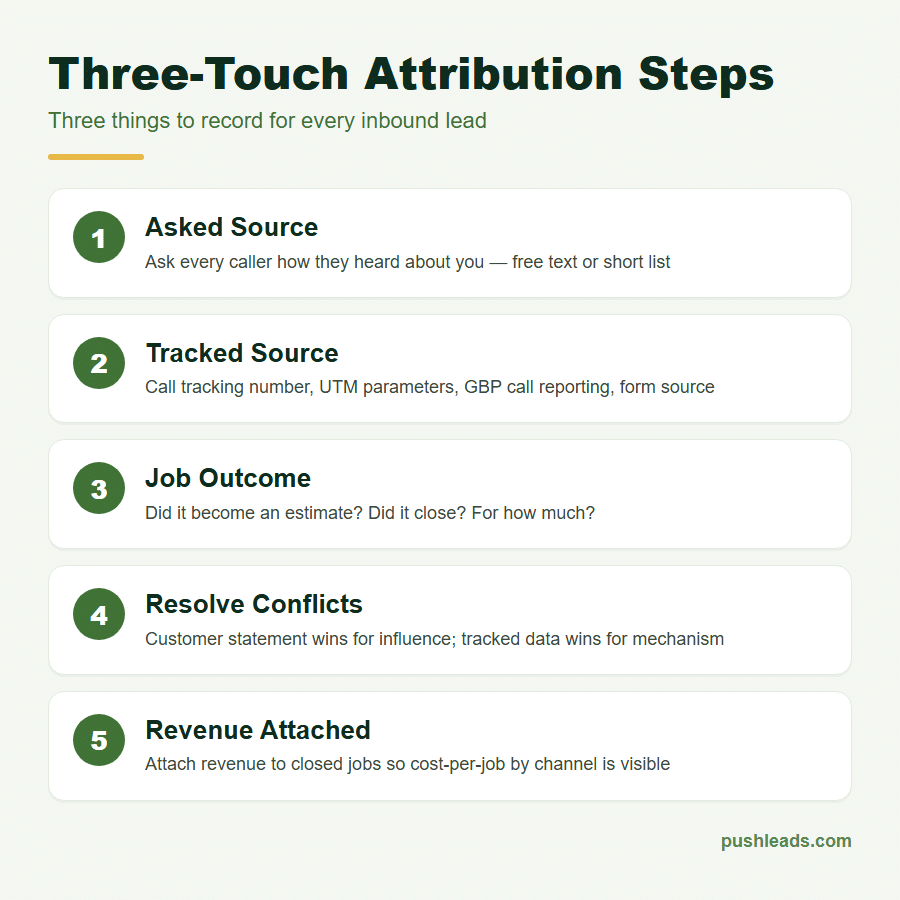
Record three things per lead:
1. Asked source. Whoever answers the phone asks: “How did you hear about us?” One field, free text or a short list. Imperfect — people misremember, and “Google” covers organic, maps, and ads — but it’s the only way to capture offline influence.
2. Tracked source. What your systems say: call tracking number, UTM parameters, GBP call reporting, form source. Objective, and blind to anything offline.
3. Outcome. Did it become an estimate? Did it close? For how much?
When asked and tracked disagree, that’s information rather than a problem. A lead tracked as organic where the customer says “my neighbor recommended you” tells you referral drove it and search was just the lookup mechanism.
Two rules make this work: one required source field on every lead, and the same person or process filling it in every time. Consistency beats sophistication — a slightly wrong taxonomy applied every day is far more useful than a perfect one applied sporadically.
Closing the Loop With Your CRM
The loop is what converts attribution from a traffic report into a budget tool. Four steps:
1. One record per lead, wherever it came from. Phone, form, chat, walk-in.
2. Source captured at creation, not added later from memory.
3. Stage tracked to conclusion — contacted, estimated, won, lost, and the reason for lost.
4. Revenue attached to won jobs.
With those four you can produce the table that matters:
| Channel | Leads | Estimates | Won | Close rate | Revenue | Spend | Cost/job |
|---|---|---|---|---|---|---|---|
| Organic search | |||||||
| Google Business Profile | |||||||
| Paid search | |||||||
| Local Service Ads | |||||||
| Referral | |||||||
| Repeat customer |
Almost no local business maintains this, and the ones that do make visibly better budget decisions. It’s also the report your marketing provider probably can’t build without CRM access — which is a good reason to grant it.
Handling Walk-Ins, Referrals, and Repeat Customers
These three break naive attribution and need explicit rules.
Referrals get their own source, always. They close at far higher rates than anything paid, and burying them inside “word of mouth” or “other” hides your best channel. If a specific customer referred them, record who — that’s a thank-you and possibly a referral program.
Repeat customers are not marketing leads. Track them separately or you’ll overstate channel performance and make bad budget calls. A returning customer found you once; crediting that to this month’s organic performance is double-counting.
Walk-ins and truck-sightings get a source too, even though nothing digital touched them. This is exactly the offline influence last-click erases.
Multi-touch leads — where asked and tracked disagree — keep both fields. Don’t force a single answer. The disagreement is the most useful data in the system.
What to Do When the Data Conflicts
Conflicts are normal. Resolve them with a hierarchy rather than arguing:
- Customer’s own statement wins for influence — what made them choose you
- Tracked data wins for mechanism — how they reached you
- CRM outcome wins for value — what it was worth
Applied: 40% of customers say “Google” while your analytics shows 25% organic and 15% GBP. Both are right. The customer experienced one thing; your systems saw two. Report it as 40% Google with the split noted, and stop trying to force reconciliation.
When numbers are genuinely irreconcilable, check the boring explanations first: a tracking number that stopped forwarding, a form that stopped emailing, a GBP call that never touched the site, UTMs stripped by a redirect. In our experience it’s a broken mechanism more often than a measurement philosophy problem.
Reporting That Survives a Skeptical Owner
Most attribution reporting fails because it reports traffic to someone who thinks in jobs. Three fixes:
Lead with jobs and revenue, not sessions and impressions. Start the report at the bottom of the funnel and work up.
Show cost per booked job by channel. It’s the only number that makes a budget decision obvious.
State the limitations out loud. “Referrals and truck sightings are self-reported and undercounted. GBP calls that never hit the website aren’t in analytics.” An owner who’s been told what the data can’t say trusts what it does say.
Then give it three months before drawing conclusions. One month of a service business is mostly weather.
Quick Recap
- Last-click undercredits GBP, absorbs credit into branded search, and erases word of mouth entirely.
- Record three things per lead: asked source, tracked source, and outcome.
- One required source field, filled in consistently, beats a sophisticated model applied sporadically.
- Referrals get their own source; repeat customers are excluded from channel performance.
- Customer statement wins for influence, tracked data for mechanism, CRM for value.
- Report jobs and revenue first, cost per booked job second, and state the limitations.
Frequently Asked Questions
Do I need attribution software?
Most single-location businesses don’t. A source field in your existing CRM plus call tracking plus GBP reporting covers it. Software helps at multiple locations or above roughly $10k monthly ad spend.
How accurate is “how did you hear about us?”
Directionally useful, precisely unreliable. People genuinely misremember. It’s still the only way to capture offline influence, so ask it anyway.
Should I credit branded search as organic?
Track it separately. Branded search measures whether your other marketing is working; folding it into organic overstates SEO and hides what created the demand.
How do I attribute a lead that took three months?
Record the first known touch and the last, and don’t agonize about the middle. For long cycles the useful question is which channel started it.
What’s the single highest-value change?
Making the source field required at lead creation. Everything else builds on it, and it costs one dropdown.
Keep Reading
Want more customers from Google & AI search?
Get a free SEO audit of your site — see exactly what to fix first.
Your path · What Is SEO? The Complete Guide to Search Engine Optimization for Businesses
Keep going: read these next

- The orphan pages killing your local business SEO
- SEO Analytics and Reporting Research Report: Measuring Success That Actually Drives Business Results




Want this done for you?
Scan your site. See the gaps. Decide with numbers.
- Rankings, Google Business Profile and site-speed teardown
- Report lands in your inbox in about a minute
- No obligation · 4.9 from 67 Google reviews

