

TL;DR: A marketing analytics dashboard tracks all your channels in one place, while an SEO dashboard focuses on search rankings, organic traffic, and local visibility. The right choice depends on where your leads come from. Many Asheville businesses get the best results using both together.
AI SEO Performance Dashboard vs Marketing Analytics Suite: What Is the Real Difference?
An AI SEO performance dashboard focuses on search-specific signals like keyword rankings, organic traffic, and backlink health, while a marketing analytics suite shows how every channel, including social, email, and paid ads, works together across your entire strategy. Both tools measure digital performance, but they answer different questions. An SEO dashboard answers, “How is my site ranking and bringing in organic leads?” A marketing analytics suite answers, “How is my entire marketing mix performing as a unit?”
Choosing between them is not about which tool is better in general. It is about which tool matches the way your business actually generates customers. Measuring digital marketing success starts with knowing which data you need most, and that depends entirely on your lead sources.
| Feature | SEO Dashboard | Marketing Analytics Suite |
|---|---|---|
| Primary focus | Organic search performance | All marketing channels combined |
| Keyword rankings | Yes, in depth | Limited or summary only |
| Local SEO metrics | Yes, detailed | Rarely included |
| Social media data | No | Yes |
| Email performance | No | Yes |
| Paid advertising results | No | Yes |
| Backlink health | Yes, detailed | Rarely included |
| Best for | Organic-first lead generation | Multi-channel marketing teams |
| Ideal user | SEO specialist or service business | Marketing director or executive team |
Want more customers from Google & AI search?
Get a free SEO audit of your site — see exactly what to fix first.
What Does a Marketing Analytics Dashboard Actually Track?
A marketing analytics dashboard tracks every channel in your digital strategy from one central view, so you can see how social media, email, paid ads, and organic traffic all influence each other at the same time.
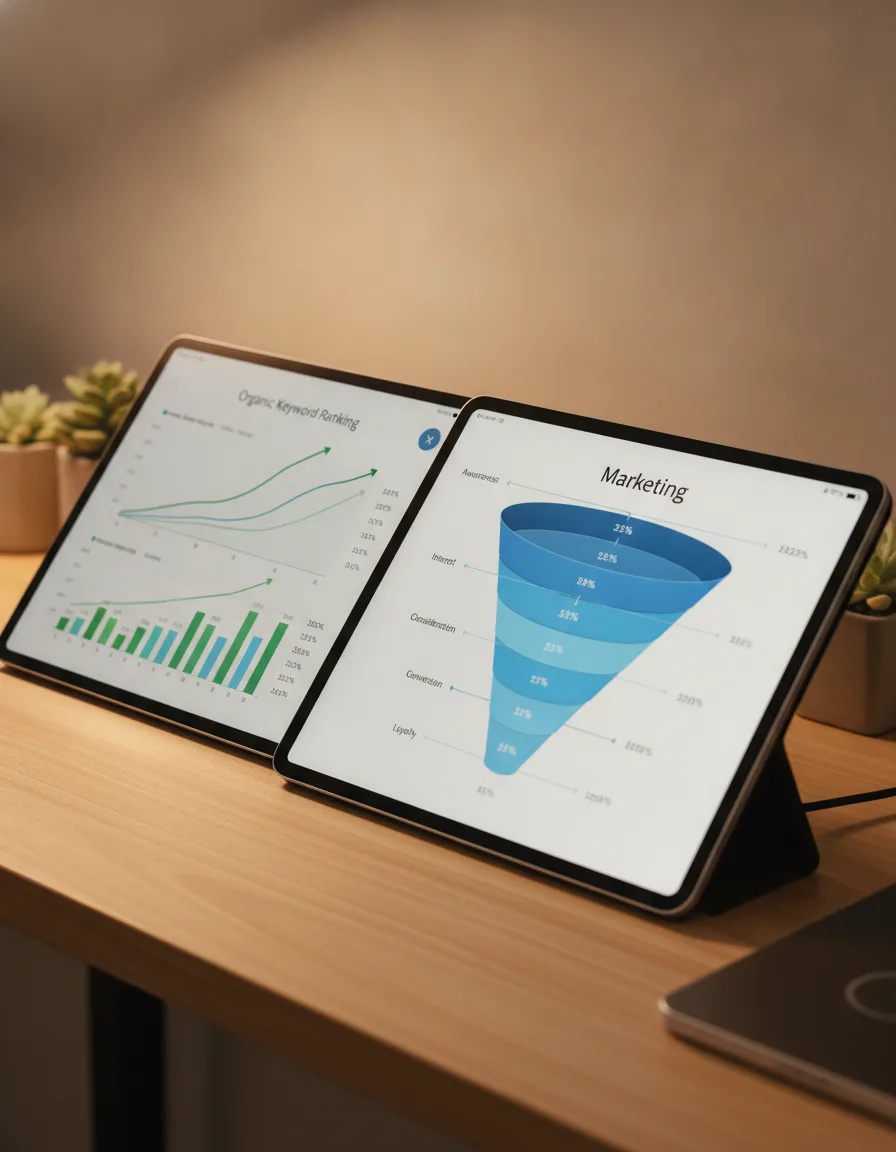
Think of it as your business mission control. Instead of logging into five separate platforms, you see all your numbers in one place. A marketing analytics dashboard typically tracks:
- Social media engagement and conversions
- Email marketing performance
- Paid advertising results
- Website traffic from all sources
- Customer journey insights
- Conversion rates across channels
The biggest advantage here is visibility into how your channels affect each other. You might find that your email campaigns push more people to engage with your social posts, or that your paid ads perform better when your content marketing is active. For businesses running multiple campaigns at once, this cross-channel view helps you find the combinations that deliver the strongest return on your investment.
What Makes a Specialized SEO Dashboard Worth Using?
A specialized SEO dashboard is worth using when organic search is your primary source of leads, because it shows the exact keyword rankings, traffic quality, and technical issues that a broad marketing dashboard glosses over.

Rather than tracking everything, an SEO dashboard goes deep on search. An SEO client dashboard features overview typically covers:
- Keyword rankings and movement over time
- Organic traffic patterns and quality
- Backlink profile health and growth
- Technical SEO issues and fixes
- Content performance for search visibility
- Local SEO metrics, which are especially important for Asheville service businesses
The strength of this tool is specificity. It tells you exactly which keywords are moving, which pages are gaining or losing ground, and what technical problems are holding your site back. For businesses that rely on organic traffic, this focused view surfaces opportunities that would disappear inside a broader dashboard full of unrelated channel data.
Which Dashboard Drives Better Results for Your Business?
The dashboard that drives better results is the one that matches your primary lead generation channel: use a marketing analytics suite if you run multiple channels equally, and use an SEO dashboard if organic search brings in most of your customers.
Marketing Analytics Dashboards Work Best When:
Your business uses social media, email, and paid advertising at the same level, and you need to see how they interact. A retail business running active campaigns across all three channels needs that unified view to make smart budget decisions.
You report to stakeholders who want a complete performance picture, not channel-by-channel breakdowns. These dashboards are built for executive meetings where the big picture matters most.
Your marketing team handles diverse responsibilities and needs one shared tool. A unified dashboard helps everyone see how their work connects to overall business goals.
SEO Dashboards Drive Better Results When:
Your business generates most of its leads through organic search. Many Asheville service businesses, including plumbers and restoration companies, rely on their websites as their primary lead generation tool. A search strategy focused on local keywords needs the precision that only an SEO dashboard provides.
You need to track local search performance closely. For businesses serving specific geographic areas like Asheville, local SEO metrics connect directly to call volume and qualified leads.
You are investing in content marketing and need to measure how each piece performs in search, not just how much traffic your site gets overall.
How Do You Get the Best of Both Dashboards?
You get the best of both dashboards by giving your SEO team a specialized dashboard for technical details while giving leadership a broader marketing analytics view that includes key SEO metrics as one input among many.

This hybrid setup works because different people on your team need different data. The person doing the SEO work needs granular keyword and backlink data. The business owner or marketing director needs to see how SEO results fit into the full revenue picture.
The most successful businesses understand that measurement is not about collecting as much data as possible. It is about collecting the right data that leads to better decisions faster.
What Happens When You Pick the Right Dashboard?
When you pick the right dashboard, you stop guessing which actions to take and start making decisions based on data that directly connects to leads and revenue.
Related: Kpi bonus.
A local legal services firm came to PushLeads tracking dozens of marketing metrics but could not figure out why their phone was not ringing with qualified leads. By switching to a specialized SEO dashboard focused on local search metrics, the team identified that the site had traffic but was not ranking for the service-specific keywords their ideal clients were searching. After targeted optimization guided by those insights, their qualified leads increased by over 40% within three months.

The key was matching the dashboard to their actual lead generation channel, which was organic search.
Quick Recap
- A marketing analytics dashboard shows how all your channels work together in one view.
- An SEO dashboard goes deep on keyword rankings, organic traffic, backlinks, technical issues, and local search.
- Use a marketing analytics suite if you run multiple channels equally or report to executive stakeholders.
- Use an SEO dashboard if organic search is your main source of leads or you serve a specific local area like Asheville.
- A hybrid setup, one tool for your SEO team and one for leadership, often delivers the best outcomes.
- Matching your dashboard to your lead source is what turns data into revenue.
- A local legal services client increased qualified leads by over 40% in three months after switching to the right dashboard setup.
What AI Adds to Each Dashboard Type
The role of AI differs depending on which tool you are using. In a specialized SEO dashboard, AI works within the organic channel only, surfacing ranking anomalies, flagging technical audit findings in plain language, and alerting you when keyword positions shift unexpectedly. In a marketing analytics suite, AI applies across all channels, helping with cross-channel spend anomalies, attribution modeling, and revenue forecasting.
The audiences for these tools are equally distinct. SEO dashboards are built for specialists and content teams who need page-level detail during organic review calls. Marketing analytics dashboards are built for owners and executives in budget meetings who need to compare cost per lead across every channel at once. When the wrong dashboard goes into the wrong meeting, the conversation loses focus and decisions slow down.
- SEO dashboard AI: ranking alerts, crawl anomaly detection, technical summaries
- Marketing analytics AI: cross-channel attribution, spend anomaly detection, forecasting
- SEO dashboard audience: SEO specialists, content teams, monthly organic reviews
- Marketing analytics audience: executives, owners, budget and strategy meetings
Frequently Asked Questions
What is the difference between an SEO dashboard and a marketing analytics dashboard?
An SEO dashboard focuses on search-specific data like keyword rankings, organic traffic, backlinks, and technical site health. A marketing analytics dashboard tracks all channels, including social, email, paid, and organic, in one combined view. The difference comes down to depth versus breadth.
In this video
- 0:00 Intro to PushLeads and Client Work
- 1:10 Why Jeremy Built the Dashboard
- 1:35 AI Visibility Snapshot Explained
- 2:48 Regular SEO Visibility and Rankings
- 3:13 Landscape Tab and Keyword Overview
- 3:43 AI Visibility by Engine and Prompts
- 4:22 Analytics Traffic and Google Ads Data
- 4:56 Website Silos Internal Links Site Report
- 5:31 How Clients Access and Use Dashboard
Which dashboard is better for a small local business in Asheville?
Most small local service businesses in Asheville benefit most from an SEO dashboard because organic search and local map rankings are typically their main source of new customers. If you also run paid ads and email campaigns at scale, adding a broader analytics layer makes sense.
Can I use both an SEO dashboard and a marketing analytics dashboard at the same time?
Yes. Many businesses use both. The SEO team uses a specialized dashboard to manage technical optimizations and keyword tracking, while leadership uses a marketing analytics dashboard to see overall performance. The two tools answer different questions and work well together.
What SEO metrics should my dashboard show?
A quality SEO dashboard should show keyword rankings and changes over time, organic traffic volume and quality, backlink profile health, technical SEO issues, content performance in search, and local SEO metrics if you serve a specific geographic area.
In this video
- 0:00 SEO vs Marketing Analytics Dashboard Overview
- 0:50 Core Difference Between the Two Dashboard Types
- 1:41 Audience for Each Dashboard Type
- 2:46 Inside a Well-Built SEO Dashboard
- 3:26 How the SEO Data Pipeline Works
- 4:15 How the Marketing Analytics Pipeline Works
- 5:05 Why GBP Data Needs Its Own Layer
- 5:58 Three Most Damaging Reporting Mistakes
- 6:47 Separate Calls Drive Client Retention
- 7:34 Three Tool Setups by Budget Level
- 9:13 Feature Gaps Side by Side
- 10:05 AI in Dashboards Still Reflects the Split
How do I know if my current dashboard is giving me the right data?
If you can look at your dashboard and immediately know which actions to take to get more leads, it is working. If you feel overwhelmed by metrics that do not connect to revenue or phone calls, you likely have the wrong tool or the wrong setup for your business model.
Does an AI SEO performance dashboard replace a traditional SEO dashboard?
An AI SEO performance dashboard builds on traditional SEO dashboards by adding automated analysis and surface-level recommendations, but it still tracks the same core signals: rankings, organic traffic, backlinks, and technical health. The core data remains the same; the AI layer helps interpret it faster.
How long does it take to see results after implementing the right dashboard?
The dashboard itself does not drive results; the decisions you make using its data do. One PushLeads client saw qualified leads increase by over 40% within three months after switching to an SEO dashboard that revealed the right keyword opportunities for their business.
Ready to Stop Guessing Which Metrics Matter?
PushLeads helps Asheville businesses cut through data confusion and focus on the numbers that directly impact calls, qualified leads, and revenue. Whether you need a full marketing analytics view or a laser-focused SEO measurement system, we match the right solution to the way your business actually grows.
Contact us today for a free consultation on which analytics dashboard best supports your business goals. We speak in outcomes, not jargon, and we focus on the metrics that grow your business.
Call us at (828) 338-2826 or visit our website to schedule your free consultation.
Keep Reading
Want more customers from Google & AI search?
Get a free SEO audit of your site — see exactly what to fix first.
Your path · The Ultimate Guide to SEO and Marketing Dashboard Tools
4 articles. About 95 minutes.
 The Ultimate Guide to SEO and Marketing Dashboard Tools: Comprehensive Comparison and Selection Guide
- SEO Ranking Dashboard Guide for Small Businesses
- You’re hereMarketing Analytics vs SEO Dashboards: A Guide
- Up nextShould You Upgrade to Paid Marketing Dashboard Tools?



Want this done for you?
Scan your site. See the gaps. Decide with numbers.
- Rankings, Google Business Profile and site-speed teardown
- Report lands in your inbox in about a minute
- No obligation · 4.9 from 67 Google reviews
 Continue to Part 4
