
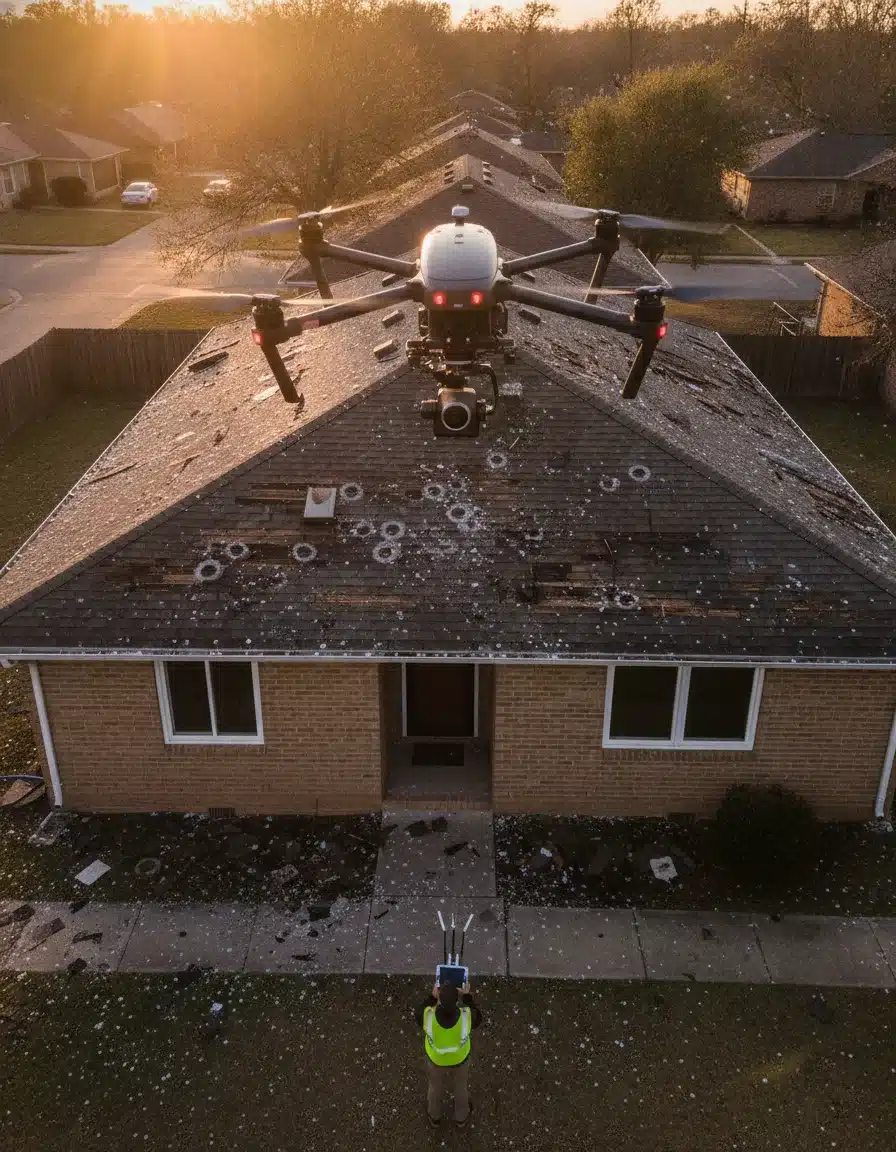
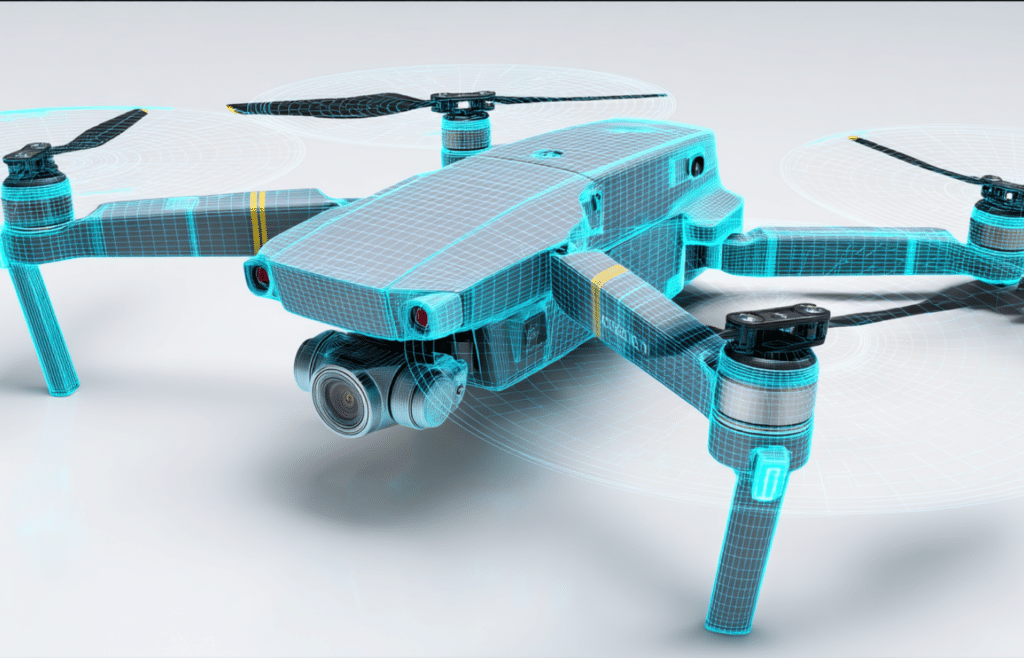
According to R&R Magazine’s 2026 technology forecast, drones equipped with LiDAR, thermal imaging, and AI analytics will revolutionize restoration workflows through improved safety, efficiency, and decision-making. Multispectral sensors can assess fire damage and identify hidden damage, while hyperspectral analysis detects subtle material degradation and chemical contamination. These technologies provide insights that the naked eye cannot detect, enhancing the entire restoration process.

Why Drones Matter for Restoration Companies
Part of our Restoration Company SEO: Why You’re Not Showing Up. Want it done for you? See our restoration SEO and marketing agency.
Restoration work frequently requires assessing damage in dangerous or difficult-to-access locations. Climbing on fire-damaged roofs, inspecting storm damage on steep slopes, or evaluating multi-story buildings all create safety risks and slow down the assessment process. Drones eliminate these challenges while producing superior documentation.
The operational advantages are substantial:
Safety improvements. Workers don’t climb compromised roofs or navigate dangerous debris fields. This reduces workers’ compensation exposure and eliminates delays caused by safety concerns about structural integrity.
Speed of assessment. A drone survey of a residential roof takes 15-20 minutes compared to 1-2 hours for manual inspection. Commercial properties show even greater time savings. Faster assessments mean faster job starts and improved customer satisfaction.
Documentation quality. Drone imagery provides comprehensive visual records that support insurance claims, protect against disputes, and create marketing assets. High-resolution aerial photos tell the story of damage more effectively than ground-level shots.
Access to difficult areas. Multi-story commercial buildings, steep residential roofs, and debris-filled properties become immediately accessible. Drones reach places that would require scaffolding, lifts, or dangerous climbing.
For restoration companies, drones represent both operational improvement and marketing differentiation. When competitors still send technicians up ladders with clipboards, your drone-equipped assessment process looks professional, thorough, and modern.
Core Drone Technologies for Restoration Assessment
Different drone technologies serve different restoration assessment needs. Understanding these capabilities helps you invest appropriately and market services accurately.
High-Resolution Visual Cameras
Standard visual cameras remain the most common drone payload for restoration work. Modern cameras capture 20-60 megapixel images that reveal damage invisible from ground level. Key applications include:
- Roof damage documentation (missing shingles, hail impacts, wind damage)
- Fire damage extent mapping
- Storm damage pattern analysis
- Insurance documentation photography
- Before-and-after project documentation
Visual inspection drones start around $2,000-$5,000 for capable consumer models and range to $15,000+ for professional systems. The DJI Mavic and Phantom series serve many restoration companies’ needs affordably.
Thermal Imaging Systems
Thermal cameras detect temperature variations that indicate moisture intrusion, insulation defects, and hidden damage. According to drone inspection specialists at Saiwa, thermal imaging reveals temperature anomalies invisible to conventional visual inspection.
Restoration applications for thermal imaging include:
- Moisture detection in roofs and walls after water damage
- Hidden fire damage behind walls and under surfaces
- Insulation defects affecting energy efficiency
- Electrical hot spots indicating fire risk
- Leak detection in commercial flat roofs
Thermal camera payloads add $3,000-$15,000 to drone costs depending on resolution and integration. The return on investment comes from identifying hidden damage that would otherwise require destructive investigation.
LiDAR Mapping Technology
LiDAR (Light Detection and Ranging) uses laser pulses to create precise 3D models of structures and terrain. According to R&R Magazine, LiDAR enables direct creation of digital twins that assist in detailed project planning and execution.
Restoration applications for LiDAR include:
- Precise structural measurements for reconstruction estimates
- Terrain mapping for water flow analysis after flooding
- 3D modeling for complex commercial restoration projects
- Volume calculations for debris removal estimates
- Historical comparison showing structural changes
LiDAR systems represent significant investment ($20,000-$100,000+) and typically serve larger restoration companies handling substantial commercial work. The technology justifies its cost through more accurate estimates and comprehensive documentation.
Indoor Drones for Air Quality and Confined Spaces
Emerging indoor drone technology extends assessment capabilities to enclosed spaces. Small, cage-protected drones can navigate inside structures to assess damage in locations too dangerous for human entry.
Applications include:
- Post-fire interior assessment before structural clearance
- Air quality monitoring in contaminated spaces
- Confined space inspection in commercial properties
- Mold assessment in crawl spaces and attics
Indoor drone technology remains emerging, with systems costing $10,000-$30,000. Early adopters in restoration gain experience positioning them for growing applications.
Want more customers from Google & AI search?
Get a free SEO audit of your site — see exactly what to fix first.
Marketing Drone-Equipped Assessment Services
Drone capabilities create marketing opportunities at multiple touchpoints: website content, sales conversations, insurance relationships, and social media presence.
Website Content Strategy
Create dedicated pages and blog content around drone assessment capabilities:
Service page content:
- How our drone assessments work
- Drone technology we use (cameras, thermal, LiDAR)
- Benefits of aerial damage assessment
- Sample drone imagery and reports
Blog content opportunities:
- How drones improve water damage assessment
- Why thermal imaging finds hidden fire damage
- Drone technology for storm damage assessment
- The future of restoration technology
Link drone content to your core services. A fire damage restoration page should reference thermal imaging capabilities. Water damage content should mention moisture detection through aerial thermal surveys.
Insurance Adjuster Relationships
Insurance adjusters appreciate thorough documentation that supports accurate claims processing. Drone imagery provides exactly what adjusters need:
- Comprehensive roof coverage without climbing
- Clear damage visualization for claims files
- Measurement accuracy supporting estimates
- Before-and-after documentation for completed work
Position drone documentation as a benefit to your insurance marketing for restoration companies strategy. When building relationships with adjusters, demonstrate your documentation capabilities by sharing sample reports and imagery.
Your Xactimate estimates become more defensible when supported by comprehensive aerial documentation. Disagreements about damage extent decrease when you have clear imagery showing every angle of the affected area.
Social Media and Video Content
Drone footage creates compelling social media content that demonstrates capabilities better than text descriptions:
- Aerial damage assessment videos showing inspection process
- Before-and-after comparisons from consistent aerial angles
- Time-lapse videos of restoration progress
- Educational content explaining what thermal imaging reveals
Your restoration company social media marketing should include regular drone content. These posts typically generate higher engagement than standard ground-level job photos.
Operational Implementation: Getting Started with Drones
Adding drone capabilities requires investment in equipment, training, and regulatory compliance. Plan implementation carefully to ensure return on investment.
FAA Part 107 Certification
Commercial drone operation requires FAA Part 107 Remote Pilot certification. The certification process includes:
- Studying aeronautical knowledge (typically 10-15 hours)
- Passing the Part 107 knowledge test at an FAA testing center
- Registering your drone with the FAA
- Understanding airspace restrictions in your service area
Part 107 certification costs approximately $175 for the test plus study materials. Most restoration professionals can prepare and pass within 2-4 weeks of focused study. The certificate remains valid for two years with recurrent testing requirements.
Equipment Selection
Match drone equipment to your restoration focus and budget:
Entry-level setup ($2,500-$5,000): Consumer prosumer drone (DJI Mavic or similar), high-resolution camera, basic flight training. Suitable for visual roof inspections and documentation.
Professional visual setup ($8,000-$15,000): Professional drone platform, professional-grade camera, spare batteries, carrying case, post-processing software. Enhanced image quality and flight reliability.
Thermal imaging setup ($15,000-$30,000): Professional drone with integrated thermal camera or dual visual/thermal payload. Adds moisture detection and hidden damage assessment capabilities.
Full commercial setup ($50,000+): Enterprise drone platform with LiDAR, thermal, and high-resolution visual capabilities. Comprehensive data capture for large commercial projects.
Training and Skill Development
Beyond Part 107 certification, drone piloting requires practice to develop proficiency:
- Start with open-area flights to learn controls
- Practice inspection patterns over your own vehicle or building
- Build experience in varying wind conditions
- Develop proficiency with thermal camera operation and interpretation
- Learn post-processing software for image enhancement and reporting
Many drone manufacturers offer training programs. Third-party training companies provide restoration-specific instruction covering inspection techniques, documentation standards, and report generation.
Insurance Considerations
Commercial drone operations require appropriate insurance coverage:
Hull coverage protects your drone equipment against damage or loss. Policies typically cost $500-$1,500 annually depending on equipment value.
Liability coverage protects against third-party claims from drone operations. Expect $1,000-$3,000 annually for $1 million in coverage. Some general liability policies exclude drone operations, requiring specific aviation endorsements.
Verify that your drone insurance integrates with your existing business coverage. Insurance requirements may also appear in commercial contracts with property managers who require proof of coverage before allowing drone flights on their properties.
Advanced Applications: AI and Digital Twins
Leading-edge drone technology integrates artificial intelligence and digital twin creation for enhanced restoration applications.
AI-Powered Damage Detection
Machine learning algorithms trained on thousands of damage images can automatically identify and classify damage from drone imagery:
- Roof damage classification by type (wind, hail, age)
- Mold identification from thermal patterns
- Structural anomaly detection
- Change detection comparing pre- and post-event imagery
According to Anvil Labs, AI-driven analytics can analyze thermal data in real time, identifying anomalies, detecting patterns, and triggering alerts that enable immediate action. These capabilities are emerging in restoration applications and will become more accessible as software develops.
Digital Twin Creation
Digital twins are virtual replicas of physical structures created from drone survey data. LiDAR and photogrammetry combine to create accurate 3D models that serve multiple purposes:
- Precise measurements for reconstruction estimates
- Virtual walkthroughs for remote stakeholder review
- Historical documentation showing pre-loss conditions
- Progress tracking through periodic re-surveys
Large restoration companies handling substantial commercial work find digital twin capabilities justify their investment through improved estimate accuracy and client communication.
Competitive Positioning Through Technology
In this video
- 0:00 Why Restoration Leads Feel Unpredictable
- 0:39 The Myth Holding Restoration Companies Back
- 1:33 Four Lead Categories You Must Separate
- 2:03 Where Restoration Leads Actually Come From
- 2:40 Local SEO Pillars for Restoration Rankings
- 3:28 Pay Per Call vs Form Fill Conversion Data
- 3:56 Channel Costs and Conversion Rates Compared
- 4:46 Response Time Is Where Most Leads Are Lost
- 5:20 Building Insurance Adjuster Referral Streams
- 6:26 Storm Events and Surge Preparation
- 7:07 Follow-Up System Six Components
- 7:49 Full Channel Picture and 18-Month Goal
Full transcript: Restoration Digital Marketing: Fill Your Pipeline Year-Round
Drone capabilities differentiate restoration companies in competitive markets. Marketing this differentiation effectively requires consistent messaging across channels.
Website Differentiation
Feature drone technology prominently:
- Include aerial imagery in service galleries
- Add “Drone Assessment” or “Aerial Inspection” to service listings
- Create video content showing drone assessment process
- Publish case studies demonstrating technology advantages
Sales Conversation Positioning
Train sales staff to incorporate drone capabilities into conversations:
- Explain how drone assessment protects their property from further damage
- Describe the documentation quality for insurance purposes
- Demonstrate technology during assessments as proof of capability
- Use tablet or laptop to show real-time drone footage during inspections
Referral Partner Communication
Communicate technology capabilities to referral sources:
- Insurance agents appreciate thorough documentation
- Property managers value efficient multi-property assessments
- Real estate professionals benefit from quick inspection turnaround
Include drone capabilities in your restoration company referral programs marketing materials.
ROI Tracking for Drone Investment
Measure drone program return on investment through multiple metrics:
Time savings: Track assessment time reduction compared to manual methods. Calculate labor cost savings from reduced hours.

Safety improvements: Document reduction in ladder-related incidents, workers’ compensation claims, and near-misses.
Job conversion: Measure whether drone-assessed jobs convert at higher rates than traditional assessments. Professional presentation often improves close rates.
Estimate accuracy: Compare change order frequency on drone-documented jobs versus others. Better initial assessment should reduce scope changes.
Marketing value: Track engagement on drone-related content and mentions in customer reviews citing technology.
Record drone metrics in your restoration company CRM to build data for ROI analysis.
Frequently Asked Questions
How much does a restoration inspection drone cost?
Entry-level drones suitable for basic visual inspection cost $2,000-$5,000. Professional systems with better cameras and reliability run $8,000-$15,000. Adding thermal imaging increases costs to $15,000-$30,000. Full commercial setups with LiDAR capabilities exceed $50,000.
Do I need a license to fly drones commercially?
Yes. Commercial drone operations in the United States require FAA Part 107 Remote Pilot certification. The certification involves passing a knowledge test covering aeronautical information, airspace regulations, and safety procedures. Most professionals can complete certification within 2-4 weeks of study.
Can drones fly inside buildings for assessment?
Specialized indoor drones designed for confined space operation can fly inside structures. These systems are smaller, cage-protected, and capable of navigating without GPS. Indoor drone technology is emerging in restoration with applications for post-fire interior assessment and contaminated space inspection.
What kind of insurance do I need for commercial drone operations?
Commercial drone operations require hull coverage for equipment and liability coverage for third-party claims. Expect annual costs of $1,500-$4,500 combined depending on coverage limits and equipment value. Some general liability policies exclude drone operations, requiring specific aviation endorsements.
How accurate are drone measurements for estimates?
Photogrammetry from calibrated drone systems achieves measurements within 1-3% accuracy for roof areas and structural dimensions. LiDAR mapping provides sub-centimeter accuracy for precise measurements. This accuracy supports defensible estimates and reduces measurement disputes with adjusters.
Can thermal imaging drones detect moisture in buildings?
Yes. Thermal cameras detect temperature variations caused by moisture presence, evaporative cooling, and thermal mass differences in wet materials. Thermal imaging can identify moisture behind walls, under roofing, and in locations not visible to standard inspection.
Building Your Drone-Enabled Restoration Practice
Drone technology represents both operational improvement and market differentiation for restoration companies. The companies that adopt these capabilities now will establish expertise and market position before competitors catch up.
Start with visual inspection capabilities using affordable drone systems. Gain experience with flight operations, documentation workflows, and client presentation. As skills develop and ROI justifies investment, add thermal imaging and eventually LiDAR capabilities for comprehensive assessment packages.
Market your technology consistently across all channels. Customers increasingly expect professional service providers to use current technology. Drone-equipped assessment demonstrates that your company invests in quality and keeps pace with industry advancement.
Your restoration company SEO strategy should include drone-related content to capture traffic from property owners searching for technologically advanced restoration services.
Keep Reading
Want more customers from Google & AI search?
Get a free SEO audit of your site — see exactly what to fix first.
Your path · Restoration Company SEO
Keep going: read these next
 You’re hereDrone Technology in Restoration: Marketing Your Aerial Assessment Capabilities
- Email Marketing for Restoration Companies: Templates and Automation That Generate Repeat Business



Want this done for you?
Scan your site. See the gaps. Decide with numbers.
- Rankings, Google Business Profile and site-speed teardown
- Report lands in your inbox in about a minute
- No obligation · 4.9 from 67 Google reviews

