

TL;DR: Septic breaks standard local SEO in two ways — your customers are spread across rural geography where map-pack proximity works against you, and search volume per town is genuinely thin. The answer is county-level content rather than town-level, plus the referral channel most septic companies neglect entirely: real estate inspections. We’ve covered the emergency side in emergency septic marketing and the combined trade in plumbing and septic marketing services.
Table of Contents
- Why rural geography breaks local SEO
- County pages instead of town pages
- The keyword set, and its honest volume
- The real estate referral channel
- Emergency versus scheduled maintenance
- What competitors get wrong
Why Rural Geography Breaks Local SEO
Local search results are heavily influenced by proximity to the searcher. In a city that works fine — everyone is close to everyone. In septic territory it creates two problems.
In this video
- 0:00 Welcome to AI Search Session Two
- 1:12 Five-Step Plan to Get Found by AI
- 2:32 Building Reputation with Reviews
- 3:37 Asking ChatGPT to Audit Your Visibility
- 4:44 Technical Basics Making Your Site AI-Friendly
- 5:27 Mobile-First Design and Page Speed
- 6:02 WordPress vs Squarespace for AI Readiness
- 6:38 Structuring Business Information for AI
- 7:48 Essential Business Data AI Needs
Your customers are dispersed. Septic systems exist where sewer doesn’t, which means low-density areas. A searcher 25 miles out may see companies closer to them than you, even if you serve their area and they don’t.
Your service radius is large and uneven. You might cover 40 miles in one direction and 15 in another based on roads and terrain. That doesn’t map cleanly onto how search results get assembled.
Two practical responses. First, your Google Business Profile service area should reflect where you genuinely go, and your address matters — a location on the rural side of your territory often serves you better than a downtown office. Second, stop competing on proximity alone and compete on the queries where proximity matters less: cost questions, diagnostic questions, and regulatory questions.
Want more customers from Google & AI search?
Get a free SEO audit of your site — see exactly what to fix first.
County Pages Instead of Town Pages
The standard advice — a page per town — fails here. A town of 900 people generates almost no search volume for septic services, and forty such pages produce forty near-identical thin pages.
Structure by county instead:
- One page per county you serve, named as people say it
- Inside each, name the towns, communities, and unincorporated areas you actually cover
- Include county-specific regulatory information — permit requirements, health department rules, inspection standards. This genuinely differs by county and it’s the most legitimately unique content available to you.
- Reference real jobs: soil conditions, common system types, typical tank ages in that area
County-level regulatory content is the strongest play in this vertical. Homeowners searching “septic permit [county]” or “septic inspection requirements [county]” are high-intent and almost nobody serves them well. Your health department knowledge is a genuine content asset.
The Keyword Set, and Its Honest Volume
Be realistic — this is a lower-volume vertical than plumbing or HVAC. That’s fine; conversion intent is high and competition is thin.
| Intent | Example terms |
|---|---|
| Routine service | septic pumping [county], septic tank cleaning near me, how often to pump septic |
| Emergency | septic backup, septic overflowing, sewage backup in yard |
| Cost | septic pumping cost, septic tank replacement cost, drain field repair cost |
| Diagnostic | signs septic tank is full, septic smell in yard, slow drains whole house |
| Real estate | septic inspection [county], septic inspection for home sale, septic certification |
| Regulatory | septic permit [county], septic requirements [state], perc test |
| Installation | new septic system cost, septic system installation [county] |
Two clusters deserve disproportionate effort. Diagnostic queries — “signs your septic tank is full,” “why does my yard smell” — carry real volume and convert to service calls, because the homeowner has a symptom and no idea what it means. Cost queries, particularly for high-ticket work like drain field repair and full replacement, where uncertainty is enormous and honest ranges build immediate trust.
The Real Estate Referral Channel
This is the most underused channel in the trade and it deserves its own section.
Nearly every home sale involving a septic system requires an inspection, and often a pump-out. The people who decide which septic company gets that call are real estate agents, home inspectors, and closing attorneys — not the homeowner.
Build for it:
A dedicated real-estate inspection page. Written for agents, not homeowners: turnaround time, report format, whether you provide certification documentation, how you handle failed inspections, scheduling around closing timelines. Agents care about speed and paperwork.
Content targeting agent searches. “Septic inspection for home sale [county],” “how long does a septic inspection take,” “what happens if a septic inspection fails.” Agents search these on behalf of clients.
Relationships as link sources. Agent websites, brokerage vendor lists, and local real estate association directories are legitimate, relevant local links that competitors don’t pursue.
A steady agent referral relationship is worth more than most keyword rankings in this vertical, and the content supports the relationship rather than replacing it.
Emergency Versus Scheduled Maintenance
Septic has an unusual demand profile: mostly predictable maintenance punctuated by genuine emergencies.
Scheduled pumping is your recurring revenue. Every system needs it every few years, which means your existing customer list is an asset most septic companies underuse. A reminder system — postcard, text, or email at the interval — generates work with no acquisition cost. Content supporting this: pumping frequency guidance by household size and tank capacity.
Emergencies are backups and failures. High urgency, low price sensitivity, and won on availability. Same rules as any emergency trade: answer the phone, state real timing, and make the phone number impossible to miss on mobile.
Seasonal patterns matter more than people expect. Heavy rain overwhelms drain fields. Holidays with houseguests overload systems. Frozen ground complicates access. Publishing ahead of these predictable spikes captures demand competitors react to late.
In this video
- 0:00 Why Greenville Businesses Lose to Competitors
- 1:34 Four-Layer Local SEO System Overview
- 2:02 Google Business Profile Optimization
- 2:46 Google Reviews Strategy and Responses
- 3:29 Citations NAP Consistency and Directories
- 4:15 Technical SEO Mobile Speed and Schema
- 5:02 Time Investment and When to Hire Out
- 5:36 Tracking GSC GBP and Analytics Monthly
Full transcript: How to Improve Your Google Rankings in Greenville SC (2025)
What Competitors Get Wrong
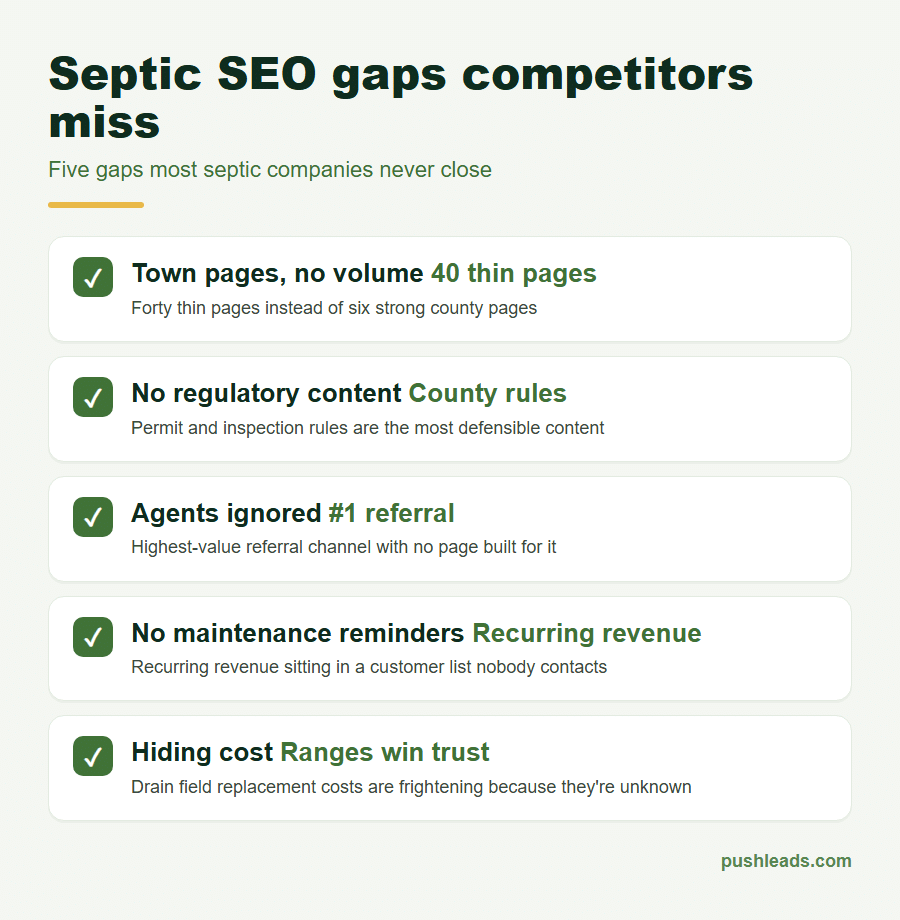
Town pages with no volume. Forty thin pages instead of six strong county pages.
No regulatory content. County permit and inspection rules are the most defensible content in the vertical and almost nobody writes it.
Ignoring agents entirely. The highest-value referral channel, with no page built for it.
No maintenance reminders. Recurring revenue sitting in a customer list nobody contacts.
Hiding cost. Drain field and replacement costs are frightening precisely because they’re unknown. Ranges with explanation win the trust.
Quick Recap
- Rural dispersion and large service radii make proximity-based local SEO weaker; compete on cost, diagnostic, and regulatory queries instead.
- Build county pages, not town pages, and load them with county-specific permit and health department detail.
- Diagnostic and cost clusters carry the most usable volume.
- Real estate inspections are the most underused channel — build a page for agents, not homeowners.
- Use your existing customer list for pumping reminders; it’s free recurring revenue.
- Publish ahead of predictable spikes: heavy rain, holidays, frozen ground.
Frequently Asked Questions
Is SEO worth it for a septic company in a rural area?
Yes, but expect lower volume and correspondingly lower cost per lead. The competition is thin, so modest effort produces real position gains.
Should I target the nearest city even if I mostly serve rural areas?
Only if you genuinely serve it and can compete there. City competition is heavier and city homes are more likely on sewer — thin returns for the effort.
How important is my Google Business Profile address?
Significant. A location positioned within your actual service territory generally serves you better than one at the edge, and your service area settings should match reality.
What’s the highest-value content I can write?
County-specific permit and inspection requirements. It’s genuinely useful, almost nobody publishes it, and the people searching it are ready to buy.
How do I get real estate agents to use me?
Build the agent-facing page, be fast on turnaround, and make your report format easy to hand to a buyer. Then tell local brokerages the page exists.
Keep Reading
Want more customers from Google & AI search?
Get a free SEO audit of your site — see exactly what to fix first.
Your path · What Is SEO? The Complete Guide to Search Engine Optimization for Businesses
Keep going: read these next

- Up nextAI-SEO: How Artificial Intelligence is Revolutionizing Search Rankings in 2026
- Visual and Video SEO: The definitive guide to optimizing for image and video search in 2026


Want this done for you?
Scan your site. See the gaps. Decide with numbers.
- Rankings, Google Business Profile and site-speed teardown
- Report lands in your inbox in about a minute
- No obligation · 4.9 from 67 Google reviews
 Continue reading
