0:00 Intro
1:34 Why the Revenue Gap Exists
2:45 When a Direct Site Pays Off
3:41 When It Doesn’t Pay
4:28 What the Site Actually Needs to Do
5:19 The Commission Math: A Worked Example
7:21 AI Search Is Changing the Discovery Layer
8:15 What a Repeat Guest Is Actually Worth
8:58 The Email List Is the Business
9:37 Common Mistakes Owners Make
10:24 The Decision Framework
11:12 What to Do Next
Full transcript
0:00 Intro
Yes, it’s still worth it, and here’s the number that proves it. According to the Key Data US Index for Q2 -2026, direct bookings make up 21% of reservations, but only 29% of revenue. That gap is the whole argument. Fewer bookings, more money per booking. That’s the case for a direct website right there. Now, let me show you exactly when it pays and when it doesn’t, and what a site actually needs to do the job. The number is every owner needs to know. Let’s start with what Key Data actually found. In Q2 -2025, direct was 25 % of reservations and 36 % of revenue. By Q2 -2026, those numbers had dropped to 21 % of reservations and 29% of revenue. Direct Share fell over that 12 -month window. Both the reservation share and the revenue share came down, but look at the spread. Revenue is still running 8 points ahead of reservation share. That means that guests who book direct are spending more per stay than the channel average. That gap only exists because direct bookings carry no OTA commission, guests tend to book longer stays, and your pricing on your own site can include things the platform strip out. The trend is worth watching, but the gap is still real, and that’s the number that drives the decision. Why the revenue gap exists.
1:34 Why the Revenue Gap Exists
OTA commissions are the obvious piece Airbnb charges host a commission that varies by listing type and market. Check your current agreement for the exact percentage. VRBO’s model varies by plan, but the moment a guest booked directly, that percentage stays in your pocket on every reservation, so multiply that across a full season and you can see how the revenue math tilts towards direct, even if the volume is lower. There’s a second reason the gap exists. Guests who find your site directly are often repeat visitors or referrals. They already trust you. They don’t need the platform’s buyer protection layer, more likely to book longer stays, add extra nights, and reach out with questions before they book, which almost always converts at a higher rate. The third reason is control. On your own site, you can offer a loyalty discount, a free early check -in, or a referral credit without violating OTA terms of service, and those small incentives shift the booking without eroding the net rate. When a direct site pays off, not every owner should prioritize this equally.
2:45 When a Direct Site Pays Off
Here’s how to think about whether it pencils in for your situation. If you have fewer than two or three properties, the return on a well -built, well -marketed site is harder to justify on volume alone. The fixed cost of building and maintaining the site, running paid search, and doing SEO gets spread across fewer reservations. However, though, if you have four or more properties, or if your properties are in a recognizable destination where people search by area rather than platform, the math shifts in your favor. The stronger your repeat guest base, the stronger the case, one returning guest who finds your site, books directly, and refers a friend, can generate five figures of commission -free revenue over a few years, and you can’t build that relationship through an OTA. The platform owns that guest data. You don’t. When it doesn’t pay, let’s be honest about the cases where it’s
3:41 When It Doesn’t Pay
a harder sell. If your market is highly seasonal, if your occupancy is already a struggle and you don’t have the timer budget to invest in real search engine optimization, a direct site can sit there and almost do nothing. A site without traffic is just an expense. The build is not the investment. The visibility is. If you can’t commit to getting the site found, whether through SEO, paid ads, email it to your past guest list, or some combination, then the direct channel won’t generate enough reservations to justify the work. That’s not the reason to skip the site entirely. It’s a reason to be clear about what you’re buying. You’re buying a marketing system, not a webpage. What the site actually needs to do.
4:28 What the Site Actually Needs to Do
A direct booking website has one job, convert a guest who is already looking for your area. That means it needs to rank and search for the terms that guests actually use. Phrases like cabin rentals near Asheville or beachfront vacation rental near me are where organic traffic comes from. If your site doesn’t show up for those phrases, the site can’t do its job. Beyond search, the site needs to be a booking engine that doesn’t feel like a step backward from Airbnb. So, if the guest hits friction in the process, they bounce back to the OTA in book there. The site also needs to capture email addresses even when a guest isn’t ready to book right now. Your email list is the most valuable asset you can build in this business. It’s the one channel that the platforms can’t take away. The Commission math a worked example.
5:19 The Commission Math: A Worked Example
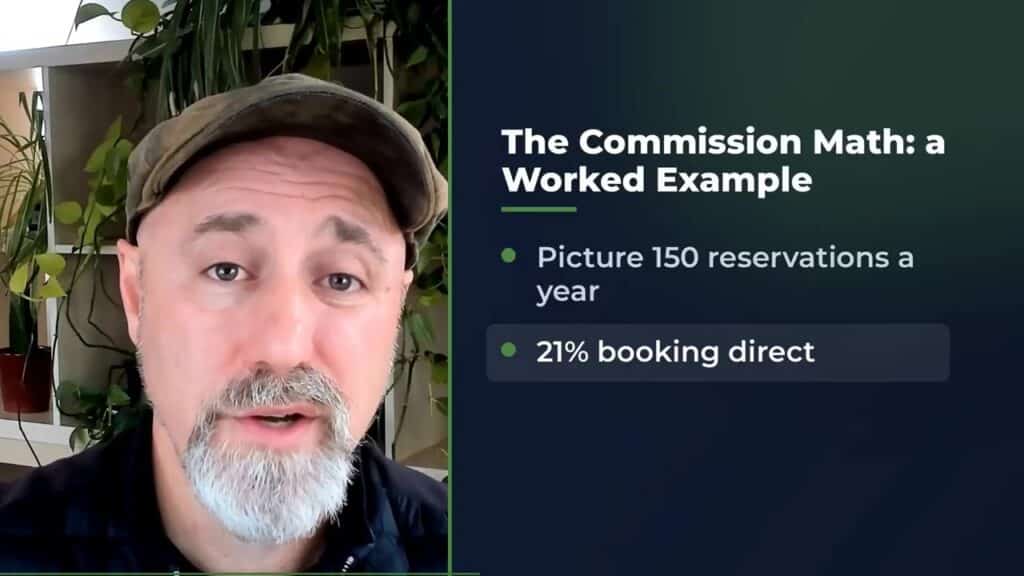
Picture a vacation rental company doing 150 reservations a year and say the average nightly rate is $250 and the average day is four nights. That’s $150,000 in gross revenue. If 21% of those bookings come through direct, that’s roughly $31 ,000 commission -free. Instead, those same bookings went through an OTA at whatever host fee your platform charges. Say you looked it up and it’s 3%. You’d calculate the commission cost on that slice. So plug in your actual rate to see the real number. Scale that OTA fee higher and you’re paying into a subscription model that costs more and the number gross. This is not a claim about what any real company earns. It’s about how the math works when you run your own numbers. The point is to do the exercise with your actual fee structure and your actual reservation count. The gap in key data is Q226 numbers, 21% of bookings generating 29% of revenue suggests that when guests do book direct, those reservations are higher value and that’s worth protecting. The SEO layer you can’t skip. A direct booking site without SEO is a site without guests. Search engine optimization for vacation rentals is about matching the word guest type to the pages that you’ve actually built. A destination page targeting Lakefront Cabin Rentals near Asheville does something a generic home page can’t do. It captures guests mid search when they know where they want to go and are deciding who to book with Google’s search results for vacation rental searches still drive a meaningful share of organic discovery and showing up there is a durable advantage because the OTA’s compete for those same slots ahead of or alongside the platforms is how independent operators punch above their weight. AI search is changing the discovery layer.
7:21 AI Search Is Changing the Discovery Layer
Here’s something that’s shifted in the past year. Travelers are starting trips on AI tools, not just Google. A guest might ask an AI assistant or a chatbot for recommendations for pet friendly, lake rentals in western North Carolina. If your site has the right content, the right structured data and is cited in enough trusted places online, the AI might recommend you by names. If your site is thin or invisible, you won’t be in that answer. The platforms have enough high volume to show up almost anywhere. You have to earn it. This means that your site needs content that actually answers guest questions, reviews and signals that build trust and a listing presence in the directors that AI tools pull up from when they build recommendations. And this is all new territory, but it matters now and it’s only going to matter more. What a repeat guest is actually worth.
8:15 What a Repeat Guest Is Actually Worth
One guest who books directly in their site and comes back two more times over three years is worth dramatically more than three separate first OTA guests. And here’s why. The first OTA booking comes with a commission cost. The two return visits, if they come to your site or through direct mail, come commission -free. They also tend to cost you nothing in acquisition. You didn’t run a paid ad. You just sent an email to someone who already knows you and trusts you. And this is adorable argument for investing in direct. You are building an asset that compounds and OTA listing does not compound. It resets each time a guest leaves the platform. The email list is the business.
8:58 The Email List Is the Business
If a guest books through Airbnb owns that relationship, you get a masked email address. You cannot market to that guest without violating terms of service. If the same guest books through your direct site, you have their real contact information. You can send them a pre -stay guide. You can email them in January when they’re dreaming about vacation summer travel. You can offer them a returning guest’s rate. That sequence can generate repeat bookings for years. Building a direct booking site is partly about avoiding the OTA feeds, but it’s mostly about owning the relationship. Common mistake owners make.
9:37 Common Mistakes Owners Make
The most common mistake is treating the site like a one -time project. You build it, it goes live, and nothing happens. And that’s because no one told Google it exists, and no one is writing content that earns rankings. The second mistake is using a booking engine that creates too much friction. If a guest can’t get a quote in 30 seconds, they’re gone. The third mistake is not capturing leads from guests who aren’t ready to book yet. A simple offer like a local guide or discount for direct booking converts browsers into email subscribers that you can close later. The fourth mistake is ignoring your past guest lists. You’ve had 50 guests through the OTAs, and you have no way to reach them directly. You’ve left a lot of repeat business on the table.
10:24 The Decision Framework
The decision framework. Here’s how to make the call for your situation. Do you have enough properties or enough average nightly rate to make the commission’s savings meaningful? Do you have an existing guest base, even a small one, that you could start marketing to directly? Your market one where travelers search by destination, meaning SEO can actually drive traffic. Are you willing to treat the site as a marketing channel, not just a brochure? If you answered yes to most of these, a direct booking site is worth building. If you’ve answered no to most of them, start by getting the OTA presence right, building your guest list, and revisiting the direct site question in 12 months. What to do next?
11:12 What to Do Next
The right starting point is knowing where you stand. If you’re not sure where your current site is visible in search, whether AI tools would service your property, or whether you have the right content to compete, you can get your free AI visibility check at pushlies .com backslash check. And we’ll look at what’s working, what’s not, and what would actually drive the needle for your properties. You can also call us directly at 828 -348 -7686. The key data numbers make this case clearly. Direct is now a smaller share than it was a year ago, but is still generating a revenue premium that makes it worth fighting for. The question isn’t whether direct booking is dead, it’s whether your site is set up to capture it. I’m Jeremy Ashburne with PushLeads and I help. Vacation mental business owners get more leads without struggle or frustration. Talk to you soon.
Key Takeaways
Want it done for you? See our contractor web design.
Direct bookings still generate a revenue premium over OTA bookings. According to the Key Data US Index, direct reservations made up 21% of bookings in Q2 2026 but produced 29% of revenue, an 8-point spread that proves commission-free bookings are worth more per stay. The question is not whether direct booking is relevant. It is whether your site is built, optimized, and visible enough to capture that premium consistently.
- Direct bookings represented 21% of reservations but 29% of revenue in Q2 2026, meaning guests who book direct spend more per stay.
- OTA commissions are the core reason the revenue gap exists, and every direct booking keeps that percentage in your pocket.
- A direct booking site without traffic is just an expense. SEO and content visibility are the actual investment.
- OTA platforms own your guest data. Your direct site and email list are the only relationship assets you control.
- AI-powered search tools are now part of the discovery process, and thin or invisible sites will not appear in those recommendations.
- Repeat guests who book direct compound in value over time. OTA relationships reset every time a guest leaves the platform.
- The decision to build a direct site depends on your property count, market type, repeat guest base, and willingness to treat the site as a marketing channel.
What the Key Data Numbers Actually Tell Vacation Rental Owners
Direct booking is still worth pursuing, and the revenue data makes the case clearly. According to the Key Data US Index for Q2 2026, direct bookings accounted for 21% of reservations but generated 29% of revenue. That 8-point gap between reservation share and revenue share is the central argument for building and maintaining a direct booking website. Fewer bookings through direct channels, but each one is worth more money.
Compare that to Q2 2025, when direct was 25% of reservations and 36% of revenue. Both numbers dropped over that 12-month window, so the trend is worth tracking. But the spread has not closed entirely. Direct still punches above its weight on revenue, and that premium exists for three structural reasons: no OTA commission comes out of the booking, guests who find your site tend to book longer stays, and your own site gives you pricing and offer flexibility that OTA terms of service restrict.
I want to be honest about what the trend means. Direct is not growing as a share of the market. It is shrinking slightly. But a channel that represents 21% of reservations and 29% of revenue is not a channel you ignore. It is a channel you protect and build deliberately, because the guests coming through it are your most valuable guests. For direct booking statistics and how they apply to vacation rental SEO strategy, that revenue premium is exactly why we advise owners to think of direct booking as a core business channel rather than a secondary one.
Want more customers from Google & AI search?
Get a free SEO audit of your site — see exactly what to fix first.
Why the Revenue Gap Between Direct and OTA Bookings Exists
The revenue premium on direct bookings comes from three distinct factors: eliminated commissions, higher-value guest behavior, and pricing control that OTA terms do not allow. Understanding all three helps you see why the gap persists even as direct’s overall share has declined.
How much do OTA commissions actually cost me per season?
OTA commissions vary by platform and listing type, so the right move is to check your current agreement for the exact percentage. Airbnb charges hosts a commission that varies by listing structure and market. VRBO’s model depends on the plan you are on. What matters is that the moment a guest books through your direct site instead of an OTA, that percentage stays in your pocket on every reservation. Multiply that across a full season and the number becomes meaningful fast, especially as your average nightly rate rises.
Why do guests who book direct tend to spend more per stay?
Guests who find your direct site are usually repeat visitors or personal referrals. They already trust you and do not need the platform’s buyer-protection layer to feel comfortable completing a reservation. That existing trust translates into longer stays, more willingness to add extra nights, and a higher likelihood of reaching out with pre-booking questions, which almost always closes at a better rate. A guest who messages you directly before booking is already invested in the stay.
What pricing flexibility do I have on my own site that I do not have on OTAs?
On your direct site you can offer a loyalty discount, a complimentary early check-in, or a referral credit without touching OTA terms of service. Those small incentives shift guest behavior toward direct booking without eroding your net rate. On an OTA listing, your ability to offer guest-specific perks is restricted. Your own site removes that constraint, which is part of why direct guests end up being more valuable even when the gross nightly rate looks similar.
When a Direct Booking Website Actually Pays Off
A direct booking site earns its keep when you have enough volume, the right market conditions, and a guest base you can actually market to. It is not the right priority for every owner at every stage, so it is worth being clear about where it makes sense.
How many properties do I need before a direct booking site makes financial sense?
If you have fewer than two or three properties, the fixed cost of building, maintaining, and marketing a direct site is harder to justify on volume alone. Those costs, covering the site build, SEO, and potentially paid search, get spread across fewer reservations. Once you reach four or more properties, or if your properties carry a high average nightly rate, the commission savings start to significantly outweigh the investment. Scale amplifies everything, both the savings and the marketing leverage.
Does my market type affect whether direct booking is worth pursuing?
Yes, and this is an underrated factor. If your properties sit in a recognizable destination where travelers search by area, phrases like cabin rentals near Asheville or beachfront rental in the Outer Banks, then your direct site can capture that organic search traffic. If your market is niche or if guests primarily browse by property type on platforms rather than searching by destination, SEO-driven direct traffic is harder to generate and the case for direct becomes more dependent on your existing repeat guest base.
What does a strong repeat guest base mean for my direct booking ROI?
A single returning guest who finds your site, books commission-free, and refers one friend can generate five figures of commission-free revenue over a few years. That math compounds. One guest relationship, properly nurtured, is worth far more than three separate first-time OTA bookings at the same nightly rate. The stronger your repeat base, the stronger the ROI on a direct site, because you are converting an existing relationship into a channel you control rather than paying an OTA to mediate it every time.
When a Direct Booking Site Is a Harder Investment to Justify
A direct booking site without traffic is an expense, not an asset. There are real situations where the investment does not pencil in, and I would rather be straight with you about them than oversell the idea.
What if my occupancy is already low? Should I still build a direct site?
If your occupancy is already a struggle, the priority is fixing the fundamentals of your OTA presence before layering in a direct channel. A direct site will not solve a visibility or pricing problem. It will just add a marketing cost on top of one. The situation where a direct site underperforms is almost always one where the owner built the site but did not invest in getting it found. If you cannot commit to SEO, paid ads, or consistent email marketing to your past guest list, the site will sit idle and generate nothing.
What am I actually buying when I build a direct booking site?
You are buying a marketing system, not a webpage. The site itself is just the destination. The investment is everything that drives a guest to it, the search rankings, the content, the email sequences, the referral incentives. Owners who treat the site as a one-time build project almost always end up disappointed. The ones who treat it as an ongoing marketing channel, the same way they would treat their OTA listing, end up seeing the revenue premium the data describes.
When should I wait 12 months before prioritizing direct booking?
If you answered no to most of these questions, you do not yet have the guest volume to market to, your market is not one where destination-based SEO drives traffic, and you do not have the time or budget to invest in real search visibility, then the right move is to focus on your OTA presence for the next year. Build your guest list from those bookings, even if you cannot reach them directly yet. Then revisit the direct site question when you have more to work with.
What a Direct Booking Site Actually Needs to Do
A direct booking site has one job: convert a guest who is already looking for your area into a reservation. Everything the site does, its content, its structure, its booking flow, should serve that one function.
What content does my vacation rental site need to rank in Google search?
Your site needs destination-specific pages targeting the phrases guests actually type. A page built around cabin rentals near Asheville captures guests who are mid-search, already know where they want to go, and are deciding who to book with. A generic homepage cannot do that. Each destination or property type you serve deserves its own page with content that answers guest questions: what is nearby, what the property sleeps, what the cancellation policy is. That specificity is what earns rankings.
How do I make sure the booking process does not push guests back to the OTA?
The booking engine you choose matters as much as the site design. If a guest cannot get a quote or complete a reservation in roughly 30 seconds, they will leave and book on Airbnb instead, where the process is familiar and fast. Your direct site needs to match that experience, not feel like a step backward. Friction in the booking flow is one of the most common reasons direct sites underperform. Test your own checkout process the way a guest would experience it, and remove every unnecessary step.
How does my site capture guests who are not ready to book right now?
Not every visitor is ready to reserve on the first visit. Your site should offer something that converts browsers into email subscribers, a local area guide, a checklist for visiting the area, or a small discount for direct booking. When you have their email address, you can follow up in January when they are planning a summer trip. That email sequence can generate repeat bookings for years without paying another commission. This is part of the reason building a rental website is a decision that goes well beyond the technical build itself. The relationship infrastructure around the site is the real asset.
The Commission Math: Running the Numbers for Your Business
Running the actual commission math with your numbers is the clearest way to see whether the investment is worth it. Here is how to structure the exercise.
How do I calculate what OTA commissions are costing me annually?
Picture a vacation rental business doing 150 reservations a year, with an average nightly rate of $250 and an average stay of four nights. That is $150,000 in gross annual revenue. If 21% of those bookings come through direct, that is roughly $31,500 in commission-free revenue. Take the same slice of bookings through an OTA at whatever host fee your platform charges, look up your current rate, multiply it against that $31,500, and that is what you are paying to the platform on just your direct-eligible bookings. Scale the OTA fee higher or move to a subscription model and the number grows. The point is to run this with your actual fee structure and your actual reservation count.
What does the Key Data revenue premium mean in real dollars?
The Key Data Q2 2026 finding, that direct makes up 21% of reservations but generates 29% of revenue, tells you that direct bookings are not just commission-free. They tend to be higher-value reservations in absolute terms. Longer stays and direct pricing flexibility mean those guests are spending more per booking than the OTA average. That is two layers of advantage: you keep the commission and the reservation is worth more to begin with. Both of those factors are worth protecting as you think about where to invest your marketing effort.
How should I think about the cost of building the site versus the revenue upside?
The build cost is a one-time investment. The commission savings are recurring. If a well-optimized direct site shifts even 10 additional reservations per year from OTA to direct, the savings on commissions alone can recoup the site cost in the first season depending on your nightly rate and fee structure. The more properties you manage, the faster that math closes. The variable is not whether the savings are real. The variable is whether your site can generate the traffic to drive those additional direct reservations, which brings everything back to SEO and content.
The SEO Layer You Cannot Skip
A direct booking site without search visibility is a site without guests. SEO for vacation rentals is about matching the words guests type into search engines to the pages you have actually built, and showing up before or alongside the OTA listings that compete for the same slots.
How long does SEO take before I start seeing direct bookings from it?
SEO takes time, and owners who expect results in the first 30 days will be disappointed. For vacation rental sites, meaningful organic traffic typically takes several months of consistent content, technical optimization, and link-building before it compounds into bookings. For a realistic look at the SEO timeline for bookings and how that timeline varies by market competitiveness and site age, the key variable is how much content you are publishing and how authoritative your site looks to search engines. This is a channel that rewards patience and punishes the one-time-build mentality.
How do I compete with Airbnb and VRBO in Google search results?
OTAs have massive domain authority and content volume. You cannot out-SEO them on broad, high-volume terms. What you can do is win on specific destination and property-type phrases where the OTAs have thin content or where local authority matters. A page targeting a hyper-specific search like dog-friendly cabin rental near Asheville with a hot tub can outrank a generic Airbnb category page because your page is more directly relevant to that exact query. Niche specificity is how independent operators compete with platforms in search results.
What local SEO signals matter most for a vacation rental site?
Your Google Business Profile optimization is one of the most important local signals you can build for a vacation rental business. A well-maintained profile with accurate information, photos, and consistent engagement sends trust signals to Google that your business is legitimate and active. Combine that with destination-specific pages on your site and citations in local directories and you build a local authority footprint that the OTAs, which are national platforms, have a harder time replicating at the hyper-local level.
How AI Search Is Changing the Discovery Process for Vacation Rentals
Travelers are starting trips on AI tools now, not just Google, and that shift is happening faster than most vacation rental owners realize. If your site is thin or invisible online, AI-powered recommendations will not include you.
How does an AI assistant decide which vacation rentals to recommend?
When a traveler asks an AI tool for pet-friendly lake rentals in western North Carolina, the AI pulls from sources it has indexed and trusts, including websites with strong content, structured data markup, and citations from reputable online directories. Sites with thin content, no reviews, or poor visibility in those trusted sources will not appear in those answers. The platforms have the volume to show up almost anywhere. Independent operators have to earn their place in AI-generated answers through content quality and citation breadth.
What content signals help AI tools recommend my vacation rental?
Your site needs content that genuinely answers guest questions: what the property sleeps, what is nearby, what guests have said about their stays, and what makes your location worth choosing. Structured data markup, the technical code that labels your content for search engines and AI tools, helps those systems understand what your page is about. Reviews matter here too. For context on how review ratings for visibility in AI search results work, the quantity and consistency of your reviews directly affect whether AI tools treat your property as a credible recommendation. This is new territory compared to traditional SEO, but it matters now.
Should I be worried that OTAs will always dominate AI search results?
The platforms have an advantage in AI search for the same reason they have an advantage in traditional search: volume, authority, and the sheer number of reviews and properties they aggregate. But AI tools also pull from local directories, travel blogs, and niche content sites. An independent operator with strong local citations, detailed property content, and a healthy review profile can appear alongside OTA results in AI-generated answers. The window to build that presence is now, before every operator in your market figures out the same thing.
The Real Value of a Repeat Guest and Your Email List
One repeat guest who books directly is worth dramatically more than three separate first-time OTA guests, and the reason comes down to compounding versus resetting.
How do I calculate what a repeat direct guest is actually worth over three years?
Take one guest who books directly the first time and returns twice more over three years. The first visit might carry an acquisition cost if you ran a paid ad or spent on SEO to earn that ranking. The two return visits, if they come through your site or in response to an email, cost you almost nothing in acquisition and carry no OTA commission. That guest’s lifetime value is significantly higher than their first reservation suggests. When you compare that to three separate first-time OTA bookings at the same nightly rate, the OTA version costs more and builds nothing you own.
Why does Airbnb masking my guest emails matter so much?
When a guest books through Airbnb, you receive a masked email address. You cannot market to that guest outside of the platform without violating terms of service. When the same guest books through your direct site, you have their real contact information and permission to communicate. You can send a pre-stay guide, a January email when they are planning summer travel, or a returning guest rate offer. That sequence can generate repeat bookings for years. The email list is the most valuable asset you can build in this business because it is the one channel the platforms cannot take from you. For comparison, consider how SEO versus buying leads plays out in other service businesses: in both cases, owned channels compound while rented channels reset the moment you stop paying.
What is the simplest way to start building a direct email list from OTA guests?
You cannot reach OTA guests directly through the platform, but you can capture email addresses at the property itself. A welcome card with a QR code linking to a local guide opt-in, a sign at the property inviting guests to join your direct booking list for a returning guest discount, or a follow-up message through the OTA platform inviting guests to visit your website, all of these move guests from the platform relationship into your direct relationship without violating terms of service. Even building a small list of 50 past guests gives you a meaningful direct marketing asset.
Common Mistakes Vacation Rental Owners Make With Direct Booking Sites
Most direct booking sites underperform not because direct booking does not work but because owners make a predictable set of mistakes that are entirely fixable once you know what to look for.
Why do most direct booking sites fail to generate reservations?
The most common mistake is treating the site as a one-time project. The site goes live, nothing happens, and the owner concludes that direct booking does not work. What actually happened is that no one told Google the site exists, no content was written to earn rankings, and no one sent the URL to their past guest list. A site without traffic cannot generate bookings. The build is not the investment. Everything that makes the site findable is the investment, and that work is ongoing, not a one-time event.
What booking engine mistakes push guests back to the OTA?
If a guest cannot get a price quote in roughly 30 seconds, they will close your tab and book on Airbnb instead. The booking flow on your direct site needs to be as fast and transparent as the OTA experience, ideally faster. Common friction points include requiring guests to create an account before seeing availability, hiding fees until the final step, and using a booking engine that does not display well on mobile. Test your own booking flow as a guest would experience it. Any step that makes you hesitate will make your guests leave.
What do most owners miss when it comes to their past guest list?
If you have hosted 50 guests through OTAs and have not found a way to build a direct relationship with any of them, you have left a significant amount of repeat business on the table. The fourth common mistake I see is ignoring this entirely. Owners focus on new guest acquisition and forget that the guests who already know their property are the easiest people to rebook. Even a small effort, like adding a simple welcome card at the property with an opt-in offer, starts moving guests from the platform relationship into one you control.
Frequently Asked Questions
Is direct booking actually growing or shrinking as a share of vacation rental reservations?
Direct booking’s share has shrunk slightly over the past year. According to Key Data, direct went from 25% of reservations and 36% of revenue in Q2 2025 to 21% of reservations and 29% of revenue in Q2 2026. Both metrics fell. But direct still generates a revenue premium of 8 percentage points above its reservation share, which means direct bookings remain higher-value per reservation than the channel average. The trend is worth watching, but the case for protecting your direct channel remains solid.
How many properties do I need to justify building a direct booking site?
Four or more properties is a reasonable threshold where the commission savings start to clearly outweigh the fixed costs of building, optimizing, and marketing a direct site. With fewer than two or three properties, the math is tighter and depends heavily on your average nightly rate and how much repeat business you already have. Owners with a high average rate or a strong referral network can justify a direct site at a smaller portfolio size because each commission-free booking saves a larger dollar amount.
What is the single most important thing my direct booking site needs to do?
Your site’s primary job is to rank in search results for the destination and property-type phrases your target guests actually type, and then convert that traffic into reservations without friction. If your site does not show up in search, it cannot do anything else. Content that matches guest search intent, a fast and transparent booking engine, and an email capture mechanism for guests who are not ready to book immediately are the three functions that determine whether a direct site earns its keep or just sits idle.
How do OTA platforms limit what I can do with my guest relationships?
When a guest books through Airbnb, you receive a masked email address and cannot market to that guest outside the platform without violating terms of service. VRBO and other platforms have similar restrictions. This means every guest who books through an OTA is a relationship the platform owns, not you. The moment you have their real contact information through a direct booking, you can follow up, offer returning guest rates, and build a long-term relationship that generates commission-free bookings for years.
How is AI search changing how travelers find vacation rentals?
Travelers are increasingly starting trip research on AI tools and chatbots rather than going directly to Google or an OTA. These AI systems pull recommendations from sites with strong content, structured data, and trustworthy citations. If your property site is thin on content or not cited in credible local directories, it will not appear in AI-generated recommendations. The platforms have the volume to show up automatically. Independent operators need to earn that visibility through content quality and a broad online presence.
Can a small vacation rental owner compete with OTAs in search results?
Yes, but on specific terms rather than broad ones. You cannot out-rank Airbnb on a phrase like vacation rentals in Asheville, but you can win on more specific searches like dog-friendly cabin with hot tub near Asheville, NC because your page can be more directly relevant to that exact query than a generic OTA category page. Destination-specific, property-specific content is how independent operators earn organic search rankings alongside or ahead of platform listings on the searches that matter most to their target guests.
How long does it realistically take to generate bookings through a direct site?
Several months of consistent SEO work is the realistic expectation before organic traffic compounds into a steady stream of direct bookings. The timeline depends on your market’s competitiveness, how old your domain is, and how consistently you are publishing content and building citations. Owners who treat SEO as a 90-day test almost always conclude it did not work. Owners who commit to 9 to 12 months of consistent effort typically see the compounding returns that make direct booking the more profitable channel over time.
What is the first step I should take if I want to start getting direct bookings?
The right starting point is knowing where your current site stands in search and AI visibility. Before you invest in rebuilding or redesigning anything, find out what guests see when they search for your property type in your destination. If you have no site, get one built with destination-specific content from day one. If you have a site that is not ranking, audit the content and technical SEO before spending more on design. The visibility gap, not the visual design, is almost always what is limiting direct booking volume.
Start Protecting Your Direct Booking Revenue Now
The Key Data numbers are clear. Direct bookings still generate a revenue premium over OTA bookings, and that premium is worth protecting even as direct’s overall share has pulled back from where it was a year ago. The question is not whether direct booking is worth pursuing. The question is whether your site is set up to capture it.
If you are not sure where your site stands in search results, whether AI tools would surface your property in a recommendation, or whether your content is strong enough to compete with OTA listings for the searches that matter, the starting point is a free AI visibility check at pushleads.com/check. We will look at what is working, what is not, and what would actually move the needle for your properties.
At PushLeads, we work with vacation rental owners and local service businesses to build the kind of search and AI visibility that generates leads without depending entirely on platforms you do not control. We publish our pricing, which most agencies will not. If you want to talk through your specific situation before committing to anything, reach out at pushleads.com/contact or call us at 828-348-7686. I am Jeremy Ashburn, and I would be glad to help you figure out whether a direct booking site is the right next move for your business.
Keep Reading
Want more customers from Google & AI search?
Get a free SEO audit of your site — see exactly what to fix first.
Your path · What Is SEO? The Complete Guide to Search Engine Optimization for Businesses
Keep going: read these next
 You’re hereIs a Direct Booking Website Still Worth It for Vacation Rentals?
- Up nextSEO Analytics and Reporting Research Report: Measuring Success That Actually Drives Business Results
- AI-SEO: How Artificial Intelligence is Revolutionizing Search Rankings in 2026
- Visual and Video SEO: The definitive guide to optimizing for image and video search in 2026



Want this done for you?
Scan your site. See the gaps. Decide with numbers.
- Rankings, Google Business Profile and site-speed teardown
- Report lands in your inbox in about a minute
- No obligation · 4.9 from 67 Google reviews
 Continue reading