


=True Cost Per Acquired Job CalculatorFind out what each closed job actually costs you from a lead platform — before counting your team’s time.Open
0:00 Intro
0:36 What "Buying Leads" Actually Means
1:18 The Three Numbers That Actually Matter
1:59 What Lead Platforms Actually Charge
2:59 The Hidden Labor Tax on Purchased Leads
3:36 What Mold Remediation SEO Actually Costs
4:11 What SEO Builds That Lead Platforms Can't
5:01 The Twelve-Month Comparison: Worked Example
6:22 Where Lead Buying Makes Sense
6:58 The Most Common Mistake I See
7:31 What Good Mold Remediation SEO Includes
8:19 What to Track Starting Now
Full transcript
0:00 Intro
Mold Remediation SEO runs roughly $1,500 to $4,000 a month. Buying leads through platforms like Angi or Home Advisor can cost you more than that per job once you count every fee, your close rate, and your time. Most mold companies I talk to have no idea what their true cost per acquired job actually is. They see a lead price of $40 or $80 and think that's the number, it's not. That's the starting price for eight maybe. Today I'm going to run the 12 month math on both models so you can make a real decision with real numbers.
This is part of our guide to Junk removal SEO cost.
0:36 What "Buying Leads" Actually Means
Lead platforms sell you contact information for someone who typed in a keyword or answered a web form or maybe just clicked an ad by accident. You get a name and a phone number. You pay for that whether the job closes or not. Platforms like Angi, Home Advisor, and Modernize sell the same lead to multiple contractors at the same time. In my experience in the restoration space, you're commonly competing against three to five other companies on every single lead. That competition alone is why your close rate on purchase leads rarely hits 50 % and often lands somewhere between 20 and 35%. That's not a knock on you. That's the structure of the product.
This is part of our restoration SEO guide.
1:18 The Three Numbers That Actually Matter
There are three numbers every mold company needs to know before they can compare any marketing channel honestly. Number one, cost per lead. Number two, close rate on that lead source. Number three, cost per acquired job. Cost per acquired job is the only number that matters for comparison. Not cost per lead, not monthly spend, cost per acquired job. If your lead platform charges $60 per lead and you close one in three, your cost per acquired job is $180. If it charges $120 per lead and you close one in four, you're at $480 per job before you've answered a single phone call.
1:59 What Lead Platforms Actually Charge
I'm going to give you real numbers from what I've seen in the remediation space. Mold specific leads on major platforms typically run 40 to $150 per lead. Water damage leads can go higher, sometimes $200 or more on competitive platforms. That range exists because of geography, competition, density, and job size in the market. Now layer in your close rate. If you close 25% of purchase mold leads at $100 per lead, you're spending $400 to acquire each job. That's not a disaster if your average job is $4,000. But it is a disaster if that's a $1,200 crawl space job where half your margin is gone before you touch a tool. And that's before we count the hours. Someone on your team is answering those calls. Someone is sending estimates. Someone is following up two in three times because the lead went to four other companies too. That labor cost is real, even if it doesn't show up on your lead platform invoice.
2:59 The Hidden Labor Tax on Purchased Leads
Here's what almost nobody accounts for. Purchase leads require active sales effort on every single one. A $40 lead that takes two hours of phone tag, two estimate trips, and a follow -up sequence has a real cost far above $40. If you're paying a salesperson or a CSR to work those leads, divide their weekly cost by the number of jobs that close from their effort. That number will surprise you. In my experience working with restoration companies, the fully loaded cost per acquired job from lead platforms is almost always higher than what the owner thinks. Sometimes double, sometimes triple once you count labor.
3:36 What Mold Remediation SEO Actually Costs
SEO for a mold remediation company, in a midsize competitive market typically runs between $1,500 and $4 ,000 a month, depending on market size, competition, and what's included. Larger metros cost more, rural or smaller markets cost less. The range exists because the work scales with competition. Over 12 months, you're looking at $18 ,000 to $48,000 in total investment. That's the honest range. I'm not gonna pretend there's a $900 a month option that moves the needle in a competitive market. There isn't, but here's what that investment builds.
4:11 What SEO Builds That Lead Platforms Can't
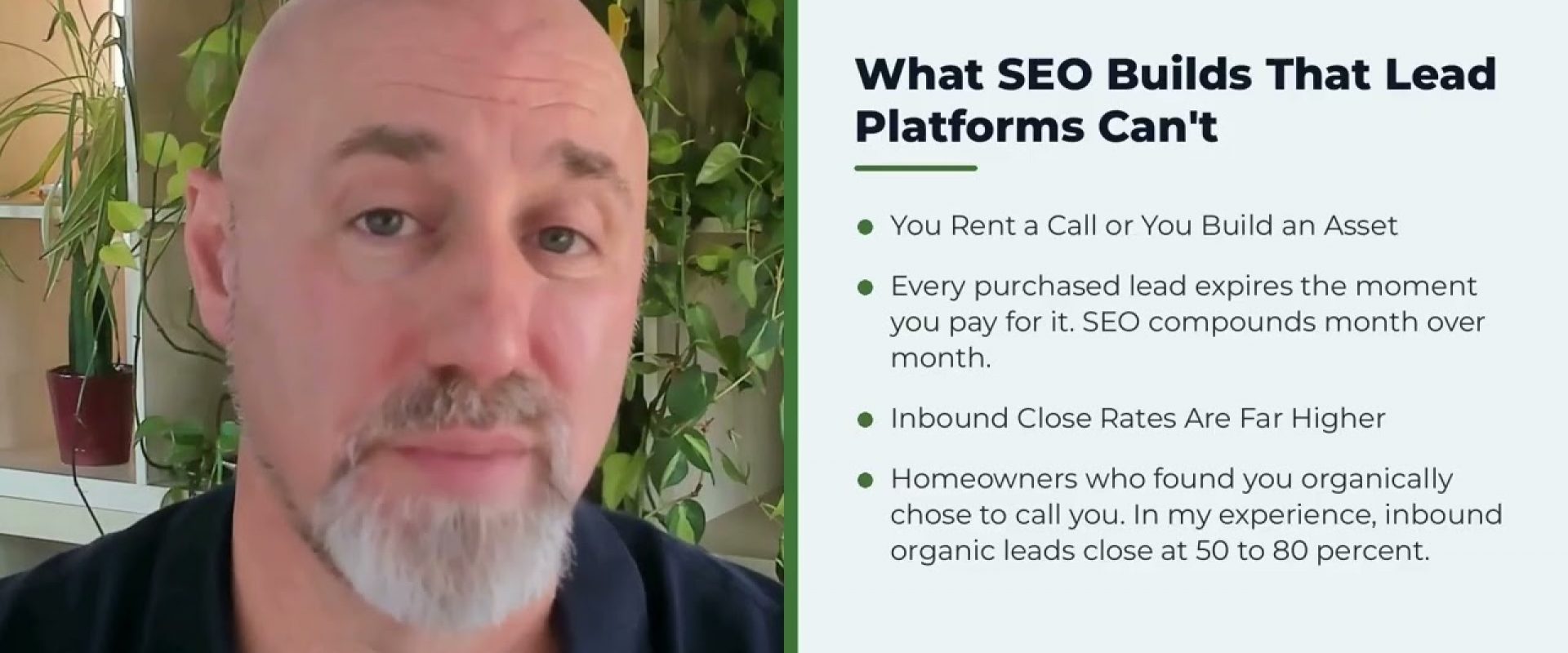
When you buy a lead, you rent a phone call. When you invest in SEO, you build an asset. After 12 months of real SEO work, a mold remediation company should be ranking for terms like mold remediation companies in their metro, showing up in the map pack for searches like mold remediation near me, and pulling in organic calls they don't pay per click for. Those calls are inbound. The home owner found you. They searched, they saw your listing, they chose to call inbound close rates or typically far higher than outbound purchase leads. In my experience inbound organic leads close at 50 to 80% depending on how well you answer the phone. That's not a small difference. That's the difference between a $400 cost per job and a cost per job that might be under $100 by month 18.
5:01 The Twelve-Month Comparison: Worked Example
Let me run a real example. Company A buys leads. They spend $3,000 a month on a lead platform. They receive roughly 40 leads. They close 30%, so 12 jobs. Their cost per acquired job is $250. Over 12 months, $36 ,000 spent, 144 jobs acquired, lead platform cost per job, $250. No asset built, month 13 spent restarts at zero. Company B invests in SEO. They spend $2,500 a month, months one through four, ranking improvements, limited calls, months five through eight, mapped pack visibility improving, calls increasing, months nine through 12, consistent inbound volume. By month 12, in my experience with restoration SEO, a well executed campaign in a mid market is generating 15 to 40 organic leads per month. Close rate on those inbound leads, 60 % or better, cost per acquired job in month 12 under $150. And the asset keeps working a month 13 without a reset. Over 12 months, total SEO spend, $30,000. Total jobs, harder to project exactly, but the trajectory matters. The lead platform job stops when you stop paying. The SEO job compounds. I'm gonna be fair here.
6:22 Where Lead Buying Makes Sense
Lead buying makes sense in specific situations. If you just launched a need cash flow immediately, buying leads fills the gap. If you're in a brand new market and have zero local authority, leads keep the crew busy. If you have a dedicated salesperson who closes at high rates, the math can work. Lead platforms are not evil. They're just expensive per job. And most companies don't run the actual math. The companies that get hurt are the ones who buy leads for three years, never build any organic presence, and wonder why their margins keep shrinking as platform costs go up every year. The number one mistake mold companies make is treating SEO and lead buying as
6:58 The Most Common Mistake I See
either or choices and picking lead buying because the feedback is instant. SEO takes four to 12 months to show serious results. Lead platform show results on day one. That timeline mismatch causes most owners to under invest in SEO because they don't see immediate output. But the companies winning in mold remediation right now started their SEO 12 to 24 months ago. The companies who didn't are watching their lead costs climb while their competitors are getting inbound calls they don't pay for.
7:31 What Good Mold Remediation SEO Includes
When you're evaluating SEO for your remediation company, here's what should be in scope. Local SEO, including Google Business Profile Optimization. Service area pages targeting the specific cities and counties you work in, content that answers real questions, homeowners type, like mold remediation costs and how to find a mold remediation company, technical site health. So Google can actually crawl and index your pages, link building and citations to build local authority, reporting that shows ranking movement, impressions and actual phone calls. If an agency can't tell you what keywords they're targeting, show you ranking progress month over month and connect SEO activity to inbound calls, find a different agency.
8:19 What to Track Starting Now
Whether you're buying leads, running SEO or both, track these numbers starting this week. How many leads did you get from each source? How many became paying jobs? What was the average job revenue from each source? What was the total cost of that source, including your team's time? Divide costs by jobs. That's your cost per acquired job. Run that number for three months. Then you'll have real data to make a real channel decision. If you want to see where you actually stand right now, we run a free visibility teardown from mold and restoration companies. We look at your current rankings, your map pack position, what keywords you're showing up for and where the biggest gaps are. No pitch deck, no fluff, just your numbers. Go to SEO .PushLeads .com slash audit to request yours or call us at 828 -348 -7686. If you found this useful, subscribe. Next week, I'm covering why most restoration companies, Google Business Profiles are set up in ways that actively hurt their rankings and it's a quick fix. Most companies miss completely.
By Jeremy Ashburn, founder of PushLeads, an Asheville, NC SEO and digital marketing agency for contractors and home-service businesses.
Key Takeaways
Want it done for you? See our restoration SEO and marketing agency.
Mold remediation SEO costs $1,500 to $4,000 a month. Buying leads from platforms like Angi or HomeAdvisor often costs more per acquired job once you factor in close rates and labor. SEO builds a compounding asset; lead platforms reset to zero every month. The only number worth comparing between any two marketing channels is cost per acquired job, not cost per lead and not monthly spend.
- Cost per acquired job is the only metric that lets you compare SEO to lead buying honestly.
- Shared leads on major platforms go to three to five competitors simultaneously, which hammers your close rate.
- Purchase leads commonly close at 20 to 35 percent; inbound organic leads close at 50 to 80 percent.
- SEO compounds over time; lead platform results stop the month you stop paying.
- Labor cost from chasing purchased leads is real even when it does not appear on the platform invoice.
- Lead buying makes sense for short-term cash flow, but it rarely builds any long-term marketing asset.
- Tracking four numbers weekly, leads, jobs, revenue, and total cost, gives you the data to make a real channel decision.
Mold Remediation SEO Cost vs Leads: The Only Comparison That Actually Matters
Mold remediation SEO runs roughly $1,500 to $4,000 a month, and buying leads through platforms like Angi or HomeAdvisor can cost you more than that per acquired job once you account for the lead price, your actual close rate, and the labor your team puts into working those contacts. Most mold companies I talk to have never calculated their true cost per acquired job. They see a lead price of $40 or $80 and assume that is the number they are competing against. It is not. That is the starting price for a maybe, a name and phone number for someone who may have clicked an ad by accident and is simultaneously being called by four of your competitors.
The mold remediation SEO cost vs leads question is really a math problem, and once you run the math honestly, the answer becomes clearer. I am going to walk through the real numbers I have seen working with restoration companies, including a full 12-month side-by-side comparison, so you can make a channel decision based on data rather than gut instinct or whoever gave you the cheapest pitch last week.
Before you can compare anything, you need three numbers for every marketing channel you use: cost per lead, close rate on that specific lead source, and cost per acquired job. The third number is the only one worth arguing about. If your platform charges $60 per lead and you close one in three, your cost per acquired job is $180. If it charges $120 per lead and you close one in four, you are at $480 per job before a single phone call is answered. Everything else in this conversation flows from those calculations.

Want more customers from Google & AI search?
Get a free SEO audit of your site — see exactly what to fix first.
What Lead Platforms Are Actually Selling You
Lead platforms sell you contact information for someone who expressed interest in a related service, often a shared signal sold to multiple contractors at the same moment. That is the core of the product, and understanding it changes how you evaluate the price.
Who else gets the same lead I just paid for?
Platforms like Angi, HomeAdvisor, and Modernize sell the same lead to multiple contractors at the same time. In the restoration space, you are commonly competing against three to five other companies on every single lead you purchase. That is not a flaw in the system you can work around; it is the design of the product. The moment you get that notification, so does your competition. Your close rate on purchased leads rarely hits 50 percent because of that structure, and it often lands somewhere between 20 and 35 percent. That is not a reflection of your sales skills. That is what happens when a homeowner gets five calls in ten minutes.
What happens to my lead cost when competition increases in my market?
Platform pricing is tied to geography, competition density, and average job size in the market. As more restoration companies enter a metro and bid on the same lead inventory, prices per lead rise. Mold-specific leads on major platforms typically run $40 to $150 per lead. Water damage leads can go higher, sometimes $200 or more in competitive markets. The more contractors competing for leads in your area, the more the platform can charge, and the lower your close rate tends to drop because every competitor on that lead is also competing for the same phone call.
Why do inbound SEO leads close at a higher rate than purchased leads?
Inbound organic leads close at 50 to 80 percent in my experience because the homeowner initiated the contact. They searched for a mold remediation company, saw your listing or website, and chose to call you. That intent signal is completely different from a shared form fill. The homeowner is not bracing for five competing calls. They called one company: yours. That difference in intent is why cost per acquired job from organic search is almost always lower than from purchased leads, even when SEO costs more per month on paper.
The Hidden Labor Cost Nobody Puts on the Invoice
The fully loaded cost of a purchased lead is almost always higher than the platform price, sometimes double or triple, once you count the time your team spends working contacts that never become jobs.
How do I calculate the real cost of working purchased leads?
A $40 lead that requires two hours of phone tag, two estimate trips, and a follow-up sequence has a real cost far above $40. If you are paying a salesperson or customer service rep to work those leads, divide their weekly cost by the number of jobs that close from their effort. That number will surprise most owners. Someone on your team is answering those calls, sending estimates, and following up two out of three times because the lead went to four other companies simultaneously. That labor is real even when it does not appear on your platform invoice.
Why does my team spend so much time on leads that never close?
Purchased leads require active sales effort on every single contact. You are reaching out to someone who did not specifically choose you. They may be comparing five quotes, or they may have already booked another company by the time you call. That reality means a significant portion of your sales effort produces no revenue. When you track it honestly, the labor cost attached to low close rates often pushes the true cost per acquired job well past what owners expect. For a deeper look at how these numbers stack up over time, the mold SEO vs buying leads math I have put together walks through the full calculation.
What is a fair way to measure the labor cost attached to my lead platform?
Take your CSR or salesperson's weekly loaded cost, including wages, benefits, and any commission. Divide that by the number of paying jobs they close per week from purchased leads alone. Add that figure to your platform spend and divide the total by jobs closed. That is your real cost per acquired job from that channel. Most owners who run this calculation for the first time discover their effective cost per job is 40 to 60 percent higher than they assumed based on the lead platform price alone.

What Mold Remediation SEO Actually Costs and What It Builds
SEO for a mold remediation company in a mid-size competitive market runs between $1,500 and $4,000 a month, and that range exists because the work scales with how competitive your market is, not because agencies are pulling numbers out of thin air.
Why does SEO cost vary so much from market to market?
Larger metros cost more because there are more established competitors ranking for the same terms, more content needed to cover service areas, and more aggressive link building required to earn authority. Rural and smaller markets cost less because the competitive threshold is lower. I am not going to pretend a $900 per month retainer moves the needle in a competitive metro market. It does not. Over 12 months in a mid-size market, you are looking at $18,000 to $48,000 in total investment. That is the honest range, and it is worth comparing against what you would actually spend acquiring the same number of jobs through a lead platform. You can see how that comparison shakes out in detail on the SEO cost versus actual returns breakdown I published for restoration companies.
What does SEO build that a lead platform cannot?
When you buy a lead, you rent a phone call. When you invest in SEO, you build an asset. After 12 months of real SEO work, a mold remediation company should be ranking for terms like "mold remediation companies in [their metro]," showing up in the map pack for "mold remediation near me," and pulling in organic calls they do not pay per click for. That asset keeps producing results in month 13, month 18, and month 24 without resetting to zero. A lead platform resets the moment you stop paying. That compounding effect is the core of the economic argument for SEO over time, and it is the reason the companies winning in mold remediation right now started their SEO 12 to 24 months ago.
What should a mold remediation SEO campaign actually include?
A legitimate campaign should include Google Business Profile optimization, service area pages targeting the specific cities and counties you work in, content answering real questions homeowners search for like "mold remediation cost" and "how to find a mold remediation company," technical site health so Google can crawl and index your pages, link building and citation development to establish local authority, and reporting that shows ranking movement, impressions, and actual inbound phone calls. If an agency cannot tell you what keywords they are targeting, show you ranking progress month over month, and connect their work to inbound calls, find a different agency. The mold removal SEO ranking strategy I cover in more depth explains exactly how that ranking process works for remediation companies specifically.
The 12-Month Side-by-Side Comparison
Running a real 12-month comparison between a lead-buying model and an SEO model gives you a clearer picture than any single month snapshot because SEO performance changes over time while lead platform costs stay relatively flat or rise.
What does a lead-buying model look like over 12 months?
Company A buys leads. They spend $3,000 a month on a lead platform and receive roughly 40 leads per month. Closing 30 percent of those gives them 12 jobs. Their cost per acquired job is $250. Over 12 months that is $36,000 spent and roughly 144 jobs acquired at a consistent $250 per job. That is not a terrible outcome if job revenue is strong. But on month 13, they start at zero again. No ranking, no organic presence, no asset. The spend has to continue at the same rate to maintain the same volume.
What does an SEO model look like over the same 12 months?
Company B invests $2,500 a month in SEO. Months one through four deliver ranking improvements with limited inbound calls. Months five through eight show map pack visibility improving and call volume increasing. Months nine through 12 produce consistent inbound lead volume. By month 12 in a well-executed mid-market campaign, a mold remediation company is typically generating 15 to 40 organic leads per month. With a 60 percent or better close rate on inbound calls, the cost per acquired job by month 12 is under $150, and the asset keeps working into year two without resetting. Total 12-month SEO spend: $30,000. The lead platform spent $36,000 and built nothing permanent.
How does the cost per acquired job change as SEO matures?
In month one of an SEO campaign, your cost per acquired job is essentially infinite because you are investing without yet receiving inbound leads from that effort. By month six it starts to drop meaningfully. By month 12 to 18 it is usually well below what a lead platform delivers, and it keeps improving as rankings solidify and review volume builds. The digital marketing cost per lead comparison I put together for restoration companies shows how this trajectory plays out across different channel types with real numbers attached.
When Buying Leads Actually Makes Sense
Lead platforms are not the enemy, and I am not going to tell you to cancel your Angi account tomorrow. There are real situations where buying leads is the right short-term decision.
Should a new mold company buy leads while waiting for SEO to kick in?
If you just launched and need cash flow immediately, buying leads fills a real gap. If you are entering a brand-new market and have zero local authority, leads keep your crew busy while your SEO foundation is being built. The problem is not using lead platforms during that phase. The problem is staying on them for three years, never building organic presence, and watching margins shrink as platform costs climb every year. Using lead platforms as a bridge while SEO compounds is a legitimate strategy. Using them as your only strategy indefinitely is what hurts companies long-term.
What kind of sales operation makes lead buying more cost-effective?
If you have a dedicated salesperson who consistently closes at a higher rate than the industry average on outbound contacts, the math on purchased leads looks better. A company closing 45 percent of purchased mold leads at $100 each has a cost per acquired job around $222, which is acceptable in a market where average jobs are $3,500 or more. The issue is that most companies do not actually know what their close rate is on purchased leads specifically. They blend it with inbound referrals and organic calls and end up thinking the lead platform is performing better than it is. Separating your tracking by source is the first step to making this decision clearly. For companies weighing both channels, the SEO versus paid ads comparison gives additional context on how different acquisition channels stack up for remediation work.
Is there a revenue threshold where lead buying makes more sense than SEO?
There is not a clean revenue cutoff, but the economics shift based on average job value. A company doing $800 crawl space inspections has much less margin to absorb a $400 cost per acquired job than a company doing $5,000 full remediation projects. If your average job revenue is low and purchased lead costs are high, the margin squeeze becomes severe quickly. Knowing your average job value and your realistic close rate on purchased leads is the foundation of that calculation. Without those two numbers, you are guessing.

The Most Common Mistake Mold Companies Make With Marketing Channels
The most common mistake I see is treating SEO and lead buying as mutually exclusive choices, then defaulting to lead buying because the feedback is immediate.
Why do most mold companies stay on lead platforms longer than they should?
Lead platforms show results on day one. SEO takes four to 12 months to show serious results. That timeline mismatch causes most owners to underinvest in SEO because they do not see immediate output. The instant feedback loop of a purchased lead feels productive even when the cost per acquired job is high. The companies winning in mold remediation right now started their SEO 12 to 24 months ago. The companies that did not are watching their lead costs climb while competitors receive inbound calls they do not pay per click for. The investment required to catch up grows the longer you wait. For restoration companies thinking about this long-term, the content on year-round restoration demand building covers how to build stable inbound volume that does not depend on storm cycles or lead platforms.
What happens to a mold company that relies on lead platforms for three or more years?
After three or more years of lead buying without building organic presence, you have a business that is entirely dependent on a vendor whose prices you do not control. Every time platform costs go up, your margins go down. Every time the platform changes its algorithm or expands into your market, your lead volume shifts without warning. You have no brand presence in search, no organic rankings, and no asset to show for three years of spend. The $36,000 you spent in year one is gone. So is the $36,000 from year two. A company that invested that same money in SEO over the same period would be generating significant organic volume by month 24 with a cost per acquired job well below what the lead platform delivers. The comparison is not abstract. The restoration SEO versus shared leads analysis gets into exactly this dynamic for restoration businesses specifically.
How do I avoid making channel decisions based on feeling rather than data?
Track four numbers for every channel every week: leads generated, jobs closed, average job revenue, and total cost including labor. Divide total cost by jobs closed. That is your cost per acquired job for that channel. Run it for three months across every source you use. After 90 days you will have real data and real channel decisions become straightforward. Gut instinct about which channel feels productive is no substitute for knowing your actual numbers.
What Good Mold Remediation SEO Includes in Practice
When you are evaluating an SEO agency for your remediation company, you need a clear picture of what work should actually be happening every month in exchange for your retainer.
What local SEO work matters most for a mold remediation company?
Google Business Profile optimization is foundational. Your GBP drives map pack visibility, and the map pack is where most local searches for mold remediation convert to calls. Beyond the GBP, service area pages targeting the specific cities and counties you work in are essential. A company serving eight cities needs eight pages, each built around the search intent for that geography. Generic state-level pages do not win local map pack placement, and thin pages that repeat the same content with a city name swapped in do not either. Real pages with real local content and structured data are what move the needle.
What content should a mold remediation company be publishing for SEO?
Content that answers questions homeowners actually type into search engines. Questions like "how much does mold remediation cost," "how to find a mold remediation company," "is mold remediation covered by insurance," and "how long does mold remediation take." These are the queries that bring in homeowners who are actively researching a purchase decision. A single well-built page answering one of those questions with authority can generate inbound calls for years. That is a different model than paying $100 per lead to a platform. It takes longer to build, but the asset does not disappear when your credit card stops charging.
How do I know if my SEO agency is actually doing the work?
Demand ranking reports that show specific keyword positions month over month, not just traffic estimates. Ask for Google Search Console data showing impressions and clicks. Ask to see call tracking numbers by channel so you can attribute actual inbound calls to organic search. If an agency gives you a monthly report full of vanity metrics but cannot connect their work to inbound phone calls and ranking movement on the specific keywords you care about, that is a problem. Transparency in reporting is not a premium add-on. It is the minimum standard for knowing whether your investment is working. The broader question of how remediation companies build sustainable lead flow is covered in detail at the SEO versus paid ads comparison resource I mentioned earlier for anyone who wants to dig into channel strategy further.
In this video
- 0:00 Buy Leads vs SEO Real Cost Breakdown
- 0:20 True Cost of Buying Mold Leads
- 1:08 What SEO Actually Costs Upfront
- 2:07 Side by Side 24 Month Comparison
- 3:05 Seasonal Demand and Why SEO Wins
- 4:02 High Intent Mold Keywords That Convert
- 4:47 Compounding Returns Lead Buying Never Gets
- 5:37 Four SEO Mistakes Mold Companies Make
- 6:33 Realistic 12 Month SEO Timeline
- 7:34 When Buying Leads Still Makes Sense
- 8:16 Transition Framework From Leads to SEO
Full transcript: Should a mold remediation company invest in SEO or just buy leads?
What to Track Starting This Week
Whether you are buying leads, running SEO, or both, the tracking process is the same and it should start now rather than after you make a channel change.
What four numbers should every mold company be tracking weekly?
Track how many leads came in from each source, how many of those became paying jobs, what the average job revenue was from each source, and what the total cost of that source was including your team's time. Divide total cost by jobs closed. That is your cost per acquired job. Do that for every channel separately. Blending channels into a single marketing budget number makes it impossible to know what is working. You need source-level data to make source-level decisions. Most mold companies I talk to are not doing this, and it is the single biggest reason their marketing spend feels like guesswork.
How long should I track before making a channel decision?
Three months of clean data gives you a defensible sample. One month is too noisy. Seasonal fluctuations, a slow week, or one unusually large job can distort a single month's numbers. After three months of tracking leads, close rate, revenue, and total cost by source, you will have enough signal to make a real decision. If your purchased lead cost per acquired job is running $400 and your early organic leads are closing at $180, you have a clear direction. If the numbers are close, you can use that data to optimize rather than guess.
What does a free SEO audit actually show a mold remediation company?
A legitimate visibility audit for a mold remediation company should show your current keyword rankings for the terms that actually produce calls, your map pack position across the cities you serve, what keywords you are showing up for versus what you are missing, and where the biggest gaps are relative to competitors ranking above you. It is not a generic score from an automated tool. It is a look at your actual position in the search results where your customers are making decisions. That information tells you whether SEO is a real opportunity for your business right now or whether other priorities should come first.
Frequently Asked Questions
How much does mold remediation SEO cost per month?
Mold remediation SEO costs between $1,500 and $4,000 a month for most companies in competitive markets, with smaller or rural markets falling toward the lower end and large metros toward the higher end. The range reflects the amount of work required to rank against established competitors. Over a full year, that is $18,000 to $48,000 in total investment. Agencies offering meaningful results for $500 to $900 a month in a competitive metro market are typically not doing the volume of work required to move rankings.
What is the average cost per lead from platforms like Angi or HomeAdvisor for mold?
Mold-specific leads on major platforms typically run $40 to $150 per lead depending on geography and market competition. Water damage leads can reach $200 or more in competitive markets. The listed price is not your cost per acquired job. Once you apply your actual close rate on shared, purchased leads, which often falls between 20 and 35 percent, the cost per job acquired from those platforms is significantly higher than the face price of each lead.
Why is my close rate on purchased mold leads so low?
Your close rate on purchased leads is low primarily because the same lead is being sold to three to five other contractors at the same time. The homeowner receives multiple calls in a short window and often books the first company to reach them, or they compare quotes from all five and choose on price. That competitive structure, not your sales approach, drives close rates on shared leads down to the 20 to 35 percent range that is common in the restoration space.
How long does mold remediation SEO take to produce results?
Mold remediation SEO typically takes four to 12 months to show meaningful ranking and call volume results. The first two to four months usually involve technical work, content development, and profile optimization with limited visible ranking changes. Months five through eight tend to show map pack improvement and increasing organic call volume. By months nine through 12, a well-executed campaign in a mid-size market should be generating consistent inbound leads at a cost per acquired job below what lead platforms deliver.
Should I cancel my lead platform while doing SEO?
You do not need to cancel your lead platform while SEO builds. Using purchased leads for cash flow during the first six to 12 months of an SEO campaign is a reasonable approach. The risk is continuing to rely entirely on lead platforms after your SEO has matured, because by that point you are paying for leads you could be receiving organically. Track both channels separately so you can see when organic performance has reached a point where lead platform spend can be reduced without hurting overall job volume.
What is a realistic organic lead volume from SEO for a mold company?
A well-executed mold remediation SEO campaign in a mid-size market typically produces 15 to 40 organic leads per month by month 12. Volume depends on market size, how competitive the local search landscape is, and how comprehensive the SEO work has been. Larger metros with more population density and more search volume can produce higher numbers. Smaller markets may produce fewer leads per month but at lower competition, meaning close rates tend to be strong and cost per acquired job stays favorable.
Does buying leads hurt my ability to build organic rankings?
Buying leads has no direct negative effect on your organic search rankings. SEO rankings are determined by your website, your Google Business Profile, your backlinks, and your content, none of which are affected by whether you purchase leads from Angi or HomeAdvisor. The indirect cost is opportunity cost. Every dollar and hour spent managing purchased leads is a dollar and hour not invested in the SEO work that builds long-term organic presence. The two channels operate independently in terms of search ranking mechanics.
What makes inbound SEO leads close at a higher rate than purchased leads?
Inbound organic leads close at 50 to 80 percent because the homeowner found you through their own search and chose to call you specifically. They were not reached by five competitors in the same minute. Their intent is clear and their trust is higher because they selected you rather than being assigned to you by a platform. That self-selection process removes most of the friction that drives purchased lead close rates down. The caller has already done enough research to pick up the phone and contact you directly.
Run the Real Numbers for Your Mold Business Before Your Next Marketing Decision
The mold remediation companies I see winning right now are not the ones with the biggest lead platform budgets. They are the ones that ran the real math on cost per acquired job 12 to 18 months ago, decided to build an organic asset, and are now getting inbound calls they do not pay per click for while their competitors keep watching platform costs rise.
If you have never calculated your true cost per acquired job by channel, start there. Pull three months of data, separate your sources, divide total cost including labor by jobs closed, and see what your numbers actually say. That calculation alone changes the conversation.
If you want to know where your mold or restoration company stands in organic search right now, we run a free visibility teardown at PushLeads. We look at your actual rankings, your map pack position across your service area, and where your biggest gaps are relative to competitors ranking above you. No pitch deck, just your real numbers. Reach out to us at https://pushleads.com/contact/ to request yours or call 828-348-7686. We publish our pricing and we will tell you honestly whether SEO makes sense for your market right now or whether something else should come first.
Keep Reading
Want more customers from Google & AI search?
Get a free SEO audit of your site — see exactly what to fix first.
Your path · Restoration Company SEO
Keep going: read these next


Want this done for you?
Scan your site. See the gaps. Decide with numbers.
- Rankings, Google Business Profile and site-speed teardown
- Report lands in your inbox in about a minute
- No obligation · 4.9 from 67 Google reviews


