0:00 Intro
0:27 What Shared Leads Actually Cost You
1:23 What SEO Actually Costs in Year One
2:02 The Twelve-Month Comparison That Flips the Math
3:05 The Three Numbers That Drive the Decision
4:00 How the Search Volume Maps to Your Market
5:11 The Compounding Effect Over Months Seven Through Twenty-Four
7:00 The Worked Example: Mid-Market Restoration Company
8:16 Common Mistakes That Kill SEO ROI
9:15 What Good Restoration SEO Actually Includes
10:01 How to Tell If Your Market Has Enough Demand
10:46 What to Do Right Now
Full transcript
0:00 Intro
Is restoration company SEO worth it? Or should you just buy shared leads? SEO pays for itself in about 12 months. And after that, your cost per exclusive lead drops to a fraction of what platforms charge. I’m gonna show you the actual math because the numbers are the only thing that should drive this decision. What shared leads actually cost you?
This is part of our guide to Restoration software pricing.
0:27 What Shared Leads Actually Cost You
So let’s start with shared leads because most restoration owners already run this experiment. What happens is you buy a lead from a platform and that lead was also sold to two, three, or sometimes four other companies. You get a call within 60 seconds and so did the other guys. The home under is confused because their field calls from strangers and now a price is the only tiebreaker. Industry ballpark on a shared water damage lead somewhere between $150 to $250 per lead. And that’s not per job. That’s for a phone number you compete for. If you’re closing one in four of these, your real cost per acquired job is pushing $600 to $1,000 before a single truck rolls. And that number recessed to zero every single month you stop paying. What SEO costs in year one?
Want the bigger picture? Our guide to digital marketing for restoration companies covers which channels actually turn into signed jobs.
This is one piece of a bigger plan. Our restoration SEO guide shows how it fits together.
1:23 What SEO Actually Costs in Year One
Now let’s look at the SEO side honestly because I’m not gonna pretend it’s free or fast. A credible restoration SEO engagement runs roughly $1,500 to $4,000 a month depending on market size and competition. So call it $24,000 for a full 12 month commitment in a mid -sized market. Now that’s real money. In month one, you get almost nothing back. Month three, you might see some movement. Month six, lead start rolling in. In month nine, the volume starts mattering. The curve is slow and then steep. The 12 month comparison that flips the math. Here’s where the comparison gets real.
2:02 The Twelve-Month Comparison That Flips the Math
Assume you’re spending $2,000 a month on shared leads. That’s $24,000 over 12 months. How many exclusive inbound leads did you generate? Zero because shared leads aren’t your leads. You rented access to someone else’s leads. Now take that same $24,000 into an SEO campaign. By month 12, a well -run campaign in a competitive mid -market is generating somewhere between 15 and 40 organic inbound calls a month depending on your geography and how much competition you have. And those calls are exclusive to you. Nobody else got that phone number. The home owner searched, found your site, found your company and called you. And your close rate on those calls will run 20 to 40 points higher than your shared close rate, in my experience, because the prospect chose you before they answered. The three numbers that drive the decision. Here are three numbers you need to run your own version of this.
3:05 The Three Numbers That Drive the Decision
Number one, your current cost per shared lead, write that down. Number two, your close rate on shared leads versus inbound organic calls. Most owners I talk to see a close rate difference of 20% or more. Number three, your average job revenue. For water damage, that’s often $4 ,000 to $8,000 per residential job. When you multiply the close rate improvement by the average job value, the SEO investment clears itself inside 12 months in most markets. After month 12, you’re not paying per lead. You’re paying a monthly management fee while the leads compound. On the other hand, the shared lead model has no compound effect. It’s a faucet that you rent. SEO is a faucet that you own. How the search volume maps to your market.
4:00 How the Search Volume Maps to Your Market
Let me show you what the search demand actually looks like, so this isn’t abstract. The keyword restoration company SEO alone pulls 409 impressions per month at an average position of 23. That means there are hundreds of searches every month from owners trying to figure out exactly what we’re talking about right now. The search water damage restoration costs gets 462 impressions at position 17. And the search restoration company SEO lead generation hits 451 impressions. Those aren’t massive national numbers, but your market is local and your city, water damage surges spike every time there’s a weather event. Pericane damage restoration 210 impressions, fire damage restoration SEO 242 impressions. When a pipe bursts at two in the morning, the homeowner opens Google and they’re typing something like water damage restoration near me. If you rake, you get the call. If you don’t, you competitor who invested in SEO gets it. The compounding effect over month seven through 24. Month one through six is investment.
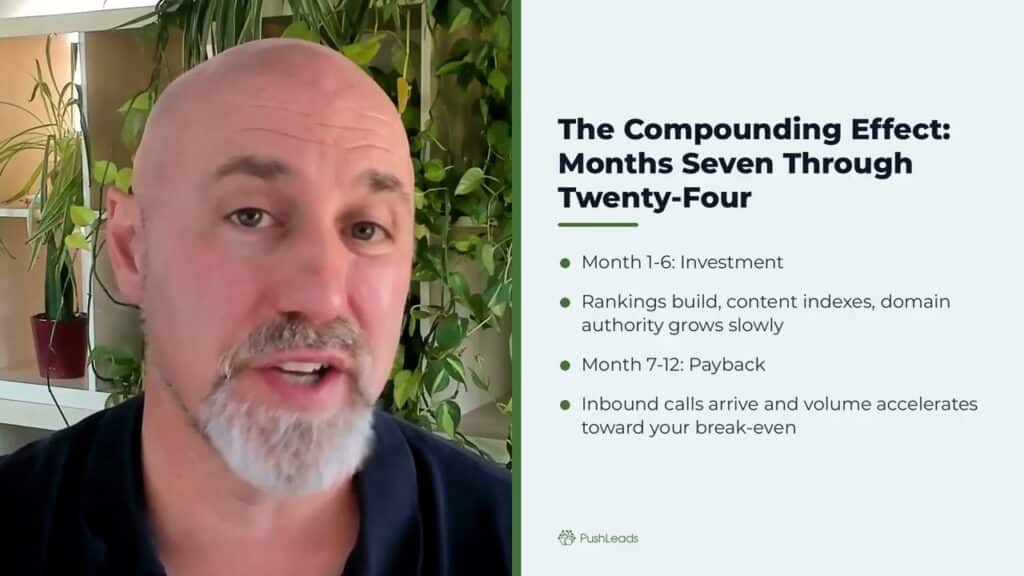
5:11 The Compounding Effect Over Months Seven Through Twenty-Four
Month seven through 12 is payback. Month 13 through 24 is profit. Here’s what changes after month 12. Your domain authority is building. Domain authority is your reputation of your website to Google and AI and other places online. And it’s just a number of the scale of one to 100. Brand new websites start with zero and then older websites, their main authority increases. And of course, if you’re working with an SEO company who’s actually doing their work, your domain authority should be growing. So let’s say you start with a five or 10. It should go from a 10 to a 20 over period of six months to 12 months or higher. It should be increasing. Now, if you’re working with somebody who’s not doing SEO or they’re not doing any work, your domain authority will be flat and it will never grow. And this is one way you can tell that you’re working with scam people versus people that actually know what they’re doing and are actually doing real SEO. Of course, be aware that there are many scams out there and maybe about third to a half of all companies that do SEO that do what we do are actually scams, at least in my opinion. But anyway, back to it. Your domain authority is building your content, it’s index and ranking and new pages you add reg faster because the site now has momentum because it’s growing in domain authority. And you pick up adjacent keywords, fire damage, mold remediation, storm restoration. And each keyword is another lane of inbound calls. Meanwhile, the restoration company that’s still buying shared leads is spending the same money every month with no asset accumulation. At month 24, the SEO invested company has a growing digital asset. The lead buying company just has receipts. A work example, let me run a real scenario.
7:00 The Worked Example: Mid-Market Restoration Company
The company is in a mid -sized city, has three trucks, and the annual revenue is around 2 million and they’re spending $3,000 a month on shared leads, which is around 36,000 a year. The close rate for this company on shared leads is 20%. The leads bought is around 150 per year and the jobs one is 30. The average job value is $6,000. The revenue from shared leads is $180,000. The cost is 36,000. The net from that one channel is $154,000. Now shift half to that budget, $1,500 a month towards SEO. They keep 1,500 in shared leads as a bridge. By month 12, SEO is generating 30 inbound calls a month. Your close rate on inbound is 40%. That’s 12 jobs a month from organic. And that’s 144 jobs in year two from organic alone. At 6,000 average, 864,000 in revenue from a channel that costs them 18,000 a year. That math does not work against SEO. It worked against shared leads. Common mistakes that kill SEO ROI.
8:16 Common Mistakes That Kill SEO ROI
I wanna be direct about why some restoration companies try SEO and say that it didn’t work. Mistake number one, they hired somebody who did generic SEO, not local, and not restoration specific. The rankings in Houston don’t help you in Asheville, North Carolina. Mistake number two, they quit at month four. That’s one month before the curve starts turning. Quitting at month four is like drilling for water, hitting sand and calling it dry. Mistake number three, they didn’t track call attribution. If you don’t know which calls came from organic search, you can’t measure ROI and you’ll undercut the winds. Mistake number four, they had a slow, thin website. SEO drives traffic to your website. If your site loads in five seconds on a mobile and has three pages of thin content, the traffic is just going to leave. Fix your website before you pour fuel on it. What a good restoration SEO actually includes.
9:15 What Good Restoration SEO Actually Includes
Local SEO is not just blog posts, it’s a stack. It includes Google Business Profile optimization, local citation consistency across directories, location specific service pages, water damage in your city, motor mediation in your suburbs. On page optimization for high intent keywords, review acquisition systems because reviews are one of the strongest ranking signals to Google and both AIs. Linked building from local and industry sources, content that answers the question homeowners type at two in the morning when they’re standing at an inch of water in their basement. And all of that compounds, none of it resets at the end of the billing cycle. How to tell if your market has enough demand?
10:01 How to Tell If Your Market Has Enough Demand
This is the question you should ask before committing to any SEO spam. Run at Google Keyword Planner, check for your city plus terms like water damage restoration, fire damage cleanup or mold removal. So if you’re based in Houston, Texas, it would be Houston Water Damage Restoration or Houston Fire Damage Cleanup or Houston Mold Removal. If you’re in a market with more than 50,000 residents, the demand is there. Weather events in your region drive spikes that can triple normal search volume for weeks. The keyword disaster restoration marketing sits at 49 position, which means most companies are not even in the game yet. That’s an opportunity, not a warning sign. What to do right now?
10:46 What to Do Right Now
If you’re still buying shared leads and you haven’t run the 12 month comparison for your own numbers, that’s the first step. So pull your lead costs, your close rate and your average job value and run the math I showed you. If SEO wins on your numbers, the next question is whether your current online presence is even ready for a campaign. That’s exactly what our free visibility teardown covers. We look at your Google Business Profile, your website, your site speed, what’s ranking on your website and your competitor gaps in your specific market. And you’ll get a real picture of where you sand and what it would take to actually compete. It’s no pressure, no pitch, just the numbers. Go to SEO .PushLeads .com or call 828 -348 -7686. And if you already know that you want to talk strategy, you can use the same link and the same number. The comparison is clear. Run the math on your own business and let the numbers make the call. I’m Jeremy Ashburn with PushLeads, helping restoration companies get more leads without struggle and frustration. Talk sick.
By Jeremy Ashburn, founder of PushLeads, an Asheville, NC SEO and digital marketing agency for contractors and home-service businesses.
Key Takeaways
Want it done for you? See our restoration SEO and marketing agency.
Restoration company SEO pays for itself in roughly twelve months, and after that your cost per exclusive inbound lead drops far below what shared lead platforms charge. Shared leads reset to zero every month you stop paying. SEO builds a digital asset that compounds over time. The decision should be driven by three numbers: your current cost per shared lead, your close rate difference between shared and organic calls, and your average job revenue.
- Shared leads cost $150 to $250 each and are sold to two, three, or four competitors simultaneously, pushing your real cost per acquired job to $600 to $1,000.
- A credible restoration SEO engagement runs $1,500 to $4,000 per month depending on market size and competition.
- Inbound organic callers close at 20 to 40 percentage points higher than shared leads because the homeowner chose you before they called.
- By month twelve a well-run campaign in a mid-size market generates 15 to 40 exclusive organic calls per month.
- Month one through six is investment, month seven through twelve is payback, and month thirteen through twenty-four is compounding profit.
- Common mistakes that kill SEO results include hiring a generic (not restoration-specific) agency, quitting before month six, and not tracking call attribution.
- If your city has more than 50,000 residents, local search demand for water damage, fire damage, and mold remediation is almost certainly large enough to support an SEO investment.
Restoration SEO vs Buying Leads: Which One Actually Builds Your Business?
Restoration SEO wins the long-term cost comparison against shared leads in almost every mid-size market, but only after you survive the first six months of the curve and only if the campaign is built correctly. I want to be upfront about that because I am not going to pitch you something that requires hiding the rough part. The honest answer is that shared leads give you calls tomorrow and nothing permanent, while SEO gives you almost nothing in month one and a compounding asset by month thirteen. The decision hinges on three numbers specific to your business: what you currently pay per shared lead, the difference in close rates between a shared call and an inbound organic call, and your average job value. When you plug real numbers into that formula, the math almost always favors SEO over a twenty-four month window. The rest of this post walks through each piece of that calculation, the worked example I use with restoration owners, the mistakes I see kill SEO campaigns before they pay off, and what a properly built restoration SEO program actually includes.
Want more customers from Google & AI search?
Get a free SEO audit of your site — see exactly what to fix first.
What Shared Leads Actually Cost When You Run the Full Math
Shared leads cost most restoration companies between $600 and $1,000 per acquired job once you account for the leads you lose to competitors, and that number resets to zero every month you stop paying the platform. That is the number that matters, not the sticker price of $150 to $250 per lead that the platform advertises.
Why does a $200 lead actually cost me $800?
When you buy a shared lead, the same phone number goes to two, three, or sometimes four other restoration companies at the same moment. Your phone rings within sixty seconds and so does everyone else’s. The homeowner is fielding calls from strangers simultaneously, which means price becomes the only tiebreaker. If your close rate on shared leads is one in four, which is roughly what I hear from most owners, your real cost per acquired job is four times the lead price. At $200 per lead, that puts you at $800 per job before a single truck rolls.
What happens to my shared lead investment if I pause for a month?
It disappears entirely. There is no equity, no ranking, no content, and no asset that carries forward. The moment you stop paying, the calls stop. That is fundamentally different from an SEO investment, where the pages you built, the links you earned, and the domain authority you accumulated keep working even if you scale back spend. I am not saying shared leads are worthless in the short term. They can bridge cash flow while SEO builds. But relying on them as your only channel means you are renting a faucet instead of building one you own.
How does competing on price hurt my margins on shared leads?
When a homeowner is getting four calls from strangers, the fastest and cheapest quote usually wins. That pressure pushes your technicians to discount on the phone before they have even seen the job. Over time, a business built on shared leads tends to train its sales process around price defense rather than value explanation. Inbound organic callers behave differently because they already selected you before they picked up the phone. That changes the entire conversation and protects your margins.
What SEO Actually Costs in Year One and When You See Returns
A credible restoration SEO engagement costs roughly $1,500 to $4,000 per month depending on your market size and the level of competition, which works out to about $24,000 for a full twelve-month commitment in a mid-size city. Month one you get almost nothing back, month three you start to see ranking movement, month six leads begin arriving, and month nine the volume starts to matter. The curve is slow and then steep.
Why do I pay for six months before I see real results?
Search engines index and test new content over time. Domain authority, which is a score on a scale of one to one hundred reflecting how much trust Google and AI systems assign your site, does not jump overnight. A brand new site might start at five or ten. A well-run campaign should move that number to twenty or higher within six to twelve months. During months one through six, the agency is building the foundation: optimizing your Google Business Profile, building location-specific service pages, cleaning up citation inconsistencies, and earning early links. Rankings follow the foundation, not the other way around.
How can I tell if an SEO agency is actually doing work during those early months?
Watch your domain authority number. If it is flat six months into a campaign, that is a sign the agency is not doing real link building or content work. A legitimate campaign will show a steadily rising domain authority, new pages being indexed, and early keyword movements even before phone volume picks up. I would estimate that somewhere between a third and half of all agencies selling SEO services are not doing real work, so verifying domain authority growth is one of the clearest checkpoints you have.
Is $24,000 in year one actually comparable to what I spend on shared leads?
For many restoration companies, yes. If you are spending $2,000 to $3,000 per month on shared leads, you are already at $24,000 to $36,000 per year with nothing to show for it at the end of twelve months except a stack of invoices. The SEO investment at the same dollar amount produces a ranked website, a stronger Google Business Profile, a library of indexed content, and inbound calls that belong exclusively to you. The year one cost is the same or less. The year two situation is dramatically different.
The Twelve-Month Comparison That Changes the Calculation

When you put $24,000 into shared leads over twelve months and $24,000 into SEO over the same period, the shared leads produce zero exclusive leads because every lead was rented from a platform, while a well-run SEO campaign in a competitive mid-market produces 15 to 40 organic inbound calls per month by month twelve. That difference is the core of the restoration SEO vs buying leads decision.
What does 15 to 40 organic calls per month actually mean in revenue?
At a 40 percent close rate on inbound calls, which is realistic because organic callers already chose you, thirty calls per month becomes twelve jobs. At a $6,000 average job value for residential water damage, that is $72,000 in revenue per month from one channel that costs you a monthly management fee rather than a per-lead fee. Compare that to the shared lead model where thirty acquired jobs required 150 purchased leads at roughly $200 each, totaling $30,000 in lead costs alone for the same job count.
Why is my close rate higher on organic inbound calls?
The homeowner found your website, read about your company, saw your reviews, and decided to call you specifically. They did not receive your number from a platform that was simultaneously texting it to three competitors. That means you are starting the conversation as the chosen option rather than one of four options competing on price. In my experience talking with restoration owners, the close rate difference between shared leads and organic inbound is typically 20 percentage points or more. That difference alone is often enough to justify the SEO investment before you even factor in lead volume growth.
What if my market is smaller and I only get 15 calls a month instead of 40?
Fifteen exclusive inbound calls at a 40 percent close rate is six jobs per month. At $6,000 average, that is $36,000 per month in revenue from a channel costing you $1,500 to $2,000 per month. The math still works clearly in favor of SEO. Smaller markets also tend to have less SEO competition, which means you can reach page one rankings faster and with less monthly investment than a major metro market requires.
The Three Numbers That Drive Your Personal Decision
The three numbers you need to run your own version of this analysis are your current cost per shared lead, your close rate on shared leads versus organic inbound calls, and your average job revenue. When you multiply the close rate improvement by the average job value and compare it to the SEO monthly cost, the investment clears itself inside twelve months in most markets.
How do I calculate my real cost per shared lead right now?
Take your total monthly spend on the lead platform and divide it by the number of jobs you actually won, not the number of leads you purchased. If you spent $3,000 and won six jobs, your real cost per acquired job is $500. Then compare that number to what your cost per acquired job would look like from an SEO channel at month twelve, where you are paying a management fee divided by the number of organic jobs won that month. Most owners who run this calculation are surprised by how quickly the SEO number becomes favorable.
What average job revenue should I use for water damage versus mold or fire?
For residential water damage, the typical range I hear from owners is $4,000 to $8,000 per job. Fire damage jobs tend to run higher. Mold remediation varies widely depending on scope. Use your own actual average, not an industry estimate, because your specific service mix and pricing will change the calculation. The higher your average job value, the faster the SEO investment pays back because each marginal job recovered by a higher close rate is worth more.
At what close rate difference does SEO clearly beat shared leads?
A 10 percentage point close rate improvement in favor of organic inbound is usually enough to tip the math, but most owners I work with see a 20 to 30 point difference. If your shared close rate is 20 percent and your organic close rate is 40 percent, you are winning twice as many jobs from the same number of calls. That means SEO does not need to match the raw call volume of your shared lead platform to produce equal or better revenue. It just needs to generate a fraction of the contact volume to break even, and then it keeps compounding.
How Local Search Volume Maps to Your Specific Market
If your city has more than 50,000 residents, the local search demand for water damage restoration, fire damage cleanup, and mold removal is almost certainly large enough to support an SEO investment, and weather events can triple that search volume for weeks at a time. The demand is not abstract or national. It is your neighbors typing into Google at two in the morning with water rising in their basement.
How much search volume is there for restoration keywords in a typical market?
To give you a concrete sense of what the data looks like, the keyword phrase water damage restoration costs gets 462 impressions per month at an average position of seventeen for sites currently competing on it. Hurricane damage restoration pulls 210 impressions and fire damage restoration SEO pulls 242. These are not massive national numbers, but your market is local. In a city of 200,000, water damage searches after a single significant rain event can spike sharply above normal monthly volume. Each of those searches represents a homeowner with an immediate problem and a credit card ready to hire someone today.
What should I look for in Google Keyword Planner to confirm demand in my city?
Search for your city name combined with terms like water damage restoration, fire damage cleanup, and mold removal. If you see monthly search volumes above a few hundred searches per term, the demand exists. The keyword disaster restoration marketing currently sits at position forty-nine for most companies, meaning most restoration businesses are not even competing for it yet. That is not a warning sign about demand. It is an open lane. Low competition on a keyword with real intent behind it is exactly the kind of opportunity a well-run SEO campaign can capture in months rather than years.
Does seasonal weather affect whether SEO is worth it in my region?
Yes, significantly. Markets with hurricane exposure, heavy snow melt, or frequent severe storms see multi-week surges in restoration search volume that can dramatically outperform monthly averages. If your region has one major weather event per year, and many do, the calls generated during that spike alone can justify a significant portion of your annual SEO investment. The companies that rank when the storm hits are the ones that invested in SEO during the quiet months, not the ones who tried to buy emergency leads from a platform that is suddenly charging a premium because every restoration company in the area is competing for the same pool.

The Compounding Effect from Month Seven Through Month Twenty-Four
After month twelve, the SEO-invested restoration company has a growing digital asset, while the company still buying shared leads has only a stack of monthly invoices and zero accumulated equity. The compounding happens because domain authority rises, content indexes faster, and adjacent keywords like mold remediation, storm restoration, and fire damage each become additional lanes of inbound calls without proportionally increasing your cost.
How does domain authority growth change what I can rank for over time?
When your domain authority rises from ten to twenty, new pages you publish tend to get indexed and ranked faster because Google already trusts your site. That means a new service page for storm restoration or a new city-specific page for a suburb you want to serve can start driving calls within weeks rather than months. Each new keyword you rank for is another channel of inbound traffic that costs you nothing beyond the monthly management fee you were already paying. The shared lead model has no equivalent. There is no accumulation, no momentum, and no expansion that comes without additional spend.
What does the revenue picture look like at month twenty-four compared to month twelve?
At month twelve you are likely breaking even or generating modest ROI from organic. At month twenty-four, the same monthly management fee is supporting a significantly larger keyword footprint, higher domain authority, a deeper backlink profile, and more content indexed. The leads keep coming without a corresponding increase in cost. The shared lead company at month twenty-four has spent twice as much with no asset to show for it. That gap in outcomes is the compounding effect, and it is the reason the comparison flips so decisively in SEO’s favor over a two-year window.
What adjacent services should I add pages for as my site gains authority?
Start with water damage because it tends to have the highest search volume and emergency intent in most markets. Then add mold remediation, fire damage restoration, and storm damage repair as separate service pages targeting your city and nearby suburbs. Each page targets a different set of high-intent keywords and, as your domain authority grows, each new page has a better chance of ranking quickly. Over two years, a well-structured restoration website can rank for dozens of city-plus-service combinations, each driving its own stream of exclusive inbound calls.


The Worked Example: A Mid-Market Restoration Company Runs the Numbers
A restoration company with three trucks, roughly $2 million in annual revenue, and $3,000 per month in shared lead spend generates $180,000 in revenue from that channel at a 20 percent close rate, netting $144,000 after lead costs. Shifting half that budget to SEO while keeping a shared lead bridge changes the math significantly by year two.
What does the shared lead channel look like in this scenario before the switch?
At $3,000 per month, the company is spending $36,000 per year on shared leads. At roughly $200 per lead, that is 150 leads purchased annually. With a 20 percent close rate, they win 30 jobs. At a $6,000 average job value, that is $180,000 in revenue from that one channel. After subtracting the $36,000 in lead costs, the net contribution is $144,000. That is not a bad result, but it depends entirely on continuing to pay $36,000 every year with no asset accumulation and no close rate advantage.
What does redirecting $1,500 per month to SEO produce by month twelve?
By month twelve, that $1,500 per month SEO campaign is generating approximately 30 inbound organic calls per month in this scenario. At a 40 percent close rate, that is 12 jobs per month. Over the full second year, that is 144 jobs from the organic channel alone. At $6,000 average, the revenue from that channel is $864,000, and the cost of the channel for the year is $18,000. The remaining $1,500 per month in shared leads is still bridging cash flow during the ramp. The combined picture in year two is dramatically better than the shared-leads-only model at the same total budget.
Is this scenario realistic or is it an optimistic projection?
Thirty inbound organic calls per month at month twelve is within the range I described earlier for a mid-market campaign, which is 15 to 40 calls depending on geography and competition. It is not the top of the range. A 40 percent close rate on inbound organic is conservative for calls where the homeowner specifically searched and chose to call one company. And a $6,000 average job value is the midpoint of the $4,000 to $8,000 residential water damage range. None of the inputs are stretched. The worked example uses numbers I hear regularly from restoration owners, not best-case assumptions.
In this video
- 0:00 Broker Leads vs Owned Leads Short Answer
- 0:30 Pay Per Lead Broker Pricing Breakdown
- 1:31 Gross Margin Math on Restoration Jobs
- 2:31 Why Shared Leads Bleed Your Close Rate
- 3:21 When Broker Leads Actually Make Sense
- 4:12 Organic SEO Cost Per Lead Reality
- 5:30 Side by Side Cost Per Job Model
- 6:29 The Crossover Point Explained
- 7:17 Lead Quality from Owned Channels
- 8:03 Three Hidden Costs of Broker Leads
- 9:14 Three Mistakes Restoration Shops Make
- 10:14 Action Steps to Audit Your Lead Sources
Full transcript: is buying restoration leads from lead brokers ever worth it?
Common Mistakes That Kill Restoration SEO ROI
The restoration companies that try SEO and report that it did not work almost always made one of four mistakes: they hired a generic agency with no restoration or local expertise, they quit before the curve turned, they did not track which calls came from organic search, or they sent SEO traffic to a slow and thin website that could not convert visitors into calls.
Why does hiring a generic SEO agency fail for restoration companies?
A generic agency optimizes for broad keywords without understanding that restoration is a hyper-local, emergency-intent category. Rankings in a large city do not help you if you serve a different market. Restoration-specific SEO requires location-targeted service pages, Google Business Profile optimization tuned for the map pack, review acquisition systems, and content written for the specific questions homeowners ask during an emergency. A generalist agency typically misses most of those elements because they do not understand the buying behavior of a homeowner standing in six inches of water at midnight.
How early is too early to quit an SEO campaign?
Quitting at month four is the most common mistake I see. The typical curve puts meaningful lead volume starting around month six to nine, which means month four is the period of maximum doubt and minimum return. Stopping there is like drilling for water, hitting sand, and declaring the ground dry. The domain authority is still building, the content is still indexing, and the compound effect has not had time to materialize. Restoration owners who stick through month six almost universally see movement that makes the prior months feel worthwhile in retrospect.
What tracking do I need to actually measure SEO ROI?
At minimum you need call tracking that distinguishes organic search calls from other sources, and a simple spreadsheet or CRM that records which channel each job originated from. Without that, you cannot calculate cost per acquired job by channel and you will likely undercount the wins from organic because you have no way to attribute them correctly. Many owners who say SEO did not work for them simply did not have the attribution in place to see that it was working. Set up call tracking before you launch the campaign, not after you are trying to measure it.
What Good Restoration SEO Actually Includes
A properly built restoration SEO program is a stack of interconnected elements, not just blog posts, and every element compounds on the others over time rather than resetting at the end of a billing cycle. The core components are Google Business Profile optimization, citation consistency, location-specific service pages, on-page keyword optimization, review acquisition, and link building from local and industry sources.
Why are location-specific service pages so important for restoration companies?
When a homeowner in a suburb searches for water damage restoration in their specific neighborhood or city, a single generic homepage will rarely rank for that term. A dedicated page for each service in each geography gives Google a clear, relevant document to serve for that search. A restoration company serving five cities should have service pages combining each service type with each city, which could mean fifteen or more targeted pages. Each of those pages is a separate opportunity to appear at the top of local results for a high-intent search.
How much do reviews actually affect restoration rankings?
Reviews are one of the strongest ranking signals for local Google results, particularly for the map pack that appears above organic results for emergency service searches. The quantity, recency, and rating of your Google reviews all contribute to where you appear. A review acquisition system that automatically prompts satisfied customers to leave a review is not optional for a competitive restoration SEO program. It is a core component that should be built into the campaign from month one.
What kind of content actually converts homeowners at two in the morning?
Content that directly answers the questions people search for during an emergency performs best for restoration companies. Questions like what to do when a pipe bursts, how long water damage drying takes, or whether homeowners insurance covers mold are all real searches with real intent behind them. Pages that answer those questions clearly and quickly, with your phone number prominently placed, convert at high rates because the reader is actively in crisis mode. That content also signals to Google that your site is a relevant authority for restoration-related searches in your area.
Frequently Asked Questions
How long does restoration SEO take to generate leads?
Restoration SEO typically begins generating meaningful lead volume around month six, with the curve steepening through months nine to twelve. Month one through three is foundation building with little visible return. Month four through six shows early ranking movement. The payback period in most mid-size markets runs from month seven to month twelve, and the compounding profit phase begins after month twelve. Committing to at least twelve months before evaluating the investment is essential to seeing the full picture.
What is my actual cost per lead from SEO versus shared leads?
By month twelve of a $2,000 per month SEO campaign generating 25 organic calls, your cost per call is $80. By month eighteen with the same management fee and 35 calls per month, it drops to roughly $57 per call. Compare that to $150 to $250 per shared lead that you are also competing for with three other companies. The SEO cost per exclusive lead continues falling as the campaign matures, while the shared lead price stays fixed or rises.
Can I run both shared leads and SEO at the same time?
Yes, and for most restoration companies that is the recommended approach during the SEO ramp period. Keep a reduced shared lead spend as a cash flow bridge while SEO builds toward meaningful volume. Once organic inbound calls reach a level that covers your revenue targets, you can reduce or eliminate the shared lead spend. The worked example in this post uses exactly this model: $1,500 per month in shared leads as a bridge alongside $1,500 per month in SEO investment.
What if I have tried SEO before and it did not work?
Most failed SEO experiences I hear about trace back to one of four issues: a generic agency without local or restoration expertise, quitting before month six when the curve turns, missing call tracking so wins were invisible, or sending traffic to a slow or thin website that could not convert visitors. Before writing off SEO, identify which of those four mistakes occurred. Fixing the root cause and restarting with a restoration-specific agency changes the outcome in most cases.
How do I know if my market has enough search demand to justify SEO?
Run Google Keyword Planner and search for your city name combined with terms like water damage restoration, fire damage cleanup, and mold removal. In any market above 50,000 residents, you will almost always find sufficient search volume to support an SEO campaign. Weather events in your region can triple normal monthly search volume for several weeks, which means a single storm season can generate enough organic calls to cover a significant portion of your annual SEO investment.
What does a free visibility teardown from PushLeads actually include?
The free visibility teardown covers your Google Business Profile setup and completeness, your website speed and mobile performance, what keywords your site currently ranks for, the strength of your existing content, and where your competitors are outranking you in your specific local market. You get a real picture of where you stand and what it would take to compete, with no sales pressure attached. It is a starting point for running your own numbers, not a pitch for a service.
Is restoration SEO different from general local SEO?
Yes, meaningfully so. Restoration is an emergency-intent category where the homeowner needs to hire someone within hours, not days. That changes which keywords matter most, what content converts, how your Google Business Profile should be structured, and what kind of review signals Google weights most heavily for map pack rankings. A local SEO approach built for a restaurant or retail business does not translate to restoration without significant adjustment to the keyword strategy, content tone, and local citation structure.
How much does restoration SEO cost per month at PushLeads?
PushLeads publishes its pricing, which most agencies will not do. Restoration SEO engagements generally fall in the $1,500 to $4,000 per month range depending on market size and the level of competition you are up against. Smaller or less competitive markets sit toward the lower end. Major metros with multiple established competitors ranking in the map pack require more investment to break through. The free visibility teardown gives you a clearer picture of which end of that range applies to your specific situation.
Run Your Own Numbers and Make the Call
Pull your monthly shared lead spend, your close rate on those leads, and your average job value right now and run the comparison I walked through. Calculate your real cost per acquired job from shared leads, not the sticker price per lead. Then model what month twelve of an SEO campaign looks like at a conservative 15 inbound calls per month with a 35 percent close rate in your market. In most mid-size markets with average job values above $5,000, the SEO side of that comparison wins clearly. If it does not win in your specific numbers, shared leads make more sense for your situation. I would rather you make the right call for your business than the wrong one for mine.
If the numbers point toward SEO and you want to see exactly where your current online presence stands before committing, get the free visibility teardown at pushleads.com/contact or call 828-348-7686. We will look at your Google Business Profile, website speed, existing rankings, and competitor gaps in your market and give you a real picture with no pressure attached. I am Jeremy Ashburn with PushLeads, and we are here when you are ready to stop renting leads and start owning them.
Keep Reading
Want more customers from Google & AI search?
Get a free SEO audit of your site — see exactly what to fix first.
Your path · Restoration Company SEO
Keep going: read these next


Want this done for you?
Scan your site. See the gaps. Decide with numbers.
- Rankings, Google Business Profile and site-speed teardown
- Report lands in your inbox in about a minute
- No obligation · 4.9 from 67 Google reviews