
Marketing reconstruction services means capturing every phase of the loss event, from the first emergency call through the signed rebuild contract, using local SEO, insurance carrier relationships, and documented project content that proves full-scope capability. Restoration companies that do this well increase revenue per job by 200% to 500%.
0:00 Marketing Reconstruction Services: Revenue You’re Leaving Behind
0:24 One Job, Five Times the Revenue
0:59 Why Stop at Mitigation Costs You
1:36 The Funnel: Emergency Call to Signed Contract
2:16 Five SEO Pillars for Restoration Companies
3:05 Margins Are Different — Volume Makes Up For It
3:35 How to Win Insurance Carrier Relationships
4:22 Content That Converts Reconstruction Leads
5:00 Operational Requirements Before You Market
5:52 Stop Referring Reconstruction Revenue Away
Full transcript
0:00 Marketing Reconstruction Services: Revenue You’re Leaving Behind
If your restoration company stops at mitigation, you are walking away from two hundred to five hundred percent more revenue on every job you already close. This video covers the full marketing funnel for adding reconstruction services — from the emergency call at one in the morning through the signed rebuild contract.
0:24 One Job, Five Times the Revenue
Here is the core opportunity in plain numbers. A water damage mitigation job averages three thousand to five thousand dollars. That same loss event can generate ten thousand to fifty thousand dollars in reconstruction work — on the identical project, for the identical homeowner. Consultant Phillip Rosebrook puts it directly: a company doing two million in mitigation can realistically add three to five million in reconstruction revenue. The revenue is sitting inside jobs you are already winning.
0:59 Why Stop at Mitigation Costs You
Why does this gap exist? Three reasons. First, homeowners hate being left with a gutted house. The most repeated complaint on Reddit and BiggerPockets is that the restoration company tears everything apart and doesn’t put it back together — handing your revenue to a general contractor. Second, the math is undeniable at scale. Third, demand is not slowing down. The January twenty twenty-six Los Angeles fires destroyed over sixteen thousand structures. Companies already offering reconstruction captured disproportionate market share from week one.
1:36 The Funnel: Emergency Call to Signed Contract
Most restoration marketing ignores what happens between the emergency call and the signed rebuild contract. Stage one is emergency discovery — your Google Business Profile ranking determines whether a homeowner at one in the morning calls you or a competitor. Stage two is mitigation delivery — technicians who explain the reconstruction phase, leave branded materials, and introduce a reconstruction coordinator before leaving convert mitigation jobs into rebuild contracts at dramatically higher rates. Stage three, contract close, comes down to your portfolio, your reviews, and trust built during mitigation.
2:16 Five SEO Pillars for Restoration Companies
SEO for restoration companies must serve two search intents. Emergency intent — someone searching ‘water damage company near me’ at two in the morning — is won through your Google Business Profile, local pack ranking, and review recency. Research intent — someone searching ‘insurance reconstruction contractor’ or ‘fire damage rebuild’ days later — is won through dedicated service pages and case studies. BrightLocal confirms businesses with more recent reviews outrank older profiles even with fewer total reviews. Schema markup for Local Business, Service, and FAQ types improves click-through rates for both intents. Most mitigation companies only optimize for emergency searches, leaving reconstruction research traffic completely uncontested.
3:05 Margins Are Different — Volume Makes Up For It
Here is the margin reality. Mitigation gross margins run sixty to eighty percent. Reconstruction gross margins run thirty to forty percent. That sounds worse — but reconstruction volume on a single loss event dwarfs mitigation revenue. The combined opportunity means a two-million-dollar mitigation operation can realistically reach seven million in total revenue. Lower margin on a much larger ticket still produces more total profit per customer relationship.
3:35 How to Win Insurance Carrier Relationships
Insurance carriers are your most important marketing audience — they control the referral pipeline and approve reconstruction scope. The pitch: single-source capability reduces their administrative burden, shortens claim cycle times, and lowers total claim costs. Prove it with a documented portfolio of before, during, and after photos, timelines, and budget data. Carrier programs like State Farm’s Premier Service Program and USAA’s contractor network have specific requirements — response time commitments, certifications, and technology compatibility. Meet those before you pitch. Clean Xactimate scope submissions matter most. Adjusters who receive complete, well-documented scopes approve them faster and consistently refer more work to those same companies.
4:22 Content That Converts Reconstruction Leads
Content is where reconstruction marketing compounds over time. Eighty-seven percent of consumers check local business photos before hiring, according to BrightLocal. Reconstruction before-and-after galleries give you a visual advantage mitigation-only competitors cannot match — the transformation is dramatic and immediately credible. Before-and-after posts on Facebook generate engagement rates three to five times higher than service description posts. One well-documented completed project generates marketing value for two to three years — feeding your website gallery, Google Business Profile, social channels, and carrier sales presentations.
5:00 Operational Requirements Before You Market
Before marketing reconstruction, build the operational foundation. Most states require a separate general contractor’s license. Your general liability policy must cover construction operations. Builder’s risk insurance may be required for larger projects. Workers’ compensation must extend to construction activities, which carry different risk classifications than mitigation. Many companies start with a hybrid model — an in-house reconstruction project manager who subcontracts specialty trades. Estimators need training on Xactimate’s rebuild modules. Project management systems must handle timelines measured in weeks to months, not days. Plan for six to twelve months to reach full operational readiness. Marketing reconstruction before those systems exist creates jobs your team cannot deliver — damaging your review profile and carrier relationships simultaneously.
5:52 Stop Referring Reconstruction Revenue Away
Every reconstruction job you refer to a general contractor is revenue you earned through emergency response and gave away at the most profitable phase. The marketing system that captures it combines local SEO, a documented project portfolio, carrier relationships, and consistent content proving full-scope capability to homeowners, adjusters, and property managers. PushLeads works with restoration and reconstruction companies to build exactly that system. Get your free visibility teardown at the link in the description, or call eight two eight, three four eight, seven six eight six.
–>

Reconstruction services are the single largest revenue expansion opportunity for restoration companies that stop at mitigation. Half of restoration industry respondents focus on remodeling and reconstruction work, according to the Cleanfax Benchmarking Survey, yet many mitigation companies leave this revenue on the table by referring reconstruction to general contractors. A water damage mitigation job averaging $3,000 to $5,000 can generate an additional $10,000 to $50,000 in reconstruction work. If you are a restoration company owner ready to capture that revenue, this page covers the full marketing funnel, operational requirements, and realistic expectations for adding reconstruction to your service portfolio.
Why Restoration Companies Should Add Reconstruction
Adding reconstruction closes the gap between mitigation and full project completion, which is the most common homeowner complaint about restoration companies. On forums like Reddit and BiggerPockets, the most repeated frustration is: “They tear everything apart but don’t put it back together.” That gap hands revenue directly to a competitor and creates unnecessary friction for your customer.
From the homeowner’s perspective, dealing with one company from emergency response through rebuild completion is dramatically simpler. They don’t have to find a second contractor, manage two separate insurance scopes, or wait for one company to finish before another can start.
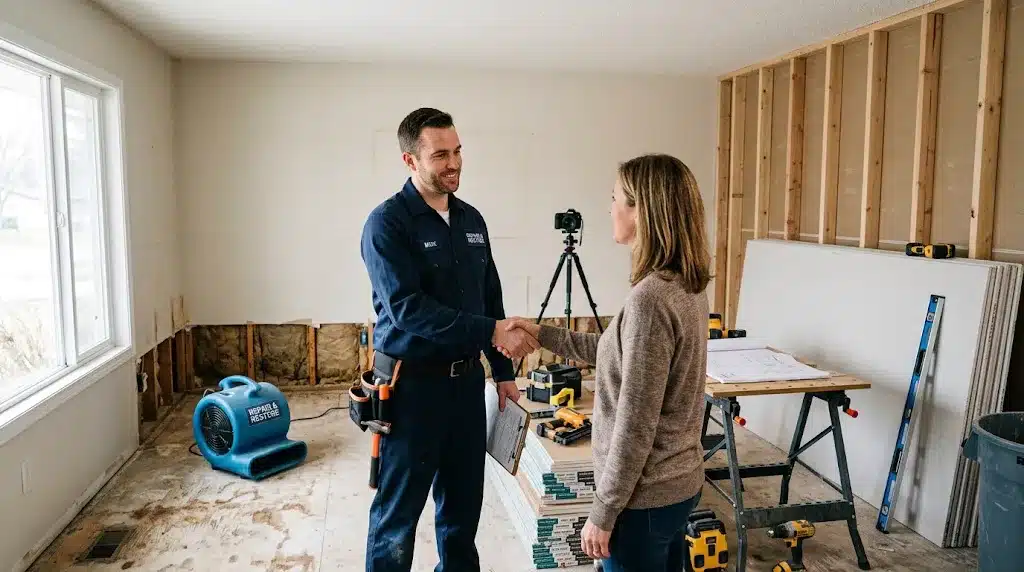
From a business perspective, the numbers are clear:
- Mitigation gross profit: 60% to 80%
- Reconstruction gross profit: 30% to 40%
- Revenue per job increase: 200% to 500% by capturing both phases
- Customer lifetime value: Significantly higher when you complete the full project
“The reconstruction margin is lower than mitigation, but the volume is enormous,” says Phillip Rosebrook, a restoration industry consultant writing for C&R Magazine. “A company doing $2 million in mitigation can realistically add $3 to $5 million in reconstruction revenue.”
According to industry financial benchmark data, the January 2026 Los Angeles fires destroyed over 16,000 structures, generating billions in reconstruction demand. Companies that already offered reconstruction services captured disproportionate market share from the start.
Why does reconstruction marketing differ from mitigation marketing?
Mitigation marketing targets urgency. Someone’s basement flooded at 2 a.m. and they’re searching right now. Reconstruction marketing targets a longer decision window. The homeowner is comparing contractors, talking to their adjuster, and reading reviews over days or weeks. Your content and SEO strategy must serve both timelines at once. Emergency response pages capture the immediate search. Reconstruction portfolio pages and case studies capture the comparison phase that follows.
Want more customers from Google & AI search?
Get a free SEO audit of your site — see exactly what to fix first.
The Full Marketing Funnel: Emergency Call to Signed Contract
Most restoration marketing plans focus on top-of-funnel lead capture and ignore what happens between the emergency call and the signed reconstruction contract. That middle section is where revenue is won or lost.

What happens at each stage of the funnel?
Stage 1. Emergency discovery. A homeowner searches “water damage restoration near me” or “fire damage company” at 1 a.m. Your Google Business Profile and local pack ranking determine whether they call you or a competitor. Speed of response at this stage directly determines whether you get the mitigation job, which is the entry point for reconstruction revenue.
Stage 2. Mitigation delivery. This is not a marketing stage in the traditional sense, but your crew’s on-site behavior is your best marketing. Technicians who explain the reconstruction phase during mitigation, leave branded door hangers, and introduce the customer to a reconstruction coordinator before they leave convert mitigation jobs into rebuild contracts at a far higher rate than companies that treat the two phases as separate sales events.
Stage 3. Scope approval. The adjuster reviews the mitigation report and approves the reconstruction scope. Your estimator’s ability to write a complete, well-documented Xactimate scope is a marketing function. Adjusters who work with restoration companies that submit clean, complete scopes approve them faster and refer more work to those same companies. Sloppy scopes create delays and damage carrier relationships.
Stage 4. Contract close. The homeowner signs the reconstruction contract. At this stage, your portfolio of completed projects, your online reviews, and the trust built during mitigation delivery are the deciding factors. Companies with documented before-and-after galleries and strong Google review profiles close reconstruction contracts at higher rates than those without.
Stage 5. Referral activation. A completed reconstruction project, documented with photos and a customer testimonial, becomes a marketing asset. It feeds your website gallery, your Google Business Profile, your social media channels, and your sales presentations to carrier program managers. One completed project generates marketing value for two to three years after completion.

How to Market a Restoration Company
To market a restoration company effectively, you need a strategy that combines local SEO, insurance carrier relationships, and content that proves your capability across the full project lifecycle from mitigation through reconstruction. Each channel serves a different part of the customer decision process.
Homeowners searching after a loss event need to find you fast through local search and Google Maps. Insurance adjusters and program managers need to see documented proof of your reconstruction capability. Property managers and commercial clients need case studies showing you can handle larger, longer projects without disrupting operations.
The companies that grow fastest don’t treat these as separate marketing efforts. They build a single content and reputation engine that serves all three audiences at once. Your fire damage restoration pages should communicate reconstruction capability just as clearly as your emergency response speed.
What does a restoration company marketing plan actually include?
A functional marketing plan for a restoration company covers six components: local SEO and Google Business Profile management, service page content optimized for mitigation and reconstruction keywords, a review generation process, a referral program targeting insurance agents and property managers, social media content that documents completed projects, and a carrier outreach program with a documented portfolio. Plans that skip any of these components leave a measurable gap in lead flow.
In this video
You may also find this useful: Email Marketing for Restoration Companies.
- 0:00 How Much Restoration Companies Should Spend
- 0:46 Where the 3 to 10 Percent Range Comes From
- 1:46 Start With Revenue Target Not Budget
- 2:54 Real World Example a 2 Million Company
- 4:15 Five Variables That Shift Your Number
- 5:41 What Channels Actually Eat the Budget
- 7:05 Common Mistake Spending Before Funnel Is Ready
- 7:59 What a Healthy Budget Allocation Looks Like
- 8:55 When to Increase or Hold Your Budget
- 9:34 The One Number to Calculate Right Now
SEO for Restoration and Reconstruction Services
SEO for restoration companies targets two distinct search intents: emergency searches like “water damage company near me” that need local pack dominance, and research searches like “reconstruction services after fire” or “insurance reconstruction contractor” that need well-built service pages with documented proof of capability.
What does restoration SEO actually involve?
Restoration SEO has five core components. First, your Google Business Profile needs complete category selection (restoration, general contractor, and reconstruction service), accurate service areas, and recent photos from completed projects. Google uses this data to rank you in the local pack for emergency searches.
Second, your service pages need to target reconstruction-specific keywords beyond the generic mitigation terms your competitors already rank for. Pages targeting “fire damage reconstruction [city],” “water damage rebuild contractor,” and “insurance reconstruction services” capture homeowners and adjusters at the comparison stage.
Third, your site needs Schema.org structured data. Schema.org markup for LocalBusiness, Service, and FAQPage types helps search engines understand your service scope and improves click-through rates in search results. Restoration companies that implement Schema markup correctly see improved visibility for both mitigation and reconstruction searches.
Fourth, your review volume and recency affect local pack rankings directly. BrightLocal research shows that businesses with more recent reviews rank higher in local search results than those with older review profiles, even if total review counts are similar.
Fifth, content authority matters for competitive markets. Publishing documented case studies, industry trend analysis, and FAQ content that matches the actual questions homeowners and adjusters search builds the topical authority that moves you from page two to page one for high-value reconstruction keywords.
How does restoration SEO differ from general contractor SEO?
Restoration SEO must rank for emergency searches where speed is the primary ranking factor (Google Business Profile, local pack, review recency) and for insurance-related searches where documentation and scope capability are the ranking signals. General contractor SEO focuses almost entirely on the research phase. Restoration companies need both, which makes the SEO strategy more complex and more valuable when executed correctly.
Content Marketing Strategy for Restoration Companies
Content marketing for the restoration industry works best when it documents real outcomes, not service descriptions. Homeowners dealing with a fire or water loss are searching for answers to specific questions, and the company whose content answers those questions most completely wins the trust that converts to a signed contract.
What content types work best for restoration marketing?
Project case studies. Document completed reconstruction projects with photos, timelines, scope descriptions, and customer quotes. A case study showing a fire-damaged kitchen rebuilt to modern standards in 42 days, on budget, with an insurance scope approved in full, answers every question a homeowner or adjuster has about your capability. This is the highest-converting content type in the restoration industry.
Process explainer pages. Homeowners don’t know what happens after the mitigation crew leaves. Pages that explain “what to expect during reconstruction” or “how the insurance reconstruction process works” capture search traffic from people in the middle of a claim and position you as the trusted expert before they’ve even decided on a contractor.
FAQ content targeting real queries. Questions like “how long does reconstruction take after water damage” and “does insurance cover full reconstruction” get searched thousands of times per month. Answering these questions clearly on your website puts you in front of people actively researching their options.
Before-and-after galleries. According to BrightLocal consumer survey data, 87% of consumers look at local business photos before making a hiring decision. Reconstruction project photos give you a significant advantage over mitigation-only competitors because the visual transformation is dramatic and immediately credible.
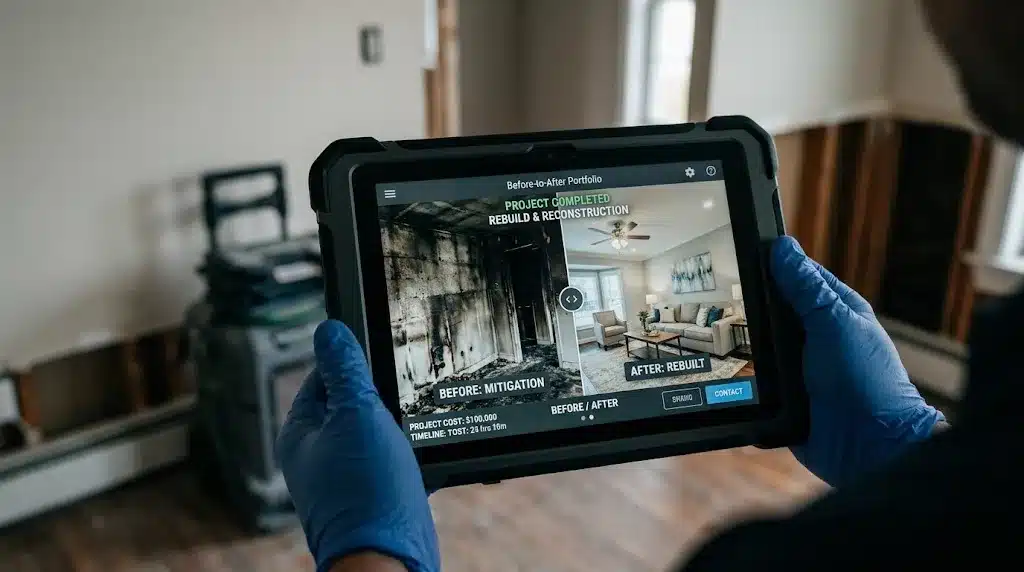
A documented fire damage restoration content strategy builds on all of these formats and keeps your site generating leads from search long after you stop actively promoting it.
How often should a restoration company publish new content?
Publish at minimum two pieces of new content per month: one project case study from a recently completed job and one FAQ or process page targeting a keyword your site doesn’t currently rank for. Search Engine Land research consistently shows that sites publishing consistent, specific content on a defined topic cluster outrank those publishing sporadic general content, even when the general content is higher quality.

Social Media Marketing for Restoration Companies
Social media marketing for restoration companies serves two functions: building credibility with homeowners who check your profiles before calling, and generating referral relationships with real estate agents, insurance agents, and property managers who follow local contractors in their market.
Start with the full restoration company SEO guide if you are new to the topic.
Which social platforms work for restoration marketing?
Facebook still delivers the highest return for restoration and reconstruction companies targeting homeowners. Before-and-after photo posts of completed reconstruction projects generate engagement rates three to five times higher than service description posts. Local Facebook groups for neighborhood associations and homeowner communities are direct referral channels when you participate authentically.
Instagram works for visual project documentation. Short videos of reconstruction progress, from framed walls to finished rooms, build an audience of local homeowners and property professionals who remember your company name when they need a contractor.
LinkedIn is the right platform for commercial reconstruction marketing. Property managers, facility directors, and commercial real estate professionals use LinkedIn actively. Case studies showing commercial rebuilds with documented business interruption minimization perform well there and reach an audience that mitigation-focused content doesn’t touch.
Consistency matters more than volume. Posting two to three times per week with real project content outperforms daily posting of generic tips. Every completed reconstruction project gives you ten to fifteen pieces of social content: demo photos, framing progress, finish work, the final reveal, and the customer’s quote about the experience.
In this video
- 0:00 Why Restoration Leads Feel Unpredictable
- 0:39 The Myth Holding Restoration Companies Back
- 1:33 Four Lead Categories You Must Separate
- 2:03 Where Restoration Leads Actually Come From
- 2:40 Local SEO Pillars for Restoration Rankings
- 3:28 Pay Per Call vs Form Fill Conversion Data
- 3:56 Channel Costs and Conversion Rates Compared
- 4:46 Response Time Is Where Most Leads Are Lost
- 5:20 Building Insurance Adjuster Referral Streams
- 6:26 Storm Events and Surge Preparation
- 7:07 Follow-Up System Six Components
- 7:49 Full Channel Picture and 18-Month Goal
How a Restoration Company Can Market to Insurance
A restoration company markets to insurance carriers by demonstrating single-source capability, meeting program-specific requirements, and proving that fewer vendors per claim means faster cycle times and lower total claim costs. Insurance carriers control the referral pipeline and approve the reconstruction scope, making them your most important marketing audience.
“Insurance carriers want speed and documentation,” notes a program manager from a national carrier quoted in R&R Magazine. “A restoration company that delivers complete project management from first notice of loss through certificate of completion is incredibly valuable.”
How do you market reconstruction services to insurance agents specifically?
Insurance agents don’t approve claims, but they do refer clients to contractors when a loss happens. An agent who trusts your company gives your name to every policyholder who calls. Build that relationship before a loss by showing up at local insurance industry events, sending agents documented case studies of completed reconstruction projects in their coverage area, and offering to present at their office about the mitigation-to-reconstruction process so they can explain it accurately to clients.
Specific steps to position your company with carriers and agents:
- Demonstrate single-source capability. A company that handles both mitigation and reconstruction reduces administrative burden, shortens claim cycle times, and typically produces lower total claim costs because there’s no overlap or miscommunication between two separate contractors.
- Build a reconstruction portfolio. Document completed reconstruction projects with before, during, and after photos. Include timelines, budgets, and customer satisfaction data. This portfolio becomes your proof of capability when approaching carrier programs.
- Target program requirements. Major carrier programs like State Farm’s Premier Service Program, USAA’s contractor network, and Allstate’s vendor programs have specific requirements for reconstruction participants. These often include response time commitments, financial stability thresholds, certification requirements, and technology platform compatibility.
- Price competitively but profitably. Carriers compare your reconstruction pricing against market rates. Research local general contractor rates and position your pricing competitively while accounting for the overhead of running a full-service restoration operation.
Your fire and structural damage service content is a direct entry point for adjusters researching vendors for complex claims. Make sure it reflects your full reconstruction scope.
How to Increase Commercial Restoration Sales
To increase commercial restoration sales, position your company as a single-source vendor that can handle mitigation and reconstruction for property managers, facility directors, and building owners who can’t afford extended downtime. Commercial clients prioritize speed, documentation, and minimal operational disruption above all else.
What sales tools work for restoration industry commercial outreach?
Commercial decision-makers respond to three things: documented proof of past performance, pre-negotiated vendor agreements that reduce friction during a loss event, and a single point of contact who manages the full project. Build sales tools around all three.
A commercial capability deck should include: completed commercial reconstruction case studies with documented timelines and business interruption data, your carrier program certifications and license documentation, a description of your preferred vendor agreement program with specific response time commitments, and references from property managers or facility directors in your market.
Your commercial restoration marketing strategy should address commercial priorities directly. Case studies showing completed commercial rebuilds with minimal business interruption are more persuasive to a property manager than any service description.
Specific steps to grow commercial revenue:
- Build relationships with commercial property managers and facility directors before a loss event happens, not after
- Create a preferred vendor agreement program that gives commercial clients priority response and pre-negotiated rates
- Document every commercial project with timeline adherence data and client sign-off at each phase
- Present reconstruction capability as a business continuity solution, not just a repair service
Revenue and Profit Benchmarks
Restoration companies that offer both mitigation and reconstruction generate significantly more revenue per job than mitigation-only operators, with mitigation alone averaging $3,000 to $5,000 per job and reconstruction adding $10,000 to $50,000 on top of that same project.
| Metric | Mitigation Only | Mitigation + Reconstruction |
|---|---|---|
| Average job revenue | $3,000 to $5,000 | $13,000 to $55,000 |
| Gross profit margin | 60% to 80% | 30% to 40% on reconstruction phase |
| Revenue per job increase | Baseline | 200% to 500% higher |
| Potential revenue add at $2M mitigation baseline | None | $3M to $5M in reconstruction |
Even though reconstruction margins are lower than mitigation margins, the volume of reconstruction work on a single loss event dwarfs the mitigation revenue. Companies that capture both phases keep more total revenue in-house and build stronger customer relationships that generate referrals and repeat business.
You can review detailed restoration company financial benchmarks and KPIs to set realistic revenue targets for your market.
Franchise vs. Independent Reconstruction
When evaluating franchise options, compare them specifically on whether they provide reconstruction training, systems, and brand positioning, because mitigation-only franchise models leave the highest-value revenue phase uncaptured. The Cleanfax Benchmarking Survey shows that half of restoration industry respondents already focus on remodeling and reconstruction work, meaning operators who include reconstruction are capturing market share from those that don’t.
If you’re weighing franchise options versus building an independent reconstruction capability, consider that franchise systems with reconstruction programs give you established insurance carrier relationships, estimating systems, and training frameworks. Independent operators who build reconstruction capability have more pricing flexibility and keep all margin in-house without royalty obligations. Either path requires meeting the same operational requirements: licensing, insurance, staffing, estimating, and project management systems suited to longer project timelines.
Operational Requirements for Reconstruction
Adding reconstruction is not as simple as hiring a carpenter. There are real operational and legal prerequisites you need to meet before marketing these services.
What licenses and insurance do you need before marketing reconstruction?
Licensing. Most states require a general contractor’s license for reconstruction work, separate from any restoration-specific licenses you hold. Requirements vary by state but most involve passing an exam, meeting experience thresholds, and maintaining bonding and insurance minimums. In some states, you can operate under a qualifying individual’s license while building your own experience record.
Insurance. Your general liability policy needs to cover construction operations, not just restoration work. Builder’s risk insurance may be required for larger projects. Workers’ compensation coverage must extend to construction activities, which carry different risk classifications than mitigation work.
Staffing. You need skilled tradespeople, such as carpenters, painters, and flooring installers, or reliable subcontractor relationships. Many restoration companies start with a hybrid model: an in-house reconstruction project manager who subcontracts specialty trades.
Estimating. Reconstruction estimating uses the same Xactimate platform your mitigation team already knows, but the contents and repair modules differ from emergency services. Your estimators need training on rebuild pricing, which factors in material costs, labor rates, and overhead differently than mitigation work.
Project management. Reconstruction projects run weeks to months, compared to days for mitigation. You need project management processes, scheduling tools, and quality control procedures that match the longer timeline and more complex coordination requirements.
Quick Recap
- A mitigation job averaging $3,000 to $5,000 can generate $10,000 to $50,000 in additional reconstruction revenue on the same project.
- Companies doing $2 million in mitigation can realistically add $3 to $5 million in reconstruction revenue.
- Mitigation gross margins run 60% to 80%; reconstruction gross margins run 30% to 40%, but reconstruction volume per job is much larger.
- The full marketing funnel runs from emergency discovery through mitigation delivery, scope approval, contract close, and referral activation.
- Restoration SEO targets emergency search intent (Google Business Profile, local pack) and research intent (reconstruction service pages, case studies) at the same time.
- Content marketing works best when it documents real completed projects with photos, timelines, and customer quotes rather than generic service descriptions.
- Social media for restoration companies builds credibility with homeowners and referral relationships with agents and property managers.
- Marketing to insurance carriers requires demonstrating single-source capability, building a documented project portfolio, and meeting carrier program requirements.
- Commercial reconstruction sales grow fastest when you position as a business continuity solution with pre-negotiated preferred vendor agreements.
- Before marketing reconstruction, you must meet licensing, insurance, staffing, estimating, and project management requirements in your state.
Frequently Asked Questions
What is the difference between restoration and reconstruction?
Restoration covers emergency mitigation work such as water extraction, drying, and debris removal. Reconstruction covers the rebuild phase, including framing, drywall, flooring, painting, and finish work that returns the property to pre-loss condition or better. Restoration companies that offer both services capture the full revenue opportunity from a single loss event instead of handing the higher-dollar rebuild phase to a competing general contractor.
How do you market a restoration company effectively?
Effective restoration company marketing combines local SEO, Google Business Profile management, documented project content, and direct outreach to insurance agents and property managers. Your website needs dedicated reconstruction service pages with project galleries. Your Google Business Profile needs recent photos from completed rebuild projects. Your review profile needs consistent new reviews. All three channels work together. Treating them as separate tactics instead of one system is the most common mistake restoration companies make.
What does restoration company SEO actually involve?
Restoration SEO covers five areas: Google Business Profile optimization with accurate categories and recent project photos, service pages targeting reconstruction keywords beyond generic mitigation terms, Schema.org structured data markup per Schema.org standards, review generation for local pack ranking, and content authority built through case studies and FAQ pages. Companies that address all five consistently move from position 15 to position 3 for high-value reconstruction searches within six to twelve months.
How long does it take to add reconstruction to a restoration business?
Most restoration companies need six to twelve months to properly add reconstruction services. That timeline covers obtaining the required general contractor’s license, updating insurance policies, hiring or contracting skilled tradespeople, training estimators on rebuild pricing in Xactimate, and building out project management systems for longer project timelines. Marketing reconstruction before the operational foundation is in place creates jobs your team can’t deliver correctly, which damages your review profile and carrier relationships.
How do I market reconstruction services to insurance agents and carriers?
Build relationships with insurance agents before losses happen by showing up at local industry events and sending them documented case studies of completed reconstruction projects in their coverage area. Market to carriers by demonstrating single-source capability that reduces their administrative burden and shortens claim cycle times. Meet carrier program requirements for response times, certifications, and technology platform compatibility. A documented portfolio of completed reconstruction projects is your most persuasive sales tool with both agents and program managers.
Do insurance carriers pay for reconstruction work?
Yes. Insurance carriers pay for reconstruction work as part of the covered loss when the damage meets policy terms. Reconstruction scope is approved by the adjuster using Xactimate pricing. Companies that handle both mitigation and reconstruction submit a single coordinated scope, which carriers prefer because it reduces administrative complexity and shortens claim cycle times. Clean, complete scope submissions get approved faster and build the carrier relationships that generate ongoing referrals.
What certifications help a restoration company win reconstruction contracts?
A general contractor’s license is the most important credential for reconstruction work. Beyond that, certifications from the Institute of Inspection Cleaning and Restoration Certification (IICRC) demonstrate mitigation competence, while carrier-specific program certifications like State Farm’s Premier Service Program validate reconstruction capability to a network of adjusters and program managers. Carrier program participation also opens access to direct referral pipelines that are closed to uncertified contractors.
How do I increase commercial restoration sales?
Build relationships with commercial property managers and facility directors before a loss event, not after. Create a preferred vendor agreement program with pre-negotiated rates and documented response time commitments. Present reconstruction capability as a business continuity solution with timelines that minimize operational disruption. Document every commercial project with timeline adherence data and client sign-off at each phase. Commercial case studies with real numbers outperform any general marketing message when selling to facility directors and building owners.
Get a Free Visibility Teardown for Your Reconstruction Business
PushLeads works with restoration and reconstruction companies to build marketing systems that capture rebuild revenue, win carrier relationships, and turn completed projects into a steady stream of inbound leads. Whether you’re adding reconstruction to an existing mitigation operation or competing for commercial rebuild contracts in a new market, the starting point is knowing exactly where your current visibility stands and what it’s costing you.
See exactly where your visibility stands with a free teardown at seo.pushleads.com/audit or call 828-348-7686.
Keep Reading
Want more customers from Google & AI search?
Get a free SEO audit of your site — see exactly what to fix first.
Your path · Restoration Company SEO
Keep going: read these next

- Commercial Restoration Marketing: How to Win Property Manager and Facility Manager Accounts
- In-House Marketing Hire vs. Agency for Restoration Companies




Want this done for you?
Scan your site. See the gaps. Decide with numbers.
- Rankings, Google Business Profile and site-speed teardown
- Report lands in your inbox in about a minute
- No obligation · 4.9 from 67 Google reviews

