
 Finding hidden moisture is one of the most critical skills in water damage restoration. Miss a moisture pocket behind a wall, and you’re setting up your customer for mold growth and a callback that costs more than the original job. Over-estimate the affected area, and you’re tearing out materials that didn’t need replacement.
The right detection technology turns this guessing game into a science. Modern thermal imaging cameras and moisture meters allow restoration technicians to see what the human eye cannot: temperature differentials that indicate water presence, moisture levels inside wall cavities, and the exact boundaries of water migration.
According to industry data, moisture-related issues account for approximately 24% of all property claims. For restoration companies, mastering detection technology isn’t optional. It’s the foundation of profitable operations and quality outcomes that satisfy both homeowners and insurance adjusters.
How Thermal Imaging Works in Restoration
Want it done for you? See our restoration SEO and marketing agency.
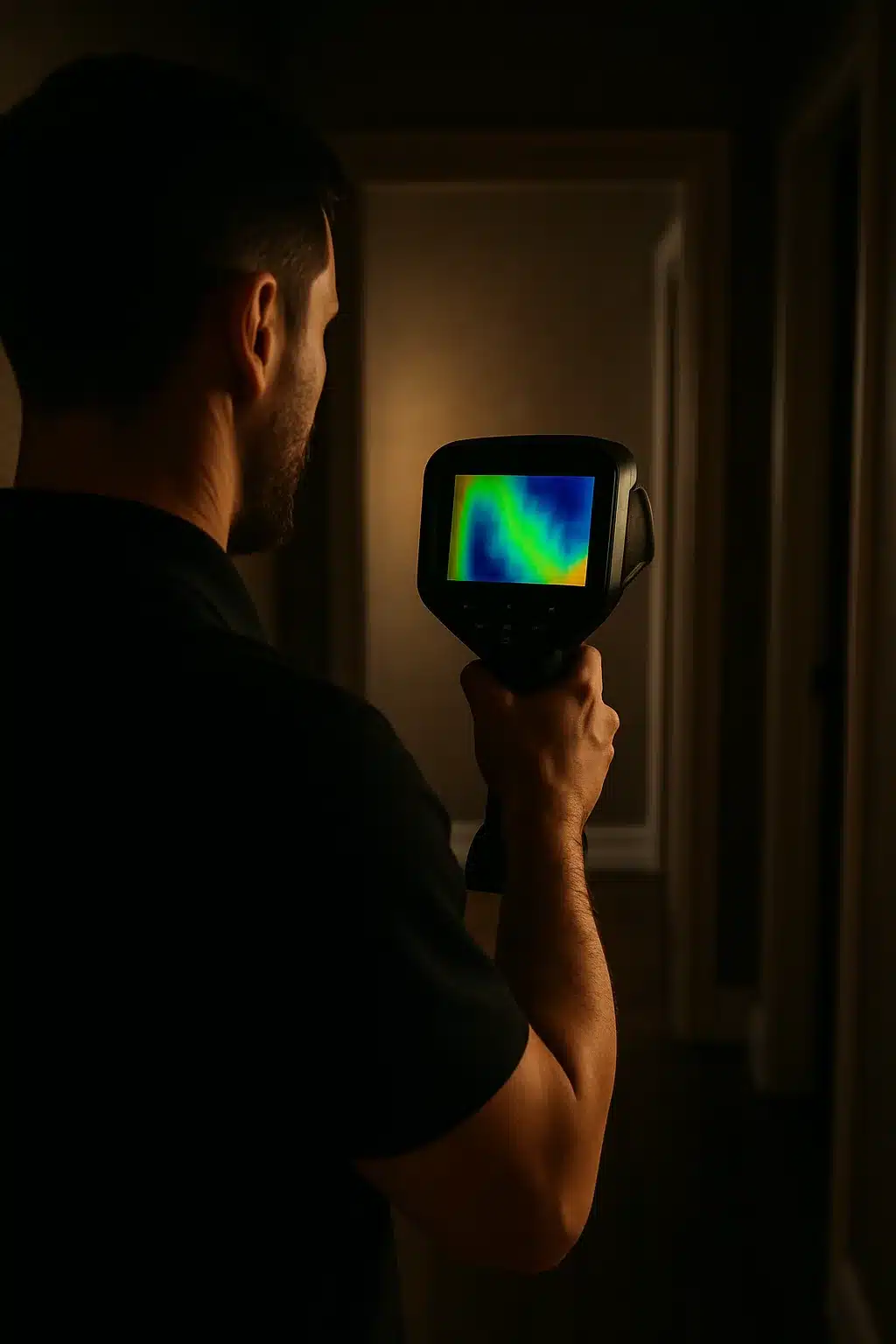
Thermal imaging cameras detect infrared radiation emitted by objects, translating temperature differences into visible images. When water evaporates, it cools the surrounding surface. That cooling effect creates a temperature differential that thermal cameras can detect, revealing moisture hidden behind walls, under floors, and in ceiling cavities.
FLIR, the dominant manufacturer of thermal imaging equipment for restoration, has been producing thermal cameras for over 65 years. Their technology can detect temperature differences as small as 0.01°C, making even subtle moisture signatures visible to trained technicians.
The key limitation to understand: thermal cameras don’t detect moisture directly. They detect temperature anomalies that correlate with moisture presence. A cool spot on a wall might indicate water evaporation, but it could also indicate an air leak, insulation gap, or cold pipe behind the surface. This is why thermal imaging serves as a screening tool, not a definitive moisture measurement.

The most effective approach combines thermal imaging with moisture meters. Use the thermal camera to quickly identify areas of concern across a large space, then verify those findings with pin or pinless moisture meters that provide quantitative readings.
Types of Moisture Meters for Restoration
Moisture meters fall into two primary categories: pin-type and pinless (also called non-invasive). Each technology serves different purposes in the restoration workflow.
Pin-Type Moisture Meters
Pin meters measure electrical resistance between two pins inserted into the material. Wood and building materials act as insulators; water is a conductor. The less resistance between the pins, the more moisture is present. This electrical resistance measurement provides quantitative moisture content readings when properly calibrated for the material being tested.
Pin meters excel at precise, targeted measurements. They can determine the exact depth of moisture penetration by driving insulated pins to different depths and noting where readings change. According to Delmhorst, a leading moisture meter manufacturer, pin meters provide high accuracy for wood and porous materials, making them essential for documentation and verification.
The trade-off is that pin meters create small holes in the material being tested. In visible areas or on finished surfaces, this can be undesirable. Pin meters also measure only the moisture between the two pins, making them slower for scanning large areas.
Pinless Moisture Meters
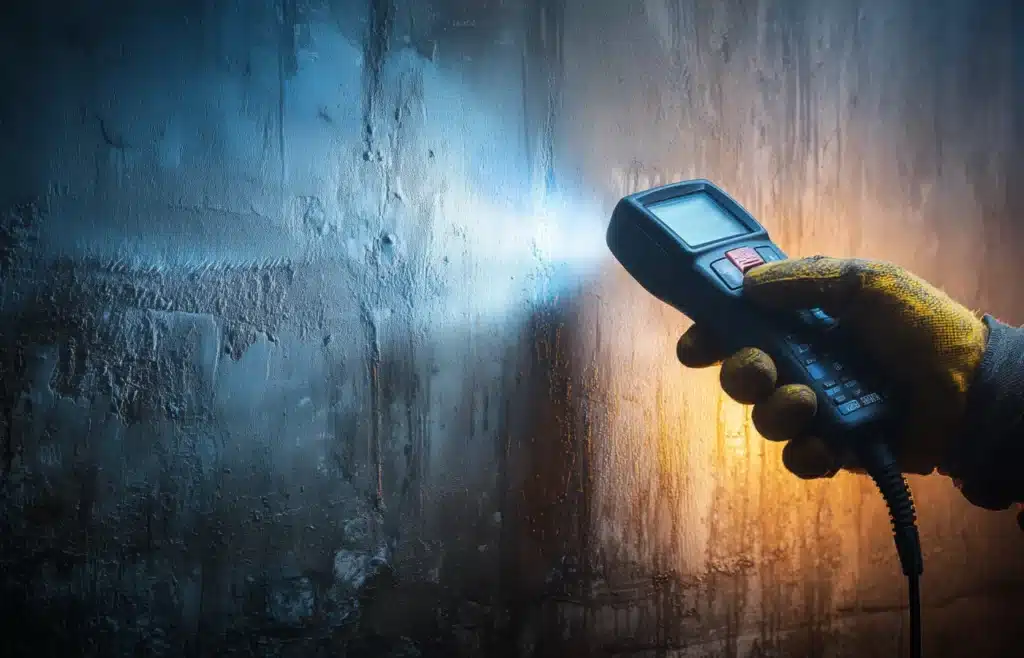
Pinless meters use electromagnetic signals (radio frequency or capacitance) to detect moisture without penetrating the surface. A sensor plate on the meter emits signals that penetrate into the material, measuring moisture content within the scanning field.
These non-invasive meters are ideal for initial screening. According to industry research, restoration experts recommend using pinless meters to quickly scan large areas and identify moisture hot spots that require further investigation. The sensor typically reads an average moisture level across the entire scanning area at a specific depth, usually 0.75 to 1 inch.
The limitation is that pinless readings can be affected by other materials behind the surface. A metal pipe, electrical wiring, or structural member behind drywall will affect the reading. This is why pinless meters are best used for initial screening rather than definitive measurements.
Combination Meters
Modern restoration-grade meters increasingly combine pin and pinless capabilities in a single device, often adding a thermo-hygrometer for ambient conditions. Manufacturers like Tramex, Delmhorst, Lignomat, and Protimeter offer multi-function meters designed specifically for water damage restoration.
The Tramex Moisture Encounter MEX5, for example, combines dual-depth non-destructive scanning, pin measurement capability, built-in hygrometer, and infrared surface thermometer. This versatility lets technicians switch between rapid screening and precise documentation without changing equipment.
Want more customers from Google & AI search?
Get a free SEO audit of your site — see exactly what to fix first.
Thermo-Hygrometers and Environmental Monitoring
Understanding ambient conditions is essential for both damage assessment and drying monitoring. Thermo-hygrometers measure temperature and relative humidity simultaneously, providing data critical for psychrometric calculations.
When relative humidity is measured against temperature, the resulting data tells you whether conditions favor further moisture absorption or drying. Cross-referencing these readings with an equilibrium moisture content chart reveals whether building materials will continue absorbing moisture from the air or releasing it.
For the drying process, thermo-hygrometers help calculate grains per pound (GPP), the measure of moisture in the air. According to IICRC S500 standards, tracking psychrometric parameters including GPP, dew point, and vapor pressure enables technicians to verify that drying conditions are being maintained and to calculate moisture removal rates.
Modern data loggers extend this capability by continuously recording temperature and humidity over time. This documentation proves invaluable for both process optimization and insurance documentation.
Thermal Camera Selection for Restoration
Thermal camera options range from smartphone attachments under $500 to professional-grade units exceeding $10,000. The right choice depends on your company’s volume, documentation requirements, and budget.
Entry-Level Options ($200-500)
Smartphone-compatible thermal cameras like the FLIR ONE Pro attach to your phone’s USB port, using the phone screen for display. These devices work for basic screening and can help smaller companies build thermal imaging capability without major investment. Resolution and sensitivity are limited compared to dedicated units.
Mid-Range Professional ($1,000-3,000)
Dedicated handheld thermal cameras in this range offer improved resolution, better temperature sensitivity, and restoration-specific features. These units typically include MSX enhancement (FLIR’s technology that overlays visible details on thermal images for easier identification), built-in reporting software, and construction-grade durability.
High-End Professional ($3,000-10,000+)
Premium thermal cameras offer the highest resolution (up to 640×480 pixels), greatest temperature sensitivity (detecting differences as small as 0.01°C), advanced analytics, and sophisticated reporting integration. These units make sense for high-volume operations or companies emphasizing thermal inspections as a profit center.
FLIR’s new iXX-series represents the next generation of professional thermal cameras, integrating app-driven workflows that guide less experienced users through inspections while enabling cloud-based data management and team collaboration. According to industry research, approximately 60% of maintenance teams report a shortage of skilled thermographers, making these guided-workflow features increasingly valuable.
The IICRC S500 Standard and Detection Requirements
The ANSI/IICRC S500 Standard for Professional Water Damage Restoration, first developed in 1994 and continuously updated, establishes the industry standard for detection and documentation practices.
According to IICRC standards, thermal imaging cameras enable rapid identification of hidden moisture in wall cavities, beneath flooring, and in ceiling spaces without invasive inspection. The standard recognizes thermal imaging as an essential screening tool while requiring verification with penetrating moisture meters for quantitative readings.
S500 mandates comprehensive moisture documentation throughout the restoration process. This includes initial moisture mapping to define the affected area, ongoing monitoring during drying to verify progress, and final readings to confirm materials have reached acceptable moisture content.
Dry standards vary by material type. IICRC S500 establishes specific moisture content targets for various building materials measured at standardized depths and environmental conditions. For example, wood is typically considered dry at 6-9% moisture content for finish materials like floors and cabinets, 12% for moldings, and 16-19% for structural lumber.

Best Practices for Moisture Detection
Following a systematic approach improves both accuracy and efficiency.
Initial Screening Phase
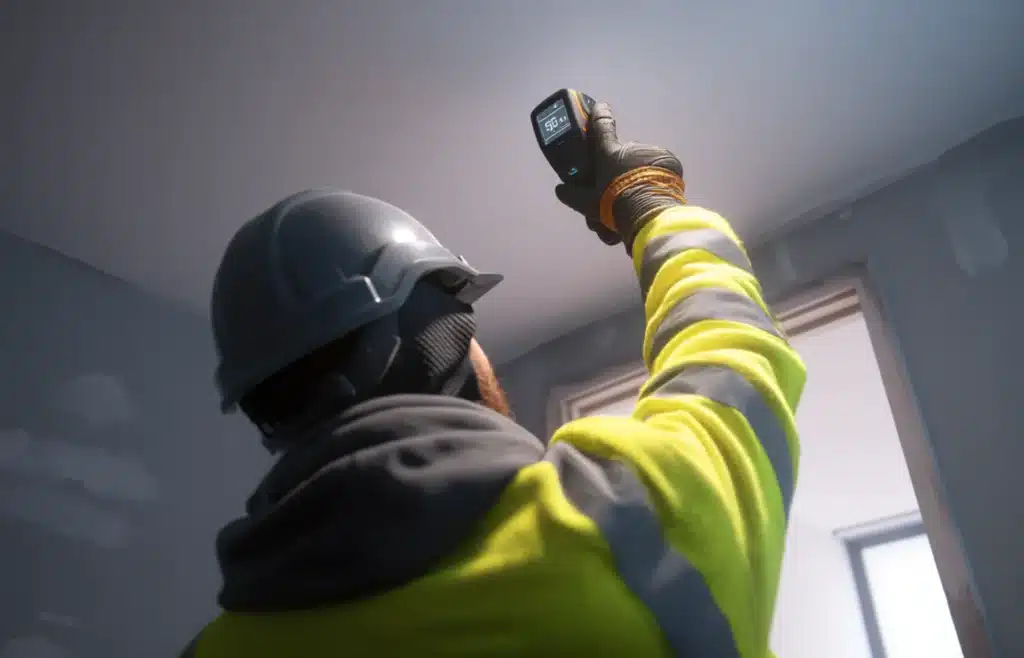
Begin every assessment with a thermal scan of the entire affected area and adjacent spaces. Move the thermal camera slowly across walls, floors, and ceilings, looking for temperature anomalies that might indicate moisture presence. Document anything that appears unusual.
Use a pinless moisture meter to quickly verify thermal findings. The pinless scanner should cover the same areas, noting elevated readings that confirm or contradict thermal observations.
Detailed Assessment Phase
Switch to pin-type measurements for areas of concern identified during screening. Use insulated pins driven to varying depths to map the vertical extent of moisture penetration. Document precise readings at each measurement point.
Take ambient readings with your thermo-hygrometer, recording temperature and relative humidity in affected and unaffected spaces for comparison.
Documentation Requirements
Create moisture maps showing reading locations and values. Modern meters and apps like Tramex Meters App or magicplan allow digital documentation with GPS-tagged readings that export directly to reports.
According to restoration industry sources, complete documentation packages should include moisture maps, thermal images, drying logs, psychrometric readings, and progress photos. This documentation supports insurance claims and demonstrates compliance with industry standards.
Using Detection Technology to Support Insurance Claims
Comprehensive detection and documentation directly impacts claim outcomes. Insurance adjusters rely on objective data to approve scopes of work and validate line items.
Thermal images showing the extent of moisture migration provide visual evidence that supports your scope. Quantitative moisture readings document the severity of damage. Ongoing measurements during drying demonstrate that your equipment and processes are working as billed.
According to industry best practices, daily moisture mapping and drying logs are essential for insurance documentation. Equipment should remain in place until meters confirm materials have reached acceptable moisture content per IICRC S500 drying goals, not simply when surfaces look or feel dry.
In this video
- 0:00 Ozone Thermal Fogging Hydroxyl Overview
- 1:01 Scale of Smoke Odor Demand
- 1:35 How Each Technology Works at Molecular Level
- 2:10 Speed and Evacuation Trade-offs
- 3:16 Cost Comparison Across All Three Methods
- 3:45 Safety and Material Damage Risks
- 4:57 IICRC Three-Step Protocol for Severe Damage
- 5:37 Matching Method to Smoke Type
- 7:37 Hotels as Real-World Case Study
- 8:43 Ozone for Flea Elimination
- 9:25 Five-Step Permanent Odor Elimination Sequence
Full transcript: Ozone vs Thermal Fogging vs Hydroxyl: Which Odor Treatment When
Start with the full SEO for restoration companies guide if you are new to the topic.
In this video
- 0:00 Roof Leaks Hidden Water Damage Overview
- 0:54 Scale and Frequency of Roof Leaks
- 1:23 Where Roof Leaks Actually Start
- 2:01 Slow Leaks vs Active Storm Damage
- 2:44 Water in Wall Cavities and Framing
- 3:27 Reading Ceiling Stains and Drywall Damage
- 4:20 Insulation Type Drives Scope Decisions
- 5:09 Real Costs by Damage Scenario
- 6:29 Slate Roofs and Flashing Failures
- 7:18 Insurance Sudden vs Gradual Damage
- 8:04 Five-Step Restoration Sequence
When disputes arise, detailed detection documentation provides defensible evidence. Timestamped readings, calibrated instrument data, and systematic methodology demonstrate professional practice that withstands scrutiny from adjusters, independent consultants, or legal proceedings.
Common Detection Mistakes to Avoid
Relying solely on thermal imaging: Thermal cameras show temperature, not moisture. Always verify thermal findings with moisture meter readings.
Using uncalibrated equipment: Moisture meters require periodic calibration verification. Manufacturers provide calibration check devices for each meter type. Using uncalibrated equipment produces unreliable readings that won’t withstand scrutiny.
Ignoring affected adjacent areas: Water migrates. The visible damage often represents a fraction of the actual affected area. Systematically screen adjacent rooms, spaces above and below, and areas on the opposite side of affected walls.
Taking insufficient readings: A few spot checks don’t constitute proper assessment. Industry standards require thorough mapping with documented reading locations. Insufficient readings create liability when hidden moisture causes problems later.
Failing to document “dry” readings: Establishing what “normal” looks like is just as important as finding moisture. Take readings in unaffected areas of the same material type to establish baseline comparisons.
Equipment Investment Considerations
For restoration companies building or upgrading detection capabilities, consider both immediate needs and growth trajectory.
At minimum, every restoration truck needs a reliable combination moisture meter (pin and pinless) and a thermo-hygrometer. This basic kit enables IICRC-compliant assessment and documentation. Budget approximately $500-1,500 for quality instruments from recognized restoration brands.
Adding thermal imaging capability typically requires an additional $500-3,000 depending on the level of device. The investment pays back through faster screening, better documentation, and the ability to market thermal inspections as a value-added service.
Data logging and remote monitoring capabilities represent the next level of sophistication. These systems, covered in the following article on IoT sensors, enable continuous monitoring during drying and create documentation automatically.
When evaluating equipment, prioritize accuracy and repeatability over features. A $300 moisture meter that gives consistent, accurate readings is more valuable than a $600 meter with unreliable performance. Stick with established restoration equipment brands that provide calibration verification tools and professional support.
Frequently Asked Questions
How often should moisture meters be calibrated?
Most manufacturers recommend calibration verification before each job, using the verification device specific to your meter model. Full factory recalibration is typically recommended annually, or whenever verification reveals readings outside acceptable tolerances. Tramex, Delmhorst, and other major brands provide calibration check devices designed for field verification.
Can thermal imaging see through walls?
No. Thermal cameras see surface temperatures, not through materials. However, moisture inside a wall cavity affects the surface temperature, creating visible patterns on the thermal image. This is why thermal imaging works for detecting hidden moisture, even though it technically only measures the surface.
What’s the best thermal camera resolution for restoration work?
Most professional restoration work performs well with 160×120 or 320×240 pixel resolution. Higher resolution (640×480) provides more detailed images but costs significantly more. The key metric is thermal sensitivity (NETD), not just resolution. A camera that detects 0.05°C differences is more useful than one that only detects 0.1°C differences, even at the same resolution.
Do I need different moisture meters for different materials?
Quality meters include calibration settings for various materials: wood species, drywall, concrete, and other common building materials. When measuring moisture content, using the correct calibration setting matters significantly. For qualitative screening (finding wet versus dry areas), the material setting matters less than consistency in your measurement approach.
How do I know when a structure is dry enough?
IICRC S500 establishes dry standards for various materials. Compare your readings to unaffected areas of the same material type and to published standards. Materials are considered dry when they’ve reached equilibrium with the ambient environment and meet the applicable moisture content targets for their material type.
Keep Reading
Want more customers from Google & AI search?
Get a free SEO audit of your site — see exactly what to fix first.
Your path · Restoration Company SEO
Keep going: read these next
 You’re hereThermal Imaging and Moisture Detection Technology for Restoration Companies
- Up nextDrone Technology in Restoration: Marketing Your Aerial Assessment Capabilities


Want this done for you?
Scan your site. See the gaps. Decide with numbers.
- Rankings, Google Business Profile and site-speed teardown
- Report lands in your inbox in about a minute
- No obligation · 4.9 from 67 Google reviews
 Continue reading
