

✓Is Your Restoration Business Built for Year-Round Leads?8 quick questions · about 1 minuteStart
=Paid-to-Organic Shift Savings CalculatorSee how much monthly ad spend you could recover by building organic search alongside paid ads.Open
0:00 Intro
0:51 Why Storm-Chasing Stalls Growth
1:51 The Search Data Proves the Demand
3:01 What a Year-Round Pipeline Actually Looks Like
4:00 The Role of SEO in Restoration Marketing
5:24 The Referral Network Most Companies Ignore
8:33 The Worked Example: How the Math Works
9:45 Common Mistakes Restoration Companies Make
10:57 What to Prioritize First
11:57 What Makes This Approach Different
Full transcript
0:00 Intro
You build a year-round pipeline that pulls calls even when the weather is calm, and that means owning the searches that people make every day, not just after the disaster. Hi, I'm Jeremy Ashburn with PushLeads, and we work with restoration companies on search visibility, showing up in AI search, being found by chatbots. And in this video, I'm going to walk you through the exact model that keeps your phones ringing in July just as much as in October. We're going to cover real numbers, the most common mistakes that owners make, and a working example so you can see how the math plays out for a shop during a steady volume of inbound calls every month. So stick with me through the whole thing because the CTA at the end is something I normally don't give away for free.
0:51 Why Storm-Chasing Stalls Growth
Why storm chasing alone stalls growth. Most restoration owners I talk to build their first revenue on storm response. This makes complete sense. A hail storm drops, phones go crazy, and the crews stay busy for months. But here's the problem: storm chasing is essentially a feast or famine model. You're at the mercy of weather events, insurance cycles, and the competition from a hundred other companies who showed up in the same zip code the same week. The owners who scale past that pattern aren't necessarily working harder. They're pulling from a different source of demand. They're capturing the everyday year-round calls that exist in every market, regardless of weather. Water heater bursts on a Tuesday, sewage backup under a kitchen in March, and mold discovered during a home sale in August. And those calls happen every day. The question is whether your company shows up when someone else searches for help. The search data that proves the demand is there.
This is part of our restoration SEO guide.
1:51 The Search Data Proves the Demand
Let me give you some real numbers from the search query data I pulled for this specific topic. The phrase "water damage restoration cost" gets six hundred and eighty impressions in our track data set. The average position is twenty point one. That means it's ranking, but not near the top. Page two or a low page one where no one else clicks. "How to market a restoration company" gets four hundred and sixty-six impressions, and that's position thirty-five point nine. It's not even on the radar for most searches. And the search "disaster restoration marketing" gets three hundred and forty-four impressions at position forty-seven, and that's essentially invisible. And these numbers tell me two things. One, the demand is real and consistent. People are searching for restoration help and for restoration marketing help every single month. Two, most of the market isn't ranking well, and that's an open lane. So if Google's AI is already citing someone else in your market for these questions, that's a gap you need to close. What a year-round pipeline actually looks like.
3:01 What a Year-Round Pipeline Actually Looks Like
Picture a funnel with three layers. Layer one is awareness and education. This is content that answers the question that people ask before they even have an emergency. Things like, "How much does water damage restoration cost?" Or, "What do I do after a pipe burst?" Layer two is intent and consideration. These are the people that are actively searching for a company. Searches like "water damage restoration near me" or "restoration company in Asheville." This is where local SEO and Google Business Profile do the heavy lifting. Layer three is the conversion, the call, the form, the booked job. This is where your speed to answer, your online reviews, and your site's most trusted signals either close the deal or send the person to your competitor. Most restoration companies only invest in layer three. They run a little pay-per-click, maybe have a five-page website and hope the phone rings. The companies that grow year-round invest in all three layers simultaneously. The role of SEO in restoration marketing.
4:00 The Role of SEO in Restoration Marketing
The search "restoration SEO" pulls four hundred and eight impressions in our data at position sixteen point two, and then the search "restoration company SEO lead generation" pulls three hundred and sixty-two at position nineteen point one. These are people actively looking for what we do, but more importantly, they reflect what your potential customers are also searching. SEO for a restoration company isn't complicated in concept, but it does require consistency. You need pages targeting the specific searches that you offer in the specific cities you serve. Water damage restoration is not the same page as fire damage restoration. Mold remediation is not the same page as storm damage cleanup. Each service, each city gets its own focused page. That's how you compete for the everyday searches, not just the storm season spike. The search "fire damage restoration SEO" shows up in our data at one hundred and seventy-nine impressions at position twenty-two point three. "Water damage marketing" is at one hundred and fifty-six at position twenty-one point six. And these aren't huge numbers individually, but stack ten or fifteen of those pages together, each ranking on page one, and you're generating consistent inbound volume every month of the year.
5:24 The Referral Network Most Companies Ignore
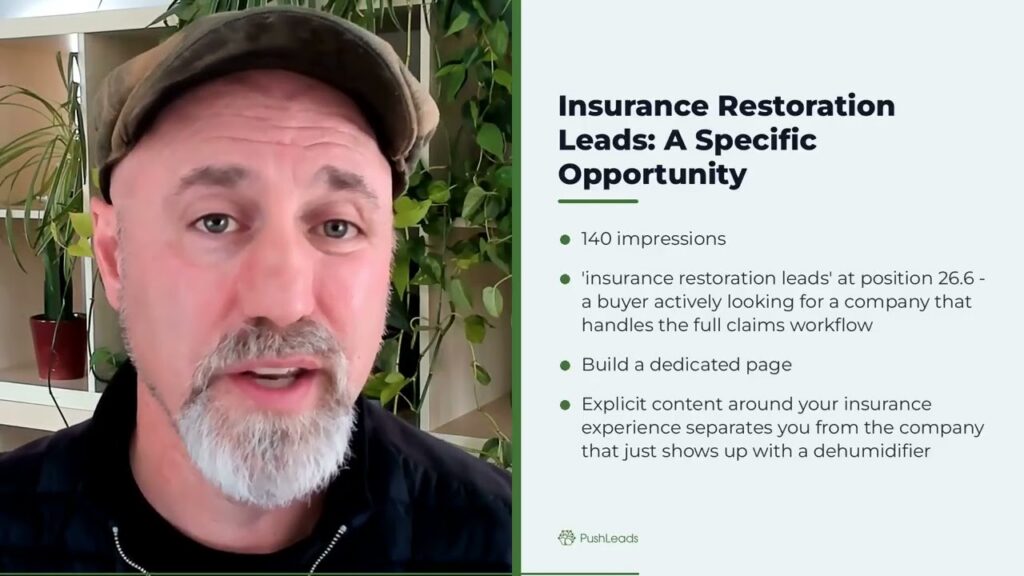
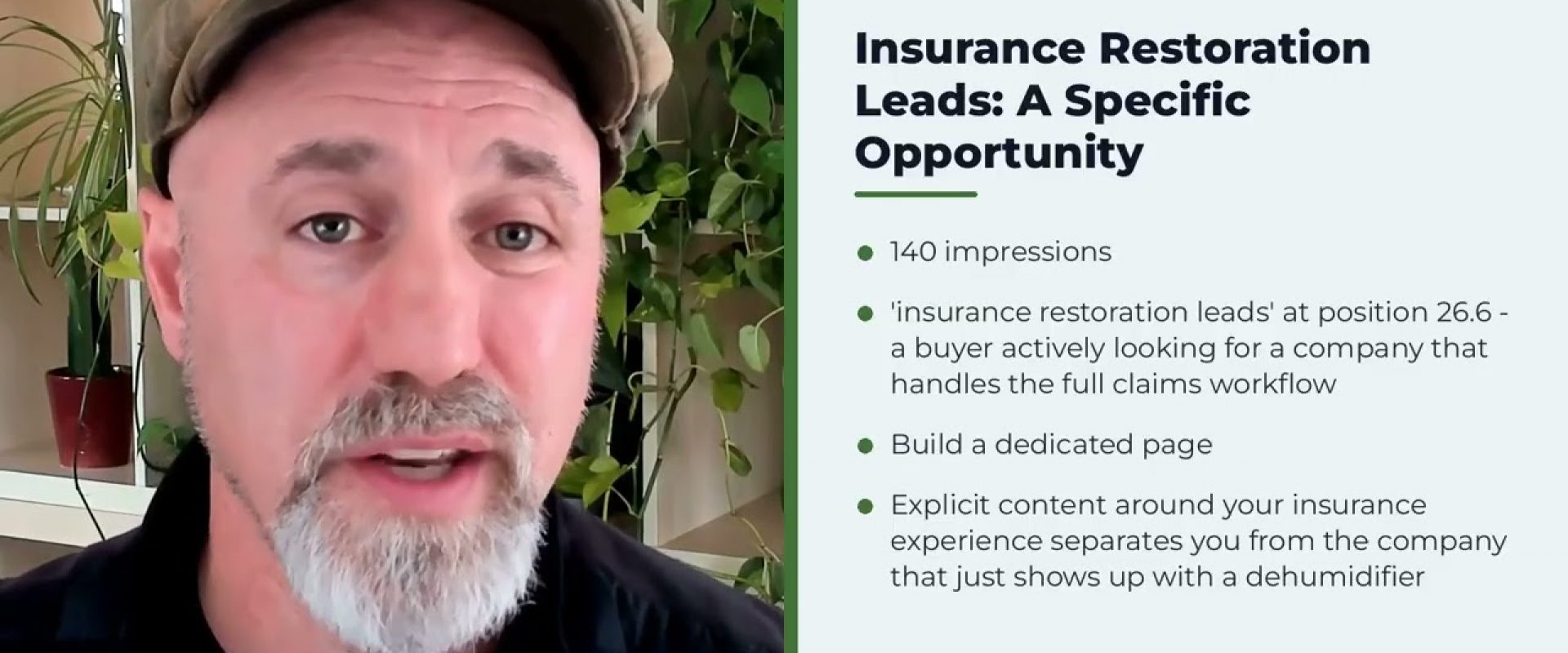
The referral network most companies ignore. SEO and paid ads get the most of our attention, but there's a channel that restoration companies routinely leave on the table: professional referral networks. Plumbers see water damage on every job. HVAC techs find mold behind walls. Real estate agents need remediation vendors before closings go sideways. Public adjusters are literally paid to help homeowners navigate insurance claims. Building a structured referral program with these professionals is not glamorous, but it's one of the most cost-effective pipelines you can build. You're not paying per click. You're paying in relationship building time and maybe referral acknowledgement structure that keeps you on top of mind. In my experience, one solid relationship with a busy plumber or a public adjuster network can generate ten to twenty qualified calls a year. Do that with ten different referral partners, and you've got meaningful volume without even touching your ad budget. How pay per click fits in. Pay per click for restoration companies shows up at four hundred and seventy-nine impressions across two related searches in our data, PPC for restoration companies at one hundred and fifty and restoration PPC at one hundred and forty-five. PPC works in restoration. The intent is high, and someone searching for emergency water damage restoration at eleven o'clock at night is not window shopping. But PPC alone has a ceiling. When you stop paying, the calls stop. It also doesn't build any lasting equity in your market. The model that works best in my experience is PPC for immediate volume while SEO builds the foundation underneath it. Use paid ads to fill the calendar now. Use organic search to reduce your cost per lead over the next six to eighteen months. Retargeting for at restoration companies shows up one hundred and forty-two impressions at position twenty-two point three in our data. Retargeting is underused industry. So if someone visits your water damage page and doesn't call, a retargeting campaign helps your brand stay in front of them as they browse other sites. For a service with high stakes and emotional urgency, that reminder can close jobs that you'd otherwise lose. Insurance restoration leads shows one hundred and forty-nine impressions at position twenty-two point six in our data, and that's a specific buyer signal. People searching for this phrase are often looking for a company that can handle the full insurance restoration workflow, not just the mitigation piece. If your company does work directly with carriers or you have experience guiding homeowners through the claims process, differentiator worth marketing explicitly. Create content around it. Build a page around insurance restoration or working with insurance and water damage. Show homeowners that you've done this before and that you can document properly for the adjuster that you'll handle the headaches they are dreading. That positioning separates you from the company that just shows up with a dehumidifier. The word example,
8:33 The Worked Example: How the Math Works
how the math works. Here's how the math works for a shop doing two hundred inbound calls a month with a mix of paid and organic searches. Let's say right now that eighty percent of those calls come from paid ads at an industry ballpark cost of around two hundred and fifty dollars per lead. That's forty thousand dollars a month in ad spend for one hundred and eighty-six paid leads. The other forty calls come from word-of-mouth and whatever organic rankings exist. Your effective cost per lead on these is near zero. Now imagine over eighteen months of consistent SEO, that ratio flips to fifty fifty. One hundred leads come from organic, one hundred from paid. You're now spending twenty five thousand dollars a month on paid instead of forty thousand and generating the same two hundred calls. That's fifteen thousand dollars a month back in your margin, not because you worked harder, but because organic search is doing the work for you around the clock. And that's just a ballpark illustration, not a guarantee. Your actual numbers will depend on your market, your close rate, and your average job value. But the direction of the math is always the same.
9:45 Common Mistakes Restoration Companies Make
Organic reduces your dependency on paid spend over time. Common mistakes restoration companies make. Let me run through the common ones I see most often. One page or five page websites trying to rank for twenty five different services and ten different cities. That spreads your authority too thin. Two, ignoring your Google Business Profile. For a local search, this is often more important than your actual website. Your Google Business Profile needs photos, weekly updates, review responses, and accurate service areas. Three, no review strategy. In restoration specifically, social proof is everything. If your competitor has four hundred reviews and you have thirty, you're losing jobs before the first conversation. Four, writing content for search engines instead of for anxious homeowners. The person who just had a pipe burst is scared and overwhelmed. Write to that person and answer their real question. Five, quitting SEO after ninety days. Search visibility compounds over time. Most restoration companies see a meaningful traction at the six to twelve month mark. The ones who quit after ninety days never find out what they left on the table.
10:57 What to Prioritize First
What to prioritize first. If you're starting from close to zero on the digital side, here's the order I would use. First, get your Google Business Profile fully built out and optimized. This is free and produces your local results first. Second, build your core service pages on your website. One page per major service and one page per city you serve. Third, start a review generation process. After every job, ask for the review. Make it easy with a direct link. Target fifty reviews as your first milestone. Fourth, build or improve your PPC campaigns if you need volume now while SEO develops. Fifth, add content that answers questions people ask before they need you. Cost pages, process pages, and what to expect pages. Sixth, build your referral network relationships in parallel with all the above. And none of this happens overnight, but none of it is mysterious either. It's a consistent system applied over time. What makes this approach different?
11:57 What Makes This Approach Different
Most marketing vendors sell restoration companies one piece of the puzzle. Here's a PPC campaign. Here's a website. Here's a directory listing. What actually grows a restoration business beyond storm season is treating all of those as one integrated system. SEO feeds organic calls. Paid ads fill gaps in the calendar. Retargeting captures people who didn't call. Referral partners send pre qualified jobs. Reviews and content build trust before the first phone call. When those channels work together, you stop being a company that chases storms and start being the company in your market that people think of first year round. What to do next. I want to give you something concrete. If you want to know exactly where your online visibility stands right now, where the gaps are in your local search presence, and what would move the needle fastest in your market, you can get a free visibility teardown from our team. Just go to SEO.PushLeads.comaudit or call eight two eight three four eight seven six eight six, and we'll look at your current rankings, your Google Business Profile, your site structure, your competitor landscape, and give you a straight read on where you stand and what we would do first. No hard sell, just real data on your actual situation. I'm Jeremy Ashburn with PushLeads. We help restoration companies get more leads with less effort. Thanks for watching this video. Now go book that audit, and let's see what your market actually looks like.
Key Takeaways
Want it done for you? See our restoration SEO and marketing agency.
Storm-season revenue is real, but it is not a growth strategy on its own. Restoration companies that build consistent inbound volume own the everyday searches that exist in every market regardless of weather. That means combining SEO, a tuned Google Business Profile, a structured referral network, pay-per-click, retargeting, and a review strategy into one integrated system rather than betting everything on the next hail event.
- Storm chasing creates a feast-or-famine cycle that caps how far a restoration business can scale.
- Everyday searches like "water heater burst" and "sewage backup cleanup" generate consistent call volume year-round in nearly every market.
- Building one focused page per service and per city is the foundation of organic search visibility.
- A structured referral program with plumbers, HVAC techs, and public adjusters can generate ten to twenty qualified calls per partner per year.
- Shifting from 80 percent paid to 50 percent paid leads can recover roughly fifteen thousand dollars a month in margin for a shop handling two hundred calls monthly.
- Google Business Profile optimization and review generation are the highest-leverage, lowest-cost starting points for most restoration companies.
- SEO compounds over six to eighteen months, so companies that quit after ninety days never see the return on what they already invested.
Why Restoration Companies Get Stuck in the Storm-Season Trap
Most restoration businesses build their early revenue on storm response, and that makes complete sense in the beginning. A hail event drops, the phones go crazy, crews stay busy for months, and cash flow looks great. The problem is that storm chasing is a feast-or-famine model by design. You are at the mercy of weather events, insurance cycles, and a hundred competitors who show up in the same zip code the same week chasing the same homeowners. The companies that scale past that pattern are not necessarily working harder. They are pulling from a fundamentally different source of demand.
The everyday calls exist in every market regardless of season. A water heater bursts on a Tuesday in July. A sewage backup happens under a kitchen in March. Mold gets discovered during a home sale in August. Those jobs are out there every single month, and the question is only whether your company shows up when someone searches for help. If a competitor owns those searches in your area, they are collecting calls that should have been yours, calls that have nothing to do with the last storm.
The shift I want to walk through in this post is not about abandoning storm work. It is about building a pipeline underneath it so that when the storms are quiet, the phones are not. That means understanding where the demand lives, which channels capture it, and how the math improves over time as organic search does more of the heavy lifting.

Want more customers from Google & AI search?
Get a free SEO audit of your site — see exactly what to fix first.
What the Search Data Actually Shows About Restoration Demand
Real search query data confirms that restoration demand is consistent and largely under-served in most markets. The phrase "water damage restoration cost" generates 680 impressions in our tracked data set at an average position of 20.1, which means it is ranking but sitting on page two or a low page one where almost nobody clicks. "How to market a restoration company" pulls 466 impressions at position 35.9, and "disaster restoration marketing" gets 344 impressions at position 47, which is essentially invisible to any searcher.
Does the search volume for restoration services hold up outside storm season?
Yes, everyday restoration searches happen consistently throughout the year because water damage, mold, and sewage events are not weather-dependent. Queries tied to specific situations, like what to do after a pipe burst or how much water damage restoration costs, reflect homeowners with active problems who need a company right now, not people browsing during a storm recovery window.
Why are so many restoration companies ranking poorly for searches that have clear demand?
Most restoration websites are built as digital brochures rather than search-optimized resources. A five-page site trying to rank for twenty-five services across ten cities spreads authority too thin across all of them. When position data shows queries sitting at positions 35 to 47, it almost always reflects a site with no dedicated service pages, a thin content structure, or a Google Business Profile that has been set up and forgotten. That is an open lane for any company willing to build the right foundation.
What does an open lane in local restoration search actually mean for revenue?
When competitors in your market are ranking on page two or three for high-intent searches, the top positions are available to a company that puts in consistent work. Ten to fifteen service-and-city pages each ranking on page one, combined with a well-maintained Google Business Profile, can generate meaningful inbound volume every month without any paid spend attached to those specific queries.
What a Year-Round Lead Pipeline Looks Like in Practice
A healthy restoration pipeline runs on three layers working simultaneously rather than one channel doing everything. The first layer is awareness and education: content that answers questions people ask before they have an emergency, things like "how much does water damage restoration cost" or "what do I do after a pipe burst." The second layer is intent and consideration, where local SEO and Google Business Profile capture people actively searching for a company in their area. The third layer is conversion, where speed to answer, online reviews, and trust signals close the job or send the caller to a competitor.
Why do most restoration companies only invest in the conversion layer?
Pay-per-click advertising drops calls into the bottom of the funnel quickly, so it is the natural starting point for owners who need revenue now. The problem is that PPC alone has a ceiling. When the ad spend stops, the calls stop. It also builds no lasting equity in the market, so the company is effectively renting its lead volume rather than owning it over time.
What does investing in all three funnel layers simultaneously actually require?
It requires creating content for the awareness layer, optimizing local search assets for the consideration layer, and building social proof for the conversion layer at the same time rather than treating them as sequential phases. None of these tasks is individually complicated, but they do require consistency over months rather than weeks. A company that runs PPC while also publishing cost pages and building reviews is compressing the timeline for when organic starts contributing meaningfully.
How long before the year-round pipeline produces reliable volume?
In my experience with restoration clients, meaningful organic traction typically appears at the six to twelve month mark. Referral network relationships often start producing calls within the first two to three months if they are pursued actively. The full effect of treating all six channels as one integrated system usually shows up clearly around the eighteen-month point, which is also when the cost-per-lead math starts to shift significantly in the company's favor.
How SEO Builds the Foundation Under Everything Else
SEO for a restoration company is not complicated in concept, but it requires a specific structure to work. The search "restoration SEO" pulls 408 impressions in our data at position 16.2, and "restoration company SEO lead generation" shows 362 impressions at position 19.1. Those numbers reflect real demand from restoration owners looking for exactly this, but they also mirror the structure that your potential customers use when searching for your services.
Each service you offer and each city you serve needs its own focused page. Water damage restoration is not the same page as fire damage restoration. Mold remediation is not the same page as storm damage cleanup. "Fire damage restoration SEO" shows up in our data at 179 impressions at position 22.3, and "water damage marketing" sits at 156 impressions at position 21.6. Those are not huge individual numbers, but stack ten or fifteen of those pages together, each ranking on page one, and you are generating consistent inbound volume every month regardless of what the weather is doing.
What pages should a restoration website have to rank for local searches?
At minimum, one dedicated page for each primary service (water damage, fire damage, mold remediation, storm damage, sewage cleanup) and one page for each city or service area you actively cover. Each page needs to target the specific search phrases that match that service in that location, include real detail about your process, and answer the questions that an anxious homeowner would have. Thin pages with a paragraph of text and a phone number do not rank in competitive local markets. If you want to understand how this affects your overall acquisition cost, it helps to look at your restoration marketing cost per lead across paid versus organic sources before deciding where to invest next.
How does AI search change the SEO strategy for restoration companies?
AI-powered search results, including Google's AI Overviews and answers pulled by chatbots like ChatGPT, tend to cite sources that answer questions clearly and completely rather than just matching keywords. If a competitor in your market is already being cited by AI for questions like "how much does water damage restoration cost in my city," that is a visibility gap that affects not just traditional search rankings but also the growing share of searches that never result in a click at all. Building thorough, question-answering content is the same strategy that serves both traditional SEO and AI search visibility.
Should a restoration company prioritize SEO or paid ads first?
The practical answer is both, but in different roles. Paid ads fill the calendar now while SEO builds the foundation underneath it. Use pay-per-click for immediate volume, and use organic search to reduce your cost per lead over the next six to eighteen months. The companies that run only paid ads stay dependent on that spend indefinitely. The companies that build SEO alongside paid ads eventually reach a point where organic handles a large share of inbound volume at near-zero marginal cost per lead. Comparing SEO versus buying restoration leads over an eighteen-month window almost always favors organic once the foundation is in place.
The Referral Network Most Restoration Companies Leave on the Table

SEO and paid ads get most of the attention in restoration marketing conversations, but there is a channel that consistently gets ignored: structured professional referral networks. Plumbers see water damage on nearly every job. HVAC technicians find mold behind walls during routine service calls. Real estate agents need remediation vendors before closings go sideways. Public adjusters are paid specifically to help homeowners navigate insurance claims and frequently need a restoration partner they can trust.
Building a structured referral program with these professionals is not glamorous, but it is one of the most cost-effective pipelines available. You are not paying per click. You are investing relationship-building time and potentially a referral acknowledgment structure that keeps your company front of mind when the right situation comes up.
How many calls can a single referral relationship realistically generate?
One solid relationship with a busy plumber or a public adjuster network can realistically generate ten to twenty qualified calls per year. That is not a number from a marketing pitch. That is what I have seen play out for restoration companies that approach referral relationships systematically rather than casually. Build ten of those relationships and you have meaningful inbound volume that costs nothing in ad spend and arrives pre-qualified because someone the homeowner already trusts sent them to you.
What does a structured referral program actually look like for a restoration company?
It starts with identifying the professional categories that see water, mold, and fire damage before homeowners call a restorer: plumbers, HVAC techs, real estate agents, property managers, insurance agents, and public adjusters. Then it requires a consistent outreach approach, a clear explanation of your process and documentation capabilities, and some form of ongoing communication so that your company stays top of mind when the situation arises. A simple referral tracking system inside a restoration CRM for scaling makes it possible to see which relationships are producing and where to invest more attention.
Are referral relationships worth pursuing if the restoration company is already busy from storms?
Yes, precisely because they produce volume during the periods when storm work is not available. A referral partner relationship built during your busy season pays dividends during your slow season. The relationship has already been established, the partner already knows your work quality, and the calls keep coming regardless of what the weather is doing. Referral networks and SEO are the two channels that produce the most durable, weather-independent call volume over time.
How Pay Per Click and Retargeting Fit Into the Model
Pay-per-click advertising works in restoration because the intent behind the searches is extremely high. Someone searching for "emergency water damage restoration" at eleven at night is not window shopping. They have an active problem and they need help immediately. That intent makes PPC cost-effective even at relatively high cost-per-click rates, provided the campaign is structured correctly around the highest-intent queries rather than broad match terms that burn budget on irrelevant clicks.
In our data, PPC-related searches for restoration companies show 479 impressions across related queries, with "PPC for restoration companies" at 150 impressions and "restoration PPC" at 145. The market for this knowledge reflects how many restoration owners are actively trying to figure out whether paid ads are worth it for their business.
What is the biggest mistake restoration companies make with paid search campaigns?
Running broad keyword targeting without negative keyword lists is the most common and most expensive mistake. Broad match ads for "water damage" can trigger for searches like "water damage movie" or "water damage DIY fix," neither of which will ever become a customer. Tightly structured campaigns targeting high-intent phrases with proper geographic boundaries and strong negative keyword hygiene are what separate paid campaigns that produce profitable leads from ones that just burn through budget. Avoiding these kinds of wasteful setups is part of understanding the financial mistakes restoration companies most commonly make early on.
What is retargeting and why does it matter for restoration companies specifically?
Retargeting serves ads to people who visited your website but did not call or submit a form. In our data, "retargeting for restoration companies" shows 142 impressions at position 22.3, which signals that restoration owners are aware of this but underusing it. For a service with high emotional stakes, a homeowner who visits your water damage page and then leaves to compare options is not necessarily lost. A retargeting campaign that keeps your brand visible while they browse other sites brings a meaningful percentage of those visitors back to convert. The reminder matters when the decision carries real financial weight.
How should a restoration company position itself for insurance-related restoration searches?
"Insurance restoration leads" shows 149 impressions at position 22.6 in our data, which reflects a specific and valuable buyer signal. Homeowners searching for a company that handles the insurance workflow are looking for more than mitigation. They want a company that can document correctly for the adjuster, guide them through the claims process, and handle the parts of restoration they dread most. If your company does that work, build a dedicated page around it. Show homeowners you have done this before. That positioning separates you from competitors who show up with a dehumidifier and leave the paperwork problems behind. Targeting commercial storm damage keywords as part of this strategy also opens the door to larger commercial accounts that pay significantly better than residential insurance jobs.

The Worked Example: How the Math Changes Over Eighteen Months
Here is a concrete illustration of how the economics shift when organic search starts contributing meaningfully. Take a restoration shop handling two hundred inbound calls per month with the current mix heavily weighted toward paid advertising. Right now, 80 percent of those calls, which is 160 calls, come from paid ads at an industry ballpark cost of around $250 per lead. That is $40,000 per month in ad spend. The remaining 40 calls come from word of mouth and whatever organic rankings already exist, at near-zero marginal cost per lead.
Now imagine that over eighteen months of consistent SEO work, that ratio shifts to 50/50. One hundred calls come from organic, one hundred from paid. The company is now spending $25,000 per month on paid ads instead of $40,000 and generating the same two hundred calls. That is $15,000 per month back in margin, not because anyone worked harder, but because organic search is producing leads around the clock without a cost attached to each one.
Is the $250 cost per lead figure realistic for restoration pay-per-click?
That figure is a ballpark illustration based on general industry ranges, not a guarantee for any specific market. Actual cost per lead varies significantly by geography, competition level, keyword targeting, landing page quality, and close rate. In highly competitive markets, restoration PPC cost per lead can run higher. In smaller or less competitive markets, it can run lower. The directional point of the example holds regardless of the exact number: every lead that comes from organic search rather than paid advertising reduces the effective cost per customer acquired. Understanding your own numbers across channels is how you decide where to allocate the next marketing dollar. You can also compare these numbers against commercial restoration marketing returns if your company is pursuing larger commercial accounts alongside residential work.
How does a restoration company track whether organic search is actually contributing to revenue?
Call tracking with source attribution is the most practical tool for this. Every channel, organic search, paid ads, referral partners, and Google Business Profile calls, gets a dedicated tracked number or a UTM-tagged form so that revenue can be tied back to its source. Without that tracking in place, it is impossible to know whether the SEO investment is producing results or whether the organic calls you think you are getting are actually coming from somewhere else entirely.
In this video
- 0:00 Storm Season Visibility Won Before Forecast
- 1:03 Why Storm Demand Behaves Differently
- 2:03 Six Assets to Build in Advance
- 2:04 Storm Page Structure That Matches Search
- 3:03 GBP Configuration for Emergency Searches
- 4:16 LSA Verification and Dispute Strategy
- 5:01 After-Hours Answer and Review Velocity
- 6:34 Storm-Day Execution Hour by Hour
- 7:50 After-Storm Plays Mitigation to Reconstruction
- 9:23 AI Search and Getting Recommended
- 10:11 Six Metrics to Track Per Storm Event
Full transcript: Storm Season Marketing Playbook for Contractors
The Most Common Mistakes Restoration Companies Make With Marketing
After working with restoration companies on search visibility, I keep seeing the same patterns. The first is a one-page or five-page website trying to rank for twenty-five services across ten cities. That approach spreads whatever authority the site has too thin to rank competitively for any of them. The second is a neglected Google Business Profile. For local search, the Business Profile often matters more than the website itself in terms of what a searcher sees first. It needs photos, regular posts, review responses, and accurate service area information, not just a name and phone number.
The third common mistake is having no review strategy at all. In restoration specifically, social proof carries enormous weight because homeowners are making a high-stress decision quickly. If a competitor has four hundred reviews and your company has thirty, you are losing jobs before the first conversation happens. Building google reviews for contractors in this industry is not optional, it is part of the baseline that earns the call.
Why do restoration companies write content that fails to attract or convert homeowners?
Most restoration content is written with search engines in mind rather than the person experiencing the emergency. The homeowner who just had a pipe burst at two in the morning is scared, overwhelmed, and wants to know what to do right now. Content that leads with company history, licensing credentials, and generic SEO phrases does not speak to that person. Content that starts with "here is what to do in the next sixty minutes" does. Writing for the emotional state of the reader is what gets the page read, shared, and cited by AI search engines that are looking for genuinely useful answers.
Why do so many restoration companies quit SEO before it produces results?
Search visibility compounds over time, but the early months feel slow because rankings build gradually rather than appearing overnight. Most restoration companies that abandon SEO after ninety days do so because they expected to see meaningful lead volume by then. The six-to-twelve-month mark is where traction typically becomes visible. Companies that quit at ninety days never find out what they left on the table, and they usually go back to full paid-ad dependency with a higher cost per lead than they would have had if they had stayed consistent.
What to Prioritize First When Starting From Near Zero
If your company is starting close to zero on the digital side, the order of operations matters because resources are limited and some steps create the foundation that others depend on. The right sequence keeps early investment from going to waste.
Start with your Google Business Profile. It is free and it produces local results immediately once properly optimized. Fill out every field, add real photos of your work, set accurate service areas, and respond to every existing review. Next, build the core service pages on your website, one per major service and one per city you serve. These do not need to be finished overnight, but they need to exist and be substantive enough to rank.
What review milestone should a restoration company target first?
Fifty reviews is a reasonable first milestone because it is achievable within a few months for a company doing consistent volume and gives enough social proof to be competitive with most mid-tier local competitors. After every completed job, ask for the review directly. Make it simple by sending a direct link to your Google review page via text immediately after job completion. The close rate on review requests drops significantly when the request is delayed, so the ask needs to happen while the customer is still in the positive emotional state of having had a problem solved.
When should a restoration company add content beyond core service pages?
Content that answers pre-emergency questions, cost pages, process explanation pages, and "what to expect" guides, should be added as a fourth or fifth priority rather than first. The reason is that service pages and Google Business Profile optimization produce the highest-intent traffic, the people who already know they need restoration help right now. Educational content captures the awareness layer of the funnel and builds long-term organic authority, but it does not produce immediate inbound calls the way a well-optimized "water damage restoration in [city]" page does. Build the revenue-generating foundation first, then layer in the awareness content.
Frequently Asked Questions
How do I grow my restoration business when there are no storms?
You grow by owning the searches that exist regardless of weather: water heater failures, sewage backups, mold discoveries during home sales, and slow leaks that become bigger problems. These calls happen every month in every market. Capturing them requires service-specific pages optimized for local search, an active Google Business Profile, a review strategy, and referral relationships with plumbers, HVAC techs, and real estate professionals who encounter these situations before homeowners call a restorer.
How long does restoration SEO take to produce leads?
Meaningful traction from organic search typically appears at the six to twelve month mark for restoration companies starting from a thin or neglected website. Markets with less established competition can show results faster. Markets with multiple well-optimized competitors take longer. The companies that stay consistent through the first year are the ones that eventually reduce their dependence on paid advertising. Quitting after ninety days, which is the most common point of abandonment, almost always means missing the return on the investment already made.
What is the most important digital asset for a local restoration company?
For most local restoration companies, the Google Business Profile is the highest-leverage digital asset because it is what appears in map pack results when someone searches for restoration services nearby. A fully built-out profile with photos, accurate service areas, consistent posting, and a strong review count often drives more calls than the company website for local intent searches. It is also free to maintain, which makes neglecting it one of the more expensive mistakes a restoration company can make.
Should a restoration company buy leads or invest in SEO?
Buying leads produces immediate volume but creates permanent dependency on the lead provider and typically comes with lower close rates because the homeowner contacted multiple companies at once. SEO produces leads that arrive because the homeowner found and chose your company specifically, which tends to produce higher close rates and lower cost per acquired customer over time. Most restoration companies benefit from using both during the SEO build phase and then shifting the balance toward organic as rankings improve.
How many Google reviews does a restoration company need to be competitive?
The competitive threshold varies by market, but fifty reviews is a reasonable first target for any market, and one hundred or more puts you in a strong position in most mid-sized cities. In larger or more competitive markets, competitors with three hundred to five hundred reviews are not unusual. The key factor is not just the count but the recency. A steady stream of recent reviews signals to both searchers and search algorithms that the company is active and consistently delivering work worth reviewing.
What does a realistic restoration marketing budget look like?
Budget size depends heavily on market competition, target revenue, and current organic rankings. Companies with no organic presence typically need paid advertising to generate near-term volume while SEO builds, which means the combined investment is higher early and decreases over time as organic takes over a larger share. The more useful question than total budget is cost per lead by channel. Knowing what you pay per lead from PPC versus organic versus referral partners is how you allocate the next dollar intelligently rather than just spending more on what is already running.
What makes restoration SEO different from general contractor SEO?
Restoration searches have a much higher emergency component than most contractor searches. Someone searching for a roofer has days to decide. Someone searching for emergency water damage restoration has hours. That urgency changes the content approach, the speed-to-answer requirements, and the conversion optimization priorities. It also means that reviews and trust signals carry more weight in restoration than in categories where the homeowner has time to research carefully. The emotional state of the searcher shapes everything from what content gets read to which company gets the call.
Can a small restoration company compete with large franchises in local search?
Yes, and local search is actually one of the areas where a well-run independent company can outperform a national franchise. Google Business Profile rankings weight proximity and review quality heavily. A locally-operated company with a genuine review base, consistent posting, and accurate service area information often outranks a franchise location that is managed by a corporate marketing department with less local attention. The independent company also has the flexibility to build hyper-local content that speaks to the specific neighborhoods, weather patterns, and housing stock of its market in ways that franchise templates cannot replicate.
Build the Pipeline Now Before the Next Storm Season Ends
Storm work will come back. It always does. But the companies that use the quiet periods to build their organic presence, their referral networks, and their review base are the ones that grow rather than just recover. The model I have laid out here is not complicated. One page per service, one page per city, a maintained Google Business Profile, a consistent review request process, referral relationships with the professionals who see damage before homeowners do, paid ads to fill gaps while organic builds, and content that speaks to an anxious homeowner rather than a search algorithm.
None of these steps is mysterious. They require consistency over months rather than a single campaign push. But when all six channels work together, you stop chasing storms and start being the company your market calls first regardless of what the weather is doing.
If you want to know exactly where your visibility stands right now, where the specific gaps are in your local search presence, and what would move the needle fastest in your market, reach out to us at PushLeads. We will look at your current rankings, your Google Business Profile, your site structure, and your competitor landscape and give you a straight read on where you stand and what we would do first. No pitch, just real data on your actual situation. Contact us at https://pushleads.com/contact/ and let us see what your market actually looks like.
Keep Reading
Want more customers from Google & AI search?
Get a free SEO audit of your site — see exactly what to fix first.
Your path · Restoration Company SEO
Keep going: read these next

- Up nextRestoration Company Scams: How to Identify Storm Chasers, Inflated Billing, and AOB Fraud
- Restoration Company Succession Planning and Exit Strategy: Building Wealth Beyond the Business



Want this done for you?
Scan your site. See the gaps. Decide with numbers.
- Rankings, Google Business Profile and site-speed teardown
- Report lands in your inbox in about a minute
- No obligation · 4.9 from 67 Google reviews
 Continue reading