0:00 Intro
0:41 Why Commercial Jobs Are a Different Business
1:43 Who Actually Makes the Commercial Buying Decision
2:39 The Real Cost of Commercial Restoration Marketing
3:53 Why SEO Is the Foundation, Not an Add-On
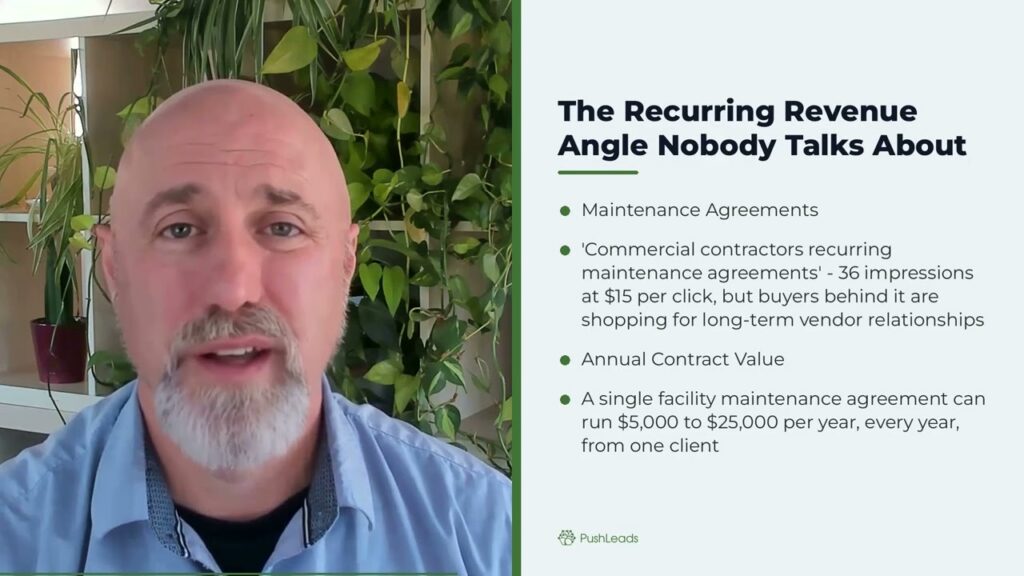
4:46 The Recurring Revenue Angle Nobody Talks About
5:30 What a Commercial Marketing Funnel Actually Looks Like
6:32 What PPC Looks Like on the Commercial Side
7:23 The Mold Remediation Commercial Opportunity
8:14 Common Mistakes in Commercial Restoration Marketing
10:23 What to Do Before You Spend a Dollar
11:07 What to Do Next
Full transcript
0:00 Intro
Here’s the direct answer, commercial restoration marketing costs between $5,000 and $15,000 a month depending on your market and a single mid -sized commercial loss can return $50,000 to $250 ,000 in revenue. That math is hard to ignore, but most restoration companies never run it because they’re stuck chasing residential claims and they don’t know what it actually takes to get in front of the commercial buyer. That’s what this video covers. The real cost, the real return, the mechanism behind why commercial margins are three to five times higher than residential and the specific mistakes that keep companies from breaking into this market.
This is part of our guide to Restoration software pricing.
0:41 Why Commercial Jobs Are a Different Business
Let’s run the numbers. First, let’s separate the two markets clearly. A typical residential water loss pays out $8,000 to $20,000. A commercial water loss in a mid -sized office building, a hotel, a school, a warehouse, that same category of job pays out $50,000 to $500,000. Same course skill set, dramatically different contract value, and the margin gap is even wider than the revenue gap. On residential jobs, you’re competing on price with three other guys who showed up the same night. On commercial jobs, if you have the right relationships and the right digital presence, you’re often the only call they make. That’s the mechanism. The commercial buyer is not using the same decision process as a homeowner who just flooded their kitchen. They’re a facility manager, a property manager, a risk manager, or a CFO. They research vendors in advance. They vet you before the loss happens. That means your marketing has to reach them before the emergency, not during it.
This is part of our restoration SEO guide.
1:43 Who Actually Makes the Commercial Buying Decision
This is where most restoration companies get it wrong. They run the same ads. They run for homeowners, but the commercial buyer is not on Facebook at 11 at night, panicking about wet drywall. The commercial buyer is a professional. They’re searching phrases like getting commercial sales and restoration industry or increase commercial restoration sales. We see those keywords searched with impression volumes in the 60 to 87 range, but their click values are $54 per click. Compare that to a general phrase like restoration marketing at $20 per click. The commercial intent keywords cost more per click because the buyer behind them is worth more per conversion. Your targeting has to match that buyer’s behavior. That means LinkedIn outreach, direct property manager, contact campaigns, and search content that speaks to facility managers and risk officers, not homeowners. Let’s break down what a real commercial marketing budget looks like.
2:39 The Real Cost of Commercial Restoration Marketing
A basic entry level push into commercial will run $5,000 to $8,000 a month. That typically covers search engine optimization, targeting commercial keywords, a content strategy aimed at the commercial buyer persona, and some form of outreach to property managers and facilities directors. A mid -tier program with paid search layered in runs $8,000 to $15 ,000 a month. That’s where you’re bidding on commercial content, pack out services, SEO for mold remediation commercial, and commercial sales marketing restoration companies. Those phrases have impression volumes between 75 and 89 per month at click values between $20 and $30. Low volume, but high in 10, every click that converts is someone actively looking for what you do in the commercial space. One converted lead at this level can return a $50,000 job minimum, so a $15,000 monthly marketing spend that generates two commercial conversions per month returns $100,000 in revenue from roughly $30,000 of spend over 60 days. That is not a complicated ROI calculation. Paid search works for commercial restoration,
3:53 Why SEO Is the Foundation, Not an Add-On
but it rents your visibility. The moment you stop paying, you disappear. SEO builds an asset. When you rank for increased commercial restoration sales or commercial contractors recurring maintenance agreements, those rankings keep producing leads without a cost per click attached to every visitor. The search volume on marketing plans for restoration companies is 97 impressions at $36 per click. The search volume on how to increase commercial restoration sales is 64 impressions at $54 per click. These are not high volume terms. That’s actually good news for you. High volume means high competition. These commercial specific terms have real buyers behind them and relatively few restoration companies targeting them properly. The companies that build content around these terms now are establishing authority before their competitors wake up.
4:46 The Recurring Revenue Angle Nobody Talks About
One of the biggest commercial marketing returns doesn’t come from emergency response. It comes from maintenance agreements, commercial facilities by recurring inspection and preventive maintenance contracts. Commercial contractors recurring maintenance agreements get searched at 36 impressions with a click value near $15. That seems cheap until you understand what’s behind it. A commercial property manager searching that phrase is shopping for a long -term vendor relationship. A maintenance agreement on a mid -size facility can run $5,000 to $25 ,000 a year every year from one client. If your marketing captures five of those clients, that’s $25,000 to $125 ,000 in recurring revenue annually, predictable, retainable, high margin.
5:30 What a Commercial Marketing Funnel Actually Looks Like
Step one, search visibility. You have to show up when the commercial buyer searches. That means pages targeting specific commercial keyword clusters, mold remediation for commercial buildings, commercial water damage response, large loss pack -out services, commercial property maintenance agreements. Step two, trust content. The commercial buyer does due diligence, case studies, documented project scopes, before and after documentation from commercial jobs, certifications displayed clearly. Step three, direct outreach. Digital alone is not enough for commercial. You need a parallel track reaching property managers directly, LinkedIn, industry associations, facility management groups, and local commercial real estate contacts. Step four, follow -up systems. The commercial buyer rarely converts on first contact. Your CRM has to handle a longer sales cycle, 60, 90, sometimes 120 days from first touch to signed contract is normal.
6:32 What PPC Looks Like on the Commercial Side
Paper click advertising for commercial restoration has different economics than residential. PPC advertising for restoration and home service businesses get searched at 11 impressions with a click value of $46. That’s a high cost per click. But on a commercial keyword, one converted click can be worth $10,000 or more in job revenue. The economics work. The mistake most companies make is running commercial PPC with residential landing pages. If someone clicks a commercial keyword and lands on a page that talks about home owner coverage and insurance claims, they leave immediately. Your landing pages have to speak directly to the facility manager reading them. Business continuity, minimal operational disruption, certified large -loss teams, documented chain of custody for contents. That’s the language that converts the commercial buyer.
7:23 The Mold Remediation Commercial Opportunity
Mold is worth calling out specifically. SEO for mold remediation commercial runs at 89 impressions with a $23 click value. Marketing for mold remediation commercial runs at 28 impressions with a $33 click value. The commercial mold job is typically much larger than residential. It involves industrial hygienist protocols and is often triggered by liability concerns rather than homeowner preference. That means the urgency is higher on the commercial side. A facility manager dealing with a mold complaint from tenants or employees is not shopping around on price the same way a homeowner does. They need a credentialed vendor, documented protocol, and fast response. If your marketing clearly communicates all three of those things for the commercial mold buyer specifically, you will win more of those jobs.
8:14 Common Mistakes in Commercial Restoration Marketing
Mistake one, running one website for both audiences. Your residential buyer and your commercial buyer need different pages, different messaging, different proof points. One generic site serves neither well. Mistake two, skipping the case study. The commercial buyer once documented evidence of large -loss capability, photos, square footage, drawing logs, timeline outcome. If you don’t have case studies built around your commercial work, you’re asking buyers to take you on faith. Mistake three, ignoring local SEO for commercial. Restoration marketing plan runs at 107 impressions with a $33 click value. A lot of companies write one generic blog post about marketing and think they’ve covered the topic. The commercial buyer needs hyper -local industry -specific content that proves you understand their world. Mistake four, no follow -up cadence. Commercial leads that don’t convert in week one are not dead leads. They’re long cycle prospects. If you don’t have a system to stay in contact over 90 to 120 days, you’re leaving signed contracts on the table. Let’s run a realistic scenario. A restoration company spends $10 ,000 a month on commercial -focused SEO and content. That’s $120,000 over 12 months. By month four to six, commercial keyword rankings begin to produce organic traffic. By month nine, they’re generating four to six commercial inquiries per month. They close two per month. Average job value, $75,000. That’s $150,000 in commercial revenue per month by month nine. Over the full 12 months, assuming a ramp, they generate roughly $900,000 to $1,200,000 in commercial revenue from that investment against a $120,000 spend. That is a seven to 10 times return over 12 months. That is not guaranteed. That is not a promise. But it is the shape of what I see work in markets where the company actually commits to the strategy and doesn’t quit after 90 days because the phone didn’t ring in week six.
10:23 What to Do Before You Spend a Dollar
Before you budget anything, you need to know what your current commercial visibility looks like. What pages do you rank for on commercial terms? What’s your share of voice for commercial keywords in your market? Where your competitors ranking that you’re not, that audit is the starting point. Without it, you’re spending blind. Here’s the summary. Commercial restoration marketing costs $5,000 to $15,000 a month. Commercial jobs return $50 ,000 to $500,000 per job. Margins on commercial are three to five times higher than residential because you’re not racing three competitors to a homeowner’s door at midnight. The buyers search differently. They vet differently. They buy differently. Your marketing has to match that process.
11:07 What to Do Next
Get a free visibility tear down at SEO .PushLeads .com slash audit or call 828 -348 -7686. We’ll show you exactly where your commercial keyword gaps are, what your competitors are ranking for, that you’re not, and what it would realistically cost and return to build this out in your specific market. No pitch. Just the numbers.
Key Takeaways
Want it done for you? See our restoration SEO and marketing agency.
Commercial restoration marketing runs $5,000 to $15,000 a month depending on your market. A single mid-sized commercial loss returns $50,000 to $500,000 in revenue. The math works decisively in your favor if you target the right buyer, build the right pages, and stay in the game long enough for SEO to compound. Most restoration companies never get there because they market to facility managers the same way they market to homeowners, and that is where the opportunity disappears.
- Commercial water losses pay $50,000 to $500,000 versus $8,000 to $20,000 for residential, same core skill set.
- Commercial buyers are facility managers, property managers, risk officers, and CFOs who vet vendors before an emergency, not during one.
- SEO builds a durable asset; paid search rents visibility and stops the moment you pause spending.
- Maintenance agreements can generate $5,000 to $25,000 per client per year in predictable recurring revenue.
- Separate landing pages for commercial and residential audiences are required; one generic site converts neither buyer well.
- Commercial sales cycles run 60 to 120 days, so your CRM and follow-up cadence matter as much as your ad spend.
- In an illustrative 12-month scenario at $10,000 a month, closing two $75,000 commercial jobs a month from around month nine puts revenue in the $900,000 to $1.2 million range. That is a worked example, not a typical or guaranteed result.

Why Commercial Restoration Is a Fundamentally Different Business
Commercial restoration operates on contract values three to five times higher than residential work, and the margin gap is wider than the revenue gap because you are rarely competing on price with three other trucks that showed up the same night. A mid-sized commercial water loss in an office building, hotel, school, or warehouse pays $50,000 to $500,000. The same category of residential job pays $8,000 to $20,000. That difference is not incremental; it changes how you staff, how you invest in equipment, and critically, how you market.
The mechanism behind that margin gap is competition, or the lack of it. On a residential emergency, price pressure is immediate because multiple contractors arrive at the same time. On a commercial job, if you have established relationships and the right digital presence, you are often the only call the facility manager makes. That dynamic does not happen by accident. It happens because the commercial buyer researched you weeks or months before the loss occurred, decided you were credentialed and capable, and put your number in their vendor file. Your marketing job is to get into that file before the emergency, not after it.
This is why running residential-focused ads and hoping commercial buyers find you does not work. The commercial buyer is not on Facebook at eleven at night in a panic. They are a professional doing structured vendor research, and your marketing strategy has to reflect that reality from the first dollar you spend.
Want more customers from Google & AI search?
Get a free SEO audit of your site — see exactly what to fix first.
Understanding Who Actually Makes the Commercial Buying Decision
The commercial restoration buyer is a facility manager, property manager, risk manager, or CFO who researches vendors before a loss happens, not during one, and your content needs to speak their professional language or they will move on immediately.
What job titles are making commercial restoration vendor decisions?
Facility directors and property managers carry the most day-to-day vendor authority in commercial restoration. Risk managers and CFOs often get involved on large losses or on approved-vendor-list decisions. Each of these roles prioritizes different things: the facility manager wants fast response and minimal operational disruption; the risk manager wants documented protocol and chain-of-custody records; the CFO wants a vendor who can defend costs to an insurer. Your website, your case studies, and your outreach messaging all need to address at least the first two of those concerns explicitly.
How does a commercial buyer vet a restoration vendor before an emergency?
Commercial buyers run structured pre-vetting processes that include checking your certifications, reviewing documented case studies from comparable commercial losses, and sometimes calling references at other commercial properties you have served. They search phrases like “commercial water damage response” or “large loss pack-out services” and they spend time on the pages they find. A page that talks about homeowner insurance claims and residential mitigation tells them instantly that you are not a commercial specialist. You lose that vendor-file slot before you ever get a call.
Why does the commercial buyer search so differently from a homeowner?
Homeowners search reactively during an emergency. Commercial buyers search proactively during planning cycles, budget reviews, and after incidents at peer facilities. That means the keywords they use reflect professional intent. Phrases like “commercial contractors recurring maintenance agreements” or “commercial property maintenance agreements” have impression volumes of 36 per month with click values near $15, low volume but every searcher is a professional shopping for a long-term vendor relationship, not a panicked homeowner looking for the fastest response at the lowest price.
The Real Cost of a Commercial Restoration Marketing Budget
A realistic entry-level commercial marketing program runs $5,000 to $8,000 a month, and a mid-tier program with paid search layered in runs $8,000 to $15,000 a month, covering SEO, commercial keyword content, and direct outreach to property managers and facilities directors.
What does a $5,000 to $8,000 a month commercial marketing program actually cover?
At the entry level, your budget covers search engine optimization targeting commercial keyword clusters, a content strategy aimed specifically at the facility manager and property manager buyer persona, and some form of direct outreach to commercial contacts through LinkedIn and local commercial real estate associations. You are not running paid search at this tier. You are building organic visibility and starting to populate your CRM with commercial prospects for a longer nurture sequence. This level is appropriate if you are entering the commercial market for the first time and want to establish foundational rankings before layering in paid spend.
What does adding paid search to a commercial program cost and what does it buy?
Moving to a mid-tier program at $8,000 to $15,000 a month adds Google Ads targeting commercial-intent phrases. Phrases like “commercial content pack-out services” and “SEO for mold remediation commercial” run at impression volumes between 75 and 89 per month with click values between $20 and $30. These are not high-volume terms, but every click is someone actively shopping for what you do in the commercial space. If one converted lead is a $50,000 commercial job, two conversions a month on a $15,000 monthly budget would mean $100,000 in revenue from roughly $30,000 of two-month spend. That is illustrative math, not a typical result; conversion rates vary by market. If you want to evaluate a detailed Google Ads campaign budget for restoration before committing, I have a full breakdown of what those numbers look like across different market sizes.
How do commercial PPC click costs compare to residential restoration ads?
General restoration marketing keywords run around $20 per click. Commercial-intent phrases like “how to increase commercial restoration sales” run at $54 per click with only 64 monthly impressions. That sounds expensive until you consider that one converted click can represent $10,000 or more in job revenue. The economics work in your favor specifically because the volume is low and the buyer behind each click is worth more per conversion. The mistake is applying residential click-cost logic to commercial keywords and deciding they are too expensive without accounting for the difference in job value.

Why SEO Is the Foundation of Commercial Restoration Marketing
SEO builds a ranking asset that keeps producing commercial leads without a cost-per-click attached to every visitor, while paid search stops delivering the moment you pause your budget, making organic visibility the more durable investment for long-term commercial growth.
What commercial keywords should a restoration company be targeting with SEO?
The highest-value commercial keyword clusters include “mold remediation for commercial buildings,” “commercial water damage response,” “large loss pack-out services,” and “commercial property maintenance agreements.” For a deeper look at the full keyword landscape, I put together a resource covering commercial restoration keywords with specific phrase data across storm, water, mold, and fire categories. The short version is that you need separate pages for each of these clusters, not a single generic commercial page that tries to address all of them at once.
How long does it take for commercial SEO to produce leads?
In the hypothetical scenario where a company spends $10,000 a month on commercial SEO and content, commercial keyword rankings begin producing organic traffic somewhere between month four and month six. By month nine, a well-executed program is generating four to six commercial inquiries per month. At a close rate of two per month and an average job value of $75,000, that is $150,000 in commercial revenue per month by month nine. Over the full 12 months, accounting for the ramp-up period, total commercial revenue from that investment lands in the $900,000 to $1.2 million range against a $120,000 spend. On paper that is a seven to ten times return. It is an illustration, not a typical or guaranteed result, and it only has a chance of playing out when companies commit to the strategy and do not quit after 90 days because the phone was quiet in week six.
How does SEO compare to buying restoration leads directly?
Purchased leads give you an immediate pipeline but no compounding value. Every lead you buy costs money, and when you stop buying, the pipeline empties immediately. SEO produces leads at decreasing cost per acquisition over time because your rankings keep working after the content investment is made. For a side-by-side look at those economics, I have a full breakdown of SEO versus buying leads specifically in the mold remediation space, which tends to be the category where the comparison is most stark because purchased mold leads are expensive and often shared across multiple contractors.
The Recurring Revenue Angle Most Restoration Companies Ignore

Commercial maintenance agreements generate $5,000 to $25,000 per client per year in recurring revenue, and a facility manager searching for “commercial contractors recurring maintenance agreements” is shopping for a long-term vendor relationship, not a one-time emergency response.
What is a commercial restoration maintenance agreement and why does it matter?
A maintenance agreement is a standing contract where your company provides regular inspection, preventive maintenance, and priority emergency response to a commercial property. The client pays an annual or monthly retainer, and you get predictable recurring revenue with a client who is not price-shopping you every time something goes wrong. Mid-size facilities run $5,000 to $25,000 a year per property. Five of those clients adds $25,000 to $125,000 in annual recurring revenue that shows up whether or not you have an active emergency pipeline in a given month.
How do you market maintenance agreements to commercial buyers?
The facility manager shopping for a maintenance agreement is at a different buying stage than someone responding to an active loss. Your marketing needs content that speaks to their planning mindset, things like inspection checklists, compliance documentation, response time guarantees, and case studies showing how a maintenance relationship prevented a larger loss. The keyword “commercial contractors recurring maintenance agreements” has only 36 monthly impressions, but the click value is near $15 and every searcher is a serious buyer. Building a dedicated landing page around that intent, supported by relevant case studies, is how you capture those prospects before any competitor does.
Can maintenance agreements help fill revenue gaps during slow seasons?
Yes, and this is one of the least-discussed benefits of building a commercial marketing program. Residential restoration is heavily weather and event-driven. Commercial maintenance agreements provide a revenue floor that does not depend on storm frequency or pipe-burst seasons. A structured lead pipeline system that combines commercial SEO, maintenance agreement marketing, and a CRM follow-up sequence gives you far more revenue predictability than a purely residential or reactive marketing model.
What a Commercial Marketing Funnel Actually Looks Like
A working commercial restoration funnel has four stages: search visibility targeting commercial keyword clusters, trust-building content that proves large-loss capability, direct outreach to property managers through LinkedIn and industry associations, and a CRM-managed follow-up system built for 60 to 120-day sales cycles.
What pages does a commercial restoration website need?
You need dedicated pages for each commercial service and each commercial buyer type. One generic commercial page does not do the job. At a minimum, build separate pages for commercial water damage response, commercial mold remediation, large-loss pack-out services, and commercial maintenance agreements. Each page should lead with the language the facility manager uses, not the language of a homeowner claim. Business continuity, minimal operational disruption, certified large-loss teams, and documented chain of custody for contents are the phrases that signal to a commercial buyer that you understand their world.
Why do commercial leads take so long to close and what do you do about it?
Commercial buyers move through a vendor approval process that involves multiple stakeholders and sometimes formal procurement steps. A 60 to 120-day sales cycle from first contact to signed contract is normal, not a sign that the lead is weak. The companies that win commercial work consistently are the ones whose CRM is set up to handle that timeline with structured follow-up touchpoints at 30, 60, and 90 days, not just an initial email and a hope that the prospect remembers them three months later. The follow-up cadence is part of the marketing system, not an afterthought.
What role does direct outreach play alongside digital marketing?
Digital marketing gets you found when commercial buyers search, but direct outreach builds the relationships that get you into vendor files before anyone searches. LinkedIn outreach to facility directors and property managers, participation in local commercial real estate associations, and direct contact campaigns to facilities management groups all accelerate the trust-building process that SEO starts. Neither channel replaces the other. The companies that build serious commercial revenue run both tracks in parallel, with digital as the inbound engine and direct outreach as the proactive relationship-building layer.
What PPC Looks Like on the Commercial Side
Commercial PPC works when the landing page matches the commercial buyer’s language and decision criteria; it fails almost universally when companies run commercial keywords against residential landing pages that talk about homeowner coverage and insurance claims.
What is the right landing page structure for a commercial PPC campaign?
A commercial PPC landing page needs to address the facility manager’s primary concerns above the fold: certified large-loss capability, business continuity focus, documented protocols, and a clear path to get a response quickly. Social proof on a commercial page means case studies with square footage, project timelines, and documented outcomes, not star ratings from homeowners. If your page shows residential testimonials to a facility manager who clicked a commercial keyword, you have wasted that click. The specificity of the proof has to match the specificity of the buyer.
How do I decide whether to run PPC or focus on SEO first for commercial restoration?
The honest answer depends on your timeline and your budget. PPC gives you visibility immediately but costs you on every click and stops when you pause. SEO takes four to six months to produce commercial traffic but builds a lasting asset. For restoration companies that have the budget, running both simultaneously is more effective than choosing one. For those who have to prioritize, I would build the SEO foundation first because commercial PPC spend without strong organic authority and trust signals means you are paying to drive traffic to pages that do not convert well yet. A full comparison of SEO versus pay-per-click for water damage restoration covers the trade-offs in detail if you want to work through the decision for your specific situation.
What budget should I start with for commercial restoration PPC?
PPC advertising for restoration and home service businesses runs at click values of around $46 with low impression volumes on commercial terms. A realistic test budget for commercial PPC starts at $2,000 to $3,000 a month in ad spend, separate from any agency management fees. That is enough to generate meaningful data on which commercial keyword clusters are producing clicks and which landing page variants are converting them into inquiries. Running below that threshold makes it difficult to distinguish signal from noise in the data, and you end up making optimization decisions on too few clicks to be reliable.
The Commercial Mold Remediation Opportunity
Commercial mold jobs are typically much larger than residential, involve industrial hygienist protocols, and are often driven by tenant or employee liability concerns rather than homeowner preference, which means the urgency is higher and price sensitivity is lower than on a comparable residential job.
Why is commercial mold remediation a higher-priority sale than residential mold?
A facility manager dealing with a mold complaint from tenants or employees is operating under liability pressure that a homeowner is not. They need a credentialed vendor with documented protocol and fast response, and they need to be able to show the decision to their building owner, their insurer, or potentially their legal team. That buyer is not shopping on price the same way a homeowner does. If your marketing clearly communicates certification, documented industrial hygienist protocol, and response speed for the commercial mold category specifically, you will win more of those jobs than a competitor whose page mixes residential and commercial mold content on the same undifferentiated page.
What keywords drive commercial mold remediation leads?
SEO for mold remediation commercial runs at 89 impressions per month with a $23 click value. Marketing for mold remediation commercial runs at 28 impressions per month with a $33 click value. These are small volumes, but the intent behind them is strong and the job values are high. For those thinking about the cost structure of acquiring these leads, I have a detailed breakdown of fire damage marketing cost per lead that applies the same per-lead economics framework to related commercial restoration categories including mold. The principle is identical: low-volume commercial keywords cost more per click but produce leads worth far more per conversion.
How should a commercial mold page differ from a residential mold page?
A commercial mold page needs to address industrial hygienist coordination, clearance testing protocols, employee safety documentation, and OSHA compliance considerations. A residential mold page addresses homeowner health concerns, insurance coverage, and remediation timelines for a single family dwelling. These are different buyers with different concerns reading different vocabulary. One page that tries to speak to both typically converts neither. Build them as separate pages, each with its own keyword targeting, its own proof points, and its own call to action language.
Common Mistakes That Keep Restoration Companies Out of the Commercial Market
The four most common commercial marketing mistakes are running one website for both audiences, skipping documented case studies, treating commercial SEO as a single blog post rather than a content system, and using a follow-up cadence built for residential lead speed on commercial prospects who need 90 to 120 days to close.
Why does one website for residential and commercial audiences hurt both?
A generic site sends a signal to the commercial buyer that you are primarily a residential company. It sends a signal to search engines that your pages are not deeply relevant to commercial-specific queries. The facility manager reading a page that mixes homeowner language with commercial language does not see a commercial specialist; they see a residential contractor who also does commercial work. That positioning costs you credibility before you ever get a phone call. Separate pages, separate navigation paths, and separate proof points for each audience are a baseline requirement, not an advanced tactic. If you are evaluating the full financial case for building this out, the SEO cost versus return breakdown I put together walks through exactly what that investment looks like against realistic revenue projections.
Why are case studies so important for commercial restoration buyers?
Commercial buyers want documented evidence that you have handled losses of comparable scale. A case study with square footage, project timeline, drying log summary, contents documentation method, and outcome gives them something concrete to evaluate. Without it, you are asking a facility manager to take you on faith for a $100,000-plus job. That is a difficult ask. Companies that invest in documenting their commercial work in structured case studies close more commercial business because they reduce the perceived risk for the buyer at the evaluation stage.
What does a proper commercial restoration follow-up system look like?
A commercial follow-up system is not an email drip sequence built for a 48-hour residential lead cycle. It is a 90 to 120-day contact plan that includes email, phone, LinkedIn, and sometimes direct mail at scheduled intervals. Each touchpoint should add value: a relevant case study, an industry regulation update, a maintenance checklist for the type of property they manage. You are staying visible and building credibility over a long decision cycle, not pressing for a fast close. Commercial leads that do not convert in the first week are not dead. They are long-cycle prospects, and the companies with systematic follow-up are the ones who end up in the vendor file when the loss finally happens.
In this video
- 0:00 SEO Cost vs Return for Restoration Companies
- 0:32 What Restoration SEO Actually Costs
- 1:20 Why Restoration Job Values Change the Math
- 2:08 Months One Through Three Investment Period
- 3:09 Months Six Through Twelve Compounding Returns
- 4:06 High-Intent Keywords That Drive Real Calls
- 4:59 Page Structure That Wins Restoration Traffic
- 5:53 Five Mistakes That Kill SEO ROI
- 7:03 Realistic Twelve-Month Case Study
- 8:31 Three Progress Signals to Track by Month Four
- 9:10 Next Steps and Free Visibility Audit
Full transcript: How much does SEO cost for a restoration company versus what it actually returns?
What to Do Before You Spend a Dollar on Commercial Restoration Marketing
Before committing any budget to commercial restoration marketing, run an audit of your current commercial keyword rankings, your share of voice in your market for commercial terms, and where your competitors are ranking that you are not, because spending without that data means spending blind.
What does a commercial restoration visibility audit actually show you?
A visibility audit maps your current organic rankings against the commercial keyword clusters that matter in your market. It shows you which competitors hold the top positions for phrases like “commercial water damage response” or “large loss restoration contractor” in your service area, what content they have that you do not, and where the gaps are that you could fill with a targeted content investment. Without that baseline, you are guessing at what to build and what to bid on. With it, you have a prioritized roadmap that tells you exactly where a dollar of SEO or PPC spend will produce the highest-leverage result.
How do I assess whether my current site can compete for commercial keywords?
Look at three things: the technical health of your site, the depth of your commercial-specific content, and the authority signals pointing to your commercial pages. A site that loads slowly, has thin commercial pages with fewer than 500 words each, and has no inbound links from relevant industry sources is not positioned to rank for competitive commercial terms regardless of ad spend. Fixing those foundations before scaling a paid campaign is the difference between spending $10,000 a month on ads that convert and spending $10,000 a month on ads that generate clicks to pages that lose the buyer in the first ten seconds.
What is the minimum commitment required to see real commercial SEO results?
Based on what I see in practice, the minimum realistic commitment is 12 months of consistent execution. Not 90 days of testing and then pausing because the phone did not ring in week six. Rankings build over months, not weeks, and commercial buyers need to see you consistently in their search results across multiple sessions before they put you in their vendor file. Companies that commit to 12 months with a disciplined content and technical SEO program are the only ones with a realistic shot at returns like the scenario above. Companies that start and stop based on short-term result expectations rarely get far enough into the ramp to see the compounding effects take hold.
Frequently Asked Questions
How much does commercial restoration marketing cost per month?
Commercial restoration marketing costs between $5,000 and $15,000 a month depending on your market size, competitive landscape, and whether you are running paid search alongside SEO. An entry-level program focused on organic search and direct outreach starts around $5,000 to $8,000 a month. A mid-tier program that adds Google Ads targeting commercial-intent keywords runs $8,000 to $15,000 a month. Larger markets with more established competitors may require budgets at the higher end of that range to gain meaningful visibility.
What return can a commercial restoration marketing investment produce?
There is no single average; it depends on your market, close rate, and job size. As an illustration, a 12-month SEO program at $10,000 a month that closes two commercial jobs a month at $75,000 from around month nine would produce $900,000 to $1.2 million in revenue, a seven to ten times return on the $120,000 investment. These numbers assume closing two commercial jobs per month at an average value of $75,000 starting around month nine. This is not a guarantee. It reflects what happens when a company commits fully to the strategy without stopping prematurely in the early months before rankings mature.
How long does it take to get commercial restoration leads from SEO?
Commercial keyword rankings typically begin producing organic traffic somewhere between month four and month six of a well-executed SEO program. Commercial inquiries at meaningful volume usually start appearing by month nine. This timeline assumes consistent content production, technical SEO maintenance, and a site architecture that separates commercial pages clearly from residential content. Companies that have existing domain authority from residential SEO work may see commercial rankings develop somewhat faster.
Should I run paid ads or focus on SEO first for commercial restoration?
If your budget allows for both, running them simultaneously is more effective than choosing one. If you have to prioritize, build the SEO foundation first. Running commercial PPC against pages that lack strong commercial trust signals means you are paying for clicks that do not convert well. Once your commercial pages have case studies, certifications, and service-specific content in place, adding paid search amplifies a foundation that already converts, rather than paying to test whether undeveloped pages can close commercial buyers.
What makes commercial restoration SEO different from residential restoration SEO?
Commercial restoration SEO targets different keyword clusters, different buyer personas, and requires different proof points on the page. Commercial keywords have lower search volumes but higher click values and higher job values per conversion. The content needs to address facility manager and risk manager concerns rather than homeowner insurance questions. Case studies need to document large-loss scope and outcomes rather than residential damage photos. The technical SEO requirements are similar, but the content strategy and page architecture need to be built specifically for the commercial buyer’s decision process.
Do I need separate landing pages for commercial and residential restoration?
Yes, separate landing pages are required for effective commercial restoration marketing. A page that mixes homeowner language with commercial language does not rank well for commercial queries and does not convert commercial buyers who arrive at it. Each commercial service category, water damage, mold remediation, large-loss pack-out, and maintenance agreements, should have its own dedicated page with keyword targeting, buyer-specific proof points, and a call to action written for the facility manager or property manager reading it, not a homeowner filing an insurance claim.
What is a commercial restoration maintenance agreement worth marketing for?
A maintenance agreement on a mid-size commercial facility runs $5,000 to $25,000 per year per property. Capturing five commercial maintenance agreement clients adds $25,000 to $125,000 in annual recurring revenue that does not depend on emergency volume. Beyond the revenue value, maintenance agreement clients tend to call you first when an emergency does occur, which means the agreement also generates preferred-vendor status for larger loss jobs. Marketing specifically for maintenance agreement buyers is one of the highest-ROI content investments a commercial restoration company can make.
How do I know if my current website can compete for commercial restoration keywords?
Assess three things: technical site health, commercial content depth, and inbound authority to your commercial pages. If your commercial pages have fewer than 500 words, mix residential and commercial content, and lack documented case studies from comparable jobs, they are not positioned to compete for commercial queries. A visibility audit comparing your current rankings against competitors for commercial keyword clusters in your market will tell you exactly where the gaps are and what content investments would close them most efficiently.
Start With the Numbers, Then Build the System
Commercial restoration marketing at $5,000 to $15,000 a month is a serious investment. The return on a single mid-sized commercial loss at $50,000 to $500,000 makes the math work clearly, but only if you execute the strategy correctly: separate commercial pages, commercial-specific content that speaks to facility managers and risk officers, documented case studies, a CRM that handles 90-to-120-day sales cycles, and a 12-month commitment that does not get abandoned when the phone is quiet in month two.
The companies that break into commercial restoration and stay there are not necessarily the ones with the biggest budgets. They are the ones that understood the buyer, built the right pages, and kept executing long enough for rankings and relationships to compound. The companies that fail at commercial marketing almost always made one of four mistakes: one website for both audiences, no case studies, no follow-up system, or they stopped too early.
If you want to know exactly where your commercial keyword gaps are right now, what your competitors are ranking for that you are not, and what it would realistically cost and return to build this out in your specific market, reach out to us at PushLeads. We will run a free visibility audit and give you the actual numbers, no pitch, just the data. Contact us at https://pushleads.com/contact/ or call 828-348-7686.
Keep Reading
Want more customers from Google & AI search?
Get a free SEO audit of your site — see exactly what to fix first.
Your path · Restoration Company SEO
Keep going: read these next

- Up nextCommercial Restoration Marketing: How to Win Property Manager and Facility Manager Accounts


Want this done for you?
Scan your site. See the gaps. Decide with numbers.
- Rankings, Google Business Profile and site-speed teardown
- Report lands in your inbox in about a minute
- No obligation · 4.9 from 67 Google reviews
 Continue reading