0:00 Intro
0:27 Why Residential & Commercial Storm Searches Are Different Animals
1:34 The Intent Signal That Changes Everything
5:00 Tier 3: Documentation & Process Keywords
6:24 Building Pages That Match Commercial Intent
8:07 Worked Example: Targeting Property Management Firms
9:25 Common Mistakes That Kill Commercial Conversions
10:14 What to Build First
Full transcript
0:00 Intro
Most storm damage keywords attract homeowners filing a two thousand dollar claim, and those keywords that close large loss commercial contracts look completely different. I’m going to walk you through the exact difference, show you the intent signals that separate a property manager’s search from a residential weather panic search, and give you real keyword structures that
0:27 Why Residential & Commercial Storm Searches Are Different Animals
convert and show you what you can do with that information today. Why residential and commercial storm searches are different animals. When a homeowner’s roof takes hail damage, they type something into Google or search on an AI, something like roof damage repair near me or hail damage restoration cost. And that’s a distress search. One building, one claim, one adjuster. When a commercial property manager has damage, their search looks nothing like that. What they’re doing is managing liability. They’re answering to an owner or a board, and they need documentation, a chain of custody, and a company that speaks their language. Their searches reflect that. Commercial storm damage restoration contractor, emergency roof tarping multi-unit property, and large loss restoration company. Same storm, completely different intent. If your SEO targets the residential panic search, you’re invisible to the buyer who signed the big contract. The intent signal that changes everything.
Want the bigger picture? Our guide to restoration digital marketing covers which channels actually turn into signed jobs.
This is one piece of a bigger plan. Our restoration SEO guide shows how it fits together.
1:34 The Intent Signal That Changes Everything
Intent signals are the words inside a search that tells you who is actually searching. For commercial restoration, the highest converting intent signals I’ve seen consistently are words like commercial, property management, multi-unit, portfolio, CAT response, large loss, emergency mitigation contract, preferred vendor. When those words appear in a search, the searcher is not a homeowner. They are a buyer with the authority to sign a contract worth tens of thousands of dollars or more. A search like preferred vendor storm damage restoration or emergency CAT response contractor commercial gets low search volume, and that’s fine. Low volume on a commercial keyword does not mean low value. It means less competition and higher average contract size. Volume versus value, the core mistake. Here’s the mistake I see restoration companies making consistently. They look at a keyword like storm damage repair and then see ten thousand monthly searches. They think that’s the best keyword to chase after. But that ten thousand is almost entirely residential. Homeowners, renters, people comparing contractors the same way they compare plumbers. A keyword like commercial storm damage restoration contractor Dallas might have only two hundred monthly searches, but the average contract it produces is twenty times larger. So what you see here is that volume is not value and restoration SEO, this difference is worth understanding before you build a single page. What the data actually shows about high intent searches. I want to be honest about something. We track data across a lot of service industries and restoration specific commercial search data is limited in what I can share as hard numbers from this data set. What I can tell you is a pattern that I see consistently. Searches with modifier words like contractor, emergency, and commercial and large loss consistently produce lower click costs and higher quality leads than generic damage searches. We saw the same pattern with plumbing keywords in our data where plumbing keywords list searches showed average positions around forty-eight. This tells me that people are actively searching for this exact keyword structure, not just any keyword, and the same logic applies in restoration. The right modifier words are the entire game. Three keyword tiers for commercial storm restoration. Tier one, emergency response keywords. These are searches happening during or immediately after a weather event. Emergency commercial roof tarping, storm damage assessment commercial building, and emergency water extraction commercial property. These keywords have high urgency, fast decision cycle, and short conversion window. Tier two, vendor qualification keywords. These are property managers researching for the next storm. Examples here are CAT response contractor preferred vendor program, large loss restoration company reviews, and commercial restoration contractor certification.
5:00 Tier 3: Documentation & Process Keywords
These searches have lower urgency, a longer research cycle, but the buyer is qualifying you for a relationship, not a single job. Tier three, documentation and process keywords. Examples here are commercial storm damage documentation process, business interruption claim restoration support, storm damage restoration scope of work. These searches come from buyers who are mid-loss and need a contractor who understands the process. If your page answers these three questions, you’re already ahead. The commercial property manager search journey. Walk through this with me. A property manager oversees twelve commercial properties. A derecho comes through on a Wednesday night and three buildings have damage. Their first search might be a generic emergency search, but within twenty-four hours, they’re searching for vendor credentials, insurance claim support experience, and references from similar property portfolios. By the time they pick up the phone, they’ve done four to six searches, and each one is more specific than the last So if your site only ranks for the first generic search, you lose them somewhere in that journey. Now, if your site ranks across all three tiers I just described, you’re present for every search they make, and you walk into that call with authority.
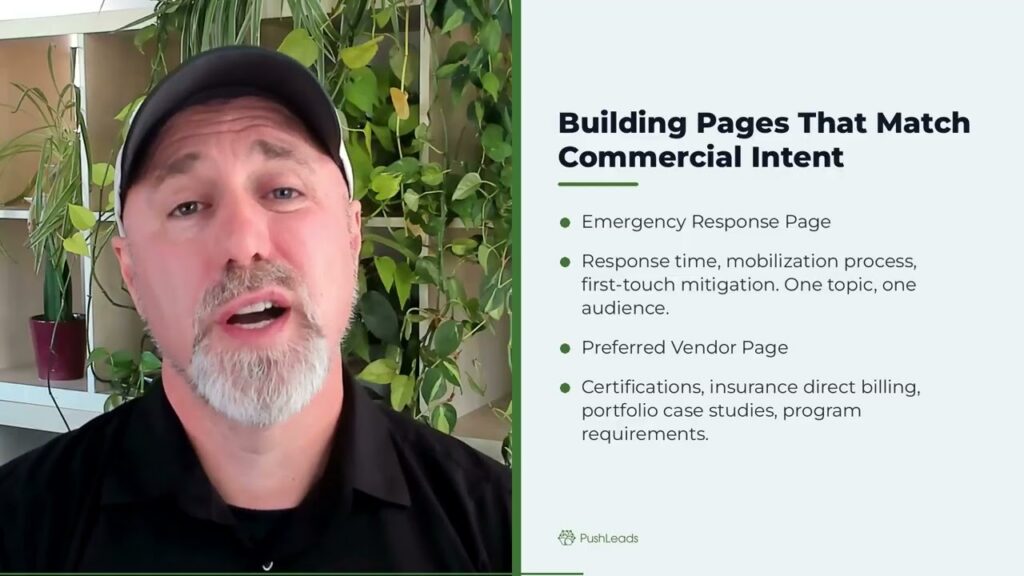
6:24 Building Pages That Match Commercial Intent
Building pages that match commercial intent. One page cannot rank for all three tiers. That’s not how Google evaluates commercial intent. You need topic-specific pages. A page targeting emergency response keywords should talk exclusively about response time, mobilization process, and first touch mitigation. A page targeting vendor qualification keywords should talk about certifications, preferred vendor programs, insurance direct building, and portfolio case studies. A page targeting documentation keywords should walk through your scope of work process, your adjuster communication protocols, and your photo documentation standards. Each page signals to Google and the reader that you are specifically the answer to their specific search. Generic pages do not convert commercial buyers. How many keywords per page is the wrong question. I want to address something that I see coming up constantly. People are asking how many keywords per page, how many keywords should I target, and what percentage should my primary keyword appear? I’m going to give you a straight answer. For a single commercial intent page, focus one primary keyword phrase and support it with three to five closely related keywords and write that page to answer the buyer’s actual question. What it does measure is whether your page actually answers what the query is asking. A page on commercial storm damage preferred vendor program should explain what a preferred vendor program is, what it requires of a contractor, and why your
8:07 Worked Example: Targeting Property Management Firms
company qualifies. If that does well, it ranks. If it’s just a generic restoration page with that phrase stuffed in a few times, it does not. The work example, targeting a property management firm. Let me give you a real-world scenario. Say that you want to win commercial contracts with property management companies in a mid-sized metro, maybe 300,000 to 800,000 population. The keyword phrase you want to own is something like commercial storm damage restoration preferred vendor plus your city. So here’s what that page needs. A headline that names the property management use case directly. A section explaining your mobilization time and CAT team structure. A section on insurance direct billing and adjuster coordination. Certifications and license information in a clear text, not just logo images. And one or two case studies with dollar amount of loss, timeline, and outcome. Then optimize for that primary phrase in a title tag, the H1, the first paragraph, and at least one subheading. Let the rest of the page be written for the buyer, not for Google. That is a page that converts a commercial property manager.
9:25 Common Mistakes That Kill Commercial Conversions
Common mistakes that kill commercial conversion. Mistake one is using residential page templates for commercial intent. Words like your home and your family’s safety signal to a property manager that they’re on the wrong site. Mistake number two is no credentials about the full. Commercial buyers qualify vendors fast. If your IICRC certification and general liability coverage numbers aren’t visible in the first scroll, you lose them. Mistake number three, targeting high volume residential keywords and calling it commercial SEO. Volume without intent match is wasted ranking. Mistake number four is having one general storm damage page trying to serve every audience. It serves none of them well enough to convert.
10:14 What to Build First
What to build first. If you’re starting from zero on commercial storm SEO, here’s the order I would build in. First, build the emergency response page. This is the one that has the fastest path to an inbound call. Second, build the preferred vendor or property management page. The one that has the highest average contract value. Third, build your documentation and claim support page. The one that keeps you running during the mid-loss research phase. And then you can add a city-specific variant for each if you serve more than one metro. That’s six to nine pages total. And that’s a real commercial storm SEO foundation. What to do right now. If you want to see exactly what your current site ranks for and what commercial intent keywords you’re missing in your market, get a free visibility teardown. Go to SEO.PushLeads.com backslash audit or call 828-348-7686. And we’ll look at your actual ranking data, map it against commercial intent keywords in your service area, and show you exactly where the gap is. No pitch, no fluff, just the numbers and a clear picture of what to fix first. I’m Jeremy Ashburn with PushLeads. I help restoration companies get more leads without struggle and frustration. Talk soon.
Key Takeaways
Want it done for you? See our restoration SEO and marketing agency.
Commercial storm damage restoration keywords look nothing like residential ones. Property managers search for vendor credentials, CAT response capability, and documentation support, not just “repair near me.” Targeting the right intent signals, across three distinct keyword tiers, puts your company in front of buyers who can sign five- and six-figure contracts instead of homeowners filing a two-thousand-dollar claim.
- Residential and commercial storm searches signal completely different buyer intent and contract size.
- High-converting commercial keywords include terms like preferred vendor, CAT response, large loss, multi-unit, and emergency mitigation contract.
- Low search volume on a commercial keyword often means less competition and higher average contract value, not lower opportunity.
- Three page tiers, emergency response, vendor qualification, and documentation support, cover the full commercial buyer journey.
- One generic storm damage page cannot rank for all three tiers or serve multiple buyer types effectively.
- Credentials such as IICRC certification and liability coverage must be visible in the first scroll or commercial buyers leave.
- A foundation of six to nine targeted pages is enough to build real commercial storm SEO traction.

Why Commercial Storm Damage Restoration Keywords Are a Different Category Entirely
Commercial storm damage restoration keywords convert into signed contracts because they carry intent signals that separate a property manager managing liability from a homeowner in a panic. A residential hail search and a commercial portfolio search happen after the same storm, but they produce completely different buyer journeys, contract sizes, and decision timelines. When you understand that separation, you stop competing for the crowded residential traffic and start showing up for the buyer with the authority to sign a contract worth tens of thousands of dollars.
When a homeowner’s roof takes hail damage, they search for something like “roof damage repair near me” or “hail damage restoration cost.” That is a distress search tied to one building, one claim, and one adjuster. When a commercial property manager has damage across three of the twelve buildings they oversee, their search looks nothing like that. They are managing liability, answering to an owner or a board, and they need documentation, a chain of custody, and a contractor that speaks their professional language. Their searches reflect all of that.
Terms like “commercial storm damage restoration contractor,” “emergency roof tarping multi-unit property,” and “large loss restoration company” all come from the same weather event as the residential search. The difference is entirely about who is typing. If your SEO targets residential panic searches, you are invisible to the buyer who signs the big contract. That is the core problem this approach is designed to fix.
Want more customers from Google & AI search?
Get a free SEO audit of your site — see exactly what to fix first.
The Intent Signals That Tell You Who Is Actually Searching
Intent signals are specific words inside a search query that reveal the searcher’s role, authority, and urgency level. For commercial storm restoration, the highest-converting intent signals I have seen consistently are: commercial, property management, multi-unit, portfolio, CAT response, large loss, emergency mitigation contract, and preferred vendor. When any of those words appear in a search, the person typing is not a homeowner comparing contractors the way they compare plumbers.
What does “preferred vendor storm damage restoration” actually mean as a search?
A search for “preferred vendor storm damage restoration” signals that a property manager or facilities director is actively building a vendor list before the next storm season arrives. They are not in crisis yet. They are qualifying contractors for a relationship, which means the average contract they are about to sign will cover multiple properties and potentially multiple seasons. That one phrase, low volume as it is, represents a buyer with budget authority and a longer engagement horizon than any residential lead you will ever close.
Why do low-volume commercial keywords produce higher-value leads?
A keyword like “preferred vendor storm damage restoration” or “emergency CAT response contractor commercial” might generate only a couple hundred searches per month in a given metro. That low volume is actually a filter. It removes the casual browsers and the homeowners comparing prices and leaves only the professionals who know exactly what they need. Less competition in search results, higher average contract size on the other end of the call. That combination is why I consistently steer restoration companies away from chasing volume and toward chasing intent.
How do intent signals appear differently in AI search versus Google?
In AI-powered search tools like ChatGPT or Google’s AI Overviews, users tend to ask more complete questions rather than short keyword strings. A property manager might ask, “What certifications should a commercial storm damage contractor have for preferred vendor status?” That is a longer, more specific query, but the intent signals are identical: certifications, commercial, preferred vendor. Pages written to answer the full professional question tend to get extracted by AI engines because they are thorough rather than keyword-stuffed.

Volume Versus Value: The Calculation Restoration Companies Get Wrong
The most common SEO mistake I see restoration companies make is choosing keywords based on monthly search volume rather than buyer intent and average contract size. A keyword like “storm damage repair” might show ten thousand monthly searches, and that number looks attractive. But almost all of that volume is residential. Homeowners, renters, and people comparing quotes. A keyword like “commercial storm damage restoration contractor Dallas” might show only two hundred monthly searches, but the average contract it produces can be twenty times larger than the residential version.
Is it worth targeting a keyword with only 200 monthly searches?
Yes, without question, if that keyword carries commercial intent and maps to a contract worth twenty thousand dollars or more. The math is straightforward. If two hundred searches produce ten qualified inquiries and you close three of those as commercial contracts at an average of thirty thousand dollars, that single keyword phrase generates ninety thousand dollars in revenue. A residential keyword with ten thousand searches producing hundreds of two-thousand-dollar claims requires a completely different operational scale to match that number.
What does keyword data actually show about commercial restoration searches?
Restoration-specific commercial search data is limited in what I can share as hard numbers, but the pattern I see consistently across service industries is clear. Searches that include modifier words like contractor, emergency, commercial, and large loss consistently produce lower click costs and higher quality leads than generic damage searches. We tracked the same pattern in plumbing keyword data, where specific modifier phrases showed people actively searching for exact service structures rather than general help. The right modifier words in a restoration keyword phrase are the entire game.
How should I explain this volume-versus-value difference to my business partner or owner?
Frame it this way: would you rather your sales rep spend a full day visiting ten residential neighborhoods or spend that same day at one property management company’s office? The commercial visit has a longer sales cycle but a contract worth ten to fifty times more. SEO keyword strategy works the same way. Ranking for one commercial intent phrase requires similar effort to ranking for one residential phrase. The difference is what happens when someone calls you from each one.

Three Keyword Tiers That Cover the Full Commercial Buyer Journey
Commercial property managers do not make one search and then call a contractor. They make four to six increasingly specific searches as they move from initial crisis to vendor selection. If your site only ranks for the first generic search, you lose them somewhere in that journey. Organizing your keyword targets into three tiers ensures you are present for every stage of that process.
What are Tier 1 emergency response keywords for commercial storm damage?
Tier 1 keywords are searches happening during or immediately after a weather event. Examples include “emergency commercial roof tarping,” “storm damage assessment commercial building,” and “emergency water extraction commercial property.” These searches have high urgency, a fast decision cycle, and a short conversion window. The buyer needs to act now. Your page targeting these phrases needs to answer one question instantly: how fast can you be there, and what exactly will you do when you arrive?
What are Tier 2 vendor qualification keywords and who searches them?
Tier 2 keywords come from property managers researching before the next storm season rather than during an active emergency. Examples include “CAT response contractor preferred vendor program,” “large loss restoration company reviews,” and “commercial restoration contractor certification.” These searches have lower urgency but a longer research cycle. The buyer is qualifying you for a relationship, not a single job. Your page for these phrases should lead with certifications, portfolio references, and insurance direct billing capability rather than response time.
What are Tier 3 documentation and process keywords?
Tier 3 keywords come from buyers who are mid-loss and need a contractor who understands the full insurance and documentation process. Examples include “commercial storm damage documentation process,” “business interruption claim restoration support,” and “storm damage restoration scope of work.” A property manager searching these phrases already has damage. They are evaluating whether you understand their claims process, their adjuster communication requirements, and their reporting obligations to the building owner. A page that walks through your documentation standards in plain professional language wins this search and this buyer. You can read more about converting storm damage inquiries to jobs in a separate guide we have on this exact mid-loss stage.
Building Pages That Match Commercial Intent at Each Tier
One page cannot rank for all three tiers. Google evaluates whether a page specifically answers the query it ranks for, and a single generic storm damage page cannot specifically answer an emergency response question, a preferred vendor qualification question, and a documentation process question all at once. You need separate, topic-specific pages for each tier, and each one needs to be written for the buyer at that stage rather than stuffed with keywords.
What should a Tier 1 emergency response page actually contain?
A Tier 1 page should talk exclusively about response time, mobilization process, and first-touch mitigation steps. State your mobilization radius and average response window in the first paragraph. Describe your CAT team structure and how many crew members deploy on a first response. Include your emergency dispatch number prominently. Do not bury the reader in certifications or case studies on this page. They need to know you can be there fast and that you know what to do when you arrive. That is the only question a Tier 1 searcher is asking.
What does a Tier 2 vendor qualification page need to convert a property manager?
A Tier 2 page should lead with certifications, preferred vendor program details, insurance direct billing capability, and portfolio case studies. Property managers reading this page are answering to a board or building owner. They need to justify their vendor choice. If your page gives them the documentation to do that, it converts. Include your IICRC certifications, your general liability coverage limits, your experience with multi-unit or multi-property losses, and at least one or two case studies with real numbers: dollar amount of loss, timeline from first call to project close, and a documented outcome. If you want to understand how IICRC certifications win contracts specifically in the commercial vendor qualification process, we have a detailed breakdown of that credentialing process.
How does building a content silo structure help these three tiers work together?
When your three tier pages link to each other in a logical hierarchy under a primary commercial storm damage topic page, Google reads the entire structure as a topical authority cluster rather than three isolated pages. A property manager who lands on your Tier 1 emergency page and then follows a link to your Tier 2 vendor qualification page is telling Google that your site answers more than one stage of their search journey. That internal linking structure is part of what building content silo structure means in practice for a restoration company website.

A Worked Example: Targeting Property Management Companies in a Mid-Sized Metro
Let me walk through a real-world scenario so the keyword and page strategy becomes concrete. Say you want to win commercial contracts with property management companies in a metro area with a population between 300,000 and 800,000. The primary keyword phrase you want to own is “commercial storm damage restoration preferred vendor” plus your city name. Here is exactly what that page needs to contain in order to rank and convert.
What should the headline and structure of a property management targeting page look like?
The headline should name the property management use case directly, something like “Commercial Storm Damage Preferred Vendor Program for Property Management Companies in [City].” Below that, the first section should explain your mobilization time and CAT team structure. The second section should cover insurance direct billing and adjuster coordination. Credentials, IICRC certification numbers and general liability coverage limits, should appear in readable text rather than just logo images. Logo images do not rank. Text does. Finish with one or two case studies that include the dollar amount of loss, the timeline from first call to project close, and the documented outcome.
How should I optimize the page for the primary keyword phrase?
Place the primary phrase in the title tag, the H1, the first paragraph, and at least one subheading. Then write the rest of the page for the buyer, not for Google. What that means in practice is answering every question a property manager would ask when qualifying a vendor: What is your response protocol? How do you handle multi-building events? Who do you communicate with during an active claim? How do you document for business interruption claims? A page that answers those questions completely will rank for related keyword variations naturally without forcing phrases in where they do not fit.
How long should a commercial intent page be to rank and convert?
Page length should match the depth of the question, not hit an arbitrary word count. For a preferred vendor qualification page, I generally see that 800 to 1,400 words is enough to cover the buyer’s questions thoroughly without padding. What matters more than length is whether every section answers a real question the buyer has. If you find yourself repeating points just to add words, cut it. Commercial property managers are professionals with limited time. A focused, complete page converts better than a long, padded one. Understanding the full SEO for disaster restoration companies picture helps put page strategy in context of the broader site architecture.

Common Mistakes That Kill Commercial Conversions Before the Phone Rings
Most restoration company websites lose commercial buyers before those buyers ever fill out a form or dial a number. The mistakes are predictable and fixable, but they require understanding how a property manager evaluates a vendor website differently from how a homeowner does.
Why do residential page templates fail commercial buyers?
Residential page templates use language like “your home,” “your family’s safety,” and “we treat every customer like a neighbor.” Those phrases signal to a property manager within the first three seconds that they are on the wrong site. A commercial buyer is not your neighbor. They are a professional managing liability for someone else’s asset. Your page language needs to match their professional context from the first sentence. This is not about being cold or formal. It is about speaking their language rather than defaulting to the homeowner pitch your residential pages already cover.
What credential information must appear above the fold on a commercial page?
Your IICRC certification level, your general liability coverage limits, and your state contractor license number need to be visible without scrolling on any commercial intent page. Commercial buyers qualify vendors fast. If they cannot see your credentials immediately, they leave and call the next contractor on their list. This is not a design preference. It is a conversion requirement. A property manager answering to a building owner cannot recommend a vendor they cannot verify in under thirty seconds on your website.
How does targeting high-volume residential keywords waste a restoration company’s SEO budget?
When you chase a keyword like “storm damage repair” with ten thousand monthly searches, you are competing against every residential restoration company, insurance review site, and home improvement platform in your market. Winning that ranking requires significant resources, and even when you win, the leads it produces are primarily residential. You have spent your ranking effort and your budget to attract a buyer pool that does not produce commercial contracts. If you want to see how the numbers actually play out, the restoration company SEO ROI math we have published shows the comparison in detail. And if you have been buying shared leads instead of building organic rankings, the comparison between SEO versus buying shared leads is worth reading before you renew any lead-generation subscriptions.
What to Build First When Starting Commercial Storm SEO from Zero
If you are starting from zero on commercial storm SEO, the order in which you build your pages matters as much as the pages themselves. Building the right page first gets you inbound calls faster and lets you learn from real buyer behavior before you invest in the full site structure.
Which page should a restoration company build first for commercial storm SEO?
Build the emergency response page first. It has the fastest path to an inbound call because the buyer searching those keywords is already in an active event and needs to act immediately. A ranking emergency response page can produce calls within the first week after a storm if your geographic targeting is correct. The emergency page does not need to be long. It needs to be fast-loading, credential-clear, and focused entirely on response capability, mobilization time, and first-touch mitigation process.
What is the right order for building out a full commercial storm SEO page set?
After the emergency response page, build the preferred vendor or property management page. That is the page with the highest average contract value attached to it, and it takes longer to rank because it targets buyers in research mode rather than active crisis mode. Third, build your documentation and claim support page for mid-loss buyers in the Tier 3 category. Once those three foundational pages are live and producing traffic, add city-specific variants of each for every metro you serve. Three pages times two or three cities gives you six to nine pages total. That is a real commercial storm SEO foundation that covers all three buyer stages across your service area.
How long does it take to see commercial leads from a targeted storm damage SEO build?
The emergency response page can produce inbound calls within days of a storm event if it ranks before the weather system arrives. Vendor qualification pages typically take three to six months to move into ranking positions that produce consistent traffic because the search volume is lower and the buyer research cycle is slower. Documentation pages often see traffic spikes mid-storm season when active losses produce searches for process guidance. Plan for a ninety-day runway before expecting consistent commercial inquiries from a new page build, and track phone calls, not just form fills, because commercial buyers typically call rather than submit web forms.
Frequently Asked Questions
What is the difference between a commercial storm damage keyword and a residential one?
Commercial storm damage keywords include intent signals like preferred vendor, CAT response, large loss, multi-unit, and property management, which identify a professional buyer managing liability across multiple properties. Residential keywords focus on a single home, a single claim, and one adjuster. The buyer intent, contract size, and decision process are completely different, which means the pages targeting each must be completely different as well.
Do I need separate pages for each type of commercial storm buyer?
Yes. A single generic storm damage page cannot rank specifically for an emergency response query, a vendor qualification query, and a documentation process query at the same time. Google evaluates whether a page specifically answers the query it ranks for. Three separate pages, each written to a specific buyer stage, outperform one broad page for every commercial intent search in your market.
How many keywords should I target on a single commercial intent page?
Focus each page on one primary keyword phrase supported by three to five closely related phrases. The goal is to answer the buyer’s actual question thoroughly, not to hit a keyword frequency target. A page written to completely answer the property manager’s vendor qualification question will naturally rank for related phrases without forcing them in. Keyword stuffing signals to both Google and professional readers that the page was built for an algorithm rather than for them.
Are low-volume commercial keywords worth targeting for SEO?
Yes. Low volume on a commercial keyword means lower competition and a higher average contract size on the other end of the call. A phrase generating two hundred searches per month from property managers with contract authority produces more revenue per ranking than a phrase generating ten thousand searches from homeowners filing two-thousand-dollar claims. Volume is not the measure of keyword value in commercial restoration SEO.
What certifications do commercial buyers look for when qualifying a storm restoration vendor?
Commercial property managers most commonly look for IICRC certification, specifically WRT, FSRT, and ASD designations depending on the loss type, along with general liability and workers’ compensation coverage documentation, state contractor licensing, and experience with large loss or CAT-level events. These credentials should appear in readable text on any commercial intent page because text is indexed by search engines while logo images are not.
How do I know if my current site is targeting commercial or residential storm keywords?
Pull your current ranking keywords from Google Search Console and look for commercial intent signals like contractor, preferred vendor, commercial, large loss, and CAT response. If your top-ranking storm damage phrases include words like home, roof repair near me, or insurance claim help, you are ranking primarily for residential intent. A visibility audit comparing your current rankings against commercial intent keyword gaps in your service area will show you exactly where the opportunity is.
Can I target commercial storm damage keywords in multiple cities from one website?
Yes, and it is the right approach if you serve more than one metro. Build the three foundational pages first, emergency response, vendor qualification, and documentation support, then create city-specific variants of each page for every market you serve. Six to nine total pages covers two to three cities across all three buyer stages. Each city page should include locally relevant details like specific commercial zones, known property management firms in the area, and any regional storm history that establishes your local CAT response credibility.
How is commercial storm damage SEO different from general contractor SEO?
Commercial storm damage SEO targets buyers in active loss situations or active vendor research cycles, both of which have compressed decision timelines compared to general construction projects. The buyer is a professional managing someone else’s asset, not a homeowner making a personal purchase. That changes the language, the credentials required, the page structure, and the conversion path. A commercial restoration buyer calls rather than submits a form, decides faster than a remodel buyer, and expects to see professional vendor documentation rather than customer testimonials and photos of finished kitchens.
Build the Commercial Storm SEO Foundation Before the Next Storm Season
Storm seasons do not wait for your website to be ready. Property managers who are building their preferred vendor lists right now are searching for exactly the commercial intent phrases I have walked through here. If your site does not rank for those phrases, you are not in consideration, and you will not be called when the next weather event hits their portfolio.
The approach is specific: three page tiers, commercial intent signals throughout, credentials visible without scrolling, and city-specific variants once the foundation is built. That is six to nine pages total. It is a manageable build with a clear order of priority, and the emergency response page alone can start producing inbound calls within days of a storm event if it ranks before the weather system arrives.
At PushLeads, we work with restoration companies to map their actual ranking data against commercial intent keyword gaps in their specific service markets. We show you exactly which phrases you are missing, which pages need to be built first, and what your commercial buyers are searching for right now in your metro. If you want that visibility teardown for your company, reach out to us at https://pushleads.com/contact/ and we will get started.
Keep Reading
Want more customers from Google & AI search?
Get a free SEO audit of your site — see exactly what to fix first.
Your path · Restoration SEO
Keep going: read these next

- Up nextStorm Damage Restoration Marketing
- Restoration Company Scams: How to Identify Storm Chasers, Inflated Billing, and AOB Fraud




Want this done for you?
Scan your site. See the gaps. Decide with numbers.
- Rankings, Google Business Profile and site-speed teardown
- Report lands in your inbox in about a minute
- No obligation · 4.9 from 67 Google reviews
 Continue reading