
Key Takeaways
Want it done for you? See our local SEO services.
Home service contractor marketing strategies work best when they match the seasonal and hyper-local nature of trades like chimney sweeping, HVAC, plumbing, and restoration. Generic agency advice misses the mark for niche contractors. The tactics covered here — Google Business Profile optimization, map pack ranking, service-area pages, and Local Services Ads — are built for trades that most marketing agencies overlook entirely.
- Google Business Profile is the single highest-leverage free tool for local contractor visibility.
- Map pack ranking depends on proximity, relevance, and consistent NAP data across directories.
- Service-area pages capture low-volume, high-intent searches that competitors ignore.
- Seasonal contractors need marketing systems that ramp up 60 to 90 days before peak demand.
- Local Services Ads (LSAs) put your business above organic results and charge only per lead.
- Niche trades like chimney and hearth companies face lower search volume but far less competition.
- Content built around buyer questions converts better than generic service-page copy.
Why Generic Contractor Marketing Fails Niche Home Service Trades
Home service contractor marketing strategies that work for a large HVAC franchise rarely translate directly to a chimney sweep, fireplace installer, or restoration company operating in a single metro area. Niche trades face a specific set of challenges: lower monthly search volume, seasonal demand spikes, and buyers who are often making a first-time purchase decision with little comparison shopping experience. Most marketing advice targets high-volume trades with broad service areas. That leaves a wide gap for the specialty contractor who needs to rank in a three-mile radius for a service that gets searched a few hundred times per month. Understanding why keyword tools show high search volume when you only get a few calls is essential context before building any strategy around niche trade searches. For additional context on small business marketing practices, the U.S. Small Business Administration offers resources on local market strategy.
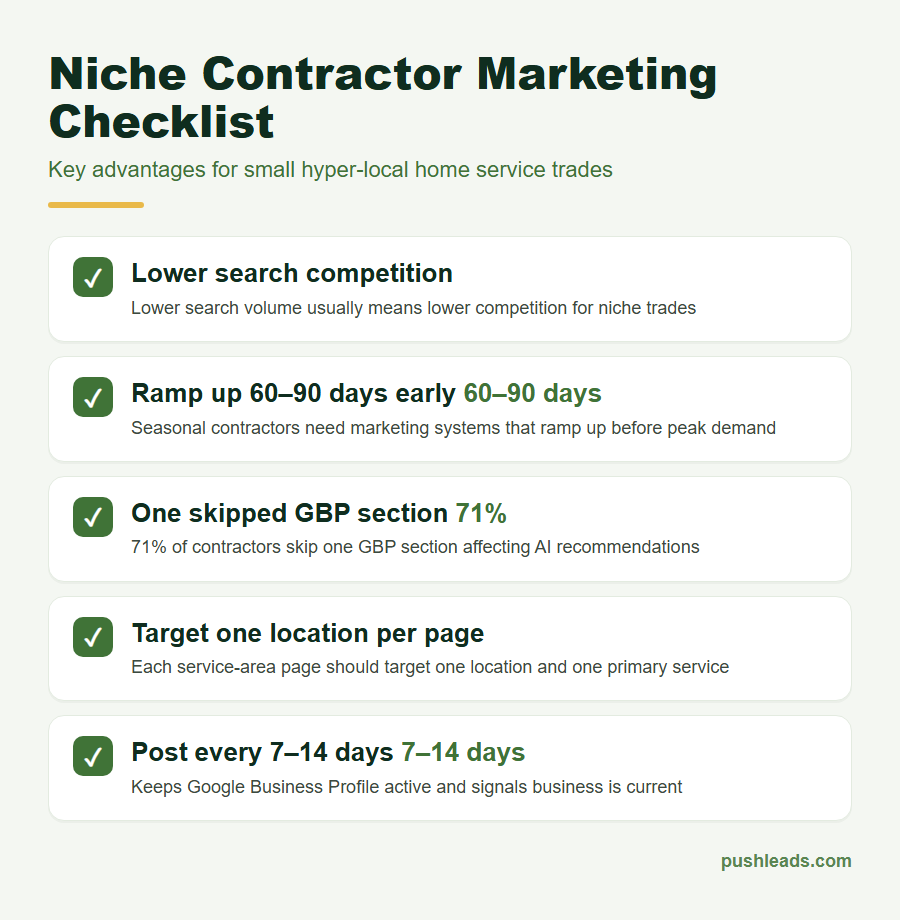
The good news is that lower search volume usually means lower competition. A chimney company ranking on the first page for a targeted local query faces fewer well-optimized competitors than an HVAC company competing in a major metro. The strategies below are built specifically for that reality. They address how to show up in the map pack, how to build service-area pages that earn rankings without cannibalizing each other, and how to set up Local Services Ads for trades that are often overlooked by Google’s category system. PushLeads works with home service contractors across Asheville, NC and beyond, applying these exact frameworks to trades that most agencies ignore. For contractors evaluating outside help, knowing what to ask a local SEO agency for home service contractors before signing anything will save significant time and money.

Want more customers from Google & AI search?
Get a free SEO audit of your site — see exactly what to fix first.
Google Business Profile Optimization for Local Contractors
A fully optimized Google Business Profile is the starting point for any contractor who wants to appear in local search results, and it costs nothing to claim and complete. Google uses the information inside a Business Profile to decide whether to show a contractor in the map pack for relevant queries. Incomplete profiles lose rankings to competitors who took the time to fill in every field.
Which profile fields matter most for map pack rankings?
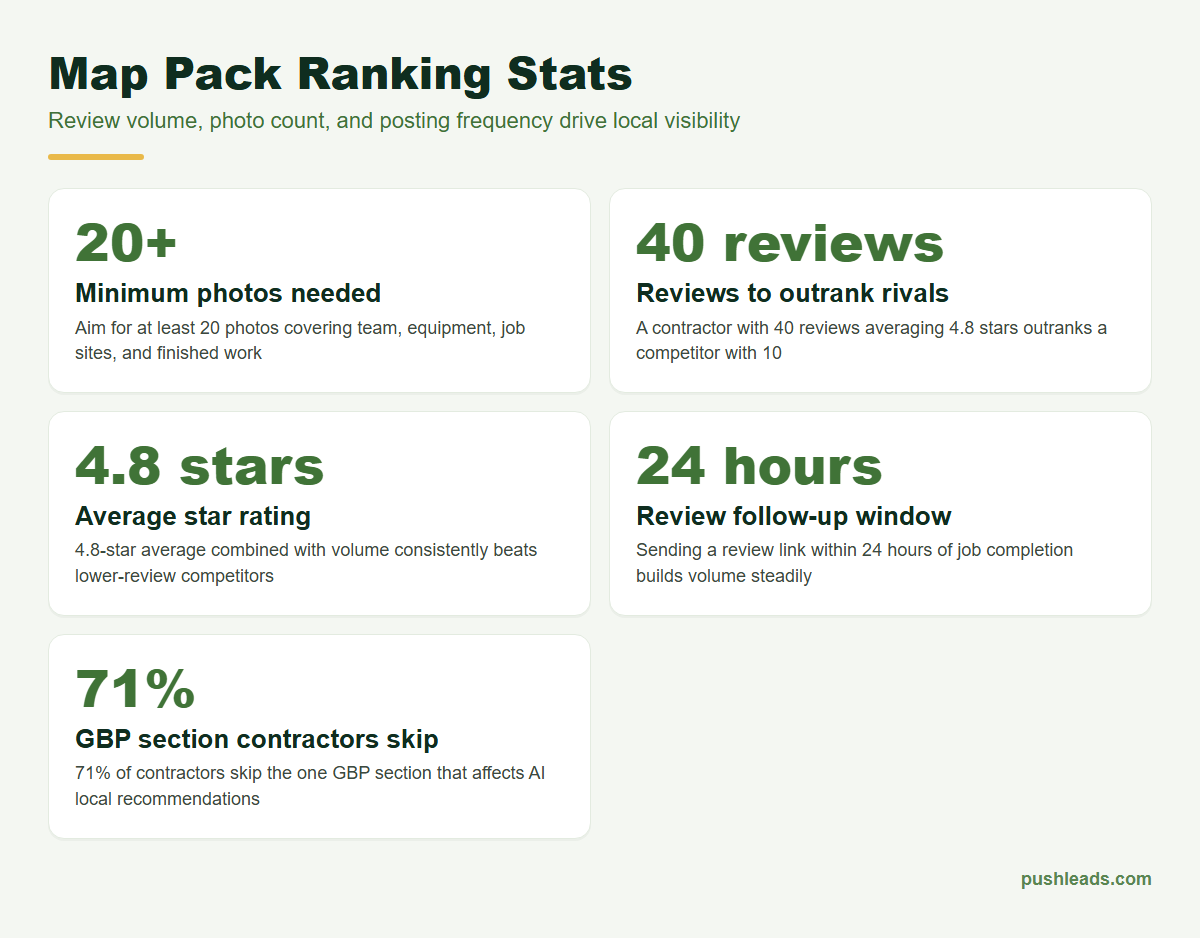
The business name, primary category, and service areas carry the most weight in Google’s local ranking algorithm. The primary category should be as specific as possible. A chimney company should select “Chimney Services” rather than the broader “Contractor” category. Secondary categories can capture related services like “Fireplace Store” or “Masonry Contractor.” Services listed inside the profile also feed Google’s understanding of what the business does, so each individual service should be named and described in plain language that mirrors how customers search. There is one Google Business Profile section that 71% of contractors skip that directly affects whether AI recommends them for local service searches.
How do photos and reviews affect local visibility?
Google’s own documentation confirms that businesses with photos receive more direction requests and website clicks than those without. For contractors, before-and-after photos of completed jobs communicate quality faster than any written description. Aim for a minimum of 20 photos covering the team, equipment, job sites, and finished work. Reviews are equally important. The volume, recency, and content of reviews all influence local pack rankings. A contractor with 40 reviews averaging 4.8 stars will consistently outrank a competitor with 10 reviews, all else being equal. Sending a follow-up text or email with a direct review link within 24 hours of job completion is the most reliable way to build review volume steadily. For best practices on customer feedback, see guidance from the Federal Trade Commission. Contractors who want a proven system should look at the automated approach that turns every completed job into a 5-star rating.
What posting schedule works for a seasonal contractor’s profile?
Google Posts inside the Business Profile allow contractors to publish short updates, offers, and announcements that appear in search results. For seasonal trades, posting every 7 to 14 days keeps the profile active and signals to Google that the business is current. Posts should reference the specific season and service. A chimney company posting in September about annual inspections before heating season connects timing to buyer intent in a way that generic posts do not.
Map Pack Ranking: The Three Factors Contractors Need to Understand
Google’s map pack shows three local businesses at the top of relevant search results, above organic listings and often above paid ads. Ranking in that pack for even one or two core service queries can generate a consistent flow of inbound calls without any ongoing ad spend. Google’s publicly stated local ranking factors are relevance, distance, and prominence. Each one is actionable.
How does relevance affect which contractors appear in the map pack?
Relevance measures how well a business profile matches what the searcher is looking for. A fireplace installation company that lists only “Fireplace Store” as its category and never mentions “gas insert installation” or “wood stove installation” in its service descriptions is invisible for those specific queries. Category selection, service listings, and the language in the business description all shape relevance. Using the exact phrases customers type into Google — not industry jargon — closes the gap between what the business does and what Google understands it to do.
What does distance mean for a contractor with a large service area?
Distance measures how far the business location is from the searcher or the searched location. A contractor whose registered address is in one part of a metro will naturally rank better for nearby searches than for searches 20 miles away. This is why service-area pages on the website matter so much for contractors who cover multiple towns. Those pages signal to Google that the business serves specific locations even when the physical address is elsewhere. For businesses that work from home or a shop not open to the public, Google allows a service-area business setting that hides the address while still enabling local rankings.
In this video
- 0:00 What Digital Marketing Packages Actually Cost
- 0:23 Why Pricing Varies So Widely
- 0:50 Tier One Starter Packages 500 to 1500
- 1:34 Tier Two Growth Packages 1500 to 3500
- 3:20 Tier Three Aggressive Full-Team Campaigns
- 4:14 Tier Four Enterprise and Multi-Location
- 4:54 Three Numbers That Determine Real ROI
- 5:44 Pricing Models Flat Retainer vs Performance
- 6:32 Red Flags to Watch Before You Sign
- 7:31 Running the Math on a Tier Upgrade
- 8:35 Questions to Ask Any Agency
Full transcript: What Do Digital Marketing Packages Actually Cost in 2026?
What actions build prominence for a small contractor?
Prominence reflects how well-known a business is online. It is built through consistent citations across directories like Yelp, Angi, the Better Business Bureau, and industry-specific directories, through inbound links from local organizations and news sites, and through the volume of Google reviews. Consistency matters more than quantity. The business name, address, and phone number must be identical across every listing. Even small differences like “St.” versus “Street” create conflicting signals that suppress rankings. The Better Business Bureau provides standards for business listings and credibility. Contractors with fewer reviews are still winning local search in 2026 by focusing on content freshness rather than chasing review counts alone.
Service-Area Pages That Rank Without Competing With Each Other
Service-area pages are individual website pages targeting a specific city, town, or neighborhood. They allow a contractor to rank in multiple locations without relying solely on the Business Profile address. Done correctly, a contractor covering five towns can rank on the first page in each of them. Done incorrectly, the pages are thin duplicates that Google ignores or penalizes.
How should a contractor structure a service-area page?
Each page should target one location and one primary service. A chimney company covering three towns should have separate pages for chimney sweep services in each town, not a single page covering all three. The fundamentals of search engine optimization emphasize unique, location-specific content. Each page should include locally relevant details: the neighborhoods served within that town, local landmarks or geography, and information about local building codes or seasonal weather patterns that affect the service. This depth signals to Google that the page is written for that specific location, not automatically generated.
Keep Reading
Want more customers from Google & AI search?
Get a free SEO audit of your site — see exactly what to fix first.
Your path · Emergency Service Marketing for Home Service Contractors
Keep going: read these next
 You’re hereHome Service Contractor Marketing Strategies That Generate Real Leads
- Up nextEmergency Electrical Contractor Marketing: How to Capture More Urgent Service Calls
- Emergency Pool and Spa Marketing: How to Win Repair and Service Calls in the Most Competitive Home Service Niche
- Nextdoor Marketing for Emergency Contractors: How to Win Neighborhood Trust and Generate Local Leads



Want this done for you?
Scan your site. See the gaps. Decide with numbers.
- Rankings, Google Business Profile and site-speed teardown
- Report lands in your inbox in about a minute
- No obligation · 4.9 from 67 Google reviews
 Continue reading