


Key Takeaways
- Our best Shorts in September got 529 to 554 views each. New Shorts after October 19 got 1 to 42.
- 5 of 14 faceless AI slideshow uploads vanished in four days. 0 of 34 other uploads did, including every video with a face on screen.
- YouTube’s October 1, 2026 Shorts update judges what a channel mostly posts.
- YouTube gave no recovery timeline. The only stated fix is shifting to original content.
Our YouTube Shorts views dropped from more than 500 per Short to between 1 and 42 in October 2026. The most likely cause is the mix of what we posted: about 35 uploads a week, most of them templated AI videos, right as YouTube changed the Shorts feed to favor channels that mainly post original work. We turned off the template lanes on November 2, and this post covers what happened, what YouTube says, and how we’re measuring recovery.
I run PushLeads. We help roofing, restoration and remodeling contractors get found in Google and AI search, and video is part of that. So when our own channel got hit, I wanted the real reason, not a guess. Here’s everything, including the parts that make us look bad.
What Happened to Our Shorts
The drop was sharp and it hit every new Short, not just weak ones. In September, our best Shorts were simple: my face, full screen, one strong opinion in the first second. Those earned 529 to 554 views each (PushLeads channel data, 2026).
Starting around October 19, every new Short landed between 1 and 42 views. That’s a 10 to 15 times drop per Short on the same channel, covering the same topics, for the same audience. It included Shorts I recorded myself, not only the automated ones.
That last part matters. If only the AI clips had flopped, you could blame the clips. When your real recordings get buried too, the problem is usually at the channel level, which is exactly how YouTube’s October update is written.
In short: per-Short views fell 10 to 15 times starting mid-October, and real recordings were hit along with automated ones.
Want more customers from Google & AI search?
Get a free SEO audit of your site — see exactly what to fix first.
What We Were Posting in October
We were posting a lot, and most of it came off the same templates. Over about 75 days, our channel took 377 uploads, roughly five a day (PushLeads upload logs, 2026). We had built automation that turned blog posts into videos, and we were testing how far it could go.
The mix looked like this:
- Faceless slideshow videos with an AI voice reading a script
- AI avatar videos of me presenting
- Shorts auto-cut from those AI videos
- Old videos re-uploaded from Vimeo
Some of this worked for search. YouTube videos can rank in Google and show up in AI answers, which we’ve written about in our guide to YouTube in Google search. But volume and sameness have a cost, and we found it.
In short: about 35 uploads a week, mostly templated or AI-made, is what our channel looked like to YouTube in October.
Five Videos Vanished With No Notice
Between October 28 and 31, five of our uploads disappeared. There was no email, no strike and nothing in YouTube Studio.
The watch page told us who removed them. When you delete your own video, YouTube shows “removed by the uploader.” These five showed “This video is unavailable,” the same message YouTube shows for a video ID that never existed. We checked every tool and app with access to the channel. None of them deleted anything.
The pattern was clear. Of 48 uploads in those four days, 5 of the 14 faceless AI slideshow videos vanished. None of the other 34 did, and that group included every video with a face on screen, whether me recorded or my AI avatar, plus Shorts, client videos and old re-uploads (PushLeads channel audit, 2026).
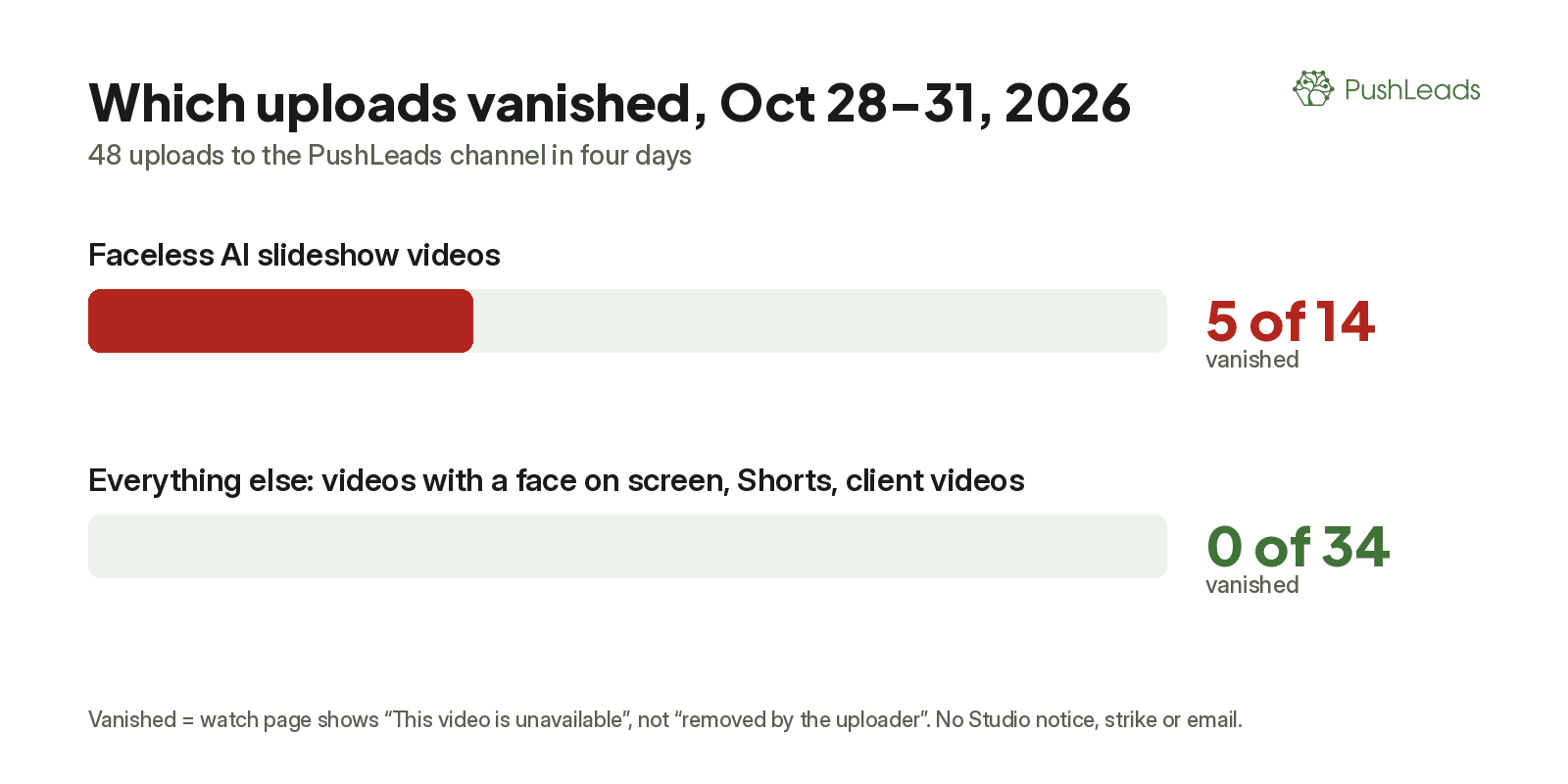
In short: YouTube appears to have silently removed faceless AI slideshows, while every video with a face on screen stayed up.
The Data Mistake We Almost Made
Our first read of the numbers was wrong, and it was worse than reality. We thought new Shorts were getting zero views from the Shorts feed and that our winners had done about 13,000 each.
The analytics table we pulled from stores a rolling 28-day total on every row. We added rows together and overstated views by roughly 15 times. The true daily numbers told a smaller but still serious story.
If your views drop, check what each number measures before you change anything. A rolling total, a lifetime total and a daily count can all sit in the same report with the same label. We almost made decisions off a number that was never real.
In short: confirm the metric before reacting, because one bad sum inflated our drop by about 15 times.
What YouTube Changed on October 1, 2026
YouTube updated the Shorts feed to favor original content and cut reach for channels that mostly re-upload or aggregate. TeamYouTube said channels identified as “primarily aggregating or re-uploading” other creators’ videos will likely see less Shorts distribution (TeamYouTube, 2026).
Two details explain our drop. First, the judgment is made about the channel, based on what it mostly posts, not about one video. Second, YouTube said template-based changes and narration that only describes the screen don’t make content your own (Relevant Audience, 2026).
The update is aimed at reposting other creators, which we weren’t doing. But a channel posting mostly templated AI video looks a lot like what the filter is built to catch. Shorts feeds have a real slop problem, too: one count found 21% of the first 500 Shorts shown to a new account were AI-generated low-quality videos (Kapwing via PPC Land, 2025).
In short: YouTube now grades Shorts reach on a channel’s overall mix, and templates don’t count as original.
The Spam Policy Line Our Slideshows Matched
YouTube’s spam policy fits our removals more closely than the Shorts update does. It has a category for automated or synthetic mass production. Testing tools and posting a few versions is allowed, but YouTube won’t let creators “flood our platform with repetitive content” (YouTube spam policy via PPC Land, 2026).
The policy’s own example is a channel using the same background music and repetitive AI images across many videos, each reading an AI-written script. That describes our slideshow lane almost exactly.
Two more details from the same policy are worth knowing. It covers unlisted and private videos, so hiding a video doesn’t take it out of scope. And it covers coordinated networks of channels, so moving the same AI workflow to a fresh channel isn’t a clean escape.
In short: mass-produced AI video is a spam policy issue, and private or unlisted status doesn’t change that.
What YouTube Hasn’t Said
YouTube gave no start date for the Shorts update, no recovery timeline and no screen in Studio that shows whether your reach was cut (Relevant Audience, 2026). Spam penalties come with an email, a warning or a strike. A reach cut under the Shorts update comes with nothing. You just see lower numbers.
The one recovery path YouTube has described came from Rene Ritchie, YouTube’s Creator Liaison, in a Creator Insider video. He said that when a channel shifts toward original content, “the recommendation system will re-evaluate reach” (Creator Insider via AITuber, 2026).
That’s the whole plan available to anyone in our spot: change what the channel mostly posts, then give the system time to notice. Recovery timelines you’ll see quoted online, like “two to four weeks,” come from vendor blogs, not YouTube.
In short: there’s no appeal button for reduced reach, only a change in what you post and time.
The Five Changes We Made on November 2
- Turned off the template lanes. No more faceless slideshows, auto-cut Shorts from AI videos, or old re-uploads.
- Put a face on every AI video and turned the AI label on. YouTube says disclosing altered or synthetic content “won’t limit a video’s audience” (YouTube Help, 2026).
- Capped AI uploads at about 14 a week. We’d been posting around 35 videos a week, most of them templated.
- Recorded more real video. I’m recording long-form myself, starting with a video on this exact topic.
- Shorts only when there’s a good take. Full-screen face, no template bars, a different setting each time.
“We were testing how far automation could go on our own channel before we ever offered it to a client,” says Jeremy Ashburn, founder of PushLeads. “Now we know where the line is, and it’s a lot closer to a real person on camera than most video vendors will tell you.”
In short: we cut volume, removed faceless templates, and moved the channel back toward real recordings.
How We’ll Judge Recovery
We check every new Short at 48 hours: is the Shorts feed showing it to anyone at all? Any feed impressions on a new original Short is the first sign the channel is being re-evaluated.
Our first review is November 16, 2026. If nothing moves, we hold until about mid-December before any bigger call, like moving Shorts to a separate channel. A new channel is the last resort, because it throws away the subscriber base and may get linked to the same workflow anyway.
We’ll update this post with the results either way, the same way we published every week of our 90-day AI visibility test, including the numbers that didn’t move.
In short: 48-hour feed checks, a November 16 review, and a mid-December decision point.
What Contractors Should Take From This
If someone is selling you a “faceless YouTube channel” or a hundred AI videos a month, ask three questions first. Whose face is on these videos? How different is video forty from video one? And what happens to your channel if YouTube decides it’s mass-produced?
Your YouTube channel is tied to your brand. A silent reach cut doesn’t email you, so you could pay for months of videos that nobody sees. Worse, the cut lands on the whole channel, including the good videos you made yourself.
The approach that holds up is the cheap one. Use your phone, show your face, and give your real opinion about your trade. Answer the questions your customers ask on site. One honest video beats fifty templated ones, for YouTube and for the homeowner deciding who to call.
In short: real people, real opinions and fewer videos protect your channel better than volume.
Summary
Our Shorts dropped from 529 to 554 views per Short to between 1 and 42 after we filled the channel with templated AI video, right as YouTube’s October 1, 2026 update started grading Shorts reach on what a channel mostly posts. Five faceless AI slideshows vanished with no notice, while every video with a face on screen stayed up. YouTube offers no timeline or status screen, only a re-evaluation once a channel shifts to original content. We turned off the template lanes, capped AI uploads, labeled every AI video and started recording for real. If your views dropped in October, check your mix before anything else.
Frequently Asked Questions
Why did my YouTube Shorts views suddenly drop in October 2026?
On October 1, 2026, YouTube changed the Shorts feed to favor original content and cut reach for channels that mostly re-upload or aggregate. The judgment is made at the channel level. If most of what your channel posts is templated, reposted or mass-produced AI video, your original Shorts can lose reach too. Check what your channel posted in the weeks before the drop.
Does YouTube tell you when it reduces your Shorts reach?
No. YouTube gave no start date, no timeline and no Studio screen for this update. Spam policy actions usually come with an email, warning or strike, but a reach cut under the Shorts update shows up only as lower numbers. That’s why checking your own analytics carefully matters so much.
How can I tell if YouTube removed my video or someone deleted it?
Open the video’s watch page. If it says “removed by the uploader,” someone with access to your channel deleted it. If it only says “This video is unavailable,” the removal happened on YouTube’s side. In our case, all five vanished videos showed the second message and were faceless AI slideshows.
Does the AI content label hurt my video’s reach?
YouTube says no. Its help page states that disclosing altered or synthetic content won’t limit a video’s audience or its eligibility to earn money. Not disclosing realistic AI content is the bigger risk, because YouTube can apply the label itself. We turned the label on for every AI video.
How long does it take to recover YouTube Shorts reach?
YouTube hasn’t said. Its Creator Liaison said the system will re-evaluate reach once a channel shifts toward original content, with no timeline. Recovery windows quoted online come from vendors, not YouTube. We’re reviewing our own channel on November 16 and holding bigger decisions until mid-December.
Should I start a new YouTube channel to fix a Shorts reach drop?
Treat it as a last resort. A new channel loses your subscribers and history, and YouTube’s spam policy covers coordinated networks of channels, so the same workflow on a fresh channel may be linked back. Changing what your current channel posts is the only recovery path YouTube has described.
Keep Reading
Want more customers from Google & AI search?
Get a free SEO audit of your site — see exactly what to fix first.
Your path · Case Study
10 articles. About 135 minutes.
 Burlingame Video Case Study
- AI Citation Data From 45 Businesses: YouTube Is the Most-Cited Source in AI Answers





Want this done for you?
Scan your site. See the gaps. Decide with numbers.
- Rankings, Google Business Profile and site-speed teardown
- Report lands in your inbox in about a minute
- No obligation · 4.9 from 67 Google reviews


